
Most people do not only need “a good day” to negotiate salary. They need a moment when their voice is clear, their number does not collapse under pressure, and the person with authority can actually see the value they are naming.
Salary negotiation astrology uses your birth chart and current planetary transits to identify windows when you are more likely to project authority, communicate cleanly, and receive a fair hearing from decision-makers.
This is not about waiting for the sky to hand you a raise. It is about choosing timing that supports the hardest parts of the conversation: naming your value, staying regulated when money feels personal, and knowing when to ask, when to document, and when to wait.
The current Sidera calculation makes one distinction most date lists miss: opening a raise conversation and finalizing salary terms are different activities. The ask_for_raise model emphasizes Jupiter, the Sun, and Venus and can retain a Mercury-retrograde or VOC date with cautions. The stricter negotiate_deal model emphasizes Mercury, Venus, and Jupiter, then requires Mercury direct and a non-VOC Moon before a final-terms date can be published.
If you are still preparing the first compensation request, use the separate best time to ask for a raise guide. The stage-by-stage tables below show when that opening date should differ from the date used to settle the number, title, effective date, bonus, equity, or benefits.
What Salary Timing Actually Feels Like
In real life, bad negotiation timing often feels like being technically prepared but emotionally misaligned. You have the results, the market data, and the right bullet points, but your delivery gets cramped: you over-explain, soften the number, rush to fill silence, or accept “we will revisit this later” without a concrete next step.
Better timing does not make you fearless. It makes the practical behavior easier to access.
- Work: You can point to outcomes instead of hoping your effort is noticed.
- Conflict: You can hold the number without turning the conversation into a referendum on your worth.
- Self-image: You can separate “I am asking for more” from “I am being difficult.”
- Decision-making: You know whether the moment is better for planting the seed, making the ask, or finalizing terms.
That is the useful version of salary astrology: not a vague promise of abundance, but a way to read when your chart supports clear self-advocacy and when you need more structure before you speak.

Useful timing helps the evidence and the number hold steady under pressure, so the ask stays clear instead of shrinking in the room.
Ready to See Your Personal Birth Chart?
Discover your unique cosmic blueprint — planets, houses, and aspects personalized to your exact birth time and location.
Get Your Birth Chart →✓ Birth chart analysis ✓ Personalized insights ✓ Free to use
Why Planetary Timing Matters for Salary Negotiation
Salary negotiation involves three astrological domains simultaneously:
- Mercury – governs how you articulate your value, structure your argument, and absorb information during the conversation
- Jupiter – governs expansion, abundance, and the cumulative luck factor that makes managers more receptive to larger numbers
- Venus – governs your perceived worth in others’ eyes, how you come across interpersonally, and the smoothness of financial conversations
Negotiation research is clear on something astrology readers already understand intuitively: context changes the outcome. Your opening number, the framing of your contribution, the decision-maker’s mood, and the level of pressure in the room can all shape the final agreement. Astrology addresses the timing and environmental dimension of that equation.
When these planets are moving favorably and activating key points in your birth chart, you walk into negotiations with an invisible tailwind. When they are stressed, you may work twice as hard for half the result.

Mercury clarity, Jupiter expansion, and Venusian value matter most when their different kinds of support converge on the same real negotiation.
The Four Best Planetary Conditions for Salary Negotiation
1. Jupiter Transiting Your 2nd or 10th House
Jupiter expands whatever it touches. When it moves through your 2nd house (money, earning capacity, self-worth), it creates a genuine window of upward financial movement. Your sense of what you deserve increases, and others tend to reflect that back.
When Jupiter transits your 10th house (career, public reputation, authority figures), managers and executives are more likely to recognize your value clearly. This is the single most favorable transit for requesting both compensation increases and title changes.
Jupiter completes its orbit in approximately 11.86 years, spending roughly 12 months in each zodiac sign and house of your natal chart. A Jupiter 2nd-house or 10th-house window comes around roughly once per decade for each placement – a significant window worth tracking well in advance.
You can track Jupiter’s current house placement in real time using Sidera’s birth chart calculator. The tool overlays live transits on your natal chart so you can see at a glance whether Jupiter is currently activating your career or money houses.
2. Venus Conjunct or Trine Your Natal Sun or Midheaven
Venus transits are brief but potent for financial conversations. When Venus forms a harmonious aspect to your natal Sun or Midheaven, you appear more likeable, competent, and worthy of investment to those making decisions about you.
Venus completes a full orbit in approximately 225 days and moves through each zodiac sign in three to five weeks under normal conditions – though Venus retrogrades approximately every 18 months, slowing or reversing that motion. The brief windows when Venus favorably contacts your chart are worth marking specifically for conversations where interpersonal warmth matters.
3. New Moon in Your 2nd or 10th House
New moons represent initiations. Planting the seed of a salary conversation – sending the request email, naming your number for the first time – within 48 hours of a new moon in your 2nd or 10th house aligns with the lunar cycle’s natural momentum.
This is particularly effective as a starting move, not a closing one. Use the new moon to open the conversation; let it build through the waxing phase toward the full moon’s culmination.
4. Mercury Direct and Well-Aspected
Clear communication is non-negotiable in salary negotiation. Mercury direct means contracts, verbal agreements, and financial terms carry significantly lower risk of misinterpretation or later revision.
Mercury retrogrades approximately three times per year, with each daily-reference run lasting about three weeks. Shadow periods are a broader interpretive layer and are not used as a hard gate in the Sidera tables below. The reproducible publication rule is narrower: Mercury must be direct at the stated 12:00 UTC reference time when you are finalizing terms.
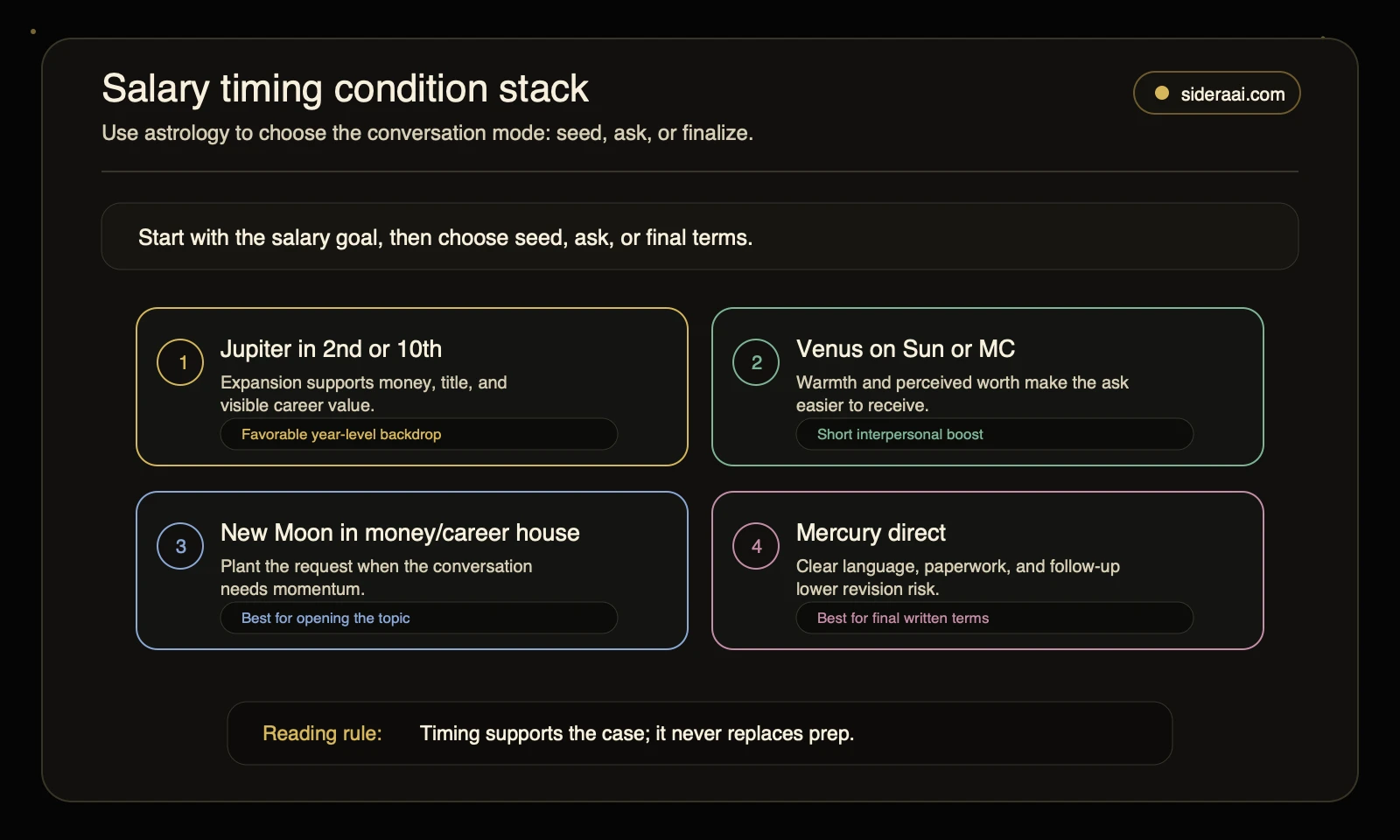
Use the condition stack to decide whether the moment is better for seeding the conversation, making the ask, or finalizing written terms.
Find your perfect moment with AI-powered electional astrology.
Discover your timing →What to Avoid: Planetary Red Flags
Mercury Retrograde
Mercury retrograde is the most commonly cited timing risk for salary negotiations – and the caution is earned. Verbal agreements made during retrograde carry elevated rates of reversal, renegotiation, or misunderstanding. Compensation terms offered in retrograde frequently get reopened after Mercury stations direct.
Practical exception: If your performance review is already scheduled and cannot be moved, use the retrograde window to prepare your case in detail. Document everything. Present your case in writing, not only verbally. Show up organized, not improvised.
Saturn Squaring or Opposing Your Natal Sun or Venus
Saturn transits create delays, structural limitations, and the experience of the system working against you regardless of individual effort. Under a hard Saturn transit to personal planets, even well-prepared negotiations can stall, receive conditional approvals that never materialize, or result in “not yet” from decision-makers who normally say yes.
“Saturn’s hard transits demand patience rather than acceleration. The window typically opens cleanly when the transit completes – and what gets built in the waiting period arrives on stronger foundations.” – Liz Greene, Saturn: A New Look at an Old Devil (1976)
Patience under Saturn is usually correct. The negotiation you defer to the other side of a Saturn square often lands better than the one you push through it.
Full Moon Stress Aspects
Full moons within 2 to 3 degrees of squaring or opposing your natal Midheaven or 2nd house ruler can bring emotional intensity into financial conversations. You may present your case too forcefully, or the discussion may surface unspoken tensions about recognition and worth that derail the practical conversation. This is not a hard no – it means emotional regulation becomes more important, and written preparation matters more than verbal improvisation.
If one of these red flags is active, change the purpose of the meeting. Use it to gather information, document your impact, or ask what criteria would unlock the next compensation step. Save the final number for cleaner timing when possible.

When timing is messy, change the meeting’s purpose and secure the facts in writing before any version can drift.
Using Your Personal Chart for Precision
The general planetary conditions above create favorable weather. Your personal chart determines whether that weather lands on fertile ground.
“The birth chart does not compel – it describes the territory. Understanding it is not fatalism; it is cartography.” – Howard Sasportas, The Gods of Change (1989)
Key points to track for salary negotiation:
- Natal 2nd house ruler’s condition – which planet rules your 2nd house, and where is it by transit right now?
- Natal 10th house ruler – what is activating your career and public reputation house?
- Progressed Venus – your progressed Venus’s position and aspects reflect multi-year themes around perceived financial worth
- Natal Jupiter’s condition – Jupiter’s natal placement and current transiting aspects influence how expansively others experience you
The intersection that produces consistent results: favorable transit weather (Jupiter expanding, Mercury direct, Venus harmonious) coinciding with a personal transit activating your 2nd or 10th house ruler. That overlap, even when rare, is the window to target.
For a deeper look at how transits activate different life areas, see our guide to electional astrology and the 10th house career meaning.
How to Build a 90-Day Negotiation Window
Rather than picking a single date, astrology works best when you identify a favorable window of two to four weeks, then schedule within it.
Four-step process:
- Locate Jupiter’s current house in your natal chart – if it sits in your 2nd or 10th, you are in a favorable year overall
- Mark Mercury retrograde dates for the next 90 days – the pre- and post-shadow periods count as elevated-risk too
- Identify upcoming new moons and determine which house they activate in your chart
- Track Venus transits over your Midheaven or natal Sun – these windows are brief (typically 3 to 5 days) but add a meaningful interpersonal boost
You do not need all four conditions to align simultaneously. Two or three positive indicators – combined with thorough preparation – is a strong foundation for action.
A useful 90-day plan separates the work into phases: seed the conversation during a lower-pressure window, make the formal ask when Mercury and Venus support clarity, and finalize terms when the agreement can be written cleanly. This keeps astrology practical instead of turning one date into an all-or-nothing test.

A workable window has phases: seed the idea, make the evidence-backed ask, then lock the final terms into a clean written agreement.
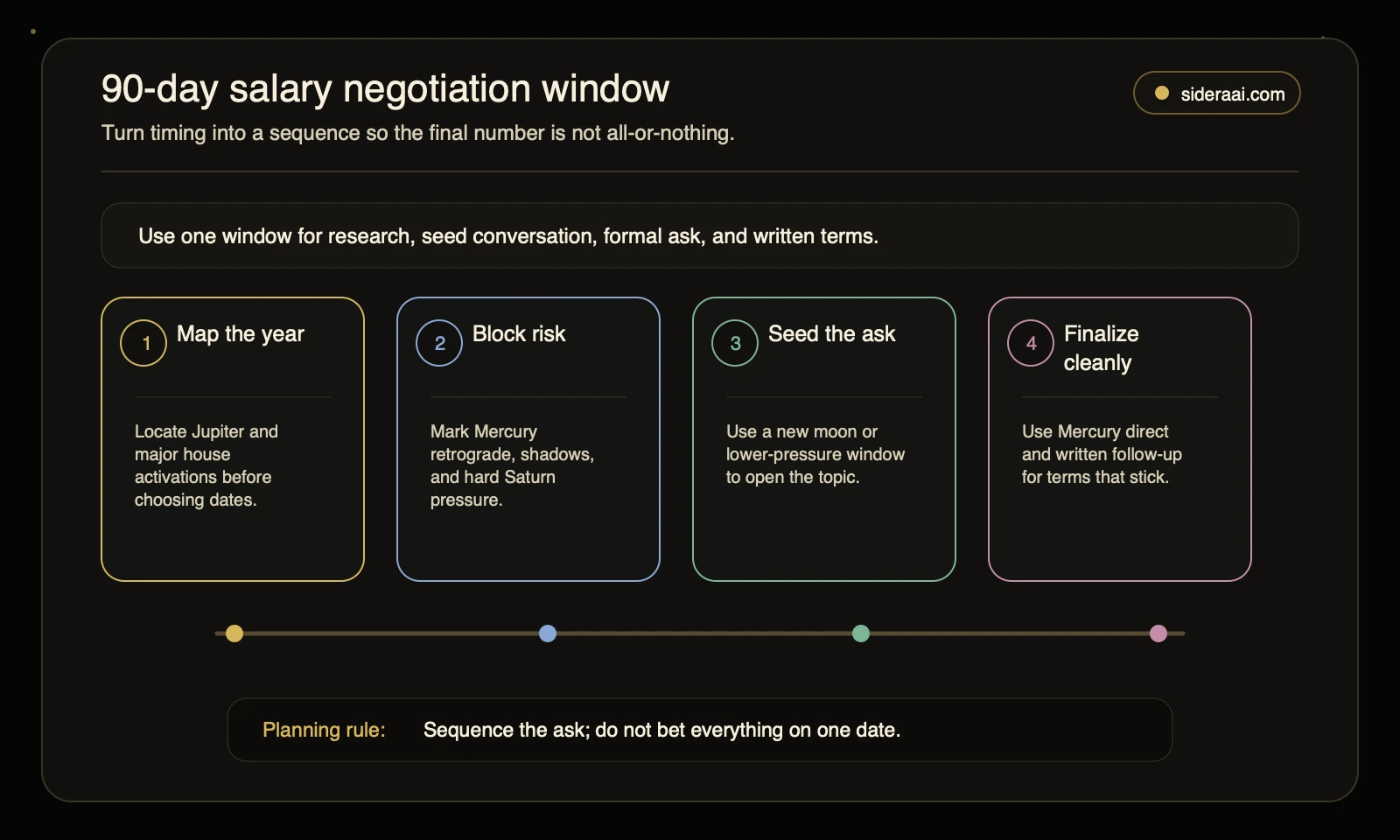
The 90-day map turns timing into a sequence so the final number is supported by research, earlier signals, and clean written follow-up.
Plan your life around the stars, not just the calendar.
Start planning →Sidera Salary Timing for the Rest of 2026
Sidera evaluated 508 dates from August 11, 2026 through December 31, 2027 twice: once with ask_for_raise and once with negotiate_deal. Both stages require at least 4.5/5, a business day, a New or waxing Moon, and more than three days of separation from the eclipses in NASA’s catalog.
The difference comes after that shared screen:
- Open the raise conversation: Jupiter–Sun–Venus model; Mercury retrograde and VOC are disclosed but not blocked; Thursday or Friday wins tied scores.
- Finalize salary terms: Mercury–Venus–Jupiter model; Mercury must be direct and the Moon must not be VOC; tied dates rank by quality, intensity, then earliest date.
| Month | Open the raise conversation | Finalize salary terms | Why the timing changes |
|---|---|---|---|
| August |
ask_for_raise · 5.0/5 · Waxing CrescentCaution: VOC at 12:00 UTC |
negotiate_deal · 5.0/5 · Waxing Crescent | The ask leader is VOC; the final-terms gate moves the negotiation one day later to a non-VOC Moon. |
| September | HoldBest screened score: 4.4/5 Best screened ask date stays below 4.5/5. |
negotiate_deal · 4.5/5 · Waxing Gibbous | Mercury–Venus–Jupiter aspects clear the deal threshold even though the Jupiter–Sun–Venus ask model has no publishable September leader. |
| October |
ask_for_raise · 4.5/5 · Waxing CrescentCaution: VOC at 12:00 UTC | HoldBest screened score: 4.3/5 Best direct, non-VOC candidate stays below 4.5/5. | October 16 can open the case, but VOC blocks final terms; the cleaner October 15 deal score is only 4.3/5. |
| November |
ask_for_raise · 5.0/5 · Waxing CrescentCaution: Mercury retrograde and VOC |
negotiate_deal · 4.7/5 · Waxing Gibbous | Use November 12 to reopen or document the case; lock terms on November 20 after Mercury turns direct under a non-VOC Moon. |
| December |
ask_for_raise · 5.0/5 · Waxing Gibbous |
negotiate_deal · 5.0/5 · Waxing Gibbous | The ask model's Friday tie preference selects December 18; stronger deal quality moves final terms to December 22. |
High raw deal scores rejected by final-terms gates
| Candidate | Raw deal score | Blocked by | Stage-specific treatment |
|---|---|---|---|
| 5.0/5Waxing Crescent | Moon VOC | Published as the 5.0/5 ask-stage leader, but final terms move to the non-VOC August 18 date. | |
| 4.7/5Waxing Crescent | Mercury retrograde, Moon VOC | The date can reopen the raise case, but two deal-specific gates block final terms until November 20. |
General transit-only comparison, generated August 11, 2026 with Sidera engine baseline 382200b. Both stages require at least 4.5/5, a Monday–Friday date, a New or waxing Moon, and the stated eclipse buffer. The ask stage then prefers Thursday or Friday on tied scores. The final-terms stage instead requires Mercury direct and a non-VOC Moon, then ranks by favorability, quality, intensity, and earliest date. No birth chart or location was used.
October 2026 is the clearest split. October 16 reaches 4.5/5 for opening the raise case, but its VOC Moon blocks final terms. The best direct, non-VOC deal candidate on October 15 reaches only 4.3/5, so the finalization column remains a hold. November shows the opposite workflow in sequence: reopen or document the case on November 12, then settle terms on November 20 after Mercury turns direct.
Best Salary Negotiation Dates in 2027
The same comparison produces ten ask-stage dates but only eight final-terms dates in 2027. February and March are holds at both stages. July and October can support opening the compensation case, yet neither month produces a negotiate_deal result that clears the strict score, Mercury, VOC, Moon-phase, weekday, and eclipse filters.
| Month | Open the raise conversation | Finalize salary terms | Why the timing changes |
|---|---|---|---|
| January |
ask_for_raise · 5.0/5 · Waxing Crescent |
negotiate_deal · 5.0/5 · Waxing Gibbous | Both stages score 5.0/5; the ask stage prefers Thursday, while the deal model ranks January 18 higher on quality and intensity. |
| February | HoldBest screened score: 3.6/5 Best screened ask date stays below 4.5/5. | Hold No weekday reaches the scoring gate while also passing Moon phase, Mercury, VOC, and eclipse filters. | Neither stage supports a general recommendation; Mercury retrograde covers much of the available waxing phase. |
| March | HoldBest screened score: 3.5/5 Best screened ask date stays below 4.5/5. | HoldBest screened score: 3.5/5 Best direct, non-VOC candidate stays below 4.5/5. | March 15 is the best screened day for both models, but challenging activity aspects leave both scores at 3.5/5. |
| April |
ask_for_raise · 5.0/5 · Waxing Gibbous |
negotiate_deal · 5.0/5 · Waxing Gibbous | Both have maximum quality; Thursday preference selects the ask date, while higher intensity selects April 19 for final terms. |
| May |
ask_for_raise · 4.8/5 · Waxing Gibbous |
negotiate_deal · 5.0/5 · First Quarter | Different primary-planet aspects put the final-terms date one day before the best raise-request date. |
| June |
ask_for_raise · 5.0/5 · New Moon |
negotiate_deal · 4.9/5 · New Moon | One date supports both stages before Mercury retrograde, though each activity weights its relevant aspects differently. |
| July |
ask_for_raise · 4.7/5 · Waxing Crescent | HoldBest screened score: 4.4/5 Best direct, non-VOC candidate stays below 4.5/5. | The raise conversation clears its model after Mercury turns direct; final terms still have no deal-specific score above the threshold. |
| August |
ask_for_raise · 5.0/5 · Waxing Crescent |
negotiate_deal · 5.0/5 · Waxing Crescent | Maximum quality and intensity make August 6 the shared leader after the eclipse buffer. |
| September |
ask_for_raise · 5.0/5 · New Moon |
negotiate_deal · 4.7/5 · Waxing Gibbous | Jupiter–Sun–Venus favors the New Moon ask; Mercury–Venus–Jupiter favors earlier final terms. |
| October |
ask_for_raise · 4.6/5 · Waxing Crescent | HoldBest screened score: 3.5/5 Best pre-retrograde direct, non-VOC candidate stays below 4.5/5. | October can open the raise case, but the final-terms model never clears its threshold before Mercury retrograde. |
| November |
ask_for_raise · 5.0/5 · Waxing Crescent |
negotiate_deal · 5.0/5 · Waxing Crescent | The ask model favors an early-month opening; deal quality and intensity favor locking terms near month-end. |
| December |
ask_for_raise · 5.0/5 · Waxing Crescent |
negotiate_deal · 5.0/5 · Waxing Crescent | December 3 is the shared leader for opening and finalizing, with different aspect weights producing the same final score. |
High raw deal scores rejected by final-terms gates
| Candidate | Raw deal score | Blocked by | Stage-specific treatment |
|---|---|---|---|
| 5.0/5Waxing Crescent | Eclipse buffer | Maximum raw quality does not override the three-day buffer after the August 2 solar eclipse; both stages select August 6. | |
| 5.0/5Waxing Crescent | Moon VOC | The raw deal score is 5.0/5, but final terms move to the shared non-VOC leader on December 3. |
General transit-only comparison, generated August 11, 2026 with Sidera engine baseline 382200b. Both stages require at least 4.5/5, a Monday–Friday date, a New or waxing Moon, and the stated eclipse buffer. The ask stage then prefers Thursday or Friday on tied scores. The final-terms stage instead requires Mercury direct and a non-VOC Moon, then ranks by favorability, quality, intensity, and earliest date. No birth chart or location was used.
June 4, August 6, and December 3 support both stages on the same date. That does not mean the two activities are identical: June 4 scores 5.0/5 for ask_for_raise and 4.9/5 for negotiate_deal because each activity weights a different set of planetary aspects. Shared date, different calculation.
Mercury Retrograde Runs Used by the Final-Terms Filter
At 12:00 UTC, the engine detects:
- 2026: February 26–March 20, June 30–July 23, and October 24–November 13
- 2027: February 10–March 3, June 11–July 4, and October 8–October 28
Station boundaries can move by a calendar day in some timezones. Near a boundary, use the exact local meeting time rather than treating the UTC date as universal.
How to Use the Two-Stage Table
- Use the ask column to send the request, present evidence, name the target range, or reopen an old promise.
- Use the final-terms column for the exact salary, title, effective date, bonus target, equity grant, benefits, and written acceptance.
- A hold means no general date cleared the stated filter. It does not mean you must reject a mandatory meeting; change the purpose to research, documentation, or criteria gathering.
- Favorability, quality, and intensity are activity-specific engine outputs. A higher score in one column cannot be copied into the other activity.
- These are general transit-only results. Your houses, natal Mercury/Venus/Jupiter, location, employer calendar, leverage, and compensation data are not included.
Salary Negotiation and the 8th House
Most career astrology focuses on the 2nd and 10th houses, but the 8th house (shared resources, bonuses, equity, benefits packages) becomes relevant in more complex compensation discussions.
When transiting Jupiter or Venus activates your 8th house or its ruler, negotiations involving bonuses, profit sharing, stock options, or renegotiating benefits packages tend to flow more easily. Saturn transiting the 8th, by contrast, may indicate a period of reduced access to shared resources or slower movement on organizational-level compensation decisions that affect you.
For standard base salary conversations, the 2nd and 10th house timing remains primary. For total compensation package negotiations, the 8th house adds a useful additional layer of timing information.

A total-compensation negotiation is a shared-resource package, not one number: base pay, bonus, equity, and benefits can move on different tracks.
2nd House vs. 10th House: Which Timing to Prioritize
This is a distinction most salary timing guides skip entirely.
| Factor | 2nd House Emphasis | 10th House Emphasis |
|---|---|---|
| Primary focus | Your sense of worth and earning capacity | Authority figures’ recognition of your value |
| Best for | Requesting salary that reflects your self-assessed contribution | Seeking promotion, title change, or public reputation upgrade |
| Feels like | “I know what I am worth and I am naming it” | “My career is visible and valued from the outside” |
| Timing trigger | Jupiter or new moon in natal 2nd house | Jupiter or new moon in natal 10th house |
| Risk when absent | Underselling; feeling undeserving mid-conversation | Manager not seeing your contributions clearly |
| Combine for | Negotiating both salary AND title in the same meeting | Full package review |
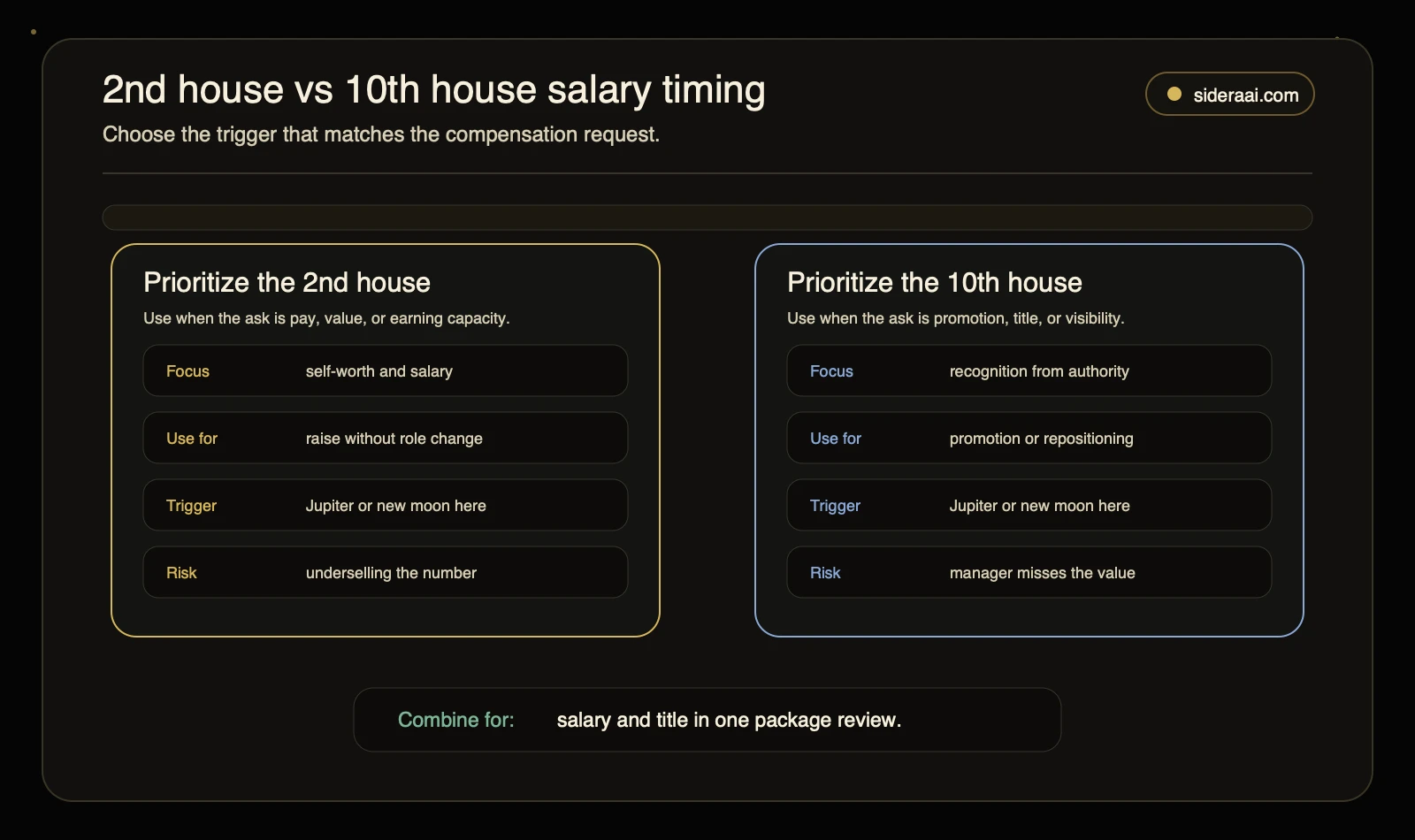
Use the house-priority map to match the timing trigger to the real request: pay, title, recognition, or a combined package review.
The practical insight: if you are primarily seeking a compensation increase without a role change, prioritize 2nd house activation. If you are seeking a promotion or repositioning, 10th house timing becomes primary – and salary tends to follow the role upgrade naturally.

Choose the timing that matches the real ask: a secure pay adjustment, a visible role upgrade, or a deliberate combination of both.
North Node and South Node: The Long-Game Timing Dimension
Most salary timing guides stop at transits. The nodal axis adds a layer that no transit analysis captures on its own.
Your North Node points toward the developmental edge of your career – the direction that creates the most sustainable growth over time, even when it feels unfamiliar or uncomfortable. Your South Node describes patterns you default to under pressure, the career moves and communication styles that feel safe precisely because they are karmic habits rather than genuine expansion.
How this applies to salary negotiation:
| Configuration | What It Means | Timing Implication |
|---|---|---|
| North Node transiting 2nd or 10th house | A multi-month window aligned with your long-term developmental trajectory | Negotiations initiated here tend to open new chapters, not just increment existing ones |
| South Node transiting 2nd or 10th house | Your familiar patterns are active – easier to fall back on habitual underselling | Good for renegotiating existing terms; less ideal for bold repositioning |
| North Node in natal 2nd house | Expanding financial self-worth is the core developmental work of this lifetime | Practicing naming your number – even when uncomfortable – is on-purpose, not greedy |
| North Node in natal 10th house | Career visibility and public authority are the developmental frontier | Avoiding the negotiation because it feels too exposed is the shadow; the growth is in claiming the recognition |
The key distinction most career astrology misses: transiting a nodal point (the current North or South Node crossing your natal 2nd or 10th house cusp) is different from natal nodal placement (what your North or South Node sits in at birth).
- A natal North Node in the 2nd house means financial self-worth expansion is your lifelong developmental edge. You will likely undercharge and undersell until you do the North Node work – and doing it directly, through salary conversations, is part of the path.
- A natal South Node in the 2nd house means financial conversations and resource accumulation are the karmic default – familiar, easy to fall back on, but potentially a place where you negotiate out of habit rather than genuine developmental need.
Neither is better. But knowing which you carry changes how you read hesitation before a negotiation: is it “this isn’t the right moment” or “this is exactly the uncomfortable-right-direction discomfort my North Node produces”?
Powered by Sidera — AI-driven cosmic timing.
Frequently Asked Questions
Can astrology really affect salary negotiation outcomes? Astrology does not guarantee outcomes – it identifies timing windows when conditions favor your natural strengths and when communication and financial conversations tend to flow with less friction. Preparation, case quality, and relationship dynamics still matter. Timing adds or subtracts environmental resistance.
What if I cannot control when my performance review happens? You can still act strategically. Use favorable windows to request informal conversations, plant seeds about your contributions, or send written documentation of your value in advance. The formal review captures what you have already built into the relationship.
Is Mercury retrograde really that risky for salary negotiations? The elevated risk applies primarily to finalizing terms, not to all conversations. Mercury retrograde is a reasonable time to prepare, research, and review your case. The direct station and the weeks following it are better for agreements you want to stick.
Which house matters most for salary negotiation astrology? The 2nd house (earning capacity, self-worth) and 10th house (career, recognition, authority figures) are the primary targets. Prioritize the 2nd house when seeking a pay increase without role change; prioritize the 10th when seeking a promotion where salary follows title. The 8th house adds useful information for complex total-compensation negotiations.
How do I find out which house Jupiter is in right now? You need your birth chart to identify your natal 2nd and 10th house cusps, then track where transiting Jupiter currently sits relative to those cusps. Sidera does this automatically, showing your live transit picture overlaid on your natal chart.
What if Jupiter is not in my 2nd or 10th house this year? Work with the available favorable indicators: Mercury direct windows, Venus transits over your Midheaven, and new moons in financial houses. Jupiter’s absence from the 2nd or 10th is not a veto – it simply means other conditions become more important for building your case.
Should I cancel a negotiation if Mercury goes retrograde? If the meeting is already scheduled and involves a relationship you care about, do not cancel. Shift your goal: use the conversation to surface information and lay groundwork, rather than to finalize terms. Follow up with written confirmation of anything agreed upon.
Can a bad Mercury retrograde negotiation still succeed? Yes. Mercury retrograde increases friction; it does not guarantee failure. Strong preparation, written documentation, and clear follow-up can compensate for retrograde conditions. Treat it as playing on a harder difficulty setting, not as a locked door.
What does the North Node in the 2nd house mean for salary negotiation? It means expanding your financial self-worth is your lifelong developmental edge. You are more likely than most to undersell. Every salary negotiation is practice in the North Node direction – uncomfortable precisely because it is growth, not because it is wrong.
Which dates are strongest for finalizing salary terms in 2027?
Sidera’s general negotiate_deal ranking identifies January 18, April 19, May 13, June 4, August 6, September 9, November 30, and December 3, 2027. February, March, July, and October do not produce a date that clears every final-terms gate.
Today’s planetary weather for your chart is worth checking before you book the meeting. See your Capricorn daily horoscope for career transit updates, or your Sagittarius daily horoscope for timing and communication windows.
Last updated: August 2026.