The void of course moon (VOC) is the low-traction window between the Moon’s last major aspect in a zodiac sign and its entry into the next sign. It can last a few minutes or more than 24 hours, and it happens roughly every 2-3 days.
In real life, a void Moon often feels less like disaster and more like drift: the meeting ends without a clear next step, the first date is pleasant but never becomes momentum, the purchase looks fine until the details change, or the conversation you hoped would settle something leaves everyone vague. Traditional astrology treats this as a poor time to initiate decisions that need staying power.
This guide is for practical astrology readers who want to use VOC timing without becoming afraid of the calendar. You’ll learn what the void Moon means, what to postpone, what is still safe to do, and how to use exact 2026–2027 timing as a planning tool.
What a Void Moon Feels Like in Real Life
A void of course Moon is not about everything going wrong. It is about starting something when the emotional weather is between chapters.
At work, it can show up as a meeting where people agree in theory but nothing gets assigned. In love, it can feel like chemistry without continuity: a text thread fades, a first date does not become a second, or a conversation opens more questions than it resolves. In conflict, it can make closure feel slippery because the facts, feelings, or power dynamics are still shifting. In your self-image, VOC periods can trigger the urge to force certainty just because uncertainty feels uncomfortable.
The practical lesson is simple: do not ask a void Moon moment to produce a clean beginning. Use it to finish, review, rest, observe, and let unclear information reveal itself before you commit.
Ask three questions before acting:
- Is this a true beginning? If you are signing, launching, asking, announcing, buying, proposing, or making a first move, timing matters more.
- Can this be revised later? Reversible choices are lower-risk than contracts, commitments, and public launches.
- Am I chasing certainty? If the real motive is anxiety, wait until the Moon changes signs before treating the decision as final.
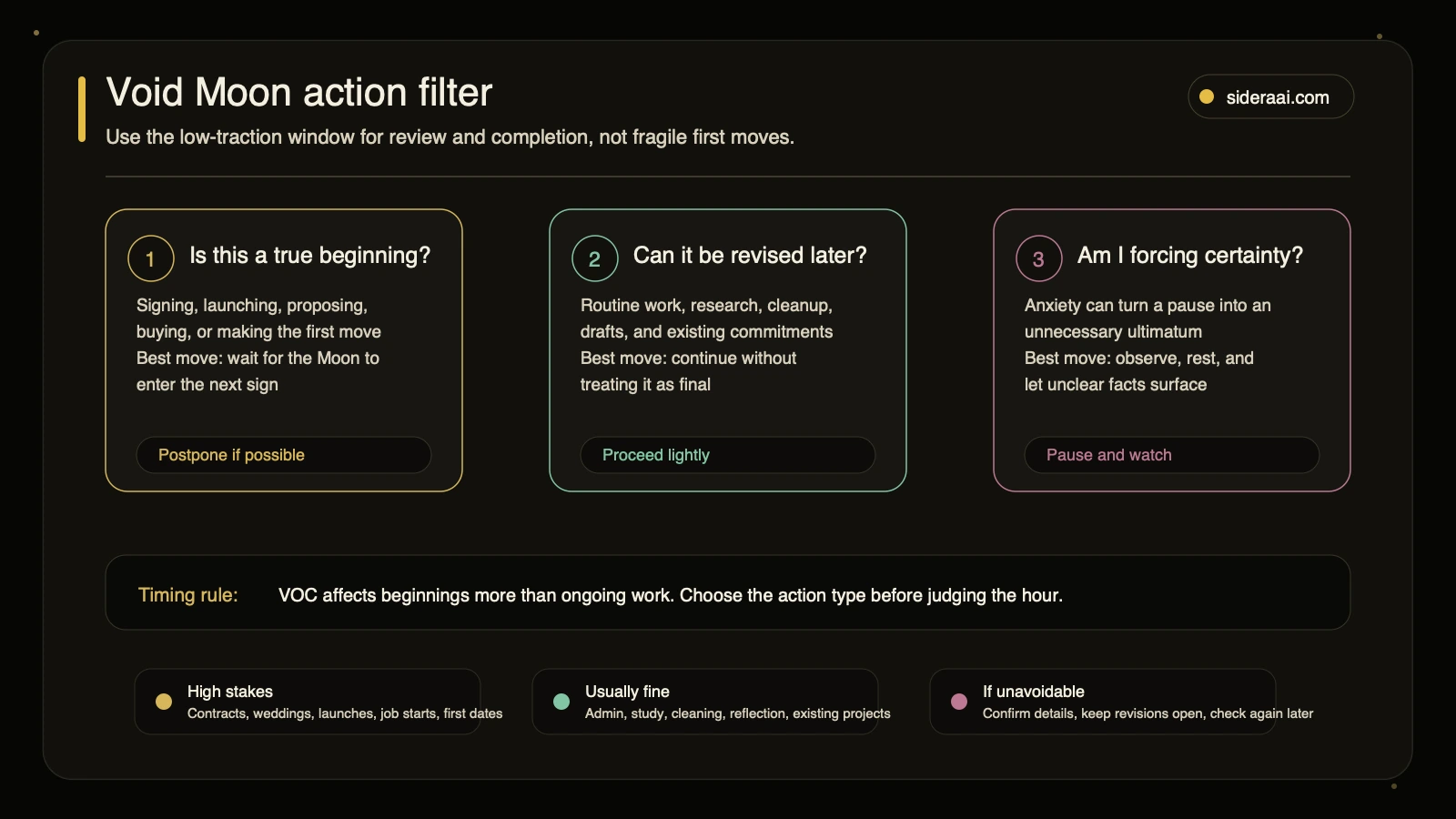
Use the filter before treating a VOC window as good or bad. The risk depends on whether you are initiating, continuing, or trying to force certainty.
What Does “Void of Course” Mean in Astrology?
The term “void of course” comes from the Latin vacuus cursus, meaning “empty journey.” In astrological terms, the Moon is void of course when it has completed its last major aspect (conjunction, sextile, square, trine, or opposition) to a planet while still in a zodiac sign and won’t make another aspect until entering the next sign.
According to William Lilly, the 17th-century astrologer and author of Christian Astrology (1647): “A planet is void of course when it is separated from a planet, yet while in that sign does not apply to any other. This is a debility, denoting things come to nothing.”
The void of course moon concept has gained renewed attention as astrology interest surges. According to Pew Research Center (2022), approximately 29% of U.S. adults believe in astrology, with rates even higher among younger demographics (37% of those under 30). For readers who already use astrology for reflection, VOC timing offers a practical way to separate “act now” moments from “wait and watch” moments.
The Astronomy Behind VOC Moon
The Moon moves through all 12 zodiac signs approximately every 27.3 days (the lunar month), spending roughly 2.5 days in each sign. As it travels, it forms geometric angles, called aspects, with other planets:
| Aspect | Angle | Nature |
|---|---|---|
| Conjunction | 0° | Intensifying |
| Sextile | 60° | Harmonious |
| Square | 90° | Challenging |
| Trine | 120° | Harmonious |
| Opposition | 180° | Polarizing |
Once the Moon completes its final aspect in a sign, it enters the void of course period until it ingresses (enters) the next sign. This can last anywhere from minutes to over 24 hours, depending on planetary positions.
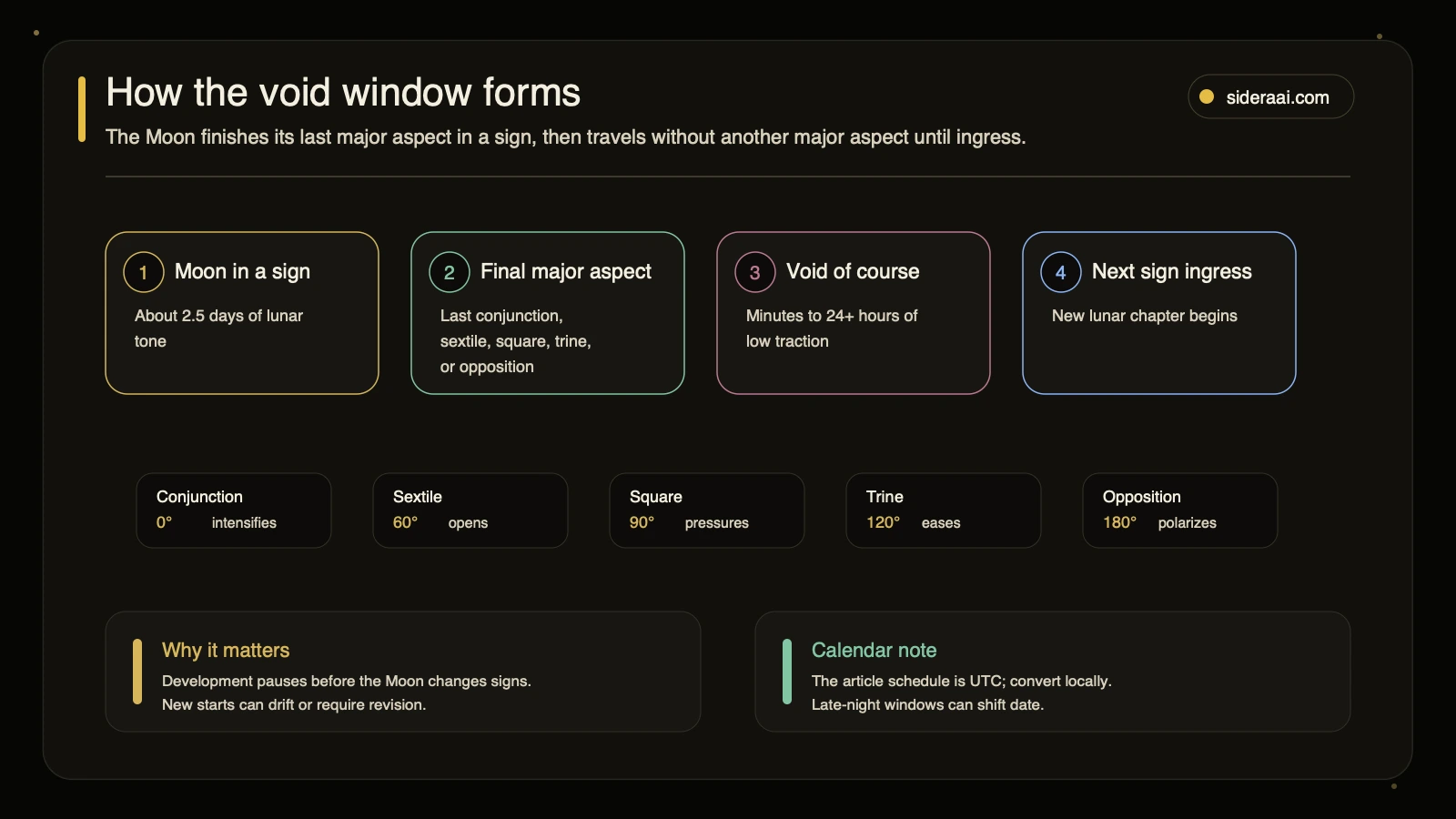
The void window begins after the Moon’s final major aspect in a sign and ends at the next sign ingress. This is why local timezone conversion matters for practical planning.
Why the Void of Course Moon Matters for Timing
Astrologers have observed for centuries that activities initiated during void of course periods tend to have unexpected outcomes. Modern VOC practice often cites astrologer Al H. Morrison, who studied VOC moons from 1950-1990 and argued that events begun during VOC periods frequently failed to develop as intended. His work, published in CAO Times, helped shape the way many contemporary astrologers use VOC timing.
The Traditional View
According to Dr. Lee Lehman, PhD and classical astrologer, author of Classical Astrology for Modern Living: “The void of course Moon represents a period where the cosmic energy is essentially ‘between channels.’ Just as a radio between stations produces static rather than clear signal, activities begun during VOC tend to lack clear direction.”
Modern Interpretation
While traditional astrology takes a stricter view, contemporary astrologers note that VOC periods are not inherently “bad.” They are simply not ideal for initiating new ventures. As Susan Miller, founder of Astrology Zone with over 20 million monthly readers, explains: “The void of course moon is not a time when bad things happen. It’s simply a time when decisions made and actions taken may not turn out as expected-for better or worse.”
Find your perfect moment with AI-powered electional astrology.
Discover your timing →What to Avoid During Void of Course Moon
Traditional electional astrology is strictest when an action creates a new commitment. Sidera does not apply that rule identically to every activity: a launch or signature gets a VOC gate, while an interview or raise request does not. They still deserve clear follow-through, but the calendar should not flatten them into the same decision.
Activities That Need a VOC Check
| Activity | Practical VOC treatment |
|---|---|
| Signing contracts | Move the final signature outside VOC when possible; Sidera treats this as a hard publication gate. |
| Launching a business | Choose a non-VOC launch moment; the start-business model applies the strongest VOC penalty in this comparison. |
| Finalizing salary or deal terms | Keep exploratory discussion provisional and move agreement on final terms outside VOC. |
| Making major purchases | Delay the irreversible commitment when practical and verify terms, returns, and financing. |
| Proposals (business or romantic) | Prefer a window with clearer follow-through for an answer meant to last. |
| Job interviews | Do not reject the date on VOC alone; ask precise questions and document next steps. |
| Asking for a raise | Opening the case can proceed; avoid forcing a final compensation agreement in the same window. |
Why These Specific Activities?
The stricter cases share one characteristic: they create new beginnings or binding commitments where you want a clear trajectory. The softer cases are conversations whose next step can be revised. This is why the same VOC timestamp can reject a contract date without automatically rejecting an interview date.
What’s Actually Fine During VOC Moon
Not everything needs to stop during a void of course period! These activities are unaffected or even enhanced:
Activities That Are Safe During VOC
- Routine tasks - Paperwork, cleaning, organizing
- Continuing existing projects - Work already in progress is fine
- Rest and reflection - Meditation, journaling, introspection
- Creative brainstorming - Ideas flow freely (just don’t launch yet)
- Self-care - Spa days, relaxation, sleep
- Spending time with established relationships - Dinners with friends/family
- Spiritual practices - Prayer, rituals, divination
- Research and learning - Studying, reading, skill-building
- Entertainment - Movies, games, casual activities
The Key Distinction
The distinction is between initiating (higher-risk) and continuing (usually fine). If you already have a job, keep working. If you are already in a relationship, spend time together. If a project already exists, revise it, clean it up, or finish the next small piece.
The VOC affects beginnings, not ongoing activities. The healthiest use is not avoidance; it is choosing the right kind of action for the moment.
Void of Course Moon Calendar: August–September 2026
The table below contains every VOC window that overlaps August 11 through September 30, 2026. UTC is the canonical timestamp, with the same moments converted for New York, London, and Singapore. The abbreviations in each cell reflect daylight-saving time on that date, so a window can begin or end on a different local calendar day.
The first row begins on August 10 because it is still active during part of August 11 UTC. The “last exact aspect” column identifies the event that starts the void; the window ends when the Moon enters the next tropical zodiac sign.
| UTC window | Duration | Moon | Last exact aspect | New York | London | Singapore |
|---|---|---|---|---|---|---|
| to | 25h 08m | Cancer → Leo | Square Saturn | Aug 10, 03:30 EDTto Aug 11, 04:38 EDT | Aug 10, 08:30 BSTto Aug 11, 09:38 BST | Aug 10, 15:30 SGTto Aug 11, 16:38 SGT |
| to | 16h 41m | Leo → Virgo | Conjunction Sun | Aug 12, 13:37 EDTto Aug 13, 06:18 EDT | Aug 12, 18:37 BSTto Aug 13, 11:18 BST | Aug 13, 01:37 SGTto Aug 13, 18:18 SGT |
| to | 42h 56m | Virgo → Libra | Square Uranus | Aug 13, 15:24 EDTto Aug 15, 10:20 EDT | Aug 13, 20:24 BSTto Aug 15, 15:20 BST | Aug 14, 03:24 SGTto Aug 15, 22:20 SGT |
| to | 10h 15m | Libra → Scorpio | Sextile Sun | Aug 17, 07:31 EDTto Aug 17, 17:46 EDT | Aug 17, 12:31 BSTto Aug 17, 22:46 BST | Aug 17, 19:31 SGTto Aug 18, 05:46 SGT |
| to | 5h 44m | Scorpio → Sagittarius | Square Sun | Aug 19, 22:47 EDTto Aug 20, 04:30 EDT | Aug 20, 03:47 BSTto Aug 20, 09:30 BST | Aug 20, 10:47 SGTto Aug 20, 16:30 SGT |
| to | 0h 28m | Sagittarius → Capricorn | Trine Sun | Aug 22, 16:31 EDTto Aug 22, 16:59 EDT | Aug 22, 21:31 BSTto Aug 22, 21:59 BST | Aug 23, 04:31 SGTto Aug 23, 04:59 SGT |
| to | 26h 32m | Capricorn → Aquarius | Square Venus | Aug 24, 02:30 EDTto Aug 25, 05:02 EDT | Aug 24, 07:30 BSTto Aug 25, 10:02 BST | Aug 24, 14:30 SGTto Aug 25, 17:02 SGT |
| to | 21h 04m | Aquarius → Pisces | Trine Venus | Aug 26, 17:59 EDTto Aug 27, 15:04 EDT | Aug 26, 22:59 BSTto Aug 27, 20:04 BST | Aug 27, 05:59 SGTto Aug 28, 03:04 SGT |
| to | 34h 24m | Pisces → Aries | Trine Mars | Aug 28, 12:15 EDTto Aug 29, 22:38 EDT | Aug 28, 17:15 BSTto Aug 30, 03:38 BST | Aug 29, 00:15 SGTto Aug 30, 10:38 SGT |
| to | 12h 14m | Aries → Taurus | Opposition Venus | Aug 31, 15:47 EDTto Sep 1, 04:01 EDT | Aug 31, 20:47 BSTto Sep 1, 09:01 BST | Sep 1, 03:47 SGTto Sep 1, 16:01 SGT |
| to | 25h 01m | Taurus → Gemini | Trine Mercury | Sep 2, 06:47 EDTto Sep 3, 07:47 EDT | Sep 2, 11:47 BSTto Sep 3, 12:47 BST | Sep 2, 18:47 SGTto Sep 3, 19:47 SGT |
| to | 5h 51m | Gemini → Cancer | Trine Venus | Sep 5, 04:40 EDTto Sep 5, 10:30 EDT | Sep 5, 09:40 BSTto Sep 5, 15:30 BST | Sep 5, 16:40 SGTto Sep 5, 22:30 SGT |
| to | 3h 10m | Cancer → Leo | Square Venus | Sep 7, 09:40 EDTto Sep 7, 12:49 EDT | Sep 7, 14:40 BSTto Sep 7, 17:49 BST | Sep 7, 21:40 SGTto Sep 8, 00:49 SGT |
| to | 0h 37m | Leo → Virgo | Sextile Venus | Sep 9, 14:58 EDTto Sep 9, 15:35 EDT | Sep 9, 19:58 BSTto Sep 9, 20:35 BST | Sep 10, 02:58 SGTto Sep 10, 03:35 SGT |
| to | 18h 00m | Virgo → Libra | Sextile Mars | Sep 11, 01:52 EDTto Sep 11, 19:52 EDT | Sep 11, 06:52 BSTto Sep 12, 00:52 BST | Sep 11, 13:52 SGTto Sep 12, 07:52 SGT |
| to | 16h 17m | Libra → Scorpio | Square Mars | Sep 13, 10:27 EDTto Sep 14, 02:44 EDT | Sep 13, 15:27 BSTto Sep 14, 07:44 BST | Sep 13, 22:27 SGTto Sep 14, 14:44 SGT |
| to | 13h 11m | Scorpio → Sagittarius | Sextile Sun | Sep 15, 23:30 EDTto Sep 16, 12:41 EDT | Sep 16, 04:30 BSTto Sep 16, 17:41 BST | Sep 16, 11:30 SGTto Sep 17, 00:41 SGT |
| to | 8h 11m | Sagittarius → Capricorn | Square Sun | Sep 18, 16:44 EDTto Sep 19, 00:55 EDT | Sep 18, 21:44 BSTto Sep 19, 05:55 BST | Sep 19, 04:44 SGTto Sep 19, 12:55 SGT |
| to | 2h 43m | Capricorn → Aquarius | Trine Sun | Sep 21, 10:31 EDTto Sep 21, 13:14 EDT | Sep 21, 15:31 BSTto Sep 21, 18:14 BST | Sep 21, 22:31 SGTto Sep 22, 01:14 SGT |
| to | 19h 05m | Aquarius → Pisces | Trine Mercury | Sep 23, 04:18 EDTto Sep 23, 23:24 EDT | Sep 23, 09:18 BSTto Sep 24, 04:24 BST | Sep 23, 16:18 SGTto Sep 24, 11:24 SGT |
| to | 1h 51m | Pisces → Aries | Trine Mars | Sep 26, 04:32 EDTto Sep 26, 06:23 EDT | Sep 26, 09:32 BSTto Sep 26, 11:23 BST | Sep 26, 16:32 SGTto Sep 26, 18:23 SGT |
| to | 4h 50m | Aries → Taurus | Opposition Mercury | Sep 28, 05:50 EDTto Sep 28, 10:40 EDT | Sep 28, 10:50 BSTto Sep 28, 15:40 BST | Sep 28, 17:50 SGTto Sep 28, 22:40 SGT |
| to | 17h 50m | Taurus → Gemini | Square Jupiter | Sep 29, 19:36 EDTto Sep 30, 13:26 EDT | Sep 30, 00:36 BSTto Sep 30, 18:26 BST | Sep 30, 07:36 SGTto Oct 1, 01:26 SGT |
Generated August 11, 2026 from Sidera engine baseline 382200b. UTC is the canonical timestamp. New York and London labels include the timezone abbreviation in effect on that date; Singapore is UTC+8 year-round.
Do not convert these rows by adding a fixed offset to every date. New York and London change offsets seasonally. For any other location, convert the machine-readable UTC start and end timestamps rather than the date label alone.
How Much of 2027 Is Void of Course?
The complete Sidera calculation finds 160 VOC windows ending in 2027. Together, the portions that fall inside the UTC calendar year total 1,648.7 hours, or 18.8% of 2027. The mean window lasts 10 hours 15 minutes, but the monthly pattern is uneven: July averages just 5.1 hours, while March averages 16.2 hours.
The longest 2027 window lasts 46 hours 56 minutes, from February 8 at 03:53 UTC until February 10 at 02:49 UTC, as the Moon leaves Pisces and enters Aries. That range is why “VOC always lasts 6–8 hours” is not a reliable planning assumption.
| Month | Windows ending | Hours in VOC | Share of month | Average window | Longest window (UTC) |
|---|---|---|---|---|---|
| January | 14 | 152.2h | 20.5% | 10.9h | 32h 00mJan 21, 00:46 UTC – Jan 22, 08:45 UTC · Cancer → Leo |
| February | 12 | 174.7h | 26% | 14.6h | 46h 56mFeb 8, 03:53 UTC – Feb 10, 02:49 UTC · Pisces → Aries |
| March | 14 | 227.2h | 30.5% | 16.2h | 46h 28mMar 20, 09:34 UTC – Mar 22, 08:02 UTC · Virgo → Libra |
| April | 13 | 161.8h | 22.5% | 12.4h | 20h 04mApr 27, 07:19 UTC – Apr 28, 03:24 UTC · Capricorn → Aquarius |
| May | 13 | 127.1h | 17.1% | 9.8h | 28h 56mMay 1, 20:48 UTC – May 3, 01:43 UTC · Pisces → Aries |
| June | 13 | 104.9h | 14.6% | 8.0h | 17h 01mJun 11, 10:57 UTC – Jun 12, 03:57 UTC · Virgo → Libra |
| July | 14 | 70.5h | 9.5% | 5.1h | 18h 42mJul 27, 21:28 UTC – Jul 28, 16:10 UTC · Taurus → Gemini |
| August | 14 | 167h | 22.4% | 11.9h | 40h 22mAug 18, 14:32 UTC – Aug 20, 06:54 UTC · Pisces → Aries |
| September | 13 | 105.2h | 14.6% | 8.1h | 19h 42mSep 28, 19:49 UTC – Sep 29, 15:31 UTC · Virgo → Libra |
| October | 14 | 123.6h | 16.6% | 8.8h | 22h 10mOct 17, 12:37 UTC – Oct 18, 10:46 UTC · Taurus → Gemini |
| November | 13 | 116.9h | 16.2% | 9.0h | 16h 07mNov 9, 12:32 UTC – Nov 10, 04:38 UTC · Pisces → Aries |
| December | 13 | 117.6h | 15.8% | 8.3h | 17h 33mDec 4, 07:47 UTC – Dec 5, 01:20 UTC · Aquarius → Pisces |
“Windows ending” assigns each VOC period to the month of its sign ingress. Monthly hours and percentages clip every period at the UTC month boundary. The 2027 longest window is 46h 56m (Feb 8, 03:53 UTC – Feb 10, 02:49 UTC, Pisces → Aries).
These monthly values answer three different questions. “Windows ending” counts sign ingresses in that month. “Hours in VOC” clips every interval at the month boundary. “Average” and “longest” describe the full windows assigned to that month by their ending ingress.
The Same VOC Window Does Not Affect Every Activity Equally
Sidera’s timing engine checks the activity configuration before applying a VOC effect. Starting a business, signing a contract, and finalizing a negotiated deal are configured to avoid VOC. A job interview and the act of asking for a raise are VOC-neutral in their activity models, so they are not rejected on this factor alone.
| Activity | Engine VOC rule | Model effect | How to use it |
|---|---|---|---|
| Start a Business | Avoid VOC | -0.25 before the 1–5 score conversion | Hard publication gate: move the launch outside VOC. |
| Sign Contract/Agreement | Avoid VOC | -0.20 before the 1–5 score conversion | Hard publication gate: move the signature outside VOC. |
| Negotiate Deal | Avoid VOC | -0.15 before the 1–5 score conversion | Hard publication gate for final terms; an exploratory talk can stay provisional. |
| Job Interview | VOC-neutral | 0.00; VOC is neutral in this activity model | No engine VOC penalty; disclose the window and strengthen follow-up. |
| Ask for Raise/Promotion | VOC-neutral | 0.00; VOC is neutral in this activity model | No engine VOC penalty; opening the case can proceed, but avoid forcing final terms. |
These are activity-configuration effects, not final date scores. A complete Sidera score also evaluates the activity's planets, aspects, Moon phase, retrogrades, intensity, and quality. The publication exporter uses the Sidera engine's tropical Swiss Ephemeris positions, planet set, Ptolemaic aspect set, and Moon-sign boundaries. It solves the complete interval rather than sampling the point-in-time API. Times are rounded to the nearest minute; birth data and location are not inputs.
The modifier is only one component before conversion to Sidera’s 1–5 favorability score. A VOC-neutral interview can still fail because of its Mercury, Moon-phase, weekday, eclipse, or overall-score rules. A non-VOC contract can still be a weak contract date for the same reason. Use the activity result, not a universal “good day” label.
How Sidera Calculated These VOC Times
This is a general transit calculation, not a personalized election. It uses Sidera’s tropical, geocentric Swiss Ephemeris positions and the same planet set as the timing engine: the Sun and Mercury through Pluto. A window begins at the Moon’s last exact conjunction, sextile, square, trine, or opposition before its next sign ingress, and ends at that ingress.
The publication exporter solves the complete interval to sub-second precision and displays it to the nearest minute. It was generated on August 11, 2026 from engine baseline 382200b, which was verified unchanged in the current timing implementation. Birth data and location do not change the global transit; location only changes how UTC appears on the clock.
VOC calendars can disagree when they use only the seven traditional planets, add different aspect types, use an orb instead of the last exact aspect, or switch between tropical and sidereal signs. Compare definitions before assuming two different tables are calculation errors.
How to Use This Information Practically
Step 1: Identify the Real Start
Before you check the calendar, define what actually counts as the beginning. Drafting a contract is not the same as signing it. Preparing a launch is not the same as going live. Talking through a relationship issue is not the same as making a final ultimatum.
Step 2: Check Before Major Decisions
Before signing anything important or starting something new, check if the Moon is void of course. You can:
- Use Sidera’s activity timing result rather than a generic “good day” score
- Reference the UTC interval and convert both endpoints to your timezone
- Confirm which VOC definition a different app or ephemeris uses
Step 3: Plan Around VOC Periods
If you have flexibility in scheduling:
- Schedule important meetings when Moon is applying to aspects
- Sign contracts when Moon is in a fixed sign (Taurus, Leo, Scorpio, Aquarius) and NOT void
- Launch products on New Moons or during waxing phases, avoiding VOC
Step 4: Use VOC Periods Productively
Instead of viewing VOC as “lost time,” use it for:
- Administrative catch-up
- Rest and recovery
- Creative exploration (without commitment)
- Meditation and reflection
Step 5: If You Cannot Reschedule, Reduce the Risk
Life will not always cooperate with an astrology calendar. If you must act during VOC, avoid treating the first version as permanent. Confirm details in writing, leave room for revision, ask follow-up questions, and give yourself a second checkpoint after the Moon enters the next sign.
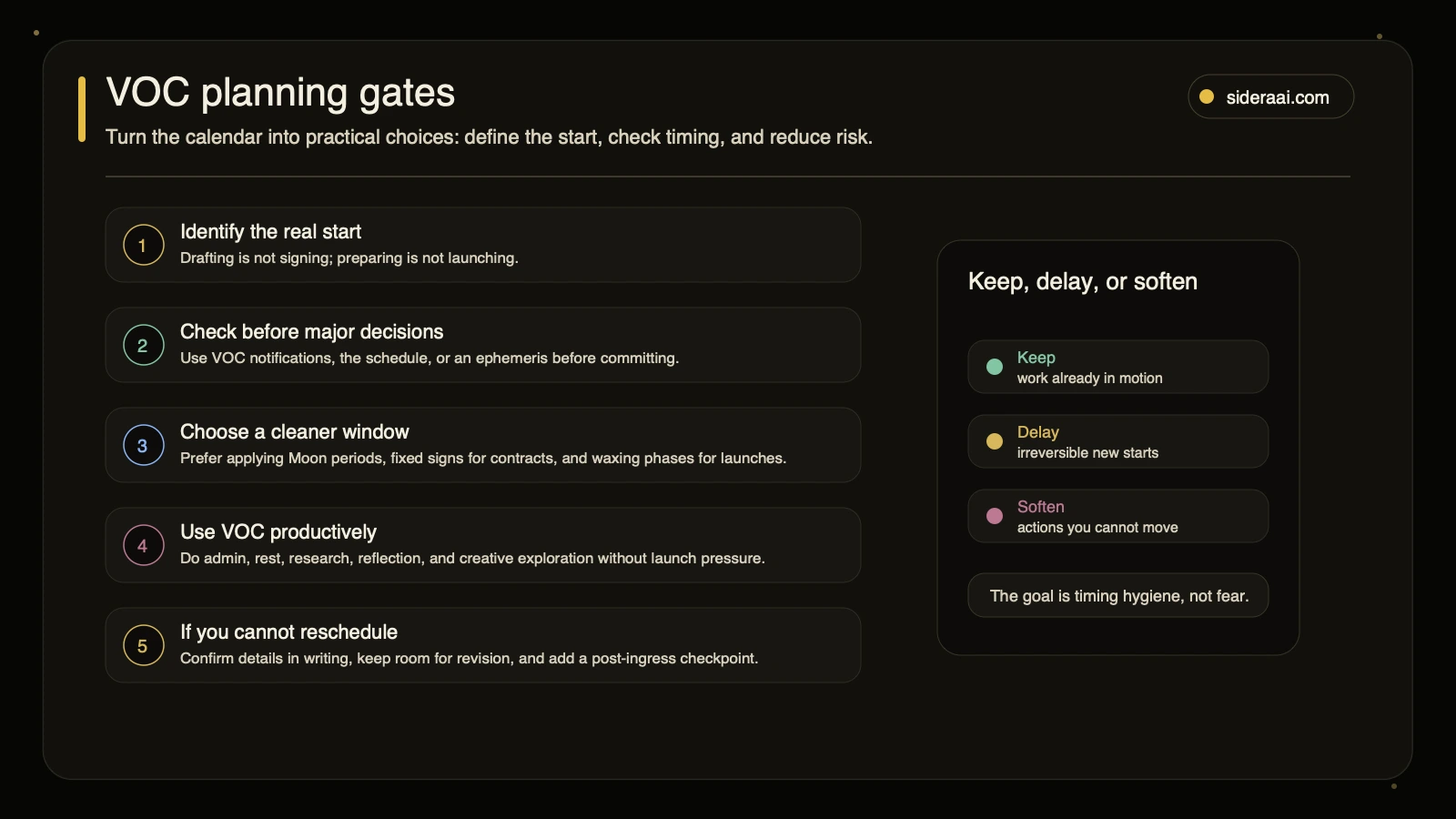
The planning gates turn VOC timing into a practical workflow: define the real start, choose a cleaner window when possible, and soften the risk when you cannot reschedule.
Plan your life around the stars, not just the calendar.
Start planning →Frequently Asked Questions
What does void of course moon mean?
The void of course moon is a period when the Moon makes no major aspects (conjunction, sextile, square, trine, or opposition) to other planets before changing zodiac signs. This creates an energetic “pause” that astrologers recommend for rest, review, routine tasks, and existing commitments rather than new ventures.
How long does a void of course moon last?
A void of course period can last only minutes or extend beyond a day. In Sidera’s complete 2027 calculation, 160 windows average 10 hours 15 minutes. The longest lasts 46 hours 56 minutes, from February 8 at 03:53 UTC through February 10 at 02:49 UTC. A different planet or aspect set can produce different durations.
Does void of course moon affect everyone?
The transit occurs at the same moment worldwide, but astrology has not established a measurable universal effect. In practical electional work, VOC is a rule about the start time of an activity. A personalized election still considers the natal chart, location-based houses, and other transits.
Can I go to a job interview during void of course moon?
Yes; Sidera’s job-interview model does not penalize or reject a date solely because the Moon is VOC. Treat the window as a caution rather than a veto. Ask clear questions about the role, team, and timeline, document next steps, and evaluate the full interview score before deciding whether a reschedule is worthwhile.
Is it bad to get married during void of course moon?
Traditional astrology advises against scheduling weddings during VOC periods. The concern is that the relationship may develop in unexpected ways or the marriage may face unusual challenges. However, if you’re already committed to a date, focus on the overall chart quality rather than VOC alone.
What happens if I sign a contract during void of course?
Contracts signed during VOC periods may need renegotiation or face unexpected complications. The terms might not hold as expected, or circumstances may change requiring amendments. It is not that the contract is “cursed” - just that outcomes tend to differ from initial expectations.
Does void of course moon affect sleep?
Some people report vivid dreams or restless sleep during VOC periods, though this isn’t universally documented. The VOC is better known for its effects on decision-making and new ventures rather than physical states like sleep.
How often does void of course moon happen?
The void of course moon occurs every 2-3 days on average. Under the definition used here, one VOC window precedes each Moon sign ingress. Sidera calculates 160 windows ending in 2027: 12-14 per month, or about 13.3 per month.
What’s the difference between void of course and retrograde?
Void of course is a short Moon interval that can last minutes or longer than a day; retrograde is an apparent reversal that lasts weeks or months depending on the planet. VOC concerns the Moon’s remaining aspects before ingress. Retrograde concerns a planet’s apparent direction of motion.
Can good things happen during void of course moon?
Yes - VOC periods are not “cursed” times. Unexpected positive outcomes are possible. The key understanding is that results may differ from intentions. Some astrologers even note that VOC is good for spiritual work, therapy, and activities where you want to release outcomes.
The Bottom Line
The void of course moon is a natural part of the lunar cycle that occurs every few days. The point is not to fear every gap in the calendar. It is to stop demanding certainty from a low-traction window.
Use VOC periods as:
- Times to pause before initiating new ventures
- Opportunities for rest and routine maintenance
- Moments for reflection rather than action
- Windows for completing (not starting) projects
By tracking the exact 2026–2027 VOC interval and applying the rule for your actual activity, you give binding choices a cleaner start without treating every interview, conversation, or routine task as forbidden.