
Venus in Sagittarius is love with the door open. This placement can feel like wanting devotion without enclosure: being sincerely attached, generous, and excited, while still feeling uneasy the second love starts to resemble a schedule, a surveillance system, or a small room.
In real life, this is the partner who books flights on impulse, argues philosophy at midnight, and loves you more for challenging their worldview than for agreeing with everything they say. It is also the person who may be fully in love and still need a separate life, private goals, honest conversation, and enough space to feel like the relationship is chosen rather than enforced.
Understanding Venus in Sagittarius means understanding what the placement is actually doing beneath the wanderlust: not running from love, but searching for a love large enough to hold an entire life of becoming. The challenge is that most relationships have walls, and walls are where this Venus starts to feel the pull of the horizon.
If you want to track how Venus transits are affecting you right now, check your Sagittarius daily horoscope for real-time updates.
Sidera uses your actual birth chart—not generic horoscopes.
Get personalized insights →What Venus in Sagittarius Actually Means
Venus governs what you love, how you attract, what you find beautiful, and how you navigate closeness. In Sagittarius, the sign of mutable fire and Jupiter’s domicile, Venus enters a register of expansion, directness, and philosophical hunger.
Dignity status: Peregrine. Venus in Sagittarius carries no major dignity or debility. It is neither exalted nor in detriment or fall here. Classical astrologer Claudius Ptolemy codified this dignity hierarchy in the Tetrabiblos (c.150 CE), establishing the framework that modern astrology still uses. What emerges in Sagittarius is pure, unadulterated fire-sign expression: the archetype operates at full volume with nothing to soften or amplify it.
Jupiter’s domain. Sagittarius is ruled by Jupiter, the planet Ptolemy termed the “greater benefic,” associated with expansion, abundance, wisdom, and faith. Where Venus in Virgo is filtered through Mercury’s precision and Venus in Leo is lit by the Sun’s need for recognition, Venus in Sagittarius is shaped by Jupiter’s instinct to grow. Love, for this placement, is an engine of expansion. The right partner makes you more, not less. Relationships are vehicles for becoming rather than destinations to arrive at.
As psychologist Liz Greene writes in Relating (1977):
“Fire Venus placements give warmth freely, but only to those who do not try to contain it. The moment the relationship becomes a cage, fire withdraws, not from malice but from suffocation.”
Mutable modality. Sagittarius is mutable fire. Mutable signs adapt; they resist fixed forms and remain open to revision. Combined with fire’s initiating energy, this creates a love nature that is simultaneously passionate and flexible, capable of deep enthusiasm that can also redirect when the direction stops feeling alive. The commitment question for Venus in Sagittarius is not whether love is real; it is whether the form the relationship takes allows enough oxygen for both people to breathe.
The core dynamic: Venus in Sagittarius loves through expansion. Its primary mode is generosity, in spirit, in gesture, in the way it brings the world to the people it loves. The challenge is that the same expansive instinct that makes this placement so vitalizing can also make containment feel like suffocation, and the relationship that needs too much routine, too much certainty, or too much proximity risks losing the Sagittarian heart to the open road.
Four Core Themes of Venus in Sagittarius
1. Love as Adventure: The Shared Expedition
Venus in Sagittarius does not fall in love with people so much as with experiences that include people. Attraction triggers when someone introduces a new idea, takes them somewhere unexpected, or reveals a perspective they have never encountered before.
Research supports this intuition. Arthur Aron’s landmark 2000 study in the Journal of Personality and Social Psychology demonstrated that couples who engaged in novel, challenging activities together experienced significantly higher relationship quality and rekindled attraction compared to couples who engaged in routine activities. Venus in Sagittarius instinctively structures love around this principle: shared growth equals sustained connection.
This creates a love style that feels thrillingly alive in its early stages. Venus in Sagittarius is generous, enthusiastic, and genuinely interested in whoever has caught their attention. They make you feel like the most fascinating person in the room because, in that moment, they mean it.
The expedition model of love has real gifts: this is the partner who pulls you out of your comfort zone, introduces you to experiences you would not have chosen alone, and refuses to let the relationship fossilize into routine. At its best, being loved by a Sagittarian Venus means your life gets bigger.
The shadow is sustainability. Adventures need destinations, and Venus in Sagittarius can struggle to remain as interested in the plateau as in the ascent. The question this placement must eventually answer is: can the ordinary life of an ongoing commitment also be an adventure, or does adventure require novelty?
2. Expansive Generosity: The Jupiter Gift
Jupiter is the planet of abundance, and it shapes Venus in Sagittarius into one of the most genuinely generous placements in the zodiac. This is not the calculated generosity of Venus in Capricorn, where gifts are given thoughtfully within appropriate limits. This is the instinctive, sometimes impractical generosity of a person who, when they love you, wants to give you everything, including things they perhaps cannot afford.
Grand gestures are natural. Declarations of feeling are made with full sincerity and full volume. “I love you” lands like a proclamation rather than a confession. There is something exhilarating about being loved by a placement that does not hedge.
The flip side of Jupiter’s abundance is the occasional failure to account for proportion. Venus in Sagittarius can over-promise, not from dishonesty but from the genuine belief, in the moment, that every promise is perfectly achievable. The mutable nature means circumstances will shift; the challenge is learning to make commitments that account for that reality.
3. Truth as Intimacy: The Direct Heart
Sagittarius is the sign associated with truth-seeking, higher knowledge, and the refusal to soften reality for the sake of comfort. Venus in this sign brings that directness into relationships.
This placement tells the truth. Sometimes before being asked. Sometimes before checking whether the truth is wanted. In a relationship culture that often prizes comfortable vagueness, Venus in Sagittarius reads as either refreshingly honest or uncomfortably blunt, depending on the recipient.
The deeper point is that honesty, for this placement, is a love language. Telling you the real answer, even the hard one, is how they demonstrate respect. Softening the truth, hedging, or performing an emotion they do not feel registers as a form of disrespect. They trust you enough to be honest with you, and they expect the same in return.
In relationships, this creates the possibility of unusual depth: the kind of connection built on the knowledge that what you are hearing is actually true. The risk is the delivery. Jupiter-ruled directness does not always pause to consider how the truth will land.
4. Freedom Within Love: The Space Requirement
The most well-known feature of Venus in Sagittarius is its relationship with freedom. This is a placement that requires space, literal and psychic, to function in love.
This is not commitment-phobia in the clinical sense. Venus in Sagittarius can commit, deeply and loyally, to a relationship that has the right architecture. What it cannot sustain is a relationship that requires constant proximity, constant check-ins, or the gradual abandonment of independent life in service of togetherness.
Self-Determination Theory (Deci & Ryan 2000, Psychological Inquiry) identifies autonomy as a core psychological need, alongside competence and relatedness. Long-term relationship satisfaction, across multiple meta-analyses, is predicted not by proximity but by autonomy support: the degree to which partners encourage each other’s independent goals, identity, and growth. Venus in Sagittarius operates from this framework instinctively.
The Sagittarian model of love is two people who each have a full life and choose, repeatedly, to share it rather than merge it. The partner who crowds this placement, who needs daily reassurance, who reads independence as withdrawal, will find Venus in Sagittarius increasingly restless.
When the architecture is right, when both people have their own ambitions, their own friendships, their own sense of direction, the loyalty of this placement is genuine and lasting. The keyword is meaning: Venus in Sagittarius stays where the meaning is.
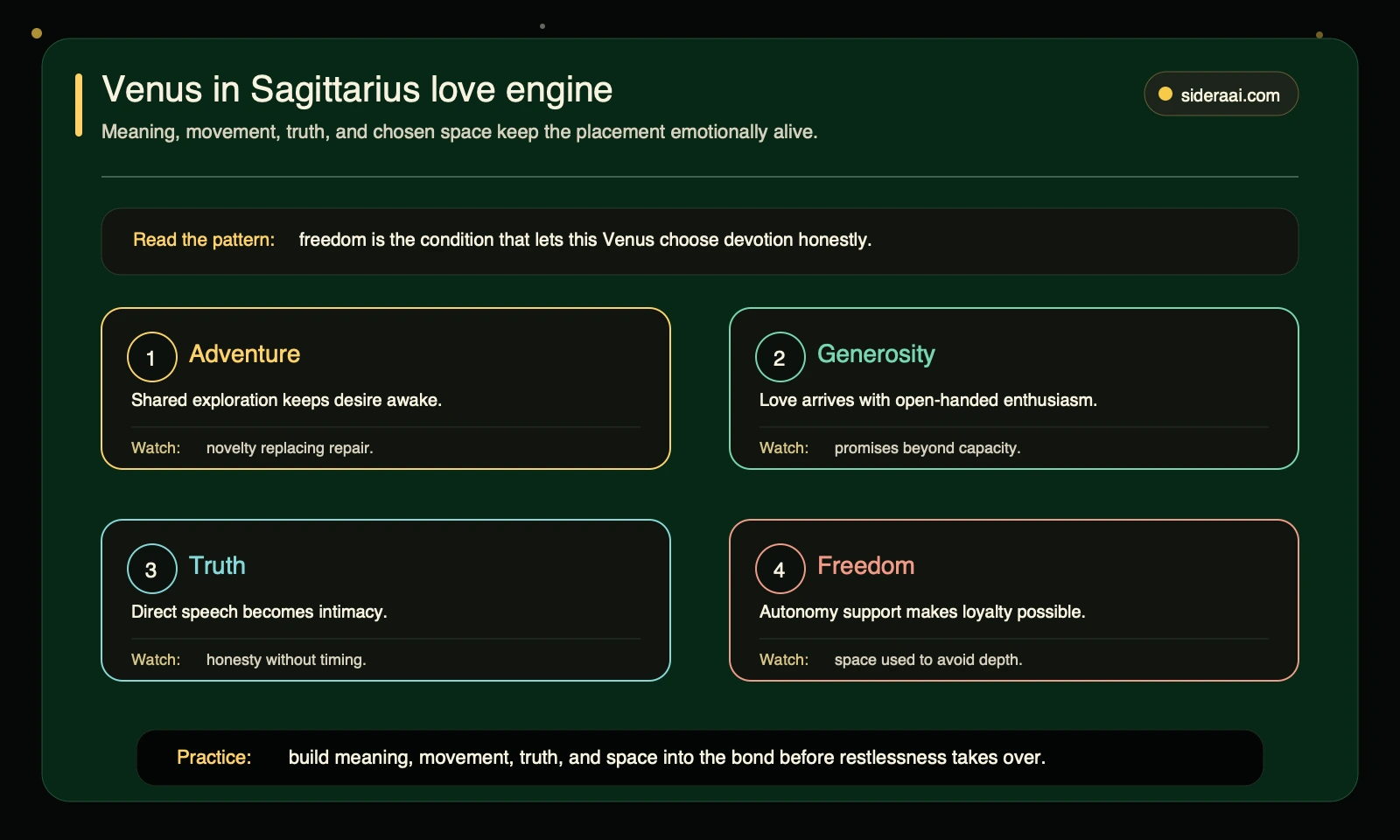
Read the four themes together: the placement is not avoiding love, it is testing whether love has enough room for meaning, movement, truth, and choice.
Understand your connections on a cosmic level.
Explore your bonds →Body Rulership: Sagittarius and Venus Retrograde
In traditional medical astrology (via William Lilly’s Christian Astrology (1647) and Nicholas Culpeper’s The English Physician (1652)), Sagittarius rules the thighs, hips, and sciatic nerve. Jupiter, its ruling planet, is associated with the liver and arterial blood flow.
For Venus in Sagittarius natives: Physical activity, especially movement involving the hips and legs (hiking, horseback riding, dance, travel), can feel like an emotional release. Sedentary lifestyles or relationships that curtail physical freedom may register as physical discomfort in these areas.
Venus Retrograde: Approximately 7-8% of people are born with Venus retrograde. If you have Venus retrograde in Sagittarius, the outward generosity and philosophical proclamation may turn inward: love becomes a private pilgrimage rather than a shared expedition, and the tendency to idealize or over-promise may be tempered by a more cautious internal process. Revisiting past relationships, themes of unresolved freedom-versus-commitment tension, or retrograde partners from earlier life chapters are common when transiting Venus stations retrograde in Sagittarius.
How Venus in Sagittarius Shows Up in Daily Life
In love: Venus in Sagittarius wants the relationship to keep opening new rooms. Attraction grows when there is shared learning, physical movement, humor, honesty, and the feeling that both people are becoming more alive together. It fades when the relationship becomes only maintenance, obligation, or emotional monitoring.
At work: This placement needs purpose as much as pleasure. It tends to do better in roles with learning curves, travel, teaching, publishing, strategy, coaching, entrepreneurship, or big-picture problem solving. Repetitive work can be tolerable if it serves a meaningful goal; repetitive work with no larger reason quickly becomes demoralizing.
In conflict: The shadow is not usually silence. It is speed. Venus in Sagittarius may blurt out the truth, argue from principle, or turn one concrete hurt into a debate about freedom, honesty, or what relationships “should” be. The growth move is to stay with the actual moment: what happened, what hurt, what needs to change.
In self-image: This Venus often needs to see itself as free, brave, generous, and open-minded. That can become a trap when admitting need, sadness, jealousy, or limitation feels like failure. The mature expression is not pretending to need nothing; it is telling the truth without making freedom the only acceptable identity.
Practical reflection: If you have Venus in Sagittarius, ask where you are genuinely outgrowing something and where you are using the idea of growth to avoid repair. If you love someone with this placement, ask whether you are requesting closeness or control. The answer changes the relationship.
Mutable Venus: How Sagittarius Compares to Gemini, Virgo, and Pisces
Mutable signs share adaptability, flexibility, and resistance to fixed forms. Venus in each mutable sign expresses love through change and fluidity, but with distinct flavors shaped by element and dignity.
| Dimension | Gemini (Air) | Virgo (Earth) | Sagittarius (Fire) | Pisces (Water) |
|---|---|---|---|---|
| Dignity | Peregrine | Fall | Peregrine | Exaltation |
| Core Drive | Intellectual curiosity | Precise improvement | Philosophical expansion | Boundless compassion |
| What Pulls | Conversation & variety | Acts of service & usefulness | Adventure & meaning | Emotional merging & transcendence |
| Attraction Speed | Fast (mind sparks) | Slow (observes before engaging) | Immediate (bold enthusiasm) | Gradual (osmotic absorption) |
| Love Language Given | Words & wit | Practical care & editing | Grand gestures & truth | Empathy & sacrifice |
| Under Boredom | Talks to anyone nearby | Critiques or withdraws | Leaves (literally or emotionally) | Escapes into fantasy |
| Depth Strategy | Intellectual intimacy | Precision attention to detail | Philosophical vulnerability | Soul-level dissolution |
| Core Shadow | Surfaces over depth | Perfectionist criticism | Over-promising restlessness | Martyrdom & boundary loss |
| Core Question | “Do you interest me?” | “Am I useful to you?” | “Are you growing me?” | “Can I dissolve into you?” |
Key Takeaway: Venus in Gemini loves through conversation, Venus in Virgo loves through service, Venus in Sagittarius loves through shared growth, and Venus in Pisces loves through surrender. All four resist stasis but for different reasons.
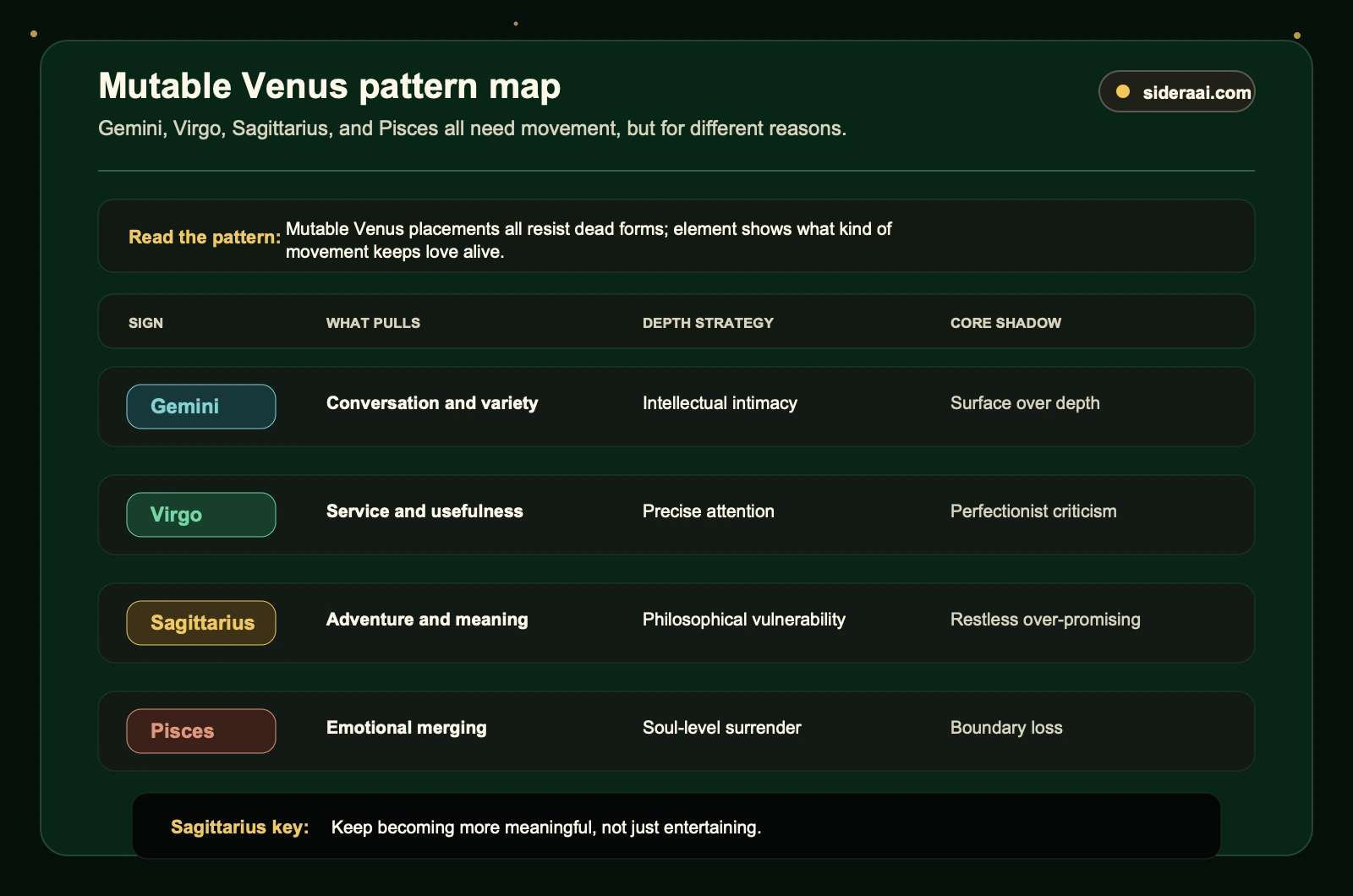
The mutable comparison shows why Sagittarius Venus needs meaning, not just novelty: each mutable sign resists stasis through a different element and shadow pattern.
For classical context on dignity and sign rulership, see Ptolemy’s Tetrabiblos via the Internet Sacred Text Archive, and for a broad reference on Sagittarius symbolism, the Encyclopaedia Britannica entry on Sagittarius provides the mythic background behind the sign’s centaur archetype.
The Sagittarius/Gemini Axis: Philosophy Meets Curiosity
Sagittarius and Gemini are the signs of mind: Gemini collects information, Sagittarius synthesizes it into meaning. The Sagittarius/Gemini opposition shapes Venus in Sagittarius by defining what it moves toward (philosophy, wisdom, the big picture, the foreign) and what it must integrate (the local, the specific, the present conversation in front of it).
In relationships, this axis shows up as the tension between the sweeping and the particular. Venus in Sagittarius is drawn to people who think, who question, who pursue ideas. The potential weakness is dismissing the immediate and concrete in pursuit of the universal. Partners with a strong Gemini signature may find common ground in shared intellectual curiosity while navigating the Sagittarius preference for meaning over information. If your partner has Gemini energy, their Gemini daily horoscope can reveal how transits are shifting the dynamic between you.
As astrologer Howard Sasportas writes in The Inner Planets (1992):
“Venus in Sagittarius seeks a philosophical quest through relationship. It is not content with surface exchange but needs the relationship to mean something, to contribute to a larger understanding of life, love, or purpose. The partner becomes a fellow traveler on the path rather than a destination.”
Find your perfect moment with AI-powered electional astrology.
Discover your timing →Venus in Sagittarius and the Nodal Axis
The North Node and South Node represent karmic direction: the South Node points to past-life patterns or early-life instincts we over-rely on; the North Node indicates the developmental edge we are learning to embody.
If you have North Node in Sagittarius: Venus in Sagittarius or any Sagittarian emphasis supports your soul’s growth trajectory. Your karmic task is to release Gemini’s information-collecting habit and cultivate Sagittarius’s meaning-making instinct. In love, this manifests as moving from curiosity-driven relationships (many short-term connections) toward philosophical partnerships that expand your worldview.
If you have South Node in Sagittarius: You may over-rely on the adventurous, freedom-seeking, philosophical instincts Venus in Sagittarius embodies. The growth edge points toward Gemini: grounding the expansive vision in immediate relationships, valuing the local and particular, and learning to stay present in ordinary conversations rather than always reaching for the horizon. In love, this means developing the skill of intimacy through everyday exchange, not just grand experiences.
If Venus conjuncts your North Node in Sagittarius: Love, beauty, and relationship are central to your soul’s evolution. You are learning to attract and give love through exploration, honesty, and the courage to stay only where meaning exists. Partners who value freedom, growth, and truth will activate your developmental path.
Venus in Sagittarius in Synastry
When Venus in one person’s chart interacts with planets in another’s chart, specific dynamics emerge. Here are six key Venus in Sagittarius synastry aspects:
1. Venus Conjunct Jupiter (either person’s Jupiter)
This is the classic “lucky in love” aspect. Venus in Sagittarius conjunct partner’s Jupiter amplifies generosity, optimism, and shared adventure. Both people feel expanded by the relationship. The challenge: over-promising or treating each other as idealized projections rather than real humans. Works best when both people have their own Jupiter transits or natal placements that support grounded optimism.
2. Venus in Sagittarius Opposite Partner’s Gemini Placements
Natural polarity attraction. The Gemini person provides variety and intellectual stimulation; the Sagittarius Venus person provides meaning and philosophical depth. If integrated well, this creates a complete axis: curiosity meets wisdom. If poorly integrated, the Sagittarius person may find the Gemini partner “shallow,” and the Gemini person may find Sagittarius “preachy.”
3. Venus Trine Fire Signs (Aries, Leo, Sagittarius)
Fire trine aspects are harmonious and energizing. Venus in Aries or Venus in Leo shares Sagittarius’s directness, enthusiasm, and need for independence. Relationships feel naturally supportive, passionate, and low-drama.
4. Venus Square Mutable Signs (Gemini, Virgo, Pisces)
Mutable squares create friction through competing adaptation strategies. Venus in Sagittarius square partner’s Pisces placements: philosophical expansion conflicts with emotional merging. Square Virgo: grand gestures conflict with precision care. Square Gemini: philosophy conflicts with information. These aspects require conscious integration but can produce dynamic, growth-oriented relationships when navigated well.
5. Venus Conjunct Partner’s Ascendant
When Venus in Sagittarius conjuncts the partner’s Ascendant, there is immediate physical and energetic attraction. The Ascendant person feels “seen” and valued for their authentic self-presentation. The Venus person finds the Ascendant person’s style, energy, and approach to life beautiful and magnetic. This aspect supports long-term compatibility if shared values align.
6. Venus Square Partner’s Saturn
Venus square Saturn is the classic “love feels like work” aspect. Venus in Sagittarius square partner’s Saturn in Pisces, Gemini, or Virgo creates tension between the Venus person’s need for freedom and the Saturn person’s need for structure, commitment, or boundaries. If the Saturn person is mature, this can stabilize the relationship; if immature, it feels like restriction. The Venus person must learn that commitment is not a cage if built with shared autonomy.
For a full breakdown of synastry dynamics, see our guide to synastry chart reading.
Sidereal vs Tropical: Venus in Dhanus Rashi
In Vedic (sidereal) astrology, Venus in Sagittarius is called Venus in Dhanus Rashi. Sagittarius (Dhanus) is ruled by Jupiter (Guru), and Jupiter is considered a natural friend to Venus (Shukra). This is a favorable placement in Vedic astrology for relationships, wealth, and artistic inclinations, especially when Jupiter is well-placed.
Key Vedic Concepts:
- Jupiter as Dispositor: Because Jupiter rules Sagittarius, the strength of Jupiter in the chart significantly impacts Venus’s expression. A strong Jupiter amplifies generosity and wisdom; a weak or afflicted Jupiter may lead to over-indulgence or lack of direction.
- Friendly Sign: Venus in Dhanus is in a “friendly” sign (not enemy, neutral, exalted, or debilitated), which supports harmonious expression but without the extreme amplification or restriction of exaltation/debility.
- Ninth House Association: Sagittarius is the natural ninth house (dharma, higher learning, long-distance travel). Venus here inclines toward relationships formed through travel, education, spiritual pursuits, or philosophical connection.
Tropical vs Sidereal Note: Due to precession of the equinoxes, the sidereal zodiac is approximately 24° behind the tropical zodiac as of 2026. Someone with Venus at 10° Sagittarius tropical may have Venus in late Scorpio sidereal. Always check both zodiacs if you practice Vedic astrology or want cross-system insight. For more on this distinction, see our article on sidereal vs tropical astrology.
What Venus in Sagittarius Is Not
Not shallow. The restlessness of Venus in Sagittarius is sometimes read as surface-level engagement, someone who dazzles and disappears. The reality is that this placement is searching for depth, not avoiding it. It moves on when depth is absent, not when depth is present.
Not incapable of commitment. Venus in Sagittarius can sustain long-term relationships with genuine loyalty. The condition is that the relationship must feel alive, growing, and meaningful. Commitment for its own sake, commitment as stasis, does not work. Commitment as ongoing choice, commitment as shared expedition, does.
Not dishonest about its needs. When Venus in Sagittarius says it needs space, it means space. This is not a test of whether you will hold on harder. The partner who hears “I need room to breathe” and responds by closing the distance will not get the outcome they want.
Working with Venus in Sagittarius
For people with this placement:
- The adventure does not have to be physical. Intellectual, philosophical, and spiritual growth can feed the Sagittarian hunger without requiring a passport.
- Naming the requirement for freedom explicitly, before it becomes a problem, is more effective than managing the fallout of unaddressed restlessness.
- The generosity instinct is genuine and valuable; pairing it with realistic promises rather than in-the-moment declarations protects both you and the people you love.
For people in relationship with this placement:
- Curiosity is more attractive than neediness. Bring your own ideas, your own life, your own direction.
- Trying to reduce the freedom requirement through reassurance rarely works. The architecture of mutual independence is what actually provides security.
- Trust the directness. When they tell you something, they mean it. When they stay, they are choosing to stay.
Venus in Sagittarius by Sun Sign
How Venus in Sagittarius expresses varies by the sun sign. The sun represents core identity and life direction; Venus in Sagittarius colors how that identity experiences attraction, beauty, and connection.
Aries Sun, Venus in Sagittarius
Double fire: bold, direct, fiercely independent. Love is an adventure entered headfirst. The Aries sun’s impatience meets Venus in Sagittarius’s philosophical wanderlust. This person attracts through courage and authenticity and commits only when the relationship feels like rocket fuel, not anchor. Challenge: balancing impulse with sustainable relationship architecture.
Taurus Sun, Venus in Sagittarius
Earthy sensuality meets fiery expansion. The Taurus sun craves stability; Venus in Sagittarius craves growth. Attraction forms around beauty, but this person needs a partner who values both grounded presence and exploratory freedom. At their best, they build stable lives that include regular doses of adventure. Challenge: reconciling the need for security with the hunger for novelty.
Gemini Sun, Venus in Sagittarius
Mutable double-whammy. The Gemini sun is curious; Venus in Sagittarius is philosophical. This combination produces someone who loves through conversation, questions everything, and attracts intellectually curious partners. Relationships thrive on variety and shared learning. Challenge: too much mental energy, not enough embodied intimacy.
Cancer Sun, Venus in Sagittarius
Water sun meets fire Venus: emotional depth combined with freedom-seeking love style. The Cancer sun needs emotional security; Venus in Sagittarius needs space. This person loves deeply but requires a partner who does not equate closeness with 24/7 availability. At their best, they create emotionally safe relationships with built-in room to roam. Challenge: managing the tension between security and independence.
Leo Sun, Venus in Sagittarius
Fire trine: magnanimous, generous, warm. The Leo sun radiates; Venus in Sagittarius expands. This person attracts through confidence and charisma and gives love generously. Relationships are grand, playful, and deeply loyal when shared values align. Challenge: over-promising or treating love as performance rather than presence.
Virgo Sun, Venus in Sagittarius
Earth sun meets fire Venus: precision meets philosophy. The Virgo sun analyzes; Venus in Sagittarius generalizes. Attraction forms around intellectual respect, but this person may oscillate between practical caution (Virgo) and impulsive adventure (Sagittarius). At their best, they bring grounded wisdom to relationships. Challenge: perfectionism (Virgo) conflicting with Sagittarius’s “good enough, let’s go” impulse.
Libra Sun, Venus in Sagittarius
Air sun meets fire Venus: social, curious, balanced. The Libra sun seeks partnership harmony; Venus in Sagittarius seeks growth. This person attracts through charm and open-mindedness and commits when the relationship supports mutual evolution. Challenge: Libra’s desire for equilibrium may clash with Sagittarius’s instinct to disrupt comfortable stasis.
Scorpio Sun, Venus in Sagittarius
Water sun meets fire Venus: intensity meets expansion. The Scorpio sun craves emotional depth and power; Venus in Sagittarius craves freedom and meaning. Attraction is magnetic but requires careful negotiation: Scorpio’s all-or-nothing intensity conflicts with Sagittarius’s need for space. At their best, they create transformative relationships built on radical honesty. For more on this dynamic, see Venus in Scorpio.
Sagittarius Sun, Venus in Sagittarius
Double Sagittarius: adventurous, philosophical, unapologetically honest. The sun and Venus align in the same sign, creating someone whose core identity and love nature are unified. This person loves through exploration and commits when the relationship is a shared quest. Challenge: the relentless hunger for meaning may leave little room for ordinary intimacy.
Capricorn Sun, Venus in Sagittarius
Earth sun meets fire Venus: ambition meets adventure. The Capricorn sun builds structures; Venus in Sagittarius resists them. Attraction forms around competence and shared goals, but this person requires a partner who respects their need for periodic escape from responsibility. At their best, they create stable lives with strategic windows for freedom.
Aquarius Sun, Venus in Sagittarius
Air sun meets fire Venus: intellectual, independent, unconventional. The Aquarius sun values ideas and community; Venus in Sagittarius values growth and truth. This combination produces someone who attracts through originality and commits when the relationship supports mutual autonomy. Both sun and Venus resist traditional relationship forms, so this person thrives in partnerships built on shared values rather than cultural scripts. For Aquarius dynamics, see Venus in Aquarius.
Pisces Sun, Venus in Sagittarius
Water sun meets fire Venus: spiritual meets philosophical. The Pisces sun dissolves boundaries; Venus in Sagittarius expands them. Attraction forms around shared ideals and spiritual or artistic pursuits. This person loves with compassion but requires a partner who does not mistake space for abandonment. Challenge: Pisces’s tendency toward merging conflicts with Sagittarius’s need for independence.
FAQ: Venus in Sagittarius
Is Venus in Sagittarius a good placement?
Venus in Sagittarius is peregrine (neutral dignity), meaning it operates without built-in amplification or restriction. Whether it is “good” depends on the rest of the chart and the person’s willingness to work with the placement’s needs. In relationships that value growth, freedom, and honesty, Venus in Sagittarius thrives. In relationships that require constant proximity or emotional predictability, it struggles. The placement itself is neither good nor bad; it is specific.
What attracts Venus in Sagittarius?
Curiosity, confidence, independence, and intellectual or philosophical engagement. Venus in Sagittarius is drawn to people who have their own life, their own ideas, and their own direction. Neediness, clinginess, or excessive routine repels this placement. Shared adventure, whether physical, intellectual, or spiritual, is the primary attractor.
Can Venus in Sagittarius be loyal?
Yes. Venus in Sagittarius is deeply loyal when the relationship feels meaningful, alive, and growth-oriented. The placement does not resist commitment per se; it resists stagnation. A relationship that allows room for both people to evolve and explore will earn lasting loyalty.
Does Venus in Sagittarius fear commitment?
Not inherently. What Venus in Sagittarius resists is commitment that feels like confinement. The placement will commit enthusiastically to a relationship structured around mutual autonomy, shared growth, and ongoing choice. It will resist or flee from commitment that requires merging, constant proximity, or abandoning independent goals.
What is the love language of Venus in Sagittarius?
Honesty and shared adventure. Telling the truth, even the uncomfortable truth, is how Venus in Sagittarius demonstrates respect and intimacy. Inviting someone into new experiences, ideas, or perspectives is how it demonstrates love. Grand gestures and philosophical conversations are secondary love languages.
What signs are compatible with Venus in Sagittarius?
Fire signs (Aries, Leo, Sagittarius) share directness and independence. Air signs (Gemini, Libra, Aquarius) provide intellectual stimulation and respect for freedom. Earth and water signs can work if they value growth and do not require constant emotional or physical availability.
How does Venus in Sagittarius show love?
Through generosity, enthusiasm, and inclusion in experiences. Venus in Sagittarius brings you into their world: introduces you to their ideas, their favorite places, their vision of the future. They show love by expanding your horizons, telling you the truth, and staying when they do not have to.
Final Thoughts
Venus in Sagittarius is the placement of the seeker, the philosopher, the partner who loves not by clinging but by choosing, again and again, to show up. It is not for everyone. The person who needs daily reassurance, who equates love with constancy of proximity, who wants a relationship that feels like arrival rather than journey, will struggle with this placement.
But for the person who values growth, who wants a partner rather than a possession, who believes that love is most real when it is freely given, Venus in Sagittarius offers something rare: a love that expands rather than contains, that asks big questions rather than settling for comfortable answers, that stays because it wants to, not because it has to.
If you have this placement, your challenge is to honor the freedom requirement without using it as an excuse to avoid depth. If you love someone with this placement, your challenge is to build a relationship architecture that allows independence without mistaking space for distance.
The right relationship for Venus in Sagittarius is not one that holds tight. It is one that holds space.
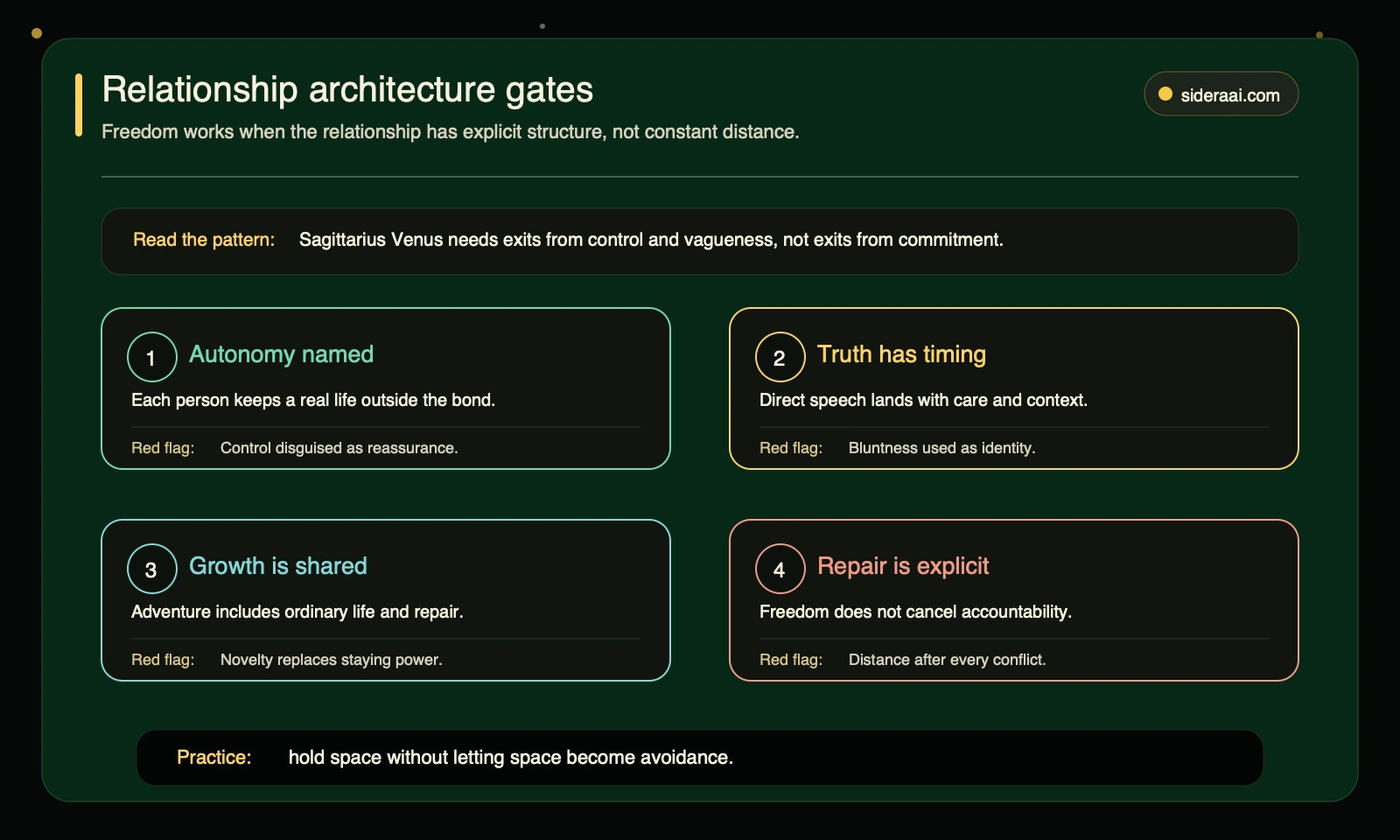
The mature version is not fewer commitments. It is a relationship design where autonomy, honest speech, shared growth, and repair all have a named place.
Calculate your Venus sign and explore your full birth chart with Sidera’s birth chart calculator.