A Vedic astrology calculator is useful only if it helps you move from chart data to recognition: why one emotion repeats, why certain relationships activate the same response, why a career season feels delayed or urgent, and which timing cycle you are actually living through.
Technically, it generates your complete Jyotish birth chart by mapping the Sun, Moon, and planets at the moment of your birth using the sidereal zodiac. Practically, a good calculator gives you the pieces that make a chart feel personal: your lagna, Moon sign, nakshatra, dasha sequence, house placements, and divisional charts.
If your Western zodiac sign never fully explained your inner life, the Vedic chart can feel like a sharper mirror. Most people see at least some placements shift because Vedic astrology uses a different astronomical framework. The point is not to collect new labels. It is to read the chart in a way that describes real behavior.
Ready to See Your Personal Birth Chart?
Discover your unique cosmic blueprint — planets, houses, and aspects personalized to your exact birth time and location.
Get Your Birth Chart →✓ Birth chart analysis ✓ Personalized insights ✓ Free to use
How a Vedic Chart Becomes Useful in Real Life
Do not stop at the first keyword a calculator gives you. A label like “Moon in Scorpio,” “Saturn in the 10th,” or “Rahu dasha” only matters when you can connect it to lived behavior.
Use the output like this:
- Love: Start with the Moon, 7th house, Venus, and Navamsa. Look for how you seek safety, what you expect from commitment, and what conflict style appears when you feel unseen.
- Work: Read the lagna, 10th house, Saturn, Sun, and Dashamsa. Ask where discipline pays off, where authority feels loaded, and whether your current dasha explains a season of pressure or visibility.
- Conflict: Watch Mars, Saturn, Rahu, and the 6th or 8th house. These often show whether you push, freeze, control, withdraw, over-explain, or keep choosing familiar tension because it feels safer than uncertainty.
- Self-image: Read the lagna, Moon, and Sun together. The gap between how you appear, how you regulate emotion, and how you want to be recognized is often where the chart starts to feel personally accurate.
A strong interpretation should make you think, “Yes, that is the pattern.” If all you get is a list of flattering traits, keep reading before you trust the answer.
What Makes a Vedic Astrology Calculator Different
The most immediate difference is the zodiac. Vedic astrology uses the sidereal zodiac, calibrated to the actual positions of constellations in space. Western astrology uses the tropical zodiac, anchored to Earth’s seasonal cycle rather than stellar positions. For a deeper comparison of both systems, see our guide to sidereal vs tropical astrology.
Due to a slow wobble in Earth’s axis called the precession of the equinoxes, moving at roughly one degree every 72 years, the two systems currently diverge by approximately 24 degrees. A correction factor called the ayanamsa bridges this gap. Most Vedic calculators default to the Lahiri ayanamsa, adopted as India’s official astronomical standard in 1955, though Krishnamurti and Raman ayanamsas serve specific schools of Jyotish practice.
The practical result: your planetary positions shift backward by roughly one sign compared to your Western chart. This is not an error. It is a different astronomical framework entirely.
Beyond the zodiac, a Vedic calculator includes elements absent from most Western tools:
- 27 Nakshatras: lunar mansions dividing the ecliptic into segments of 13°20’ each, giving far more granular placements than 12 signs alone
- Vimshottari Dasha: a 120-year planetary period sequence indicating which planet governs each life phase
- Divisional charts (Vargas): additional charts that zoom in on specific life domains
- Whole Sign house system: a classical house calculation where the rising sign becomes the entire first house
This is why a useful Vedic calculator should not stop at sign positions. It should show enough context to explain both pattern and timing: what the placement describes, where it acts through the houses, and which planetary period is currently emphasized.
How to Use a Vedic Astrology Calculator
To generate an accurate Vedic birth chart, you need three inputs:
Birth date: Day, month, and year.
Exact birth time: Vedic astrology places enormous emphasis on time accuracy. The ascendant (lagna) changes roughly every two hours. A thirty-minute error can shift your rising sign and reorder all twelve houses. Your birth certificate is the most reliable source. If unknown, a Vedic practitioner can use chart rectification techniques to estimate it.
Birth location: City and country, used to determine your ascendant and house positions. Two people born at the same clock time in different cities will have different rising signs due to differences in local astronomical coordinates.
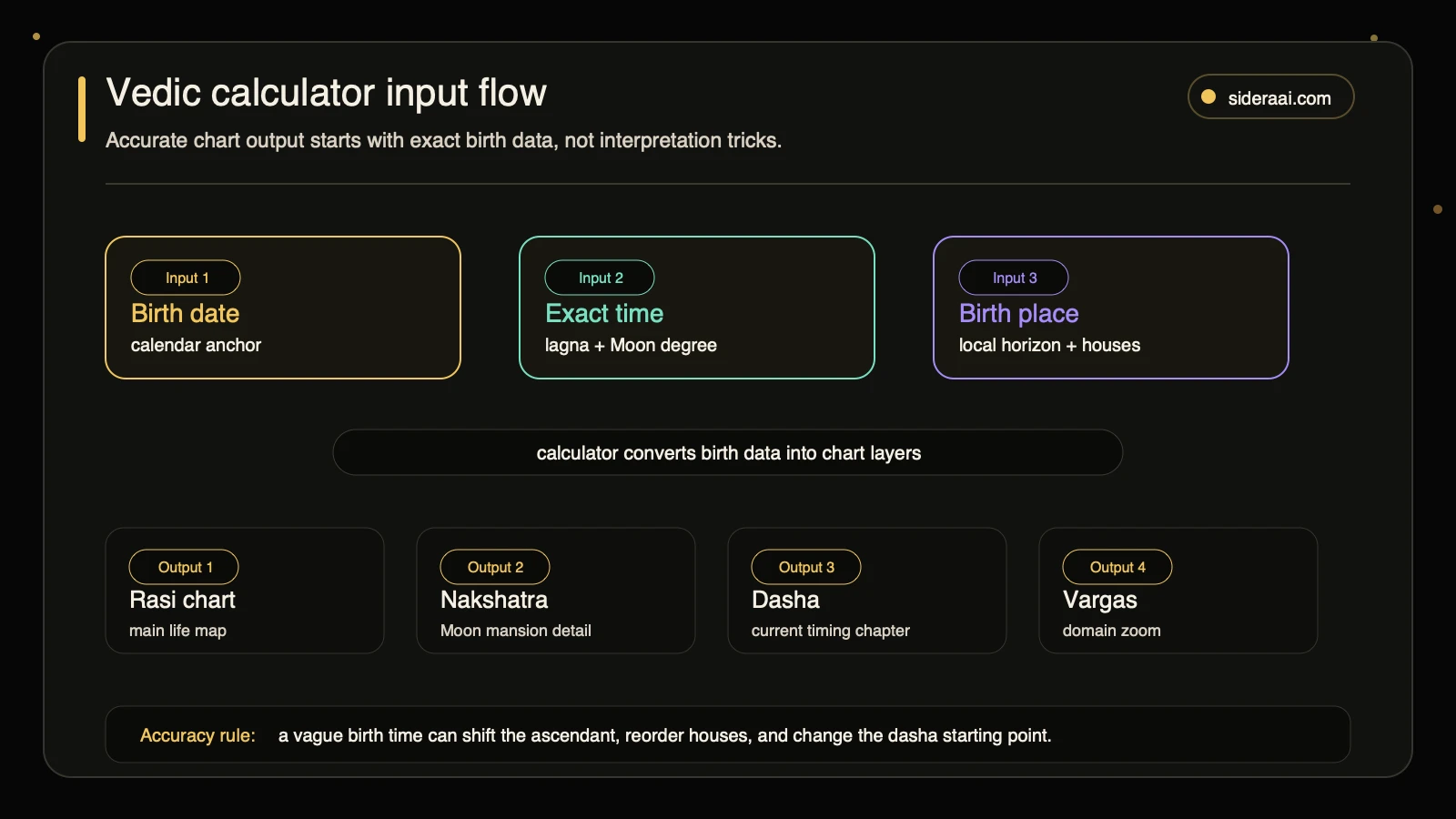
The input flow shows why exact birth data matters before interpretation: date, time, and place determine the chart layers that make Vedic astrology useful.
Once you enter this data, the calculator generates your Rasi chart (the main birth chart), typically displayed in North Indian or South Indian square format. Both formats look very different from the circular wheel of Western astrology.
North Indian vs South Indian Chart Formats
North Indian format arranges houses in a diamond pattern, with the lagna (ascendant) always placed in the top-center position. Signs move clockwise. This format is standard across northern India and is what many online calculators default to.
South Indian format arranges signs in a fixed grid left to right, with Aries always in the top-left square, and the lagna marked by a diagonal line. Planets shift position based on the native’s ascendant sign. This format is common in Tamil Nadu, Kerala, and other southern states.
Both formats carry identical information. The choice is regional preference and readability.
Sidera uses your actual birth chart—not generic horoscopes.
Get personalized insights →Reading Your Vedic Chart Output
Your Lagna (Ascendant): The sign rising on the eastern horizon at your birth. In Vedic astrology, the lagna is considered the most important point in the chart, more central than the Sun sign. The entire house system builds outward from it. For more on rising sign interpretation, see our guide to rising sign meaning.
Your Vedic Moon Sign: Vedic astrology treats the Moon as the primary personality indicator, more important than the Sun for understanding emotional makeup, habitual thought patterns, and instinctive reactions. Explore all 12 Moon signs in our Moon signs explained guide, or use the Moon sign calculator to confirm yours.
Your Vedic Sun Sign: Your solar placement in the sidereal zodiac. This will often differ from your Western Sun sign. For Western tropical Sun sign interpretations, our Sun sign articles cover all 12 signs with birth chart context.
Your Nakshatra: The lunar mansion your Moon occupied at birth. There are 27 nakshatras, each spanning exactly 13°20’ of the zodiac. Your nakshatra reveals a more granular picture of your Moon’s expression, including a ruling planet (the nakshatra lord) that influences your default energetic style. Two people with the same Vedic Moon sign may express it very differently depending on their nakshatra.
Planetary dignities: Vedic astrology uses a specific system of exaltation, debilitation, and own-sign placements for all 9 classical planets (Sun, Moon, Mars, Mercury, Jupiter, Venus, Saturn, Rahu, Ketu). A planet in exaltation performs at its highest; in debilitation, it struggles. These dignities carry a much stronger role in Vedic chart reading than in most Western approaches. See our planets in astrology guide for foundational planetary meanings.
Do not read these as separate labels. A useful first pass connects them: Moon sign for emotional baseline, lagna for how life meets you, dasha for the chapter you are in now, and houses for where the pattern becomes visible. If a calculator cannot help you connect those dots, it is giving data, not guidance.
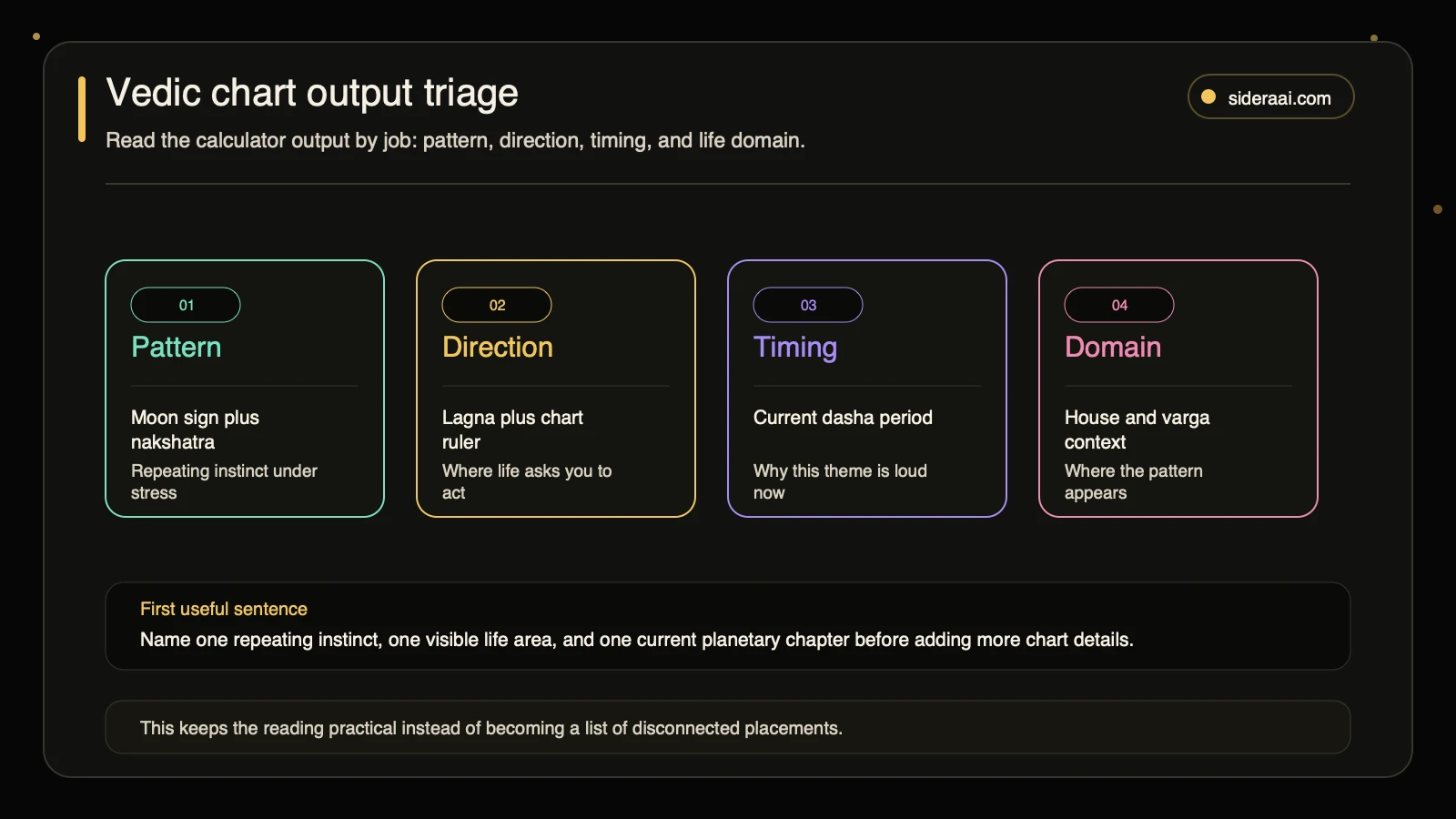
Use the triage map to turn calculator output into a first useful sentence: one instinct, one life area, and one current planetary chapter before adding more details.
The Dasha System: Vedic Timing at Its Best
One of Jyotish’s most respected contributions to astrological practice is the Vimshottari Dasha: a 120-year planetary period cycle that assigns each person a personalized sequence of ruling planets governing successive life phases.
The full cycle: Sun (6 years), Moon (10 years), Mars (7 years), Rahu (18 years), Jupiter (16 years), Saturn (19 years), Mercury (17 years), Ketu (7 years), Venus (20 years). Total: 120 years.
Your entry point in this cycle is determined by your Moon’s nakshatra at birth. If your Moon occupies Rohini nakshatra, you begin in the Moon dasha. From there, the sequence unfolds in fixed order regardless of where you start.
Practically, this means dasha timing starts from your birth-specific Moon degree rather than a calendar date shared by everyone with the same sign. Two people with the same Vedic Moon sign can be in very different life chapters if their nakshatras and dasha balances differ.
Vedic practitioners use dashas to time major life events with a specificity that generic Sun-sign forecasting cannot approach. A Jupiter dasha often correlates with expansion, opportunity, and prosperity. A Saturn dasha tends to bring discipline, hard work, and structural change. A Rahu dasha frequently brings sudden shifts, unconventional choices, and an intense focus on ambition. These are not vague planetary moods applied to everyone; they are personalized periods calculated from your specific Moon placement.
In real life, a dasha often feels less like a prediction and more like a repeated question. Saturn may keep asking whether you will choose structure over avoidance. Rahu may magnify ambition, comparison, or the urge to break from the expected path. Venus may bring relationships, pleasure, values, and attachment patterns into sharper focus. The practical value is not fatalism; it is context for the decisions already in front of you.
Each major dasha also subdivides into Antardashas (sub-periods) of shorter duration, allowing timing down to a period of months rather than years. This layered timing system is why many find Vedic astrology more practically useful for forecasting than Western methods.
For a related application of planetary timing, see our guide to Jupiter transit timing and wealth and the Saturn return career guide.
Find your perfect moment with AI-powered electional astrology.
Discover your timing →Divisional Charts (Vargas): Zooming In
One feature distinguishing a comprehensive Vedic calculator from a basic one is divisional chart generation. The main Rasi chart shows overall life themes. Vargas zoom in on specific domains:
- Navamsa (D9): The most important divisional chart. Reveals marriage and partner qualities, and shows how each planet tends to mature over time. Serious Vedic practitioners read the Navamsa alongside every Rasi chart.
- Dashamsa (D10): Career, public life, and professional reputation
- Saptamsa (D7): Children and creativity
- Dwadashamsa (D12): Parents and heredity
- Shodashamsa (D16): Vehicles and property
If a planet appears weak in the Rasi chart but gains strength in the Navamsa, Vedic astrology considers it functionally stronger than it first appears. This refinement system has no direct equivalent in Western chart interpretation.
For more on how Western astrology reads planetary relationships, our aspects guide covers conjunctions, squares, trines, and oppositions in depth.
Vedic Houses (Bhavas): The Twelve Life Domains
Vedic astrology traditionally uses the Whole Sign house system. Your rising sign becomes the entire first house. The second sign from your lagna becomes the second house, and so on. This differs from the Placidus or Koch systems common in Western astrology, where houses can vary widely in size.
Each bhava governs specific life domains:
| House | Sanskrit | Governs |
|---|---|---|
| 1st | Lagna | Self, body, overall life direction |
| 2nd | Dhana | Wealth, family, speech |
| 3rd | Sahaja | Siblings, courage, communication |
| 4th | Sukha | Home, mother, emotional security |
| 5th | Putra | Children, creativity, intelligence |
| 6th | Ripu | Health, debts, service, enemies |
| 7th | Kalatra | Marriage, partnerships |
| 8th | Mrityu | Transformation, inheritance, longevity |
| 9th | Dharma | Luck, father, higher education |
| 10th | Karma | Career, reputation, authority |
| 11th | Labha | Income, gains, aspirations |
| 12th | Vyaya | Liberation, foreign lands, expenses |
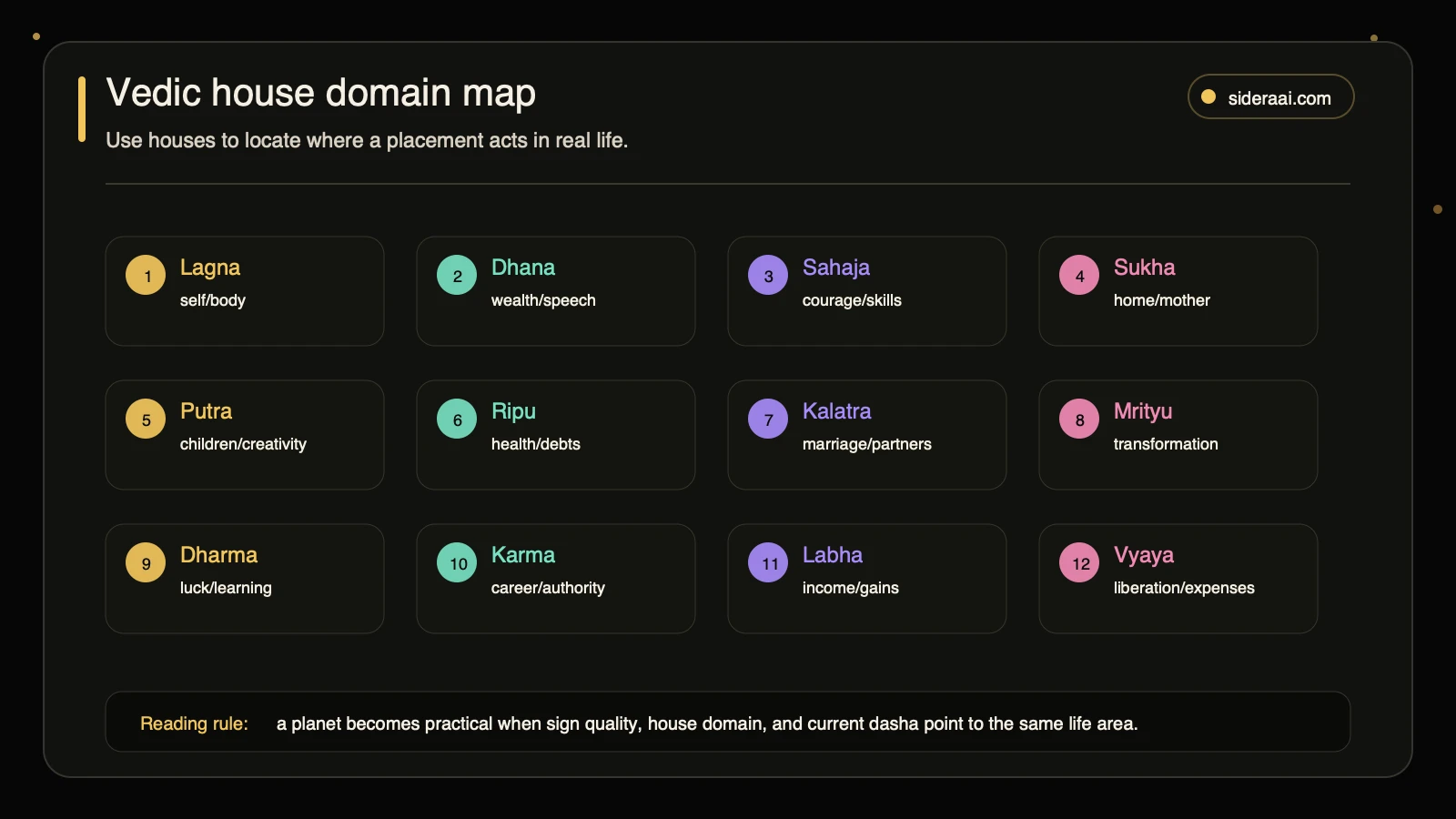
The house map keeps the reading grounded: a placement becomes practical when its sign quality, house domain, and current dasha point to the same life area.
Angular houses (1st, 4th, 7th, 10th), called kendras in Sanskrit, are considered the most active positions. Planets placed here have the greatest capacity to manifest in the outer life. For a Western perspective on house meanings, see our full astrology houses guide.
What to Do With Your Vedic Chart
A Vedic astrology calculator gives you raw data. To turn it into insight, read it in an order that separates emotional pattern, life direction, and timing:
Start with your Moon sign, not your Sun sign. Ask what you do automatically when you need safety. The sign gives the emotional style, the nakshatra shows the instinctive response, and the Moon’s dignity shows whether that response tends to flow easily or come out under pressure.
Use the lagna to ground the reading in behavior. The ascendant is not just “how you look.” It describes the body, first reactions, and the way life keeps asking you to participate. Compare it with your Moon sign: the difference between the two often explains why you seem capable on the outside while feeling very different internally.
Check your current dasha period. Knowing which planet is actively governing your life right now gives you a frame for why certain themes feel loud. Running a Rahu dasha may describe restlessness or reinvention. Saturn dasha may describe the season where shortcuts stop working. Jupiter dasha may make growth easier, but still asks what you are mature enough to steward.
Note planets in angular houses (1st, 4th, 7th, 10th). These are your most active, visible placements. They often show the patterns other people notice first: how you lead, protect, commit, work, compete, or take responsibility.
Read your Navamsa alongside your Rasi chart. This is especially useful for relationships and long-term maturity. If a planet looks strong in the Rasi chart but weaker in the Navamsa, the outer promise may require more inner work. If it strengthens in the Navamsa, the placement may become more reliable with age and practice.
For reflection, write one sentence for each core placement: “When this is healthy, I…” and “When this is stressed, I…” That turns the chart from information into a practical mirror.
For foundational Western chart-reading skills that complement Vedic study, see our beginner’s guide to reading a birth chart and the birth chart calculator guide.
For a complete natal chart interpretation blending Western and Vedic insights, explore our natal chart reading guide.
Plan your life around the stars, not just the calendar.
Start planning →Is Vedic Astrology More Accurate Than Western Astrology?
This is the most commonly asked question, and the honest answer is: it depends on what you are trying to do.
Vedic astrology tends to outperform Western approaches in event timing. The dasha system gives Jyotish practitioners a precision timing tool that most Western methods lack. Practitioners who work with dashas and transits together can often identify windows for major life events (marriages, career shifts, relocations) with surprising accuracy.
Western astrology tends to be stronger for psychological depth. Modern Western astrology, particularly through the influence of Liz Greene and other depth-psychology practitioners, has developed rich frameworks for understanding unconscious patterns, shadow material, and inner development that classical Jyotish does not emphasize in the same way.
Neither system is superior. They ask different questions and use different tools. Many serious practitioners study both. Our sidereal astrology calculator guide explores this comparison in more depth.
For personalized daily horoscopes using the Western tropical system, every zodiac sign has its own guide: Aries · Taurus · Gemini · Cancer · Leo · Virgo · Libra · Scorpio · Sagittarius · Capricorn · Aquarius · Pisces
Frequently Asked Questions
What is the difference between Vedic and Western astrology?
The primary differences are the zodiac used and the focus of interpretation. Vedic astrology uses the sidereal zodiac (aligned to actual star positions), while Western uses the tropical zodiac (aligned to seasons). Vedic astrology emphasizes the Moon sign, nakshatras, and dasha timing. Western astrology emphasizes psychological interpretation and outer planet transits. Planetary positions typically differ by about 24 degrees, causing most Sun signs to shift one sign backward in the Vedic system.
Is my Vedic Sun sign different from my Western Sun sign?
For most people, yes. The approximately 24-degree ayanamsa offset means that roughly 70% of people find their Vedic Sun sign is one sign behind their Western Sun sign. If your Western Sun is early in a sign (within the first 24 degrees), you are particularly likely to have a different Vedic Sun sign. Those born in the last degrees of a sign are most likely to remain in the same sign under both systems.
What is a nakshatra in Vedic astrology?
A nakshatra is one of 27 lunar mansions dividing the 360-degree ecliptic into equal segments of 13°20’ each. Your birth nakshatra is determined by your Moon’s position at birth. Each nakshatra has a ruling planet (called the nakshatra lord), a presiding deity, and a distinct set of qualities that modify how your Moon sign expresses itself. Nakshatras also determine your starting point in the Vimshottari dasha system.
What is the Vimshottari dasha and why does it matter?
The Vimshottari dasha is a 120-year planetary period system used in Vedic astrology to time major life events. Each planet governs a period of several years: Venus rules 20 years, Saturn 19 years, Rahu 18 years, Mercury 17 years, Jupiter 16 years, and so on. Your birth nakshatra determines which dasha you began life in. During each planetary period, the themes associated with that planet tend to dominate life circumstances. This timing system is considered one of Vedic astrology’s most practically useful tools.
What is the difference between the Rasi chart and the Navamsa chart?
The Rasi chart (D1) is the main birth chart showing planetary positions in signs and houses. The Navamsa (D9) is a divisional chart created by dividing each sign into 9 equal parts. The Navamsa adds context for marriage, long-term maturity, and whether planets that appear strong in the Rasi chart actually deliver their promise in lived experience. Vedic astrologers almost always read both charts together.
How accurate does my birth time need to be for a Vedic chart?
As accurate as possible, ideally within five to ten minutes. The ascendant (lagna) changes approximately every two hours, so a large time error can shift your rising sign and reorder all twelve houses. More importantly, the dasha calculation depends on your Moon’s exact degree within its nakshatra, which shifts every few hours. Birth certificates are the most reliable source. If your birth time is unknown, ask a Vedic practitioner about chart rectification.
What is the ayanamsa in Vedic astrology?
The ayanamsa is the degree of angular difference between the tropical zodiac (used in Western astrology) and the sidereal zodiac (used in Vedic astrology) at any given point in time. Due to Earth’s axial precession, the two zodiacs drift apart at roughly one degree per 72 years. The current difference is approximately 24 degrees. Most Vedic calculators default to the Lahiri ayanamsa, though Krishnamurti (KP system) and Raman ayanamsas are also in use.
Can I use a Vedic astrology calculator without knowing astrology?
Yes, to a degree. A good calculator generates readable output: your rising sign, Moon sign, Sun sign, nakshatra, and current dasha period. These four data points alone provide significant insight without deep technical knowledge. To interpret planetary dignities, divisional charts, and aspect relationships (called yogas), you will need either study or a consultation with a Jyotish practitioner. Our birth chart reading guide offers foundational chart-reading skills applicable to both systems.