Most people meet their South Node when life stops going smoothly. It is the version of you that knows exactly what to do when you feel exposed: shut down, over-explain, control, perform, rescue, disappear, prove yourself, or keep the peace.
That behavior may be genuinely skilled. The problem is that it can make love, work, conflict, and self-image feel like reruns. The South Node shows the pattern you use to feel safe, especially when the situation is asking for a less automatic response.
Ready to See Your Personal Birth Chart?
Discover your unique cosmic blueprint — planets, houses, and aspects personalized to your exact birth time and location.
Get Your Birth Chart →✓ Birth chart analysis ✓ Personalized insights ✓ Free to use
What Is the South Node in Astrology?
The South Node (also called the Descending Node or Dragon’s Tail) is the point in your birth chart where the Moon crossed below the ecliptic (the Sun’s apparent path) at your birth. It sits exactly opposite the North Node, forming an axis that spans your chart.
In western astrology, this axis carries one of the most layered meanings in chart interpretation: the South Node represents where you come from; the North Node represents where you’re headed.
If the North Node is the direction your soul intends to grow in this lifetime, the South Node is the accumulated wisdom, talent, and default behavior pattern you brought with you. It is not a bad placement. But it is a comfort zone, and comfort zones have a way of becoming cages.
The nodal cycle completes every 18.6 years, which means you share your South Node sign with everyone born within roughly 18 months of you. The house position, however, is personal: it shifts every two hours with the Ascendant and defines exactly where those collective patterns play out in your individual life.
South Node vs North Node: The Core Tension
The nodal axis works as a unit. You cannot fully understand the South Node without its opposite:
| South Node | North Node |
|---|---|
| Past patterns, defaults | Growth edge, new territory |
| Unconscious strengths | Conscious learning curve |
| Where you retreat under stress | Where you’re called toward |
| Can become a trap | Can feel uncomfortable but rewarding |
| The old story | The new chapter |
The South Node is not “bad karma” to be punished for. It is highly developed energy, often your strongest natural skill set. The challenge is that you’ve already mastered this ground. Your chart is asking for a different response, and the South Node keeps pulling you back to familiar terrain when things get hard.
Astrologers often describe the South Node as already-learned material: the place you reach for under pressure because it feels reliable, even when it no longer moves your life forward.
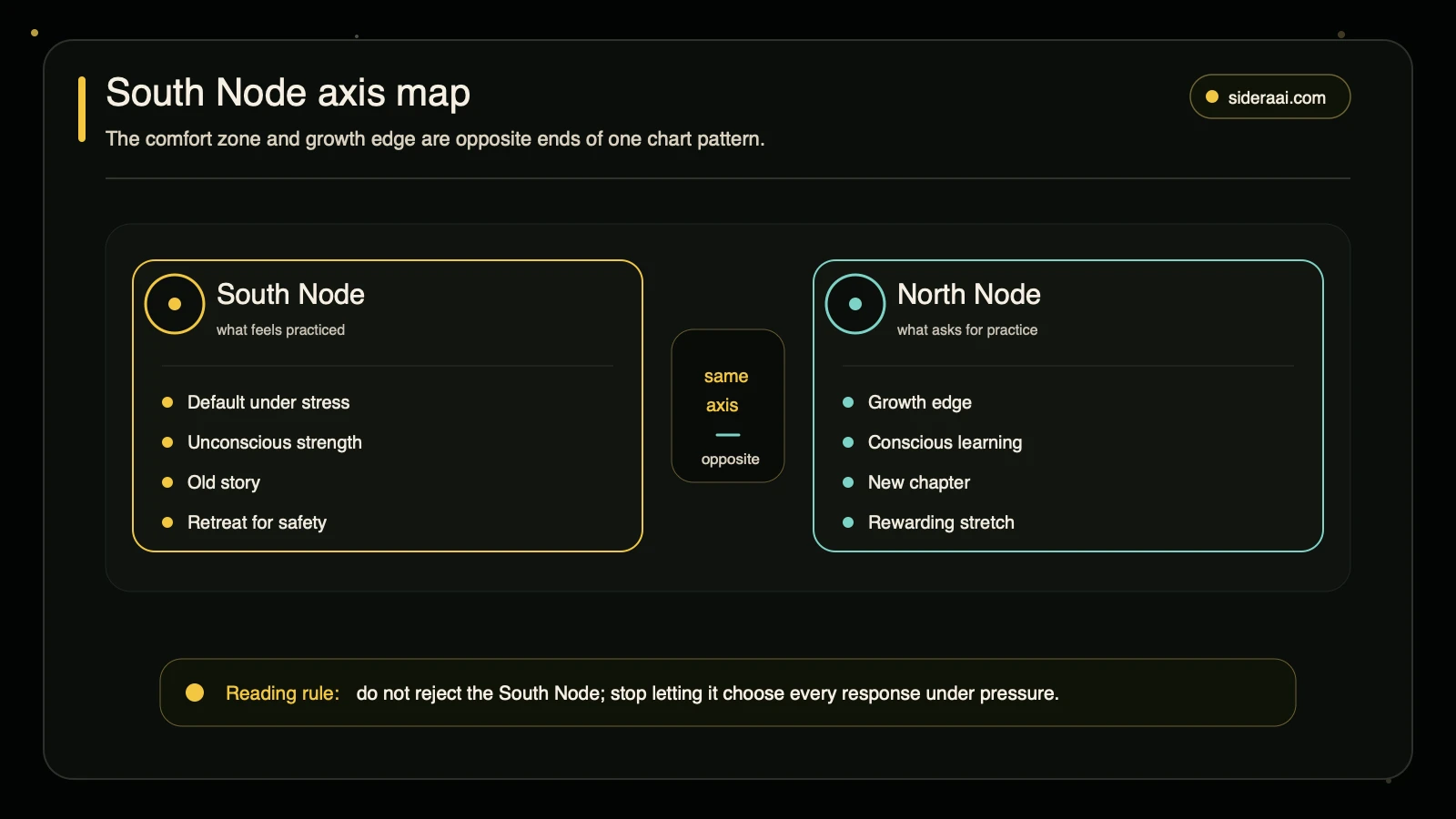
Use the axis map to read the South Node as a practiced skill that needs conscious direction toward the North Node, not as something to reject.
South Node in Each Sign
The South Node sign reveals the emotional and behavioral patterns that come most naturally, often automatically. Read these less like fixed personality traits and more like stress behaviors: what you do when you want control, safety, approval, distance, or certainty.
South Node in Aries
The old reflex is to handle everything yourself. In love, you may act independent even when you want support; at work, you may take over because waiting for consensus feels unbearable; in conflict, you can treat disagreement like a contest. The growth call is toward Libra: relationship, negotiation, and shared decisions.
South Node in Taurus
The old reflex is to stabilize first and question later. In relationships, this can look like staying because it is familiar; at work, clinging to a role, income pattern, or routine long after it has gone stale; in conflict, refusing to move because movement feels unsafe. The growth call is toward Scorpio: release, depth, and transformation.
South Node in Gemini
The old reflex is to explain, compare, and gather one more piece of information. In love, you may talk around the feeling instead of naming it; at work, you can scatter attention across too many options; in conflict, you may debate details to avoid a larger truth. The growth call is toward Sagittarius: philosophy, wisdom, and meaning.
South Node in Cancer
The old reflex is to protect, nurture, or retreat into what feels emotionally known. In love, you may parent a partner or expect them to read your needs; at work, you may avoid visibility because emotional safety feels more important; in conflict, you can become indirect or self-protective. The growth call is toward Capricorn: structure, achievement, and self-reliance.
South Node in Leo
The old reflex is to perform your way back into worth. In love, you may need to feel chosen or admired; at work, you may over-identify with being the visible leader; in conflict, you can make the issue about pride instead of the actual problem. The growth call is toward Aquarius: group contribution, objectivity, and shared vision.
South Node in Virgo
The old reflex is to fix, improve, and find what is wrong. In love, you may become useful instead of vulnerable; at work, you can over-function because competence feels like safety; in conflict, criticism may replace tenderness. The growth call is toward Pisces: faith, surrender, and compassion without conditions.
South Node in Libra
The old reflex is to restore harmony before you know what you actually want. In love, you may merge with a partner’s preferences; at work, you may soften your position to stay liked; in conflict, you can negotiate away your own anger. The growth call is toward Aries: self-definition, independent action, and clear desire.
South Node in Scorpio
The old reflex is to scan for power, threat, or hidden motives. In love, you may test trust instead of receiving it; at work, you can read politics brilliantly but stay tense; in conflict, control may feel safer than openness. The growth call is toward Taurus: simplicity, presence, and physical enjoyment.
South Node in Sagittarius
The old reflex is to reach for certainty, distance, or a big explanation. In love, you may leave emotionally when things feel too small or messy; at work, you can chase the next horizon before finishing the current task; in conflict, you may preach instead of listen. The growth call is toward Gemini: precision, curiosity, and local connection.
South Node in Capricorn
The old reflex is to become competent, controlled, and un-needy. In love, you may manage feelings instead of sharing them; at work, you can mistake achievement for emotional security; in conflict, you may harden into authority. The growth call is toward Cancer: vulnerability, home, and emotional intimacy.
South Node in Aquarius
The old reflex is to detach and analyze from above the feeling. In love, you may intellectualize intimacy; at work, you can hide inside systems, groups, or ideals; in conflict, you may sound objective while avoiding personal exposure. The growth call is toward Leo: authentic self-expression, leadership from the heart, and personal creativity.
South Node in Pisces
The old reflex is to dissolve, forgive, drift, or absorb everything. In love, you may confuse compassion with porous boundaries; at work, you can avoid structure until life forces it; in conflict, you may disappear, numb out, or martyr yourself. The growth call is toward Virgo: discernment, useful service, and embodied health practices.
South Node in the Houses
The house position of the South Node shows which life area these default patterns play out in most visibly.
- 1st house: Old identity and persona. Growth through learning to cooperate (7th house).
- 2nd house: Self-reliance through resources. Growth through shared values and intimacy (8th house).
- 3rd house: Communication and local networks. Growth through higher education and broader vision (9th house).
- 4th house: Family, home, and private life. Growth through public role and worldly contribution (10th house).
- 5th house: Creativity and personal expression. Growth through community and collective causes (11th house).
- 6th house: Service, work routine, and health. Growth through inspired creativity and spiritual surrender (12th house).
- 7th house: Relationship and partnership orientation. Growth through self-definition and personal will (1st house).
- 8th house: Depth, taboo, and shared resources. Growth through personal values and simple pleasures (2nd house).
- 9th house: Belief systems and teaching. Growth through practical communication and local connections (3rd house).
- 10th house: Career and public achievement. Growth through family roots and emotional foundation (4th house).
- 11th house: Social belonging and group identity. Growth through personal creativity and authentic joy (5th house).
- 12th house: Spiritual retreat and dissolution. Growth through daily service and discernment (6th house).
To find your South Node house, you need your full birth chart: the sign alone won’t tell you where it lands personally.
Sidera uses your actual birth chart—not generic horoscopes.
Get personalized insights →The South Node Trap
Here is the pattern most people fall into: when life gets stressful, when relationships are hard, when the North Node path feels genuinely difficult: the South Node pulls like gravity.
It is the psychological equivalent of picking up an old habit. The South Node activities feel comfortable because they’re practiced. They feel like home. And for a while they work. They can get you praised, paid, desired, trusted, or left alone. But they don’t produce the growth your chart is calling for.
Evolutionary astrology treats this as the path of least resistance: the pattern the psyche reaches for when growth creates fear. You can see it most clearly in moments where your response is technically effective but emotionally repetitive. You win the argument but repeat the relationship wound. You handle the job but reinforce the identity that keeps you overworking. You stay safe but feel smaller afterward.
The trap is not that the South Node skills are bad; they’re often your greatest gifts. The trap is over-reliance: reaching for them when the situation actually calls for North Node development.
The South Node as Hidden Talent
This is the underrated piece: the South Node is also your ace card.
The same placement that can become a trap is also a reservoir of natural ability that most people spend years trying to develop. South Node in Leo? Performance and leadership come without effort. South Node in Scorpio? You read people and power dynamics intuitively. South Node in Capricorn? Strategic discipline is already wired in.
The goal is not to abandon the South Node. It is to bring those gifts in service of the North Node direction, rather than as an escape from it. Think of the South Node as a tool, one that works best when consciously aimed at your North Node destination rather than reflexively reached for when things get uncomfortable.
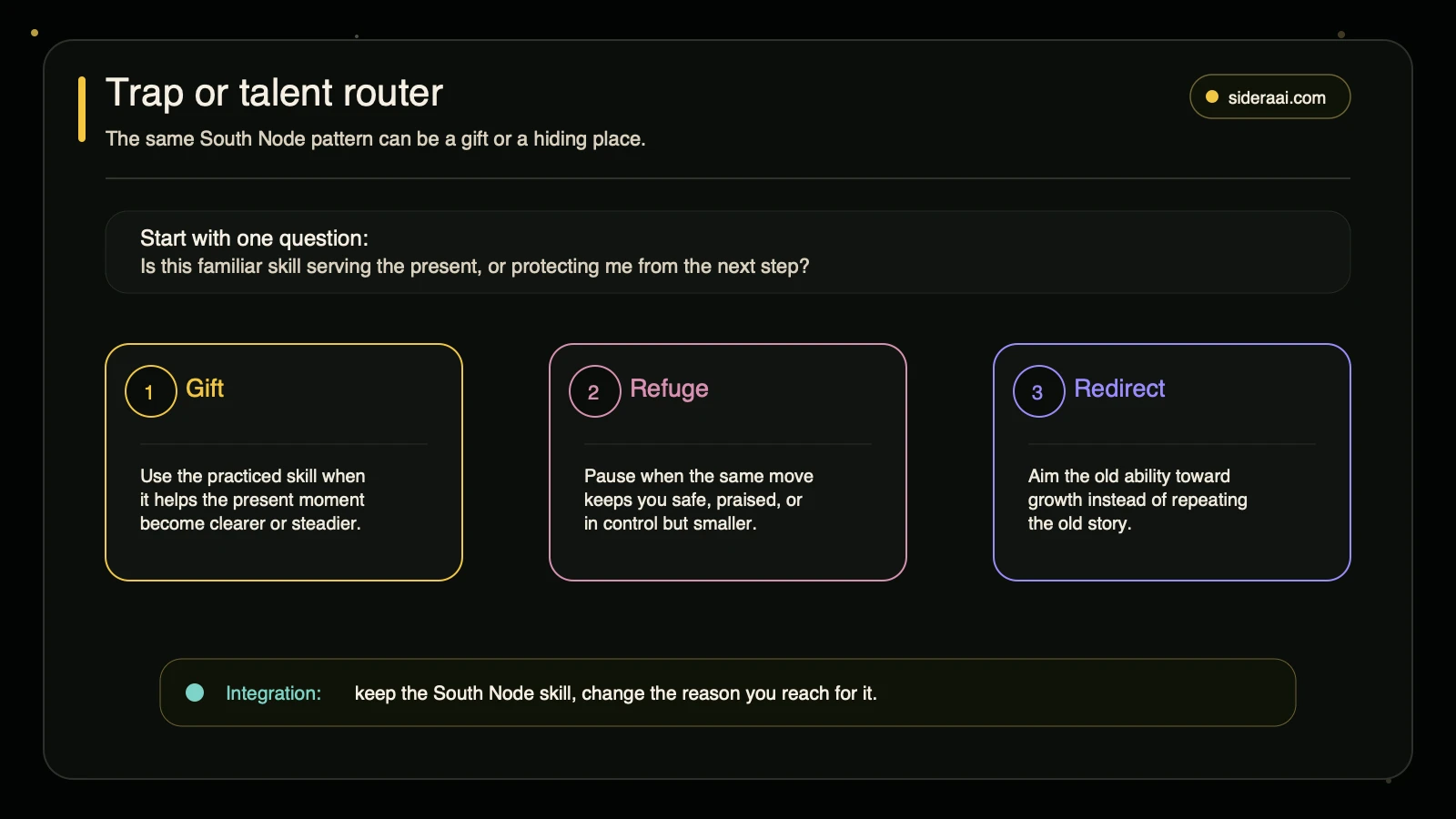
Use the router when a familiar response appears: the same South Node behavior can be a real gift, a refuge from growth, or a skill that needs redirecting.
How the South Node Shows Up in Real Life
The South Node becomes useful when you stop treating it as a symbol and start watching for the pattern in ordinary choices.
In love: it is the role you know how to play too well. You may be the rescuer, the achiever, the independent one, the peacekeeper, the critic, the performer, or the person who disappears before needing too much. The relationship may feel familiar because it activates an old self, not because it is automatically healthy.
At work: it is the competence people reward you for, even when it costs you. A South Node pattern can make you excellent in a role while keeping you over-identified with being useful, impressive, unbothered, in control, or endlessly adaptable.
In conflict: it is your first defense. Some people attack, some withdraw, some explain, some fix, some charm, some freeze, some moralize. The South Node answer is often fast because it has been practiced for years.
In self-image: it is the story you use to stay coherent. “I am the capable one.” “I am the easygoing one.” “I am the intense one.” “I am the selfless one.” Growth begins when that identity is no longer allowed to make every decision for you.
Understand your connections on a cosmic level.
Explore your bonds →The South Node Ruler: Your Pattern’s Operating Manual
Here is a technique virtually no beginner guide covers: the planet that rules your South Node sign acts as the operating manual for how your past patterns express themselves in this life.
The South Node sign tells you what kind of patterns you carry. The South Node Ruler tells you how they run, and which area of your chart those patterns route through when activated.
How to find your South Node Ruler: Look up the ruling planet for your South Node sign (same traditional rulerships used for the Ascendant). Then find where that planet sits in your birth chart. That house shows the arena where South Node defaults most actively play out.
| South Node Sign | South Node Ruler | What the Ruler’s House Reveals |
|---|---|---|
| Aries | Mars | Where competitive/independent energy flows and can get stuck in old battles |
| Taurus | Venus | Where comfort-seeking and resource attachment are strongest |
| Gemini | Mercury | Where scattered communication and information-gathering patterns emerge |
| Cancer | Moon | Where emotional default and family conditioning is most active |
| Leo | Sun | Where ego, recognition-seeking, and performance patterns surface |
| Virgo | Mercury | Where perfectionism and service patterns operate |
| Libra | Venus | Where harmony-seeking and people-pleasing are most pronounced |
| Scorpio | Pluto (Mars traditional) | Where control, depth, and intensity patterns concentrate |
| Sagittarius | Jupiter | Where philosophical default, preaching tendencies, and restlessness show up |
| Capricorn | Saturn | Where achievement pressure and authority patterns are most familiar |
| Aquarius | Uranus (Saturn traditional) | Where detachment, group identity, and rebellion patterns operate |
| Pisces | Neptune (Jupiter traditional) | Where dissolution, escapism, and boundlessness tend to emerge |
Example: South Node in Leo, Sun (the South Node Ruler) in the 7th house. The patterns of performance and recognition-seeking play out primarily in close relationships; this person may default to performing for partners, making the relationship a stage rather than a genuine meeting. The North Node in Aquarius calls toward group contribution and objective vision. Consciously redirecting the Sun in the 7th means using relationship skills in service of broader collaboration rather than personal recognition.
This technique gives you a specific house to watch when the South Node pattern activates, plus a specific planet to work with when you want to redirect that energy consciously. The North Node Ruler does the same for growth direction. Find both in the North Node astrology guide.
South Node Conjunctions in the Birth Chart
When a natal planet falls conjunct your South Node, that planet is colored by the South Node themes: natural skill, comfort-zone territory, default behavior. A few key patterns:
| Conjunction | What It Means |
|---|---|
| Sun conjunct South Node | Strong identity around default South Node themes; leadership comes naturally but can feel like a trap |
| Moon conjunct South Node | Deep emotional patterns tied to South Node sign; emotional comfort in the familiar is powerful |
| Saturn conjunct South Node | Old structures, discipline, and authority feel automatic; the real growth is toward North Node freedom |
| Venus conjunct South Node | Relationship and value patterns from the default sign are highly developed; relationship comfort can become avoidance |
| Mars conjunct South Node | Drive and assertion patterns feel instinctive; directed consciously, this is a resource; left unconscious, it repeats old battles |
A North Node conjunction, by contrast, feels more like an unfamiliar but important pull, skills worth developing that don’t come automatically.
South Node Retrograde?
The South Node is a mathematical point, not a physical body, and it does not turn retrograde in the traditional sense. What you may see listed in some chart software is the choice between True Node (tracks actual Moon crossing points, with small forward/backward wobbles) and Mean Node (a smoothed average that always moves retrograde through the zodiac). Both are valid. Most western astrologers use True Node for precision; Mean Node for simplicity.
The sign difference between True and Mean Node is rarely more than one degree, and for most interpretive purposes they are effectively the same placement.
South Node and Eclipses
Eclipses are supercharged lunations that happen within approximately 18 degrees of the nodal axis. A solar eclipse near your natal South Node can trigger old patterns with unexpected force, surfacing behaviors or relationships from the past that need to be consciously released rather than re-engaged. A lunar eclipse near the South Node often marks a culmination or ending connected to those default themes.
If you want to understand why certain eclipses feel personally intense while others pass without notice, check how close the eclipse degree falls to your natal nodal axis. Eclipses within 10 degrees of the South or North Node tend to land hardest. See more in the North Node in astrology guide for the eclipse-nodal connection explained in full.
Find your perfect moment with AI-powered electional astrology.
Discover your timing →Working with the South Node Practically
A practical South Node reading should leave you with a decision, not just a label. Use these checks when you notice yourself repeating a familiar pattern:
Track your stress defaults. When life gets hard, which South Node behaviors show up first? Write down the exact behavior, not just the placement keyword. “I over-explained for 20 minutes” is more useful than “Gemini South Node.”
Ask whether it is a strength or a refuge. The same behavior can be healthy or avoidant depending on timing. South Node in Capricorn can use discipline to build a life, or use work to avoid intimacy. South Node in Pisces can offer compassion, or use compassion to avoid boundaries.
Name the North Node alternative. Do not stop at “this is my South Node.” Ask: what would the opposite sign and house ask me to practice right now? That answer is usually less comfortable and more useful.
Watch the 18-month window. When the transiting North Node crosses your natal South Node (every 18.6 years), the tension between old pattern and new direction tends to become explicit. These are pivotal decision points. See the full nodal cycle timing in the North Node guide.
Look at the house, not just the sign. Your South Node is in the same sign as millions of others born within 18 months of you. The house is personal. The 12 houses of astrology determine where that sign energy plays out in your specific life structure.
For the full picture of how the South Node sign, house, and ruler work together, use a birth chart calculator that gives you both nodal positions and house placements. The synastry chart guide covers how the South Node works in relationship charts.
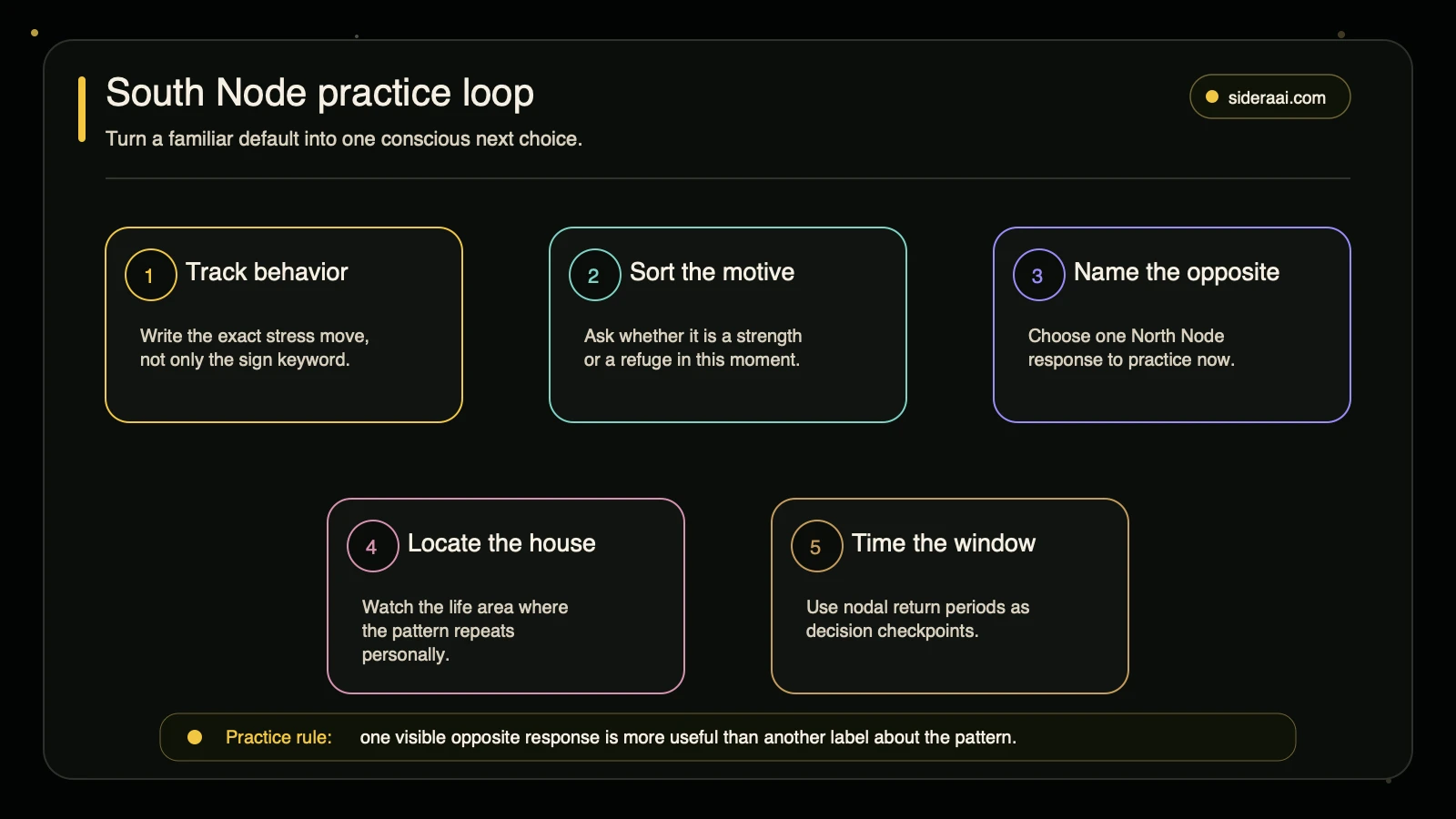
Use the practice loop to turn a South Node label into one visible opposite response you can test in the house where the pattern repeats.
Frequently Asked Questions
What does the South Node mean in astrology? The South Node marks the point where the Moon crossed below the ecliptic at your birth. In western astrology, it represents accumulated patterns, default behaviors, and natural strengths you carry from past experience. It is both your comfort zone and a potential trap if over-relied upon.
Is the South Node bad in astrology? No. The South Node is not inherently negative. It represents highly developed skills and ingrained strengths. The “trap” is over-using those patterns instead of growing toward the North Node direction. The South Node can be your greatest natural asset when deployed consciously.
What is the difference between the South Node and North Node? The South Node (comfort zone, default patterns, past tendencies) and North Node (growth direction, new territory, soul intention) are opposite points on the same axis. They are always in opposite signs and opposite houses. Understanding one requires understanding the other. See the full comparison in the North Node astrology guide.
How long does the South Node stay in each sign? The nodal axis moves through the entire zodiac in approximately 18.6 years, spending about 18 months in each sign. Your South Node sign is shared by everyone born in the same 18-month window, a generational marker. The house position is personal and shifts every two hours.
What does it mean if a planet conjuncts the South Node? A planet conjunct the South Node takes on the character of the default, highly practiced energy of the South Node sign. It can be a strong natural ability that requires conscious redirection. Sun or Moon conjunct the South Node, in particular, creates a strong pull toward default patterns under pressure.
What is the South Node in synastry? In synastry (relationship charts), when one person’s planet falls on another person’s South Node, there is often an immediate sense of familiarity, sometimes almost eerily so. It can feel like instant comfort or a sense of “we’ve done this before.” The risk is that the relationship can reinforce old patterns rather than growth. North Node contacts in synastry feel more like growth edges: less immediately comfortable but more directionally productive. See the synastry chart guide for how nodal contacts work in relationships.
How do I find my South Node? Run a free birth chart with your birth date, time, and location. The South Node is marked as the symbol that looks like an inverted horseshoe (or listed as “Descending Node” / “Dragon’s Tail”). It sits exactly opposite the North Node in your chart.
Does the South Node affect career? Yes. The house the South Node occupies can indicate where you may over-default to familiar career strategies rather than growing toward the 10th or 6th house growth areas. South Node in the 10th house, for example, can indicate that career achievement and public recognition feel natural but may become avoidance of the deeper 4th house growth (home, emotional foundation, private self).
What is the South Node Ruler in astrology? The South Node Ruler is the planet that rules the sign your South Node occupies. It acts as an operating manual for how your default patterns actually express themselves in this life. Where the South Node Ruler sits in your chart (which house) shows the specific life arena where South Node patterns most actively play out, and where the most conscious redirection is possible. For example, South Node in Taurus with Venus (the ruler) in the 3rd house shows communication, information, and local connections as the main terrain for comfort-seeking patterns.