
Your contract must be signed Friday. One tropical calculator calls it workable; a sidereal calculator changes the Moon’s sign and sounds cautious. If Friday is fixed, keep the necessary date and strengthen legal review, money checks, authority, and exit terms. If you have options, compare them inside one complete method—never by switching systems after seeing the result.
In the Sidera Western contract example below, October 15 wins over November 22 when readiness is equal because both score 5.0/5 but October’s intensity is 3.3 versus 8.5. October 16 is rejected despite a raw 5.0 because the Moon is void of course. That is the concrete outcome: pick October 15 for calmer execution, keep November 22 only when extra preparation materially improves readiness, and use a safe fixed date when the deadline cannot move.
The emotional trap is not really “which zodiac is true?” It is the fear that choosing the wrong calculator will make you responsible for a lost deal, a failed launch, a difficult move, or a conversation that goes badly. That fear encourages system-shopping: checking outputs until one grants certainty. It increases regret because the rule changes after the result is known.
This guide replaces that loop with a defensible record. You will know which method you used, why a date passed, what could still veto it, and what you will do if the preferred date is impossible. Astrology organizes the comparison; the real-world fallback keeps the decision usable.
Tropical astrology anchors twelve equal signs to the seasonal equinoxes and solstices; sidereal astrology anchors twelve equal signs to a stellar reference and applies an ayanamsha offset. “True sidereal” or constellation-based charts may instead use unequal astronomical constellation boundaries. These are different coordinate systems, not three labels for the same calculation.
That is Sidera’s core rule: settings before symbolism, method before verdict. This guide helps you choose one internally consistent method for the decision, record the settings, and create a fallback when the practical date cannot move. For the conceptual background before comparing settings, read what sidereal astrology is.
What this guide does: resolve one action when tropical and sidereal outputs conflict. A complete timing method beats an isolated sign change; separate methods must be evaluated separately; and a fixed real-world constraint beats symbolic preference. This is not personalized timing: that would require exact birth data, location, real availability, and a purpose-built method.
Where to choose the system in Sidera’s calendar
Open the monthly Calendar and tap the system button above the date grid; it displays the current short label, such as Western or Jyotish. In the list, choose Western calendar for tropical timing or Jyotish / Muhurta for Sidera’s Lahiri sidereal calculation. Compare the same available dates within that selected system. The Western contract example below retains its original calculation; switching the app view does not convert this article’s table into sidereal results.
This calendar selection is separate from your saved natal-chart system. For the broader calendar overview, use Sidera’s astrology calendar.
One-Minute Decision Map: Fixed, Shortlist, or Flexible
| Your constraint | Do this next | Required output |
|---|---|---|
| Date fixed | Keep the necessary date; use one declared method only to prepare | Yes, delay, or no based on legal, money, health, safety, consent, and a written fallback |
| Two or three dates available | Rank all candidates inside one complete method; remove any that fail its activity gates | A winner, a runner-up, why each passed, and what would veto both |
| Fully flexible | Lock the tradition before generating candidates; never switch after seeing the result | A reproducible shortlist with the zodiac, ayanamsha if sidereal, inputs, gates, and fallback recorded |
Record only what changes the decision: the exact action; the complete tradition; zodiac and ayanamsha if sidereal; birth time/location/house system; and what each method would have you do. If you already follow a technique, use its required system. If experimenting, choose the framework before seeing which date looks better.
Apply the Rule to Any Constrained Decision
Every candidate must pass four checks: identical inputs, one complete method, purpose-built activity gates, and real-world practical constraints. If inputs or method fail, recalculate. If activity gates fail, remove the date. If practical constraints fail, use another qualified date or the fixed-date fallback.
| Situation | Astrology step | Practical decision and fallback |
|---|---|---|
| Contract fixed for Friday | Keep one declared method; do not replace it with one changed Moon label | Verify terms, authority, funds, and exit rights; sign, delay, or decline on those facts |
| Launch has three available dates | Rank all three inside the same launch method | Choose the executable winner; keep the runner-up if people or systems become unavailable |
| Difficult conversation cannot move | Use the declared method for preparation, not permission | Screen consent and safety; set one question, a pause signal, and a return time |
| Move or trip is already booked | Treat the travel date as fixed; do not cancel solely because another zodiac changes one label | Verify documents, money, health, weather, transport, and a disruption plan |
Fixed-date fallback: “The date is fixed by [constraint]. I used [method] for preparation, but [law/safety/health/money/logistics] controls the decision. I will verify [three items]; if [failure condition] occurs, I will [review, delay, or exit].”
What the Sidera Contract Output Can Answer
What Sidera scored: every day in a 509-day range for “sign contract,” inside a declared Western calculation. A day needed at least 4.5/5, a waxing phase, Mercury direct, non-VOC Moon, and clearance from a three-day eclipse buffer. The data was generated August 10, 2026 at engine baseline 382200b. It does not contain a parallel sidereal calculation, a natal chart, location-specific hours, or legal review.
The 1–5 score is the final general ranking after contract rules. Quality helps order otherwise similar signals; intensity means stronger, not safer or better. A raw 5.0 is not publishable when a contract-specific rule fails.
| 2026 output | Why it passed or failed | Use / avoid | If unavailable |
|---|---|---|---|
| September 22 — 4.5/5; quality 7.5; intensity 4.2 | Cleared the threshold and every contract rule | Use as a qualified Western-system option; avoid calling it sidereal | Use the safe fixed date or compare October |
| October 15 — 5.0/5; quality 7.8; intensity 3.3 | Waxing Crescent, Mercury direct, Moon non-VOC | Use for a lower-intensity qualified option | Keep a necessary date with review/fallback safeguards |
| November 22 — 5.0/5; quality 8.0; intensity 8.5 | Mercury direct and Moon non-VOC; full contract rules passed | Use only when preparation can absorb higher intensity | Prefer October/December when calm execution matters |
| December 19 — 5.0/5; quality 9.6; intensity 7.3 | Supportive contract aspects, Mercury direct, Moon non-VOC | Use after legal and practical readiness | Keep the fixed safe date and strengthen review |
| October 16 — rejected despite 5.0 raw | Moon VOC failed the contract gate | Do not promote as a best contract date | Choose October 15 or another qualified candidate |
How to pick a winner: October 15 and November 22 both score 5.0. October has intensity 3.3; November has intensity 8.5. If legal readiness and logistics are equal, choose October for calmer execution. Choose November only when the extra preparation time materially improves the contract and the team can absorb a more intense window. Equal favorability does not mean “pick the strongest feeling.”
Do not convert one planet to sidereal and keep this ranking. A true comparison requires a complete sidereal contract method with a declared ayanamsha and disclosed rules. One changed Moon label is not a competing shortlist.
The general calendar cannot add a natal chart, location-specific hours, or your real constraints. With those inputs, Sidera can localize the same defined decision while keeping the method and assumptions visible; it still cannot replace legal, financial, health, safety, or consent checks.
Bring one real decision and its date constraints. Get a transparent comparison, visible activity gates, a constraints check, and a usable fallback.
Build my date comparison →The Minimum Technical Difference You Need
| System | Reference anchor | Zodiac divisions | What may change | What must be recorded |
|---|---|---|---|---|
| Tropical | March equinox and the seasonal cycle | Twelve equal 30° signs | Sign labels relative to a sidereal chart | Tropical zodiac, house system, time and location |
| Sidereal | A stellar reference with a chosen ayanamsha | Twelve equal 30° signs | Many planetary sign labels; exact degrees are offset | Sidereal zodiac, exact ayanamsha, house system, time and location |
| Constellation-based / “true sidereal” | IAU-style or provider-defined constellation boundaries | Usually unequal sectors | Both labels and sector sizes | Provider, boundary definition, epoch, time and location |
House cusps may also change when the software or tradition changes. Interplanetary aspects normally remain close when the same uniform offset is applied to every longitude, though traditions may interpret them differently.
Why Did My Zodiac Sign Change?
The tropical and common sidereal zodiacs are currently separated by roughly 24 degrees, with the exact offset depending on date and ayanamsha. Because each equal sign spans 30 degrees, a tropical placement in approximately the first 24 degrees of a sign usually moves into the previous sidereal sign; a placement in roughly the final 6 degrees usually keeps the same sign label. For example, 15° tropical Taurus becomes about 21° sidereal Aries, while 28° tropical Taurus becomes about 4° sidereal Taurus. Verify the exact degree rather than assuming everyone moves back one sign.
How Can Both Systems Seem Meaningful?
Each belongs to a tradition built around its own coordinate anchor. Tropical work may emphasize seasonal symbolism; a sidereal school may combine its stellar offset with different rulers, dignities, or timing techniques. Internal coherence can make either useful without scientifically validating astrological causation. Compare one complete framework prospectively; do not mix isolated pieces until a preferred answer appears.
Four Settings That Must Stay Separate
- Zodiac: tropical, sidereal, or a defined constellation-based system.
- Ayanamsha: the stellar offset used inside a sidereal calculation.
- House system: whole sign, Placidus, equal, or another method for dividing houses.
- Inputs and boundaries: exact time, time zone, location, ephemeris, and any constellation-provider boundary definition.
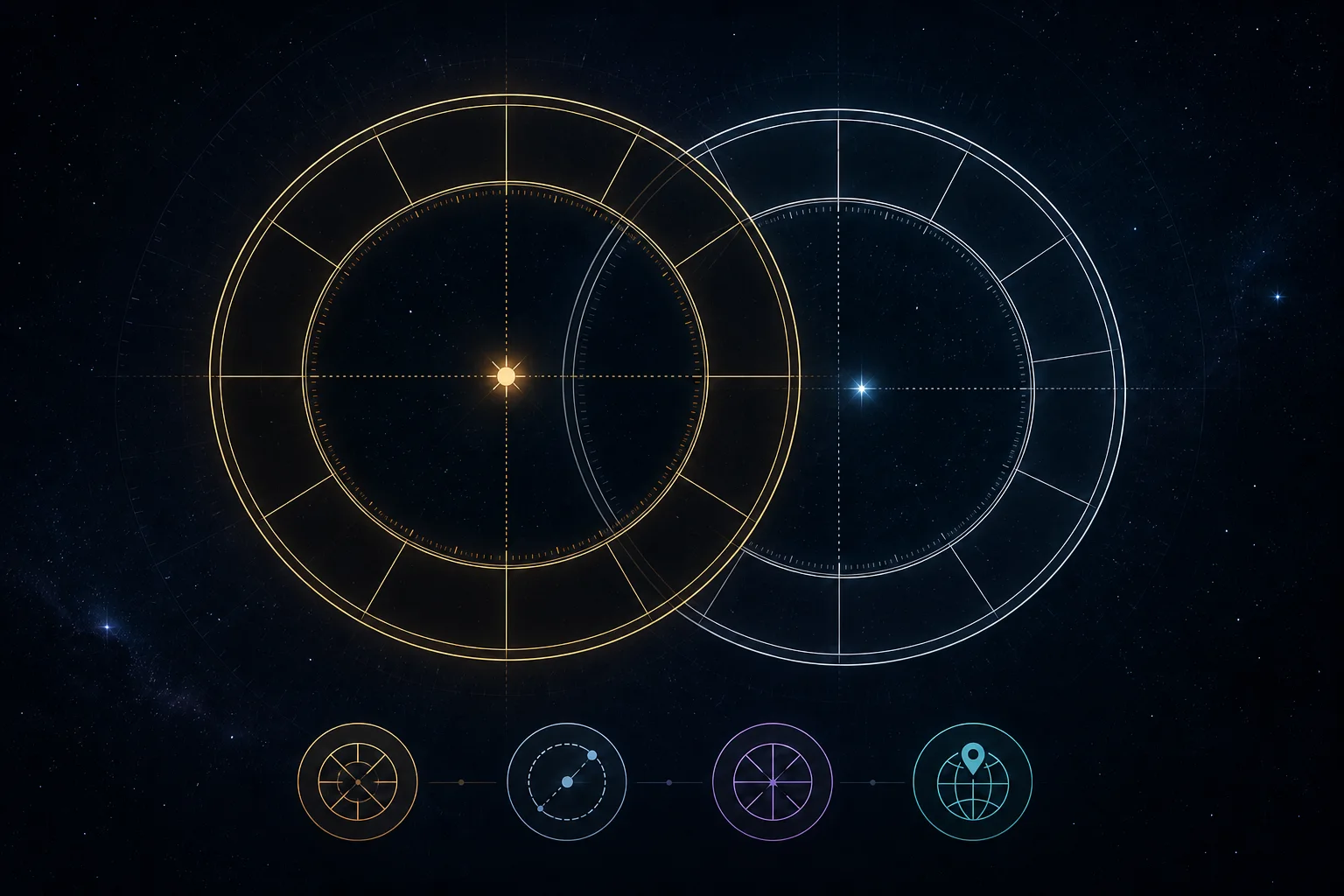 The offset wheels explain a changed sign label; the four controls below remind you that zodiac, stellar reference, houses, and input location are separate settings.
Earth’s precession explains the growing offset, but astronomy does not validate astrological interpretation. NASA explains precession; the IAU explains official constellation boundaries, which are not the same as twelve equal astrology signs. “Vedic” is a full tradition, not a synonym for every sidereal calculation.
Use the sidereal chart calculator guide to compare outputs and the birth chart calculator guide to verify input quality.
Copy This 30-Second Decision Record
Action: [what must happen]. Constraint: [fixed date or available dates]. Method: [complete tropical or complete sidereal tradition, with settings]. Passed: [dates and gates]. Winner: [date] because [execution reason]. Practical vetoes: [law, money, health, safety, consent, logistics]. Fallback: if [failure condition], I will [review, delay, or exit].
Social Listening: Sign-Change Anxiety Is a Settings Problem First
Community discussions repeatedly ask how both systems can “work” and why a familiar sign changed. These are anecdotal reader signals, not accuracy studies. They show why the decision rule must come before identity fit: use the method required by the chosen technique, keep inputs constant, and evaluate usefulness prospectively. Sources include discussion of sidereal and tropical charts and discussion of switching systems.
Methodology Note and Scope
This guide uses a July 3, 2026 Research Pack that separates astronomy facts from astrology practice. NASA, the IAU, and ESO’s precession visualization support sky mechanics and constellation facts. Astro-Seek’s tropical/sidereal calculator and Astrodienst’s Vedic astrology discussion document calculator and tradition context. Sidera’s dataset audit is a repository count, not an accuracy comparison.
FAQ
Is sidereal astrology more accurate than tropical astrology?
Sidereal positions are tied to a selected stellar reference; tropical positions are tied to the equinoxes. “More accurate” is incomplete until you state what is being measured and which interpretive tradition is being tested.
Why did my zodiac sign change?
The sidereal calculation subtracts an ayanamsha from tropical longitude. Placements earlier than the offset within a sign usually move into the previous sign; late-degree placements may keep the same sign name.
Do aspects change between tropical and sidereal charts?
Interplanetary angular aspects normally remain the same when the same offset is applied to every planet. House placement and angle relationships can change depending on chart settings.
Which ayanamsha should I choose?
Use the ayanamsha required by the tradition or practitioner you are following. Lahiri is common in Jyotish; Fagan-Bradley is common in Western sidereal work. Always record the choice.
Can I use both systems?
Yes, if each has a defined role and you avoid mixing assumptions invisibly. Compare one complete framework at a time.