
A sidereal birth chart can change the Sun, Moon, or rising-sign labels you learned from a tropical chart. The new labels may feel revealing, wrong, or simply unfamiliar. Do not solve that tension by choosing the description you like best. Verify the birth data, time zone, zodiac, ayanamsha, and house system first; then interpret the Lagna, Moon, houses, rulers, planetary condition, yogas, and dashas as one method.
A sidereal natal chart places planets in a zodiac tied to a stated stellar reference rather than the tropical zodiac’s seasonal equinox. Most sidereal/Vedic charts retain twelve equal 30-degree signs and use an ayanamsha; they are not the same as charts drawn from unequal visible constellation boundaries.
If you already have both charts, jump to the seven-step sidereal reading ladder. It gives you a repeatable process instead of another identity verdict.
Most sidereal and Vedic calculators use twelve equal 30-degree signs and an ayanamsha correction. They do not use the unequal boundaries of the visible constellations. A true-sky or constellational chart is a different method, so check which setting a calculator uses before comparing results.
With an ayanamsha near 24 degrees, a tropical placement in roughly the first 24 degrees of a sign often moves to the previous sidereal sign; a placement in the final roughly six degrees often keeps the same sign name. The exact boundary depends on the date and selected ayanamsha. The Swiss Ephemeris documentation explains the calculation principle and the existence of multiple sidereal modes, while NASA’s reference-system overview supplies the astronomical background for precession. Neither source validates astrological interpretation.
Tropical, sidereal, and true-sky charts are different calculations
| Chart type | Reference and structure | What may change | What stays stable | Common mistake |
|---|---|---|---|---|
| Tropical | Twelve equal signs anchored to the equinoxes and seasons | Sign labels differ from sidereal results | Birth moment and actual angular distances between planets | Saying tropical astrology ignores precession |
| Twelve-sign sidereal / Vedic | Twelve equal 30-degree signs using a stated ayanamsha | Signs, houses, rulers, dignities, and nakshatras may differ | Birth data and degree-based separations between planets | Treating it as tropical meanings shifted backward |
| True-sky / constellational | Astronomical constellation boundaries, which are unequal | Boundaries and sometimes the number of named constellations used | The observed birth sky | Assuming this is what every “sidereal chart” means |
Record the exact calculation choice before interpreting. A calculator that says only “sidereal” without naming its ayanamsha leaves out information needed to reproduce the result.
Ayanamsha selection note
The roughly 24-degree correction in this article is an illustration, not a universal setting. Choose one named ayanamsha—Lahiri is one common option—and preserve it across every chart you compare. Changing the ayanamsha between readings changes the experiment; hiding the setting makes the result impossible to audit.
Decision tree: which chart should you read first?
- The calculator does not name its zodiac or ayanamsha: stop. Use a tool that exposes enough settings to reproduce the chart.
- The birth time is uncertain: begin with cautiously interpreted planetary signs and degree-based separations; do not treat the Lagna or houses as settled.
- The result uses unequal constellation boundaries or Ophiuchus: treat it as a constellational chart, not a standard twelve-sign sidereal/Vedic chart.
- The chart is twelve-sign sidereal with a named ayanamsha: follow the seven-step ladder below.
- You want to compare tropical and sidereal: keep identical birth data, document both settings, and use the 30-day observation worksheet rather than choosing by one flattering description.
How This Shows Up in Real Life
A sidereal placement becomes useful only when you can recognize it in lived behavior. Do not stop at “Scorpio Moon means intense” or “Capricorn Lagna means disciplined.” Ask where that intensity or discipline shows up when life is not calm.
Read each placement through four practical questions:
- Love: Do you reach for closeness directly, test people’s loyalty, withdraw before asking for reassurance, or over-function so nobody can leave?
- Work: Do you lead by taking responsibility, controlling outcomes, avoiding visibility, mediating conflict, or proving competence through exhaustion?
- Conflict: Do you become sharp, silent, overly rational, emotionally flooded, defensive, or agreeable while resentment builds?
- Self-image: Do you see yourself through achievement, usefulness, independence, desirability, resilience, spiritual insight, or being needed?
That is the difference between astrology as personality content and astrology as self-understanding. A good sidereal reading should help you name the pattern clearly enough to practice a different response in a real conversation, decision, or boundary.
What Changes in a Sidereal Birth Chart
The most immediate shift is positional. The ayanamsha is the angular correction used to relate the tropical and selected sidereal reference points. In the simplified relationship documented by Swiss Ephemeris, the sidereal longitude is the tropical longitude minus the ayanamsha. Different ayanamshas can produce slightly different positions, so disclose the setting instead of presenting one chart as calculation-neutral.
This means a person with the Sun at 3° Aries tropical has the Sun at approximately 9° Pisces sidereal when the correction is close to 24 degrees. A Moon at 27° Leo becomes approximately 3° Leo and keeps the same sign name. By contrast, a placement at 15° Virgo becomes roughly 21° Leo, so it changes signs. Use these as examples, not universal cutoffs: the selected ayanamsha and date set the exact correction.
But the change in meaning goes deeper than sign assignments. The entire interpretive framework orients around different priorities. Learning which system fits your chart is easier if you first understand how tropical signs use an equinox-based reference while sidereal signs use a stated stellar reference and ayanamsha.
The Moon in many Jyotish traditions
In tropical Western astrology, the Sun sign is the primary identity marker. Most people know their Sun sign before any other placement.
In many Vedic or Jyotish traditions, the Moon sign carries equal or greater weight. The Moon represents manas: the mind and the cognitive and perceptual apparatus through which a person experiences daily life, not only emotion in the modern Western sense.
Some Jyotish schools use the Sun for purpose or authority themes and the Moon for manas, the mind and perceptual apparatus. In that framework, a sidereal Moon in Scorpio is not just “emotional intensity”; an astrologer might explore scanning for what is unsaid, remembering emotional debts, or needing privacy before trust. These are interpretive possibilities to test, not fixed personality facts.
For understanding your sidereal Moon sign and how it shapes emotional instinct, start here before moving to any other placement.
Do not use the Moon as a shortcut around the chart’s rising sign, houses, rulers, and condition. It is one major layer in the reading sequence below.
The Lagna: The Chart’s Operating System
The Lagna (Ascendant) functions as the foundation of a Vedic sidereal chart. It establishes the houses and their rulers, which is why the same planet can govern different life topics for different rising signs.
In Western astrology, the Ascendant often describes appearance and first impressions. In sidereal astrology, the Lagna is the chart’s operating system: every other placement is interpreted relative to which houses it governs for your specific rising sign. This is where the chart becomes practical. It can show why the same Mars placement feels like career drive for one person, relationship conflict for another, and health pressure for someone else.
A planet commonly described as difficult can govern constructive houses for some Lagnas, while a natural benefic can rule houses that introduce mixed results. Avoid a universal lookup table: first identify the rising sign, then list the houses each planet rules and assess its sign, house, aspects, and condition in the complete chart.
Your rising sign and Ascendant meaning play the same pivotal role in Western interpretation, but in sidereal, the implications run deeper into every placement.
Nakshatra: The Layer Beneath the Signs
The sidereal zodiac is not just divided into 12 signs of 30 degrees each. It is also divided into 27 lunar mansions called nakshatras, each spanning exactly 13°20’ of arc. Every planet in your chart falls within a specific nakshatra, and this layer provides specificity that sign placements alone cannot.
Two people can have the Moon in sidereal Scorpio but experience that placement very differently: one may fall in Vishakha (ruled by Jupiter, themes of purpose and ambition) while the other falls in Jyeshtha (ruled by Mercury, themes of authority and rivalry). Same sign, different nakshatras, distinctly different in character.
Your Moon’s nakshatra is called your janma nakshatra or birth star. It forms the starting point for the Vimshottari dasha system, a 120-year planetary period cycle that maps out which planet governs each phase of your life. The cycle runs: Sun (6 yrs), Moon (10 yrs), Mars (7 yrs), Rahu (18 yrs), Jupiter (16 yrs), Saturn (19 yrs), Mercury (17 yrs), Ketu (7 yrs), Venus (20 yrs). Most people alive today are in the middle of this cycle at birth.
This is why sidereal timing can feel more concrete than a list of personality traits. A Venus dasha may pull focus toward relationships, pleasure, art, money, and attachment patterns. A Saturn dasha may make responsibility, endurance, delay, work structure, and long-term consequences harder to avoid. The exact expression depends on your chart, but the dasha gives you a practical question: which planet is setting the agenda right now?
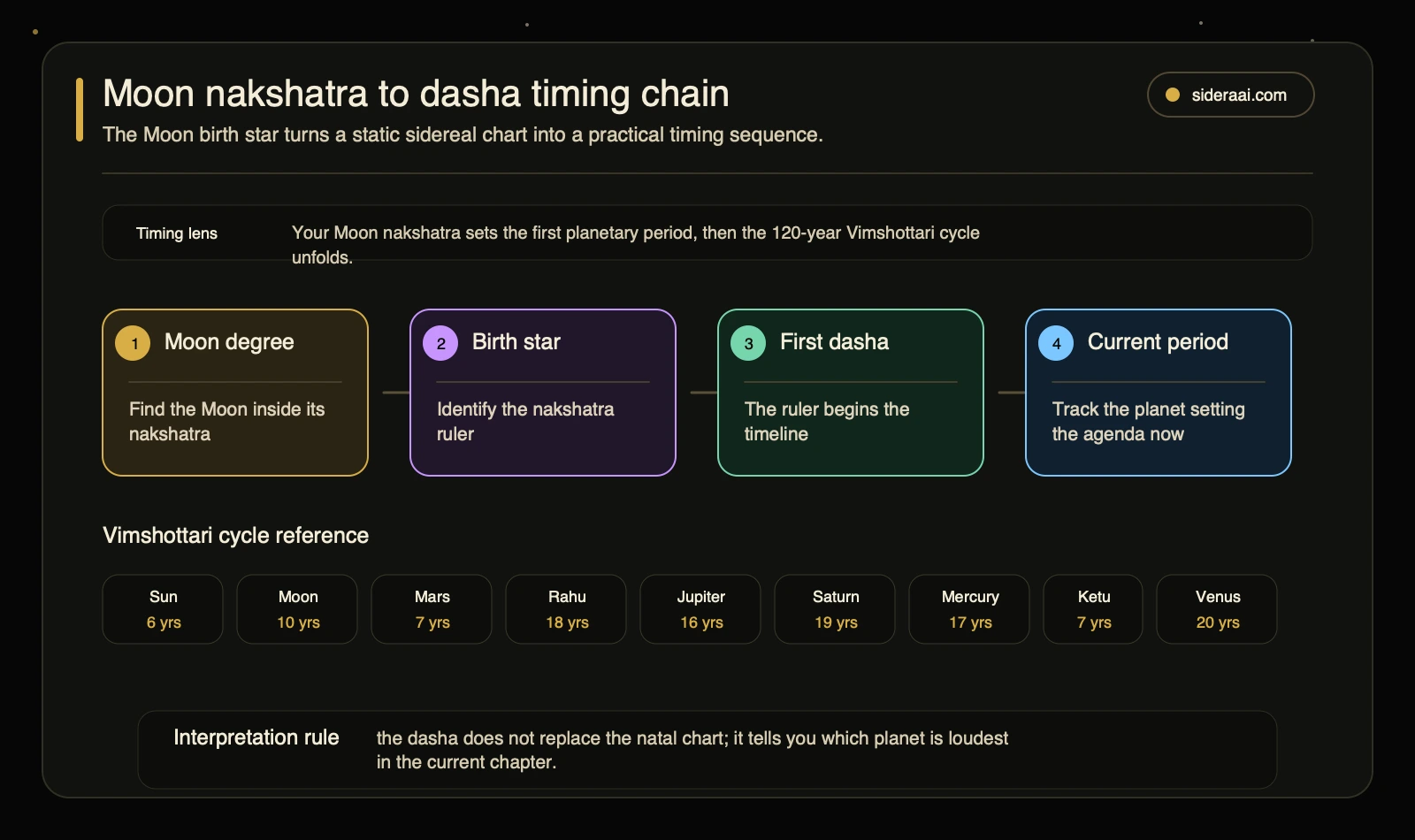
Use the timing chain to connect your Moon’s nakshatra to the planetary period that frames the current chapter of the chart.
The Vedic astrology chart reading process walks through how to identify your current dasha period step by step.
Planetary Dignity: The Sidereal Scale of Strength
Every planet has positions where it operates at peak strength (exaltation) and positions where its expression is compromised (debilitation). These dignity positions exist in both systems, but because the two zodiacs are offset by approximately 24 degrees, a planet’s dignity status can differ between tropical and sidereal calculations.
The traditional sidereal exaltation and debilitation degrees are:
| Planet | Sidereal Exaltation | Sidereal Debilitation |
|---|---|---|
| Sun | 10° Aries | 10° Libra |
| Moon | 3° Taurus | 3° Scorpio |
| Mercury | 15° Virgo | 15° Pisces |
| Venus | 27° Pisces | 27° Virgo |
| Mars | 28° Capricorn | 28° Cancer |
| Jupiter | 5° Cancer | 5° Capricorn |
| Saturn | 20° Libra | 20° Aries |
Node exaltation and debilitation assignments vary by school, so Rahu and Ketu are intentionally omitted from this compact table. Even for the seven visible planets, a degree is not a verdict: check sign rulership, house rulership, aspects, combustion, retrogradation, cancellation rules, and the interpretive school being used.
A planet whose tropical position falls near one of these degrees may or may not hold that dignity status sidereal, depending on where it lands after the ayanamsa correction. For example: a Moon at 3° Taurus tropical becomes approximately 9° Aries sidereal after subtracting 24°, losing its exaltation status in sidereal entirely.
The sidereal vs tropical comparison shows exactly which sign each planet lands in once the ayanamsa correction is applied.
Yogas: Conditional Planetary Combinations
In Jyotish, a Yoga is a defined planetary combination interpreted as modifying particular chart themes. The label does not guarantee an outcome, and schools differ on definitions, strength, and cancellation conditions.
Three foundational Yogas worth knowing when reading a sidereal natal chart:
Gajakesari Yoga: Jupiter placed in a kendra house (1st, 4th, 7th, or 10th) from the Moon is traditionally associated with learning, reputation, or recognition. Assess Jupiter, the Moon, relevant houses, aspects, and school-specific exceptions before judging its strength.
Raja Yoga (basic form): A relationship between a kendra lord and a trinal lord can be read as supporting authority or leadership themes. The houses ruled, dignity, aspects, and timing determine whether and how that symbolism becomes relevant.
Dhana Yoga: Relationships involving wealth-related house rulers may be interpreted as supporting resource themes. They are not promises of wealth; income, access, decisions, opportunity, and real-world conditions still matter.
Some Vedic birth chart calculators label possible Yogas automatically. Treat that as a prompt to inspect the definition and the full planetary condition, not as an automatic strength rating or outcome forecast.
What stays stable—and what can still change
Subtracting the same ayanamsha from every planetary longitude preserves the angular distance between those planets. If Jupiter and Saturn are 120 degrees apart in a tropical calculation, that separation remains 120 degrees in the corresponding sidereal calculation.
What can change is the sign and house context. Sign-based aspects, sign-defined configurations, house placements, rulers, dignities, and tradition-specific pattern definitions may change. A degree-based trine can retain its angle while moving into different signs. Read the aspects and angular relationships within the chosen system rather than assuming every technique transfers unchanged.
The sidereal system also uses whole-sign aspects (Graha Drishti), where planets cast influence on entire signs rather than degree-based orbs, but this is an additional interpretive layer, not a replacement for angular aspects.
How to Read a Sidereal Birth Chart: Seven Steps
If you have generated a sidereal birth chart, use one order from start to finish:
1. Verify the input. Confirm birth date, recorded clock time, birthplace, historical time zone, and daylight-saving handling. Output: a birth-data record. A small time error can move the Ascendant and house cusps.
2. Record the calculation settings. Name the zodiac, ayanamsha, and house system. Output: a settings record. Do not compare charts made from different birth data or hidden defaults.
3. Read the Lagna and its ruler. Identify the rising sign, the planet that rules it, that planet’s house and sign, and major aspects or conditions. Output: a Lagna worksheet that establishes the house structure.
4. Read the Moon and nakshatra. Note the Moon’s sign, house, lunar mansion, ruler, and major contacts. Output: a Moon worksheet translated into specific patterns of perception, attachment, stress, and recovery.
5. Check houses and rulerships. For each life topic, read the relevant house, its ruler, planets in the house, and where the ruler is placed. Output: a house-topic map that prevents a single sign label from carrying the whole interpretation.
6. Assess planetary condition and aspects. Add dignity, conjunctions, aspects, combustion, retrogradation, and any applicable cancellation rules. Output: condition notes. Treat yogas as conditional combinations, not guaranteed outcomes.
7. Add timing and lived evidence. Calculate dashas only after the natal structure is stable. Output: an observation log with three concrete examples in love, work, conflict, money, family, or recovery. Revise an interpretation that does not describe observable patterns.
The next action should preserve those settings. If you use Sidera’s birth-chart view, verify the chart’s zodiac and calculation options before applying this sidereal sequence; this article does not turn an unspecified chart into a sidereal one.
If your birth time is uncertain
An uncertain time can make the Lagna, houses, house rulers, MC, and some timing work unreliable. Record the uncertainty instead of choosing a convenient time. You can cautiously examine slower-changing planetary signs and degree-based separations, but the Moon can also change sign on some dates. Avoid house or dasha conclusions until the input is reliable enough for the technique.
Worked arithmetic example—not a person or Sidera output
Suppose a worksheet records a tropical Moon at 15° Virgo and applies an illustrative 24° correction. The sidereal label becomes approximately 21° Leo. A 120° angular distance to another planet would remain 120°, but the signs, houses, rulers, dignity, and nakshatra must be recalculated from the actual settings. Without a verified birth time and a named ayanamsha, the example cannot establish a Lagna or dasha. That boundary is the point: calculation comes before interpretation.
What readers get stuck on: changed signs and first-week navigation
Readers in astrology communities commonly report four related problems: their big three shifts; the new labels do not “resonate”; tropical and sidereal interpretations both seem plausible; or a “true sidereal” calculator uses unexpected constellation boundaries. A fourth thread asks how to rebuild self-understanding during the first week with a very different chart. These questions were reviewed June 28, 2026. They are qualitative signals, not evidence that one zodiac is more accurate.
Use this checklist before choosing a side:
- Enter identical birth date, time, place, and time-zone handling in both charts.
- Record the tropical or sidereal setting, the named ayanamsha, and the house system.
- List the placements that changed signs and those that stayed.
- Check which degree-based aspects remain stable and which sign-based techniques change.
- Write three lived examples for the Lagna, Moon, and a repeated house topic in each method.
- Compare each chart using its own techniques for a defined observation period; do not mix whichever descriptions feel flattering.
For example, a changed Moon label might be tested against how you respond during conflict, not against a generic adjective. A changed rising sign can be tested through the chart ruler and repeated house topics, not appearance alone. A changed Venus can be tested through attraction, reciprocity, and boundary patterns together with its house and aspects.
The questions are visible in discussions about switching between tropical and sidereal charts, not recognizing changed big-three labels, true-sky calculator boundaries, and navigating a very different sidereal chart. Use them as reader-language evidence only.
| Qualitative reader question | Source reviewed June 28, 2026 | Practical response in this guide |
|---|---|---|
| Can both zodiacs seem meaningful without proving either one? | Advanced Astrology comparison thread | Compare complete methods with identical inputs and an observation log. |
| What if the changed big three does not feel like me? | Astrology sidereal-vs-tropical thread | Test behavior and house topics rather than sign-label identity. |
| Is “true sidereal” the same as a Vedic chart? | True-sky calculator thread | Separate unequal constellations from equal-sign sidereal calculation. |
| How do I start when the chart looks completely different? | Sidereal Astrology navigation thread | Verify settings, then work through Lagna, Moon, houses, condition, and timing. |
Sidera original worksheet: a 30-day comparison log
This is an editorial observation framework, not app-generated data or a test of scientific validity. Copy one row for each concrete event; do not fill it with broad adjectives.
| Date and situation | Tropical method prediction | Sidereal method prediction | What actually happened | Which rule needs revision? |
|---|---|---|---|---|
| Work decision, conflict, relationship moment, money choice, or recovery pattern | Cite the placement, house, and technique used | Cite the ayanamsha, Lagna/Moon layer, house, and technique used | Record observable behavior and outcome | Keep, narrow, or reject the interpretation |
Use at least 30 days and several types of situation. The goal is not to crown a zodiac from one coincidence; it is to see whether a clearly stated method produces useful, repeatable questions.
For a deeper walkthrough of how to read a birth chart from the beginning, including house-by-house meanings, start with that guide.
Sidereal or Tropical? Working With Both
The sidereal natal chart does not invalidate your tropical chart. It frames the zodiac through a different reference: a stated ayanamsha instead of the tropical zodiac’s equinox-based starting point. A reader may recognize useful patterns in either system, but personal resonance alone does not establish that one calculation is objectively superior.
The most practical approach is to compare your sidereal and tropical charts side by side using identical birth data. Record the zodiac setting, ayanamsha, and house system; note which placements change; then interpret each chart with the techniques that belong to its tradition. Use concrete life examples to test whether an interpretation is useful without presenting that exercise as proof.
Some practitioners assign different purposes to the two systems, but that is a practice choice rather than a universal rule. Using both does not require picking a side; it does require documenting settings and interpreting each chart consistently.
Sidera’s monthly calendar has separate Western and Jyotish/Muhurta timing modes; the Jyotish option uses a Lahiri sidereal calculation. That calendar choice is separate from a natal chart’s saved settings. The timing-systems guide explains the product distinction without treating a general calendar as a personalized natal reading.
Methodology and review status
This guide was checked against Swiss Ephemeris calculation documentation, astronomy reference material, current calculator behavior noted in the research pack, and qualitative reader questions reviewed June 28, 2026. Astronomy sources support the coordinate and precession explanations; they do not support the astrology interpretations. Community threads describe confusion patterns only and are not accuracy studies. Human astrology editorial review is not recorded, so disputed school-specific claims are labeled or omitted.
Frequently Asked Questions
What is a sidereal birth chart?
A sidereal birth chart is calculated in a zodiac aligned to a stellar reference rather than the tropical zodiac’s seasonal equinox. Most sidereal and Vedic charts use twelve equal 30-degree signs and subtract an ayanamsha of roughly 24 degrees from tropical positions. This is different from a true-sky chart that uses unequal constellation boundaries.
Is a sidereal chart more accurate than a tropical chart?
Neither system is objectively more accurate. Tropical signs are anchored to the equinoxes; sidereal signs use a stellar reference and a stated ayanamsha. Compare charts only after checking the same birth data, zodiac setting, house system, and interpretive method. Personal resonance can guide further study, but it does not prove that one zodiac is universally correct.
Why does sidereal astrology prioritize the Moon over the Sun?
Many Vedic/Jyotish approaches associate the Moon with manas, the mind and perceptual apparatus, and therefore give it substantial interpretive weight. This is school-specific symbolism, not a rule that the Moon is always more accurate than the Sun or that either placement can be read without the Lagna and full chart.
What is a nakshatra in my sidereal chart?
A nakshatra is one of 27 lunar mansions, each spanning exactly 13°20’ of the zodiac. Every planet in your sidereal chart falls in a nakshatra, and each nakshatra has its own planetary ruler, symbolic deity, and set of core themes. Your Moon’s nakshatra (called your janma nakshatra or birth star) is especially important because it determines your starting point in the 120-year Vimshottari dasha cycle that maps out planetary periods throughout your life.
How do I find my current Vimshottari dasha period?
Your current dasha period is calculated from the degree your Moon occupies in its nakshatra at birth. Each nakshatra has a ruling planet, and that planet begins your first major dasha period. The 120-year cycle runs: Sun (6 yrs), Moon (10 yrs), Mars (7 yrs), Rahu (18 yrs), Jupiter (16 yrs), Saturn (19 yrs), Mercury (17 yrs), Ketu (7 yrs), Venus (20 yrs). Most Vedic birth chart calculators calculate your active dasha automatically once you enter your birth data.
Can I use both a tropical and sidereal chart?
Yes. Use identical birth data, record the zodiac, ayanamsha, and house system, and compare each chart using its own complete method. Personal resonance can suggest a question to test, but a Moon-sign description alone is not a sound basis for declaring one system correct.
Do planetary aspects change between tropical and sidereal?
Degree-based angular aspects remain the same because a uniform ayanamsha does not change the distance between two planets. A conjunction remains a conjunction and a square remains a square, although the sign labels can change. Vedic sign-based aspects and other tradition-specific rules are an additional interpretive layer, so do not assume every aspect technique transfers unchanged.
What is a Yoga in sidereal astrology?
A Yoga is a tradition-specific planetary combination interpreted as modifying a chart theme. It is not a guaranteed result. Definitions and strength can depend on house rulership, dignity, combustion, aspects, cancellation rules, timing, and the school applying the technique.
Open or generate a chart, save the birth data and calculation settings, then work through the seven outputs instead of reading one changed sign in isolation.