If you have ever read your tropical sign and thought, “some of this fits, but it misses how I actually move through life,” a sidereal chart is worth testing. A sidereal astrology chart calculator maps your birth chart against the star-based zodiac rather than the seasonal tropical zodiac used in most Western apps and magazines.
The surprise is not only that your sign may change. It is what the shift can explain. A lifelong Leo who becomes a sidereal Cancer may recognize a private need for emotional safety behind a confident public style. A committed Virgo who lands in sidereal Leo may realize their “practicality” is also a need to be respected for visible skill. This is not an error. It is a different astronomical framework, one that accounts for a phenomenon called the precession of the equinoxes, and it has been used in Vedic astrology for over 2,000 years.
How This Shows Up in Real Life
The useful question is not “Which sign do I get to call myself now?” It is “Which chart describes what I actually do when I am trying to feel loved, stay in control, make decisions, or protect my pride?”
Look at the placements that shift and test them against real behavior:
- Love: A shifted Moon or Venus can explain why your relationship needs differ from the persona you present. You may talk like you want freedom but choose partners who feel steady, loyal, and emotionally predictable.
- Work: A shifted Sun, Mars, or Saturn can show the motivation underneath your ambition. Some people discover they are less driven by praise and more driven by mastery, usefulness, or long-term security.
- Conflict: A shifted Mars, Moon, or rising sign can name your stress pattern more clearly: withdrawing before you resent someone, performing confidence when you feel exposed, or over-explaining when you fear being misunderstood.
- Self-image: A shifted Sun or rising sign can separate who you have been told you are from the pattern other people actually experience in you.
The goal is not to prove tropical wrong or sidereal right. It is to find the map that makes your patterns more visible, specific, and workable.
What opens next: the natal-chart button takes you to Your Chart after sign-in and any required birth-data setup. It uses your saved chart settings; the link does not automatically select sidereal. Check the displayed chart system before interpreting the placements.
Ready to See Your Personal Birth Chart?
Discover your unique cosmic blueprint — planets, houses, and aspects personalized to your exact birth time and location.
Get Your Birth Chart →✓ Birth chart analysis ✓ Personalized insights ✓ Free to use
Looking for dates? Open the calendar separately
Sidera’s calendar supports tropical and sidereal timing. Open the monthly Calendar and tap the system button above the date grid. Choose Western calendar for tropical timing or Jyotish / Muhurta for Sidera’s Lahiri sidereal calculation. Compare dates within the selected system; changing this calendar control is separate from opening your natal chart.
See the astrology calendar comparison for the existing overview of all seven calendars and which question each helps you explore.
What Makes Sidereal Charts Different?
The core distinction between sidereal and tropical astrology comes down to reference points.
Tropical astrology (the system behind virtually every Western horoscope) locks the zodiac to Earth’s seasons. The spring equinox permanently marks 0° Aries, regardless of where the actual constellation of Aries appears in the sky. It is a symbolic, Earth-centered system.
Sidereal astrology measures planetary positions against the backdrop of the zodiac constellations as they actually exist in space. When the Sun enters the region of sky occupied by the Scorpio constellation, sidereal astrology calls it Scorpio. It is still an interpretive system, but its reference point is fixed stars rather than seasonal markers.
This creates roughly a 24° offset between the two systems, a gap that grows by about one degree every 72 years due to Earth’s axial wobble. The result: most people’s sidereal Sun, Moon, or rising sign sits one full sign earlier than their tropical equivalent.
To bridge this gap, sidereal calculators apply a correction called the ayanamsa. Think of it as the zodiac offset that shifts tropical positions back to sidereal coordinates. The most widely used ayanamsa is Lahiri (official standard of the Indian government since 1955 and the default for Vedic astrology). Other systems include Krishnamurti, Fagan-Bradley, and Raman, each producing slightly different results.
That small technical choice matters because you are not just checking a new label. You are comparing two interpretive maps, and the ayanamsa determines the exact degrees your planets land in.
Which Planetary Placements Typically Shift?
When you switch from tropical to sidereal, here is what usually changes:
| Placement | Shift Likelihood | Notes |
|---|---|---|
| Sun sign | High (~70% of people) | Usually moves one sign back |
| Moon sign | High | Moon moves through a sign in ~2.3 days; small degree shifts matter |
| Rising sign | Very high | Changes every ~2 hours; even a 1° shift can alter the sign |
| Mercury/Venus | High | Often within the same sign as Sun but may shift independently |
| Jupiter/Saturn | Moderate | Slower planets; many stay in same sign |
| Outer planets | Low | Generational placements less likely to change |
For people born near sign cusps in the tropical system, the sidereal shift often brings clarity, placing them firmly in one sign rather than the ambiguous “cusp” territory.
Start with the placements that affect daily self-recognition most: Moon, rising sign, Venus, Mars, and Saturn. Those are usually easier to test in emotional habits, relationship choices, conflict style, and long-term pressure than a Sun sign label alone.
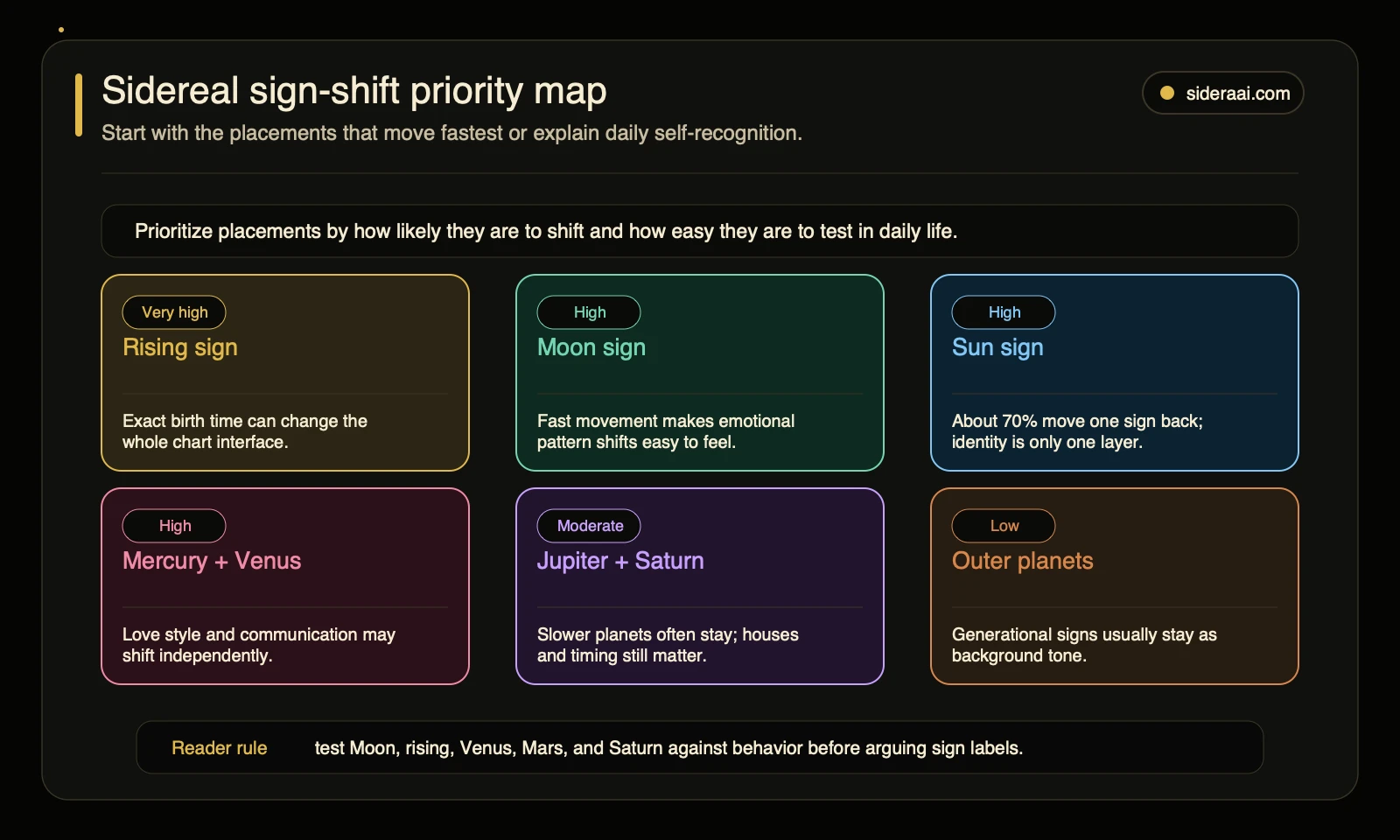
Use the map to prioritize which sidereal placements to test first. Rising, Moon, Venus, Mars, and Saturn usually create more lived evidence than a Sun-label debate alone.
How to Use a Sidereal Birth Chart Calculator
Calculating your sidereal chart requires the same birth data as any astrological chart: birth date, exact time, and location. Birth time accuracy is critical. A four-minute difference can change your rising sign. A few hours can shift house placements entirely. Your birth certificate is the gold standard source.
Once you enter your data, the calculator:
- Determines where the Sun, Moon, and planets were positioned at your exact moment of birth
- Applies the ayanamsa correction (usually Lahiri, which currently sits at approximately 23°51')
- Generates your sidereal birth chart showing sign placements, house positions, and planetary aspects
The result is a snapshot of the actual sky at your birth, a technical chart record that Vedic astrologers have used for millennia to assess personality, timing, and life patterns.
Do not treat the result as a new costume. Treat it as a set of hypotheses. If your Moon shifts, ask whether the new sign describes what calms or dysregulates you. If Mars shifts, look at how you act when you are angry, competitive, or afraid to fail. If Saturn shifts houses, compare it to the area of life where responsibility has always felt heavier than expected.
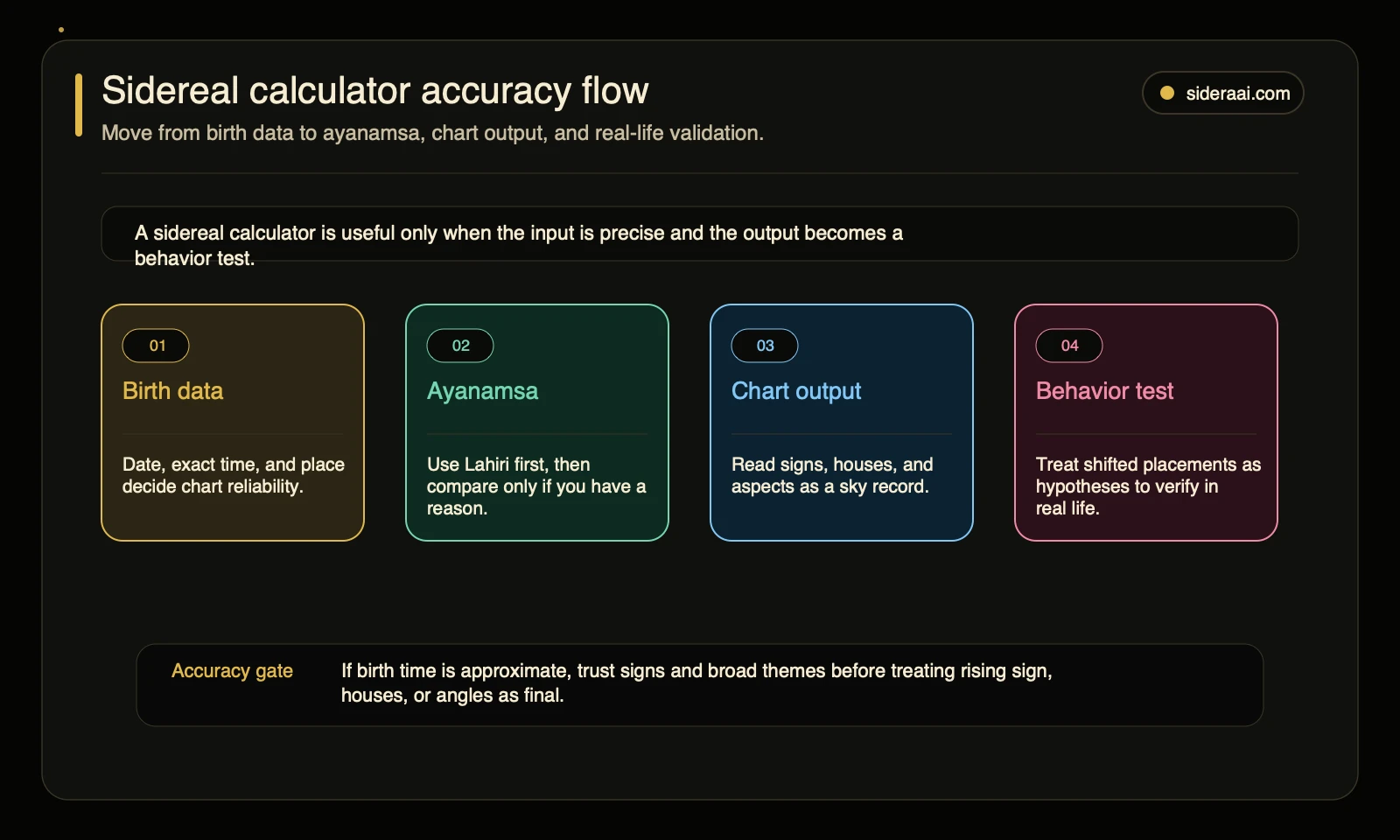
The calculator is only as useful as the data and the validation loop. Treat shifted placements as hypotheses until they explain real behavior.
For a deeper understanding of how birth charts work generally, see our guide to reading your birth chart for beginners or the comprehensive birth chart calculator guide.
Understanding Your Sidereal Placements
Sidereal Sun Sign
Your sidereal Sun sign describes the identity you build through repeated choices, not only the personality you perform. If your Sun changes signs, compare the two descriptions against how you handle purpose, visibility, pride, and self-respect. The more useful sign is usually the one that explains what you keep trying to become, especially when nobody is rewarding you yet.
Sidereal Moon Sign
Your sidereal Moon sign governs emotional patterns, instinctive reactions, and what you need to feel secure. In Vedic astrology, the Moon sign, or Rashi, often receives more weight than the Sun sign because it describes your felt life: what soothes you, what unsettles you, and what you repeat when you are trying to feel safe. Learn more about how Moon placements work in our moon signs guide.
Sidereal Rising Sign (Ascendant)
Your sidereal ascendant shapes first impressions, physical appearance, and your default approach to new situations. Because it shifts every two hours, it is the most time-sensitive placement in your chart. If the sidereal rising sign feels more accurate, it may describe what people notice before they know your inner story: your pace, guardedness, warmth, intensity, or need to scan the room first. Use our rising sign calculator to compare your tropical and sidereal ascendants side by side.
The Remaining Planets
Beyond the big three, your sidereal chart maps Mercury (communication style), Venus (values and relationships), Mars (drive and courage), Jupiter (growth and belief), and Saturn (discipline, fear, and responsibility). These placements are where sidereal interpretation gets practical. Venus can show the kind of love that actually changes your behavior. Mars can show how you fight, pursue, and defend yourself. Saturn can show where you mature through pressure rather than preference.
For a complete overview of what each planet represents, see our planets in astrology guide.
Sidera uses your actual birth chart—not generic horoscopes.
Get personalized insights →Sidereal vs Tropical: Which System Is Right for You?
This is the most common question, and the honest answer is: they measure different things.
Tropical astrology excels at describing your relationship with the seasons and psychological development within earthly cycles. It is the system behind virtually every Western horoscope, birth chart app, and astrology book you have encountered. Psychologically rich and symbolically deep.
Sidereal astrology connects you to the actual star patterns overhead. B.V. Raman, one of the most influential Vedic astrologers of the 20th century, argued for the sidereal zodiac as the astronomical basis of Vedic chart work in A Manual of Hindu Astrology (1935).
Vedic astrology, which is entirely sidereal, has used this system for over 2,000 years across India, Sri Lanka, and Southeast Asia, developing an extensive body of predictive techniques specific to sidereal placements.
Neither system is objectively superior. Some Western astrologers use both: tropical for psychological depth and inner landscape, sidereal for timing and predictive work. Your chart in one system does not erase your chart in the other.
A grounded way to decide is to compare usefulness, not aesthetics. Which chart names your stress response more clearly? Which one helps you make better choices in relationships, work, and conflict? Which one gives you timing insights you can track instead of vague validation?
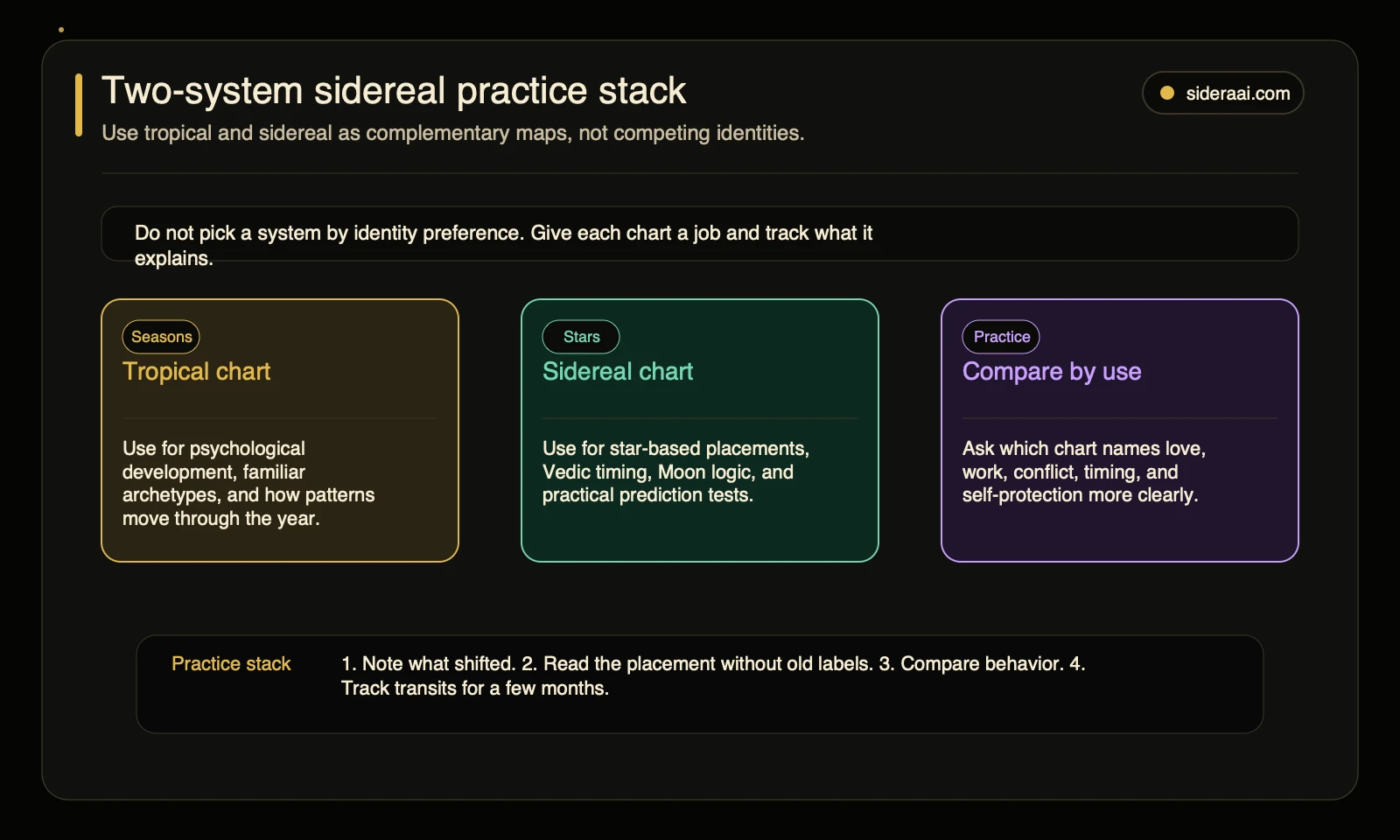
Use tropical and sidereal as complementary maps. Give each system a job, compare behavior, and track timing before choosing the chart that helps most.
For a full exploration of how these systems compare, see our guide on sidereal vs tropical astrology.
Why Your Sidereal Chart Might Feel More Accurate
Many people report their sidereal placements resonate more deeply than their tropical ones. Several factors explain this:
Cusp clarity. If you were born near a tropical sign cusp, your sidereal chart often places you firmly in one sign. A late-degree tropical Scorpio might become a clear early-degree sidereal Scorpio, or decisively shift to Libra.
Rising sign authenticity. Some people find their sidereal rising sign better captures how others perceive them, particularly in terms of physical appearance and first impressions.
Moon sign resonance. In Vedic tradition, the Moon sign is the primary psychological indicator. People who never fully connected with their tropical Sun sign often find a strong identification with their sidereal Moon.
House placement accuracy. A planet might shift houses between tropical and sidereal charts, landing in a position that better explains actual life experiences.
Pressure-pattern recognition. Sometimes the sidereal chart does not flatter you as much, but it explains the behavior you keep meeting in real life: the control habit, the avoidance pattern, the relationship fear, or the ambition you try to downplay.
Practical Applications of Your Sidereal Chart
Your sidereal chart is not just a description of personality. It is a timing tool.
Sidereal transits mark significant life periods. When Jupiter transits your sidereal 2nd house, Vedic practitioners look for financial expansion. Saturn transiting your sidereal 7th house signals relationship restructuring. These timing techniques have been refined over centuries of Vedic practice.
Sidereal planetary returns offer potent renewal periods. Your sidereal Saturn return, occurring roughly every 29 years, brings material-world responsibilities, long-term commitments, and the consequences of earlier choices into focus. Learn more in our Saturn return guide.
Daily guidance. Your sidereal rising sign sets your house structure for daily transits. Following the Moon’s movement through your sidereal chart provides more specific daily guidance than generic Sun sign horoscopes.
Compare dates in the monthly calendar. Choose Western or Jyotish in its system selector before reading the timing results.
Open the date calendar →To explore your daily horoscope by tropical sign: Aries · Taurus · Gemini · Cancer · Leo · Virgo · Libra · Scorpio · Sagittarius · Capricorn · Aquarius · Pisces
Getting Started With Your Sidereal Chart
- Calculate your sidereal chart using the Lahiri ayanamsa (the most widely recognized standard)
- Note what shifted: list which placements changed signs vs. which stayed the same
- Read each sidereal placement independently without filtering it through your tropical self-image
- Compare behavior, not preference: which placement explains your love style, conflict pattern, work drive, and self-protection more precisely?
- Track sidereal transits alongside tropical ones for a few months; note which predictions prove accurate
- Consider both systems: many modern practitioners find value in using tropical for psychological work and sidereal for timing and prediction
A helpful next step: understand the 12 astrology houses that organize both sidereal and tropical charts, and how planets moving through those houses describe life’s major themes.
Powered by Sidera — AI-driven cosmic timing.
Frequently Asked Questions
What is the difference between a sidereal and tropical birth chart?
Tropical astrology aligns the zodiac with Earth’s seasons, permanently fixing the spring equinox at 0° Aries. Sidereal astrology measures planetary positions against the actual constellations in space. Due to Earth’s axial wobble (the precession of the equinoxes), the two systems currently differ by about 24°, meaning most people’s Sun, Moon, or rising sign shifts one full sign back in the sidereal system.
Will my sign change with a sidereal calculator?
About 70% of people find their sidereal Sun sign is one sign earlier than their tropical Sun sign. If your tropical Sun is in the first few degrees of a sign, you might shift two signs back. Your Moon and rising sign are likely to shift as well, since they move faster through the zodiac.
Which ayanamsa should I use for my sidereal chart?
The Lahiri ayanamsa is the most widely used standard, particularly in Vedic astrology. It is the official ayanamsa of the Indian government and the default for most Vedic software. If you are exploring Vedic astrology specifically, Lahiri is the best starting point. Fagan-Bradley is the preferred option for Western sidereal practitioners.
Is sidereal astrology more accurate than tropical?
Neither system is objectively more accurate. They measure different things. Sidereal astrology is astronomically precise (planets are actually in those constellations). Tropical astrology is symbolically aligned with Earth’s seasons and psychological development. Many astrologers use both: tropical for inner psychology, sidereal for timing and prediction.
Does sidereal astrology use the same houses as tropical?
Both systems use house divisions, but the starting point differs. In Vedic sidereal astrology, the Whole Sign house system is most common. Each zodiac sign becomes an entire house, simplifying interpretation. Tropical astrology commonly uses Placidus, Koch, or Equal house systems. Switching from tropical to sidereal with Whole Sign houses can shift planetary house positions significantly.
Can I use a sidereal chart alongside my tropical chart?
Yes, and many astrologers recommend it. Your tropical and sidereal charts coexist as complementary maps of the same life. Tropical offers a psychological portrait; sidereal connects you to the actual sky. Working with both systems deepens self-understanding rather than creating contradiction.
What is the precession of the equinoxes?
The precession of the equinoxes is a slow wobble in Earth’s axial rotation that causes the spring equinox point to drift backward through the constellations at a rate of about 1° every 72 years. One full precession cycle takes approximately 26,000 years. This drift is why tropical and sidereal zodiacs diverge: tropical ignores the drift (staying aligned with seasons), while sidereal corrects for it (staying aligned with actual star positions).
Return to your natal chart with your birth details checked. Confirm its system label before reading sidereal placements.
Open my natal chart →