Here is what nobody tells you when you search for an astrology app comparison: most of the frustration people feel – the sense that an app looked right but did not actually help – comes from one specific confusion. Romantic timing and best-date planning are not the same thing. They look similar from a search results page, but they answer different questions, and the apps built for each are designed around fundamentally different goals.
The Pattern was built for romantic timing in the broadest sense: understanding the emotional arc of a relationship, tracking how two people’s patterns interact over months and years, knowing whether a bond is in a supported or strained phase. Sidera was built for best-date planning: finding the specific day this week when your chart and the live sky align for a launch, a negotiation, a first date, or a difficult conversation.
That distinction explains nearly every question people have when comparing these two apps. And it explains why readers who download the wrong one often blame astrology, when the real issue was a mismatch between the tool and the job they were trying to do.
Quick Verdict
Choose The Pattern if your priority is self-understanding, relationship insight, and following the emotional arc of a life period. Its Bonds compatibility feature, Romantic Timing cycles, and psychological portrait language are built for those goals.
Choose Sidera if you want to translate your chart into concrete scheduling decisions. Its daily scoring calendar, Find Best Date search, and AI astrologer are built to answer the question: when specifically should I act?
Both apps use Western tropical astrology. Neither is universally better. The question is which one solves the problem you are actually holding right now.
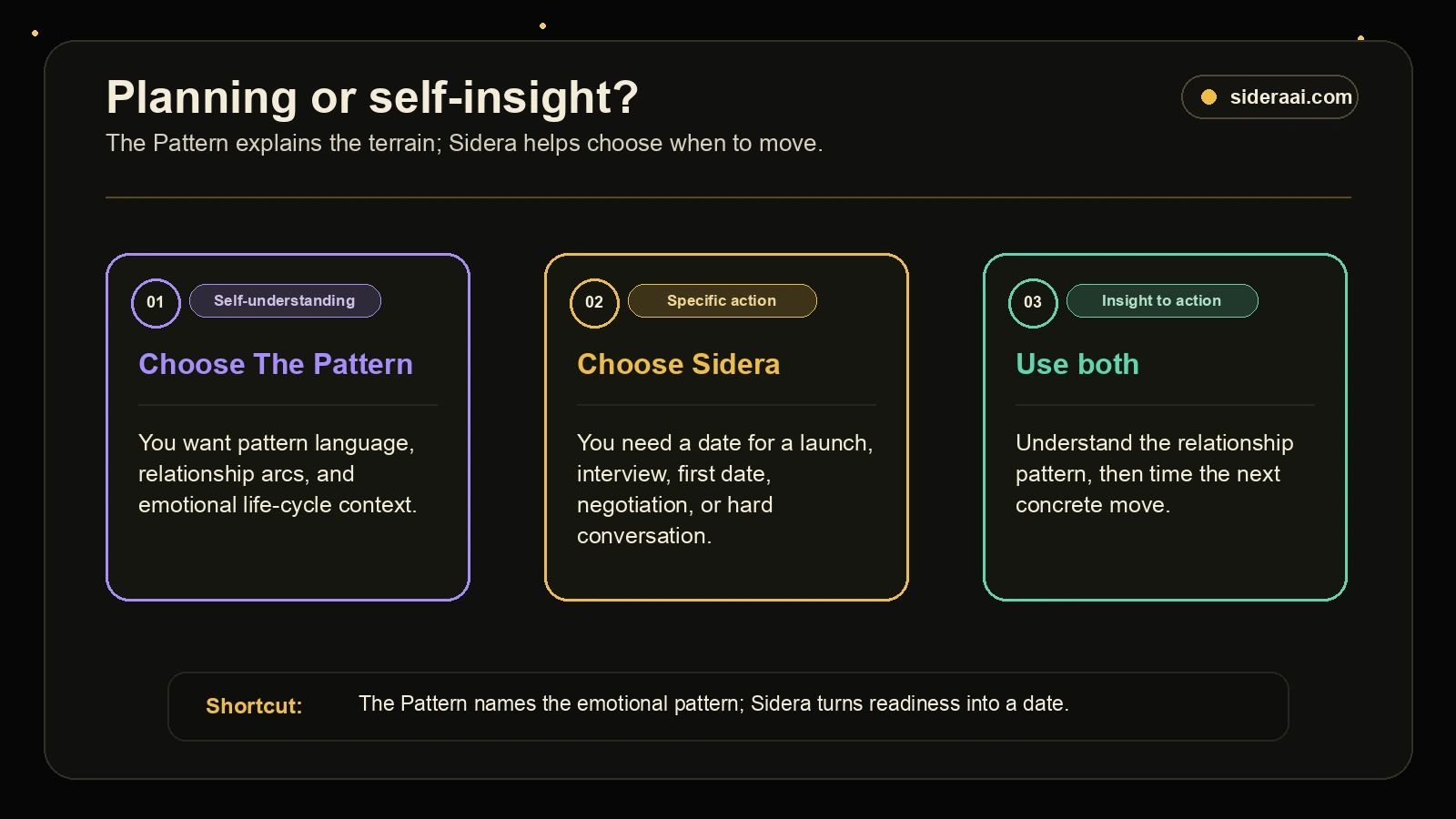
The Pattern explains the terrain; Sidera helps choose when to move across it.
Methodology Box
This comparison draws on editorial analysis of each product’s public positioning reviewed on July 1, 2026. Primary sources: Sidera’s official website (sideraai.com), The Pattern’s App Store listing, and The Pattern’s Google Play listing. A browser capture of The Pattern’s homepage was also reviewed for product language and feature positioning on the same date.
Feature claims in this article reflect current publicly stated product positioning. Subscription tiers, feature availability, and pricing change regularly on both platforms – treat this article as a directional comparison, not an authoritative in-app audit. Qualitative signals from reader community discussions are used as directional reader-language input only and are paraphrased, not reproduced. Third-party screenshots were reviewed as internal research candidates and are not embedded without editorial rights approval.
What Most Comparisons Miss
Most Sidera-vs-Pattern roundups reduce the comparison to: which app has better astrology? That framing misses the actual decision.
The sharper question is: what are you trying to resolve when you open the app?
The Pattern is built for relational and psychological context. It asks: what is the pattern underneath my behavior, and how does it show up in my closest relationships? Its transit language describes the emotional arc of a period rather than naming a day. If you are trying to understand why you keep arriving at the same dynamic with a partner – or why the same wound surfaces in different relationships – The Pattern was built for that inquiry.
Sidera is built for timing decisions. It asks: given my chart and what the sky looks like this week, when is the right moment to act? The calendar scores every day against your specific natal placements. The Find Best Date feature lets you name an intention – sign a contract, start a business, have a salary conversation, schedule a first date – and returns ranked timing windows with plain-language explanations.
Both apps are using the same raw material: your birth chart and current planetary positions. They interpret that material toward completely different ends. For a beginner, the easiest way to hold the difference is this: The Pattern explains the terrain; Sidera tells you which day to move across it.
Original Data
This editorial team assessed both products against a common decision rubric to identify where each app wins clearly and where the choice is context-dependent.
Sidera wins clearly on:
- Daily action timing (calendar scores, Find Best Date search, ranked windows by goal)
- Concrete scheduling decisions (which day to launch, negotiate, sign, or begin)
- AI astrologer access for specific chart-aware questions about current transits
- Calm, practical tone calibrated for decision-making rather than introspection
The Pattern wins clearly on:
- Relationship compatibility depth (Bonds feature, Romantic Timing cycles)
- Psychological pattern language for self-understanding and shadow work
- Life-cycle storytelling and emotional arc for major transit periods
- Connect feature for relationship discovery built on astrological compatibility
- Time Travel for processing past transit periods and previewing future cycles
Context-dependent (either may fit depending on use case):
- Future transit viewing: Sidera’s Pro plan includes forward-viewing and Find Best Date; The Pattern’s Time Travel also surfaces future cycles, but with narrative framing rather than action-date ranking
- Relationship timing: The Pattern leads on compatibility depth; Sidera can still answer timing questions for relationship decisions (when to have a conversation, not just whether the relationship is compatible)
- Daily check-in habit: Sidera’s calendar scoring is concrete and action-oriented; The Pattern’s daily updates are narrative-style and reflective
This rubric is based on publicly available product documentation. Use it as a starting frame, not a final answer – your actual use pattern may break cleanly toward one or the other.
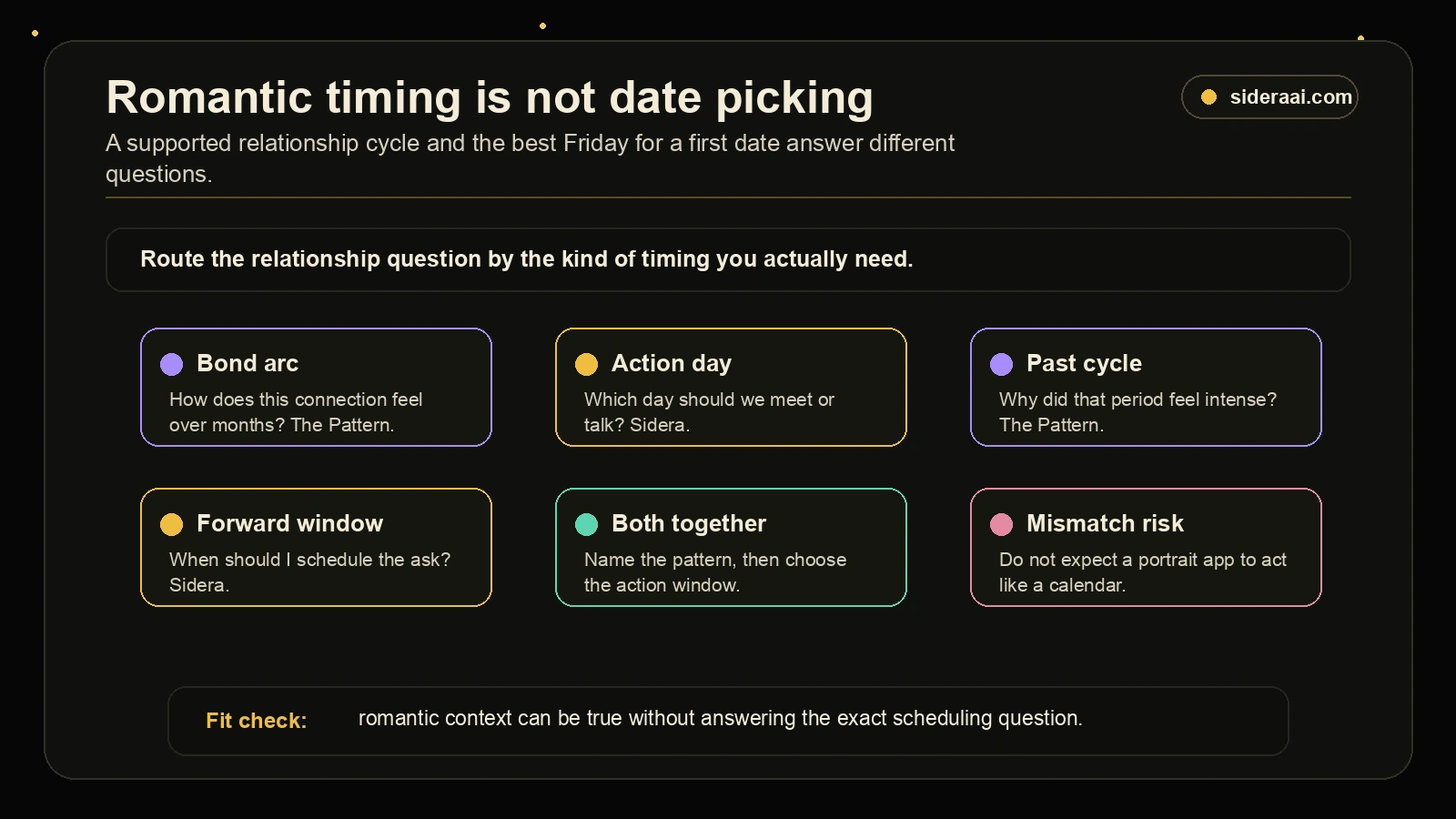
A supported relationship cycle and a best day for a first date are both useful, but they answer different questions.
What Sidera Does
Sidera is a Western tropical astrology planner. Its job is translating your birth chart and current transits into a concrete timing readout for each day.
The daily score reflects how your specific natal placements interact with the aspects currently active in the sky. The calendar view lets you scan across days and compare windows for different kinds of activity. Find Best Date is Sidera’s clearest differentiator: name what you want to do – job interview, difficult conversation, financial decision, creative project launch – and Sidera searches your chart and upcoming transits to return ranked timing windows with plain-language explanations.
The AI astrologer adds a conversational layer. You can ask chart-specific questions – is this Venus-Saturn square going to complicate a salary negotiation this week? – and receive answers grounded in your specific placements rather than recycled keyword summaries.
To understand how the transit aspects that feed Sidera’s daily scores actually work, astrology aspects: conjunction, square, and trine explained covers the foundational mechanics.
Owned Sidera screenshot: the Find Best Date search interface, where you name an activity and Sidera surfaces the strongest timing windows from your chart.
What The Pattern Does
The Pattern’s core strength is self-understanding and relationship context. Its natal chart profiles go deep on psychological patterns, emotional tendencies, and shadow dynamics – framing your chart as a portrait of who you are and why you show up the way you do in relationships, not as a scheduling guide.
Opening The Pattern on a typical morning looks different from opening a planning app. You receive a daily update that reads less like a weather forecast and more like a mirror. It might note that you are in a period of heightened sensitivity around connection, or that a pattern you carry around trust is being activated by current transits. The language is designed to sit with you through the day, not to move you toward a calendar slot.
The Bonds feature lets you add people to your account and generates a compatibility profile that tracks how both chart patterns interact over time. Romantic Timing cycles show whether the conditions between two people are in a supported or strained phase – useful for understanding why a relationship feels easier or harder during a given month. The Connect feature extends this into a relationship-discovery context built around astrological compatibility.
Time Travel lets users move through their own transit history: inspecting past periods to make sense of them, previewing approaching cycles before they arrive. This is particularly useful for processing a difficult year in retrospect – the kind of period that felt chaotic while you were inside it but becomes readable with chart context after the fact.
(Feature descriptions based on App Store listing and Google Play listing reviewed July 1, 2026.)
Comparison Table
| Area | Sidera | The Pattern |
|---|---|---|
| Primary job | Turn chart and transits into daily timing choices | Explain personal patterns, relationships, and life cycles |
| Relationships | AI timing guidance for relationship decisions | Bonds, Romantic Timing cycles, and Connect dating built in |
| Daily use | Calendar scores, ranked activity windows, Find Best Date | Reflective daily updates tied to your emotional arc |
| Future/past timing | Find Best Date searches forward; Pro includes past/future viewing | Time Travel through past and future transit periods |
| Tone | Calm, practical, decision-oriented | Psychological, emotionally immersive, sometimes intense |
| Best for | Planning a specific action on a specific day | Understanding who you are and how your patterns shape your life |
Social Listening
Reader discussions about The Pattern reveal a consistent split in experience that maps cleanly onto the two use cases above.
Users who engage with The Pattern primarily for major life transits – a Saturn return, a significant Jupiter cycle, a period of loss or beginning – tend to find it accurate and resonant. The emotional depth of the language works well when you are in the middle of something large and need a framework to make sense of it. The general signal from communities where The Pattern is discussed: it delivers on big-arc emotional timing.
Users who try to use The Pattern the way they might use a daily planning tool tend to report feeling less grounded. The transit language is calibrated for depth and reflection, not for helping someone choose between Tuesday and Wednesday for a specific action. That mismatch in expectation – wanting a schedule and receiving a portrait – is worth understanding before downloading.
A separate thread of feedback points to friction around feature changes and monetization over time. Readers who valued specific early features sometimes describe those features having shifted behind paywalls or changed in character. This is not unusual in subscription app ecosystems, but it is worth checking current tier structures in-app before subscribing rather than relying on older reviews.
A third concern that surfaces in reader communities: The Pattern’s language around difficult transit periods can feel heavy for some users. The same psychological intensity that makes The Pattern compelling for self-reflection can occasionally tip into fatalistic framing around harder cycles. This is not a reason to avoid the app, but it is worth considering if you find astrological language around challenges anxiety-provoking rather than grounding.
These signals are directional, drawn from qualitative community discussion, and not statistical proof. They are included here because they represent the category of experience questions readers should weigh when choosing between an introspective tool and a planning-first tool.
Decision Tree
You want The Pattern if:
- Your primary question is about who you are and why you keep arriving at the same relationship dynamics
- You want a Bonds feature that tracks another person’s pattern alongside yours over months
- Romantic timing cycles and emotional arc language resonate more than calendar scores
- You want to process a major transit period in retrospect using Time Travel
- You are going through something – a breakup, a career shift, a grief period – and want language that meets the emotional weight of it
You want Sidera if:
- Your question is when: which day to launch, when to have the difficult conversation, which window to schedule the interview or sign the contract
- You want a calendar that scores every day against your specific placements and lets you search for the best dates by named goal
- You prefer a calm, decision-oriented tone that treats your chart as a guide for action rather than a mirror for reflection
- You want an AI astrologer to answer specific transit questions rather than reflect a general emotional arc back to you
Concrete example: You are planning a first date with someone you care about and you are nervous about it. The Pattern tells you whether your bond is in a supported romantic timing cycle right now – the emotional arc between the two of you, whether this period favors connection or friction. Sidera tells you which Friday this month has the strongest planetary support for a positive first impression given your specific chart. Both answers are useful. They are not the same answer.
You may want both if:
The Pattern gives you the psychological vocabulary to understand your recurring patterns. Sidera gives you the timing layer to act on that understanding more strategically. These are complementary use cases, not competing ones – and the readers who get the most out of both are usually clear about which question they are asking before they open each app.
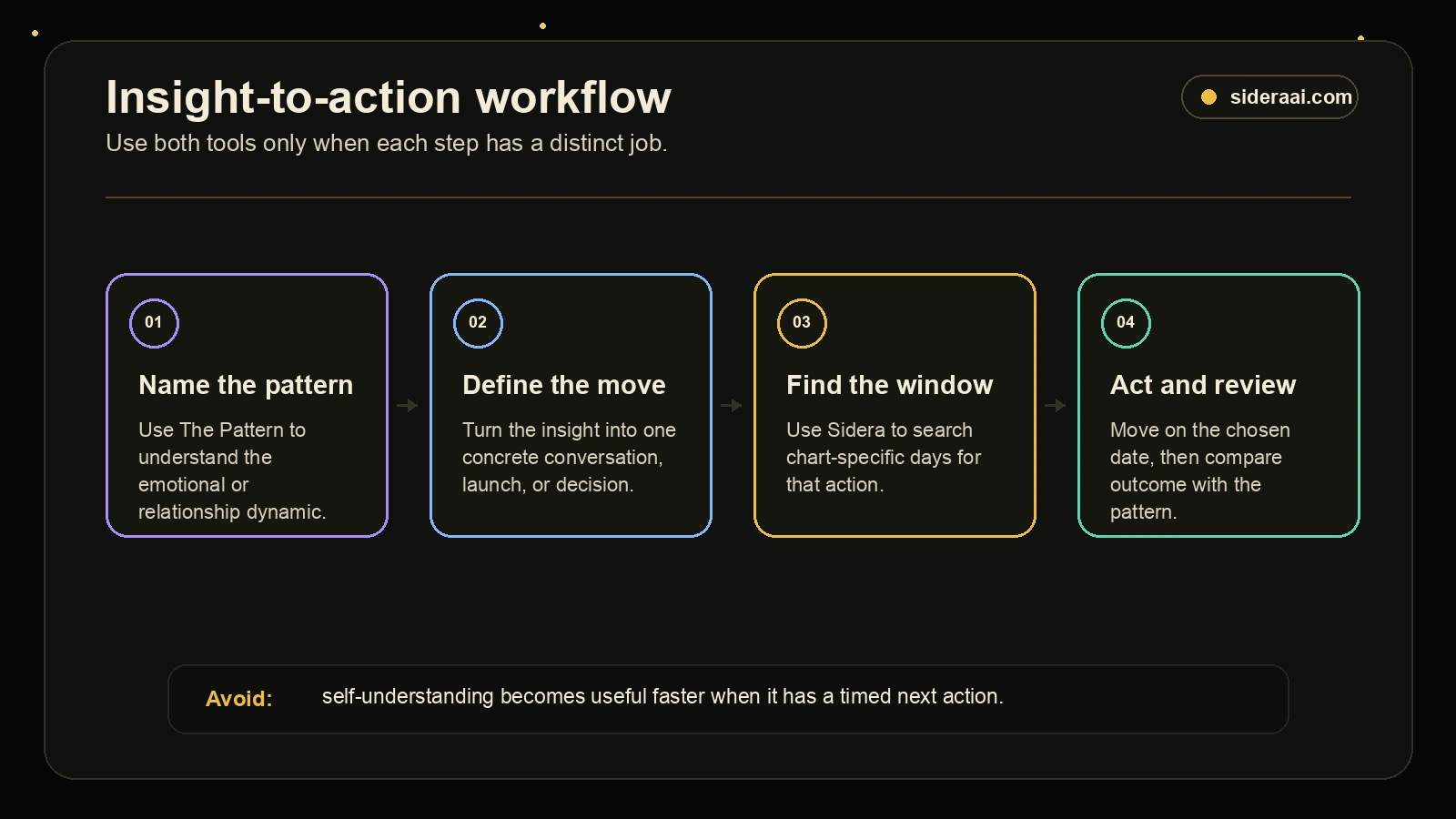
Use both tools only when each step has a distinct job: insight first, then a timed action.
For a practical walkthrough of how astrology timing decisions work for specific situations, using astrology to find the best day for a job interview shows how chart-specific timing translates into a real scheduling decision.
Freshness Note
The Pattern’s features, subscription tiers, and pricing change with some regularity. The Bonds, Connect, and Time Travel features described here reflect publicly available product documentation and app-store listings reviewed July 1, 2026. Before subscribing, confirm in-app which features are included at each tier and whether the functionality you are comparing has changed since this article was published.
Sidera’s Find Best Date and AI astrologer features are also subject to product updates. Treat app-store listings and in-app feature screens as the authoritative source rather than any third-party review, including this one.
Which App Fits Right Now?
The right question is not which app is better at astrology. It is: what are you actually trying to answer today?
If the question is about understanding – a relationship dynamic, a recurring pattern, the emotional arc of a difficult period – The Pattern was built for that question. Its language is designed to sit with you through the day, not to move you toward a calendar slot.
If the question is about timing – what day to launch, when to have the conversation, which week has the strongest window for a financial decision – Sidera was built for that question. It gives you a score, a ranked list, and a chart-aware explanation tied to your specific placements.
The gap between insight and action is where many astrology users stall. You can develop a rich understanding of your chart and still not know when to move. The Pattern can give you the language to understand what you are carrying. Sidera can give you the calendar date to act on it. Using one without knowing the other exists is a common reason people feel like astrology works in theory but not in practice.
For readers who want to understand the chart mechanics before committing to either app, how to read a birth chart for beginners builds the foundation that makes both tools meaningfully more useful.
Frequently Asked Questions
Is The Pattern better than Sidera?
Neither app is universally better. The Pattern is stronger for self-understanding, relationship insight, and emotional life-cycle language. Sidera is stronger for concrete timing decisions, ranked calendar days, and planning actions from your birth chart.
Does Sidera have relationship timing like The Pattern?
Sidera can answer relationship timing questions through its AI astrologer and timing workflows, but it is not built around a Bonds-style compatibility feed. The Pattern is the better fit if relationship pattern tracking is the main job.
Which app should I use for choosing a date?
Use Sidera when the question is which day to act. Its Find Best Date workflow and daily scoring calendar are designed to turn transits into ranked timing windows.
Can I use Sidera and The Pattern together?
Yes. The Pattern can help you understand the emotional or relationship pattern underneath a situation, while Sidera can help you choose when to act on that understanding.
Do both apps use Western astrology?
Both apps are positioned around Western tropical astrology. The practical difference is how they package that chart data: The Pattern emphasizes psychological insight, while Sidera emphasizes action timing.
Ready to See Your Personal Birth Chart?
Discover your unique cosmic blueprint — planets, houses, and aspects personalized to your exact birth time and location.
Get Your Birth Chart →✓ Birth chart analysis ✓ Personalized insights ✓ Free to use
Related Sidera Guide
Continue with this closely related guide: