You have a decision in front of you. Maybe a contract you want to sign, a difficult conversation you have been putting off, or a launch you are finally ready to push. You open an astrology app looking for a clear signal – is this week actually good for this? What comes back is a paragraph about trusting the season you are in and aligning with your higher purpose.
That is not a bad reading. But it is not what you came for.
This is the mismatch that sits under most “Sidera vs Nebula” comparisons. Both apps work with astrology. Both offer daily guidance. But they are not built for the same moment. One is a timing calendar. One is a spiritual companion. If you pick based on a generic “best astrology app” roundup, you will end up with the wrong tool and wonder why it did not solve your problem.
Here is how to tell which one you actually need.
Methodology Box
This comparison draws from publicly available information verified June–July 2026:
- Sidera: Official website (sideraai.com), in-app feature documentation, and public pricing page
- Nebula: App Store listing (Apple, June 2026), Google Play listing (June 2026), and official website (asknebula.com, June 2026)
- Community signals: Qualitative patterns from public community discussions, paraphrased without attribution to specific users; not presented as universal user experience
- Third-party screenshots: Not embedded in this article; internal research candidates pending editorial review
App features, pricing, and advisor availability change with product updates. Verify before subscribing.
What Sidera Is Built to Do
Sidera’s core job is taking your specific birth chart – calculated in Western tropical astrology – and reading it against the current planetary sky. Every day, planets form angles (aspects) to your natal placements. Sidera tracks over 200 daily aspects per chart and converts them into a scored calendar view.
The practical output is a day-by-day picture of your cosmic conditions for real actions. The Find Best Date feature searches upcoming days for a specific goal – a contract, conversation, launch, or application – and returns chart-specific ranked results with interpretive explanations. You come in with a question (“Is next Tuesday better than Thursday for this meeting?”) and leave with a ranked answer tied to your actual planetary positions, not your sun sign.
That is the gap Sidera is built to close. If you have ever read a daily horoscope and felt it could apply to anyone born in a 30-day window, that experience is exactly what chart-specific transit reading solves. For deeper background on how transits work against a natal chart, see this guide to birth chart interpretation.
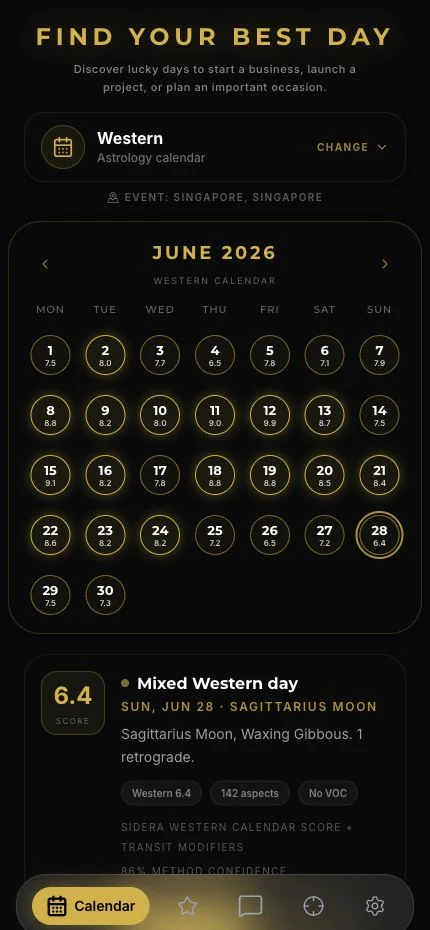
Sidera is deliberately narrow. It does not offer human advisors, psychic readings, or a spiritual community. It is a planning tool powered by astrological calculation – and that narrowness is a design decision, not a missing feature.
What Nebula Is Built to Do
According to its App Store listing (June 2026), Nebula has built a community of over 12 million users around daily zodiac readings, compatibility insights, tarot, full zodiac charts, and live chat readings with human advisors. Its Google Play listing describes daily zodiac readings, astrology insights, zodiac compatibility, horoscope features, and a full zodiac chart. Nebula’s official website (asknebula.com, June 2026) frames the service around “psychic readings, grounded wisdom, clarity, self-discovery, and spiritual well-being.”
In practice, Nebula is a daily ritual app. You might open it in the morning to read your zodiac forecast, check a compatibility snapshot with a person you have been thinking about, or explore a tarot draw. If something in your life feels unresolved and you want a human perspective – not an algorithm – you can connect with a live advisor through the app’s chat reading feature. The experience is designed to be warm, broad, and reflective.
That human-advisor layer is the most distinctive thing Nebula offers that Sidera does not. For readers who want the feeling that someone is actually listening, not just a calculation scoring the day, that is a real product advantage. The app is also a more natural entry point if you are new to astrology: daily zodiac content and compatibility features give you meaningful interaction before you are ready to work with transit specifics.
What Nebula is less optimized for is the narrow, chart-specific timing question: “Which days this month are best for a difficult conversation, based on my personal planetary aspects?” Surfacing chart-specific date rankings for concrete actions is not Nebula’s primary design goal. For that job, Nebula’s daily guidance will often give you something true and reflective but not the ranked answer you were looking for.
What Most Comparisons Miss
Most “Sidera vs Nebula” comparisons treat both as astrology apps and compare features side by side. That framing misses the more important distinction.
A spiritual guidance app is not doing the same job as a chart-based planning calendar. They are not different versions of the same product – they serve different moments and answer different kinds of questions.
Nebula’s live advisor and psychic features are not astrology calculation tools. They are human-mediated support experiences. Some readers want exactly that: the presence of someone listening, responding, and offering personal reflection. That is a real and legitimate need, and Nebula is genuinely built to meet it.
Sidera’s transit calendar is not a spiritual companion. It is closer to a decision-support tool that runs on astrological data. You bring a question, and it returns a ranked answer with a chart-based explanation. No human is on the other end; the intelligence is in the calculation and interpretation layer.
Conflating these two experiences is why readers end up disappointed with both. Nebula users who expected chart-level timing precision sometimes find the astrology reads at the sign level rather than the full-chart level. Sidera users looking for emotional conversation or daily spiritual ritual find it too narrow. Neither is a product flaw – it is a product-to-use-case mismatch. The question to ask yourself before you subscribe to either is: what is the actual job I am trying to do?
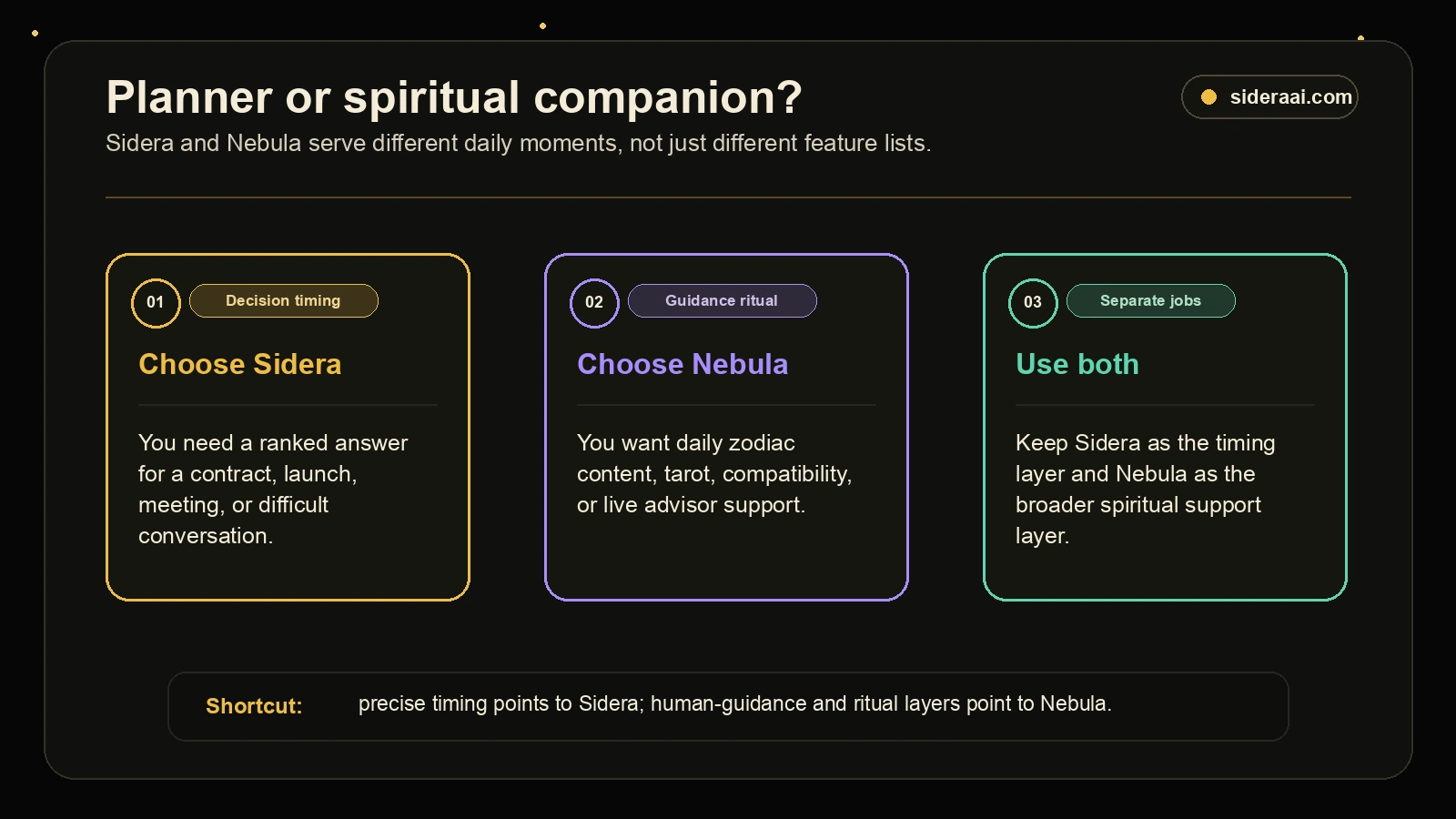
Choose by the daily moment: precise timing belongs to Sidera, while broader spiritual support belongs to Nebula.
Sidera vs Nebula: Feature Comparison
| Feature area | Sidera | Nebula |
|---|---|---|
| Primary job | Astrology planner for chart-based day and event timing | Spiritual guidance app with horoscopes, compatibility, live readings, and advisors |
| Astrology system | Western tropical birth chart | Zodiac-based readings inside a broader spiritual platform |
| Personalization depth | 200+ daily aspects per chart, AI interpretation | Daily zodiac readings, compatibility, and horoscope features |
| Human/advisor support | AI astrologer only | Live chat readings and psychic/advisor experiences are central |
| Timing decisions | Find Best Date and calendar scoring are core workflows | Daily guidance and insights; event-specific date ranking is not a primary feature |
| Community size | – | 12+ million users (App Store listing, June 2026) |
| Pricing model | Free tier + Pro subscription; verify at sideraai.com | Subscription model; trial terms vary – see checklist below |
Social Listening
Community discussions around Nebula surface patterns worth knowing before you subscribe. Users who came looking for chart-specific guidance sometimes find the astrology reads at the sign level rather than the full-chart level. The experience can feel clean in design and warm in tone, but less anchored to individual planetary placements – a meaningful gap if precise transit timing is what you came for.
The other recurring theme in community discussions is subscription friction. Some users report confusion around trial offers that transition to higher renewal rates, and cancellation paths that are not immediately obvious within the app. These are qualitative signals, not universal user experience, and many Nebula users are satisfied with the product. But the pattern is consistent enough across public community sources that the pricing checklist below is worth working through before you enter payment details.
Sidera attracts less of this type of concern partly because the product offer is more contained: one core job, one feature set, one clear subscription path. But any subscription app warrants scrutiny before you commit. The question is always the same: do you know what you are paying for, and do you know how to stop if you change your mind?
Original Data
Decision rubric – Sidera vs Nebula by reader intent (based on verified public product positioning, July 2026):
| What you want to do | Better fit |
|---|---|
| “Find the best day for a specific action” | Sidera |
| “Get daily reflective guidance and spiritual support” | Nebula |
| “Connect with a human reader or psychic advisor” | Nebula |
| “Read my full birth chart against today’s transits” | Sidera |
| “Explore compatibility and zodiac-based rituals” | Nebula |
| “Get AI interpretation tied to my actual placements” | Sidera |
This rubric maps reader intent to product design – not feature count. Use it as a quick alignment check before you subscribe.
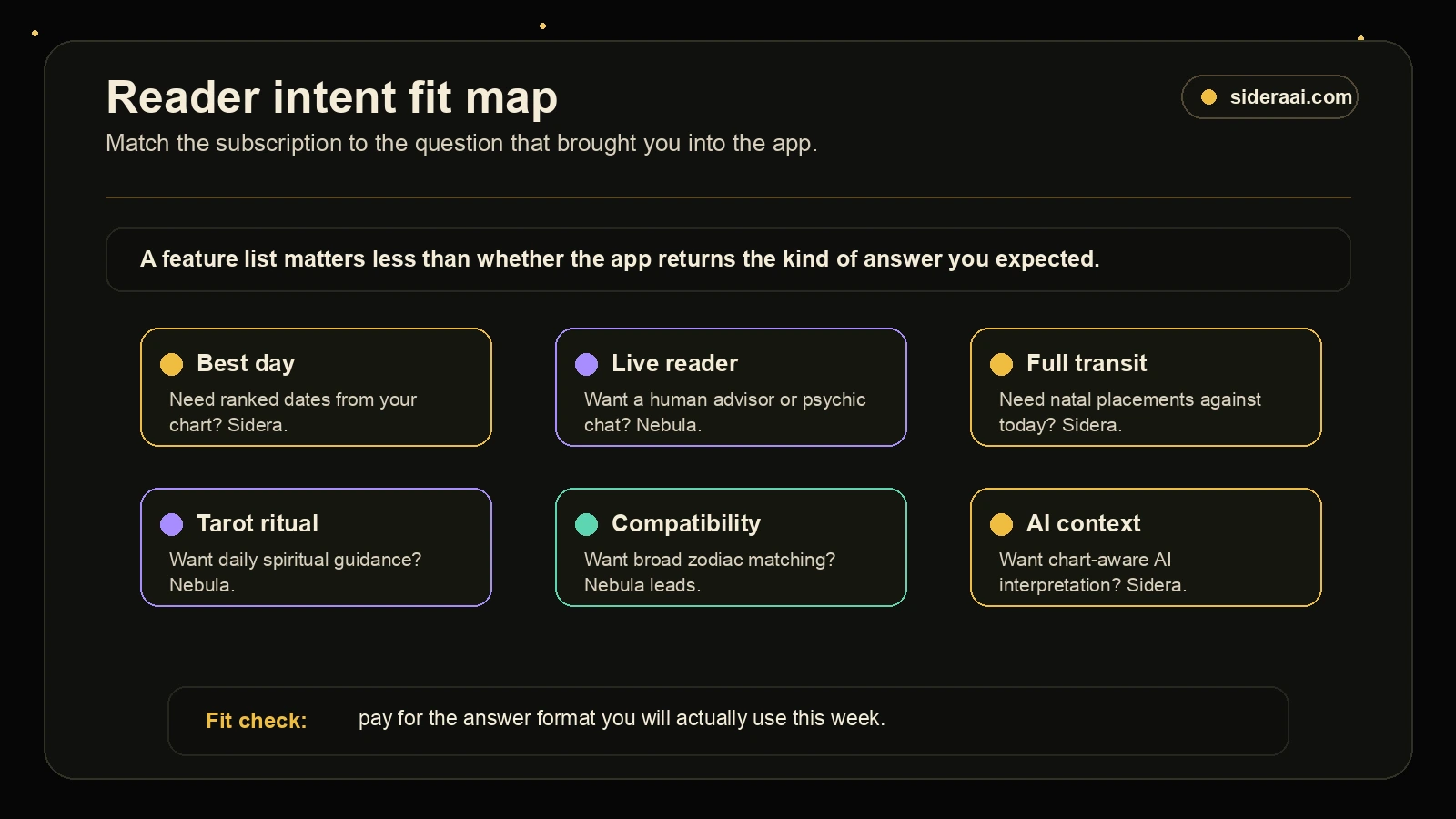
The best-fit app is the one that returns the answer format you expected when you opened it.
Pricing and Subscriptions: What to Check Before You Subscribe
For both apps, work through this before entering payment details:
- Trial terms: What happens when the trial ends? Does it auto-renew, and at what price?
- Renewal price: Is the renewal price visible before you complete the purchase?
- Billing cycle: Monthly or annual? Is the annual rate disclosed before you commit?
- Cancellation path: Can you cancel from within the app, or does it require going through iOS Settings → Subscriptions or Google Play → Payments and Subscriptions?
- Refund policy: What is the refund window if you change your mind?
App store subscription controls are the safest place to verify and cancel active subscriptions: iOS Settings → your name → Subscriptions; Google Play → Payments and subscriptions.
Sidera’s pricing is published at sideraai.com. Verify the current tier before subscribing.
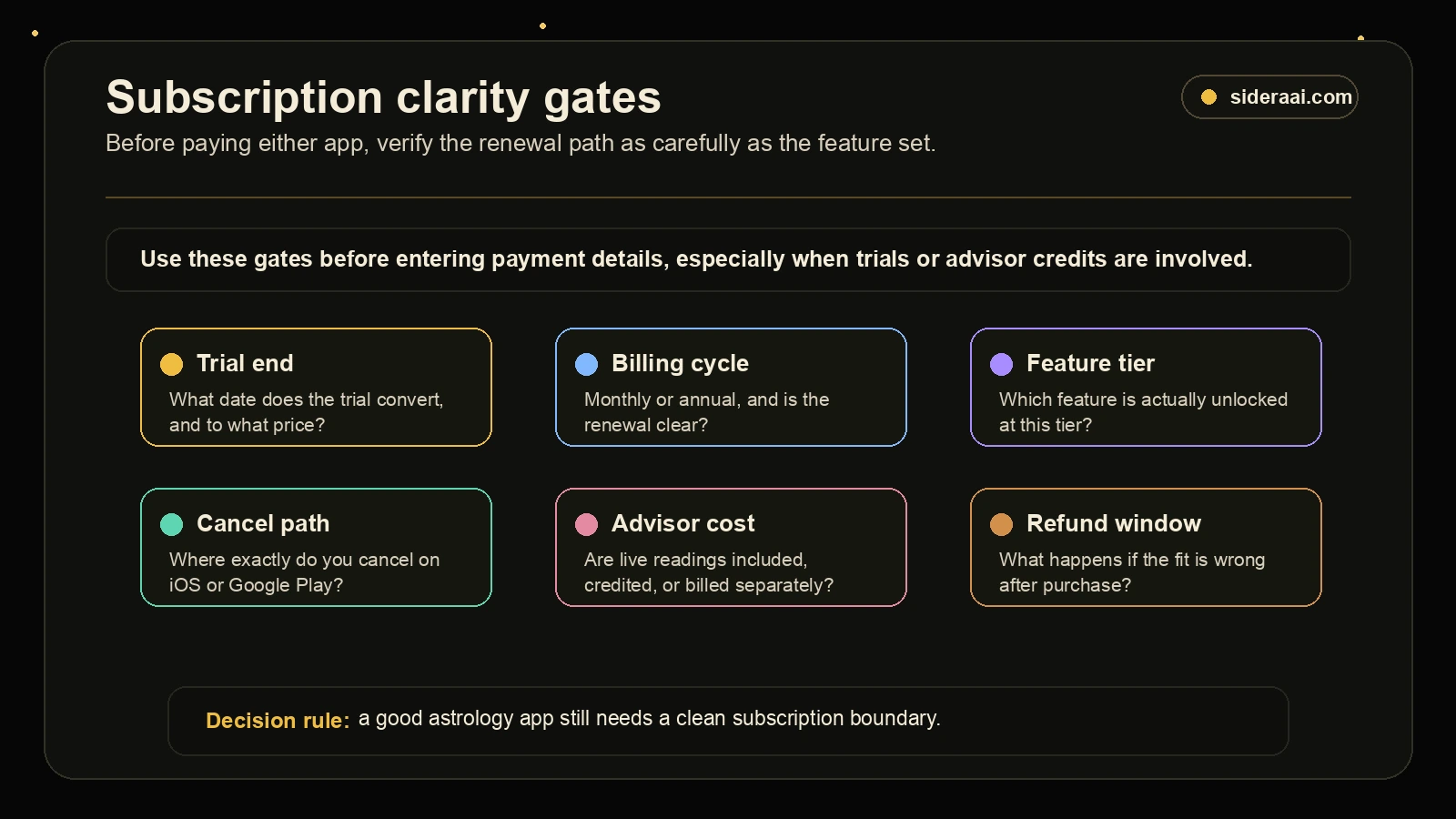
Before paying either app, verify the renewal path as carefully as the feature set.
Decision Tree
Choose Sidera if:
- You have a specific question: “Is this a good day or week to push this forward?”
- You want timing based on your natal placements and what is actually in the sky against them
- You want AI astrology interpretation tied to your full birth chart, not your sun sign
- You need to find the best date for a contract, launch, or conversation – see also this guide to auspicious days for signing contracts
- A focused, calculation-based tool fits your workflow better than a broad spiritual platform
Choose Nebula if:
- You want daily spiritual guidance, emotional support, or reflective content as a regular ritual
- You want the option to connect with a human advisor or psychic reader
- Compatibility insights and zodiac content matter more to you than precise date-timing
- You are new to astrology and want a welcoming, broad entry point before working with transit specifics
- Tarot and spiritual wellness experiences are part of what you are looking for
On using both: Some readers use Sidera for practical timing decisions and a separate practice or app for their daily emotional and spiritual needs. These can coexist without conflict. Clarity about which job you are solving – before you open your wallet – is the whole game.
If you have arrived at “I want to know whether this week is actually good for this thing I am about to do,” that is a Sidera question.
Freshness Note
App features, pricing tiers, and advisor availability for both Sidera and Nebula change with product updates. The comparison table and feature notes in this article reflect publicly available information as of June–July 2026. Before subscribing to either app, verify current feature sets and pricing directly in the app and on the product’s official website.
Frequently Asked Questions
Is Nebula a legitimate astrology app? Nebula is a real product. According to its App Store listing (June 2026), it has over 12 million users and offers daily zodiac readings, compatibility content, horoscopes, tarot, and live advisor experiences. As with any subscription app, check the trial terms, renewal price, and cancellation process before subscribing – public community discussions consistently surface billing friction as a concern worth verifying firsthand.
Does Sidera offer live psychic or advisor readings? No. Sidera does not offer human advisors, psychic readings, or live chat experiences. Its intelligence is AI-powered interpretation based on your Western tropical birth chart and current planetary transits. If you want a human reader, Nebula’s advisor feature is built for that experience.
Which app is better for finding a lucky day or best date? Sidera is built specifically for this. Its Find Best Date workflow searches upcoming days against your birth chart and returns ranked results with chart-specific explanations. Nebula’s daily insights offer broader guidance but do not surface chart-specific date ranking as a core feature. For more on timing approaches, see this guide to choosing the best day to start a business.
Does Sidera use Western or Vedic astrology? Sidera uses Western tropical astrology. It calculates planetary placements based on the tropical zodiac, not the sidereal/Vedic system. If you are looking for Vedic chart interpretation, that is a separate tool category with different calculation methods.
Can I use both Sidera and Nebula at the same time? Yes. They serve different functions and can complement each other. Sidera works as your timing and planning layer; Nebula can work as your broader spiritual-guidance and community experience. If you subscribe to both, apply the pricing checklist above to each so you are clear on what you are paying and how to cancel if needed.
What is the main difference between Sidera and Nebula? Sidera is a Western tropical astrology planner that reads your full birth chart against current planetary transits and helps you find better days for specific actions. Nebula is a broader spiritual guidance app with daily zodiac readings, compatibility content, tarot, and live advisor experiences. They serve different daily jobs: Sidera is for timing a decision, Nebula is for reflective guidance and spiritual support.
Ready to See Your Personal Birth Chart?
Discover your unique cosmic blueprint — planets, houses, and aspects personalized to your exact birth time and location.
Get Your Birth Chart →✓ Birth chart analysis ✓ Personalized insights ✓ Free to use