
You downloaded an astrology app because you wanted your chart to mean something in real life. Not a vague personality summary. Not a daily notification that leaves you more anxious than when you woke up. You wanted something specific, grounded, and actually useful on a Tuesday when you have a real decision to make.
Sidera and Co-Star both start from your birth chart. After that, they split completely. The comparison most people run – feature lists and star ratings side by side – misses the real question: what job is each app built to do, and which job do you actually need done right now?
Quick Verdict
Choose Co-Star if your primary use for astrology is a daily horoscope grounded in your full chart, comparing placements with people in your life, or receiving blunt and memorable push notifications that catch you off guard and push you toward self-reflection.
Choose Sidera if you want to take a real action – a launch, a negotiation, a first conversation, a commitment – and you want to know whether this week or next month is the better window for it, with chart-specific reasoning attached.
Both apps use Western tropical astrology and build from your full natal chart. The error is reaching for Co-Star when you need a planner, or opening Sidera when what you actually want is a sharp daily read and social chart comparison.
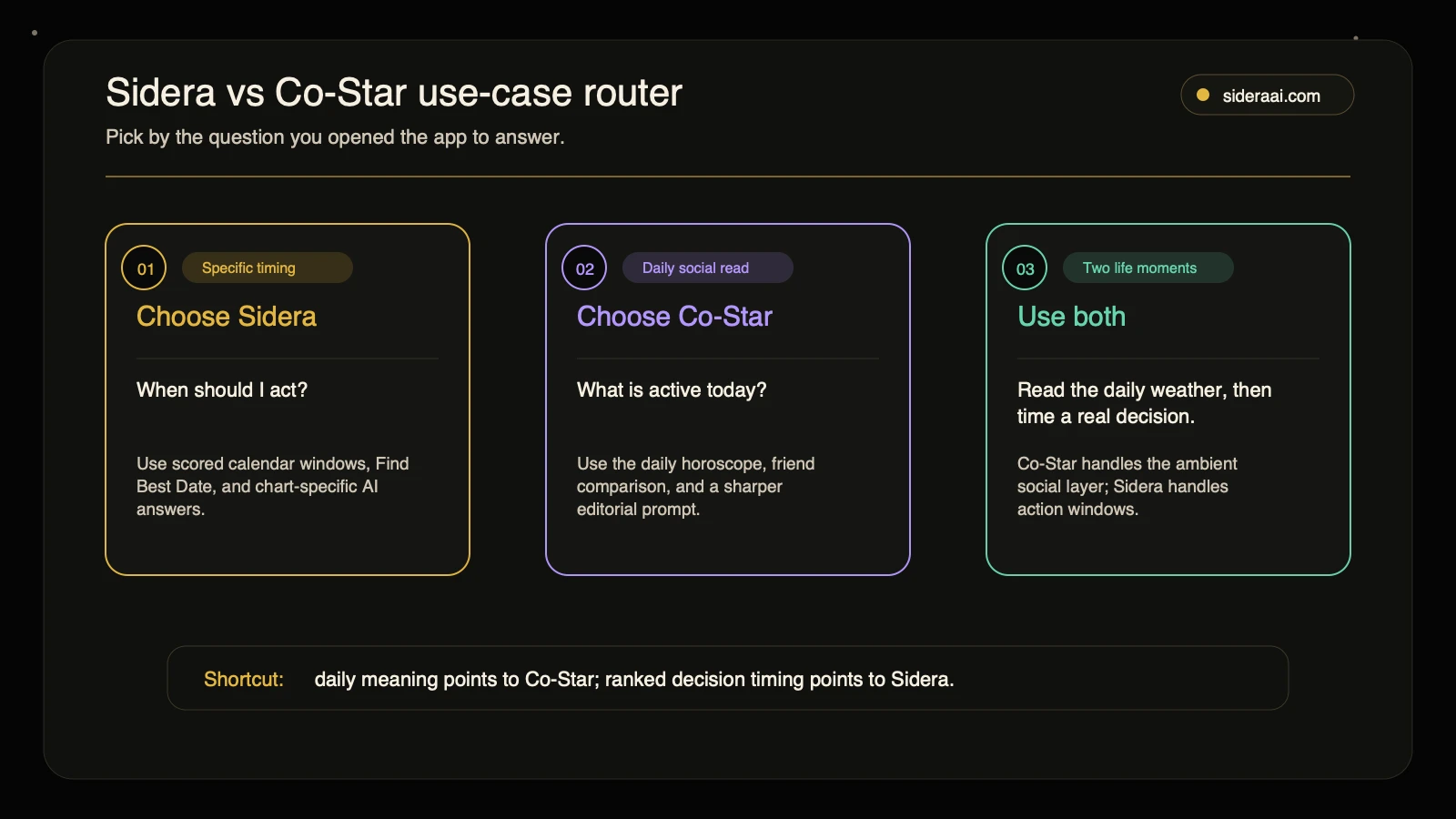
Use this router before comparing feature lists: daily meaning points to Co-Star, while ranked decision timing points to Sidera.
What Most Comparisons Miss
Every Co-Star roundup runs the same template: feature list, price, screenshots, star rating. None of them ask the more useful question: what do you actually do with an astrology app each day?
Co-Star is a daily-read and social tool. You open it to see how today looks, check compatibility with a friend, or receive a notification that catches you off guard. The birth chart is the input; the daily content and the social connection are the product.
Sidera is a planning tool. You open it to score an upcoming week, find the best date to send a proposal, or ask an AI astrologer a direct question about what a current transit means for your finances or career. The birth chart is the input; the timing decision is the product.
These are not better and worse versions of the same thing. They are different products solving different problems. Knowing this before you download saves you from the most common disappointment in astrology apps: choosing the right product for the wrong job.
What Co-Star Does
Co-Star built its reputation on making astrology social. The app uses NASA ephemeris data combined with AI and human astrologer editorial input to generate natural-language horoscopes personalized to your full birth chart – not just your sun sign. Each day, it delivers interpretive language about what is active in your chart across mood, relationships, focus, and energy.
Co-Star’s official positioning, verified on their homepage in July 2026, emphasizes personalized horoscopes built from birth chart plus real-time planetary positions, alongside social comparison and friend compatibility as core features. The App Store listing as of the same date shows over 205,000 ratings at a 4.8 out of 5 average score – one of the highest-rated astrology apps available.
A typical Co-Star session looks like this: you open the app in the morning, read your daily planetary breakdown, then navigate to a friend or partner’s chart to see how the day is landing differently for them. You share something that resonates. You might receive a push notification later that reads like a blunt observation about your mood or choices. That notification is the thing Co-Star is most known for – delivered in a distinct editorial voice that is direct, sometimes uncomfortable, and intentionally designed to stick.
The social layer is the real differentiator. You add friends using their birth data, compare chart placements side by side, share compatibility reads, and see how the current sky is landing across your circle. If astrology is something you use as a shared language – with a partner, a close group, or a community – Co-Star is built precisely for that.
What Sidera Does
Sidera describes itself as a personalized astrology planner built to help you find best days to launch, sign, decide, or begin – grounding every recommendation in your birth chart read against the live sky each day.
Every day, Sidera scores the incoming aspects between your natal placements and current transits: over 200 aspects tracked daily. The result is a favorability and intensity score for each day – not a general mood forecast, but a reflection of what the transits are actively creating in your specific chart.
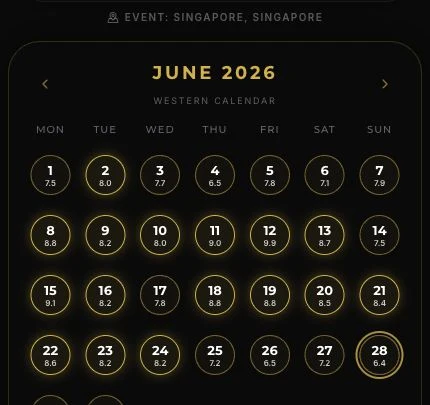
The Find Best Date feature takes this further. You give Sidera an action category – a launch, a contract signing, a difficult conversation, a financial decision, a creative project – and the app searches forward through your calendar and returns ranked windows with reasons tied to your specific placements. Not “this week looks generally good” but a specific date with reasoning grounded in your chart.
Sidera also includes an AI astrologer that answers plain-language questions about your chart or current transits. The interpretation is specific to what is in your chart and what is active right now, not keyword-based generalization that could apply to anyone. A typical Sidera session for a timing decision looks like: check the monthly calendar for high-scoring windows, ask the AI astrologer why a specific date scores well, then act on a window that aligns with your goals and your chart’s current conditions.
For a deeper look at the timing tradition Sidera’s planning tools operate within, electional astrology explained covers the framework astrologers use to select favorable dates for specific actions.
Social Listening
Community discussions around Co-Star surface three recurring patterns worth knowing before you commit to it.
The tone question. Many readers describe Co-Star’s notification voice as sharp and memorable – by design. Others, particularly those in high-pressure periods, find the directness amplifies anxiety rather than providing useful context. This comes up consistently enough in astrology community discussions to be worth flagging as a functional consideration: Co-Star’s editorial tone is a deliberate creative choice, not a product flaw, and it produces strongly divided reactions depending on what the reader is going through when the notification arrives. In a stable, curious headspace, the bluntness is often the point. Mid-crisis, the same phrasing can land badly.
The depth migration question. Readers who start with Co-Star and eventually want more – clearer transit logic, deeper placement context, specific planning utility – frequently look for a second app or a replacement. The most common shift is toward tools that explain why something is happening in the chart, not just that it is. Some readers identify Co-Star’s broadcast-style delivery as the trigger: the daily language reads personalized but does not always feel grounded in the specific dynamics of their chart. For those readers, a more interactive or question-based interpretation tool becomes more useful over time.
The cost and friction pattern. App Store discussion surfaces friction around Co-Star’s in-app purchase structure: readers who build habits around free-tier features and then encounter paywalls when those features change, or who experience lockups after app updates. These are practical risks worth noting before committing to the free tier long-term.
Methodology Box
This comparison was built using the following sources, all accessed in June–July 2026:
- Sidera official website (sideraai.com): Feature claims verified directly from the homepage and product pages. Sidera describes itself as a personalized astrology planner with daily transit scoring, Find Best Date, a cosmic calendar, and an AI astrologer operating in Western tropical astrology.
- Co-Star official website (costarastrology.com): Co-Star’s positioning around NASA data, natural-language birth chart horoscopes, social comparison, and friend compatibility verified from their homepage.
- Apple App Store listing, Co-Star Personalized Astrology: Rating count (205K+), average score (4.8), in-app purchase items, and subscription tier names verified from the live listing. Screenshots and visible review content were reviewed as qualitative research only and are not reproduced here without editorial approval.
- Community discussion patterns: Qualitative signals from astrology reader communities were reviewed for recurring language around tone, depth, and switching behavior. No individual comments, usernames, or engagement metrics are cited or reproduced. These patterns inform the Social Listening section above but are treated as observed qualitative signals, not statistical evidence.
- Internal product knowledge, Sidera: Feature depth and scoring methodology confirmed through direct use and internal product documentation.
Feature availability and pricing change frequently. The functional difference between the two apps – social daily horoscope versus chart-based planning tool – is structural and stable, but verify specific plan details in-app before subscribing.
Original Data
After reviewing both products against real switching behavior and community discussion patterns, one structural finding stands out: the readers who feel most disappointed by an astrology app are usually the ones who chose the right product for the wrong job.
Co-Star frustrates the reader who needed a planning tool and got a daily notification instead. Sidera frustrates the reader who wanted a social horoscope and got a calendar-scoring system instead. Job-to-be-done mismatch is more predictive of satisfaction than feature count, star rating, or price point.
The second finding: these apps address different life moments. Co-Star is useful when your question is ambient – how does today feel, what is live in my chart right now, what is the vibe between me and this person? Sidera is useful when your question is specific – when should I act, which week gives me better conditions, what does this transit mean for a decision I have coming up?
Both findings suggest the right recommendation is not “which app is better” but “which question are you asking today?”
Comparison Table
| Area | Sidera | Co-Star |
|---|---|---|
| Primary job | Chart-based timing and planning | Social horoscope and daily read |
| Timing tools | Find Best Date, cosmic calendar, scored windows | Daily horoscope and real-time insights |
| AI interpretation | AI astrologer reads your chart and live transits | Natural-language engine (AI + human astrologers) |
| Social features | Relationship timing via AI astrologer | Friend comparison, compatibility, chart sharing |
| Notification tone | Calm, decision-oriented | Sharp, edgy, intentionally blunt |
| Astrology system | Western tropical | Western tropical |
| Best for | Planning specific actions from your chart | Daily reflection and social chart connection |
| Depth on request | Ask direct questions, get chart-specific answers | Curated daily content, broadcast-style delivery |
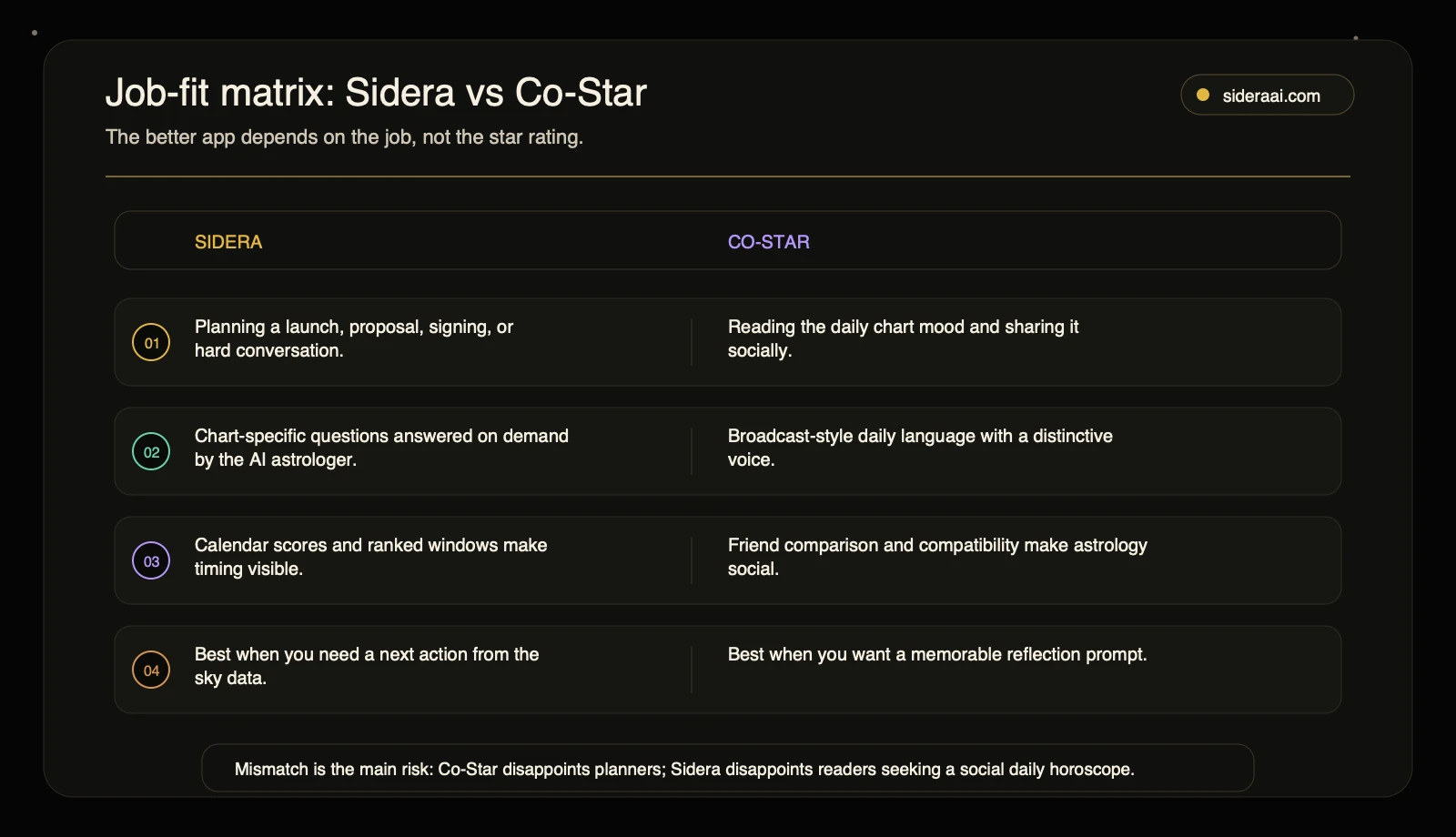
The matrix compresses the comparison table into the real job-to-be-done split: Sidera is for action timing, while Co-Star is for daily social reflection.
Decision Tree
What do you open an astrology app to do?
→ You want a daily read and a sharp prompt for self-reflection → Co-Star
→ You want to compare your chart with a partner, friend, or group → Co-Star
→ You are new to birth chart astrology and want a social entry point with daily personalized language → Co-Star
→ You want a notification that might sting but makes you think → Co-Star
→ You want to know if this week or next month is better timing for a specific action → Sidera
→ You have a real decision coming – professional, financial, or relational – and want your chart’s timing input → Sidera
→ You understand your chart basics and want to use them as a planning layer → Sidera
→ You want to find the best day to sign a lease, start a project, or have a hard conversation → Sidera
If you are still building your understanding of chart placements, how to read a birth chart for beginners gives you the foundation before you start applying transits to real decisions. If you already know your placements and want to use the current sky as a timing layer, astrology aspects: conjunction, square, and trine explained covers the mechanics that underpin both apps’ daily calculations.
Accuracy, Tone, and Trust
Both apps use accurate Western tropical birth chart calculations. Co-Star has publicly cited NASA ephemeris data as part of its data layer, combined with AI generation and human astrologer editorial input. Sidera tracks over 200 aspects daily across your natal chart and live transits, with AI interpretation specific to your placements and current conditions.
The meaningful difference is not calculation accuracy – both track the same sky. The difference is in what each app does with that data after it is calculated. Co-Star produces a daily editorial voice: sharp, personalized, designed to prompt thought or catch you off guard. Sidera produces a scoring and ranking system that surfaces upcoming windows and answers direct questions about when to act.
Neither app involves guaranteed outcomes. Astrology-based timing is a decision-support layer, not a deterministic forecast. The strongest use of either app is as one input among several, not a replacement for judgment.
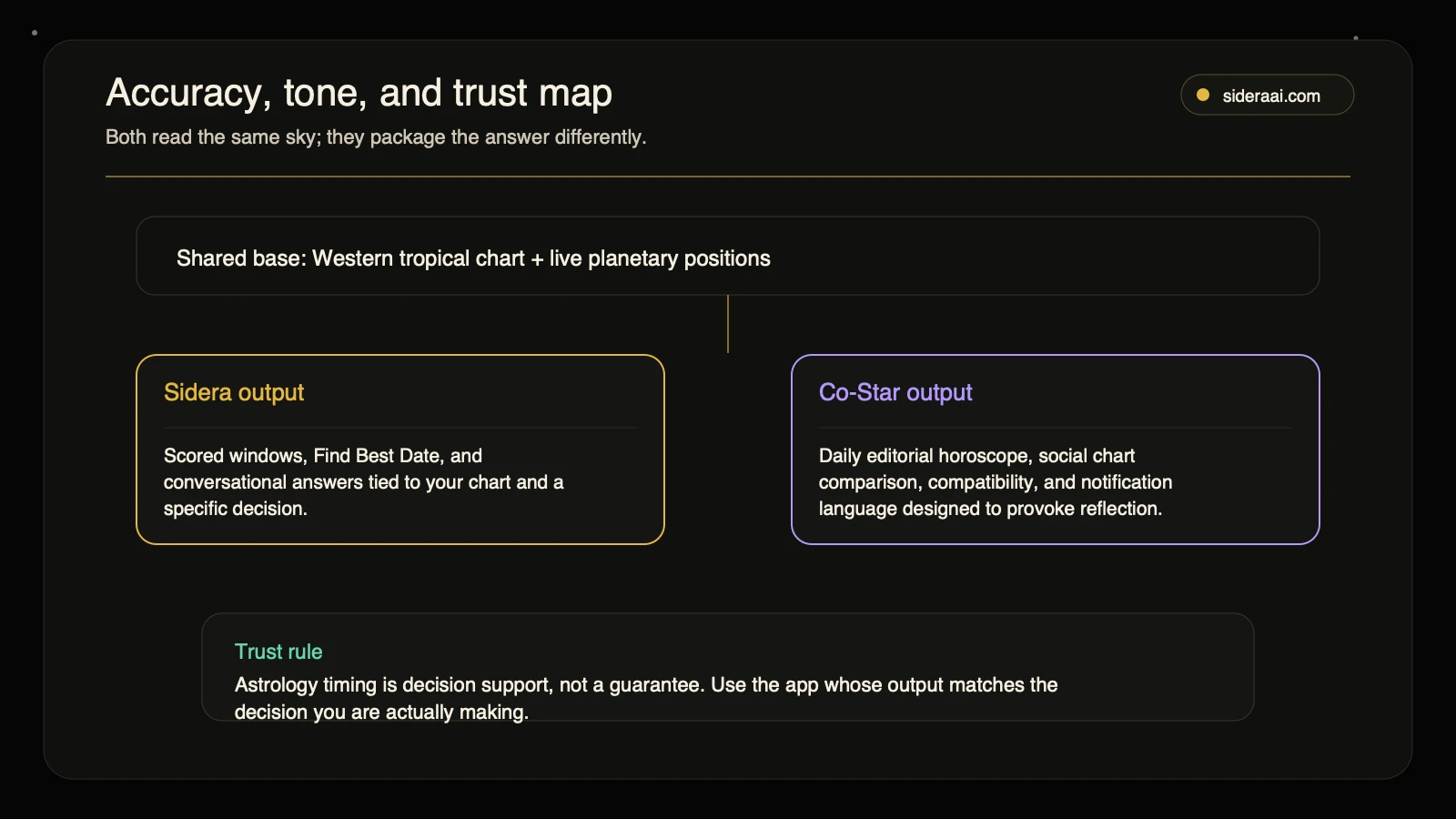
Both apps read the same sky data, but Sidera turns it into timing support while Co-Star turns it into daily editorial reflection.
For a broader look at how AI-assisted astrology apps differ in their approach to interpretation and planning, the AI astrology app guide covers what separates stronger options from generic ones.
Pricing and Value
Co-Star’s core app is free, with in-app purchases that include a Pro-Star monthly subscription unlocking additional features. Specific pricing tiers should be verified in the App Store before subscribing, as these change regularly.
Sidera offers a free tier covering daily chart conditions and AI astrologer access. Find Best Date and advanced planning features are available in the Pro plan. The free tier is sufficient to evaluate whether the planning approach fits how you actually reach for astrology in your life.
Both apps are worth testing in their free tiers before committing to a paid plan. The job-to-be-done question – daily social horoscope or chart-based planning tool – will tell you which earns a place in your routine faster than any feature comparison will.
Freshness Note
App features, pricing, and subscription structures change frequently. The comparison above is based on official product pages and App Store listings accessed in June–July 2026. Verify specific pricing and plan details directly in each app before subscribing. The core functional difference – social daily horoscope versus chart-based planning tool – is structural and unlikely to shift with updates.
Frequently Asked Questions
Is Co-Star or Sidera more accurate? Both apps ground their interpretations in accurate Western tropical birth chart calculations, using the same ephemeris data for the live sky. The difference is not chart accuracy but interpretation purpose. Co-Star uses that data to generate daily editorial horoscope language. Sidera uses it to score daily conditions and answer specific planning questions. Accuracy in practice depends on which interpretation you find useful for your actual situation.
Does Co-Star have a planning feature like Sidera’s Find Best Date? No equivalent feature exists in Co-Star. The app surfaces daily chart conditions you can use informally to time decisions, but there is no explicit forward-looking search tool. Sidera’s Find Best Date is a dedicated workflow: you choose an action category and the app returns ranked calendar windows with chart-specific reasoning. If planning is your primary use case, Sidera has the specific tooling for it.
Can I use both apps at the same time? Yes, and many astrology readers do. Co-Star handles the daily social and reflective layer; Sidera handles specific planning questions and upcoming decision windows. If you are choosing one, match it to the version of astrology you reach for most often: ambient daily context or specific timing guidance.
How does the AI astrologer in each app differ? Co-Star uses a combination of AI generation and human astrologer editorial input to produce daily horoscope language. The output is a curated daily read delivered to you. Sidera’s AI astrologer takes direct questions and responds with interpretations specific to your chart and the current transits. The Co-Star experience is broadcast-style; the Sidera experience is conversational and on-demand.
Is Sidera better for beginners or advanced users? Both levels. The daily calendar and favorability scores are readable without deep chart knowledge – you see which days score higher and act accordingly. The AI astrologer is where you get nuanced, placement-specific interpretation as your understanding deepens. If you are new to birth chart astrology, building familiarity with your placements first will make the planning features more meaningful faster. The birth chart calculator guide is a useful starting point.
What if I want both social features and planning tools? Use both. Many readers keep Co-Star for the daily social layer and use Sidera when they have a specific decision or event to time. The apps complement each other because they serve genuinely different needs. If you are choosing only one, the decision comes back to which job you reach for most often: a daily shared horoscope or a timing answer for something specific that is coming up.
Ready to See Your Personal Birth Chart?
Discover your unique cosmic blueprint — planets, houses, and aspects personalized to your exact birth time and location.
Get Your Birth Chart →✓ Birth chart analysis ✓ Personalized insights ✓ Free to use
Related Sidera Guides
Continue with these closely related guides: