You opened the app looking for an answer. Instead you got a feeling – beautifully written, resonant, but still not the answer. Or the opposite: you got a score, a date, a ranked list, and had to figure out on your own what any of it meant for you.
That gap is why the Sidera-versus-CHANI question is worth a serious answer rather than a generic “it depends.”
Both apps start from the same premise: your full birth chart matters more than a generic sun-sign horoscope. After that, they serve different people at different moments. Use the wrong one and you will feel let down – not because the app is bad, but because it was built for a different version of what you need right now.
Quick Verdict
Choose CHANI if you want an astrologer-written ritual practice: weekly readings, meditations, journaling, and a consistent human voice guiding your inner life through the transits.
Choose Sidera if you want your birth chart to inform real decisions – which day to launch, negotiate, sign, or wait – with daily aspect scoring and a searchable date planner that returns ranked windows on demand.
Both apps use Western tropical astrology. Neither is wrong. They are solving different problems for different moments in a person’s relationship with astrology.
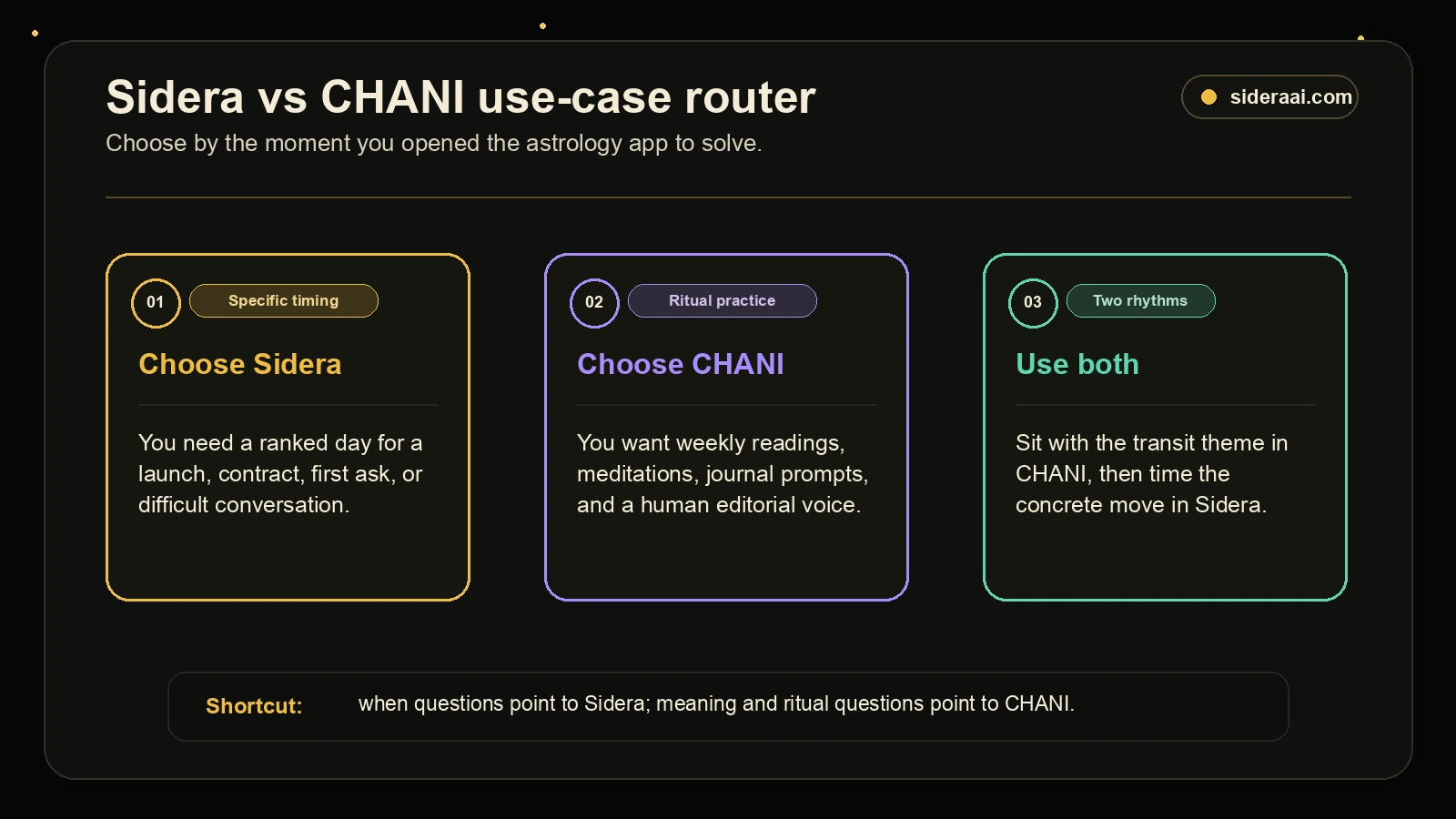
Pick by the moment you opened the app to solve: concrete timing, reflective practice, or both.
Methodology Box: What We Reviewed
Methodology: This comparison is built from editorial analysis of each product’s publicly stated positioning, feature documentation on their respective product pages and app store listings, and evaluation of available functionality as each product currently presents it. Where claims about features appear, they reflect current product positioning rather than independently audited back-end behavior. Pricing and feature sets change – verify in-app before subscribing.
Directly reviewed sources: the Sidera official product site, the CHANI official app page, the CHANI App Store listing, and browser captures taken on July 1, 2026. Inferred signals are labeled as such: Reddit and app-store search snippets are used only as qualitative reader-language input, not statistical proof. Third-party screenshots were treated as internal research candidates and are not embedded here without rights review.
What Most Comparisons Miss
Most Sidera-versus-CHANI comparisons treat these apps as two solutions competing for the same job. They are not.
The cleaner frame: these apps serve different moments in the same person’s life, and knowing which moment you are in determines everything about which app will actually help you.
The moment CHANI is built for: it is a Tuesday evening and you are trying to understand why a relationship pattern keeps showing up. You open the app, receive this week’s reading – written, deliberate, politically aware – and then move into the accompanying meditation and journal prompt. An hour later, you have language for what you were experiencing and a ritual container for sitting with it. That is the product working exactly as designed.
The moment Sidera is built for: it is a Wednesday morning and you have a launch window, a contract signing, or a difficult conversation coming up this week. You open the app, check the daily score for Thursday and Friday, ask the AI astrologer a direct question – is this Venus-Saturn square going to make the negotiation harder? – and get back an answer grounded in your specific placements. You put the better date on the calendar and move on.
Neither moment is more valid. Treating both apps as interchangeable “astrology apps” means comparing the wrong features and making the wrong choice for your actual situation.
What Sidera Does
Sidera is a Western tropical astrology planner built around one core question: what is the best day for this?
Every day, Sidera calculates aspects between your natal chart and the live sky, then scores and interprets each one in context of your specific placements. That daily rating tells you whether the timing favors decisive action, careful conversation, financial commitments, creative launches, or recovery – applied to your chart, not a recycled transit theme.
The Find Best Date feature lets you search forward in time and surface the highest-scoring windows around a specific goal. You name the category – launch, contract signing, first conversation, financial commitment, difficult conversation – and the calendar returns ranked dates from your chart’s perspective.
Sidera also includes an AI astrologer that answers plain-language questions about your chart and current transits. What does this Venus-Saturn square mean for my relationships right now? The AI responds with your placements in context, not keyword summaries pulled from a generic library.
Sidera describes its core function as reading your birth chart against today’s sky and marking the best days to launch, sign, decide, or begin. If you want to understand how the underlying aspect calculations work, astrology aspects: conjunction, square, and trine explained covers what those daily scores are actually measuring.
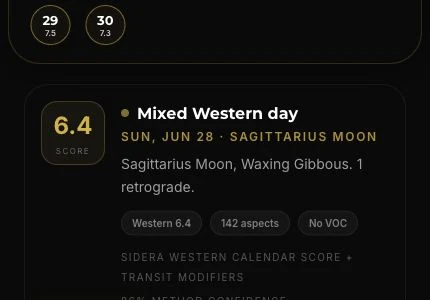
Owned Sidera screenshot: the score card for a selected day, showing how Sidera translates chart weather into a planning readout. CHANI product screenshots were reviewed as internal research candidates but are not embedded here without rights approval.
What CHANI Does
CHANI is an astrology app built around practice and reflection. Created by astrologer Chani Nicholas, the app positions itself around manifestation, self-discovery, mindfulness, and healing – alongside personalized birth chart readings, daily horoscopes, weekly readings, meditations, affirmations, and journal prompts.
Where Sidera gives you a score, CHANI gives you a narrative. A typical CHANI weekly reading walks through the major transits with writing that is intentional, politically aware, and spiritually grounded. You receive a guided meditation tied to the current sky and journal prompts that help you sit with what the transits might be surfacing for you personally. The experience is designed to accumulate: readers who stick with CHANI over months describe building a vocabulary for their chart through consistent immersion in a single interpretive voice.
CHANI explicitly positions its content as astrologer-written throughout. Many subscribers appear to value this specifically – not just for the content itself, but because the source matters to them. The weekly reading is not a dashboard result you act on; it is closer to a letter from someone who has thought carefully about the current sky and what it might mean for inner work.
If the identity of who wrote your astrology matters to you, this is a meaningful distinction to resolve before subscribing, not after.
Social Listening: Three Questions Readers Keep Asking
Qualitative signals from reader discussions point to three recurring comparison questions:
Whether the reflective guidance stays specific over time. Some readers find CHANI’s writing consistently resonant; others describe a moment when the language started to feel familiar rather than fresh. This is a real tradeoff in any subscription app with a consistent editorial voice – coherence and distinctiveness are the same quality viewed from different distances.
Why chart details can differ between apps. If a house placement looks different in CHANI than in another calculator, the most likely cause is different house system defaults, not a calculation error. Two apps can use identical birth data and return different house assignments depending on which system each defaults to.
Whether the paid value comes from raw astrology data or from something else. Readers who stay with CHANI tend to describe valuing the writing quality, the ethics of the brand, the meditation layer, and the ritual container as much as the underlying chart data. That is a different kind of value proposition than a planning tool, and it helps explain why comparing feature counts between these two apps misses the point.
Feature Comparison
| Area | Sidera | CHANI |
|---|---|---|
| Primary job | Daily planning and best-date search | Reflective practice, ritual, and self-discovery |
| Daily guidance | Aspect scores + AI interpretation | Astrologer-written horoscopes and readings |
| Timing decisions | Find Best Date, calendar scoring | Weekly themes that inform timing; no dedicated date search |
| AI guidance | Yes – plain-language chart and transit questions | No – content is astrologer-written |
| Ritual layer | Not the focus | Meditations, affirmations, journal prompts |
| Chart system | Western tropical | Western tropical |
| Content source | AI astrologer | Human astrologer (Chani Nicholas team) |
| Pricing model | Subscription with free tier | Subscription |
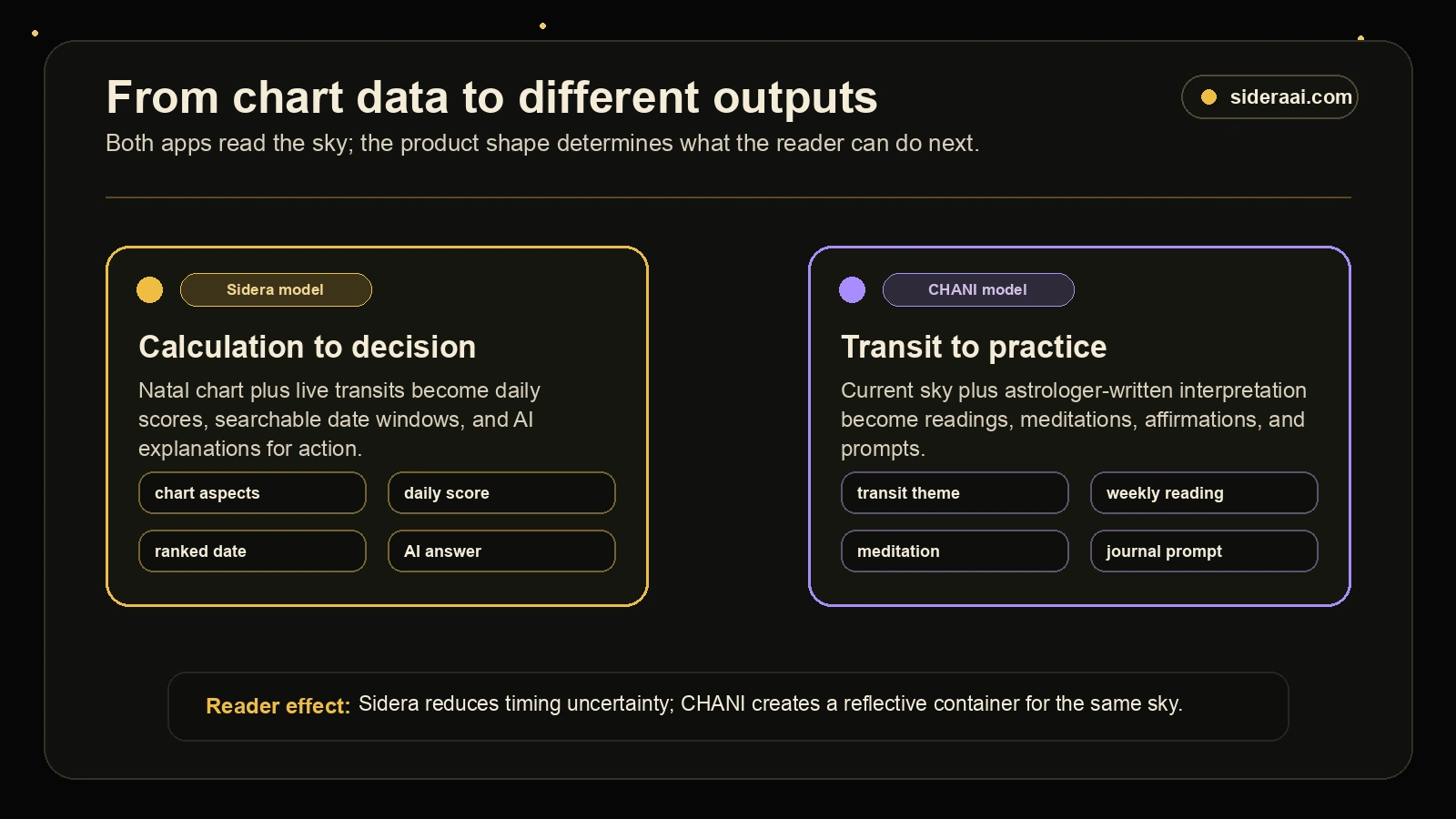
Both apps read the sky, but Sidera turns it into ranked decisions while CHANI turns it into a ritual container.
Both apps require a birth time for full chart functionality. Both use Western tropical astrology – calculated from the season of birth and most widely used in western astrological tradition, not from fixed star positions as sidereal systems are.
A Note on Chart Systems and Why Results May Differ
If you use both apps and notice that your house placements differ between them, the most likely explanation is not a calculation error. It is different house system defaults. Common options include Placidus, Whole Sign, and Koch. Each system draws house boundaries differently, which affects where planets fall in your chart – without changing your signs or aspects.
A useful checklist when comparing any two astrology apps:
- Zodiac system: tropical or sidereal? (Both Sidera and CHANI are tropical)
- House system: Placidus, Whole Sign, Koch, or another?
- Aspect orbs: how wide a window counts as an active aspect?
- Birth data requirements: does the app require a confirmed birth time, or estimate it?
- Content source: AI-generated, astrologer-written, or a mix?
These five factors explain most of the differences between astrology apps – and most of the confusion when two apps seem to tell a reader different things about their chart. The birth chart calculator guide explains the inputs – birth time, location, and house system – that directly affect your chart output in any app.
Timing, Transits, and What Each App Does with the Live Sky
Both Sidera and CHANI are current-sky products. Both track transits against your natal chart. What they do with that information is where the split becomes sharpest.
CHANI turns live transits into weekly and daily readings – narrative content that describes the themes of a period and what it might mean for your inner life, your relationships, and your spiritual orientation. The writing is broad enough to be useful to many readers at once while still being grounded in your personal chart.
Sidera turns live transits into scores. Those scores become a ranked calendar. When you need to find a day when your chart supports a specific type of action, or identify void-of-course moon windows to work around, Sidera surfaces those windows and orders them by score. The AI astrologer then explains what those scores mean for your specific situation.
Readers drawn to electional astrology – the practice of choosing dates based on astrological timing – will find that Sidera’s Find Best Date workflow is a direct implementation of electional principles, automated to your natal chart.
Decision Tree: Choose Sidera or CHANI
| If what brought you to an astrology app today is… | The better fit | Why it matters |
|---|---|---|
| “I need to know if this week is good for X” | Sidera | Daily scoring and calendar search return ranked answers, not just themes |
| “I want to reflect on what’s happening in my life” | CHANI | Narrative weekly readings and journal prompts are built for this specific need |
| “I want to find the best date to launch, sign, or ask” | Sidera | Find Best Date generates sorted timing windows from your chart |
| “I want meditations or a ritual container for the sky” | CHANI | Explicit ritual layer with affirmations and prompts woven into the experience |
| “I have a chart question and want a real contextual answer” | Sidera | AI astrologer responds with your specific placements in context |
| “I want Chani Nicholas’s interpretive voice on this transit” | CHANI | Content is written by the Chani Nicholas team; that specificity is a feature, not incidental |
| “I want to understand a repeating pattern in my life” | Either – with tradeoffs | CHANI for structured editorial reflection; Sidera AI for back-and-forth Q&A |
| “I’m a beginner just learning how this works” | CHANI first, Sidera when timing needs emerge | CHANI’s narrative absorbs without translation; Sidera’s scoring is easy to act on once you have timing questions |
The honest version of this decision: if your question starts with when, start with Sidera. If it starts with what does this mean for me, start with CHANI.
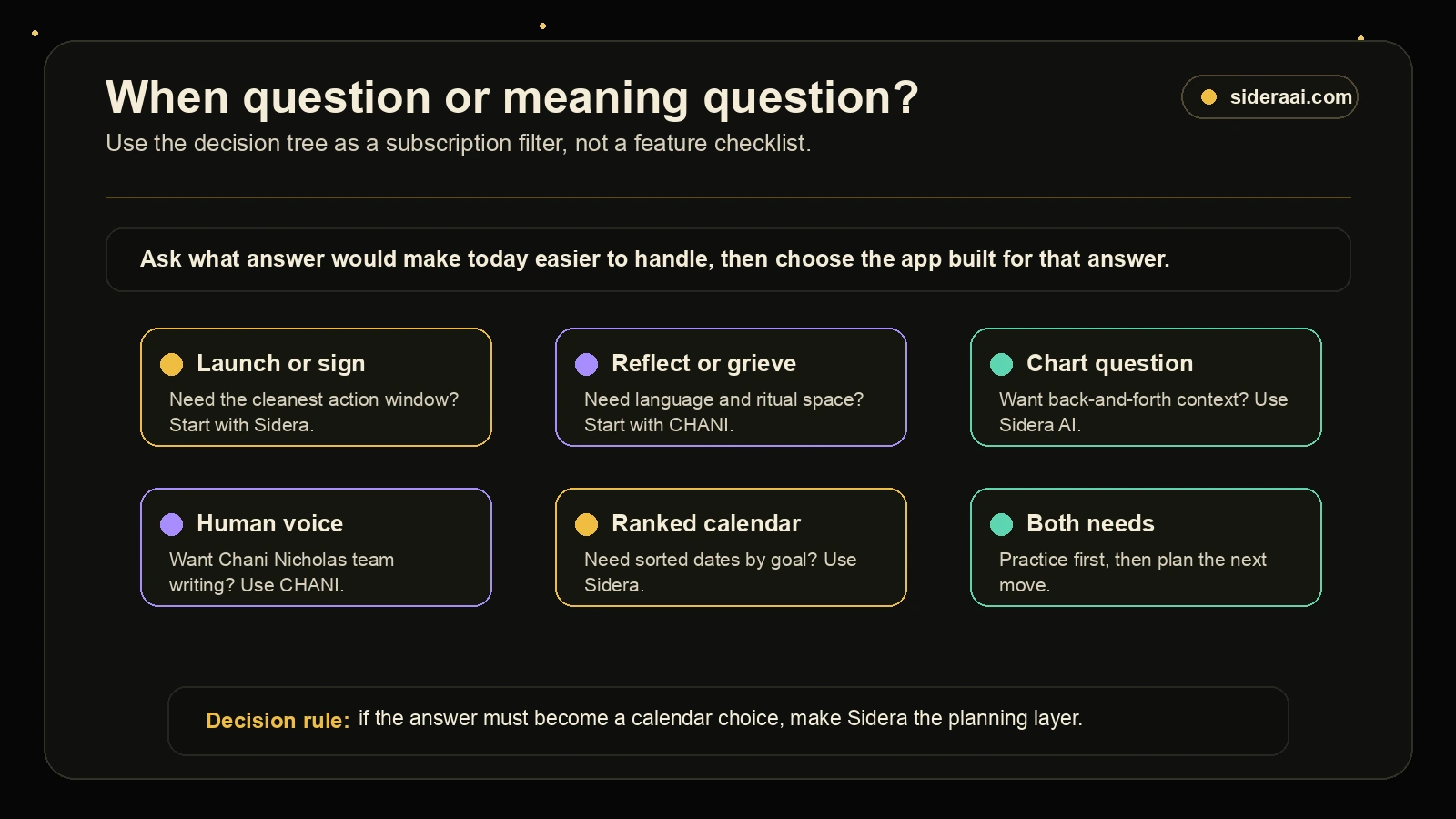
Use the decision tree as a subscription filter: calendar-choice answers point to Sidera, while meaning and ritual answers point to CHANI.
Pricing and Value
Both Sidera and CHANI operate on subscription models with core features behind a paid tier.
CHANI is positioned as a complete astrology practice ecosystem. Subscribers often describe valuing it as a content relationship as much as a chart tool – the writing quality and the specific perspective of the Chani Nicholas team are frequently cited as central to what makes the subscription worthwhile, not just the feature inventory.
Sidera’s value proposition is more utilitarian: a planner that scores every day against your personal chart, returns ranked timing windows on demand, and gives you an AI astrologer to interpret what those windows mean for your specific decisions.
Neither is overpriced for what it delivers. The question is which kind of value you are actually in the market for. Verify current pricing in-app – plans and tiers change, and pricing published in third-party articles goes stale quickly.
Freshness Note: Recheck Before Subscribing
This comparison was updated on July 1, 2026. App features, trial terms, subscription tiers, App Store wording, and product positioning can change quickly. Verify current pricing and feature availability inside each app before paying.
Frequently Asked Questions
Is CHANI or Sidera better for beginners? Both work for beginners, but in different ways. CHANI’s astrologer-written weekly readings are easier to absorb if you are still building vocabulary – you receive interpretation without having to decode anything. Sidera’s daily scoring is simpler to act on immediately – you do not need to understand aspects to read a day rating and plan around it. If you want to learn the mechanics while using an app, how to read a birth chart for beginners covers the foundations both apps will reference.
Does CHANI use AI? CHANI explicitly positions its content as astrologer-written, produced by Chani Nicholas and her team. This is a stated distinction from AI-generated or algorithm-based interpretation, and a meaningful one if the identity of who wrote your astrology matters to you.
Can Sidera interpret what a transit means for my specific chart? Yes. Sidera’s AI astrologer interprets transits and aspects in context of your personal birth chart. You ask in plain language – what does this Mars square Venus mean for me right now? – and the AI answers with your placements and current timing in mind, not a generic keyword summary.
Do Sidera and CHANI show the same chart? They both use Western tropical astrology, so your sun, moon, and rising signs should match. If house placements look different between the two apps, the most likely cause is different house system defaults – Placidus, Whole Sign, and Koch can all shift house boundaries significantly. Check each app’s chart settings before concluding that either has a calculation error.
Can I use both apps at the same time? Yes, and some readers do. The use cases are different enough that there is minimal redundancy. CHANI delivers a ritual and reflection layer that Sidera does not offer. Sidera delivers calendar date-search and AI Q&A that CHANI does not offer. If you want a reflective practice and a planning tool, running both is a reasonable approach – you are not doubling up on the same feature set.
Which app is better for relationship astrology? Both use your birth chart, but from different angles. CHANI’s written content covers relationship themes through transits and natal readings. Sidera can help you time relationship conversations and decisions through its scoring and AI astrologer. If you want to go deeper into the mechanics of how two charts interact, synastry chart guide: reading relationship astrology covers the underlying framework both apps draw from.
The Bottom Line
CHANI is an astrology practice in app form. It is built for the reader who wants an ongoing relationship with a specific interpretive voice – weekly readings, meditations, journal prompts, and a ritual container for the current sky. If the experience of sitting with astrology is as important to you as the information it delivers, CHANI was designed with you in mind.
Sidera is an astrology planner. It is built for the reader who needs to decide: when to launch, when to ask, when to wait, when to hold. The planning interface is the point – not a feature that sits alongside a meditation layer, but the core of what the app does.
Most people who use both reach for them at different moments. CHANI on a quiet morning for intention-setting. Sidera before a week with timing-sensitive moves in it. If you are choosing one: think about what you actually open an astrology app to do. If the answer usually involves a specific date, a decision, or a question you want answered with your chart in context, Sidera is built for that job.
Ready to See Your Personal Birth Chart?
Discover your unique cosmic blueprint — planets, houses, and aspects personalized to your exact birth time and location.
Get Your Birth Chart →✓ Birth chart analysis ✓ Personalized insights ✓ Free to use
Related Sidera Guides
Continue with these closely related guides: