Shadow work astrology is useful when a chart interpretation sounds technically right but still misses the part you actually live with: why you shut down when someone needs honesty, why criticism feels like danger, why control follows you into work, or why the same relationship pattern repeats after you thought you understood it.
Your natal chart does not excuse those patterns. It helps you locate them. The point is not “I have this placement, so this is who I am.” The point is “this is the behavior I fall into when I feel scared, unseen, attracted, ashamed, or protective of my self-image.”
Use this guide as a map for the parts of your chart that tend to operate in the background: the 12th house, 8th house, South Node, opposition axis, Chiron, and the outer planets. For each one, ask what it feels like in daily life, where it becomes defensive, and what a more conscious response would look like.
Ready to See Your Personal Birth Chart?
Discover your unique cosmic blueprint — planets, houses, and aspects personalized to your exact birth time and location.
Get Your Birth Chart →✓ Birth chart analysis ✓ Personalized insights ✓ Free to use
What Is the Shadow in Astrology?
Psychologist Carl Jung defined the shadow as the unconscious part of the psyche containing traits, impulses, and feelings the conscious self has rejected. In astrology, the shadow is not a single point but a collection of placements that describe how, where, and why you tend to reject or disown parts of yourself.
Every chart has a shadow signature. The question is whether you are using your chart to see it clearly or using it to confirm what you already think you know about yourself.
Astrologer Liz Greene’s psychological astrology frames the birth chart as a symbolic map of unconscious material, not a fixed sentence. That is exactly what shadow work in astrology is about.
Why Use Your Birth Chart for Shadow Work?
Most shadow work approaches start from behavior: you notice a pattern, you trace it back, you try to shift it. Astrology gives you a structural map before you start noticing patterns.
Your chart shows:
- Where you have unintegrated energy that tends to project outward onto others
- Which signs and houses hold your conditioned reactions versus your authentic responses
- What psychological patterns you are most likely to repeat across different areas of life
- Where repeated discomfort is asking for more honest attention
The birth chart does not create your shadow. It describes the shape of your psychological landscape so you can navigate it with more intention. Jungian astrologer Howard Sasportas in The Gods of Change (1989) observed that outer planet placements can feel too large for the ego to contain directly, which is why they tend to appear first as shadow material before they can be consciously worked with.
How Shadow Patterns Show Up in Real Life
Shadow material usually feels justified in the moment. You are not thinking “I am projecting.” You are thinking “they are too needy,” “I work better alone,” “I just need control,” or “I cannot trust anyone unless I test them first.” The chart becomes useful when it helps you name the reaction before it becomes the decision.
| Life Area | What the Shadow Can Feel Like | Chart Clue to Check |
|---|---|---|
| Love | Being drawn to intensity, then calling steadiness boring or unsafe | 8th house, Venus aspects, Pluto contacts |
| Work | Overperforming because rest feels irresponsible or visibility feels dangerous | Saturn, 6th house, 10th house, South Node |
| Conflict | Attacking, disappearing, over-explaining, or calling avoidance “peace” | Mars, 12th house, opposition aspects |
| Self-image | Confusing a wound with your identity and rejecting evidence that you have changed | Chiron, Moon aspects, Ascendant ruler |
| Decision-making | Choosing familiar pain because honest change feels too exposed | South Node, Saturn aspects, fixed sign emphasis |
When you read any placement, translate it into behavior: What do I do when I want closeness? What do I do when I feel controlled? What do I do when someone sees a part of me I prefer to hide? Those answers are the shadow-work material.
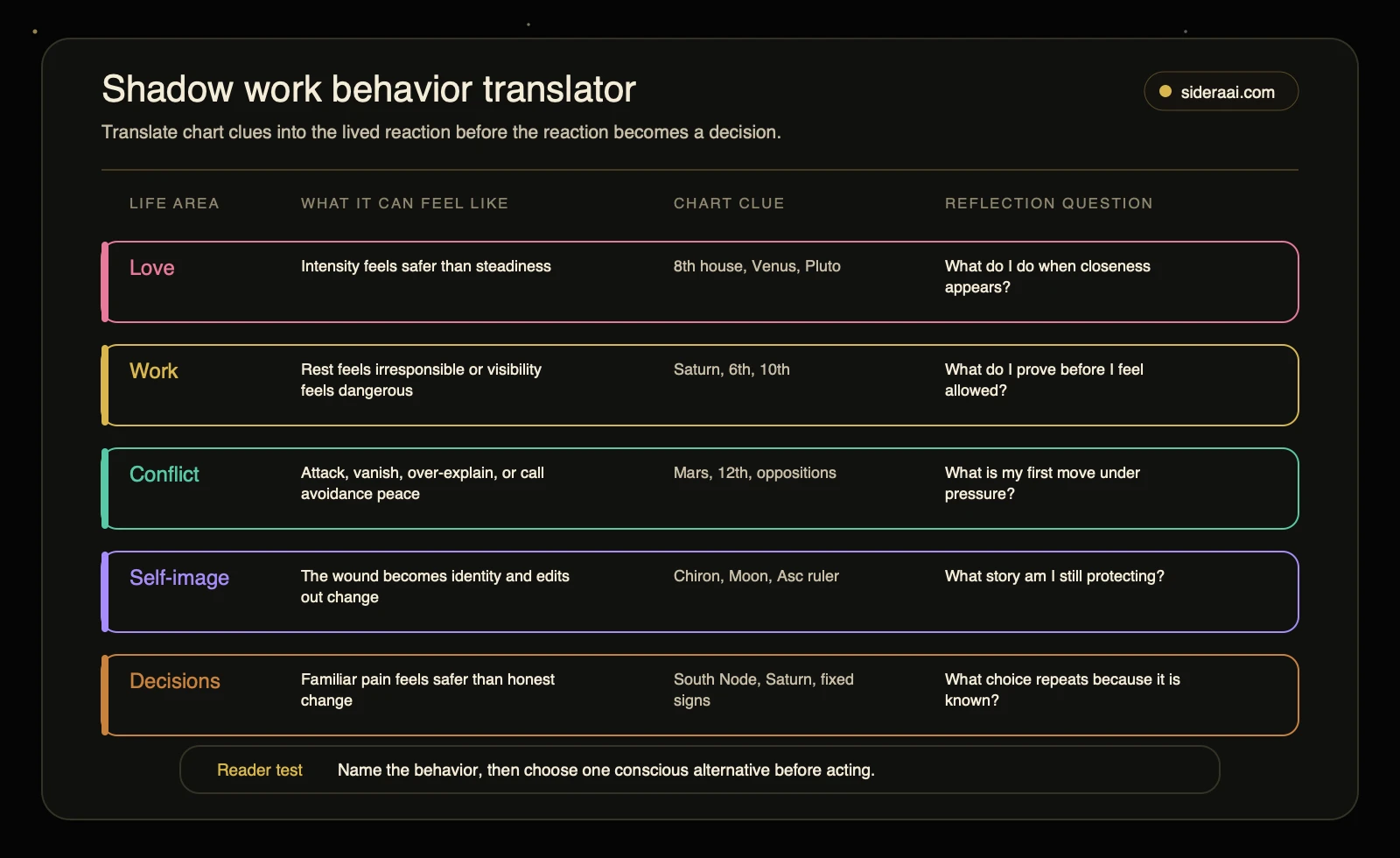
Use the translator to move from chart clue to lived reaction. The useful question is not what the placement means in theory, but what you do when that shadow is active.
Understand your connections on a cosmic level.
Explore your bonds →The Four Core Shadow Zones in the Natal Chart
1. The 12th House: The Hidden Depths
The 12th house is the most direct shadow zone in the chart. Traditional astrology called it the house of self-undoing. Modern psychological astrology calls it the house of the unconscious.
Planets in the 12th house operate below the threshold of awareness. They are active but not visible to you. You feel their effects without knowing the cause. In daily life, this can look like moods that seem to arrive from nowhere, anger that comes out indirectly, or a private sense of pressure that nobody else can see. Someone with Mars in the 12th may feel bursts of anger without understanding where they come from, or they may channel aggression into creative or spiritual work without recognizing the underlying drive.
Shadow work with the 12th house means bringing these hidden energies into conscious relationship rather than letting them run as background noise. If your 12th house is crowded, do not treat it as proof that you are unknowable. Treat it as a reminder that your strongest motives may need quiet, honest naming before they can be used well.
2. The 8th House: What You Fear and What Controls You
The 8th house rules transformation, power dynamics, shared resources, and what you would rather not examine directly. Planets here describe the themes you are most likely to avoid and the places where you give power away without awareness.
Someone with Venus in the 8th may carry deep beliefs about love being conditional or dangerous that drive relationship patterns from below the surface. This can show up as testing a partner, withholding affection first so you cannot be rejected, or confusing emotional intensity with trust. The 8th house shadow asks you to look at what you need to control, what you are afraid to lose, and where you have merged your sense of self with someone else’s needs or identity.
3. The South Node: Patterns You Default to Under Stress
The South Node describes the energy and approach that comes most naturally, often too naturally. It represents a well-worn groove of response that can feel like home but functions as a trap when relied upon under pressure.
Shadow work with the South Node means recognizing which of your most comfortable habits are actually avoidance strategies. The giveaway is speed: under stress, you go there before you choose. This is not something to eliminate. It is something to recognize so you can tell the difference between a genuine preference and a reflexive retreat. The South Node completes one sign of the zodiac every 18 months and returns to its natal position roughly every 18.6 years, creating natural review cycles.
4. The Opposition Axis: What You Project
Carl Jung described projection as attributing to others what belongs to you. In the chart, the opposition aspect describes the axis where projection operates most naturally. What sits across the chart from your dominant placements tends to be what you see most clearly in others and least clearly in yourself.
If you have three planets in Aries, Libra traits such as compromise, indirectness, and prioritizing harmony may feel irritating or foreign when you encounter them in others. That irritation is typically a signal that Libra energy lives in your shadow and wants integration rather than criticism.
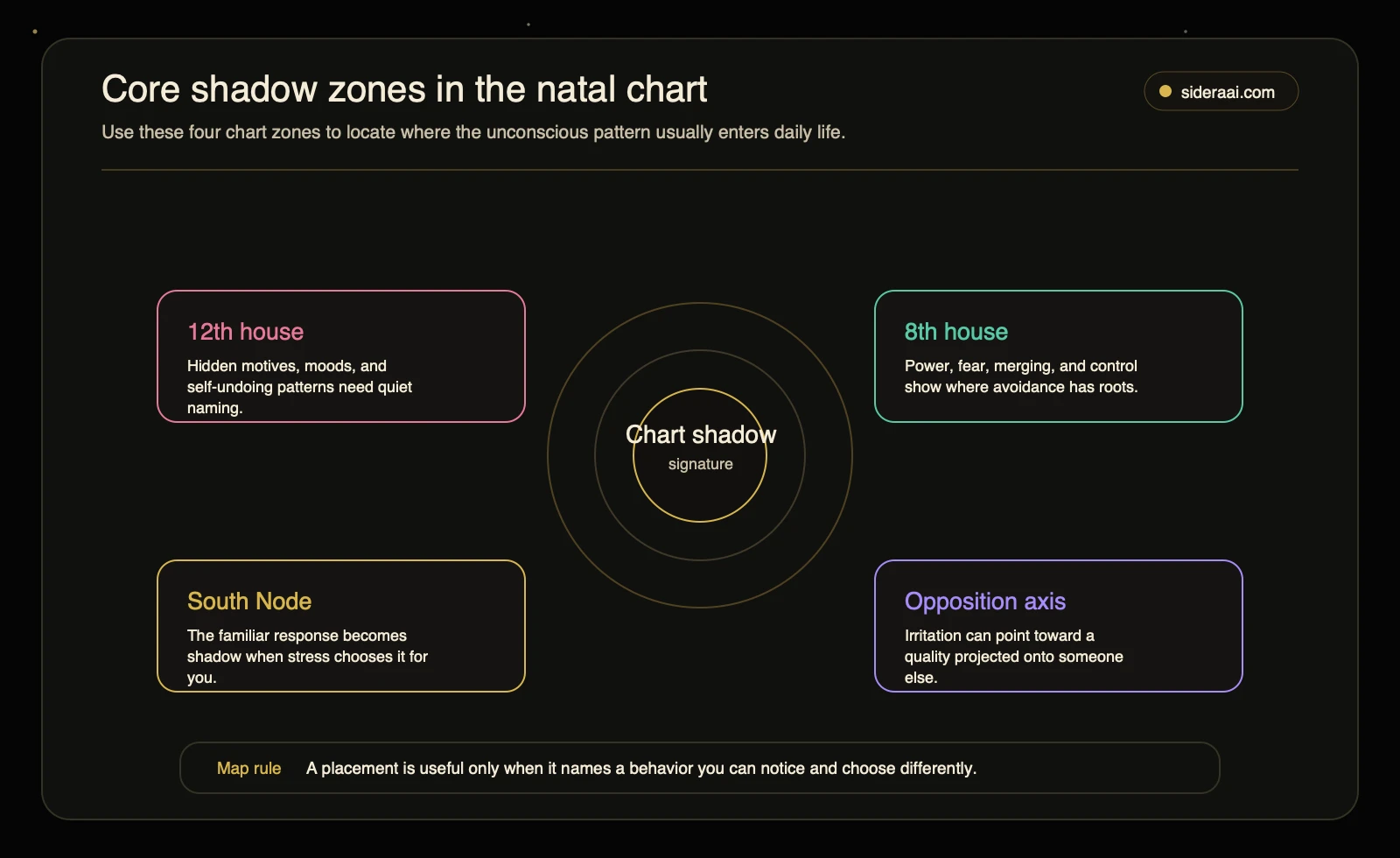
Use the four zones as a map, not a verdict. A placement becomes useful when it names a behavior you can notice before it runs the moment.
Sidera uses your actual birth chart—not generic horoscopes.
Get personalized insights →Chiron: The Wound That Becomes Wisdom
Chiron’s placement describes the wound that does not fully heal but becomes your deepest teaching material. Chiron takes approximately 50.7 years to complete one orbit and spends between 1.5 and 8 years in each sign depending on its elliptical path, which means Chiron is deeply generational as well as personal.
Shadow work with Chiron is not about eliminating the wound. It is about stopping the loop of either avoiding the wound entirely or circling it without progress. Melanie Reinhart’s Chiron and the Healing Journey (1989) frames Chiron as a point where sensitivity, vulnerability, and wisdom are tied together.
The house and sign of your Chiron tell you where the wound lives and what form it takes. The aspects to Chiron tell you which other parts of your psyche are most tangled up with that wound. If Chiron is in the 7th house, the wound may surface through partnership and rejection sensitivity. If it is in the 10th, visibility, competence, and public judgment may carry the charge. The practical question is not “How do I get rid of this?” It is “How do I stop letting this wound make every decision for me?”
The Outer Planet Shadow Signatures
This layer matters because outer planets describe patterns that can feel larger than ordinary personality traits. Your outer planet placements (Saturn, Uranus, Neptune, Pluto) each carry a specific shadow mode: a way the planet’s energy operates when it has not been brought into conscious awareness.
| Planet | Shadow Expression | Integrated Expression |
|---|---|---|
| Saturn | Rigid self-discipline, fear of failure, internalized criticism | Earned authority, consistent structure |
| Uranus | Rebellion as identity rather than genuine freedom | Authentic individuation, constructive disruption |
| Neptune | Spiritual bypassing, dissolving into others, chronic escapism | Genuine empathy, creativity from a clear center |
| Pluto | Power hunger, compulsive control, unconscious domination | Earned depth, intensity without manipulation |
The outer planet in your chart with the most challenging aspects or the most prominent house placement often represents the entry point for meaningful shadow work. These planets move slowly enough that their natal position shapes the texture of your deepest unconscious material.
The test is simple: if the pattern keeps making your life smaller, it is probably running unconsciously. Saturn shadow can make you reject opportunities unless success is guaranteed. Neptune shadow can make avoidance sound compassionate. Pluto shadow can make emotional intensity feel like proof that something is true.
Pluto Generational Shadows: The Collective Layer
Personal placements matter, but Pluto introduces another layer: the generational shadow you were born into.
Because Pluto spends between 12 and 31 years in each sign, everyone born during a given Pluto era shares a collective shadow around the same theme. This shadow is so normalized within your generation that it rarely gets questioned, which is exactly what makes it powerful.
| Pluto Sign | Birth Years (approx.) | Generational Shadow |
|---|---|---|
| Pluto in Leo | 1939-1957 | Ego as identity, personal significance at all costs |
| Pluto in Virgo | 1957-1972 | Perfectionism as control, anxiety dressed as competence |
| Pluto in Libra | 1972-1984 | Harmony as avoidance, people-pleasing masking rage |
| Pluto in Scorpio | 1983-1995 | Intensity as default, destruction before asking why |
| Pluto in Sagittarius | 1995-2008 | Certainty as armor, belief systems used to escape doubt |
| Pluto in Capricorn | 2008-2024 | Achievement as worth, ambition masking emptiness |
| Pluto in Aquarius | 2024-2044 | Collective as excuse to avoid individual accountability |
The individual work is not just integrating your personal Pluto placement. It is noticing when you are unconsciously enacting your generation’s collective shadow rather than your own authentic response.
Someone born with Pluto in Scorpio who destroys relationships reflexively is not just expressing a personal pattern. They are also living out a generational reflex that the entire cohort is being collectively asked to examine. The natal chart shows the personal texture. The Pluto generation shows the water you are swimming in.
This is useful because Pluto can make a pattern feel normal inside your peer group. If everyone around you shares the same blind spot, the work is not just asking “what is wrong with me?” It is asking “which generational reflex did I inherit as common sense?”
Practical Starting Points
Use this order if you have your chart open and want to do something concrete with it.
Start with the 12th house. List every planet you have there. Notice the last time you felt an emotion you could not explain. Ask what that planet does when it has no clean outlet.
Check your South Node sign. Name three behaviors that feel automatic under stress. Most will match the South Node sign’s shadow expression. This is not something to eliminate. It is something to recognize.
Look at your opposition axis. Identify what you criticize most often in others. Note which sign or house that falls in. There is almost always a projection mirror there.
Find your Chiron. Look at the house placement. That is the arena of the wound. Not the cause, but the location where it consistently shows up across different life chapters.
Check your outer planet aspects. Which of your Saturn, Uranus, Neptune, or Pluto placements has the most challenging aspects? That is likely where the outer planet shadow is most active.
Identify your Pluto generation. Read your cohort’s generational shadow in the table above. Ask yourself honestly: how much of that shadow do I enact without noticing? That is the collective layer of the work.
End each step with one sentence: “When this shadow is active, I tend to ___. One conscious alternative is ___.” If you cannot fill in the second blank yet, that is your next reflection point.
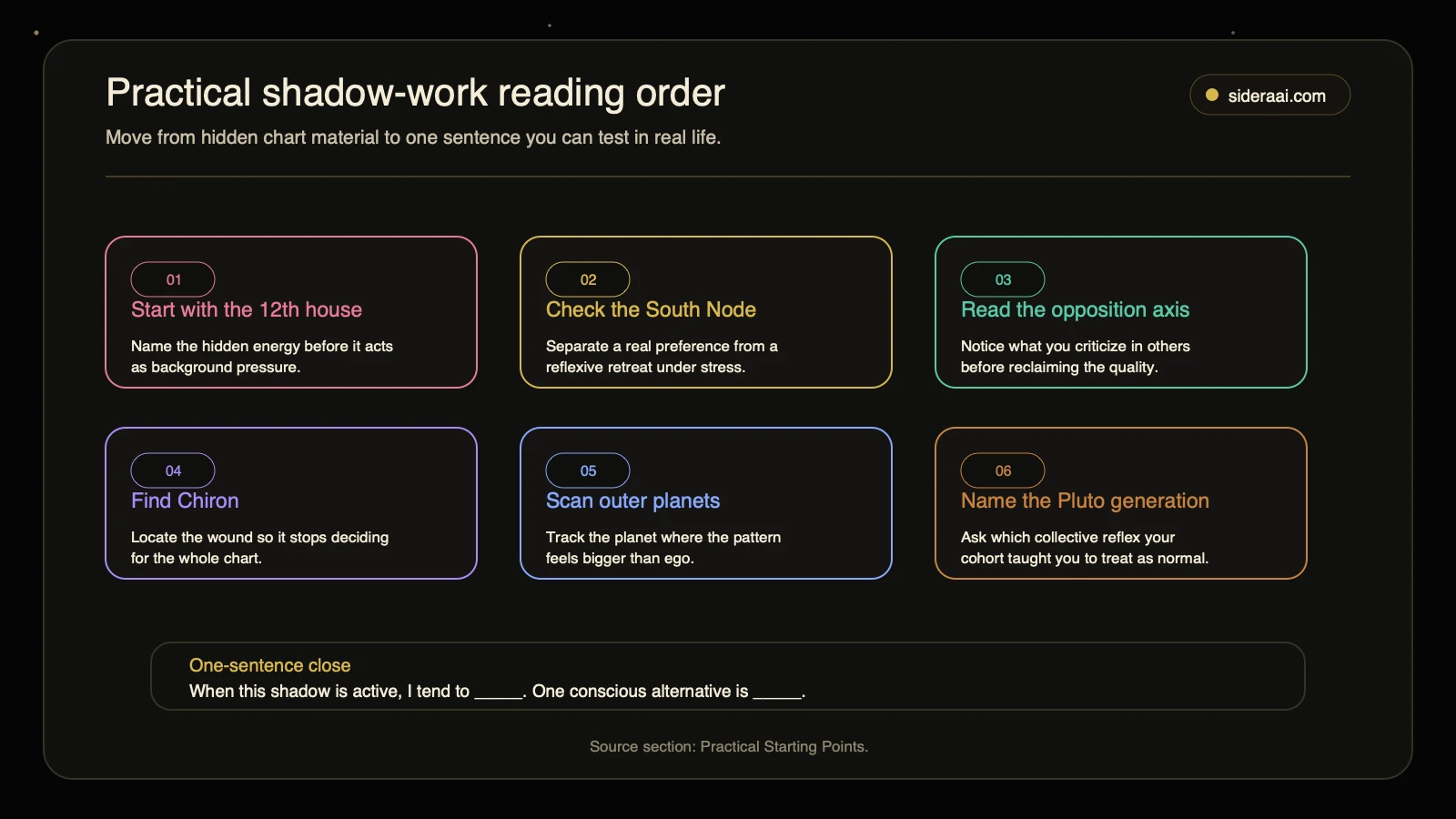
Use the reading order when your chart feels too full to interpret at once. The endpoint is one observable pattern and one conscious alternative.
For a full picture of these placements, a birth chart reading or birth chart calculator gives you the accurate degrees and aspects to work with. You can also read through the 12 houses and South Node astrology for deeper context on specific shadow zones.
Plan your life around the stars, not just the calendar.
Start planning →What Shadow Work in Astrology Is Not
Shadow work in astrology is not about reading your chart and concluding that difficult placements explain your worst behaviors. It is not permission to stay stuck because Saturn is square your Moon or because you have five planets in the 12th.
The chart is a map, not a verdict. Every shadow placement has an integrated expression. The goal is not to eliminate the shadow but to develop a conscious relationship with it so it stops running your decisions without your knowledge.
Frequently Asked Questions
What is shadow work in astrology? Shadow work in astrology is the practice of using your natal chart to identify unconscious patterns, projected qualities, and unintegrated energies that influence your behavior without your awareness. The chart acts as a structural map of your psychological landscape.
Which house in astrology represents the shadow? The 12th house is most directly associated with the shadow and the unconscious. The 8th house also holds shadow material related to power, fear, and avoidance. The South Node and opposition axis are additional shadow zones.
Can your birth chart help with shadow work? Yes. Your natal chart provides a structural map of where psychological shadow tends to accumulate, including 12th house placements, the South Node, challenging aspects, Chiron’s position, and outer planet signatures.
What does Chiron represent in shadow work? Chiron represents the core wound that does not fully heal but becomes wisdom. Shadow work with Chiron involves recognizing the wound without either avoiding it or being defined by it. Chiron’s house placement shows the arena where this wound consistently appears.
What is the South Node shadow in astrology? The South Node shadow is the over-reliance on default patterns and comfort-zone behaviors that feel natural but function as avoidance strategies under stress. These are not bad traits; they are patterns that need to be chosen consciously rather than defaulted to automatically.
How do outer planets relate to shadow work? Outer planets (Saturn, Uranus, Neptune, Pluto) each carry a specific shadow mode when their energy operates unconsciously: Saturn as rigid fear of failure, Uranus as rebellion as identity, Neptune as spiritual bypassing, and Pluto as compulsive control. Their natal aspects and house placements point to where that shadow material is most active.
What is the opposition axis in shadow work astrology? The opposition axis describes the most natural projection axis in a chart. Dominant placements in one sign or house tend to push their opposite qualities into shadow. When you feel strong irritation toward others’ behavior, it often reflects qualities from your own opposition axis that you have not yet integrated.
How is shadow work different from regular astrology? Standard astrology interpretation describes how placements operate. Shadow work astrology specifically looks for where energy is operating outside conscious awareness; not what you actively express, but what runs beneath your awareness and shapes your choices without your knowledge.
What is the Pluto generational shadow in astrology? The Pluto generational shadow is the collective unconscious pattern shared by everyone born during the same Pluto sign era. Because Pluto spends 12 to 31 years in each sign, entire cohorts carry a shared psychological blind spot around that sign’s themes. Individual shadow work is incomplete without also examining which generation-level shadow you have been swimming in since birth.
Related Sidera Guides
Continue with these closely related guides:
- 8th House Astrology: Shadow and Transformation
- Black Moon Lilith: Your Rejected Shadow in Astrology
- Chiron in Astrology: The Wounded Healer in Your Birth Chart
- Shadow Work for Aries Guide
- Cancer Shadow Work Guide
- Shadow Work Leo: The Hidden Side of the Lion
- Shadow Work Libra: The Dark Side of the Peacemaker
- Shadow Work Pisces: 4 Hidden Patterns for Deep Healing
- Sagittarius Shadow Work Guide
- Scorpio Shadow Work: Release Control
- Virgo Shadow Work: Heal Perfectionism