You have two open dates. Both work on paper. The venue is available either way, the guests are free either way, and the budget is the same either way. But one of the dates keeps giving you pause, and you cannot point to a concrete reason.
It is not a practical objection. It is something underneath practical. A sense that the date does not match what you are actually trying to do, or what you want the day to feel like. So you look for something external to either confirm the lean you already have, or give you permission to override the feeling and just pick the date that is easier to schedule.
That is where a timing layer like Rokuyo does something that a transit chart or a moon phase check does not. It does not ask about your birth chart. It does not model planetary conditions for the event. It gives each date one of six Japanese calendar labels, and sometimes, when you are stuck between two otherwise equal choices, that label is enough to break the tie. Not because it is more authoritative than astrology, but because it names the qualitative difference between two days when logic gives you nothing to hold.
Why People Reach for Timing Systems
Most guides to Rokuyo lead with history. This one starts with the use case, because the history is not why people search for Taian and Butsumetsu.
People search for these labels when they are not really asking whether the calendar approves. They are asking whether it is okay to trust what they already feel. Or they are looking for a shared framework that makes the conversation easier with a partner, a parent, or a family that still checks the almanac before agreeing on a date, even if no one in the room would call themselves traditionally observant.
Timing systems give you a language for ambiguity. They let you say “this date scores lower on the cultural calendar” instead of “I have a bad feeling I cannot explain.” For some decisions, that framing is exactly what you need. It gives the intuition a name. And once something has a name, you can act on it.
That is the honest use of Rokuyo. Not fate. Not prediction. A cultural timing signal that makes ambiguous days more readable.

When two dates are equally workable, Rokuyo can act as a quiet tiebreaker rather than replacing the practical decision.
What Rokuyo Is
Rokuyo means “six days.” It is a repeating six-label calendar system that originated in Chinese calendar tradition and became widely used in Japan during the Edo period. It is not western astrology or Vedic Jyotish. It does not track planets or construct charts. It gives each calendar day one of six labels based on a modular rule applied to the lunar date.
Modern Japanese life does not follow it uniformly, but the labels still appear in cultural timing decisions: weddings, funerals, business openings, and formal ceremonies. You will find them in fine print on traditional Japanese calendars and almanacs.
For broader historical context on Japanese calendar systems, see the National Diet Library’s Japanese Calendar collection. Sidera uses Rokuyo as a lightweight planning label, not as a complete cultural authority.
The six labels, with their cultural reading and the lived-experience quality each tends to carry:
| Label | Cultural reading | What it can feel like |
|---|---|---|
| Taian | broadly auspicious, all day | aligned, clean, no cultural friction |
| Shakku | generally difficult, with a midday window in some readings | tense, like something is resisting |
| Sensho | favorable earlier, softer later | morning momentum, afternoon drag |
| Tomobiki | socially amplifying, avoided for funerals | others get pulled in, energy spreads outward |
| Sakimake | cautious earlier, opens later | slow start, better second half |
| Butsumetsu | commonly treated as least auspicious | resistance, something finishing rather than starting |
The mistake is to treat these labels as verdicts. Rokuyo is a compact cultural calendar signal, not a complete electional system.
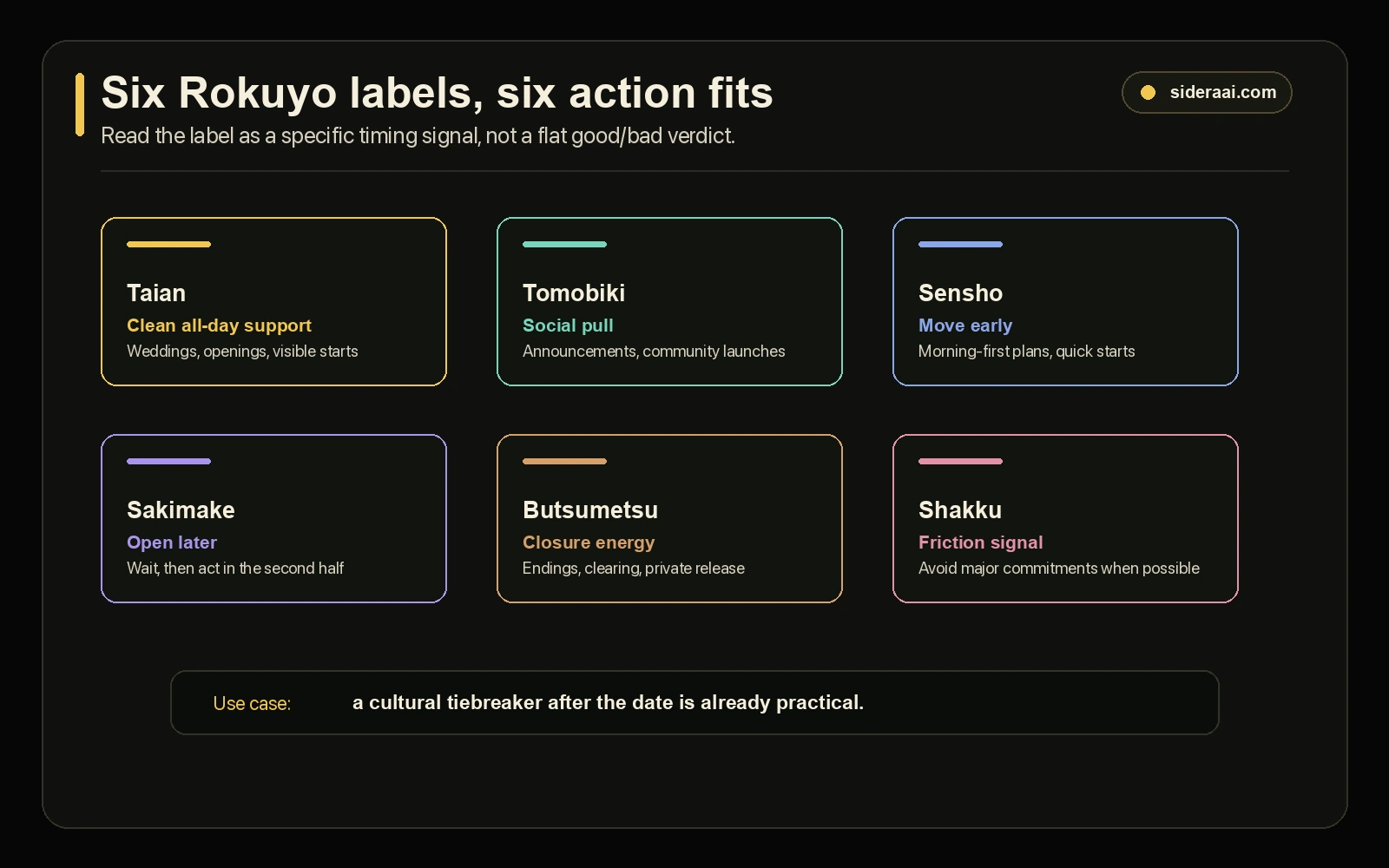
Read each Rokuyo label as a specific timing signal. The useful question is not good or bad; it is what kind of action the day supports.
For a broader comparison of how almanac timing layers like Rokuyo sit alongside Western and Vedic timing, see Sidera’s seven-system astrology calendar.
What Most Guides Miss
Most Rokuyo explanations list the six labels and stop there. They tell you Taian is good and Butsumetsu is bad and leave it at that.
What they skip is that the labels are not all the same kind of signal. Taian and Butsumetsu are full-day quality assessments. Sensho and Sakimake are time-of-day signals. Tomobiki is a social-dynamic signal. Shakku is a friction signal with a narrow opening.
Treating them all the same way, as a single lucky/unlucky verdict, is how Rokuyo gets dismissed as superstition. Reading them for what each label actually implies, which kind of energy the day carries and what that means for the specific thing you are trying to do, is how it becomes useful.
Decision Tree: How to Use a Rokuyo Label
Use Rokuyo as a tiebreaker only after the practical decision is already viable:
| If the date shows… | Choose this if… | Better use |
|---|---|---|
| Taian | You want the cleanest shared cultural signal | Weddings, openings, visible beginnings, formal starts |
| Tomobiki | You want other people pulled into the event | Community launches, announcements, introductions |
| Sensho or Sakimake | The date is workable but timing within the day matters | Morning-first or afternoon-first planning |
| Butsumetsu | The action is more about closure than celebration | Endings, clearing, private decisions, release work |
| Shakku | The date already feels pressured or conflict-heavy | Avoid major commitments unless constraints leave no choice |
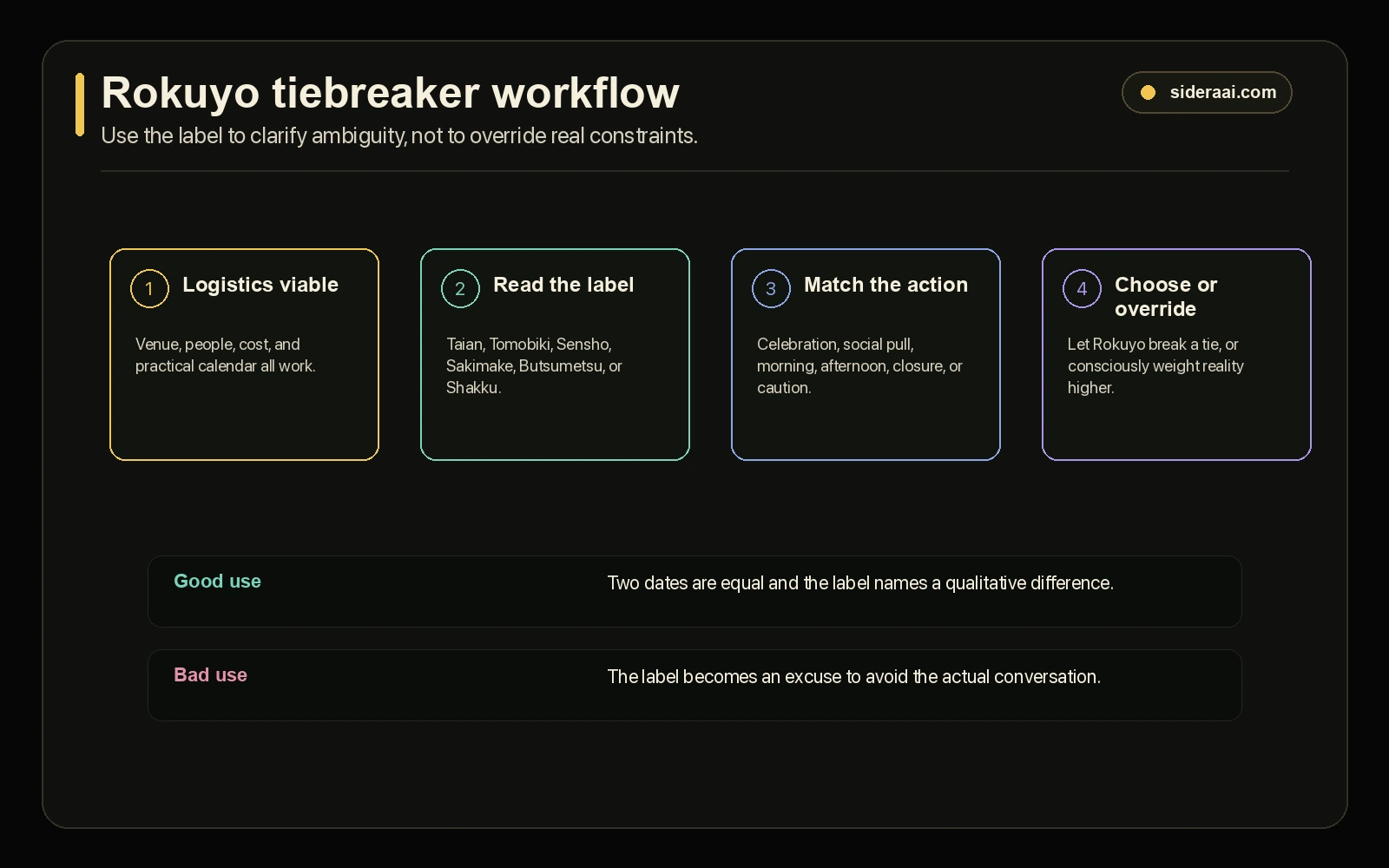
Use Rokuyo after the practical date is viable. The label can clarify ambiguity, but it should not override real constraints or needed conversations.
If two dates are equal logistically, pick the label that matches the emotional and social shape of the action. If the date is not equal logistically, do not let Rokuyo override reality.

Read the label by action type: opening, closure, and social spread need different kinds of support.
About These Screenshots
The screenshots in this article are real UI captures from Sidera Lucky Day Planner, taken on June 28, 2026 from a repeatable Singapore demo profile. They are not stock mockups or composites. The Rokuyo calculation runs entirely in the browser: it converts each Gregorian date to its lunar month and day, then applies the standard six-day modular rule. What you see here is what any user opening the same date range in Lucky Day Planner would see.
Accessing Rokuyo in Sidera Lucky Day Planner
Lucky Day Planner is Sidera’s multi-system timing interface. The system control shows the active layer and event location before the user opens the selector.
Once inside, the overview page shows all active timing systems. The Rokuyo tab is one of seven timing layers, each with its own calendar, selected-day panel, top-days list, and day log.
How Sidera Shows Rokuyo
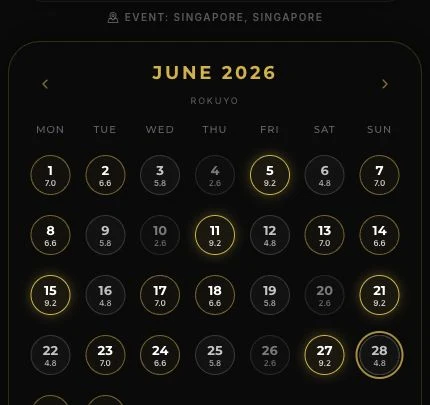
The Rokuyo calendar tab labels every day in the month view. You can see the pattern repeat across the six labels as the month progresses.
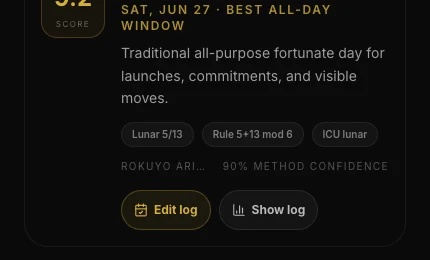
The selected-day panel goes deeper. It shows:
- score
- Rokuyo label
- signal phrase
- lunar date
- modular rule applied
- conversion source
- method confidence
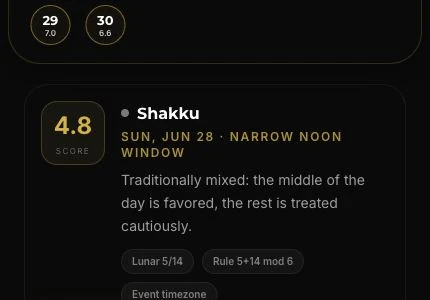
In the June 2026 example, June 28 is labeled Shakku with a 4.8 score and a narrow noon window. That is a mixed Rokuyo signal, and it shows why the label should be read before the score.
How to read this screen. Start with the label, because Taian, Butsumetsu, Tomobiki, and the half-day labels carry different kinds of meaning. Then read the score as Sidera’s ranking for that label inside the selected planning window. Finally, check method confidence. High confidence means the lunar conversion had enough coverage to be reliable; it does not mean the day is guaranteed to work.
Taian in Real Life
Taian is generally treated as the most auspicious Rokuyo label. The traditional reading is all-day favorable: a clean window for major events, public commitments, and visible beginnings.
In lived terms, Taian is the date that does not create cultural friction with the people around you. If you are planning a wedding and the partner’s family consults the Japanese calendar, Taian removes one layer of “is this okay.” If you are planning a launch and you have two candidate dates with similar practical and astrological conditions, a Taian date gives you a grounded cultural reason to choose it over a more cautious label.
What makes Taian useful is precisely what it does not claim. It does not promise outcomes. It does not predict that the event will succeed. It says: on the cultural timing calendar, this day is in a clean position. For people who care about that kind of alignment, even partially, that one fact can dissolve ambivalence that logic alone could not resolve.
Real Example: Taian as a Tiebreaker
Taian as a tiebreaker. Here is where it gets practically useful. Say you are choosing between two Saturdays for a public launch. The transit check is similar for both. Your availability and your team’s availability are nearly equivalent. Budget does not change either way.
One date is Taian. The other is Shakku.
If the people you are inviting share a cultural background where Rokuyo carries meaning, or if the label resonates personally, Taian can break the tie. It adds an independent cultural signal. It does not become more authoritative than planetary analysis.

Taian can provide a clean shared signal for a public launch once the venue, budget, and operational readiness already align.
Butsumetsu: More Than Avoidance
Butsumetsu is commonly treated as the least auspicious Rokuyo label. Many families avoid it for weddings, openings, and celebratory events. That avoidance is real and culturally consistent.
But Butsumetsu is more interesting emotionally than “avoid this day” suggests.
The word carries associations with endings. “Butsu” relates to Buddha; “metsu” means extinction or cessation. In a traditional reading, that makes it poor for celebrations. In a more psychological reading, it makes it a day when old forms finish. Something closes. Something releases.
That quality is not inherently bad. It depends entirely on what you are trying to do.
Butsumetsu tends to be better for:
- closing out a long project rather than launching a new one
- ending a difficult conversation you have been postponing
- making a private decision you need to settle quietly, without external input
- clearing something that has been occupying space in your planning without resolution
Butsumetsu can fit closure and clearing: finish the old project instead of forcing a celebratory new beginning.
Where Butsumetsu creates friction is when you are trying to force a public commitment or a major external announcement on a day that carries a quiet, closing quality. The friction is not the calendar punishing you. It is a mismatch between the action you want to take and the energy the day is carrying.
The emotionally honest version of Butsumetsu is not “this day is unlucky.” It is: “this day is not built for starting something you want to feel permanent and celebratory. If what you are doing is ending something, Butsumetsu is actually a coherent day for it.”
One concrete use is a family apology you have postponed because the timing always feels charged. Butsumetsu does not make the apology succeed. It can, however, name the day as one for closing a pattern rather than staging a celebration.
That reframing matters when you are choosing between two dates and one is Butsumetsu. The question is not automatically “avoid it.” The question is: what kind of energy does this action need, and does Butsumetsu support or contradict that?
Tomobiki: When the Day Pulls Others In
Tomobiki is the Rokuyo label most tied to social dynamics. The characters mean roughly “friend-drawing” or “companion-pulling.” The traditional reading is that Tomobiki draws others into whatever is happening, which is why it is famously avoided for funerals: the concern is that the pulling energy drags friends toward death alongside the deceased.
For events that require other people to move with you, Tomobiki’s social-amplifying quality can be an asset rather than a neutral.
A fundraising campaign, a community launch, a team announcement, a shared project going public: on a Tomobiki day, the pull quality means that when you put something out, it tends to travel. People respond. The social radius of the event extends further than it might on a quieter label.

Tomobiki suits outward-moving work: a community launch or campaign is designed to travel beyond its starting point.
The flip side is visible. If you are making a deeply private decision, or a resolution that needs to settle before you tell anyone, a Tomobiki day is not the right frame for it. The label’s social energy works against discretion. A day that draws others in is not a day for something you need to hold close while it takes shape.
Tomobiki is not bad or good. It is directionally specific. And knowing which direction you need before you check the label is the whole point.
The Half-Day Labels
Sensho and Sakimake carry time-of-day nuance that Taian and Butsumetsu do not.
Sensho is generally read as favorable earlier in the day, softer in the afternoon. If you have ever noticed that some days feel more focused and productive in the morning and then run out of forward momentum after noon, Sensho is the label that most describes that split. Early actions on Sensho days tend to carry more weight. Afternoon ones tend to need more effort to land.
Sakimake runs in the opposite direction: cautious earlier, opens later. A Sakimake day rewards patience. Forcing a commitment or an announcement in the morning often means revisiting it. Waiting until the afternoon gives the day room to open before you put your energy into it.
Shakku is treated as generally difficult across the whole day, with some traditional readings allowing a midday window. It is the most restrictive label. A Shakku date for a major commitment is worth noting at minimum, particularly if the people involved are familiar with Rokuyo.
Sidera’s Lucky Day Planner shows Rokuyo at the day level, not as precise local hour recommendations. You will see the label and signal phrase; half-day nuances should be read as directional timing context. For users who want to time Sensho or Sakimake precisely within a day, the label is a starting reference rather than a complete schedule.
Reading the Top Days View
The top-days view turns Rokuyo from a passive calendar label into a practical shortlist.
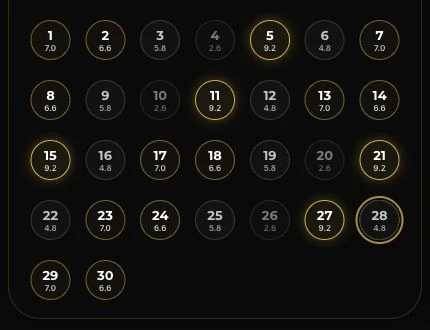
In the June 2026 example, the top Rokuyo days include:
- Fri, Jun 5: Best all-day window, score 9.2
- Mon, Jun 1: Move early, score 7.0
- Tue, Jun 2: Socially supportive, score 6.6
Users rarely need to evaluate every day in the calendar. They need candidate dates. The top-days view gives them a shortlist of Rokuyo-favorable dates to bring into comparison with their other timing checks and practical constraints.
Using the Day Log With Rokuyo
The day log is where Rokuyo shifts from cultural reference to personal data.
After each notable day, you can record what actually happened: energy level, productivity, mood, outcome, or a short note on how the day felt relative to what you expected. Over one or two lunar cycles, patterns may surface. You might notice that your Taian days consistently feel expansive and that commitments made on them tend to stick. Or that Sensho mornings are your most focused window while Sensho afternoons slow everything down. Or that Butsumetsu days are better for clearing backlogs and closing loops than for starting anything that needs external momentum.
None of this is the calendar directing your behavior. It is you observing whether the cultural timing signal correlates with your experience. That is the honest value of logging alongside an almanac layer.
Recording notes consistently across even one month gives you enough data to judge whether Rokuyo is a personally meaningful signal or just background color for your planning. If a pattern appears, you have learned something real about your own rhythms. If no pattern appears, you have equally useful data for that conclusion. Either outcome is informative.
Methodology Box: Why Lunar Conversion Matters
The Rokuyo calculation looks simple, but it depends on getting the lunar date right. Sidera converts the Gregorian date to a lunar month and day, then applies the modular rule:
(lunarMonth + lunarDay) % 6
That maps each date to one of the six labels.
The difficult part is not the six-day arithmetic. The difficult part is reproducible lunar conversion. If the lunar month or day is off by even one, the Rokuyo label changes. That is why method confidence is shown alongside the label in Lucky Day Planner. A high confidence value means the conversion had sufficient coverage to be reliable. It does not mean the outcome of the day is guaranteed. It means the system knows what it found.
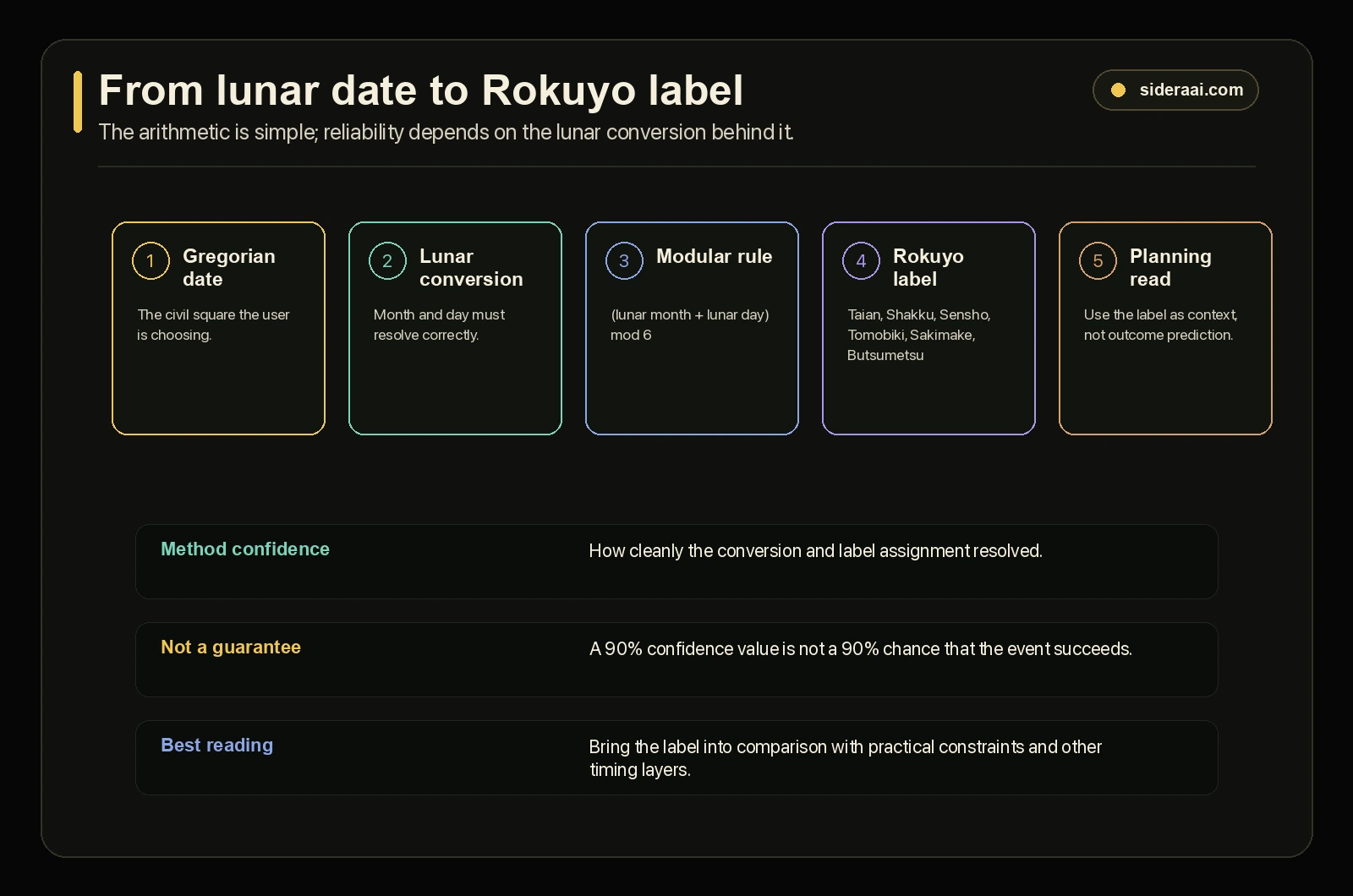
Method confidence belongs to the conversion and label assignment. It is not a promise that the event will succeed.
Common Mistakes With Rokuyo Timing
The first mistake is treating Rokuyo as a full astrology election. It is not. It does not evaluate transits, houses, natal placements, lagna, or the purpose-specific rules a practitioner might use. It is a cultural almanac signal based on a six-day cycle.
The second mistake is treating a high method confidence value as a promise. In the Sidera screenshot, 90 percent confidence means the lunar conversion and label assignment are well supported. It does not mean the event has a 90 percent chance of going well.
The third mistake is using the label to avoid the real conversation. If a wedding date feels wrong because the families are not aligned, Rokuyo can help name one layer of friction. It cannot replace the conversation the date is forcing you to have.

Rokuyo can name one timing signal, but it cannot replace the legal, financial, or relational work that makes a decision viable.
When Rokuyo Is Useful
Rokuyo is most useful when:
- The people involved have any connection to Japanese cultural timing, even casual familiarity
- You want a lightweight almanac layer alongside other timing checks rather than a standalone system
- You are choosing between dates that are already practically equal and need a directional tiebreaker
- You are looking for a second signal to confirm or complicate a direction you already feel
Use it for:
- wedding date selection when Japanese calendar awareness matters
- ceremony planning and formal openings
- personal milestones where the quality of the day matters, not just the logistics
- comparing candidate dates when other timing systems return inconclusive or mixed results
Do not use it as the sole driver for:
- legal or financial timing where professional and regulatory guidance leads
- medical decisions
- religious obligations governed by their own calendar authority
For timing decisions around contracts and professional commitments, see what to consider astrologically when signing a contract. For how lunar calendars interact with religious timing in Jewish and Islamic contexts, the lunar calendar guide shows how different systems approach the same planning questions with different frameworks. For the Chinese almanac approach to auspicious days, Ze Ri timing is the closest parallel to Rokuyo in Sidera’s Lucky Day Planner.
What Timing Systems Are Really For
The deepest use of Rokuyo is not scheduling optimization. It is permission and shared language.
Some people use it because their family still does. A partner’s parents look up the label before agreeing on a wedding date. A grandmother mentions that a particular day feels wrong even though she cannot articulate why beyond “it is not a good day on the calendar.” In those contexts, knowing what the Rokuyo label is matters because other people’s relationship to it matters. You are not adopting the system for yourself. You are meeting the people you love where they are.
Other people use it as a personal tiebreaker. The practical logistics look the same either way. The astrology check is inconclusive. They have a gut feeling they cannot fully defend. The Rokuyo label gives them something external to either align with or consciously push against. Both responses are valid.
Both uses are legitimate. The question worth sitting with is which one applies to you, and what you are actually looking for when a date does not feel quite right even though everything about it looks fine on paper.
Rokuyo does not answer that question for you. It gives you one more signal. What that signal means in your specific situation, for your specific decision, with the specific people involved, is still yours to interpret.
The reflection worth ending on is not “is Taian the best day?” It is: “what kind of support am I actually looking for when I want a date to feel right?” The answer to that question tells you more about how to use timing tools than any label can.