Introduction
If an astrology planets cheat sheet only gives you keywords, it leaves you with the same problem: you know Mars means “action,” but not why anger turns into urgency, shutdown, competitiveness, or resentment in real life. You know Venus means “love,” but not why attraction can feel like comfort for one person and pursuit for another.
The useful question is not just “what does this planet mean?” It is “where does this part of me show up when I am dating, working, arguing, choosing, avoiding, or trying to feel like myself?”
In astrology, planets describe the active functions in your chart. Signs describe the style. Houses describe the life area. Aspects describe the tension, support, or contradiction between different parts of you.
This guide keeps the meanings practical: what each planet represents, what it can feel like in daily behavior, where the shadow pattern tends to appear, and which placements to read first if you want insight instead of personality fluff.
Ready to See Your Personal Birth Chart?
Discover your unique cosmic blueprint — planets, houses, and aspects personalized to your exact birth time and location.
Get Your Birth Chart →✓ Birth chart analysis ✓ Personalized insights ✓ Free to use
The Astrological Planetary System
Modern Western astrology uses ten primary celestial bodies:
- The Sun (technically a star)
- The Moon (technically a satellite)
- Five visible planets: Mercury, Venus, Mars, Jupiter, Saturn
- Three outer planets: Uranus, Neptune, Pluto
Each planet moves through the twelve zodiac signs at different speeds. The Sun takes one year to complete the zodiac, while Pluto takes 248 years. The slower a planet moves, the more generational its influence becomes.
Planetary Categories
| Category | Planets | Influence Type | How They Affect You |
|---|---|---|---|
| Personal | Sun, Moon, Mercury, Venus, Mars | Individual personality | Daily behavior, emotional needs, communication, attraction, anger |
| Social | Jupiter, Saturn | Growth and responsibility | How you build confidence, meaning, discipline, career, and long-term trust |
| Outer/Generational | Uranus, Neptune, Pluto | Collective pressure with personal triggers | Where wider cultural patterns become personal through houses, aspects, and transits |
The Basic Reading Formula
Use this formula when any planet description feels too abstract:
- Planet: what part of you is active
- Sign: how that part of you expresses itself
- House: where it shows up in real life
- Aspect: whether it feels easy, conflicted, delayed, exaggerated, or hard to trust
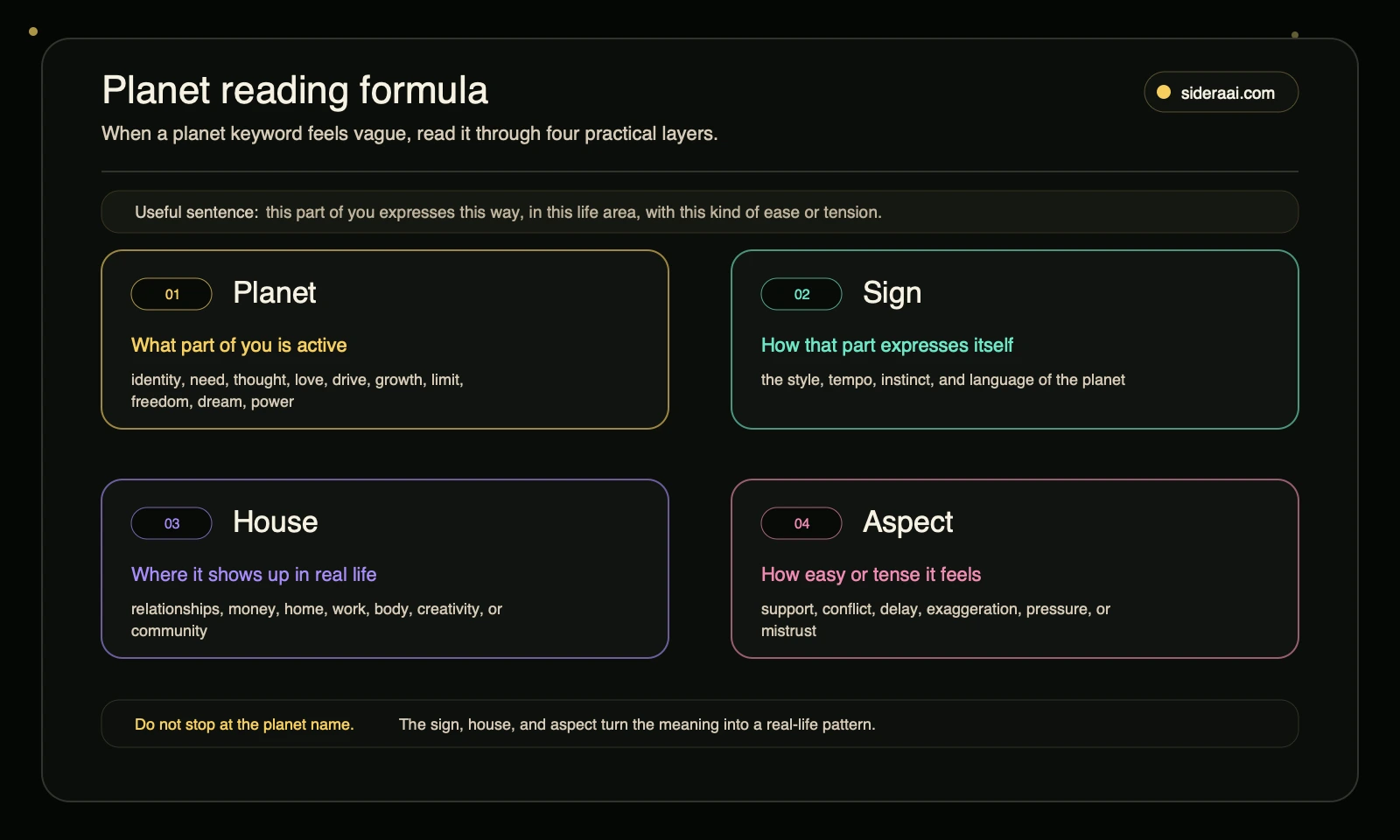
Use the formula map when a planet keyword feels too abstract. The planet names the active function, while the sign, house, and aspect turn it into a real-life pattern.
The Personal Planets (Fast-Moving)
The Sun ☉
What it represents: Core identity, ego, vitality, life purpose
Rules: Leo
Orbital period: 1 year (changes signs monthly)
Key question: “Who am I at my core?”
The Sun is your developing sense of identity: the part of you that wants to feel alive, visible, and self-directed. It shows up in the way you make choices when no one else is deciding for you.
In real life: the Sun is your confidence style, your relationship to being seen, and the kind of life that makes you feel like you are not just performing.
Shadow pattern: over-identifying with a role, needing validation to feel real, or hiding your desires because visibility feels risky.
Reflection prompt: Where do I feel most like myself, and where am I performing a version of myself that gets approval?
Check your Leo daily horoscope to see how solar energy manifests.
The Moon ☽
What it represents: Emotions, instincts, subconscious, needs
Rules: Cancer
Orbital period: 27.3 days (changes signs every 2-3 days)
Key question: “What do I need to feel safe?”
Your Moon sign reveals your emotional baseline: what you need before you can relax, trust, or respond instead of react. While the Sun describes conscious identity, the Moon often describes what happens before you have time to edit yourself.
In real life: the Moon shows your attachment needs, comfort rituals, family imprinting, and the emotional logic behind your habits.
Shadow pattern: confusing familiarity with safety, expecting others to intuit your needs, or protecting yourself through withdrawal, control, caretaking, or moodiness.
Reflection prompt: What do I need when I am overwhelmed, and do I know how to ask for it directly?
Explore the Cancer daily horoscope for lunar energy.
Mercury ☿
What it represents: Communication, thinking, learning, perception
Rules: Gemini and Virgo
Orbital period: 88 days
Key question: “How do I process information?”
Mercury governs how you think, speak, listen, learn, and turn experience into a story. It is not just your communication style; it is the filter that decides what information feels important.
In real life: Mercury shows how you text, negotiate, study, joke, explain yourself, and handle ambiguity.
Shadow pattern: overexplaining, intellectualizing feelings, arguing to manage anxiety, or assuming your interpretation is the only reasonable one.
Reflection prompt: When I am stressed, do I seek clarity, control, debate, distraction, or reassurance?
Explore Gemini daily horoscope and Virgo daily horoscope to understand Mercury’s intellectual energy.
Retrograde note: Mercury retrograde is less useful as a panic label and more useful as a review period: slow down messages, assumptions, logistics, and decisions that need clean details.
Venus ♀
What it represents: Love, beauty, values, pleasure, relationships
Rules: Taurus and Libra
Orbital period: 225 days
Key question: “What do I value and desire?”
Venus reveals what you value, how you receive affection, and what makes connection feel worth choosing. It describes taste, desire, pleasure, money patterns, and the kind of relational atmosphere you keep returning to.
In real life: Venus shows what you are drawn to in love, how you flirt, what you spend on, and what makes you feel appreciated.
Shadow pattern: people-pleasing, chasing validation, mistaking chemistry for compatibility, or undervaluing what you actually need because you want to be wanted.
Reflection prompt: Do my choices reflect my values, or do they reflect what I hope will make me more lovable?
See Taurus daily horoscope and Libra daily horoscope for Venusian energy.
Retrograde note: Venus retrograde often asks for a values audit: relationship patterns, money choices, aesthetic desires, and the difference between longing and alignment.
Mars ♂
What it represents: Action, energy, desire, anger, drive
Rules: Aries (and traditionally Scorpio)
Orbital period: 687 days (about 2 years)
Key question: “How do I assert myself?”
Mars is how you pursue what you want. It describes desire, anger, initiative, boundaries, physical energy, and the way you move from frustration into action.
In real life: Mars shows how you start things, compete, handle rejection, express anger, and recover your nerve after a setback.
Shadow pattern: forcing outcomes, picking fights to feel powerful, suppressing anger until it leaks out sideways, or confusing urgency with courage.
Reflection prompt: When I want something, do I move directly, wait to be invited, strategize, pressure, avoid, or resent?
See Aries daily horoscope and Scorpio daily horoscope for Mars-ruled energy in action.
Retrograde note: Mars retrograde can feel like stalled momentum, but the useful work is noticing where your effort, anger, or ambition needs a better strategy.
Sidera uses your actual birth chart—not generic horoscopes.
Get personalized insights →The Social Planets (Medium-Speed)
Jupiter ♃
What it represents: Growth, expansion, luck, wisdom, optimism
Rules: Sagittarius (and traditionally Pisces)
Orbital period: 12 years (1 year per sign)
Key question: “Where do I seek meaning and growth?”
Jupiter shows where you look for meaning, growth, permission, and possibility. It can describe confidence and opportunity, but also the places where you overpromise because potential feels more exciting than limits.
In real life: Jupiter shows your beliefs, risk tolerance, teaching style, generosity, and where you expect life to open up.
Shadow pattern: excess, moral superiority, avoidance through optimism, or assuming that enthusiasm is the same as follow-through.
Reflection prompt: Where am I growing from faith, and where am I using possibility to avoid the next practical step?
Explore Sagittarius daily horoscope to see Jupiter’s expansive influence.
Saturn ♄
What it represents: Structure, discipline, responsibility, limits, mastery
Rules: Capricorn (and traditionally Aquarius)
Orbital period: 29 years (2-3 years per sign)
Key question: “Where must I mature and commit?”
Saturn shows where life asks for maturity, consistency, and honest limits. It often feels heavy at first because it points to the places where avoidance has consequences.
In real life: Saturn shows your relationship to responsibility, authority, long-term work, commitment, and the fear of not being good enough.
Shadow pattern: self-criticism, control, emotional stiffness, procrastination through fear, or taking on burdens to prove your worth.
Reflection prompt: What would become easier if I stopped treating discipline as punishment and started treating it as support?
The Saturn Return, around ages 29, 58, and 87, often marks a major maturity checkpoint. See Capricorn daily horoscope for Saturn’s grounding energy.
The Outer Planets (Generational)
Understanding Generational Planets
The outer planets (Uranus, Neptune, Pluto) move so slowly that everyone born within a 7-32 year period shares the same sign placement. That does not make them irrelevant. It means the sign is collective, while the house, aspects, and transits show how that collective pressure becomes personal.
Why they still matter in your chart:
- Their house position shows where that generational energy manifests personally
- Aspects they make to your personal planets reveal how collective forces shape your individual life
- They mark major life transits that trigger transformation for everyone in their path
Uranus ♅
What it represents: Revolution, innovation, independence, sudden change
Rules: Aquarius
Orbital period: 84 years (7 years per sign)
Key question: “Where do I break free?”
Uranus shows where you need freedom, originality, and enough space to stop performing normal. It can bring breakthroughs, but it can also describe the part of you that disrupts anything that starts to feel too controlled.
In real life: Uranus shows rebellion, innovation, sudden exits, unconventional choices, and nervous-system-level resistance to being boxed in.
Shadow pattern: detachment, instability, rejecting support because it feels like control, or blowing up a situation instead of negotiating more space.
Reflection prompt: Where do I need more freedom, and where am I using disruption to avoid vulnerability?
Explore Aquarius daily horoscope for Uranian innovation.
Neptune ♆
What it represents: Dreams, illusion, spirituality, compassion, dissolution
Rules: Pisces
Orbital period: 165 years (14 years per sign)
Key question: “Where do I transcend reality?”
Neptune shows imagination, compassion, spiritual longing, and the places where reality gets blurry. It can make life feel meaningful and connected, but it can also make avoidance look beautiful.
In real life: Neptune shows dreams, ideals, art, projection, empathy, fantasy, and what you want to believe even when the facts are mixed.
Shadow pattern: savior dynamics, denial, escapism, vague promises, or falling in love with potential instead of behavior.
Reflection prompt: What am I romanticizing, and what would become clear if I stopped editing out the inconvenient details?
See Pisces daily horoscope for Neptunian themes.
Pluto ♇
What it represents: Transformation, power, death/rebirth, obsession
Rules: Scorpio
Orbital period: 248 years (12-32 years per sign)
Key question: “Where must I transform completely?”
Pluto shows power, obsession, deep attachment, endings, and the kind of transformation that cannot be solved by surface change. It points to where you meet control, fear, desire, and truth.
In real life: Pluto shows what you cannot stay casual about: trust, betrayal, intimacy, control, grief, survival, money, sexuality, ambition, or psychological honesty.
Shadow pattern: testing people, withholding vulnerability, power struggles, fixation, or trying to control what actually needs to be grieved.
Reflection prompt: Where am I trying to stay in control because honest change would require a loss?
Astrology treats outer-planet generations as symbolic patterns, not proof that a planet caused a historical event. The personal value is in noticing where those broad themes land in your actual chart.
Find your perfect moment with AI-powered electional astrology.
Discover your timing →Planet Priority Guide: Where to Start
When you first look at your birth chart, ten planets can feel overwhelming. Start with the placements that explain the most obvious patterns first, then move into the subtler layers.
Priority 1: Your “Big Three”
- Sun sign - Your core identity and life purpose
- Moon sign - Your emotional needs and instinctive reactions
- Rising sign (Ascendant) - Your outward personality and approach to life
These three form your basic astrological fingerprint. If you do not relate to your Sun sign, check whether your Moon explains your emotional life or your Rising explains how you move through the world.
Priority 2: Your Chart Ruler
Your chart ruler is the planet that rules your Rising sign. For example:
- Aries rising = Mars rules your chart
- Taurus rising = Venus rules your chart
- Gemini rising = Mercury rules your chart
Your chart ruler colors your whole approach to life. Its sign, house, and aspects often explain why two people with the same Rising sign still live that energy differently.
Priority 3: Personal Planet Emphasis
Look at which personal planets (Mercury, Venus, Mars) are most prominent in your chart:
- Multiple aspects - connects to many other planets
- Angular houses (1st, 4th, 7th, 10th) - more visible in your life
- Elevated - highest planet in your chart (closest to Midheaven)
Priority 4: Outer Planet Contacts
Check if any outer planets (Uranus, Neptune, Pluto) make close aspects to your Sun, Moon, Rising, chart ruler, Venus, or Mars. These contacts often make collective themes feel intensely personal.
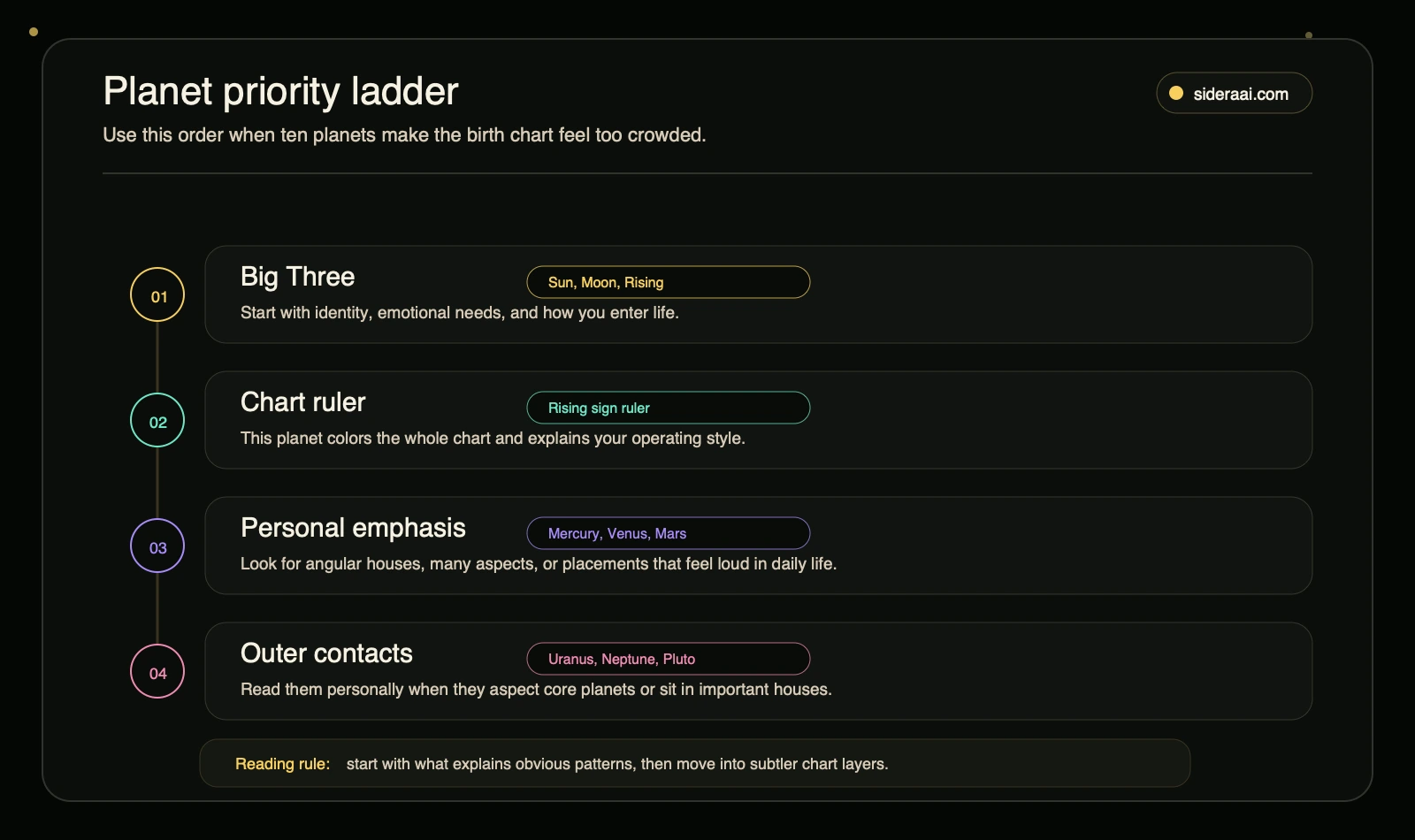
The priority ladder gives beginners a reading order before they try to interpret all ten planets at once. Start with the layers that explain obvious patterns, then move into subtler contacts.
How to Read Your Planets
When reading your chart, each planet’s sign shows how that planetary energy expresses, while its house shows where in life that energy manifests. This is where the interpretation becomes useful instead of generic.
Example 1:
- Venus in Aries in the 10th house = You may express attraction directly and value boldness (Aries), while also needing your work, reputation, or public identity (10th house) to feel aligned with your taste and values.
Example 2:
- Moon in Capricorn in the 4th house = You may feel safest when home life has structure, reliability, and practical competence. The shadow is acting emotionally self-sufficient when you actually need care.
Example 3:
- Mars in Libra in the 7th house = You may assert yourself through negotiation, charm, or fairness, but conflict in relationships can become the main place where anger, desire, and boundaries surface.
The aspects (angles) between planets add another layer - showing how different parts of your personality work together or create internal tension. For example, Sun square Saturn can indicate self-doubt, while Jupiter trine Venus often brings ease in relationships.
Quick Reference: Planet Archetypes
- Sun: The Hero
- Moon: The Mother
- Mercury: The Messenger
- Venus: The Lover
- Mars: The Warrior
- Jupiter: The King/Sage
- Saturn: The Teacher
- Uranus: The Rebel
- Neptune: The Mystic
- Pluto: The Transformer
Common Misconceptions About Planets
“I have no planets in [sign]”
This is normal. With 10 planets and 12 signs, most people have empty signs. Empty does not mean absent. That sign still appears somewhere in your chart, and its ruling planet can show how that area operates.
“Outer planets don’t affect me because they’re generational”
False. While everyone your age shares the same outer planet signs, their house positions and aspects to your personal planets are unique and highly personal.
“My Sun sign is most important”
The Sun is important, but it does not explain everything. The Moon often describes emotional needs, the Rising sign describes your approach to life, and Mercury, Venus, and Mars describe daily behavior in conversation, love, money, conflict, and desire.
“Retrograde planets are bad”
Not necessarily. Retrograde planets are often internalized - you may process that energy privately or reflectively before expressing it outwardly. The key question is not “is this bad?” but “where do I need review before direct action?”
Which Planets Govern What
Quick reference for planetary domains:
- Identity & purpose: Sun
- Emotions & comfort: Moon
- Communication & learning: Mercury
- Love & beauty: Venus
- Action & sex: Mars
- Luck & growth: Jupiter
- Discipline & career: Saturn
- Innovation & freedom: Uranus
- Dreams & spirituality: Neptune
- Power & transformation: Pluto
Why Planets Matter More Than Just Your Sun Sign
Your Sun sign is just one piece of a complex puzzle. Someone with Sun in Gemini but Moon in Scorpio and Mars in Capricorn will have a vastly different personality than another Gemini with Moon in Sagittarius and Mars in Aries.
The planets create a unique fingerprint that no horoscope column can capture. Understanding your full planetary lineup reveals:
- Why you might not relate to your Sun sign description (Moon/rising likely stronger)
- Your emotional patterns and needs (Moon)
- How you communicate and think (Mercury)
- Your love language and values (Venus)
- What motivates and angers you (Mars)
- Where you find luck and meaning (Jupiter)
- Your challenges and life lessons (Saturn)
Learn more about how the four elements interact with planetary energies, or explore individual signs like Fire signs, Air signs, and Water signs.
How Planets Show Up In Real Life
Use this table when you want the meaning to connect to actual behavior instead of memorized keywords.
| Planet | In love | At work | In conflict | Self-image question |
|---|---|---|---|---|
| Sun | Wants to be seen and chosen for the real self | Needs work that supports identity and vitality | Gets proud, defensive, or invisible when dismissed | Am I living from desire or performing a role? |
| Moon | Seeks emotional safety, comfort, and familiar rhythms | Needs a sustainable pace and supportive environment | Reacts from old protective habits | What do I need before I can respond clearly? |
| Mercury | Bonds through conversation, humor, curiosity, or analysis | Handles ideas, messages, planning, and problem-solving | Debates, overexplains, assumes, or shuts down | What story am I telling myself? |
| Venus | Shows attraction, affection, values, and pleasure | Shapes money choices, aesthetics, rapport, and collaboration | People-pleases, withholds, compares, or seeks validation | What do I actually value when no one is judging? |
| Mars | Shows desire, pursuit, sexual energy, and boundaries | Drives initiative, stamina, competition, and execution | Fights, pressures, avoids, or turns anger inward | How do I act when I want something? |
| Jupiter | Wants shared meaning, growth, generosity, and adventure | Takes risks, teaches, expands, and builds belief | Overpromises, moralizes, or avoids limits | Where am I confusing possibility with entitlement? |
| Saturn | Needs trust, commitment, maturity, and earned security | Builds mastery through discipline and responsibility | Criticizes, controls, delays, or freezes | What responsibility would make me freer? |
| Uranus | Needs autonomy, honesty, and room to be different | Innovates, experiments, and resists stale systems | Detaches, rebels, or exits suddenly | Where do I need freedom without destroying connection? |
| Neptune | Seeks romance, compassion, spiritual connection, and softness | Imagines, creates, heals, and senses atmosphere | Avoids facts, idealizes, dissolves boundaries | What am I refusing to see clearly? |
| Pluto | Craves depth, trust, truth, and emotional intensity | Handles power, crisis, strategy, and transformation | Tests, obsesses, controls, or withholds | Where do I need honesty more than control? |
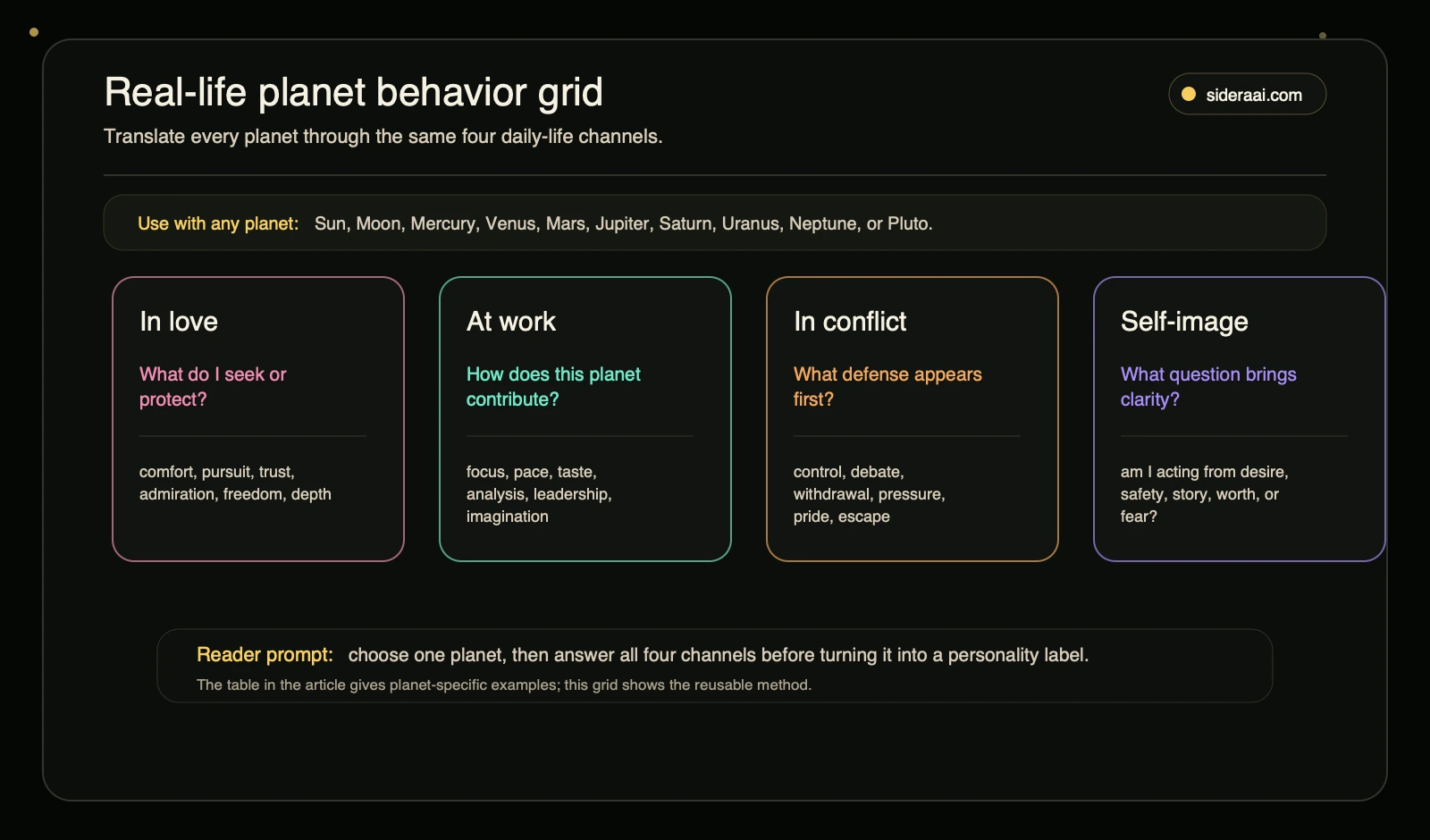
The behavior grid shows how to use the article table without memorizing keywords. Choose one planet, then translate it through love, work, conflict, and self-image before turning it into a label.
Understand your connections on a cosmic level.
Explore your bonds →FAQ
How many planets are in astrology?
Modern Western astrology uses 10 primary celestial bodies: the Sun, Moon, Mercury, Venus, Mars, Jupiter, Saturn, Uranus, Neptune, and Pluto. Some astrologers also include Chiron (a comet/asteroid) and the lunar nodes (mathematical points), bringing the total to 12-13 points of reference.
What’s the difference between personal planets and outer planets?
Personal planets (Sun through Mars) move quickly and shape your individual personality, emotions, and daily behavior. Outer planets (Uranus, Neptune, Pluto) move slowly and represent generational themes - everyone born within 7-32 years shares the same sign placement. The outer planets affect you personally through their house position and aspects to your personal planets.
Which planet is most important in my chart?
There’s no single “most important” planet - it depends on what you want to understand. Your Sun represents life purpose, Moon reveals emotional needs, Rising Sign ruler (chart ruler) shows your approach to life, and any planet that makes many aspects or sits in a prominent house becomes influential. A full chart reading considers all planets together.
Do planets in astrology include the sun and moon?
Yes. In astrology, the term “planets” is used loosely to include all major celestial bodies used in chart interpretation. Technically, the Sun is a star and the Moon is Earth’s satellite, but astrologers call them “planets” for simplicity. The correct term is “celestial bodies” or “planetary bodies.”
What does it mean when a planet is retrograde?
A planet is retrograde when it appears to move backward in the sky from Earth’s perspective. Astrologically, retrograde planets often describe energy that is processed inwardly, privately, or through review before it becomes direct action.
Next Steps
Ready to see how the planets show up in your chart? You’ll need your exact birth time and location to calculate accurate planetary positions - especially for the Moon, which changes signs every 2-3 days, and your house placements, which shift every few hours.
For slow-moving pressure, read the focused guides to Saturn in astrology and Pluto in astrology before applying a one-word planet meaning.
The planets are always moving, creating new patterns and awakening different parts of your chart. Understanding them is the first step toward using astrology as a practical tool for self-awareness, relationship reflection, planning, and timing.