
The 2nd house is where the chart gets personal about money. Not wealth as a vague promise – but the private stress you feel when a bill is due, the pride you feel when you can provide for yourself, the things you keep because they make life feel stable, and the quiet belief underneath it all: this is what I am allowed to have.
In western tropical astrology, the 2nd house governs the territory of Taurus: fixed earth, Venus-ruled, oriented toward what endures. It is the house of possessions, income, material resources, and sensory pleasure. But underneath the financial layer, the 2nd house is really about self-worth – the private equation between what you own, what you protect, what you charge for your labor, and what you believe you deserve to receive.
Research from Cambridge University (Whitebread, 2013) suggests that core money beliefs and financial habits are largely established by age 7 – long before most people have any earnings of their own. The 2nd house in astrology captures something similar: it is less about what you have and more about what you believe you are allowed to have. That belief can show up as undercharging, hoarding, comfort spending, refusing help, choosing “secure” work that drains you, or needing proof of loyalty before you feel safe in love.
Unlike angular houses (1st, 4th, 7th, 10th) where planetary energy tends to announce itself outwardly, the 2nd house is succedent – its energy accumulates steadily rather than erupting suddenly. Planets here work the same way: they shape your financial instincts, values, and relationship with material life in ways that become most visible over time, through patterns of earning, spending, and the objects you choose to keep.
Understanding what each planet does in this house gives you a direct window into what someone treats as genuinely valuable – and why. For the companion guide on how planets express through the 1st house, see planets in the 1st house astrology. To see how current planetary transits are activating your natal 2nd house themes right now, the daily horoscope guide tracks shifting planetary energies in real time.
Ready to See Your Personal Birth Chart?
Discover your unique cosmic blueprint — planets, houses, and aspects personalized to your exact birth time and location.
Get Your Birth Chart →✓ Birth chart analysis ✓ Personalized insights ✓ Free to use
What the 2nd House Rules
Before examining individual planets, it helps to be precise about this house’s domain:
- Money and income – earning capacity, salary, financial instincts
- Possessions and material resources – what you own and choose to keep
- Self-worth – the internal value you assign to yourself, often reflected in what you allow yourself to have
- Values – what you find genuinely worthwhile and are willing to work for
- Physical senses – pleasure derived from the tangible world: food, touch, comfort, beauty
- Natural talents – the innate abilities you can convert into income
The natural sign of the 2nd house is Taurus, ruled by Venus. This colors the house with themes of patience, accumulation, sensory pleasure, and a deep discomfort with instability. Even when a different sign occupies the 2nd house cusp in an individual chart, these Taurean undertones remain operative.
As astrologer Howard Sasportas writes in The Twelve Houses (1985): “The second house describes what we value and what we consider worth having in life. On a deeper level, it reflects our sense of self-worth and our capacity to receive – the degree to which we believe we deserve what life is offering us.”
The 2nd house also operates in direct dialogue with the 8th house, its polar opposite. Where the 2nd house concerns personal resources – what you earn and own independently – the 8th house governs shared resources, inheritance, debt, and what comes through other people. The tension between these two houses (what is mine versus what we share) is a recurring theme in financial astrology. For a broader introduction to house structure, the 12 astrology houses explained provides useful context.
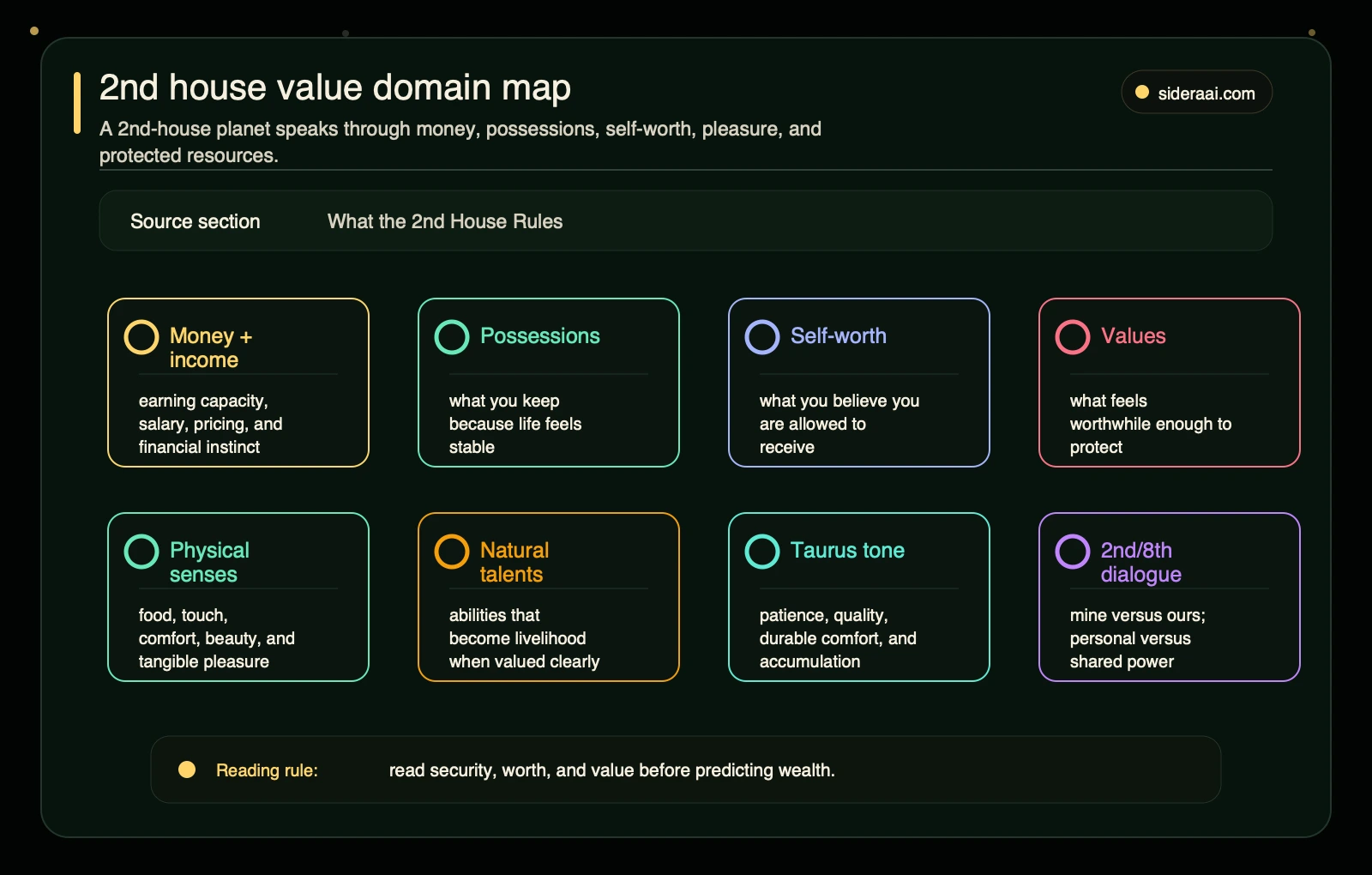
Use the domain map as a quick reference for the material and psychological places where a 2nd-house planet tends to become visible.
How 2nd House Planets Show Up in Real Life
Planets in the 2nd house do not just describe “money style.” They describe the behavior you reach for when your security feels tested.
- In love, the 2nd house shows how you receive care, gifts, touch, loyalty, and practical support. Some placements need consistency before they can trust affection; others equate love with generosity, beauty, or being materially chosen.
- At work, this house shows what you believe your skills are worth. It can reveal whether you negotiate, overdeliver for too little, chase independence, or need stable compensation before you can do your best work.
- In conflict, 2nd house planets often become protective. The fear is not always “money”; sometimes it is the fear of being undervalued, replaceable, dependent, or unable to keep what matters.
- In self-image, this house shows the difference between real self-worth and performance-based worth. If your confidence rises and falls with income, productivity, attractiveness, or possessions, the 2nd house is speaking loudly.
The useful question is not just “Will I be rich?” It is: What do I do when I feel I have to prove my value? The planet in your 2nd house describes that reflex.
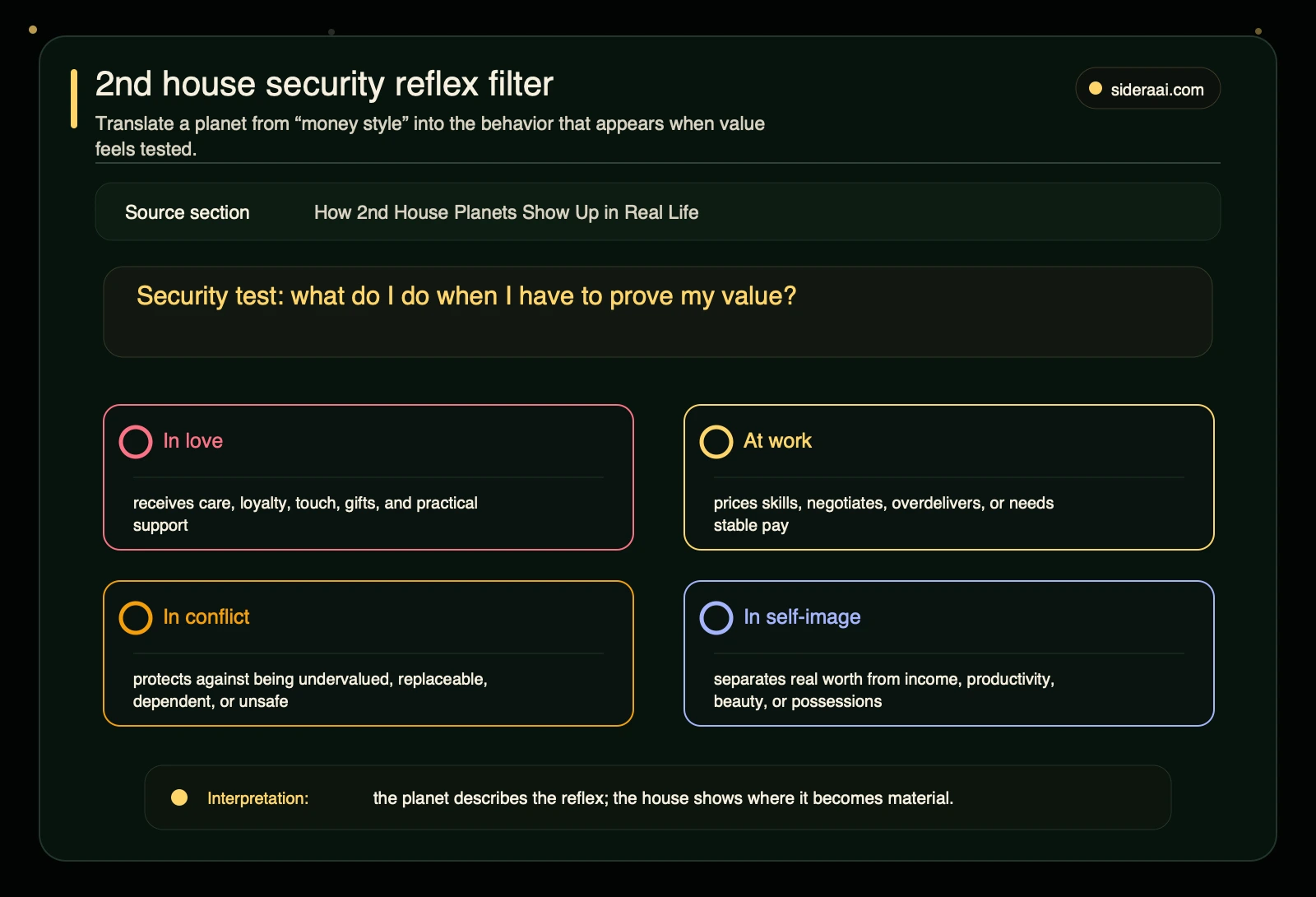
The reflex filter turns a 2nd-house planet from a money keyword into a practical behavior pattern you can notice in real life.
Understand your connections on a cosmic level.
Explore your bonds →Sun in the 2nd House
The Sun in the 2nd house anchors identity to material achievement and financial self-sufficiency. These individuals tend to feel most themselves when they are providing – for themselves, for others, for whatever they have committed to building. Security is not just practical here; it is psychological.
The drive to earn and accumulate is genuine, but the motivation runs deeper than comfort. This placement often correlates with a strong identification with what one produces and owns. In real life, this can look like feeling proud when you are useful, embarrassed when you need help, or unusually exposed when your income does not reflect your effort. When financial circumstances are unstable, the sense of self can feel genuinely threatened. The shadow of this placement is measuring self-worth too directly through net worth – locating identity in the balance sheet rather than in being.
The gift is an authentic orientation toward material life – a willingness to work steadily and build something lasting. Natural talents tend to be solar in character: leadership, visibility, creative direction, and the ability to inspire confidence in others, all of which convert naturally into income over time. Sun in the 2nd house people often develop considerable practical skill and are willing to put in the sustained effort required for real material security.
Moon in the 2nd House
The Moon in the 2nd house makes money and material comfort emotionally charged territory. Financial security is not just practical – it is deeply tied to feelings of safety, nurturing, and belonging. These individuals tend to spend on things that make them feel emotionally held: home comforts, good food, things that create a sense of sanctuary.
There is often a strong connection to family patterns around money. The emotional relationship with financial security was frequently shaped by early experiences – either abundance or instability in the home of origin. The Moon absorbs those early impressions and continues to operate from them long after circumstances have changed. Recognizing those inherited patterns – and distinguishing them from current reality – is part of the Moon-in-2nd developmental work.
Income and expenses often fluctuate with emotional cycles. Emotional spending is a real pattern to manage. When stressed, the urge to acquire or consume something comforting can be strong. When settled and content, saving comes more naturally.
This placement often creates natural financial instincts – an intuitive sense of what something is worth, when a deal is good, or when financial circumstances are about to shift. The challenge is keeping the emotional relationship with money conscious rather than reactive.
Mercury in the 2nd House
Mercury in the 2nd house earns through the mind. Communication, information, writing, teaching, analysis, and consulting are natural income sources. These individuals tend to think about money practically and analytically – they are often the ones who track expenses, research investments, and compare options before spending.
Multiple income streams are common with this placement, as Mercury’s versatility looks for more than one channel. Side projects, freelance work, writing income, or skills accumulated over years often supplement the main source of earnings. The ability to translate ideas into value – to make abstract knowledge concrete and useful – is frequently where this placement shines most.
The shadow is overthinking financial decisions to the point of inaction, or valuing only what can be monetized while undervaluing things that cannot be quantified. In conflict, Mercury in the 2nd may try to argue value through logic – receipts, comparisons, explanations – when the deeper wound is feeling dismissed or underpaid. Mercury in the 2nd can also scatter earning efforts across too many simultaneous projects, achieving breadth at the cost of depth.
Venus in the 2nd House
Venus in the 2nd house is in one of its most natural positions – this is a dignity, since Venus rules Taurus, the natural 2nd house sign. Money and beauty, pleasure and provision, tend to flow together for these individuals. Venus in Taurus captures the pure expression of this archetype: accumulation and aesthetic appreciation as a unified drive.
Income often comes through Venusian channels: aesthetics, art, design, fashion, hospitality, relationships, or industries that depend on beauty and appeal. There is usually a genuine talent for recognizing quality – in objects, in experiences, in opportunities – that others are willing to pay for.
The natural talents here tend to be relational and aesthetic: creating environments that feel beautiful, curating experiences that others value, building the kind of rapport that generates both social and financial goodwill.
The shadow is overindulgence: Venus in the 2nd house can spend as easily as it earns. The pleasure of acquiring something beautiful can temporarily override the discipline of building lasting security. In relationships, this placement often gives through touch, food, comfort, gifts, and shared pleasure – but can feel hurt when those gestures are treated as superficial. The developmental edge is learning that aesthetic pleasure and financial stability are not opposites – they are both expressions of the same Venusian instinct for quality.
Mars in the 2nd House
Mars in the 2nd house is driven about money in a way that tends to show up as active, assertive pursuit rather than patient accumulation. These individuals earn through effort, initiative, and direct action. They are often self-starters financially – building income through their own drive rather than waiting for circumstances to align.
This placement works well in entrepreneurship, physical trades, competitive fields, and any career that rewards independent initiative over institutional tenure. Natural talents are energetic and executive: the ability to start things, push through obstacles, and convert sustained effort into material outcomes.
The shadow is impulsive spending. Mars does not naturally prioritize patience or delayed gratification. What feels right and urgent in the moment can override longer-term financial strategy. This placement benefits from conscious systems for saving before spending – automating the savings step removes it from the domain of willpower, where Mars tends to lose.
When Mars’s energy is channeled well, this is one of the most effective 2nd house placements for building income – the drive to earn is genuine, consistent, and self-sustaining.
Plan your life around the stars, not just the calendar.
Start planning →Jupiter in the 2nd House
Jupiter in the 2nd house is traditionally associated with material abundance and financial expansion. This is often accurate – there is frequently a quality of growth and generosity around money with this placement. Opportunities for income tend to appear, doors open, and the financial situation tends to improve over time.
The gift, when Jupiter’s energy is conscious and disciplined, is a genuine capacity for financial growth – an ability to see abundance where others see scarcity, and to take the kinds of calculated risks that actually pay off. Jupiter in the 2nd often attracts resources through generosity itself: the willingness to give freely tends to create the conditions for receiving.
The shadow is the assumption that Jupiter will always provide. Overconfidence about future earnings, generosity beyond current means, or philosophical disengagement from financial details can create real problems. In love or friendship, this can look like paying for everything, promising more than is realistic, or using generosity to avoid the discomfort of asking for reciprocity. Jupiter expands whatever it touches – including expenses and overextension. Natural talents with this placement often include the ability to expand markets, inspire investment, and communicate value persuasively – but those skills need financial grounding to generate lasting security rather than impressive-looking instability.
Saturn in the 2nd House
Saturn in the 2nd house marks a serious, disciplined, often initially difficult relationship with money. Early in life, this placement frequently correlates with financial restriction or a strong fear of scarcity – real or perceived. The lesson is that material security comes through sustained effort, careful management, and patience rather than luck or sudden windfalls.
As astrologer Liz Greene writes in Saturn: A New Look at an Old Devil (1976), Saturn in the 2nd house “often reflects deep-seated feelings of unworthiness around material life – a sense that one must earn the right to security through unending effort, rather than simply being entitled to it.” The shadow is holding on too tightly – difficulty spending even when it is appropriate, undercharging because asking feels unsafe, or a persistent anxiety about money that remains even when circumstances are genuinely stable.
The gift of Saturn in the 2nd house is the capacity to build something lasting. Saturn spends approximately 2.5 years in each house during its 29.5-year orbit – in the natal chart, Saturn in the 2nd functions as a permanent signature of this disciplined, earned approach to material life. By mid-life, many Saturn-in-2nd individuals have achieved a level of security that eluded them in youth precisely because they learned to take the work seriously.
The deeper work is recognizing that security can never be fully guaranteed through any amount of accumulation – it also comes from an internal sense of worthiness that no balance sheet can provide. For Saturn’s full psychological landscape, see Saturn in astrology.
Uranus in the 2nd House
Uranus in the 2nd house creates an unconventional, irregular relationship with money. Income does not arrive through standard channels or on predictable schedules. Feast-or-famine patterns are common. Financial situations can change suddenly and dramatically – sometimes in ways that are thrilling and sometimes in ways that are destabilizing.
This placement often pushes toward financial independence and innovation. These individuals frequently find income through unusual, original, or ahead-of-their-time approaches. In the current era, many Uranus-in-2nd expressions show up in technology, fintech, digital economy, or entirely novel industries that didn’t exist when the person started their career.
The values of Uranus-in-2nd individuals tend to be genuinely non-conventional: they often resist the standard markers of financial success and prioritize freedom and independence over accumulation. The challenge is building financial stability around inherently irregular earning patterns – systems and structures that can hold the unpredictability rather than fighting it. The natural talent here is an ability to spot emerging value before the mainstream recognizes it.
Neptune in the 2nd House
Neptune in the 2nd house brings idealism and occasional confusion to material matters. Money can feel somewhat unreal, abstract, or spiritually uncomfortable. These individuals may resist engaging closely with financial details, preferring a more intuitive or hands-off relationship with resources.
Income often comes through creative, spiritual, healing, or imaginative channels – film, music, therapy, energy work, photography, or anything where the boundary between art and commerce is naturally permeable. The gift is an unusual relationship with material things – a genuine non-attachment that can be freeing, and that makes it easier to serve, create, and give without the distorting weight of financial fear.
The shadow is practical financial neglect, or a tendency to be deceived in financial matters due to wishful thinking or an unwillingness to look clearly at numbers. Neptune in the 2nd benefits enormously from a trusted financial structure – someone or something that handles the concrete details while the Neptune energy stays in its natural creative and spiritual domain. For Neptune’s full symbolic landscape, see Neptune in astrology.
Pluto in the 2nd House
Pluto in the 2nd house creates an intense, transformative relationship with money and self-worth. Power dynamics around resources – earning, controlling, losing, rebuilding – tend to be pronounced. These individuals often experience dramatic financial swings at some point in their life: significant loss followed by rebuilding, or access to concentrated resources that carry complicated strings.
There is often a compulsive quality to either accumulating or letting go – extremes rather than steadiness. The transformation the 2nd house Pluto is working through is learning that genuine value is not owned, controlled, or destroyed. It simply is.
The deeper work is the connection between Pluto’s intensity and self-worth. Pluto in the 2nd often reveals survival-level fears around financial security – fears that drive behaviors (hoarding, controlling, radical release) that make more sense as responses to perceived threat than as rational financial planning. Recognizing the survival pattern underneath the financial behavior is the beginning of genuine transformation. For Pluto’s broader symbolic scope, see Pluto in astrology.
For shadow work tools connected to these patterns, the shadow work and astrology guide provides practical approaches for working with material fears consciously.
Stellium in the 2nd House
A stellium of three or more planets in the 2nd house creates concentrated pressure around themes of money, values, and self-worth. Material life is simply not a background concern – it is a primary arena where significant psychological and practical work unfolds.
Approximately 5-10% of charts contain a stellium in any given house, making 2nd house stelliums genuinely uncommon. When they appear, material life becomes a primary initiatory domain for that person.
The specific nature of the stellium depends on which planets are involved and how they aspect each other. A Venus-Jupiter-Mercury stellium creates natural financial flow with a risk of overindulgence and scattered earning across too many channels at once. A Saturn-Pluto-Mars stellium creates compulsive intensity with a potential for eventual mastery – but often only after significant loss or restriction has forced a fundamental reckoning. In both cases, the 2nd house is the main event – and the work is understanding how those planetary energies interact rather than analyzing each planet in isolation.
For a broader look at how all twelve houses work together, see the 12 astrology houses explained and the planets in astrology cheat sheet.
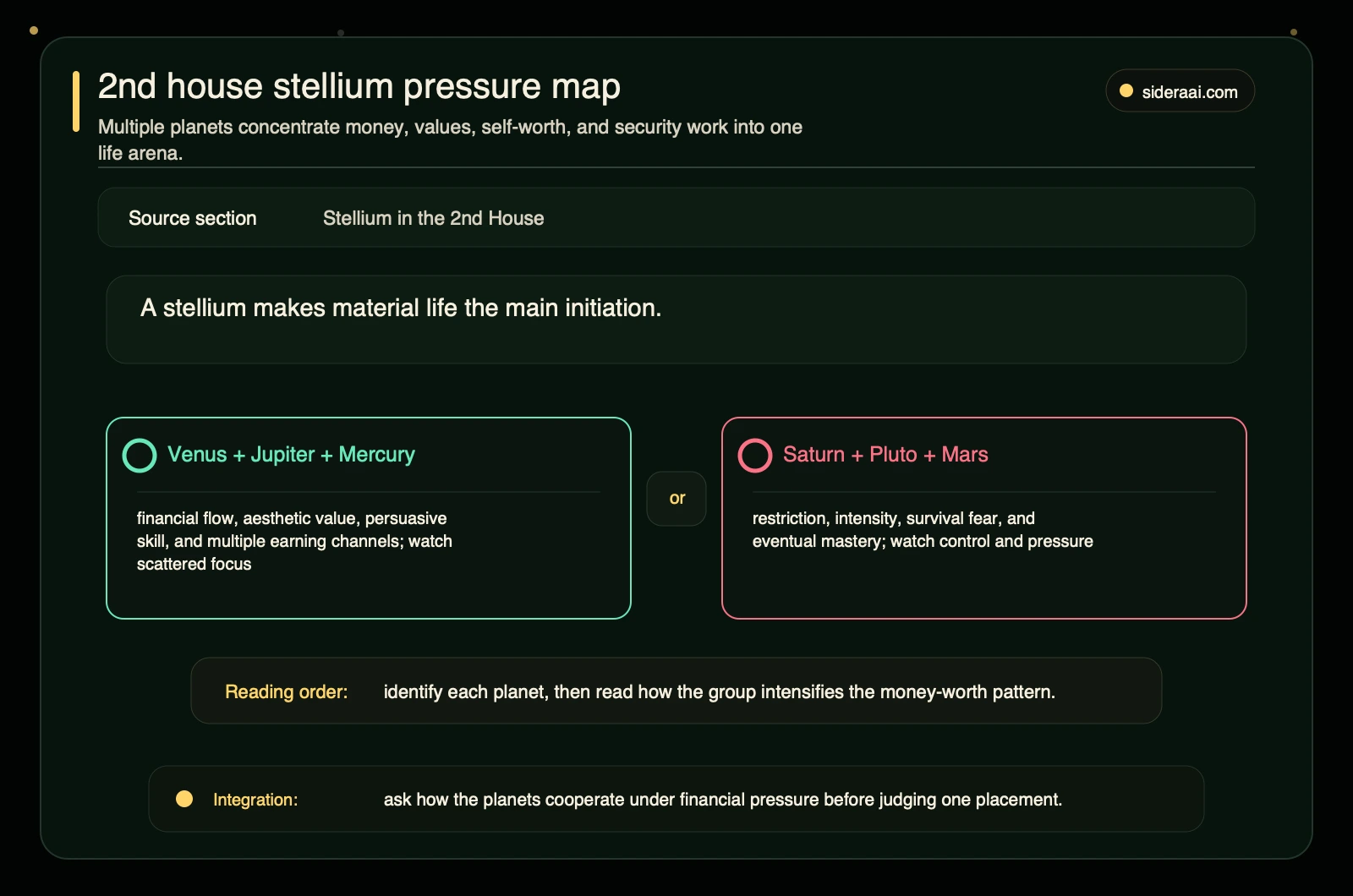
A stellium needs to be read as a group pattern: first identify each planet, then ask how the cluster intensifies security, worth, and material pressure.
Frequently Asked Questions
What does it mean to have multiple planets in the 2nd house? Multiple planets in the 2nd house (a stellium) concentrate financial and material themes significantly. Your relationship with money, values, and self-worth becomes a primary psychological arena rather than background noise. The planets involved determine the specific quality of that focus – each combination tells a different story about how resources flow and where the developmental pressure sits.
Which planet is best in the 2nd house? Venus is the most naturally at home in the 2nd house, since it rules Taurus (the natural 2nd house sign) and resonates easily with themes of beauty, accumulation, and sensory value. Jupiter also tends to function well here, bringing expansion and opportunity. But “best” is context-dependent – a well-aspected Saturn in the 2nd house builds more lasting security than an afflicted Venus, and the house cusp sign matters significantly.
Does a planet in the 2nd house mean you’ll be rich? Not directly. The 2nd house describes your relationship with money and material resources, not a fixed financial outcome. Jupiter in the 2nd may bring natural abundance, but it can also bring overextension. Saturn in the 2nd may bring early restriction followed by genuine financial mastery. The planet’s dignity, aspects, and the overall chart context all determine the actual expression.
How does the 2nd house connect to self-worth? The 2nd house is fundamentally about what you believe you deserve – and that belief system shapes what you allow yourself to earn, keep, and receive. Planets like Saturn or Pluto here often indicate deep work around self-worth that shows up in financial patterns: difficulty accepting payment, undercharging for services, compulsive accumulation, or fear of spending even when resources are genuinely available.
What is the difference between the 2nd house and the 8th house in astrology? The 2nd house governs personal resources: what you earn, own, and value independently. The 8th house governs shared resources: debt, inheritance, investment, and what comes through intimate partnerships or institutions. The 2nd/8th axis captures the tension between financial independence and financial interdependence – between what is mine and what is ours. Both houses together tell the full story of a person’s relationship with material power.