The 1st house is the part of the birth chart other people meet before they know your story. If you have planets here, you may be used to being read quickly: intense, warm, guarded, magnetic, restless, soft, intimidating, or “too much” before you have actually done anything.
In western tropical astrology, the 1st house begins at the Ascendant – the degree of the zodiac rising on the eastern horizon at the exact moment of birth. This point marks the cusp of the house of self: identity, physical body, first impressions, the instinctive way you move through the world. While the rising sign sets the tone of the 1st house, planets placed inside it add specific energies that color how that tone actually shows up. A Scorpio rising with Jupiter in the 1st house shows up very differently from a Scorpio rising with Saturn there.
Planets in the 1st house are considered angular placements – the most powerfully expressed positions in any chart. In Hellenistic astrology, Vettius Valens described angular houses as places where planets “act with full force,” and later medieval astrologers formalized this by assigning angular planets the highest dignity weighting in their scoring systems. A useful parallel from social psychology: Alexander Todorov’s 2006 Princeton study found that people form judgments of personality and competence from a face in as little as 100 milliseconds – before any words are exchanged. In a birth chart, 1st house planets describe the part of you that people tend to register first.
Understanding what each planet does in this house gives you one of the most direct windows into how a person experiences and presents their sense of self: how they enter love, how they take up space at work, how they react under pressure, and what they tend to mistake for “just my personality.”
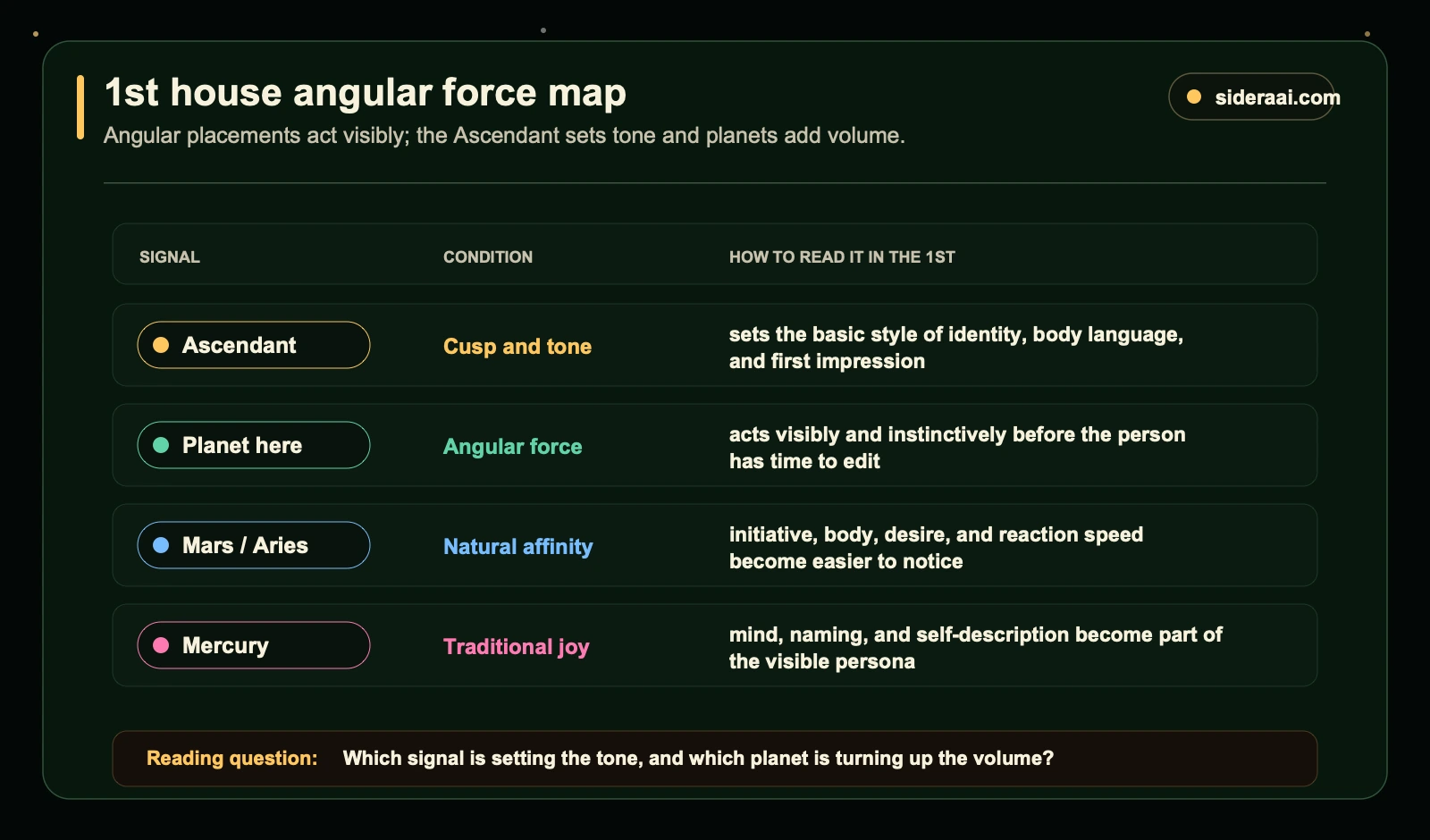
Use the angular force map to separate the Ascendant’s baseline tone from the planet that makes the 1st house immediately visible.
Ready to See Your Personal Birth Chart?
Discover your unique cosmic blueprint — planets, houses, and aspects personalized to your exact birth time and location.
Get Your Birth Chart →✓ Birth chart analysis ✓ Personalized insights ✓ Free to use
How This Shows Up in Real Life
The important part of planets in the 1st house is not the keyword list. It is the pattern you can recognize in love, work, conflict, self-image, and the private choices you make before you have time to edit yourself.
This house describes your default entrance into life. In relationships, it can show what people feel from you immediately. At work, it can describe whether you lead with confidence, caution, competence, charm, disruption, or emotional availability. In conflict, it often reveals your first defense: push forward, explain harder, withdraw, please, disappear, control the room, or act like you are fine.
Read your 1st house planet through three questions:
- Where do I overuse the strength? The gift of a placement often becomes the same habit that creates friction.
- Where do I avoid the shadow? Defensiveness, control, withdrawal, people-pleasing, or over-explaining usually point to the real lesson.
- What would growth look like today? Choose one concrete behavior you can practice in a conversation, decision, or boundary.
That is the difference between astrology as personality content and astrology as self-understanding: the point is not to label yourself more accurately, but to notice the moment when the placement starts running the room.
What the 1st House Rules
Before examining individual planets, it helps to know what this house governs:
- Identity and self-concept – how you understand and experience yourself
- Physical body and appearance – the face you present to the world, body type tendencies
- First impressions – what others perceive about you in initial encounters
- Vitality and life force – your baseline energy and presence
- Instinctive behavior – how you act before you think about it
- The persona – the interface between inner self and outer world
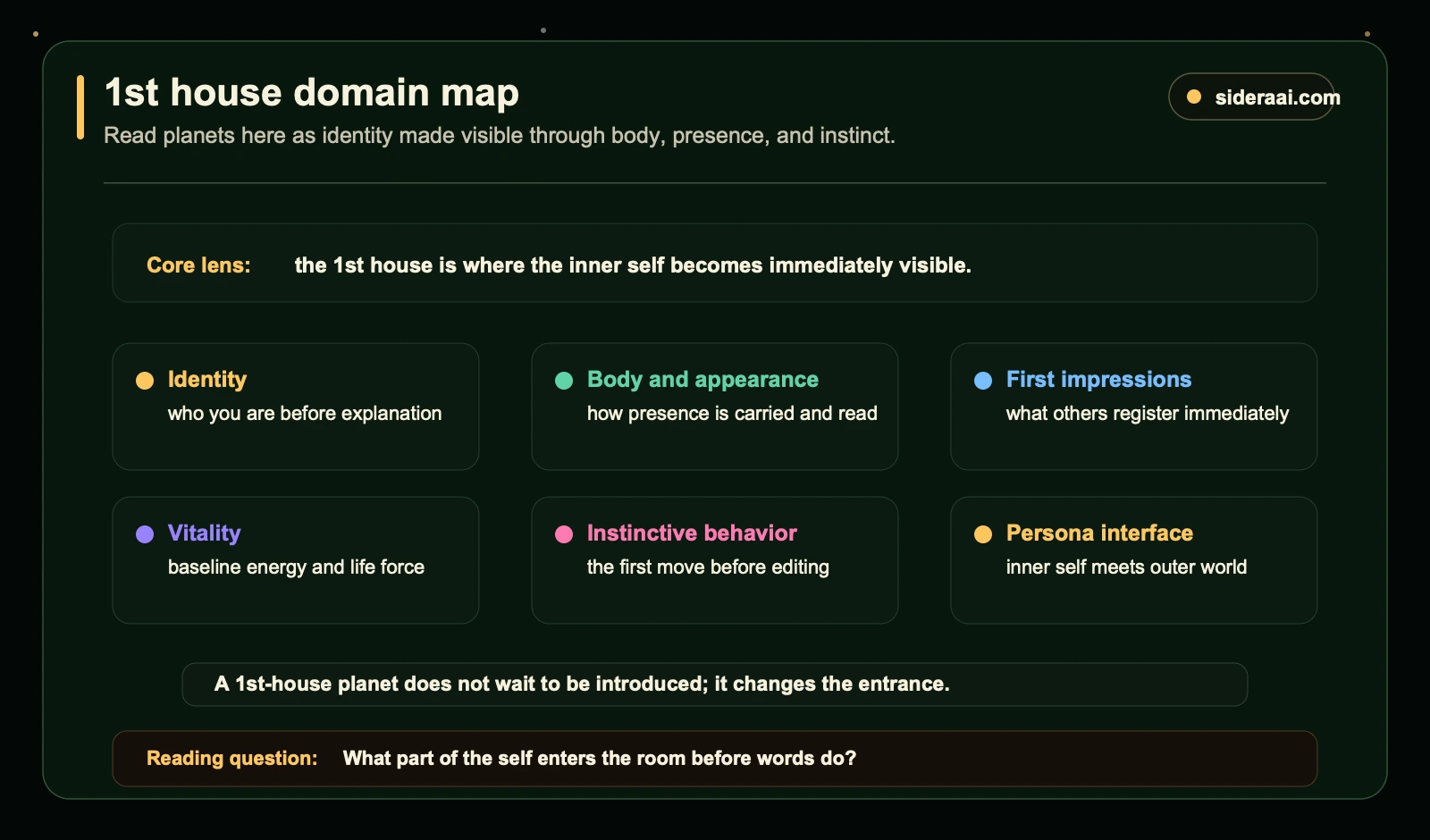
Use the 1st house domain map as a quick reference for where a planet becomes visible before explanation.
The natural sign of the 1st house is Aries, ruled by Mars. This colors the house with themes of self-initiation, instinct, and directness – even when a different sign occupies the Ascendant in an individual chart.
As astrologer Howard Sasportas wrote in The Twelve Houses (1985): “Angular planets don’t politely wait to be introduced. They stride into the room first. The 1st house planet is identity made visible before any words are spoken.”
For a full map of how all twelve houses operate, see the astrology houses guide.
Planets in the 1st House and Physical Appearance
One of the most frequently searched questions about this placement is how it affects physical appearance. The short answer: planets in the 1st house do influence how people look and carry themselves – not in a deterministic way, but through the energy they radiate.
- Sun in the 1st: bright eyes, commanding presence, natural warmth in the face
- Moon in the 1st: soft or round facial features, expressive eyes, fluctuating weight
- Mercury in the 1st: quick, alert, youthful appearance regardless of age; often slender
- Venus in the 1st: symmetrical features, graceful bearing, natural aesthetic sensitivity in dress
- Mars in the 1st: strong build or athletic frame, quick movements, direct eye contact
- Jupiter in the 1st: large or expansive physical presence, generous smile, robust energy
- Saturn in the 1st: angular or fine-boned features, often appears older when young
- Uranus in the 1st: unusual or distinctive features, unconventional style choices
- Neptune in the 1st: otherworldly quality, soft features, eyes that seem to look through rather than at
- Pluto in the 1st: intense gaze, penetrating eyes, a quality of coiled stillness
Borkenau et al. (2004, Journal of Personality and Social Psychology) confirmed that in zero-acquaintance encounters, observers accurately read Big Five personality traits from 20-second video clips at rates significantly above chance – a finding that maps directly onto what 1st house planets do astrologically: they make the inner architecture legible at a glance, before any credentials or biography are offered.
These are tendencies, not blueprints. The Ascendant sign, the planet’s own sign placement, and aspects from other planets all shape how these signatures actually manifest.
Sidera uses your actual birth chart—not generic horoscopes.
Get personalized insights →How 1st House Planets Behave in Love, Work, and Conflict
Use this as a quick reality check before reading the longer interpretations. The planet in your 1st house does not only describe how you seem; it describes the behavior others keep responding to.
| Planet | Love and self-image | Work and conflict |
|---|---|---|
| Sun | Wants to be chosen for who they genuinely are, not just admired for presence. | Leads naturally, but can take feedback as a threat to identity. |
| Moon | Bonds through emotional immediacy and visible care. | Reads the room fast, but can absorb stress that is not theirs. |
| Mercury | Needs mental rapport and can narrate feelings before fully feeling them. | Thinks quickly under pressure, but may over-explain when insecure. |
| Venus | Attracts through warmth, style, and social grace. | Smooths tension well, but may avoid necessary disagreement. |
| Mars | Desires directly and reacts quickly when frustrated. | Initiates with courage, but can mistake urgency for clarity. |
| Jupiter | Loves generously and wants room to grow. | Inspires people, but can overpromise or skip practical limits. |
| Saturn | Protects vulnerability behind composure and self-control. | Earns authority slowly, but may expect rejection before it happens. |
| Uranus | Needs freedom and may resist being defined by a partner. | Innovates fast, but can rebel against structure reflexively. |
| Neptune | Merges easily and may become what the other person wants. | Senses subtle dynamics, but needs boundaries around confusion and projection. |
| Pluto | Loves intensely and notices power shifts immediately. | Sees beneath surfaces, but can control when trust feels unsafe. |
Understand your connections on a cosmic level.
Explore your bonds →Sun in the 1st House
The Sun in the 1st house is one of the most visible placements in astrology. Identity and self-expression are fused here. People with this placement tend to lead with their personality – there is often a natural charisma, a desire to be seen, and a strong identification with whatever sign the Sun occupies.
This is not always about ego in the negative sense. It is more that the core self radiates outward naturally. The physical vitality is usually strong, and the individual often makes an impression simply by being present. Think of it as the Sun doing exactly what it does best: shining. When the Sun occupies the house of the self, there is no buffer between the solar identity and how it is expressed to the world.
In love, they need to feel seen without having to constantly impress. At work, they often become the visible face of a project, team, or idea. In conflict, the sore spot is pride: criticism can feel less like feedback and more like a verdict on the whole self.
The shadow: identity can become over-attached to how others perceive them. When the outer performance and inner self diverge, Sun in the 1st house people can struggle with the gap between the person they present and the person they actually are. The work is aligning the self that shines with the self that is – making the performance authentic rather than compensatory.
Moon in the 1st House
The Moon in the 1st house brings emotional availability to the surface. These individuals often wear their feelings visibly – the face shifts with the mood, the body language is readable, and emotional responsiveness happens in real time.
There is a nurturing quality to how they present themselves, and others often feel safe opening up to them quickly. The challenge is that the same permeability that makes them approachable can make them absorb the emotional weather of any room they enter. Public spaces, busy environments, or emotionally charged gatherings can be genuinely draining.
This placement often correlates with a close connection to the physical body – strong appetite, sensitivity to environment, and fluctuating energy levels that track the lunar cycle more noticeably than most. Many Moon-in-1st individuals find their mood and vitality shift significantly with the moon’s phases. Check the Aries daily horoscope if Aries is on your Ascendant and you’re navigating Moon transits through your 1st house.
Mercury in the 1st House
Mercury in the 1st house makes communication central to identity. These individuals often think out loud, speak quickly, and define themselves through their ideas, words, and intellectual agility. Curiosity is part of the presentation – there is an alert, engaged quality to how they show up even in casual interactions.
Physical restlessness is common. The hands move when they speak. They may read constantly, shift between projects, or have the feeling that their mind never fully stops. The mental apparatus and the self are not separate functions – thought is how they meet the world.
The shadow: identity becomes overly dependent on being seen as intelligent or articulate. When Mercury in the 1st house feels misunderstood, it can register as a personal failure rather than a communication gap. Learning to separate “being misread” from “being unseen” is part of the developmental work.
Venus in the 1st House
Venus in the 1st house places aesthetic sensibility, charm, and relational instinct at the forefront of identity. There is often a physical attractiveness or elegant quality to the presentation – not always by conventional beauty standards, but by a natural sense of harmony in how they carry themselves.
These individuals are usually attuned to social dynamics from the first moment. They notice beauty, read the relational temperature, and often adapt naturally to what the other person needs – sometimes so naturally that they lose track of what they themselves want.
The challenge is differentiating between genuine expression and performance of likability. Venus in the 1st house can become so skilled at being pleasant that the authentic self gets muted in favor of the relational surface. The path forward is learning that genuine desire – and genuine disagreement – does not make you unlovable.
Mars in the 1st House
Mars is at home in the 1st house by nature – Aries rules this house, and Aries is Mars’s domicile. This is one of the most energetically direct placements in the chart. Drive, assertion, and physical vitality express themselves without the filtration that other houses impose.
These individuals often lead with action before reflection. The body moves before the mind catches up. Competitive instincts are present even in casual situations, and the anger response tends to be immediate rather than accumulated.
The gift is genuine initiative and a magnetic physical presence. The shadow is that the same direct channel can become impatience, aggression, or an inability to read how the impact lands before it has already landed. In love, this can look like pursuing honestly but escalating quickly when frustrated. At work, it can look like being the first to act and the last to tolerate delay. Learning to introduce a pause between impulse and action is the key developmental task – not to suppress Mars, but to give it better aim. See the full Mars in astrology guide for how Mars placement interacts across the chart.
Jupiter in the 1st House
Jupiter in the 1st house expands the self. These individuals often seem larger than life – a natural enthusiasm, generosity of spirit, and an ability to make things feel more possible simply by being in the room. There is usually an optimistic cast to how they approach new situations.
Physical expansion is a real theme. Jupiter in the 1st correlates with a tendency toward a larger physical presence or build, and a natural inclination toward abundance in lifestyle and self-expression.
The shadow: over-extension. The same expansive quality that makes Jupiter here magnetic can lead to promising more than can be delivered, or inflating the sense of self to the point where honest self-assessment becomes difficult. In relationships, this may show up as assuming everything will work out without naming the practical details. At work, it can show up as big vision that needs steadier follow-through. The work is matching genuine expansiveness to actual capacity.
Saturn in the 1st House
Saturn in the 1st house is one of the most formative placements in a chart, and one of the most misunderstood. There is a seriousness to the self-presentation – a reserve, a measured quality, sometimes a physical austerity. These individuals often appear older than their age when young, and frequently grow into their authority and presence over time.
The developmental arc is significant. Early life often involves a felt sense of restriction around self-expression – a feeling of not being allowed to take up space, of needing to earn the right to be seen, or of carrying a weight that others don’t seem to notice. This can emerge from early experiences of criticism, heavy responsibility, or the internalization of a parental figure’s severity.
Liz Greene observed in Saturn: A New Look at an Old Devil (1976) that Saturn in angular houses does not deny its gifts – it defers them. The individual must work toward what others may receive more freely, and in that work, something more durable is forged than what early ease might have produced.
What emerges, when the Saturn work is done, is a formidable authority – earned, not performed. These individuals command rooms they once felt excluded from. The self that was restricted early becomes the self that cannot be rattled later. In love, the growth edge is letting someone witness the unfinished version, not only the composed one. If Saturn in Capricorn or Aquarius falls in your 1st house, the Capricorn daily horoscope can help you track Saturn’s transits in real time.
Uranus in the 1st House
Uranus in the 1st house makes individuality non-negotiable. These individuals often look or present themselves in ways that deliberately or unconsciously mark them as different. The appearance may shift dramatically over time. There is an electric, unpredictable quality to how they move through situations.
The need for autonomy is deep – any structure that tries to define them from the outside will be resisted. This is not always comfortable for those around them, but it is entirely consistent with how Uranus in the 1st functions: the self as a site of constant reinvention. In relationships and work, the pattern to watch is leaving too quickly when something starts to feel predictable. The challenge is distinguishing between genuine individuality and reflexive contrarianism.
Neptune in the 1st House
Neptune in the 1st house softens the edges of identity in ways that can be both beautiful and disorienting. There is often a fluid, chameleon-like quality to the presentation – people project their own needs and fantasies onto Neptune in the 1st individuals, who can become skilled at being whatever the room needs them to be.
The gift is sensitivity, imagination, and a soft emotional presence that others often respond to immediately. The challenge is knowing where you end and others begin – Neptune here makes identity porous in ways that require conscious tending. In love, this can look like becoming the dream partner before asking whether the relationship is real. At work, it can look like sensing everything but struggling to state a clean position. Creative, spiritual, or contemplative practices often become crucial anchors: they give the porous self a place to focus instead of leaving every boundary up for negotiation.
Pluto in the 1st House
Pluto in the 1st house carries intensity that is immediately felt before it can be named. There is a penetrating quality to the gaze, a presence that others often experience as magnetic, unnerving, or both. Power dynamics arise naturally and often unconsciously – people either move toward or away from the Pluto-in-1st individual without being entirely sure why.
The developmental work involves learning to use that power intentionally rather than through control or compulsion. There is often a quality of seeing through surfaces – social masks, self-deception, comfortable fictions – that can feel like a gift to some and an invasion to others. In love and conflict, the growth point is noticing when protection has turned into testing, suspicion, or silent dominance. Pluto in the 1st house individuals frequently go through profound identity transformations across their lifetime: periods where an old self no longer fits and a more honest one has to be built.
Explore the full Pluto in astrology guide for how this outer planet’s sign, house, and aspects work together.
Multiple Planets in the 1st House (Stellium)
When two or more planets occupy the 1st house, the effect compounds and often creates internal tension. The identity becomes a complex blend of those planetary energies, and the quality of their relationship matters enormously.
A Sun-Jupiter conjunction in the 1st produces a naturally magnified, confident presence – both planets expand the self outward. A Sun-Saturn conjunction, by contrast, creates an ongoing tension between the desire to shine and the felt need to restrict or earn that shining. Neither is better or worse; both create specific developmental work.
When three or more planets cluster in the 1st house, the identity can feel overwhelming – to the person themselves as much as to others. There is simply a great deal of self happening at once. The work for 1st house stellium individuals is often learning to modulate: to turn the volume up or down depending on context, and to recognize that presence of this magnitude carries responsibility for how it lands.
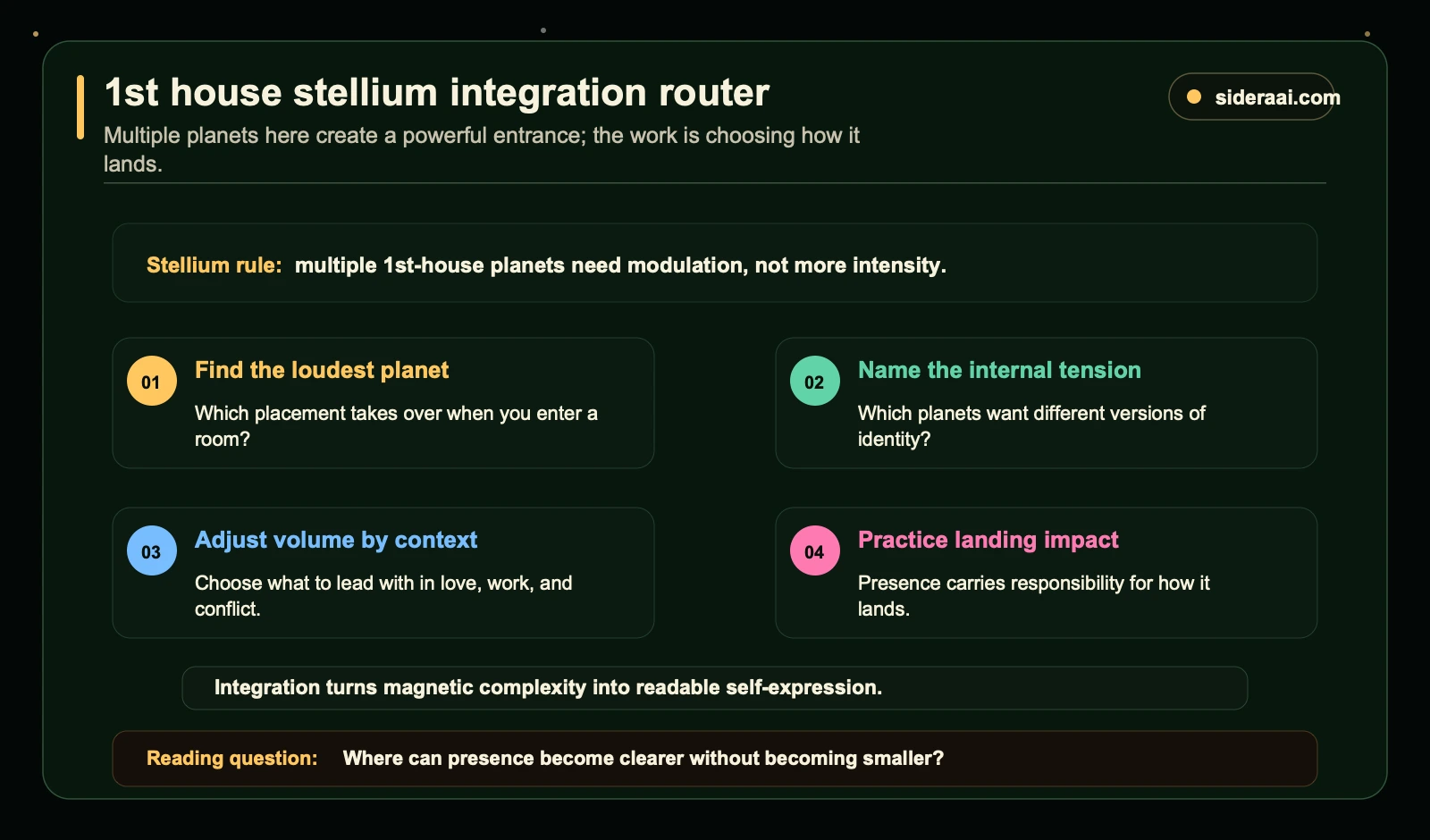
Use the stellium router to turn a powerful 1st house cluster into clearer self-expression rather than more intensity.
See the planets in astrology guide for a complete breakdown of how each planet operates across the chart.
The 1st House in Context
No planet in the 1st house operates in isolation. The sign on the Ascendant, the sign the planet occupies, aspects from other planets, and the overall chart shape all modify how that planet expresses itself. A Sun in the 1st house in Capricorn conjunct Saturn operates very differently from a Sun in the 1st house in Leo trine Jupiter.
Campbell et al. (1996, Journal of Personality and Social Psychology) found that self-concept clarity – having well-defined, internally consistent beliefs about who you are – predicts emotional stability and well-being more strongly than self-esteem alone. The 1st house, and the planets within it, are the astrological territory of that clarity: they describe the shape of the self that either knows itself or spends a lifetime discovering it.
What remains constant: planets in the 1st house express themselves directly through the person’s presence, appearance, and instinctive way of moving through the world. They are among the most visible placements in any chart – which makes them both a gift and a responsibility. The invitation with any 1st house planet is not to perform it, but to understand it deeply enough that the expression becomes genuinely yours.
For a full picture of how your personal planets sit in your chart, run your birth chart calculator or read the natal chart reading guide.
Powered by Sidera — AI-driven cosmic timing.
Frequently Asked Questions
What does it mean to have a planet in the 1st house?
A planet in the 1st house means that planetary energy directly shapes your identity, appearance, and how others perceive you. Unlike planets in more interior houses, 1st house placements express outward automatically – they are part of the face you show the world before any conscious choice is made.
Which planet is best in the 1st house?
There is no universally “best” placement – each planet has gifts and challenges in the 1st house. Mars is considered dignified here because Aries, its home sign, naturally rules the 1st house. Jupiter brings expansive, optimistic energy. But Saturn, often considered difficult, produces extraordinary earned authority over time. The quality of the placement depends heavily on the sign, aspects, and the individual’s developmental work.
Does having a planet in the 1st house affect your appearance?
Yes, in the sense that 1st house planets influence how you present and carry yourself – which includes but goes beyond physical features. They shape the energy you project: a Mars-in-1st person reads as energized and direct; a Neptune-in-1st person reads as soft and slightly otherworldly. These impressions are real and consistent enough to be noticeable.
What happens if you have multiple planets in the 1st house?
Multiple planets in the 1st house – a stellium – compound the effect. The identity becomes a blend of all those planetary energies, and the tensions between them become part of how the person presents. It creates a sense of considerable personal complexity that others often find magnetic, intense, or hard to categorize.
Does a planet in the 1st house override the rising sign?
No – the rising sign sets the fundamental tone of the 1st house. Planets inside it add specific flavors but don’t replace the Ascendant. A Pisces rising with Mars in the 1st house will still have the Piscean sensitivity underlying the chart, but Mars will add drive, directness, and a more assertive edge than a Pisces rising without that planet.