If you have planets in the 11th house, friendship is not background scenery. Your social world can shape how confident, useful, inspired, rejected, powerful, or invisible you feel. This house shows who you become around peers: whether you over-adapt to belong, lead through a shared vision, compete inside groups, rescue communities, distrust them, or keep searching for people who feel like your future.
The 11th house is often reduced to “friends, groups, hopes, and dreams.” That is accurate, but too thin. In real life, 11th house planets show up when you choose collaborators, fall for someone in your wider circle, feel exposed in a group chat, join a movement, leave a community, or realize that your long-term dream depends on other people.
If the 10th house is the summit – the most public point of the chart, where ambition crystallizes into reputation and legacy – then the 11th house is what comes after the summit: the wider world you step into once you have built something, the community you join, the future you begin to imagine from that elevated vantage point.
In western tropical astrology, the 11th house is a succedent house carrying the energy of Aquarius and its ruling planets Saturn (traditional) and Uranus (modern). Ancient Hellenistic astrologers gave this house one of the most prestigious designations in all of astrology: Vettius Valens, in his Anthologies (c. 150 CE), named it the Agathos Daimon – the Good Daemon or Good Spirit – and counted it among the most fortunate positions in the chart, associated with blessings, benefactors, and the gifts that flow from community and collective alignment. Jupiter, the planet of abundance and good fortune, has its traditional joy here: the 11th house is the place where Jupiter most naturally expresses its gifts of expansion, optimism, and generosity.
Where the 5th house holds personal creative expression, romance, and the individual’s joy, the 11th holds collective expression, long-term social vision, and the joy found through belonging to something larger than oneself.
Whatever planets sit in your 11th house describe the texture of your social world. They reveal how you experience friendship, how you move within groups and organizations, how your hopes and long-term visions take shape, and whether you are drawn toward individual belonging or collective transformation.
“The eleventh house is not just about the friends we make – it is about the vision we hold for the future and our need to find a community of people who share that vision. It is here that we discover whether our hopes and dreams can survive contact with the larger world.” – Howard Sasportas, The Twelve Houses (1985)
The 11th house is where the self becomes a citizen of the future.
How This Shows Up in Real Life
Read your 11th house planet as social behavior, not just a personality keyword. The planet describes what you bring into groups, what you expect from friends, and what gets triggered when belonging feels uncertain.
- In love, the 11th house shows whether attraction grows through friendship, shared ideals, social proof, or the feeling that someone belongs in your future.
- At work, it describes how you handle teams, professional networks, collaborators, audiences, and the difference between personal ambition and collective mission.
- In conflict, it reveals what you do when the group disappoints you: withdraw, appease, compete, moralize, organize, disappear, or try to control the social field.
- In self-image, it shows whether you feel most yourself when you are recognized as an individual or when you are needed by a community.
Use each planet below as a mirror for one practical question: where does your need for belonging help you build a better life, and where does it make you betray your own signal?
Ready to See Your Personal Birth Chart?
Discover your unique cosmic blueprint — planets, houses, and aspects personalized to your exact birth time and location.
Get Your Birth Chart →✓ Birth chart analysis ✓ Personalized insights ✓ Free to use
What the 11th House Rules
The 11th house governs the social and collective dimension of life:
- Friends and friendships – the chosen family; the network of equals you build over a lifetime; not all friendships, but the peer group that shares your values and long-term vision
- Groups, networks, and communities – organizations, associations, clubs, movements, online communities; any collective that pursues a shared goal or identity
- Hopes, dreams, and long-term wishes – the aspirations you hold for the future; what you are working toward beyond the immediate career climb of the 10th
- Collective vision and social ideals – your sense of how society should be; the causes, movements, and reforms you align yourself with
- Benefactors and allies – people who help you not out of obligation (like family) but out of genuine affinity and shared purpose
- Humanitarian causes and social change – the Aquarian drive to improve conditions for the collective; activism, reform, and contribution to the greater good
- The future – both your personal sense of where you are headed and the broader arc of collective progress; 11th house energy naturally orients toward what has not yet been built
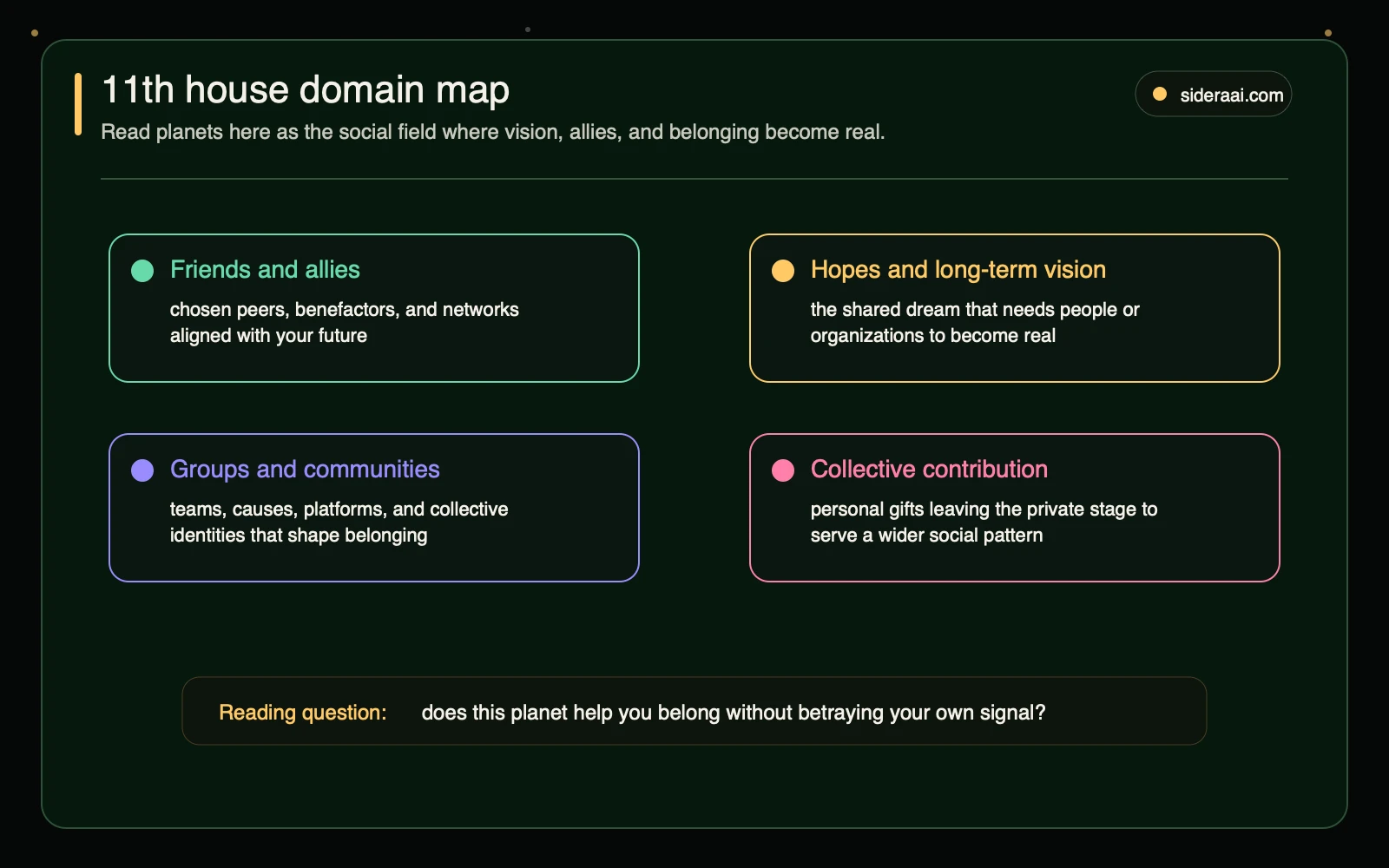
Use the map as a reading shortcut: every planet in the 11th house speaks through belonging, allies, groups, future vision, and the question of whether community expands or distorts the self.
Modern research confirms what ancient astrologers intuited about the 11th’s importance. Robert Waldinger and Marc Schulz’s landmark Harvard Study of Adult Development – tracking participants continuously since 1938 and published in full as The Good Life (2023) – found that the quality of close social relationships is the single strongest predictor of physical health and emotional wellbeing in later life, outpacing wealth, career achievement, intelligence, and genetic profile. The 11th house is not a secondary concern of the chart; it may be among its most consequential.
The 11th and 5th houses form the chart’s creative axis – but at opposite poles of the individual/collective spectrum. The 5th (Leo/Sun) asks what can I create and express as an individual? The 11th (Aquarius/Saturn-Uranus) asks what can we create and achieve together? To follow Aquarian collective energy as it moves through the daily sky, see the Aquarius daily horoscope.
The 11th/5th House Axis: Community and Self-Expression
The polarity between the 11th and 5th houses maps the fundamental tension between individual creative expression and collective social vision. Leo (5th) is the sign of the singular performer, the creative ego, the radiant individual center. Aquarius (11th) is the sign of the group, the network, the idea that transcends any one person.
People with strong 11th house energy often find that their greatest creative fulfillment comes not from solo expression but from contributing something to a movement, a community, or a shared project. The challenge the 5th house offers in balance is essential: a collective vision with no individual creative heart at its center can become ideology without aliveness. The most vital 11th house energy brings personal creative gifts into the service of something larger, rather than losing them entirely in collective abstraction. For the Leo perspective on this polarity – individual creative fire as the counterpoint to Aquarian collective vision – the Leo daily horoscope tracks that solar energy day to day.
This axis also maps the shift between personal joy and transpersonal meaning. The 5th house holds what delights you. The 11th holds what you believe the future should look like.
The Succedent House: Building and Sustaining
The 11th house is succedent – one of the four houses (2nd, 5th, 8th, 11th) that follow the angular houses and carry the quality of building on and sustaining what angular houses initiate. The 10th house career builds the public platform; the 11th house community grows from and supports that platform over time.
Planets in the 11th operate through relationship and network rather than through direct individual action. Their expression often emerges slowly, through sustained involvement with groups and communities, rather than in sudden public flashes.
Dignity Conditions in the 11th House
Several planets carry significant dignity conditions in the 11th house, because Aquarius defines a distinct set of planetary power relationships. The ancient doctrine of planetary joys – codified by Paulus Alexandrinus (c. 378 CE) and reflected throughout Hellenistic sources including Valens – assigned Jupiter to the 11th as its house of greatest ease and natural expression.
| Planet | Condition | Meaning |
|---|---|---|
| Jupiter | Joy in 11th house | Most natural and freely expressive placement; delivers 11th house gifts of benefactors, abundance, and community fortune with ease |
| Saturn (traditional) | Accidental dignity | Rules Aquarius in traditional western astrology; structure and discipline applied to social/collective themes with focused, purposeful authority |
| Uranus (modern) | Accidental dignity | Rules Aquarius in modern western astrology; innovation and collective transformation expressed in the sign it naturally governs |
| Sun | Detriment concern | Aquarius opposes Leo (Sun’s domicile); the individuating Solar ego must consciously navigate the Aquarian imperative toward collective belonging and equality |
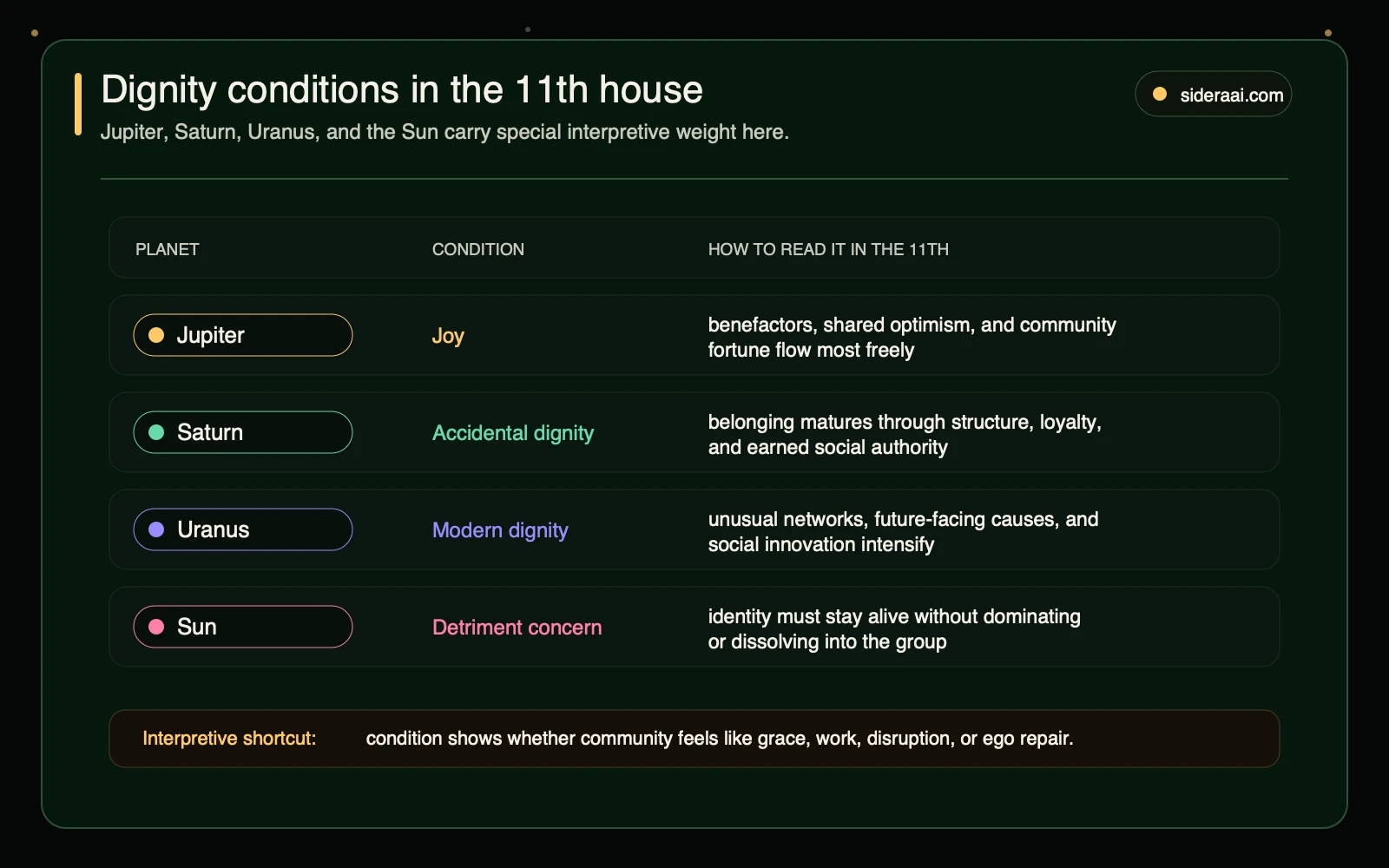
The condition tells you whether the planet tends to experience 11th house community as grace, earned work, disruption, or a direct challenge to ego expression.
These dignity conditions give the 11th house a particular dynamic: it is simultaneously the most fortunate house in the ancient tradition (Jupiter’s joy, Agathos Daimon) and a domain that challenges the ego’s need to stand out (Sun’s detriment). The house rewards those who can hold individual identity lightly enough to give generously to the collective.
Sidera uses your actual birth chart—not generic horoscopes.
Get personalized insights →The Sun in the 11th House
The Sun in the 11th house orients the core identity toward community, collective causes, and the social future. Where the Sun in the 10th finds itself through public achievement and career prominence, the Sun in the 11th finds itself through belonging to a movement, a network, or a vision larger than personal ambition.
This is the placement of the idealist, the reformer, the networker, the person who lights up in a room of like-minded others pursuing a shared goal. The public identity is built around affiliation and collective purpose rather than individual achievement. Friends, communities, and causes become central to the sense of self.
Career resonance: Roles that connect the individual to collective mission resonate most: nonprofit leadership, social entrepreneurship, community organizing, tech platforms, progressive politics, humanitarian work, or any field where personal success and collective impact align.
The gift: A genuine ability to inspire and unite groups; natural leadership within collectives; the Sun’s vitality channeled into causes and communities that matter; a life full of meaningful social connections.
The shadow: The detriment condition (Aquarius opposite Leo) means the Sun here can struggle with individual identity in tension with collective belonging. The self can dissolve too completely into the group or cause, losing individual distinctiveness. Alternatively, the ego can reassert itself in ways that fracture the very communities the Sun in the 11th claims to serve. The work is learning that a strong individual identity enriches rather than threatens the collective.
The Moon in the 11th House
The Moon in the 11th house places emotional security and belonging in the domain of community, friendship, and social connection. These are the people who feel most emotionally nourished by their friend network, most at home in groups aligned with their values, most unsettled when they feel excluded from a community that matters to them.
Emotional wellbeing tracks closely with the health of the social world: when friendships are flourishing and the collective purpose feels alive, the inner life is nourishing. When the social world fractures or the community drifts, emotional ground can feel suddenly unstable.
The Waldinger/Harvard research speaks directly to this placement: the study found that people with warm, reliable relationships at age 50 were the healthiest at age 80 – suggesting that the Moon in the 11th’s instinct to root emotional security in community relationships is not merely a temperamental pattern but a genuinely health-sustaining orientation when navigated with awareness.
The Moon here also brings emotional intelligence to group dynamics. There is an instinctive reading of what a collective needs emotionally, and often a natural gift for nurturing the bonds that hold communities together.
Career resonance: Community development, social work, group facilitation, grassroots organizing, cultural preservation, education within community contexts, mental health services, or any role that involves tending to the emotional life of groups and collectives.
The gift: Deep emotional resonance with friends and communities; natural emotional intelligence within groups; the ability to be genuinely nurturing in collective settings; emotional roots in shared vision.
The shadow: Emotional dependency on group approval; mood states driven by the social weather; difficulty maintaining emotional equilibrium outside of a felt-community context; over-identification with the emotional life of the group at the expense of individual emotional clarity.
Mercury in the 11th House
Mercury in the 11th house orients the mind toward networks, collective ideas, and the communication that holds communities together. This is the strategic networker, the connector of people and ideas, the person whose intellectual energy naturally flows toward groups, platforms, and the exchange of information at scale.
The mind here is socially wired: Mercury in the 11th tends to think in terms of movements, systems, and connections between people rather than in isolation. Ideas gain energy when they are shared, discussed, and refined within community. There is often a gift for building networks of intellectually aligned people and for articulating the collective vision in ways others can act on.
Career resonance: Journalism, social media strategy, community platforms, technology that connects people, political communications, think tanks, cooperative projects, writing that serves social movements, or any role where the mind’s gift is deployed in service of a network rather than in isolation.
The gift: A natural instinct for networks and collective intelligence; communication skills that serve group cohesion; ability to convene conversations that move communities forward; multiple intellectual communities and friendships.
The shadow: Ideas that remain perpetually in the planning and theorizing stage, never landing in individual creative action; over-stimulation from too many social inputs; scattered social engagement that lacks depth.
Venus in the 11th House
Venus in the 11th house places the planet of beauty, relationship, and pleasure in the domain of friendship, community, and collective values. This is Venus at its most socially expressed: pleasure found in shared aesthetic and social experience, relationships built on genuine affinity and shared vision rather than romantic projection.
Friendships are often genuinely significant here, carrying emotional depth more typically associated with romantic partnerships. There is a gift for social harmony within groups, for weaving people together with warmth and aesthetic sense, for making communities feel like beautiful things worth belonging to.
Romance itself can emerge through social networks and shared causes: Venus in the 11th often meets significant partners through friends, communities, or collective pursuits.
Career resonance: Event production, cultural programming, community arts, social enterprise, environmental or social justice work with aesthetic dimension, design for collective spaces, or any role that uses Venus’s gifts to make collective life more beautiful and humane.
The gift: Genuine ease and warmth in social settings; the ability to build communities that feel inviting and harmonious; romantic connections through shared values and social worlds; a life enriched by genuine, lasting friendships.
The shadow: A tendency to prioritize social harmony in groups at the expense of honest individual expression; friendships that carry unacknowledged romantic or emotional dependency; the social persona can become a performance of likability that conceals authentic values or desires.
Understand your connections on a cosmic level.
Explore your bonds →Mars in the 11th House
Mars in the 11th house channels competitive drive, courage, and assertiveness into collective goals, causes, and social activism. This placement often produces the activist, the organizer, the person who fights for something beyond personal gain – or who fights, sometimes more problematically, for supremacy within the group structures they claim to serve.
The 11th house’s communal orientation gives Mars a larger target than personal ambition: the drive here wants to win something for the collective, to push a cause forward, to defend a community against what threatens it.
Career resonance: Activism and campaign leadership, union organizing, competitive sports within team contexts, political strategy, emergency and crisis response for communities, military or defense roles oriented toward collective protection, or roles where assertive drive serves a mission larger than individual gain.
The gift: The courage and drive to fight for collective causes; natural leadership in activist or reform-oriented communities; the energy to turn social visions into actual campaigns; ability to galvanize groups toward action.
The shadow: Aggression projected onto group dynamics; faction-fighting and power struggles within communities; the collectivist language can mask a fundamentally competitive ego; the need to be the leader of the movement rather than a participant in it.
Jupiter in the 11th House
Jupiter in the 11th house is in its Hellenistic joy – the ancient doctrine’s most natural placement for the planet of abundance, good fortune, and expansion. Vettius Valens (Anthologies, c. 150 CE) named the 11th house the Agathos Daimon (Good Daemon) – one of the chart’s most fortunate positions – and the alignment between Jupiter’s significations and the house’s ancient reputation is among the most cohesive in all of astrology. Jupiter is the greater benefic; the 11th is the Good Daemon. The match is exact.
This placement delivers what its traditional reputation promises: expansive social networks, genuine good fortune through community and allies, and a life touched by benefactors who appear at key moments. The long-term visions tend to be genuinely large, the causes genuinely inspiring, and the circle of friends often wide, intellectually rich, and full of opportunity.
There is also a natural gift for inspiring others toward shared visions – Jupiter in the 11th can become a galvanizing presence within communities, expanding what a group believes is possible.
Career resonance: International NGOs and humanitarian organizations, foundation work and philanthropy, educational movements, cross-cultural initiatives, spiritual community leadership, publishing or media that serves collective inspiration, or any vocation where Jupiter’s abundance flows through social and collective channels.
The gift: Abundance through community and allies; natural attraction of benefactors and opportunities through social networks; an expansive, inspiring social presence; genuine good fortune in collective endeavors; the most traditionally fortunate placement for this house.
The shadow: An over-reliance on social fortune rather than individual effort; communities that expand in breadth but lack depth; grandiose visions for collective change that lack practical groundwork; over-promising to groups or causes.
Saturn in the 11th House
Saturn in the 11th house brings the planet of structure, discipline, and earned mastery into the domain of friendships, community, and long-term social vision. In traditional astrology, this carries a degree of accidental dignity (Saturn rules Aquarius), but the felt experience of Saturn in the 11th is rarely easy in early life.
The classic pattern is a restricted or difficult early social world – few friends, a sense of exclusion from peer groups, social awkwardness or isolation that creates a painful awareness of the gap between the 11th house’s promise of community and the lived reality of social loneliness. Yet the arc of Saturn applies here as it does everywhere: the restriction is a forge. The person who learns to build genuine community deliberately and sustainably, rather than expecting easy belonging, often develops an extraordinary capacity for deep, lasting, structurally sound friendships and collective contributions in midlife and beyond.
Robert Putnam’s Bowling Alone (2000) documented that participation in civic groups and community organizations declined by roughly 25 to 50 percent in America between 1970 and 2000 – correlating with measurable declines in health, trust, and happiness. The Saturn in the 11th journey mirrors this collective predicament: in an era of atomized social fragmentation, the deliberate, committed work of building real community is not just a personal developmental task but a genuinely counter-cultural act.
“Saturn in the eleventh demands that we earn our community – that we learn to build slowly what we so desperately need, rather than expecting it to arrive by grace. The reward is a social world of real substance: friendships forged by intention, tested by time, and genuinely our own.” – Liz Greene, Saturn: A New Look at an Old Devil (1976)
Career resonance: Long-term institution building, public policy and governance, systems design for communities, historical preservation, serious academic or research communities, roles requiring sustained commitment to collective structures over decades rather than years.
The gift: The capacity for genuine, tested, long-lasting friendships built on substance rather than convenience; serious commitment to collective causes; a disciplined, strategic approach to building and sustaining communities over time; earned social authority.
The shadow: Early social isolation or feelings of not-belonging; difficulty trusting groups or allowing easy access to the inner world; the social world can feel like a performance of duty rather than genuine pleasure; long-term visions can become rigid, pessimistic, or freighted with the weight of what will inevitably disappoint.
Uranus in the 11th House
Uranus in the 11th house is in accidental dignity (modern rulership: Uranus rules Aquarius, Aquarius rules 11th) – and this placement carries the hallmark of a planet operating in its own territory: the significations are strong, sometimes overwhelming in their expression.
This is the placement of the innovator within social structures, the person whose presence disrupts conventional community norms, the networker who connects radically unlike people into unexpected coalitions. The social world here is unconventional, eclectic, and often ahead of its time. Friends are chosen from across all backgrounds, subcultures, and worldviews; the community is defined by shared vision rather than shared demographics.
Friendships can also be erratic – deep and transformative but sometimes subject to sudden breaks or reversals. The social world with Uranus in the 11th rarely settles into comfortable predictability.
Career resonance: Technology that disrupts social systems, platform development, decentralized organizations and cooperatives, social movements at the vanguard of cultural change, scientific communities working on paradigm-shifting research, roles that create new forms of collective organization.
The gift: A socially innovative and genuinely original presence in any collective; the ability to build communities that transcend conventional categories; friendships that are genuinely intellectually and creatively electric; a natural home in avant-garde, progressive, or visionary movements.
The shadow: Erratic or unstable friendships; difficulty sustaining community bonds over time; the individualism that fuels originality can also fragment collective cohesion; the social rebel can mistake iconoclasm for wisdom.
Neptune in the 11th House
Neptune in the 11th house dissolves the clear boundaries between self and community, between individual dream and collective vision. The planet of imagination, spiritual longing, and idealization in the house of friends and social aspiration creates a profoundly utopian social orientation – and, at its shadow edge, significant vulnerability to collective illusions.
At its best, Neptune in the 11th contributes a visionary, spiritually animated social presence: the person who holds a genuinely transcendent vision for what community, society, or humanity could become. At its shadow, this placement can draw one into communities built on collective fantasy, shared delusion, or charismatic group-think that collapses when it meets reality.
Career resonance: Spiritual communities and contemplative movements, visionary arts that serve social transformation, environmental advocacy drawing on ecological imagination, interfaith and cross-cultural dialogue, creative collectives, roles that hold and articulate transcendent visions for collective futures.
The gift: A visionary capacity for collective imagination; the ability to inspire communities with genuinely transcendent ideals; friendships that carry a quality of spiritual depth and soul recognition; natural attunement to the emotional and spiritual needs of groups.
The shadow: Idealization of friends and communities that cannot survive contact with reality; susceptibility to group-think, cults, or collective movements built on projection rather than substance; difficulty with healthy boundaries in social settings; the dream of perfect community perpetually dissolving before it can be built.
Pluto in the 11th House
Pluto in the 11th house carries the planet of total transformation, power, and depth into the domain of friendships, social networks, and collective vision. This placement marks people whose social world becomes a site of profound personal transformation – and, sometimes, of genuine collective power.
The friendships and communities here are rarely casual. They tend toward the intense, the transformative, and the generationally significant. Pluto’s generation-level placement (Pluto moves slowly, spending roughly 12 to 30 years in each sign) means that an entire cohort shares Pluto in the 11th in the same sign, giving this placement a collective cultural dimension beyond the personal.
Personally, Pluto in the 11th often produces someone whose major life transformations are catalyzed through their social world: friendships end abruptly and profoundly, communities become crucibles of psychological change, collective causes carry an intensity that feels almost fated.
Putnam’s documentation of social capital decline is relevant here: the generations with Pluto in the 11th (Pluto in Virgo/Libra roughly 1957 to 1984, in Scorpio 1984 to 1995) came of age precisely during and after the era Putnam describes – inheriting a social landscape already transformed by the forces Pluto signifies: power, disruption, and the dismantling of inherited collective structures.
Career resonance: Investigative journalism, psychology and depth therapy for communities, political transformation work, crisis leadership within communities, generational cultural movements, roles that require the courage to name and challenge power structures within organizations.
The gift: Friendships and communities that transform at depth; the ability to engage in collective causes with genuine power and conviction; a social world that is never superficial; natural involvement in movements that reshape generational norms.
The shadow: Power struggles within communities and friendships; control dynamics in social settings; a compulsive need to influence or transform every group one belongs to; the social world becomes a stage for projection of the deepest fears and hungers.
The 11th House Stellium
Three or more planets in the 11th house create a stellium – a concentration of planetary energy in the house of friends, community, and collective vision that makes these themes central organizing forces in the life, regardless of whether the person consciously prioritizes them.
A stellium in the 11th often produces someone whose identity, sense of meaning, emotional wellbeing, and long-term direction are all routed through the social world. The sheer weight of planetary attention here ensures that community, networks, and collective causes are never optional background features – they are the main stage.
For a deeper look at how all planetary placements interact in the broader chart, the planets in astrology cheat sheet offers a useful reference across all 10 planets.
Specific combinations shape the texture:
- Jupiter-Venus-Moon: A deeply warm and generous social presence; communities built on emotional depth and genuine affinity; abundance through friendships; the social world as a primary source of emotional and material nourishment. The risk is emotional enmeshment in community life – boundaries can blur between the individual’s feelings and the group’s mood.
- Saturn-Pluto-Uranus: An intense, transformative, and structurally innovative approach to collective endeavors; communities as engines of systemic change; potential for both extraordinary collective impact and complex power dynamics within groups. This combination tends to produce either reformers or disrupters – sometimes both in sequence.
- Sun-Mercury-Mars: An intellectually driven, assertive, and creatively individual presence in collective settings; the tension of strong individual ego (Sun in detriment) within the communal orientation; leadership of ideas within movements. The shadow is dominating the very communities one seeks to serve.
- Neptune-Uranus (generational): The Uranus-Neptune conjunction of the early 1990s fell in Aquarius’s co-ruled domain; those with this stellium in the 11th carry both utopian vision and radical disruption as their collective inheritance – a generation simultaneously drawn toward ideal communities and prone to disillusioning when the ideal meets the real.
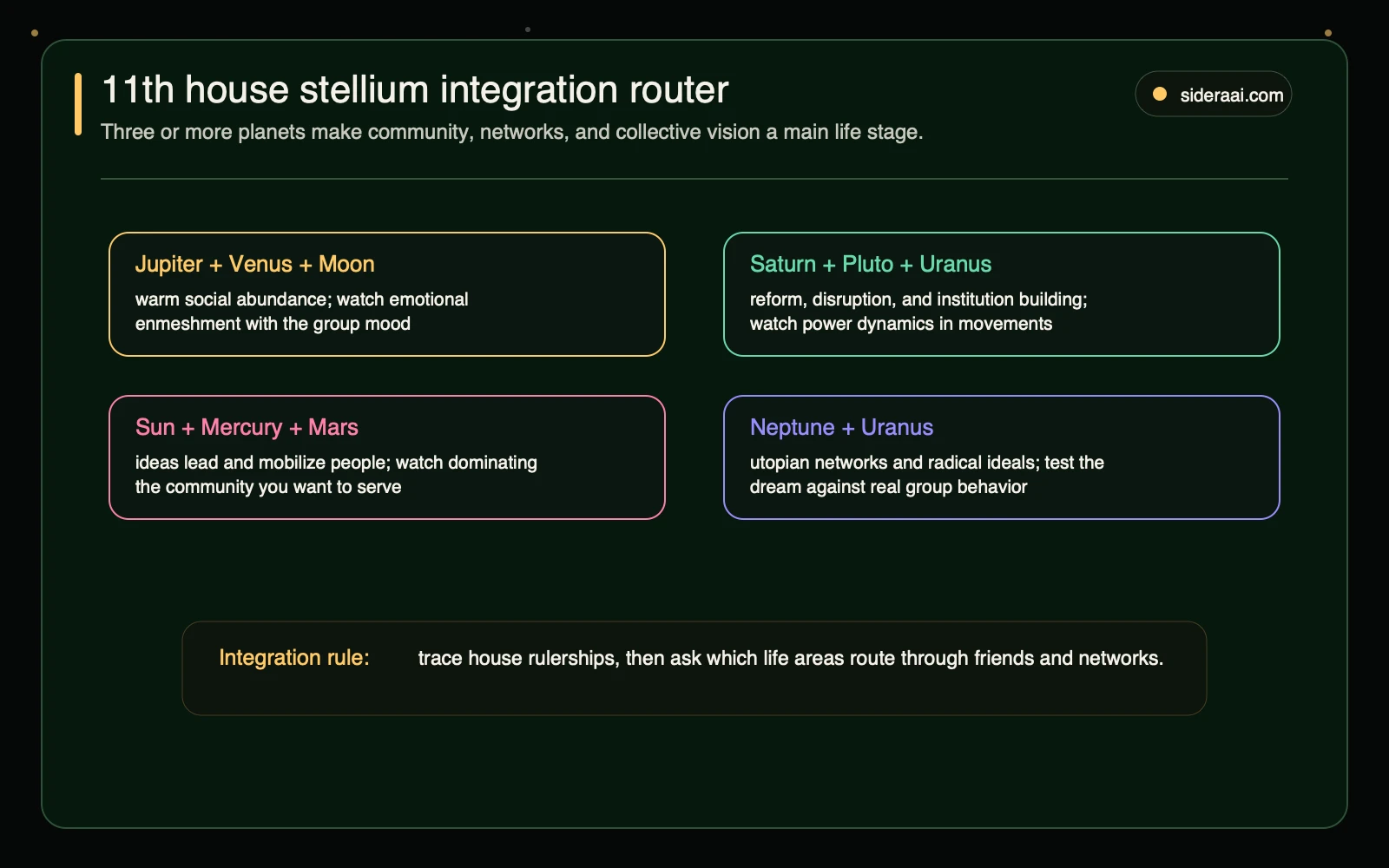
Use the router to keep a stellium from flattening into “lots of friends.” The combination shows whether the social field is warm, reforming, mobilizing, idealizing, or carrying several life areas through one community channel.
A stellium also means that the collective and social life of the 11th becomes entangled with many other areas of the chart, as each planet carries its own house rulerships. The natal chart reading guide explores how to trace these cross-house connections.
11th House Astrology: Western Tropical vs. Vedic Sidereal
The western tropical system described throughout this article – Aquarius, Saturn/Uranus, Jupiter’s joy, the Agathos Daimon – represents one interpretive tradition. Vedic astrology (Jyotish), which uses the sidereal zodiac, frames the 11th house quite differently.
In Vedic astrology, the 11th house is called Labha Bhava: the house of gains (labha = profit, fulfillment, incoming). Its significations include:
- Income and material gains – particularly gains from the career signified by the 10th house; financial income flowing into the life
- Elder siblings – the older sibling relationship is a classic 11th house signification in Jyotish
- Fulfillment of desires – the house governing whether one’s wishes and ambitions are realized; it is sometimes called the house of desire-fulfillment
- Social networks and friends – overlapping with western tradition here, but framed more through the lens of who brings material and practical benefit
- Left ear – a body-part signification (right ear = 3rd house in Jyotish)
The planetary karaka (natural significator) for the 11th house in Vedic astrology is Jupiter – which aligns with the Hellenistic joy doctrine, though through a different interpretive framework.
The key practical distinction for readers: if you are exploring your chart in a western tropical system (which Sidera uses), the 11th house framing above applies. If you use Vedic astrology, the same house speaks more directly to material gains and desire-fulfillment alongside the friendship and community themes. The sidereal vs. tropical astrology guide covers these distinctions in depth.
Plan your life around the stars, not just the calendar.
Start planning →Frequently Asked Questions
What does it mean to have multiple planets in the 11th house? Multiple planets (three or more) in the 11th house create a stellium, concentrating significant chart energy in the domain of friends, community, and collective vision. The more planets clustered here, the more central social life, group involvement, and long-term collective purpose become to the overall direction of the life. Stelliums also mean that the themes of the 11th house interact with every area of the chart each planet rules.
Is the 11th house really about friendship, or is it more about social networks and causes? Both, but with important nuance. The 11th house rules chosen relationships – the peers who share your values and long-term vision – rather than all friendships indiscriminately. It also governs the organizations, movements, and causes that embody those shared values. In the ancient Hellenistic framing, the primary significations were hopes, long-term wishes, and benefactors: friends in the sense of allies aligned with your future direction, not just companions.
What is Jupiter’s joy in the 11th house, and why does it matter? The ancient planetary joys doctrine assigned each planet to a house where it most naturally expressed its gifts. Jupiter – the greater benefic, the planet of abundance and good fortune – was assigned its joy to the 11th house, which was itself named the Agathos Daimon (Good Daemon). This mutual reinforcement makes Jupiter in the 11th house among the most traditionally fortunate placements in the chart. The gift of benefactors, community abundance, and expansive social fortune flows most freely here.
Why is Saturn in the 11th house considered difficult, especially early in life? Saturn in the 11th brings the planet of restriction and earned mastery to the domain of friendship and community. The early pattern is often social isolation, exclusion, or a painful gap between the desire for community and the lived experience of loneliness. This is Saturn’s forge: the difficulty eventually shapes someone who builds genuine community deliberately and sustainably, rather than relying on easy belonging. Midlife and beyond typically bring the reward – deep, lasting friendships built on substance. The Saturn in astrology guide covers the restriction-to-mastery arc in detail.
How does 11th house astrology work in Vedic vs. western tropical systems? In western tropical astrology, the 11th house is framed through Aquarius and its Saturn/Uranus rulership, emphasizing community, collective vision, and idealistic social purpose. In Vedic astrology, the same house is called Labha Bhava – the house of gains and desire-fulfillment – with somewhat more emphasis on material income, elder siblings, and the practical realization of ambitions. Jupiter is the natural significator in both traditions. The sidereal vs. tropical guide explains the broader differences between these two systems.
Final Thoughts
The planets in your 11th house describe the raw material of your collective life – but not a fixed social destiny. Saturn in the 11th does not condemn you to lifelong social isolation; it maps a path from early difficulty to earned, genuine community built through sustained commitment. The Sun here in its detriment does not mean a failed social life; it points toward the profound work of learning to bring your full individual self into collective contexts rather than dissolving or performing.
The 11th house is always in dialogue with the 5th: the most vital communities are those that hold space for individual creative expression alongside collective purpose. Whatever planets you carry here, the work of the 11th is to find or build communities that expand rather than diminish what you are – and to contribute something genuinely yours to the vision of what the world could become.
The Harvard Study of Adult Development, after 85 years of research, arrived at a conclusion ancient astrologers named millennia earlier: the quality of our relationships – the 11th house’s core domain – is the closest thing to a reliable predictor of a good life that empirical science has found. The Agathos Daimon was not merely poetic. It was accurate.
That is the Aquarian challenge: to be both fully yourself and genuinely in service of something larger.
Explore the complete planets in houses astrology series for context on how the 11th house connects to every other domain of your chart.