Planets in the 10th house describe which psychological functions become public through reputation, responsibility, authority, and contribution. They can shape how a person approaches visibility, but they do not determine one career. A 10th house stellium concentrates several planetary functions in this area; this guide uses three or more planets as a working definition.
A single planet in the 10th house also matters. It describes what it feels like to be seen, evaluated, promoted, criticized, trusted, or misunderstood in public. The house shows where the theme plays out; the planet and its actual zodiac sign show how it behaves.
This is the house that shows up when you ask: What am I known for? Why do I feel so exposed when my work is judged? Am I building a life that is mine, or performing success for an invisible authority figure?
If the 4th house is the chart’s most private point – the bedrock of your inner world, your roots, the emotional foundation you carry everywhere – then the 10th house is its polar opposite: the chart’s most public point, the peak of the sky at the moment of your birth, the place where your life becomes visible to the world.
In many quadrant house systems, the 10th-house cusp is the Midheaven (MC), one of the four angles of the birth chart. In whole-sign houses, the MC can fall in the 9th, 10th, or 11th house, so the MC, the 10th-house sign, planets in the 10th, and the ruler of the 10th should be read as related but distinct factors. The 10th is an angular house – one of the four (1st, 4th, 7th, 10th) associated with visible and concrete areas of life.
Whatever planets sit in your 10th house describe the territory of your public life. They reveal your approach to career and vocation, your relationship with authority and ambition, the way the world sees you, and the legacy you are building – whether you know it or not.
In western tropical astrology, a planet in the 10th house is a planet that goes public: its qualities, drives, and patterns are expressed outwardly through career, reputation, social role, and the lasting mark you make on the world.
The 10th house is where the private self steps onto the stage. The question is whether that stage becomes a place of honest vocation or a place where you keep trying to prove you deserve to be taken seriously.
What the 10th House Rules
The 10th house governs the public dimension of life and everything connected to your place in the world. Modern teaching often compares its themes with Capricorn and Saturn, but that analogy does not set the sign or ruler in your chart. Your actual 10th-house sign and the planet that rules it supply the chart-specific style.
- Career and vocation – not just what you do for income, but what you are called to do; the work that expresses who you are at your most capable and responsible
- Public reputation – how the world perceives you; the qualities that precede you into a room; what others say about you when you’re not there
- The Midheaven (MC) – a public-direction angle that commonly forms the 10th cusp in quadrant systems but can fall in the 9th, 10th, or 11th whole-sign house
- Authority and hierarchy – your relationship to those above you and to the structures of power in your world; how you handle rank, responsibility, and institutional life
- Ambition and achievement – the drive to build something lasting; the desire to reach the top of whatever mountain you have chosen
- Legacy and social contribution – what you leave behind; the mark you make on the world beyond your personal circle
- Authority learned at home – some Western traditions connect the 10th with one parent or authority figure, but astrologers dispute whether the 10th signifies the mother, father, or the parent associated with public expectation
- Public roles – positions of prominence, leadership, or responsibility; how you step into roles that carry weight in your community or profession
The 10th and 4th houses form the chart’s public-private axis. The 4th holds what is private, foundational, and deeply personal; the 10th holds what is public, achieved, and exposed to scrutiny. In quadrant systems this is often described through the MC/IC angles. In whole-sign houses, read the angles and house topics separately when they do not occupy the same houses.
The difference between employment and vocation, between climbing someone else’s ladder and building your own, is one practical way to explore 10th-house symbolism. It is a reflection framework, not evidence that a placement determines job satisfaction. For a deeper orientation to how astrology maps the sectors of life, see our guide to the 12 houses of astrology.
The 10th/4th House Axis: Public Achievement and Private Foundation
The opposition between the 10th and 4th houses is the chart’s most direct encounter with the tension between who you are in private and who you become in public. The actual sign pair depends on the birth chart. Ask two questions together: What do I need in private to stay grounded? and What am I trying to build or contribute in public?
Charts with several 10th-house factors may focus attention on public achievement, career, or contribution. The 4th-house side of the axis offers a useful counter-question: what private foundation makes that public effort sustainable? This is a reflection prompt, not a prediction that success will feel hollow.
Parent attribution across the MC/IC or 10th/4th axis is disputed. Some modern astrologers use the 4th for a nurturing or private parent and the 10th for an achievement-oriented or public parent; older and other contemporary schools assign them differently. If that lens is useful, test it against the actual family roles rather than gendering the houses in advance.
For a detailed exploration of the 4th house side of this axis – the private foundation that supports every public achievement – see Planets in the 4th House.
Where the 4th house shapes your inner life, the 10th shapes your outer one.
The Angular House: Visible, Concrete, Active
Angular houses (1st, 4th, 7th, 10th) are the chart’s most powerful positions for direct manifestation. A planet placed in an angular house – especially conjunct an angle – acts with unusual strength and visibility.
Astrological traditions commonly treat angular places as prominent or effective, but prominence is not the same as guaranteed fame or career success. The planet’s condition, proximity to an angle, house system, and real circumstances still matter.
A planet in the 10th house is not operating quietly in the background. It is expressing itself where the world can see – in your professional choices, your public persona, your relationship to authority, and the arc of your career over time.
In a quadrant system, a planet close to the Midheaven degree can have a particularly visible public expression. In whole-sign houses, a planet can occupy the 10th house without being close to the MC, and the MC can fall outside the 10th. Record the house system before comparing interpretations.
10th House, Midheaven, Ruler, and Dignity
Do not collapse the 10th house into Capricorn or treat every planet here as if it were in that sign. These layers answer different questions:
| Chart factor | What it tells you |
|---|---|
| 10th house | The life area: career, public role, responsibility, reputation, and contribution |
| Planet in the 10th | The drive or function that becomes visible in that life area |
| Sign on the 10th | The style and conditions through which the house operates |
| Ruler of the 10th | Where the career and reputation story connects to another area of life |
| Midheaven (MC) | A public-direction angle: often the 10th cusp in quadrant systems, but potentially in the 9th, 10th, or 11th whole-sign house |
| Essential dignity | A planet’s condition by its actual sign, not by the house number |
For example, Mars is exalted only when it is in Capricorn; being in the 10th house does not automatically exalt it. The Moon is in detriment only in Capricorn, and Jupiter is in fall only in Capricorn. A 10th-house placement can still gain prominence from angularity, especially near the MC, but sign-based dignity must be calculated separately.
Sidera original framework: six steps for reading planets in the 10th house
Use this order before jumping to the planet descriptions:
- Record the chart system. Confirm birth data, zodiac, and house system. In whole-sign houses, the MC may fall outside the 10th; in many quadrant systems it is the 10th-house cusp.
- Identify the 10th-house sign and MC. Read the sign on the house and the sign and degree of the MC as related but distinct information.
- List planets actually in the 10th. Note each planet’s sign, degree, distance from the MC, and whether it is direct or retrograde.
- Find the ruler of the 10th. Its house and condition show where the public-role story connects to another life area. A 10th ruler in the 2nd, for example, links vocation with resources and values; it does not guarantee income.
- Check condition and aspects. Add essential dignity, sect when your method uses it, combustion, and major aspects to both the planet and MC. A planet’s house placement alone is incomplete.
- Separate three outcomes. Write one observation each for vocation, public reputation, and authority pressure. Then choose one real action: a skill to build, boundary to state, responsibility to accept, or role to test.
| Planet | Public expression to examine | Shadow pressure | Reflection question |
|---|---|---|---|
| Sun | Leadership and authorship | Identity fused with status | What do I want to represent, apart from applause? |
| Moon | Responsiveness and public connection | Feedback controls mood | What private support keeps public work sustainable? |
| Mercury | Speech, teaching, analysis, trade | Reputation managed through over-explaining | What needs a clearer message or evidence? |
| Venus | Diplomacy, aesthetics, relationships | Being liked replaces a hard decision | Where is harmony useful, and where is it avoidance? |
| Mars | Initiative, competition, execution | Conflict with authority | Which battle serves the work rather than the ego? |
| Jupiter | Teaching, growth, judgment | Promise exceeds delivery | What proof makes the vision credible? |
| Saturn | Standards, structure, responsibility | Perfectionism delays authority | What responsibility am I ready to hold now? |
| Uranus | Innovation and reform | Disruption without continuity | Is this pivot liberating or avoidant? |
| Neptune | Imagination, healing, symbolic work | Vague role, rates, or boundaries | What structure lets the calling become workable? |
| Pluto | Research, crisis, power, transformation | Control replaces integrity | What power dynamic must be named directly? |
This method is the article’s practical core. Sidera’s birth-chart view can help you locate placements, but verify the house system and chart settings shown before applying the sequence.
Ready to See Your Personal Birth Chart?
Discover your unique cosmic blueprint — planets, houses, and aspects personalized to your exact birth time and location.
Get Your Birth Chart →✓ Birth chart analysis ✓ Personalized insights ✓ Free to use
Decision tree: what should you read next?
- No planets in the 10th: the house is not inactive. Read the 10th-house sign, its ruler and placement, the MC, and aspects to the MC.
- A planet is in the 10th and close to the MC: read both the house placement and the angle contact; the conjunction may heighten public visibility in the chosen method.
- The MC falls in the 9th or 11th whole-sign house: keep the 10th-house topics separate, then connect the MC to learning, belief, networks, or groups only after reading its actual house.
- A planet conjuncts the MC from the 9th: treat “planet on the MC” and “planet in the 10th” as different statements. Do not silently move it across a house boundary.
- Two house systems relocate a planet: record both systems and interpret each consistently. Do not combine whichever parts sound strongest.
- Several planets form a 10th-house stellium: define which bodies count, read each planet and ruler, then choose one low-risk public-role experiment instead of searching for one perfect career label.
What readers’ questions reveal
Qualitative astrology-community questions repeatedly blur the MC with the whole 10th house, ask for a single “correct” career, and describe anxiety about being known, respected, competent, or publicly judged. These threads are not representative surveys and do not prove a placement causes a career outcome. They do show which distinctions a useful guide must make.
| Community source | Evidence type and review date | Recurring question | Editorial response |
|---|---|---|---|
| MC versus 10th house | Search-result excerpt; June 22, 2026 | Which matters more? | Read the angle, house, resident planets, and ruler as distinct factors. |
| Career-field method | Search-result excerpt; June 22, 2026 | How do ruler, planets, and MC combine? | Use the six-step sequence rather than one placement keyword. |
| Public competence and recognition | Search-result excerpt; June 22, 2026 | Why does being known feel exposing? | Separate public feedback from worth and choose a testable work action. |
| What does the 10th mean for me? | Search-result excerpt; June 22, 2026 | Is the house only career, and what about a boundary? | Include reputation, authority, contribution, house system, and the whole chart. |
These four sources are qualitative reader-language signals, not verified outcomes, representative research, or evidence that astrology determines careers.
The source framing is equally bounded: Cafe Astrology’s house overview supports the conventional career, responsibility, standing, and Midheaven associations; Astrodienst’s 10th-house essay supplies a broader public-direction interpretation; and the house-ruler reference supports tracing a house topic through its ruler. These are astrology sources, not scientific validation or career counseling.
Two worked examples
Same planet, different MC relationship: imagine two charts that both place Mars in the 10th. In Chart A, Mars is far from the MC; start with 10th-house topics such as public initiative and conflict, then modify by sign, aspects, and rulership. In Chart B, Mars is tightly conjunct the MC; an astrologer may give the public-visibility symbolism more weight. Neither chart proves a military, athletic, surgical, or executive career. The distinction changes interpretive emphasis, not destiny.
The 10th ruler in another house: if the 10th-house sign is Taurus, Venus rules the 10th. If Venus is in the 2nd, the method links public role with resources, pricing, voice, or values. That is a topic map—not a promise of wealth or a command to choose a Venus-related profession. The reader should test it against actual work decisions and the rest of the chart.
How 10th House Planets Show Up in Real Life
A 10th house placement is not only about job titles. It shows up anywhere your identity meets visibility, judgment, or responsibility.
- At work, these planets describe the role you keep being asked to play: the leader, caretaker, strategist, disruptor, expert, artist, crisis-handler, or person who carries the standard for everyone else.
- In love, they shape how comfortable you are being seen in your ambition. Some 10th house people need a partner who respects their public goals; others have to unlearn the belief that being impressive is the same as being lovable.
- In conflict, they show your reaction to authority, criticism, hierarchy, and public embarrassment. A 10th house Mars may fight for position. A 10th house Moon may feel professionally exposed. A 10th house Saturn may hear every critique as proof they are behind.
- In self-image, they reveal where achievement and identity blur. The shadow question is: Who am I when no one is validating my competence, beauty, intelligence, sacrifice, or success?
For reflection, pick the planet you have here and ask three questions: What do I want to be known for? What kind of public approval do I chase too hard? What would my career look like if it were built from integrity instead of performance?
The Sun in the 10th House
The Sun in the 10th house is one of the most recognized placements in astrology – and for good reason. The Sun’s essential signification (identity, vitality, the sense of self) placed in the chart’s most public house creates a person who is deeply oriented toward achieving public recognition and expressing who they are through their career and social role.
This placement can emphasize leadership, authorship, recognition, or the wish to build something visible. How public it becomes depends on the Sun’s sign, aspects, rulerships, proximity to the MC, opportunity, skill, and choice; it does not guarantee prominence.
In real life, Sun in the 10th can feel like a pressure to become someone. Praise lands deeply because it confirms identity; criticism can feel personal because the work and the self are so intertwined. In love, this person needs a partner who respects their ambition without reducing them to their resume.
Career resonance: Leadership positions, executive roles, politics, public administration, entrepreneurship, performance, and any vocation in which the individual must embody authority and inspire others. The Sun in the 10th is most energized when the professional role allows genuine self-expression – not merely prestige.
The gift: A naturally powerful sense of vocation; the ability to lead with authority and warmth; career as a primary vehicle for self-expression; the capacity to represent something larger than themselves publicly.
The shadow: When the Sun in the 10th over-identifies with status and achievement, the private self can collapse into the public persona. The person becomes what they do rather than who they are. Burnout, difficulty in private intimacy, and a hollow quality to success can follow when the 4th house (private foundation) is starved.
For a fuller portrait of the Sun’s nature and essential significations, see The Sun in Astrology.
The Moon in the 10th House
The Moon in the 10th house carries one of the more complex signatures in this position. Emotional needs, responsiveness, care, and changing public feedback become entangled with career and reputation. The Moon is not automatically in detriment here; that condition applies only when the Moon is actually in Capricorn.
The Moon’s essential nature (emotional sensitivity, fluctuation, the need for belonging) in the 10th means that emotions become public. This person’s feelings are visible to the world whether they intend them to be or not. There can be a public career in domains ruled by the Moon – caregiving, food, real estate, education, emotional support at scale – and a genuine gift for connecting with the public emotionally, for sensing what people need.
The Moon in the 10th can be interpreted as sensitivity to changing public feedback or as a connection between care and public responsibility. Parent associations are school-dependent; if a caregiver’s work became a blueprint, treat that as a lived pattern rather than something the placement proves.
In real life, feedback rarely feels neutral with Moon in the 10th. A good meeting can soothe the nervous system; a cold response from a boss or audience can linger for days. In relationships, the partner may see how strongly work moods spill into home life, especially when the person feels unseen, needed, or publicly exposed.
Career resonance: Caregiving and healthcare, counseling, real estate, hospitality, food and culinary arts, education (especially with young people), public relations, and any vocation that requires reading and responding to the public’s emotional temperature.
The gift: Emotional intelligence in public life; natural resonance with mass audiences; the ability to nurture and be nurtured through work; career as a form of emotional expression.
The shadow: Emotional exposure in professional settings; difficulty separating private feeling from public role; fluctuating reputation; career choices driven more by the need for emotional approval than by genuine vocation; the outer parent dynamic played out through fluctuating standards.
For the emotional vocabulary behind this placement, see Moon Signs Explained, then combine the Moon’s actual sign with its 10th-house topics.
Mercury in the 10th House
Mercury in the 10th house orients the career toward communication, information, ideas, and the movement of language through the world. These are the writers, journalists, teachers, speakers, advisors, and intellectuals who find their vocation in transmitting knowledge at scale – not just locally (that is Mercury’s 3rd house domain) but publicly, to wider audiences.
The mind is put to work in the world. The public identity is intellectual – others come to know this person through what they say, write, or teach. Career may shift and diversify over time, following Mercury’s characteristic adaptability rather than a single linear climb.
In real life, Mercury in the 10th often lives through reputation-by-language. One sharp email, public talk, article, post, or pitch can open doors; one careless sentence can become the thing people remember. The shadow is not simply “overthinking” – it is trying to control perception by explaining, clarifying, and rephrasing until the person no longer trusts their own voice.
Career resonance: Journalism and writing, public speaking and teaching, consulting and advisory roles, marketing and communications, research, publishing, law (particularly verbal and written advocacy), broadcasting, and technology-enabled communication.
The gift: A quick, versatile public mind; professional fluency; the ability to communicate authority without stiffness; multiple career threads that weave together into a coherent public voice.
The shadow: A reputation that feels too contingent on what you say rather than what you do; scattered professional focus across too many directions; overthinking public image; anxiety about how ideas are received by the world.
Venus in the 10th House
Venus in the 10th house brings the planet of beauty, harmony, relationships, and values into the domain of career and public life. This placement creates a natural gift for the aesthetics of professionalism – how things look, how relationships are navigated, how to move through hierarchies with grace.
Career often intersects with art, beauty, design, luxury, diplomacy, or human connection at some level. Venus here also describes someone whose public reputation is built in part on charm, likability, and the ability to create aesthetic or relational value in a professional context.
In real life, Venus in the 10th often becomes the person who knows how to make a room feel smoother. They may be praised for being polished, pleasant, attractive, diplomatic, or easy to work with. The harder pattern is avoiding visible desire: wanting success, recognition, money, or influence, but hiding that ambition behind being agreeable.
Career resonance: Arts and design, fashion, beauty, luxury goods, diplomacy and international relations, human resources and mediation, client-facing roles, event planning, branding, social media, and any vocation where creating beauty or harmony is a core professional offering.
The gift: Genuine ease in professional environments; an instinct for diplomacy and social harmony; career in aesthetically or relationally oriented fields; being genuinely liked and trusted in public roles.
The shadow: Professional choices driven by a need for approval rather than genuine vocation; avoiding necessary conflict for the sake of harmony; charm as a substitute for substance; the public persona can become a performance of agreeableness that conceals real ambitions or values.
For the relationship and value themes behind this placement, see Venus in Astrology, then combine Venus’s actual sign with its 10th-house topics.
Mars in the 10th House
Mars in the 10th house brings initiative, competition, conflict, courage, and the will to push through obstacles into career and public life. Its actual sign determines how that drive works. Mars is exalted only when the placement is also in Capricorn.
Where Mars in the 7th can make conflict more visible in partnership, and Mars in the 6th pours drive into daily work and craft, Mars in the 10th directs its energy toward public goals. The task is to turn urgency into a strategy rather than treating every obstacle as a contest.
Career often involves some form of leadership, competition, physical activity, advocacy, or fields that require courage and directness.
In real life, Mars in the 10th often has a complicated relationship with being told what to do. Conflict with bosses, institutions, or gatekeepers can become a recurring growth edge: sometimes the person is right to challenge authority, and sometimes they are reacting to the feeling of not being in control. In relationships, partners may experience their ambition as exciting, intimidating, or hard to soften.
Career resonance: Military and law enforcement, athletics and sports, surgery and medicine, entrepreneurship, competitive business, politics, engineering, advocacy and activism, law, and any vocation requiring decisiveness under pressure and the courage to lead.
The gift: Drive and ambition; the capacity for sustained effort; courage in public roles; leadership that moves things forward; willingness to act when a professional situation has stalled.
The shadow: The relentless drive can make rest feel like failure; conflict with authority figures is a recurring pattern (wanting to be at the top rather than work within hierarchy); the career can become a battleground; ambition without reflection can lead to burnout or ethical compromise.
For a comprehensive portrait of Mars’s nature, significations, and essential qualities, see Mars in Astrology. For the specific exalted expression of Mars in Capricorn, see Mars in Capricorn.
Jupiter in the 10th House
Jupiter in the 10th house expands ambition, opportunity, teaching, judgment, and the desire to contribute through a visible role. It is not automatically in fall; that condition applies only when Jupiter is actually in Capricorn.
Jupiter in the 10th often brings genuine expansion and opportunity in career over time. There can be a natural public presence, a capacity for leadership with breadth of vision, and a philosophical or ethical dimension to the vocation. This person may become a mentor, teacher, or public intellectual – someone whose career involves pointing toward larger meaning.
Jupiter’s opportunities still require scope, evidence, and follow-through. Grand ambitions that skip the groundwork can outgrow the person’s resources or credibility.
In real life, Jupiter in the 10th can feel like being trusted before everything is fully built. People may project wisdom, confidence, or leadership onto the person, which can open doors but also tempt them to overpromise. The practical lesson is to make the vision measurable: fewer sweeping claims, more proof of delivery.
Career resonance: Education and academia, publishing and broadcasting, law and philosophy, international business, consulting, religion and spirituality as a public vocation, ethics and policy, philanthropy, and any field where broad vision and meaning-making are the core professional offering.
The gift: Broad vision in professional life; capacity for public teaching, leadership, or philosophical contribution; genuine generosity and optimism in career; ability to attract opportunity and growth over time.
The shadow: Overextension and grandiosity; assuming opportunity will replace preparation; reputation built on promises that outpace delivery.
For Jupiter’s full nature and symbolism, see Jupiter in Astrology.
Saturn in the 10th House
Saturn in the 10th house is a visible and demanding placement. Traditional astrology can give angular planets accidental prominence, but Saturn’s essential dignity still depends on its actual sign. Here its themes of standards, responsibility, delay, mastery, and authority become public.
This placement can emphasize a Saturnian arc of standards, delay, responsibility, and mastery. Some people experience early restriction or a slower route to authority; others meet Saturn through institutional work, accountability, or an exacting internal standard. Neither delay nor eventual mastery is guaranteed.
Astrologer Howard Sasportas, in The Twelve Houses (1985), frames the 10th house as the arena where ambition meets collective standards. That is especially true for Saturn here: the person does not simply want success; they want to know that what they built can withstand scrutiny.
Saturn here may describe obstacles, self-doubt, heavy responsibility, or internalized standards from an authority figure. A useful reading asks how inner authority is built through real competence and boundaries, without forecasting that later life will compensate for every early difficulty.
In Saturn: A New Look at an Old Devil (1976), Liz Greene emphasizes Saturn’s connection to inherited standards and the work of internalizing real authority. For Saturn in the 10th, that often means separating mature ambition from a parent’s voice, a boss’s approval, or the fear of public failure.
A Saturn Return occurs when transiting Saturn returns to its natal position, roughly around ages 29–30 and again around 58–60. For a natal Saturn in the 10th, an astrologer may examine professional responsibility or authority during those periods, but the transit does not force a career crisis or guarantee later mastery. Exact timing and interpretation require the complete natal chart and transit.
In real life, Saturn in the 10th can feel like always being behind an invisible professional timeline. The person may downplay wins, overprepare, or wait too long to claim authority because competence never feels complete enough. The turning point comes when they stop asking, Have I earned permission? and start asking, What responsibility am I actually ready to hold?
Career resonance: Law and governance, architecture and engineering, finance and banking, administration and management, academia, science, and any field requiring long-term structural thinking, institutional integrity, and the willingness to earn authority over time.
The gift: Capacity for sustained building, disciplined standards, professional integrity, and authority that can become more credible through demonstrated competence.
The shadow: The early career feels blocked, delayed, or freighted with obligation; perfectionism paralyzes; the internalized critic (often carrying the voice of the authority-and-achievement parent) can sabotage risk-taking; workaholism as an attempt to outrun the fear of failure.
For more on Saturn’s full symbolism and its defining restriction-to-mastery arc, see Saturn in Astrology. For how Saturn Return timing reshapes career trajectories at age 29-30, see Saturn Return: Meaning and Survival Guide.
Uranus in the 10th House
Uranus in the 10th can symbolize innovation, autonomy, or disruption in the public role. Some people experience a non-linear path or tension with institutional norms; the placement does not require instability or rebellion.
Possible vocational expressions include technology, reform, research, or work that questions established systems. Treat those as examples, not occupational instructions. The practical question is whether autonomy and experimentation can coexist with commitments that other people rely on.
In real life, Uranus in the 10th can look like a resume that only makes sense in hindsight. The person may leave stable paths suddenly when the work becomes too predictable or politically suffocating. The growth edge is learning the difference between a liberating pivot and an avoidant escape from structure.
Career resonance: Technology and innovation, social entrepreneurship, scientific research (especially paradigm-shifting work), politics and social reform, astrology and alternative knowledge systems, broadcasting and media that challenge conventions, and any vocation where breaking with the status quo is the work itself.
The gift: Genuine originality in professional life; the ability to innovate and lead change; a public presence that is distinctive and forward-looking; career in fields that shape the future.
The shadow: Erratic professional reputation; difficulty sustaining career structures; impulsive pivots that undermine long-term building; conflict with established authority; the public can find the unpredictability as disruptive as it is exciting.
For Uranus’s full nature and generational influence, see Uranus in Astrology.
Neptune in the 10th House
Neptune in the 10th can bring imagination, idealism, projection, or unclear boundaries into public life. It may suit symbolic or creative work, but it does not prescribe art, healing, spirituality, or any licensed profession.
The public reputation can be idealized – projected onto by others who see what they want to see – and this is both a gift and a liability. Neptune’s dissolving quality can also mean confusion about vocation: the 10th house call is felt as a spiritual longing rather than a career plan.
In real life, Neptune in the 10th can feel like having a calling but not a job description. Others may project inspiration, glamour, healing, or savior fantasies onto the person, while the person privately struggles to define boundaries, rates, timelines, and concrete commitments. The practical work is to give the dream a structure.
Career resonance: Art, music, film, dance, and creative performance; healing arts and alternative medicine; spiritual leadership and ministry; psychology and psychotherapy; charity and humanitarian work; photography and visual storytelling; and any vocation that traffics in imagination, empathy, and the invisible dimensions of human experience.
The gift: A magnetic public presence that carries inspiration or spiritual resonance; vocation in art, healing, film, music, spirituality, or service to the marginalized; the ability to embody something that transcends the ordinary professional role.
The shadow: Unclear professional direction; a reputation built partly on projection and illusion; vulnerability to professional deception (by others or by idealistic self-assessment); the career can feel ungrounded or elusively out of reach.
For Neptune’s essential nature and its dissolving, transcendent symbolism, see Neptune in Astrology.
Pluto in the 10th House
Pluto in the 10th house carries the planet of total transformation, death and rebirth, and power dynamics into the most public point of the chart. This placement often marks a person whose career is not just a professional path but a transformative force – both for themselves and, potentially, for the world around them.
Career often involves some form of power: research, investigation, crisis intervention, psychology, politics, finance, or any field that requires going to the depths of something. The public reputation may be intense, polarizing, or magnetic. Pluto in the 10th often attracts both profound respect and significant opposition.
In real life, Pluto in the 10th often cannot keep career casual. Work becomes the place where control, fear, ambition, shame, and power have to be confronted directly. This can produce extraordinary influence, but only when the person stops confusing intensity with integrity.
Career resonance: Psychology and psychotherapy, investigative journalism, forensic science, finance and investment banking, politics and governance, crisis management, research into taboo or hidden subjects, transformation-focused coaching or healing, and any vocation that requires confronting power – including one’s own.
The gift: The capacity for deep, transformative work; resilience in the face of professional destruction and rebuilding; authority that carries genuine weight; the ability to influence and reshape systems or fields at a fundamental level.
The shadow: Compulsion toward power and status; the career can become an arena for control dynamics; intense public scrutiny; professional crises that force complete reinvention; the shadow of the outer parent (power, control, transformation) looms large in the early career formation.
For Pluto’s full symbolism, transformative arc, and collective generational influence, see Pluto in Astrology. For working with the shadow material that Pluto in the 10th often surfaces – particularly around authority, power, and professional compulsions – see our guide to Shadow Work in Astrology.
10th House Stellium Meaning
For this guide, three or more planets in the 10th house count as a stellium. Some astrologers require conjunctions, use four planets, exclude outer planets, or treat angles and nodes separately, so state the rule being used. The concentration can emphasize career, reputation, responsibility, or visibility, but a private professional life remains possible.
The specific combination of planets determines the texture:
- Sun-Venus-Jupiter: A naturally prominent public presence with warmth, aesthetic sensibility, and expansive opportunity; career in creatively or expansively oriented fields; genuine generosity in leadership. The shadow: idealization of status, overextension, or charm substituting for depth.
- Saturn-Mars-Pluto: Extraordinary ambition and resilience; a career built through effort, crisis, and transformation; formidable professional endurance. The shadow: the career becomes a battleground for power and control; difficulty accepting limits; intense public scrutiny.
- Mercury-Uranus-Neptune: An intellectually original and creatively unconventional public mind; career in communications, art, or technology; reputation built on visionary ideas that challenge what is possible. The shadow: difficulty with sustained conventional structure; scattered professional focus; a reputation that promises more than it delivers.
- Moon-Venus-Neptune: Exceptional emotional and aesthetic attunement; career in healing, art, or emotionally resonant public service; deep empathy as a professional gift. The shadow: professional boundaries dissolve; reputation fluctuates with emotional tides; difficulty with the harder demands of authority and structure.
A stellium also means that multiple house rulerships are concentrated in the 10th – so the career and public life become entangled with many other areas of the chart that those planets rule. For an overview of what each planet fundamentally represents in the birth chart, see Planets in Astrology: A Cheat Sheet.
The practical move with a 10th house stellium is to stop asking for one perfect career label. Ask which planet is currently running the show. Is the Sun trying to be recognized? Is Saturn trying to prove competence? Is Venus trying to stay liked? Is Pluto trying to stay in control? Naming the active planet makes the pattern workable instead of overwhelming.
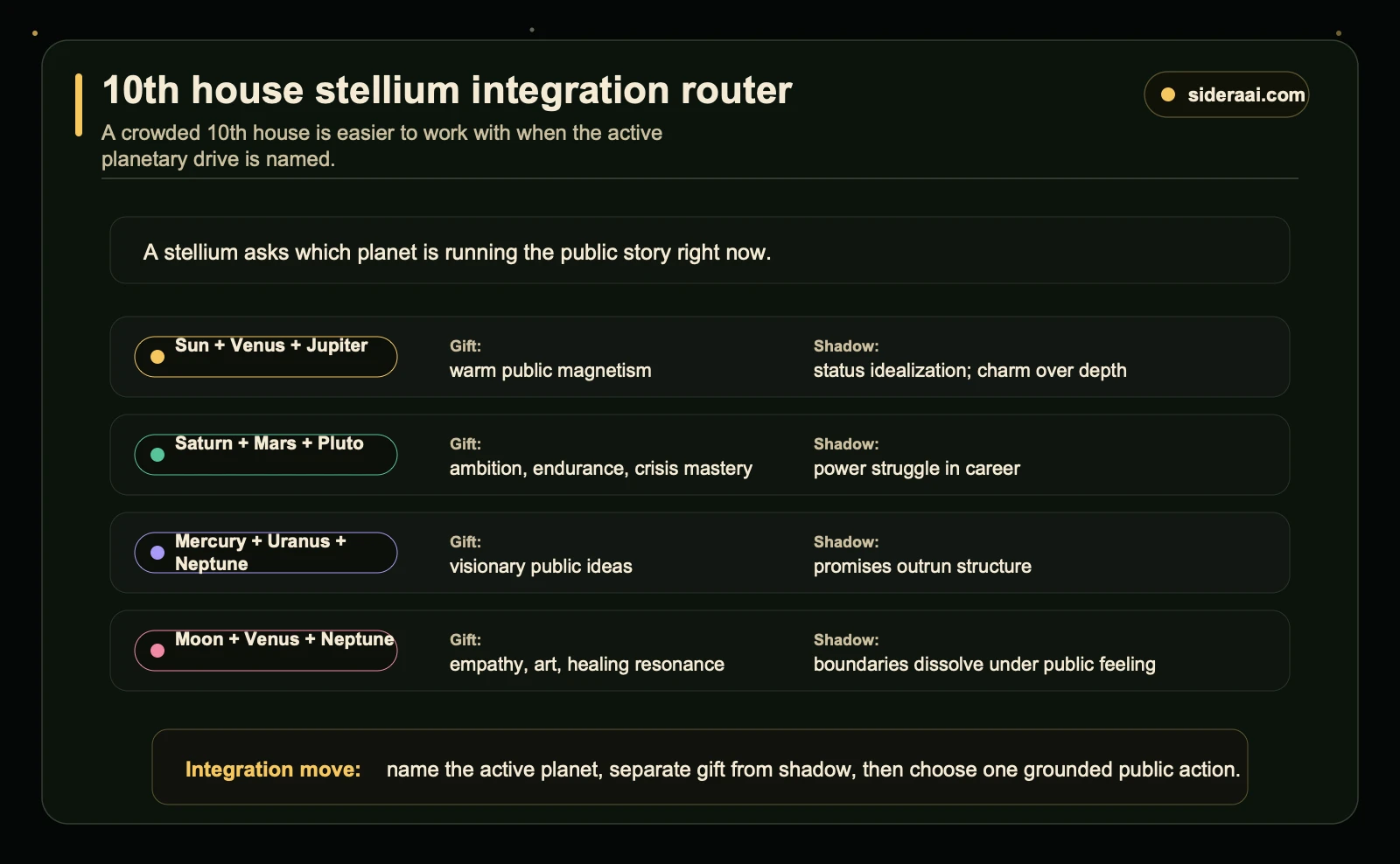
The router keeps a stellium from becoming one vague career label: name the active planetary drive, then separate the gift from the shadow.
The 10th House in Western vs Sidereal Astrology
It is worth noting a key distinction for readers who have encountered both systems.
In Western tropical astrology, quadrant systems commonly use the Midheaven (MC) as the 10th-house cusp. Whole-sign houses separate the twelve sign-based houses from the MC degree, which may fall in the 9th, 10th, or 11th. In either case, the 10th house is not automatically Capricorn: use the actual sign, its ruler, planets in the house, and aspects to the MC. This guide uses Western tropical terminology; Sidera’s calendar system selection is a separate setting from natal-chart interpretation.
In sidereal/Vedic astrology, the corresponding house is called Karma Bhava (the house of karma and right action) or Rajya Bhava (the house of career and rulership). Saturn is also the primary karaka (significator) for the 10th in the Vedic system, and the themes overlap – career, ambition, public achievement. However, Vedic interpretation incorporates additional layers: the concept of karma as the overarching theme (this life’s purpose of right action), the Dashamsha (D10) divisional chart for detailed career analysis, and the planetary period system (Dasha) for timing career phases.
The house numbers align, but the interpretive frameworks diverge significantly. This guide follows the western tropical tradition throughout. For more on how these two traditions differ in practice, see Sidereal vs Tropical Astrology.
Methodology and limits
This guide was revised from a June 22, 2026 research pack covering exact and related search results, four qualitative community questions, and published astrology references on houses, the Midheaven, and house rulers. The six-step sequence and planet comparison table are Sidera editorial frameworks assembled from those inputs; they are not app-generated career predictions or scientific findings. No named human astrology reviewer is recorded.
Interpretations describe possibilities to test against the full chart and lived evidence. They should not replace education, labor-market research, financial planning, mental-health support, or professional career advice. Recheck the linked sources and product behavior when this page is materially updated.
Frequently Asked Questions
What does it mean to have Saturn in the 10th house?
Saturn in the 10th house is a visible and demanding career placement, but it does not mean Saturn is in Capricorn. Its recurring themes are standards, responsibility, delay, mastery, and earned authority. Early career may bring self-doubt or heavy responsibilities; sustained effort can build professional depth that others trust. The Saturn Return around ages 29–30 may intensify the review, depending on the full natal chart and the exact transit.
Is Moon in the 10th house a good placement?
Moon in the 10th is not automatically in detriment; that sign condition applies only when the Moon is in Capricorn. In the 10th, emotional needs and responsiveness become visible through career and reputation. The Moon’s sensitivity can support work involving care, media, education, food, community, or healing. The challenge is navigating emotional exposure and changing public feedback without making every response a verdict on personal worth.
What careers suit someone with the Sun in the 10th house?
Sun in the 10th can emphasize leadership, authorship, recognition, and visible responsibility. It may be useful to ask whether a role permits genuine self-expression or mainly serves inherited expectations. The placement does not prescribe politics, executive work, entrepreneurship, or performance, and burnout depends on real workload and support as well as chart symbolism.
What does a 10th house stellium mean?
Using this guide’s working definition, a 10th house stellium contains three or more planets in the 10th. It can concentrate several drives around career, reputation, authority, or contribution, but it does not make fame or a public profession unavoidable. Interpret each planet’s sign, condition, aspects, rulerships, and MC relationship before integrating the cluster.
Does the 10th house represent the mother or the father?
Astrological schools disagree. Some assign the 10th to the father and the 4th to the mother; others reverse the pair or use the 10th for whichever parent represented public authority and expectation. Treat this as a disputed interpretive tradition and compare it with actual family roles.
Final Thoughts
The planets in your 10th house describe possible themes in public life, not an inevitable career. Saturn in the 10th does not doom you to delay, and Jupiter there is not automatically in fall. Interpret the planet, its sign, aspects, the 10th-house ruler, and the MC before drawing a conclusion.
The 10th house is always in dialogue with the 4th: the most lasting public achievements are built on private foundations. Whatever planets you carry here, the work of the 10th is to build something in the world that is genuinely yours – not an imitation of someone else’s ambition, not a performance designed to win the approval of an inner parental authority, but a vocation that expresses who you actually are.
For readers new to reading planetary placements in context, How to Read a Birth Chart offers a useful foundation. For the previous article in this series, see Planets in the 9th House.
Leave with three actions: verify the birth data and selected house system; complete the six-step interpretation without collapsing the MC into the 10th; then test one low-risk real-world action, such as clarifying a role, documenting a skill gap, or setting a work boundary. A chart can frame reflection, but the result should be a decision you can evaluate in ordinary life.