The North Node in astrology is not just a “life purpose” keyword. It describes the growth pattern that feels awkward because it asks you to stop solving life with your most familiar strategy.
You can often spot it in real life by the gap between what feels comfortable and what actually moves you forward. In love, it may be the relationship pattern you keep repeating even when it costs you closeness. At work, it may be the role you hide inside because it feels competent but too small. In conflict, it is the default defense you reach for under pressure. In self-image, it is the old identity that once protected you but now keeps deciding for you.
The South Node (the opposing point) feels safe and familiar because it represents patterns you’ve already mastered. The North Node points toward unfamiliar terrain - the traits, experiences, and choices that feel exposing precisely because they are still developing. The growth comes from consciously moving toward the North Node, not abandoning the South Node’s gifts, but expanding beyond them.
Ready to See Your Personal Birth Chart?
Discover your unique cosmic blueprint — planets, houses, and aspects personalized to your exact birth time and location.
Get Your Birth Chart →✓ Birth chart analysis ✓ Personalized insights ✓ Free to use
What the North Node Actually Is
The North Node (also called the True Node or Rahu in Vedic tradition) is not a planet. It’s one of two mathematical points where the Moon’s orbit crosses the ecliptic - the apparent path of the Sun. The South Node sits exactly opposite.
Because the Nodes are calculated points rather than physical bodies, they operate differently from planets: they describe themes and directions rather than active drives or energies.
The North Node moves backward through the zodiac, spending roughly 18 months in each sign. This means everyone born within the same 18-month window shares the same nodal axis - making it both a personal placement (by house) and a generational one (by sign). The nodal cycle completes in approximately 18.6 years, which is why Nodal Returns coincide with major life chapters.
One important technical note: astrology software uses two versions of the North Node - the True Node (which wobbles slightly in its movement) and the Mean Node (a mathematical average). For birth chart interpretation, both give very close results; the True Node is slightly more precise for transit timing.
North Node vs. South Node: The Core Tension
Astrologer Jan Spiller, in Astrology for the Soul (1997), describes the nodal axis as “the road map for conscious evolution” - with the South Node as the well-worn path and the North Node as the road not yet taken but meant to be traveled.
The nodal axis always operates as a polarity:
- South Node - what you carry in naturally, where you default under stress, where you can be too comfortable (or stuck)
- North Node - what you’re stretching toward, where growth lives, what you’re often initially resistant to
Neither node is better. The South Node’s gifts are real - they represent genuine mastery. The danger is overusing the South Node as a refuge, avoiding the North Node’s challenge altogether.
Evolutionary astrologer Jeff Green, in Pluto: The Evolutionary Journey of the Soul (1985), frames this dynamic as intentional: the soul specifically chose the South Node’s tendencies to move beyond, toward the North Node’s qualities, as the evolutionary intent of the incarnation.
Think of it like this: if the South Node is your dominant hand, the North Node is the hand you’re training. It will feel awkward at first. That awkwardness is the point.
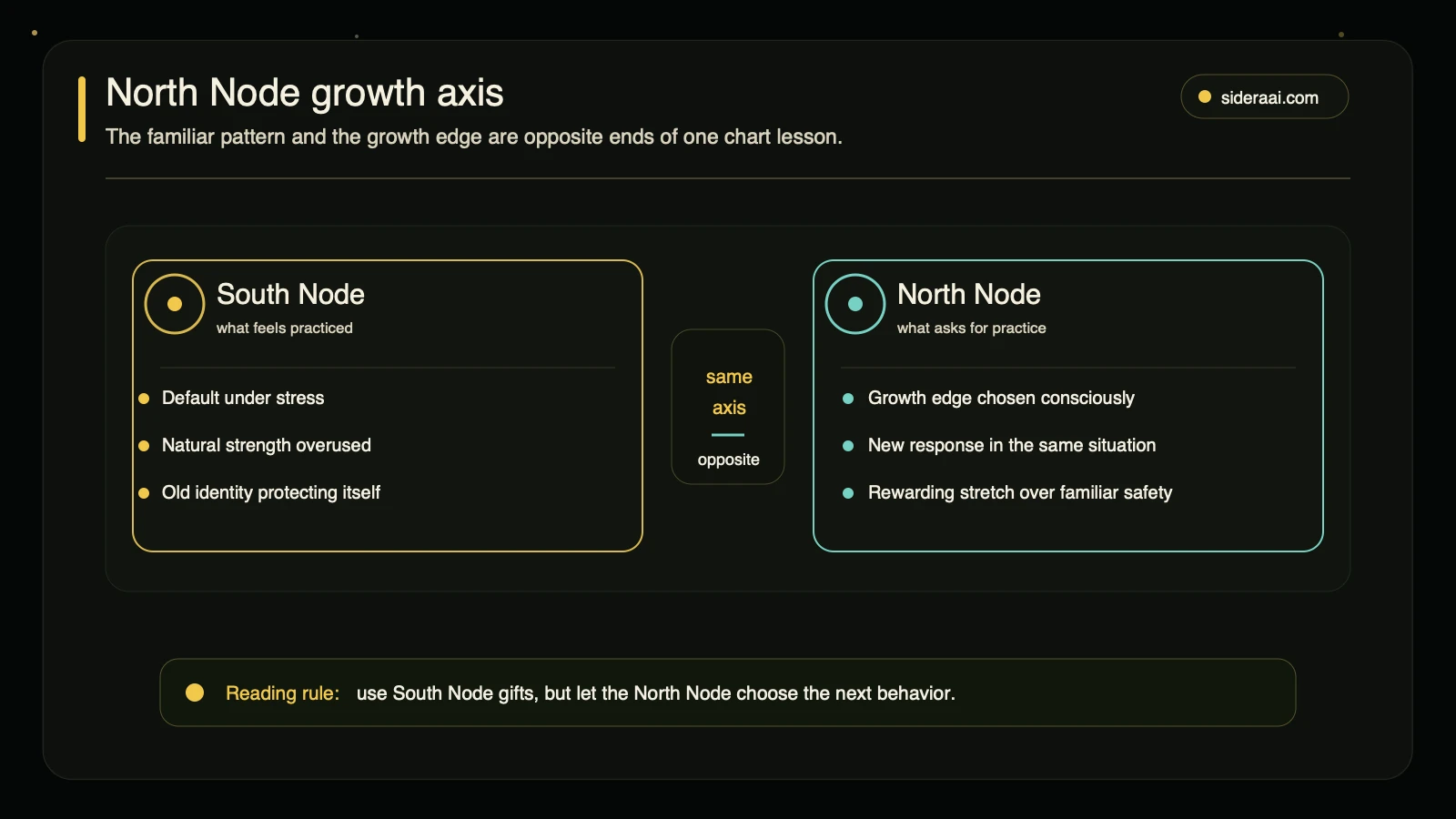
Use the axis map to spot where a familiar South Node strategy has become the exact place to practice the North Node response.
In practice, South Node behavior often looks reasonable from the outside. It can sound like “I’m just being considerate,” “I’m just staying realistic,” “I’m just keeping the peace,” or “I’m just being responsible.” The tell is repetition: if the same emotional outcome keeps happening, the South Node pattern may be running the choice before you are.
North Node Through the Signs
Each sign-based North Node describes the qualities the person is here to develop. Your South Node is always the opposite sign.
North Node in Aries / South Node in Libra: Learn to act independently, initiate without approval, and prioritize your own needs. South Node tendency: overcompromising, deferring to others, needing consensus before acting.
North Node in Taurus / South Node in Scorpio: Build material security, trust the physical world, practice patience and simplicity. South Node tendency: crisis mentality, power struggles, intensity for its own sake.
North Node in Gemini / South Node in Sagittarius: Gather specific information, stay curious about local life, communicate precisely. South Node tendency: preaching, over-philosophizing, skipping details in favor of big pictures.
North Node in Cancer / South Node in Capricorn: Develop emotional attunement, nurture others, build home and family. South Node tendency: over-reliance on achievement and status as identity, emotional armoring.
North Node in Leo / South Node in Aquarius: Express yourself creatively, lead, allow individual recognition. South Node tendency: hiding in the group, deflecting personal expression, collectivizing everything.
North Node in Virgo / South Node in Pisces: Develop discernment, practical skills, and service through craft. South Node tendency: avoidance, floating, over-idealization blocking real-world engagement.
North Node in Libra / South Node in Aries: Build true partnerships, develop diplomacy, learn to consider others. South Node tendency: self-centeredness, acting without consulting others, leading with force.
North Node in Scorpio / South Node in Taurus: Go deep, face transformation, embrace intimacy and shared resources. South Node tendency: material attachment, resisting change, valuing comfort over growth.
North Node in Sagittarius / South Node in Gemini: Develop philosophical breadth, seek meaning, expand beyond the local. South Node tendency: scattered curiosity, surface-level learning, data without synthesis.
North Node in Capricorn / South Node in Cancer: Build real-world structure, take authority, achieve through discipline. South Node tendency: emotional dependency, using nurturing as avoidance of responsibility.
North Node in Aquarius / South Node in Leo: Contribute to the collective, collaborate, think systemically. South Node tendency: ego-centering, needing constant recognition, subordinating group needs to personal drama.
For a current example of this transit in weekly astrology language, Zoe Moon Astrology frames the North Node’s move into Aquarius through freedom, friendships, personal aspirations, original projects, technology, astrology, and social groups.
North Node in Pisces / South Node in Virgo: Develop faith, surrender control, trust what cannot be measured. South Node tendency: hypercriticism, over-analysis, perfectionism blocking creative flow.
Read these as behavior patterns, not personality labels. Aries North Node is not just “be independent”; it can mean naming your preference before you know whether someone approves. Taurus North Node is not just “be grounded”; it can mean choosing a steady plan instead of escalating the crisis that makes you feel alive. Gemini North Node is not just “communicate”; it can mean asking a real question instead of defending a finished belief.
North Node by House: Where the Growth Happens
The sign shows how to grow; the house shows where that growth plays out in daily life:
| House | Area of Growth | Key Theme |
|---|---|---|
| 1st | Identity and personal presence | Self-assertion, embodied confidence |
| 2nd | Material stability and self-worth | Financial independence, value clarity |
| 3rd | Communication and local community | Curiosity, siblings, everyday connections |
| 4th | Home, family, emotional roots | Nurturing, belonging, inner security |
| 5th | Creativity, romance, play | Self-expression, risk for joy |
| 6th | Daily routine, health, craft | Practical service, skillbuilding |
| 7th | One-on-one partnership | Commitment, conscious relating |
| 8th | Shared resources, intimacy, transformation | Depth, merging, facing mortality |
| 9th | Philosophy, travel, higher learning | Meaning, expansion, foreign cultures |
| 10th | Career, public role, legacy | Ambition, visible achievement |
| 11th | Community, groups, long-term vision | Collective purpose, friendship networks |
| 12th | Spirituality, solitude, the unconscious | Surrender, faith, retreat |
For North Node in 7th house, the synastry chart guide covers partnership astrology in depth. For 10th house placements, career timing and Saturn’s role in career change offer useful context.
The house is where the lesson becomes concrete. If your North Node sign says “be more direct” and it sits in the 7th house, directness will be tested through partnership. If it sits in the 10th house, directness may be tested through career visibility, public decisions, and authority.
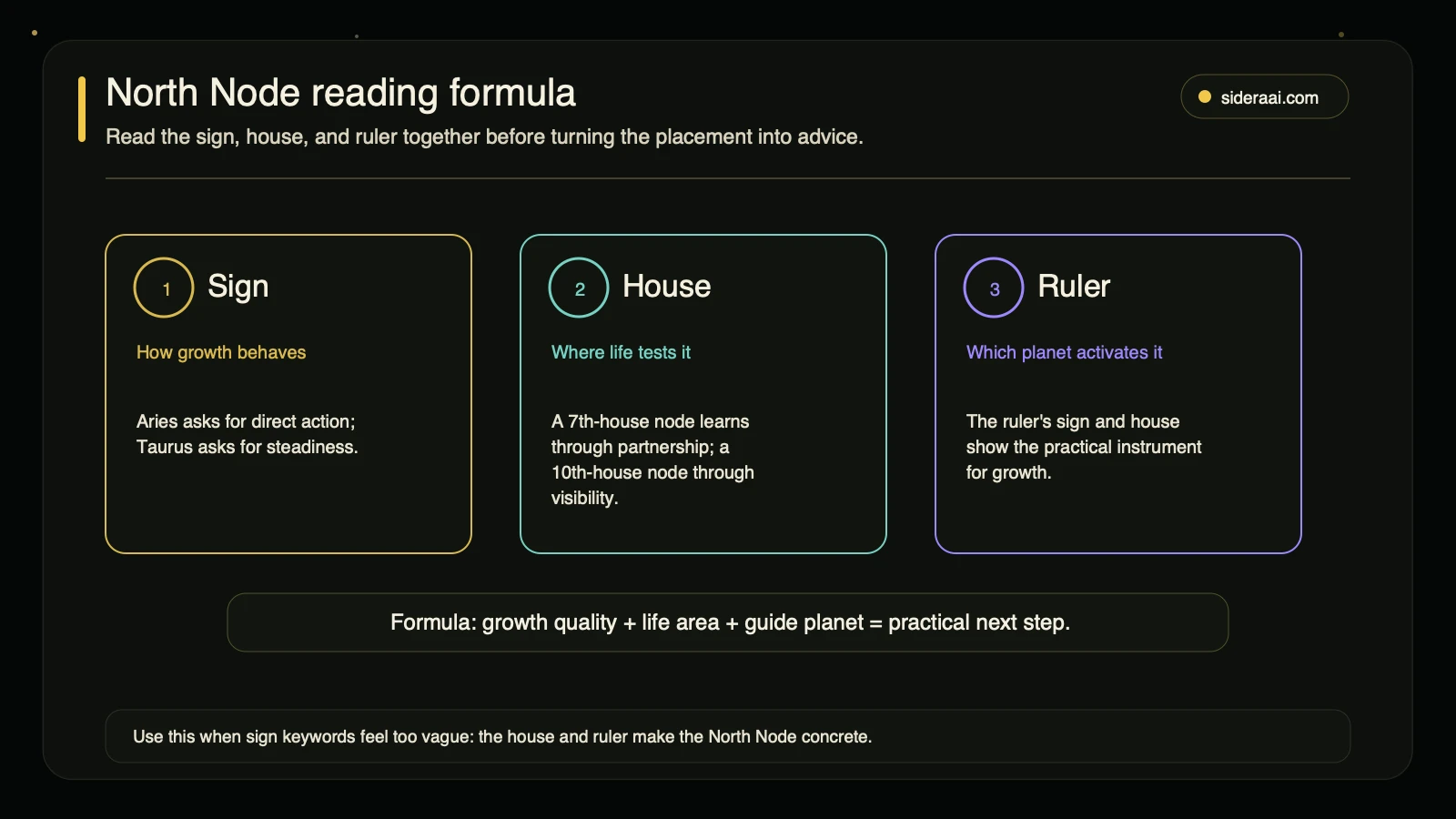
The formula keeps the North Node reading practical: sign shows the growth quality, house shows the life arena, and the ruler shows how to act on it.
How the North Node Shows Up in Real Life
The fastest way to make the North Node useful is to watch where your default response keeps giving you the same result.
- Love: The North Node often appears where intimacy asks for a new emotional skill. A South Node in Libra may keep smoothing things over and then resent being unseen. A South Node in Aries may push for independence so quickly that partnership never gets a chance to become mutual.
- Work: It can show the role you have outgrown. A South Node in Capricorn may keep proving competence while avoiding vulnerability and support. A South Node in Cancer may stay in emotionally familiar environments long after the professional structure is too small.
- Conflict: Under stress, the South Node gets louder. It is the move you make before you have had time to choose: appease, control, detach, analyze, perform, disappear, rescue, intensify, or shut down.
- Self-image: The North Node challenges the identity that once kept you safe. If you built your self-worth around being needed, impressive, agreeable, invulnerable, or endlessly useful, the North Node asks what remains when that role stops running your life.
A practical reflection: when a situation repeats, ask, “What familiar strength am I overusing here?” Then choose one small North Node behavior that interrupts the loop. Growth is usually less dramatic than the fantasy of transformation. It is the uncomfortable honest sentence, the boundary, the application, the repair attempt, the slower decision, or the willingness to be new at something.
Understand your connections on a cosmic level.
Explore your bonds →The North Node Ruler: Your Evolutionary Guide Planet
Most astrologers stop at the North Node sign and house. But there’s a third layer that few beginner guides explain: the North Node Ruler - the planet that rules the sign your North Node occupies.
This planet acts as a practical guide for how to pursue your North Node direction. It shows you the instrument, not just the destination.
How it works:
- Find your North Node sign
- Identify that sign’s ruling planet
- Look at where that ruling planet sits in your birth chart - its sign and house show where and how to take action toward your evolutionary growth
Examples by North Node sign:
| North Node Sign | Ruler | What to Look For |
|---|---|---|
| Aries | Mars | Where is Mars in your chart? That house activates the growth path. |
| Taurus | Venus | Venus’s placement shows how you build toward security and values. |
| Gemini | Mercury | Mercury’s sign and house point to how to develop curiosity and communication. |
| Cancer | Moon | The Moon’s sign and house describe how to develop emotional depth. |
| Leo | Sun | The Sun’s position shows where your creative self-expression naturally wants to emerge. |
| Virgo | Mercury | Mercury’s house shows where to build practical skill and discernment. |
| Libra | Venus | Venus’s placement shows where partnership and diplomacy naturally develop. |
| Scorpio | Pluto (modern) / Mars (traditional) | Pluto’s house shows where deep transformation is meant to unfold. |
| Sagittarius | Jupiter | Jupiter’s house shows where expansion and meaning-making want to happen. |
| Capricorn | Saturn | Saturn’s placement shows where disciplined achievement will serve your path. |
| Aquarius | Uranus (modern) / Saturn (traditional) | Uranus’s house shows where collective contribution or innovation wants to develop. |
| Pisces | Neptune (modern) / Jupiter (traditional) | Neptune’s house shows where surrender and creative faith are called for. |
Why this matters: If someone with North Node in Sagittarius has Jupiter in the 9th house, their growth path has a clear, easy channel - travel, higher education, and philosophical study are natural gateways. If that same Jupiter is in the 2nd house, the philosophical expansion may come through building financial independence and learning the real-world value of ideas.
The North Node Ruler doesn’t replace the sign and house reading - it activates it with a specific planetary instrument.
Sidera uses your actual birth chart—not generic horoscopes.
Get personalized insights →The 18-Year Nodal Return
Every 18-19 years, the North Node returns to the sign it occupied at your birth - a period when your soul’s evolutionary themes come sharply into focus. You may feel pulled to recommit to the North Node’s direction or to resolve unfinished South Node patterns.
Nodal Return windows:
- First Return: ages 18-19 (adulthood threshold)
- Second Return: ages 36-38 (midlife reckoning)
- Third Return: ages 54-56 (legacy focus)
- Fourth Return: ages 72-74 (late-life completion)
The halfway point - the Nodal Opposition - arrives around ages 9-10, 27-28, and 45-47, often bringing tension between old patterns and new directions. The age-27-28 Nodal Opposition frequently coincides with the Saturn Return at approximately the same period, amplifying the pressure to evolve.
During these windows, the useful question is not “What is fated to happen?” but “Which old response is no longer enough?” Nodal timing often coincides with choices that reveal whether you will keep protecting the old identity or practice the next one.
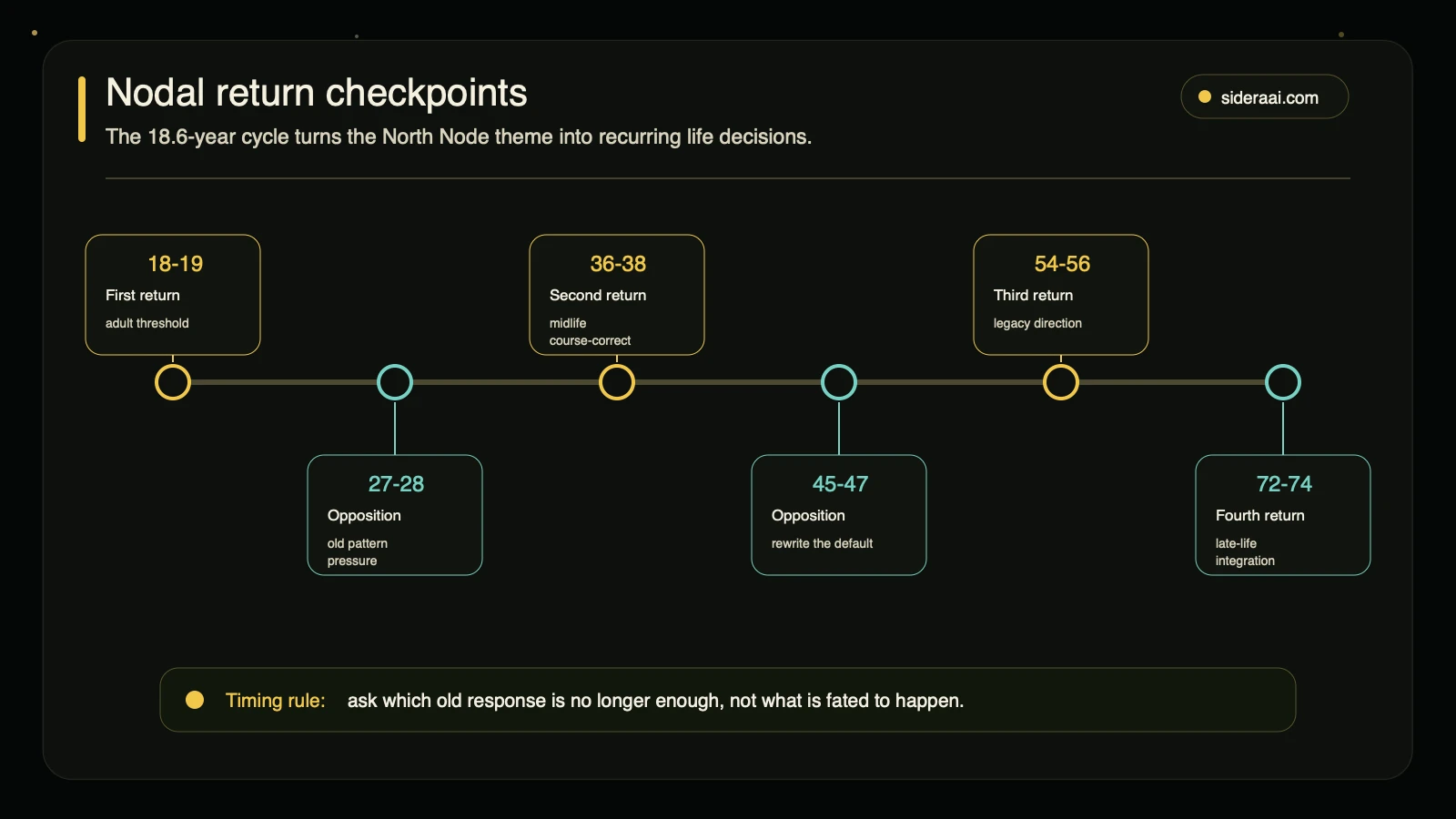
The timeline turns the 18.6-year nodal cycle into review points for choosing the growth pattern instead of repeating the default response.
Find your perfect moment with AI-powered electional astrology.
Discover your timing →North Node Conjunctions in the Birth Chart
When a natal planet sits close to the North Node (within 5-8 degrees), that planet becomes a key player in the evolutionary story:
- Sun conjunct North Node: Identity and self-expression are directly tied to the evolutionary mission; this person often grows into their purpose consciously
- Moon conjunct North Node: Emotional instincts point toward growth; the person often intuitively senses their path but must trust it
- Saturn conjunct North Node: The growth path demands discipline and earned mastery; it will not happen by chance or shortcut
- Venus conjunct North Node: Relationships and values are central to the evolutionary journey; partnerships often catalyze the growth
- Jupiter conjunct North Node: Expansion and abundance support the direction; following the North Node tends to create fortunate circumstances
South Node conjunctions tell the opposite story: planets near the South Node feel natural and easy but can trap the person in familiar territory. These planets require conscious redirection toward the North Node’s sign and house.
Eclipse Connection: Why Some Eclipses Hit Harder
Solar and lunar eclipses always occur near the nodal axis - within about 18 degrees of the Nodes. This is why eclipse seasons (roughly every 6 months) often trigger notable life events: the Nodes and eclipse points align, activating whatever natal planets are nearby.
If you want to understand why a particular eclipse affected you strongly, check whether it fell close to a natal planet, your Ascendant, or your nodal axis. Eclipses within 5 degrees of the North Node carry an especially developmental quality - they push you toward the North Node’s themes whether you feel ready or not.
FAQ: North Node Astrology
What does the North Node mean in astrology? The North Node marks the direction your soul is growing toward in this lifetime - the qualities you’re here to develop, which often feel unfamiliar or challenging at first. It sits opposite the South Node, which represents patterns and strengths you’ve already internalized.
What’s the difference between the True Node and Mean Node? Both refer to the North Node, but calculated differently. The True Node accounts for the Moon’s slight wobble in its orbit; the Mean Node smooths this out mathematically. For birth chart interpretation, the difference is usually 1-2 degrees and rarely changes the practical meaning. True Node is slightly more precise for transit timing.
How do I find my North Node? Use a free birth chart calculator - you’ll need your birth date, time, and location. Look for the symbol that looks like a horseshoe (☊). The house it falls in is as important as the sign.
What is the South Node in astrology? The South Node is the point exactly opposite the North Node. It represents qualities and patterns that come naturally - sometimes too naturally. It’s not “bad,” but overreliance on South Node behavior can stall growth. The South Node’s gifts are meant to support the North Node mission, not replace it.
How does the North Node differ from the Ascendant? The Ascendant (rising sign) describes your outer personality and approach to life - your interface with the world. The North Node describes evolutionary direction - where you’re growing toward, not who you already appear to be. Both influence identity, but they operate at different levels: the Ascendant is immediate; the North Node is developmental.
What happens at a Nodal Return? A Nodal Return occurs every 18-19 years when the transiting North Node returns to your natal North Node sign. These periods often bring major life decisions, a sense of destiny, or a strong urge to course-correct toward your evolutionary direction. Ages 18-19, 36-38, and 54-56 are the main windows.
Does the North Node sign change every year? No - the North Node spends about 18 months in each sign and moves backward through the zodiac. So a new North Node sign begins roughly every 18 months, affecting everyone born in that window with the same nodal axis.
What does it mean if a planet is conjunct the North Node? A planet within 5-8 degrees of the North Node becomes deeply entwined with the evolutionary mission. That planet’s energy points you toward your growth direction. Sun conjunct North Node often produces strong purpose-orientation; Saturn conjunct North Node adds rigor and discipline to the path.
What is the North Node Ruler in astrology? The North Node Ruler is the planet that rules your North Node’s sign. It acts as a practical guide for how to pursue your evolutionary direction - its sign and house placement in your birth chart show you the instrument, not just the destination. For example, North Node in Sagittarius with Jupiter in the 9th house points clearly to travel and higher learning as key growth channels.
Putting It Together: North Node in Practice
The North Node is less about what you do and more about who you become. It’s a developmental indicator, not a prescription.
Practical approaches:
- Notice what feels unfamiliar but compelling - that’s often the North Node calling
- Notice what you default to under stress - that’s often the South Node’s pull
- Find the planet that rules your North Node’s sign; look at its house for practical activation
- Lean toward the North Node’s sign and house, especially when life feels stagnant or repetitive
The discomfort of the North Node is the signal, not the warning. Growth lives at the edge of familiarity.
For a complete picture of your evolutionary direction, pair your North Node with your birth chart, rising sign, and the planets in your 12 houses. The North Node tells you where you’re growing; the rest of the chart tells you how.
For sign-specific daily context, the Aries daily horoscope and Libra daily horoscope are especially relevant if you have your North Node in either of these signs - the Aries/Libra axis is one of the most recognizable nodal polarity lessons.