Neptune in astrology describes the part of life where something feels meaningful, beautiful, and hard to pin down.
If Neptune is strong in your birth chart, you may recognize it as a familiar blur: love that feels fated before trust has been earned, work that feels unbearable unless it has a purpose, conflict where everyone avoids the plain truth, or a self-image that shifts depending on who is looking.
Neptune is not just “dreams” or “spirituality.” It shows where your boundaries get porous: where you absorb other people’s moods, believe in potential more than behavior, rescue people instead of relating to them, escape pressure when reality gets too sharp, or receive real creative and spiritual inspiration that cannot be forced.
At its healthiest, Neptune helps you soften, imagine, forgive, create, and surrender control. At its shadow, it can blur facts enough that you stay too long in a fantasy. The practical question is not whether Neptune is good or bad. It is: where do I need more compassion, and where do I need clearer edges?
Neptune takes approximately 165 years to complete one orbit of the Sun, spending around 14 years in each zodiac sign. Like Pluto and Uranus, Neptune is a generational planet: your Neptune sign is shared by everyone born within roughly a 14-year window. Your Neptune house, however, is personal. It marks the specific area of life where idealism, inspiration, confusion, and the need to surrender to something beyond ego-control play out most vividly.
Western tropical astrology treats Neptune as the modern ruler of Pisces. Traditional astrology assigned Jupiter to Pisces; most contemporary astrologers use both: Jupiter for expansiveness and faith, Neptune for mysticism, dissolution, and transcendence. (Note: Sidera uses western/tropical astrology, where sign assignments are based on seasonal positions, not the sidereal zodiac.)
Neptune was discovered in 1846, making it the first planet located through mathematical prediction before visual confirmation: an appropriately Neptunian beginning for a planet that often works through intuition before fact.
For a full map of how Neptune fits alongside the other planets, see the planets in astrology guide.
Ready to See Your Personal Birth Chart?
Discover your unique cosmic blueprint — planets, houses, and aspects personalized to your exact birth time and location.
Get Your Birth Chart →✓ Birth chart analysis ✓ Personalized insights ✓ Free to use
The Dissolution Principle: How Neptune Actually Works
Neptune does not sharpen. It softens. It does not provide answers so much as dissolve the question until the usual categories of “problem” and “solution” no longer apply. Astrologers often describe Neptune’s operating mode as the Dissolution Principle: the gradual wearing away of separation until boundaries become permeable and individual consciousness can merge with something larger.
As Liz Greene writes in The Astrological Neptune and the Quest for Redemption (1996): “Neptune is the longing of the part for the whole, the yearning of the separated individual to return to the source from which it came.” This captures Neptune’s drive: not toward achievement or mastery, but toward merger, transcendence, and return.
This process can produce inspiration, spiritual awakening, creative genius, and oceanic compassion. At its highest expression, Neptune describes the mystic, the artist, the healer who dissolves their own needs to serve others. At its lowest, it produces confusion, escapism, addiction, self-deception, and the willingness to believe whatever is most comforting rather than most true.
Neptune’s shadow operates through idealization. The planet makes things look better than they are: more beautiful, more perfect, more spiritually charged. The vision it offers can be genuinely transcendent, or it can be a soft fog that lifts suddenly to reveal a reality starkly different from what was imagined.
What Neptune Feels Like in Love, Work, Conflict, and Self-Image
Neptune is easiest to understand when you stop treating it as a keyword and start watching behavior. It often shows up as the place where you want the beautiful version of reality to be true so badly that you ignore the missing evidence.
In love: Neptune can feel like soul recognition before emotional safety has been established. You may bond with someone’s pain, potential, mystery, or artistic sensitivity, then struggle to admit when their actual behavior is inconsistent, unavailable, or unclear.
At work: Neptune needs meaning. A role that looks fine on paper can feel draining if it has no emotional or creative purpose. The shadow is vagueness: unclear goals, porous boundaries, undercharging for creative or healing labor, or hoping inspiration will replace structure.
In conflict: Neptune avoids the hard edge of directness. You may disappear, forgive too quickly, make excuses, or feel so flooded by everyone’s feelings that you lose track of the facts. The growth move is gentle honesty: naming what happened without turning anyone into a villain or a saint.
In self-image: Neptune can make identity feel fluid. You may become what others need, sense what people want from you before they say it, or feel hard to define even to yourself. The gift is empathy and imagination. The work is learning the difference between being open and being undefined.
Neptune Dignity Table
| Status | Sign | Notes |
|---|---|---|
| Domicile (modern) | Pisces | Neptune rules Pisces; its 2012–2026 Pisces transit operated at maximum strength |
| Co-ruler (traditional) | Jupiter (Pisces) | Traditional ruler; Jupiter and Neptune share Pisces co-rulership in modern practice |
| Exaltation | Debated (Cancer or Leo) | No consensus among classical sources; Cancer and Leo are most commonly proposed |
| Detriment | Virgo | Neptune’s dissolving quality clashes with Virgo’s need for precision and discernment |
| Fall | Debated (Capricorn or Aquarius) | Capricorn’s structural realism and Aquarius’s rationalism both conflict with Neptunian dissolution |
The absence of established exaltation and fall degrees reflects Neptune’s relatively recent discovery (1846). Classical dignity tables were built before Neptune was known, which is why modern astrologers disagree more about Neptune’s dignity than they do about visible planets.
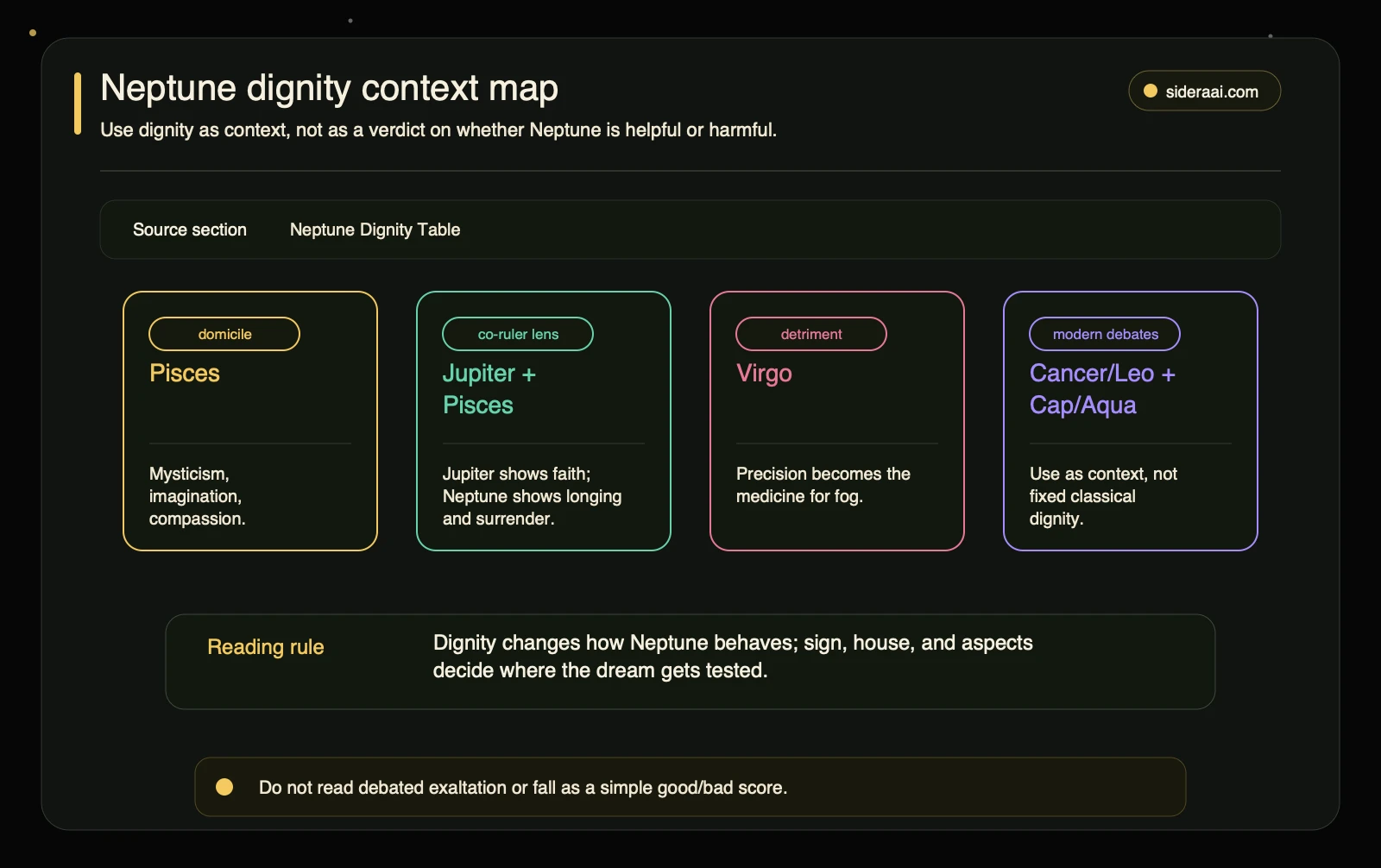
Use Neptune dignity as context, not as a simple verdict. The sign describes style; the house and aspects show where the dream gets tested.
Neptune Through the Zodiac Signs (Generational Meaning)
Unlike the personal planets (Sun through Mars), Neptune’s sign describes the spiritual, cultural, and idealistic preoccupations of an entire generation, not individual personality traits. Neptune completes one orbit roughly every 165 years, spending an average of 14 years per sign.
Neptune in Libra (1942–1957): Idealized peace, partnership, and social harmony. This generation romanticized love and the post-war social contract, carrying deep idealism about relationships and international cooperation.
Neptune in Scorpio (1957–1970): Dissolved boundaries around taboo, death, sexuality, and shared resources. This generation explored altered consciousness and the shadow side of culture as spiritual inquiry.
Neptune in Sagittarius (1970–1984): Romanticized freedom, travel, world religion, and philosophical search. This generation idealized the guru, the spiritual seeker, and the idea that truth is everywhere and nowhere.
Neptune in Capricorn (1984–1998): Dissolved the boundaries of structure, ambition, and institutional authority. This generation inherited institutions that looked solid but proved hollow: financial systems, corporate loyalty, governmental trust.
Neptune in Aquarius (1998–2012): Idealized technology, collective connection, and the democratic potential of the internet. The spiritual dream of this generation was that networks could dissolve borders between people.
Neptune in Pisces (2012–2025/2026): Neptune rules Pisces, making this its home sign and most powerful placement. This period brings dissolution of categories: real versus fabricated, online versus offline, human versus artificial. The spiritual challenge is discernment in an era of maximum blur.
Neptune in Aries (2025/2026–2038/2039): Neptune enters Aries across 2025–2026, dissolving boundaries around individual identity and courage. This generation will idealize the spiritual warrior and visionary pioneer. The shadow is spiritual ego and messianic self-belief.
Neptune in the Houses (Personal Meaning)
While your Neptune sign is generational, your Neptune house is your personal arena for idealism, confusion, and spiritual opening. To find your Neptune house placement, use the birth chart calculator or read our guide on how to read a birth chart.
1st House: Neptune softens the presentation of self. People may project fantasies onto you, and you may survive by becoming whatever the room seems to need. Charm and empathy are natural gifts; the growth work is naming your own preferences before absorbing everyone else’s.
2nd House: Idealism around money and resources. You may undercharge for creative or healing work, rescue others financially, or avoid looking closely at numbers when they feel emotionally loaded. The gift is discovering values that go deeper than status or accumulation.
3rd House: Dreamy, imaginative communication and thinking. The mind works through images more than logic, which can support writing, poetry, music, and symbolic insight. The shadow is misremembering details, assuming people understood what you meant, or letting mood replace evidence.
4th House: An idealized or elusive sense of home and family. The childhood home may carry mystery, spirituality, secrecy, sacrifice, or emotional confusion. As an adult, home needs to feel spiritually safe, not just physically comfortable.
5th House: Creative genius mixed with romantic idealization. You may fall in love with chemistry, beauty, or the idea of a person before you know their consistency. Art, performance, and play can be genuinely transcendent when they are supported by discipline.
6th House: Sensitivity to environments, routines, and substances is heightened. Daily life works best when service, healing, or creativity has a real place in the schedule. The challenge is keeping enough structure that compassion does not become exhaustion.
7th House: Idealized partnerships. You may project savior, muse, victim, or soulmate roles onto partners, then feel betrayed when they turn out to be human. The work is seeing partners as they are rather than as you need them to be.
8th House: Heightened intuition around intimacy, shared resources, grief, and transformation. Emotional, sexual, and financial boundaries can blur easily. Trust needs both spiritual depth and practical clarity.
9th House: Spiritual philosophy and religious idealism. You may move through several belief systems over a lifetime, each dissolving into the next when it stops feeling true. The quest for meaning is sincere; the shadow is believing a teacher, doctrine, or worldview because it relieves uncertainty.
10th House: Career in service, healing, arts, media, or spirituality. Public image can be hard to pin down, and early career direction may feel foggy. You need a vocation with meaning, but the role still needs expectations, deadlines, and boundaries.
11th House: Idealism around friendship, community, and collective vision. You may be drawn to artistic, spiritual, activist, or online groups that promise belonging. The gift is compassion for the collective; the shadow is losing discernment inside group emotion.
12th House: Neptune’s most natural house. Strong psychic sensitivity, vivid dreaming, and a genuine feel for the invisible world are common. Solitude is medicine here, but avoidance, secrecy, and escapism become problems when ordinary reality is treated as something to disappear from.
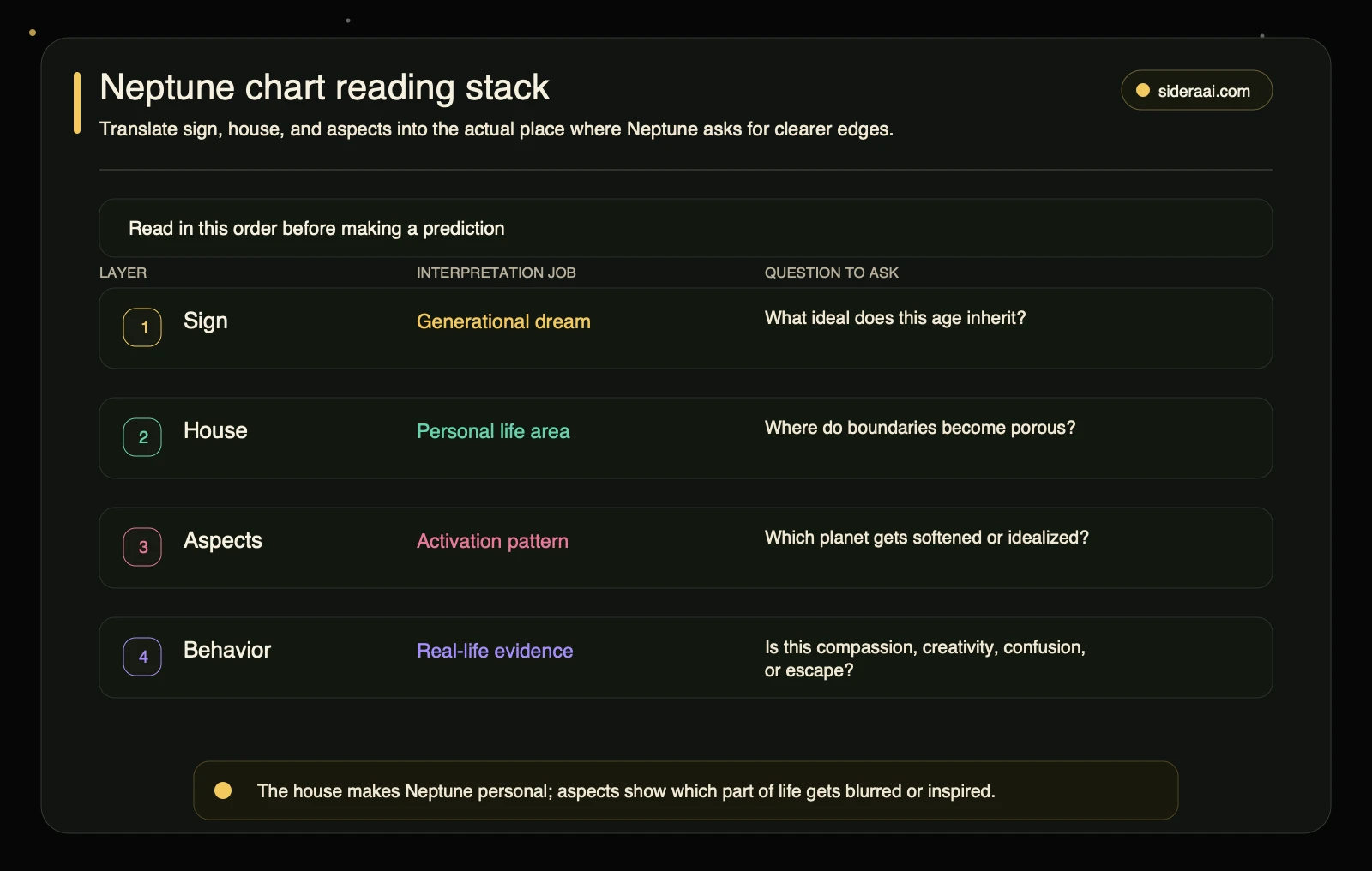
Read Neptune in layers: sign gives the generational dream, house makes it personal, aspects show the activated planet, and behavior reveals whether the pattern is creative, compassionate, confusing, or escapist.
Neptune Through the Major Aspects
As Robert Hand writes in Horoscope Symbols (1981): “Neptune contacts dissolve the boundaries of whatever planet they touch, creating a sense that the ordinary limits of that function no longer apply, for better or worse.”
Neptune conjunct Sun: The ego takes on a Neptunian quality: idealistic, imaginative, and permeable. Identity can be fluid and creative, or elusive and hard to anchor.
Neptune conjunct Moon: Heightened emotional sensitivity, empathy, and psychic receptivity. The emotional world is vivid, imaginative, and easily flooded by others’ feelings.
Neptune square or opposite Sun/Moon: Tension between Neptunian idealism and the grounded needs of self or emotion. Periods of inspired vision followed by disillusionment require regular recalibration.
Neptune conjunct Venus: Love, beauty, and relationship become areas of deep idealism and potential confusion. Romantic vision is heightened; so is the risk of idealizing partners beyond recognition. See our article on Venus in astrology for how Venus and Neptune interact.
Neptune conjunct Mercury: Imaginative, poetic thinking. The mind works through intuition and image rather than linear logic. Writing, music, and spiritual study are natural channels.
Neptune conjunct Saturn: Brings the task of grounding spiritual vision into practical form: the spiritual architect. This conjunction occurred in Capricorn in the late 1980s–early 1990s. Compare with Saturn in astrology for the full tension between structure and dissolution.
Neptune conjunct Jupiter: Expands the Neptunian quality. Spiritual idealism and creative vision operate at maximum scale, and so does the risk of overreach, delusion, or escapism through excess. See Jupiter in astrology for this conjunction’s dynamic.
Neptune’s 2-Phase Creative Cycle: Vision, Then Reality Check
This is one of Neptune’s most practically useful patterns for artists, writers, relationship decisions, and anyone trying to tell the difference between inspiration and fantasy.
Neptune operates in two distinct phases when activated by transit or progression:
Phase 1 (Neptune approaches or conjuncts a natal planet): The vision arrives. Ideas feel inspired, almost channeled. The project or relationship seems perfect, infused with meaning, charged with potential. This is the genuine gift of Neptune: access to a creative or spiritual frequency that bypasses the analytical mind’s tendency to say “this will never work.”
Phase 2 (Neptune separates or moves into hard aspect): Reality asserts itself. The vision does not disappear, but its imperfections become visible. This is not failure. It is the moment when the inspired raw material meets craft, discipline, and real-world conditions.
The mistake most people make is abandoning the work in Phase 2, interpreting the loss of the initial inspiration-high as evidence the project was flawed. The mature Neptune response: recognize Phase 2 as the moment the creative work actually begins. The dream that survives contact with reality and still stands is the work worth completing.
This 2-phase pattern also applies to relationships, spiritual paths, and major life directions activated by Neptune transits. The initial dissolution of ordinary limits (Phase 1) opens a door; what you build through that door (Phase 2) is where the actual growth happens.
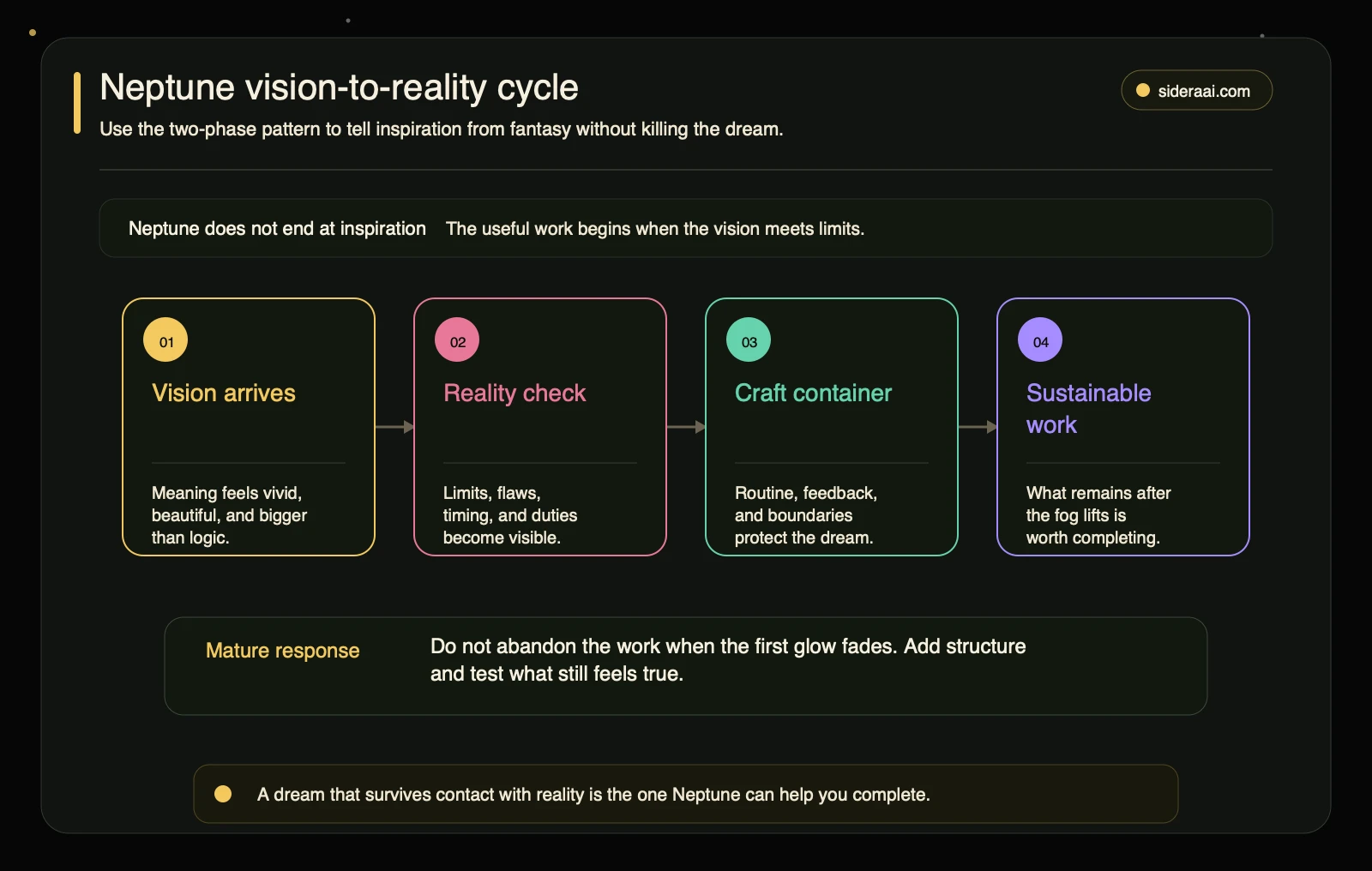
The useful Neptune pattern is not just inspiration. The dream becomes workable when it survives limits, feedback, and structure.
To see how current Neptune transits are activating your natal chart, check your Pisces daily horoscope or Virgo daily horoscope for Neptune’s current position.
Find your perfect moment with AI-powered electional astrology.
Discover your timing →Neptune in Synastry
In a synastry chart, Neptune contacts between two people’s charts tend to create an atmosphere of enchantment, idealization, and sometimes confusion. Neptune contacts are common in both deeply spiritual partnerships and relationships that eventually collide with reality.
Your Neptune conjunct their Sun or Moon: You cast a Neptunian spell on this person. You may appear more ideal, more mysterious, or more inspiring than you actually are. This can be beautiful, but it creates a burden: the spell eventually lifts.
Their Neptune conjunct your Sun or Moon: They see you through a romantic, idealized lens. You may feel simultaneously elevated and misread: loved for a projection rather than your actual self.
Neptune conjunct Venus (either direction): One of the most classically romantic and confusing contacts in synastry. Deep aesthetic resonance, emotional porosity, and a feeling that this person is somehow fated, paired with the long-term risk of idealization giving way to disappointment.
Neptune conjunct Saturn: One partner brings Neptunian vision; the other brings Saturnian reality. At best, the Saturn person helps ground the Neptune person’s dreams. At worst, the Saturn person feels suffocated by Neptunian impracticality, and the Neptune person feels their spirit crushed by structure.
The practical synastry question is not “Is this connection magical?” Neptune can make almost anything feel magical at first. The better question is: does the relationship become clearer, kinder, and more accountable over time, or does it depend on confusion to stay alive?
Understand your connections on a cosmic level.
Explore your bonds →Neptune Retrograde
Neptune spends approximately 5 to 6 months in retrograde every year, meaning roughly 40 percent of people are born with natal Neptune retrograde. Unlike Mercury retrograde, which produces noticeable disruptions, Neptune retrograde is subtle.
Natal Neptune retrograde turns the planet’s dissolving, visionary energy inward. The spiritual search is primarily internal: the person processes transcendence through dreams, solitary contemplation, and private spiritual practice rather than through community ritual or obvious religious devotion. The dissolution Neptune brings is quiet and personal.
Neptune Versus Pisces: What Is Different?
Neptune rules Pisces and shares many of its qualities. But there is a useful distinction. Pisces (as a sign) describes a way of being: fluid, empathic, porous to the environment. Neptune (as a planet) describes an active process: the gradual wearing away of boundaries wherever it sits in the chart.
A person with strong Pisces placements may simply feel things deeply. A person with a prominent natal Neptune (conjunct an angle, the chart ruler, or a personal planet) encounters dissolution as an active theme in their life story: recurring cycles of inspiration, confusion, awakening, and surrender.
To understand how your Cancer daily horoscope is shaped by transiting Neptune, or how natal Neptune colors your Virgo or Pisces placements, the house and aspect picture is essential.
How to Work With Neptune Without Getting Lost
Use Neptune as a reflection tool, not as permission to ignore reality. When a Neptune pattern is active, ask specific questions:
- What am I hoping is true, and what evidence do I actually have?
- Where am I confusing compassion with over-responsibility?
- What boundary would make this dream more sustainable?
- What practical routine would help inspiration survive past the first emotional wave?
- If the fantasy disappeared tomorrow, what real value would still remain?
Neptune becomes useful when it refines perception instead of replacing it. The goal is not to kill the dream. The goal is to give the dream enough structure that it can become real.
Powered by Sidera — AI-driven cosmic timing.
FAQ
What does Neptune represent in astrology? Neptune represents spirituality, imagination, dreams, illusion, and the longing for transcendence. It governs the impulse to dissolve boundaries and merge with something larger than individual identity, producing both mystical insight and self-deception depending on how consciously it is handled.
What sign is Neptune in right now? As of 2026, Neptune is in Aries after briefly entering Aries in 2025 and completing its long Pisces cycle in early 2026. Neptune in Aries shifts the collective dream from surrender, blur, and spiritual longing toward identity, courage, and spiritualized action.
Is Neptune in Pisces a big deal? Yes. Neptune rules Pisces, making this its domicile: the placement where its qualities operate most fully. Neptune enters Pisces only once every 165 years. The 2012–2026 transit coincided with the dissolution of categories: fake versus real content, human versus AI, online versus offline experience.
What does Neptune in the 12th house mean? Neptune in the 12th house amplifies that house’s natural qualities: psychic sensitivity, vivid dreams, spiritual depth, and a thin boundary between the conscious and unconscious mind. It can also deepen the need for retreat and solitude; at its shadow extreme, escapism.
What does it mean to have Neptune retrograde in my natal chart? Natal Neptune retrograde turns the planet’s dissolving, visionary energy inward. People born with natal Neptune retrograde tend to seek spiritual experience through inner reflection and private practice rather than external community. The search is no less genuine, just more solitary.
How long does Neptune stay in one sign? Approximately 14 years per sign, completing its full 165-year orbit. This makes Neptune a generational influence. Your Neptune sign describes your generation’s spiritual dream, not your individual personality.
What is Neptune’s relationship to addiction? Neptune governs the desire to dissolve the boundaries of ordinary ego-consciousness: a genuine spiritual impulse. Addiction is one shadow expression: substances or behaviors that temporarily dissolve those boundaries without the integration, growth, or meaning that genuine spiritual experience provides. Neptune house and aspect patterns often appear prominently in charts where addiction is a life theme.
Does Neptune rule both Pisces and any other sign? In modern Western astrology, Neptune rules Pisces exclusively. Traditional astrology assigned Jupiter to both Sagittarius and Pisces. Most contemporary astrologers use Jupiter as the traditional ruler of Pisces and Neptune as the modern ruler, applying both in interpretation.
What is Neptune’s 2-phase creative cycle in astrology? Neptune activates creativity in two phases: an initial inspired vision phase (when Neptune approaches or conjuncts a natal planet) and a reality-check phase (when Neptune separates or moves into hard aspect). Most people mistake Phase 2 (when the initial inspiration cools) for failure. It is actually the moment when craft and real-world conditions test whether the vision has genuine substance. The work that survives Phase 2 intact is worth completing.