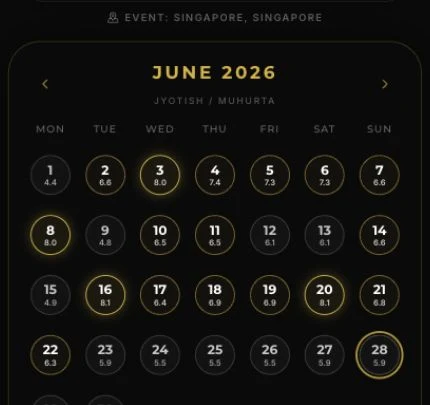
You have two possible start dates in your head. Maybe it is a business launch, a difficult conversation you have been putting off, a first day at something new. Both dates are logistically possible. Both feel slightly off for reasons you cannot fully name. And you are not completely sure if you are picking a date or just picking the feeling of being ready.
That is what Muhurta is built for. Not to resolve the fear, but to give the tension a structure.
Muhurta is the Vedic tradition of choosing a supportive moment to begin. A wedding, business opening, first day at work, contract, move, or meaningful conversation can all be treated as a beginning with its own timing quality. Sidera’s Lucky Day Planner turns that idea into a day-level Muhurta calendar: a practical signal for comparing dates rather than a mystical score to follow blindly.
The important phrase is day-level. A full traditional Muhurta can go much deeper than a 1-10 score. It may consider tithi, nakshatra, weekday, yoga, karana, lagna, planetary strength, local time, and the precise nature of the action. Sidera’s Jyotish / Muhurta tab is a planning layer inside a modern app. It is built to help you shortlist better starts – not to replace a qualified practitioner.
All screenshots in this article are real captures from Sidera Lucky Day Planner, taken on June 28, 2026 using a consistent Singapore demo profile – not stock mockups or generated diagrams. They show the Lucky Day Planner interface with neutral Singapore demo data where location is visible.

The Jyotish layer is its own timing lens, separate from Western electional astrology and local almanac calendars.
Quick Decision Tree: Start Now, Prepare First, or Wait
Use the Muhurta score as a decision filter, not as a command:
| If the day shows… | Choose this if… | Better action |
|---|---|---|
| Favorable score + usable Moon | The plan is ready and logistics are clean | Start, launch, sign, or open with normal practical care |
| Mixed score + usable Moon | You need momentum more than perfection | Begin a reversible step, soft launch, or first conversation |
| Cautious score + limited Moon | The decision still feels emotionally or operationally unfinished | Prepare first, review the plan, or wait if flexibility exists |
| Cautious score but no flexibility | The date is fixed by real-world constraints | Proceed carefully, reduce risk, and avoid treating the score as fate |
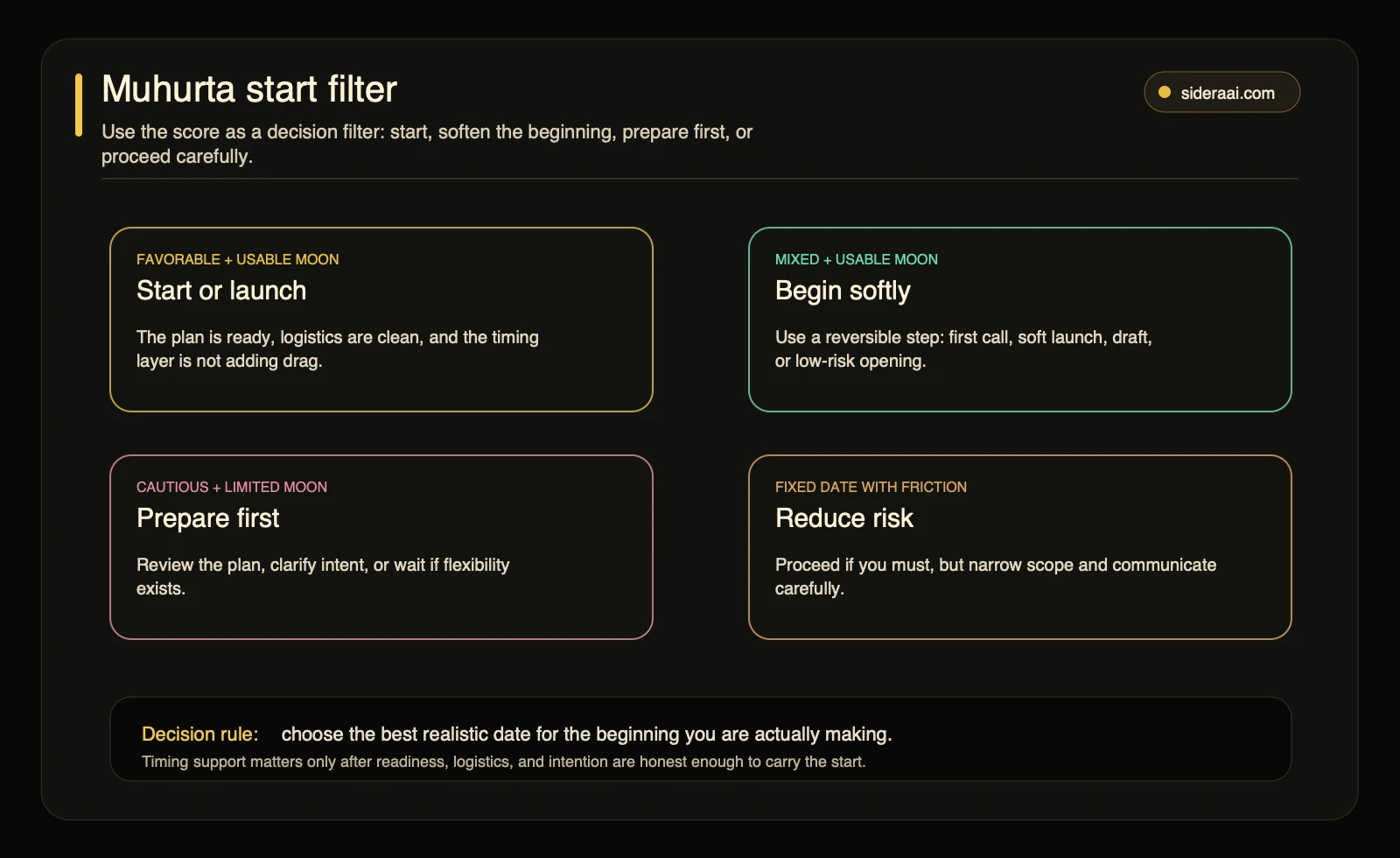
Use this filter before treating the score as a command. The better move is choosing the best realistic date for the beginning you are actually making.
The important move is not “always wait for the best number.” It is asking whether the date supports the kind of beginning you are actually making.

Muhurta is most useful as a practical filter: begin cleanly, take a reversible first step, or prepare until the real-world opening is ready.
What Most Muhurta Guides Miss
Most Muhurta explainers treat the question as if the reader only needs a better date. Real decisions are messier. A person may be looking for the best muhurta for starting work while also wondering whether the role is right. Someone may ask for an auspicious business launch date while quietly knowing the offer is still unclear. Someone may check a wedding or agreement date when the real issue is not time, but trust.
That is why Sidera’s Lucky Day Planner screenshots matter here. They do not just show a symbolic day label. They show the day score, Moon usability, method confidence, top-day shortlist, and day log together. That combination makes the tool useful as a reflective planning layer: it helps separate timing friction from readiness friction.
What a Cautious Muhurta Actually Feels Like
In the June 2026 example, June 28 shows as a “Mixed muhurta” with a 5.9 score and Moon usable.
A mixed score is not a catastrophe number. It is not “do not begin anything today.” But in lived terms, what does a mixed or cautious day actually feel like?
It feels like friction before you have started. Not dread, just friction. Like sending an important message and immediately wondering if the wording landed wrong. Like opening a conversation and noticing the other person seems distracted. Like launching something and feeling the first responses come in slower than expected, without a clear reason why.
A cautious Muhurta is often the day when things are possible but not effortless. Preparation and review move forward cleanly. Soft communication works. But public launches, formal first agreements, and vulnerable first moves tend to require more energy than usual to land – and if something goes sideways, recovery takes longer than it would on a cleaner day.

A cautious day is workable, but small alignment problems make the first move demand more correction and recovery.
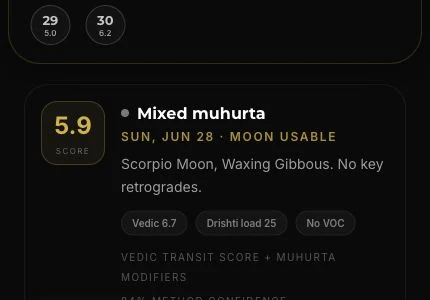
The 80% method confidence on that same screenshot means the system had enough input coverage to calculate the score and show the day’s modifiers. It does not mean the app is 80% sure the day will be difficult. Method confidence answers: “Do we have enough data to show you this timing signal?” It does not answer: “Will your launch succeed?” That distinction protects rather than limits. A planning tool earns trust by being precise about what it is actually telling you.
Real Example: What a Supportive Muhurta Day Feels Like
A cleaner Muhurta day usually feels less dramatic than people expect. The meeting starts on time. The message is easier to write. The other person understands the intent without needing three follow-ups. A launch still has work behind it, but the first contact with the outside world feels less resistant.
That is the practical contrast with a cautious day. A supportive score does not create readiness for you, and it does not remove risk. It simply means the timing layer is not adding as much drag to a beginning that is already prepared.

Supportive timing does not do the preparation; it lets a ready beginning meet the outside world with less drag.
When the Moon Makes a Day Feel Soft
The Moon is central to timing because it changes quickly. In Jyotish, the Moon’s sign, nakshatra, phase, and usability each carry meaningful weight for beginnings. Sidera’s day-level UI shows Moon usability alongside the Muhurta score. But what does limited Moon usability feel like in practice?
Think of the days when you wake up slightly more emotionally reactive than usual. Where conversations carry an edge that was not there the week before. Where you feel less settled and more susceptible to second-guessing a decision you were confident about yesterday. That is not superstition. That is the felt version of what the Moon-usability flag is pointing at: a nakshatra that classical texts mark as difficult for beginnings, a void interval, or a phase transition that introduces instability at the instinctual level.
Limited Moon usability is not a reason to freeze. It is a reason to be honest about what kind of beginning you are planning. Preparation, review, and low-stakes communication tend to survive a difficult Moon day intact. But public first moves, formal commitments, and emotionally vulnerable conversations tend to be harder to recover if they land awkwardly.
When Moon usability is marked usable, it signals more natural support for attention and forward motion – not a guarantee, just less friction at the instinctual layer. Sidera shows Moon usability separately from the Muhurta score because the two can tell different stories. A 5.0 Muhurta score paired with limited Moon usability is not the same thing as a 5.0 score with Moon usability confirmed. Reading both together helps you understand whether a calendar-friendly day also has support in the more immediate, emotional layer that the Moon governs.

Moon usability is the immediate stability layer: it cannot guarantee the outcome, but it can make attention and first motion feel more settled.
For deeper context on how Vedic timing relates to your birth chart, read the Vedic astrology calculator guide and the Vedic astrology birth chart calculator guide.
Bad Timing vs Emotional Unreadiness
Here is a reflection worth sitting with before you commit to a date:
When a Muhurta score and an internal hesitation point in the same direction, are you dealing with bad timing – or with a plan that is not yet ready?
A cautious Muhurta score flags day-level Vedic friction. It cannot read whether the business plan still has a gap you have not addressed. It cannot see that the conversation you are planning to have still needs a clearer intention behind it. It cannot tell you that the contract has one clause you have not actually negotiated yet.
Timing tools are decision support for a beginning that is genuinely ready. They are not a substitute for the preparation that makes readiness real.
A concrete example: You plan to sign a lease for a studio space. You have picked a date three weeks out. When you check the Muhurta calendar, the date shows a 3.3 score with limited Moon usability. You could proceed – the date is not cursed, and your practical constraints may make flexibility impossible. But the signal is worth sitting with honestly. Is the friction coming from the date, or from the fact that you have not yet fully confirmed the space works for what you actually need? Sometimes a cautious timing signal points directly at the readiness gap the busy part of your mind was moving past.
That is not Muhurta telling you to wait indefinitely. That is timing doing what it is actually for: slowing the decision down just enough for the preparation to catch up.

A cautious date may be a timing signal, but unfinished utilities, terms, and operating space reveal a readiness gap the calendar cannot fix.
Methodology Box: Day-Level Muhurta vs Full Muhurta
This article evaluates Sidera’s Lucky Day Planner Muhurta layer using screenshots captured on June 28, 2026. The visible system is day-level: it can compare dates in a month, show Moon usability, rank top days, and display method confidence for the available data.
That methodology has a boundary. A full traditional Muhurta can require hour-level lagna selection, local ritual context, action-specific rules, and practitioner judgment. Sidera’s day-level layer is strongest when the user needs a shortlist and a trust-aware planning signal. It should not be presented as a final priestly ruling or as a prediction engine.
For a broader reference point on traditional Muhurat categories, Drik Panchang’s Muhurat section shows how detailed electional timing can become when the goal is a specific auspicious window rather than a day-level shortlist.
How Sidera’s Muhurta Calculator Works
Lucky Day Planner’s Jyotish / Muhurta tab reads Sidera’s Vedic calendar range score in personal mode and adds practical day-level modifiers. The selected-day view can show:
- Muhurta score and label (Cautious, Neutral, Favorable)
- Moon usability and Moon phase
- Void-of-course state where applicable
- Retrograde pressure, intensity, and quality
- Aspect count, source label, and method confidence
The table below shows where day-level Lucky Day Planner fits versus a full traditional election:
| Question | Day-level Lucky Day Planner | Full traditional Muhurta |
|---|---|---|
| Which days look better this month? | Strong fit | Can answer, but more detail than needed |
| What exact hour should I begin? | Not yet exposed | Core use case |
| Is this fit for a specific ritual? | Not authoritative | Better handled by tradition-specific guidance |
| Does my profile matter? | Yes, through Sidera Vedic scoring | Yes, often in more detailed ways |
| Can I compare with Western timing? | Yes | Only if the astrologer or system supports it |
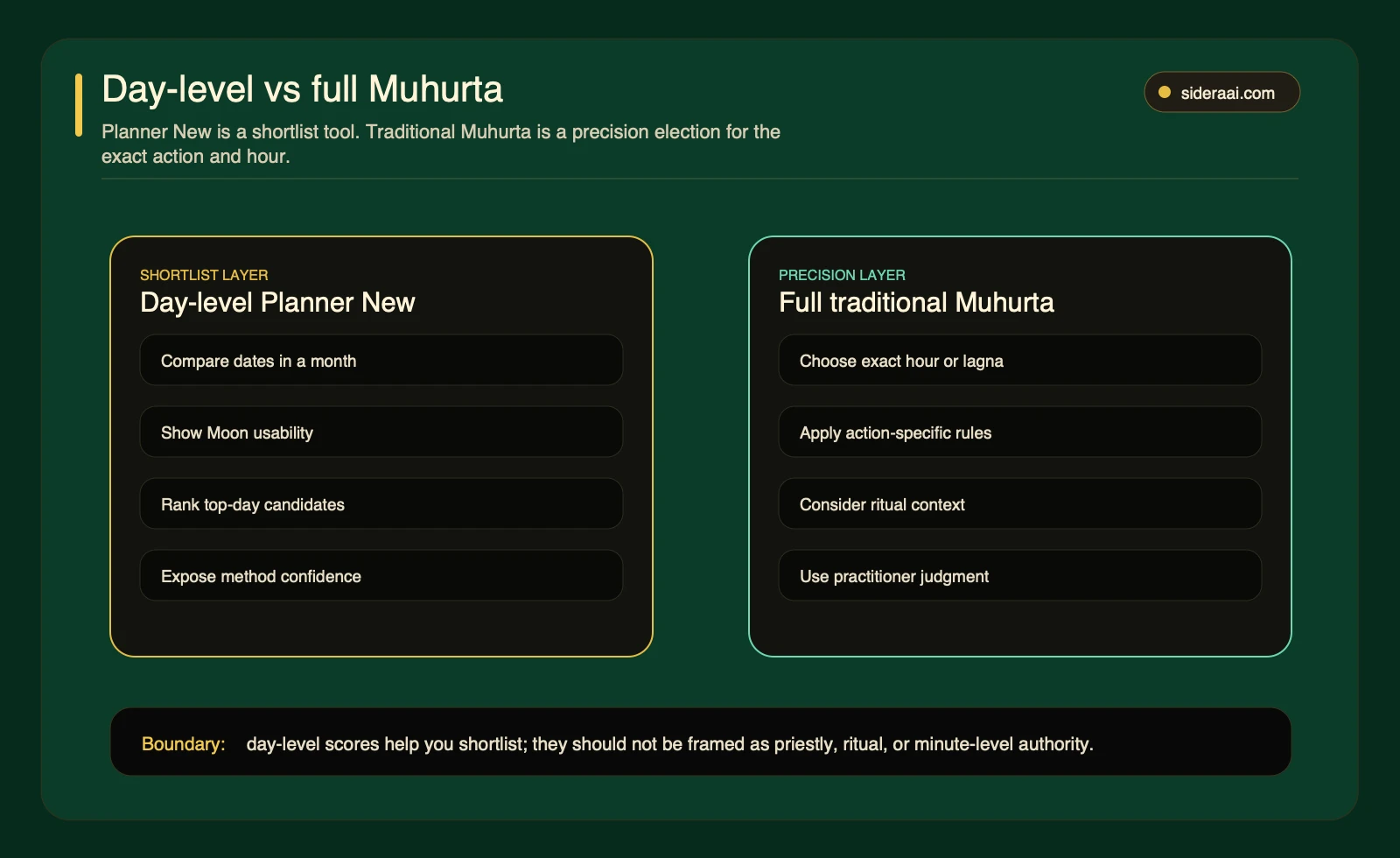
Lucky Day Planner is best used as a shortlist layer. Full Muhurta is the precision layer when exact hour, ritual context, and practitioner judgment matter.
A day-level Muhurta score is a shortlist tool. A full Muhurta election is a precision tool. Understanding the difference changes how much weight to put on any individual day’s number.
Reading the Top Days
The top-days view is where a Muhurta calendar becomes practical for most people. Inspecting every date in a month is exhausting. What most decisions actually need is a handful of usable candidates.
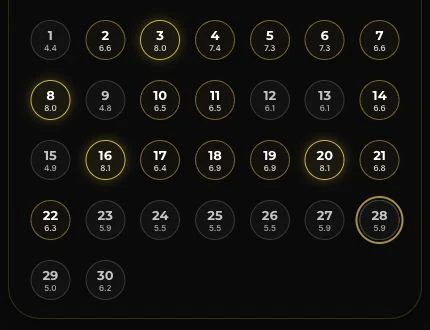
In the June 2026 screenshot profile, the top Jyotish candidates were:
- Tue, Jun 23: Moon usable – 6.8
- Mon, Jun 22: Moon usable – 6.0
- Thu, Jun 11: Moon usable – 4.4
The scores are not very high in this particular month. That matters. A well-designed planning tool should not invent confidence because the user wants a perfect answer. Sometimes a month is genuinely mixed, and the right move is to choose the least frictional date within real constraints – not to hold out for a score the calendar cannot offer.
Top days work best as a first filter, not a final decision. After identifying two or three candidates, check each for Moon usability, then look at your actual logistics. The timing and the readiness need to arrive together.
Using Muhurta for Starting Work
The search for “best muhurta for starting work” can mean a new job, a business opening, a studio day, a project sprint, a public launch, or a first conversation with a new client. Each of those carries different timing weight.
A practical sequence:
- Define what kind of beginning this is. Is it legal, public, operational, relational, or symbolic?
- Remove obvious conflicts first. Do not choose a date your team, family, legal process, or market cannot support regardless of timing score.
- Check the Muhurta tab for stronger and weaker days.
- Look at Moon usability alongside the day score – not just one or the other.
- Compare Western timing if the action benefits from an electional perspective.
- Choose the best realistic date, not the imaginary perfect one.
- Log the day afterward and note what actually happened.
For work and business timing, also compare best day to start a new job, best day for a job interview, and when to negotiate salary.
Common Mistakes When Using a Muhurta Calculator
The biggest mistake is treating method confidence as prediction confidence. An 80% method confidence label means the tool has enough data coverage to show the signal. It does not mean there is an 80% chance your action succeeds.
The second mistake is using a timing score to outsource responsibility. If the plan is not ready, a favorable day cannot make it ready. If the date is fixed, a cautious score does not mean the action is forbidden; it means the beginning deserves more preparation, smaller first steps, or cleaner communication.
The third mistake is reading one number in isolation. In the Sidera screenshots, the useful answer comes from the score, Moon usability, top-days shortlist, and day log together. That is why the combined planning view is more useful than a static “good day / bad day” list.
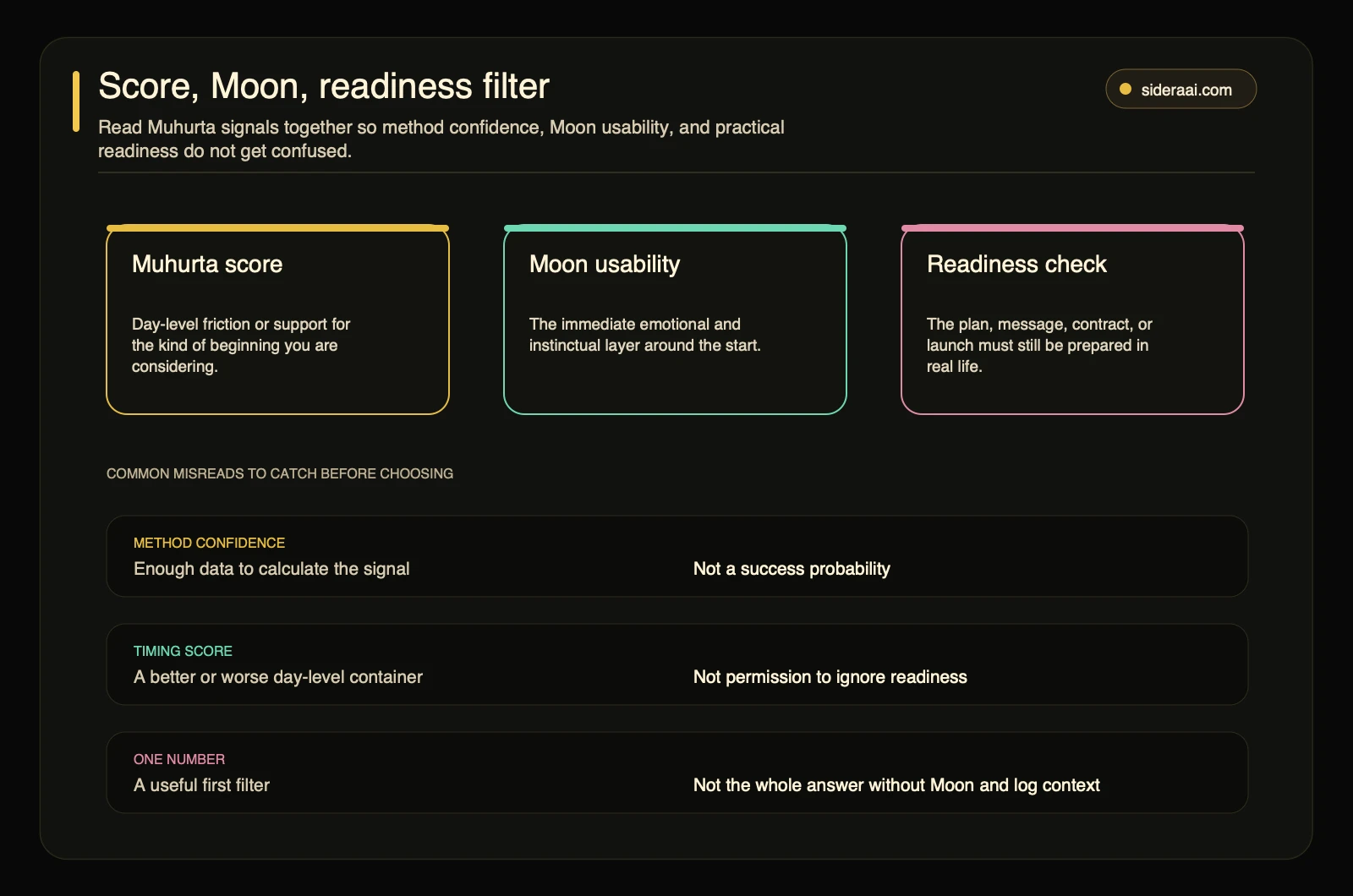
Read the score, Moon signal, and readiness check together. Method confidence is calculation coverage, not a success probability.
The Day Log as Personal Timing Mirror
The day log in Lucky Day Planner is where Muhurta stops being abstract and starts being about your specific rhythm.
After a cautious day: did it actually feel frictional? After a high-scoring day: did things feel noticeably easier? When Moon usability was marked limited, did you notice more emotional reactivity or second-guessing than usual? When it was marked usable, did your attention feel more settled?
No timing system arrives with perfect individual calibration out of the box. Over weeks and months, logging your actual experience alongside the day scores reveals which signals map most closely to how you personally move through time. Some people find they are particularly sensitive to Moon usability. Others notice retrograde pressure more clearly. Others find the Vedic day score almost imperceptible day-to-day.
The day log is how you build a personal calibration instead of just following a generic number. It is also how timing self-observation becomes a real skill rather than a one-time check.

Recording what actually happened turns a generic score into a personal calibration built from repeated real-world outcomes.
What Sidera’s Muhurta Layer Does Not Claim
To use this system well, it helps to know what it is not:
- It is not a priestly ruling engine or a Panchang replacement.
- It does not expose hour-level lagna selection.
- It does not guarantee outcomes.
- It does not remove the need for practical readiness.
- Method confidence is not a probability that the day will go well.
- It should not be used as medical, legal, or financial advice.
Naming limits clearly is how a timing tool earns trust. Sidera’s Muhurta layer is a practical planning signal. It is useful in direct proportion to how honestly it is used – as one input in a larger decision, not as the decision itself.
For a side-by-side view of Jyotish, Western timing, and five calendar-based systems, use the Sidera astrology calendar comparison.
A better date can support a beginning. It cannot create the readiness the beginning still needs.