Moon phase manifestation is the practice of aligning your goals, intentions, and actions with the eight phases of the lunar cycle - using each phase’s distinct energy to plant, nurture, harvest, and release what you’re creating in your life.
If you have ever set a new moon intention, felt motivated for a few days, then lost the thread when life got complicated, you are not doing it wrong. That arc is the cycle. Moon phase manifestation is not about forcing a perfect mood onto every day. It is about knowing when to begin, when to act, when to face resistance, when to tell the truth, and when to stop pushing.
The Moon completes a full cycle in roughly 29.5 days, but the intervals between exact quarter phases are not identical. This guide uses exact ephemeris anchors for the calendar and treats the spiritual meanings as reflection prompts, not proof that the Moon causes a particular mood or outcome.
Current Cycle and Complete 2027 Calendar
As of September 2, 2026 at 12:00 UTC, the Moon is waning gibbous after the August 28 Full Moon. The next exact anchors are the Last Quarter on September 4 at 7:51 AM UTC, the New Moon on September 11 at 3:27 AM UTC, the First Quarter on September 18 at 8:44 PM UTC, and the Full Moon on September 26 at 4:49 PM UTC.
The generated panel also includes every New and Full Moon in 2027: 13 new moons, 12 full moons, and the eclipse markers attached to those events. This turns a generic eight-phase framework into a calendar that can be checked against exact dates and updated deterministically.
Current lunar cycle
At , Sidera measures the Moon as Waning Gibbous. The previous exact anchor was Full Moon on .
| Next anchor | Exact UTC | Tropical position | Moon distance |
|---|---|---|---|
| Last Quarter | 11.81° Gemini | 370401 km | |
| New Moon | 18.43° Virgo | 376650 km | |
| First Quarter | 25.95° Sagittarius | 404216 km | |
| Full Moon | 3.62° Aries | 379436 km | |
| Last Quarter | 10.36° Cancer | 370106 km | |
| New Moon | 17.36° Libra | 387639 km |
Every New and Full Moon in 2027
There are 13 New Moons and 12 Full Moons in 2027. August contains two New Moons; the calendar also contains 5 solar or lunar eclipses.
| Phase | Exact UTC | Tropical position | Distance | Eclipse |
|---|---|---|---|---|
| New Moon | 17.30° Capricorn | 406524 km | — | |
| Full Moon | 2.24° Leo | 357644 km | — | |
| New Moon | 17.63° Aquarius | 402712 km | Annular solar | |
| Full Moon | 2.09° Virgo | 363306 km | Penumbral lunar | |
| New Moon | 17.58° Pisces | 394345 km | — | |
| Full Moon | 1.59° Libra | 372527 km | — | |
| New Moon | 16.95° Aries | 383641 km | — | |
| Full Moon | 0.62° Scorpio | 383429 km | — | |
| New Moon | 15.71° Taurus | 372976 km | — | |
| Full Moon | 29.23° Scorpio | 393902 km | — | |
| New Moon | 13.97° Gemini | 364258 km | — | |
| Full Moon | 27.56° Sagittarius | 401952 km | — | |
| New Moon | 11.96° Cancer | 358803 km | — | |
| Full Moon | 25.81° Capricorn | 405979 km | Penumbral lunar | |
| New Moon | 9.92° Leo | 357384 km | Total solar | |
| Full Moon | 24.20° Aquarius | 405082 km | Penumbral lunar | |
| New Moon #2 | 8.10° Virgo | 360262 km | — | |
| Full Moon | 22.88° Pisces | 399355 km | — | |
| New Moon | 6.72° Libra | 367134 km | — | |
| Full Moon | 21.98° Aries | 389939 km | — | |
| New Moon | 5.90° Scorpio | 377029 km | — | |
| Full Moon | 21.52° Taurus | 378767 km | — | |
| New Moon | 5.65° Sagittarius | 388237 km | — | |
| Full Moon | 21.41° Gemini | 368142 km | — | |
| New Moon | 5.84° Capricorn | 398404 km | — |
Method: Quarter phases are exact roots of the geocentric tropical Moon–Sun longitude angle. Distances use the Swiss Ephemeris geocentric Moon distance. Eclipse maxima and contacts use Swiss Ephemeris eclipse routines. Activity comparisons use Sidera's general transit-only model at 12:00 UTC with the solved exact VOC boundary applied before ranking. Engine revision 3e710b8; generated 2026-09-02T12:00:00Z.
Why Manifest With the Moon?
Before diving into the phases, it’s worth understanding why the lunar cycle can be useful as a manifestation framework.
The Moon’s gravity is central to ocean tides, but that fact does not establish a reliable rule for personal energy, sleep, or behavior. The practical value here is the repeatable review cadence: an exact new moon, two quarter checkpoints, a full moon, and the next reset.
Beyond the physical, the lunar cycle provides something most goal-setting systems lack: a built-in rhythm of action and rest. Unlike linear productivity frameworks that push constant output, lunar manifestation alternates between expansion (waxing) and reflection (waning), mirroring how nature itself operates.
Here’s what makes lunar manifestation uniquely effective:
- Built-in deadlines. Each phase lasts roughly 3.5 days - forcing you to act, not just plan.
- Natural review cycles. Every 29.5 days, you get a full reset and reflection point.
- Emotional attunement. The waxing and waning mirrors natural energy fluctuations most people already feel.
The 8 Moon Phases and How to Manifest With Each
1. New Moon - Set Your Intentions
Duration: ~1–3 days | Energy: Fresh starts, planting seeds, quiet clarity
The new moon is the darkest night of the cycle - and the cleanest moment for setting intentions. The sky is blank, and so is your canvas.
What to do:
- Write down 1–3 specific intentions (not vague wishes - precise goals)
- Create a vision board or journal entry for this cycle
- Light a candle and sit in stillness for 10 minutes with your intention
- Check what sign the new moon falls in for additional focus (e.g., a new moon in Taurus = financial intentions)
Manifestation tip: Frame intentions as “I am” or “I choose” statements, not “I want” or “I hope.” The language signals commitment.
Want to track upcoming new moons? Check our guide to the February 2026 new moon for specific timing and sign details.
2. Waxing Crescent - Take the First Step
Duration: ~3.5 days | Energy: Courage, momentum, initial action
The first sliver of light appears. This phase is about doing something - however small - toward your intention. Doubt is normal here. Move anyway.
What to do:
- Take one concrete action toward your goal (send the email, research the opportunity, start the outline)
- Affirm your intentions out loud or in writing
- Begin gathering resources, tools, or information you’ll need
- Practice visualization - see yourself already living the outcome
Common mistake: Trying to do everything at once. The crescent is about the first step, not the whole staircase.
3. First Quarter Moon - Face the Challenge
Duration: ~3.5 days | Energy: Decision-making, obstacles, commitment
The half-moon marks a turning point. This is where resistance shows up - internal doubts, logistical hurdles, competing priorities. The first quarter asks: Are you committed to this?
What to do:
- Make a difficult decision you’ve been avoiding
- Problem-solve around obstacles instead of abandoning the goal
- Adjust your approach without changing your intention
- Journal about what’s blocking you and brainstorm solutions
Manifestation tip: Resistance at the first quarter is useful information, not automatic proof that you should quit or push harder. The exact anchor gives you a scheduled moment to identify the obstacle, check whether the goal still matters, and revise the method.
4. Waxing Gibbous - Refine and Trust
Duration: ~3.5 days | Energy: Patience, refinement, editing, trust the process
The moon is nearly full but not quite there. This is the editing phase - refine your work, adjust your methods, and practice patience. You’re close, but rushing will cost quality.
What to do:
- Review and improve what you’ve built so far
- Seek feedback from trusted sources
- Fine-tune details - this is the “polish” phase
- Practice gratitude for progress already made
- Release perfectionism (good enough to launch beats perfect but stuck)
5. Full Moon - Celebrate and Illuminate
Duration: ~1–3 days | Energy: Culmination, clarity, celebration, release
The full moon is the climax of the cycle. Intentions planted at the new moon now come into full light - you’ll see results, receive clarity, or understand what needs to change.
What to do:
- Celebrate what you’ve accomplished - no matter how small
- Release what isn’t working (write it down and symbolically burn or tear it up)
- Charge crystals, tools, or meaningful objects in moonlight
- Practice forgiveness - of yourself and others
- Do a full moon ritual or meditation
Pro tip: Full moons are emotionally intense. If things feel chaotic, that’s the illumination doing its work. Lean into clarity, not reaction.
Explore what specific full moons mean: our Snow Moon guide covers energies unique to each lunar event.
6. Waning Gibbous (Disseminating) - Share and Teach
Duration: ~3.5 days | Energy: Gratitude, sharing wisdom, giving back
The light begins to recede. This phase is about sharing what you’ve gained - insights, skills, lessons, or literal results. Generosity amplifies manifestation.
What to do:
- Share your knowledge or results with someone who could benefit
- Write about your experience (journal, blog, social post)
- Express gratitude - specifically and in detail
- Mentor or help someone on a similar path
- Begin gently winding down active effort
7. Last Quarter Moon - Release and Forgive
Duration: ~3.5 days | Energy: Letting go, clearing, forgiveness, closure
Another half-moon, but now the light is shrinking. The last quarter is for releasing - habits, beliefs, relationships, or patterns that no longer serve you.
What to do:
- Identify what you need to let go of to make space for new growth
- Clean your physical space (desk, closet, digital files)
- End conversations or situations that need closure
- Forgive yourself for anything that didn’t go as planned this cycle
- Review your original new moon intentions - what worked, what didn’t?
Manifestation tip: Releasing is an active, powerful act - not a passive “giving up.” You’re choosing what stays and what goes.
8. Waning Crescent (Balsamic Moon) - Rest and Surrender
Duration: ~3.5 days | Energy: Rest, surrender, reflection, preparation
The thinnest crescent before darkness returns. This is the most yin, receptive phase of the entire cycle. Rest isn’t optional here - it’s the work.
What to do:
- Rest. Seriously - cancel what you can, sleep more, slow down
- Meditate, take baths, spend time in nature
- Reflect on the entire cycle - journal about lessons learned
- Dream about what’s next (without forcing a plan yet)
- Prepare your new moon intention-setting space
For timing everyday decisions - like whether to schedule important meetings during this rest phase - electional astrology offers a framework for choosing auspicious dates.
Find your perfect moment with AI-powered electional astrology.
Discover your timing →Your Moon Phase Manifestation Cheat Sheet
| Moon Phase | Energy | Action | Duration |
|---|---|---|---|
| 🌑 New Moon | Beginnings | Set intentions | ~1–3 days |
| 🌒 Waxing Crescent | Momentum | Take first action | ~3.5 days |
| 🌓 First Quarter | Challenge | Commit and decide | ~3.5 days |
| 🌔 Waxing Gibbous | Refinement | Edit and trust | ~3.5 days |
| 🌕 Full Moon | Culmination | Celebrate and release | ~1–3 days |
| 🌖 Waning Gibbous | Gratitude | Share wisdom | ~3.5 days |
| 🌗 Last Quarter | Release | Let go and forgive | ~3.5 days |
| 🌘 Waning Crescent | Rest | Surrender and reflect | ~3.5 days |
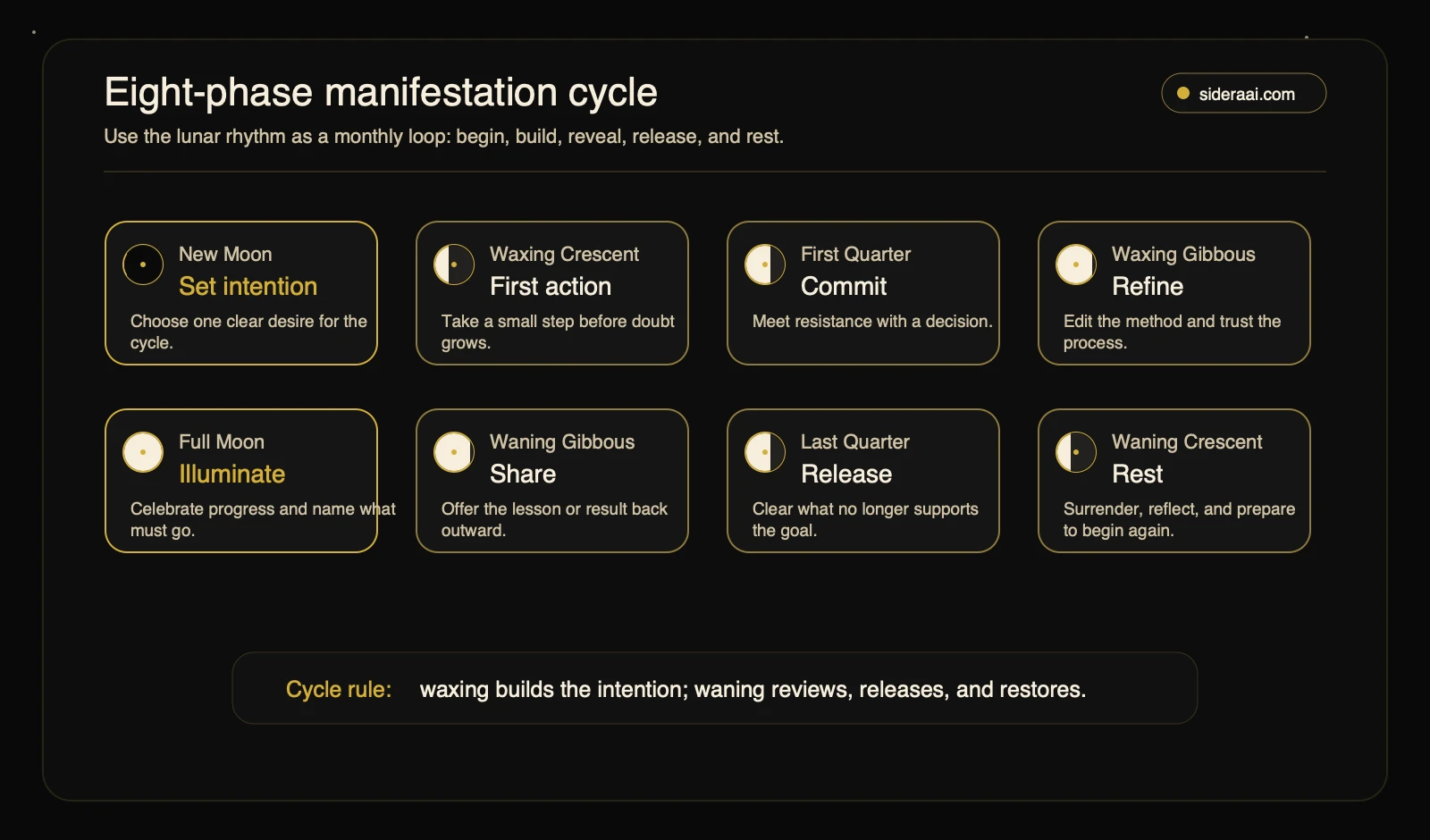
Use this cycle map to keep the practice moving from intention to action, review, release, and rest instead of treating manifestation as a single new-moon ritual.
How Sidereal Astrology Enhances Moon Phase Manifestation
Most mainstream manifestation guides use the tropical zodiac, whose zero point is tied to the March Equinox. Sidera also computes a sidereal position using its configured ayanamsa. These are two explicit reference frames; presenting the sidereal sign as the only “real” sign would be misleading.
Why this matters for manifestation:
- A declared sign lens. If the Moon is sidereal Taurus and tropical Gemini, choose the interpretive system before drawing conclusions instead of mixing the two labels.
- Exact void-of-course timing. Sidera solves the Moon’s last configured major aspect and the following sign ingress instead of assigning a whole day a generic warning.
- A natal-chart layer. The phase calendar is collective; a personal chart can add house and aspect context without changing the physical phase time.
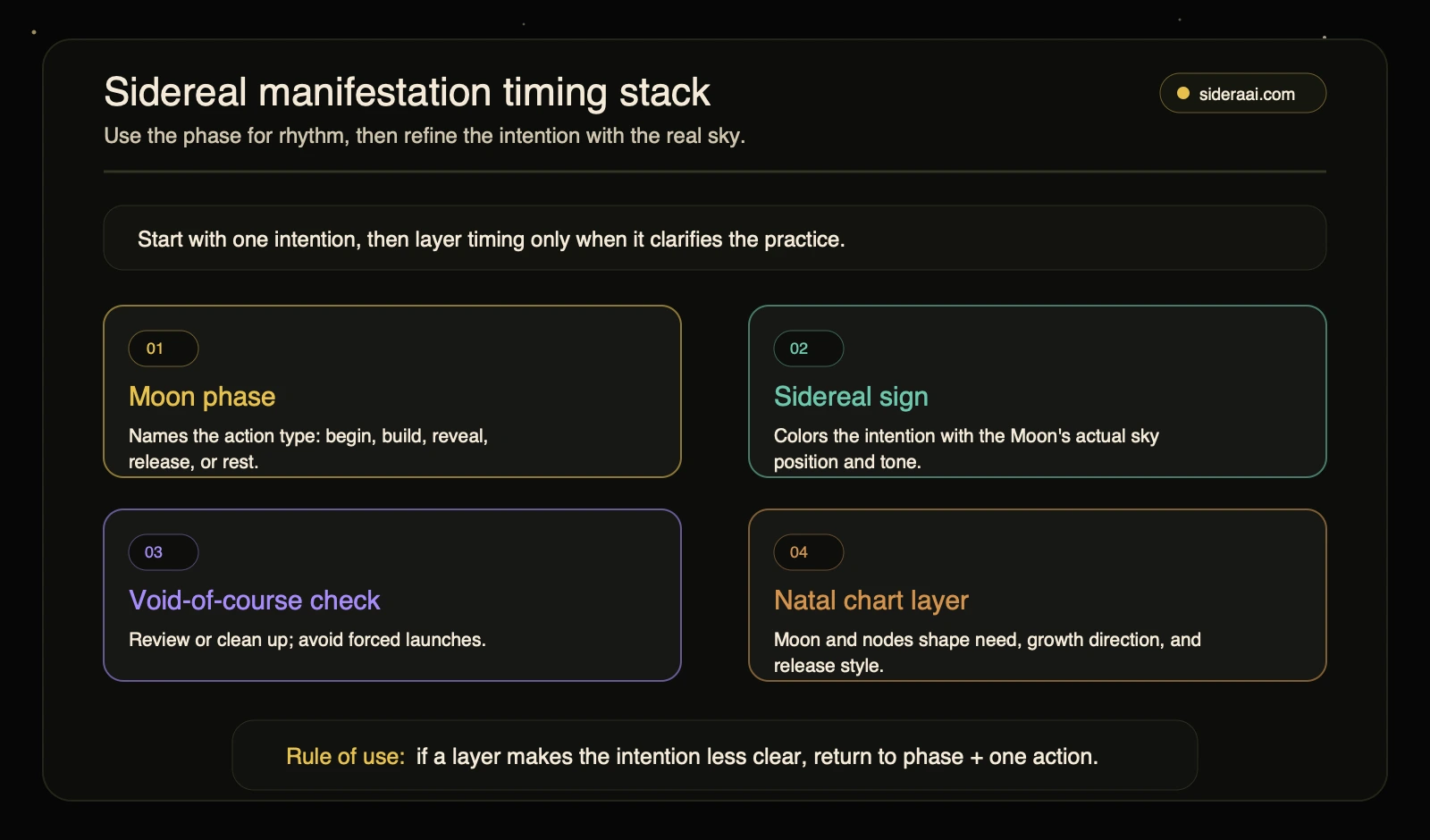
Use this stack when the lunar phase alone feels too broad: add sidereal sign, void-of-course timing, and natal chart context only when they make the intention clearer.
Track the current phase with Sidera’s daily horoscope, and keep the zodiac reference frame explicit when interpreting its sign.
Sidera uses your actual birth chart—not generic horoscopes.
Get personalized insights →5 Tips for Consistent Lunar Manifestation
1. Start with one cycle. Don’t commit to “doing this forever.” Commit to one 29.5-day cycle and see what happens.
2. Use a lunar calendar. Keep a physical or digital moon phase calendar visible. Awareness is the first step - you can’t align with a rhythm you don’t track. Even practical decisions like when to cut your hair by the Moon follow this same principle.
3. Journal every phase. Even one sentence per phase creates powerful continuity. After 3 cycles, you’ll see patterns in your own energy you never noticed before.
4. Don’t skip the waning phases. Use them for review and recovery because a complete practice needs both action and evaluation—not because the calendar can diagnose how much sleep your body needs.
5. Combine with your natal chart. The sign of your natal Moon tells you how you naturally process emotions and manifest. Someone with a sidereal Moon in Capricorn manifests through discipline and structure; a sidereal Moon in Pisces manifests through intuition and surrender.
How Moon Phase Manifestation Shows Up in Real Life
The point is not to outsource your choices to the Moon. It is to notice where you are in a cycle before you demand the wrong kind of energy from yourself.
For event-specific examples, compare Sidera’s February 2026 New Moon, May 2026 Blue Moon, and August 2026 lunar eclipse. Each page now combines the same phase framework with its own exact sign, distance, eclipse, VOC, activity-score, and 2027 comparison data.
In love and relationships: New moons are useful for naming what you actually want before resentment builds. Waxing phases support initiating the conversation, making the plan, or showing effort. Full moons reveal what cannot stay vague: unmet needs, recurring conflict, mixed signals, or the places where you perform ease instead of asking for honesty. Waning phases are for repair, apologies, boundaries, and releasing the old story you keep bringing into new dynamics.
At work: Use the new moon to choose one focus, the waxing crescent to send the first pitch or draft the first outline, and the first quarter to deal with resistance instead of calling it a sign to quit. Waxing gibbous is for revision. The full moon is for an honest results review. Waning phases are for cleanup: close the tabs, document what you learned, and drop the strategy that keeps draining you.
In conflict: The first quarter and full moon are pressure points. If you get reactive here, pause before sending the message. Ask, “Is this truth, urgency, or an old defense?” The last quarter supports saying the clean thing you were avoiding without trying to win the entire argument.
In self-image: The cycle exposes where you over-identify with productivity. Waxing phases can make you feel capable, full moons can make you feel seen or exposed, and waning phases can make you feel like you are falling behind. The better reflection is: “What phase am I in, and what would be an honest next step for this phase?”
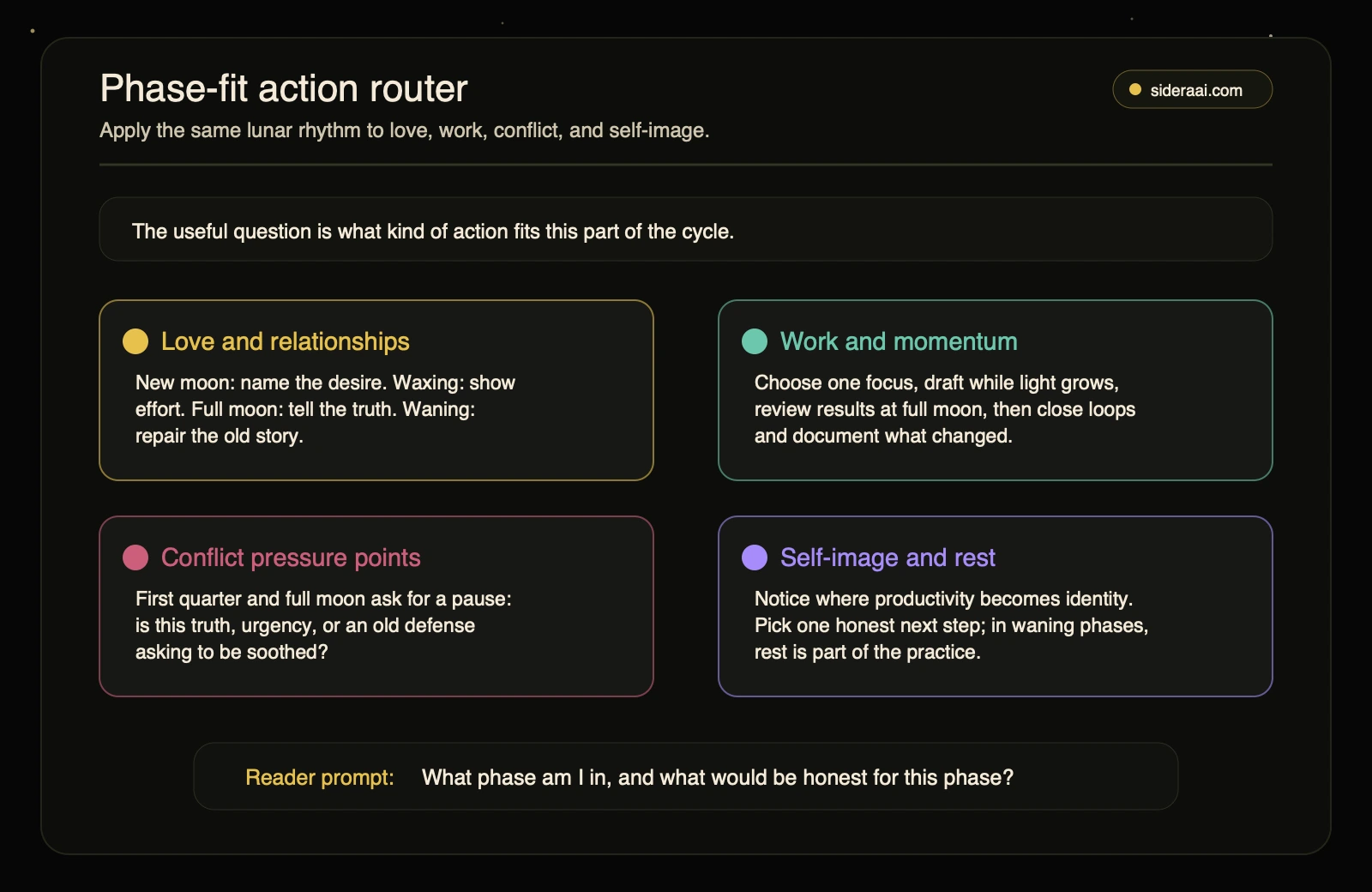
Use this router to turn the lunar cycle into a practical reflection prompt instead of demanding the same energy from every relationship, work, conflict, or self-image moment.
Understand your connections on a cosmic level.
Explore your bonds →Start Your First Moon Phase Manifestation Cycle
You don’t need crystals, candles, or any special equipment to start. All you need is:
- A journal (or phone notes app)
- A lunar calendar (Sidera shows you real-time Moon phases and transits)
- One clear intention
Write your intention at the next new moon. Follow the phases. Review at the full moon. Rest during the waning crescent. Repeat.
Your job is to notice the phase you are in, choose a fitting action, and review honestly before the next cycle starts.
Frequently Asked Questions
What is moon phase manifestation?
Moon phase manifestation is the practice of aligning your intentions, actions, and energy with the eight phases of the lunar cycle. Each phase has distinct energy, from the new moon’s fresh start energy for setting intentions to the full moon’s climactic energy for celebration and release. The 29.5-day lunar cycle provides a structured natural rhythm for intentional goal setting.
Which moon phase is best for manifesting new goals?
The new moon is the clearest phase for setting new intentions because its dark sky represents a blank slate and fresh beginning. Setting one to three specific intentions during the new moon and taking a first action during the waxing crescent phase that follows creates a stronger foundation than waiting for motivation to appear later.
What is the difference between waxing and waning moon phases?
Waxing moon phases are those where the moon grows from new to full, encompassing the new moon, waxing crescent, first quarter, and waxing gibbous. These phases support growth, action, and building momentum. Waning phases are when the moon shrinks from full back to new, including the waning gibbous, last quarter, and waning crescent, which support release, reflection, and letting go.
How long is one complete lunar cycle?
One complete lunar cycle lasts approximately 29.5 days, meaning the moon completes about 12 to 13 full cycles every year. Many lunar manifestation practitioners work with this rhythm by setting new intentions each month at the new moon, taking action through the waxing phases, celebrating at the full moon, and releasing during the waning phases.
What should I do during the full moon for manifestation?
During the full moon, focus on celebration, clarity, and release. Acknowledge what has manifested or progressed since the new moon, even if progress was small. Write down what you are ready to release or let go of. Gratitude practices, charging crystals in moonlight, or a release ceremony where you write and symbolically destroy what no longer serves you are all effective full moon practices.
Does the zodiac sign of each moon phase matter for manifestation?
Yes, each lunar phase occurs in a specific zodiac sign that changes the emotional focus of the phase. A new moon in Taurus, for example, favors intentions around financial stability and physical comfort. A full moon in Scorpio highlights intimacy, control, fear, and emotional honesty. Aligning your intention with the current moon sign makes the practice more specific.
Can moon phase manifestation be combined with other spiritual practices?
Yes, moon phase manifestation pairs naturally with journaling, meditation, crystal work, tarot readings, yoga, and conventional goal setting methods. The lunar cycle simply provides a timing structure and natural rhythm for any existing practice. The moon offers built-in deadlines through its phases, which many people find more motivating than arbitrary calendar milestones.
How do I know when the new moon and full moon occur each month?
You can track moon phases using a lunar calendar, an astrology app like Sidera, or simple web searches. Many practitioners keep a physical moon calendar visible as a daily reminder to stay in alignment with the lunar cycle. Awareness of where you are in the current cycle is the essential first step to effectively working with moon phase manifestation.
Related Sidera Guides
Continue with these closely related guides: