Introduction
If your Moon is in Gemini, feelings often arrive as thoughts first. You may know exactly how to explain what happened before you know whether you are hurt, angry, bored, or scared. The mind moves quickly because stillness can feel like being trapped with an emotion you have not named yet.
In real life, this can look like texting a friend mid-spiral, making a joke in the middle of a hard conversation, changing rooms when the mood gets too heavy, or researching a feeling until it seems manageable. You are not emotionless. You are trying to translate emotion into language fast enough that it does not overwhelm you.
In astrology, the Moon describes emotional needs, instincts, memory, and the private self. In Gemini, the Moon needs movement: conversation, questions, variety, and enough room to change its mind. This guide focuses on what that actually feels like in love, work, conflict, and self-image, not just the usual “curious and witty” keywords.
Sidera uses your actual birth chart—not generic horoscopes.
Get personalized insights →When the Transiting Moon Enters Gemini
The natal placement describes how you process feelings through language; the transit creates a short calendar window for everyone. Sidera compares each exact Gemini ingress with its Important Conversation model, then shows which 12:00 UTC sample led the other dates, how much pre-VOC time the window contained, and what the quality/intensity numbers add beyond a simple sign label.
| Moon in Gemini (UTC) | Before VOC | Best 12:00 UTC sample | Sidera score | What the comparison says |
|---|---|---|---|---|
| to | 44.9 hVOC 11.5% · last trine Venus | Waning Crescent · VOC | 4.6/5quality 7.4 · intensity 1.0 | At 12:00 UTC, 2026-09-05 ranked first of 3 sampled dates for having an important conversation: 4.6/5, quality 7.4, intensity 1.0, during Waning Crescent. The next sampled date scored 3.7/5. |
| to | 33.3 hVOC 34.1% · last sextile Jupiter | Waning Gibbous · VOC | 4.3/5quality 7.4 · intensity 9.4 | At 12:00 UTC, 2026-10-02 ranked first of 2 sampled dates for having an important conversation: 4.3/5, quality 7.4, intensity 9.4, during Waning Gibbous. The next sampled date scored 3.9/5. |
| to | 44.7 hVOC 8.9% · last trine Venus | Waning Gibbous | 4.4/5quality 8.3 · intensity 6.9 | At 12:00 UTC, 2026-10-29 ranked first of 2 sampled dates for having an important conversation: 4.4/5, quality 8.3, intensity 6.9, during Waning Gibbous. The next sampled date scored 4.4/5. |
| to | 42.2 hVOC 11.4% · last sextile Jupiter | Waning Gibbous | 4.9/5quality 7.5 · intensity 7.9 | At 12:00 UTC, 2026-11-25 ranked first of 2 sampled dates for having an important conversation: 4.9/5, quality 7.5, intensity 7.9, during Waning Gibbous. The next sampled date scored 3.8/5. |
| to | 42.6 hVOC 10.4% · last sextile Jupiter | Waxing Gibbous | 5.0/5quality 9.2 · intensity 6.4 | At 12:00 UTC, 2026-12-22 ranked first of 2 sampled dates for having an important conversation: 5.0/5, quality 9.2, intensity 6.4, during Waxing Gibbous. The next sampled date scored 5.0/5. |
Gemini Moon across all of 2027
The engine found 13 complete ingress windows beginning in 2027, totaling 659.8 hours. The average window lasts 50.8 hours; the average pre-VOC segment is 44.2 hours, with 12.8% of each window VOC on average.
How to read this: ingress and VOC times are exact tropical geocentric calculations; the activity comparison samples each calendar date at 12:00 UTC. It is a general planning layer, not a reading of your natal Moon and not a substitute for medical, financial, legal, or safety constraints. Each transit window runs from one exact tropical Moon ingress to the next. The exporter solves the last major aspect and reports the pre-VOC hours. It then compares every 12:00 UTC calendar sample inside the window with one matching Sidera activity model, replacing the engine's approximate day-sample VOC flag with the solved exact boundary before ranking. Results are general, not natal. Engine revision 3e710b8; generated 2026-09-02T12:00:00Z.
Core Traits of Moon in Gemini
The Mental Processor
Your emotions don’t just happen - they’re analyzed, verbalized, and intellectualized. When something upsets you, your first instinct is to talk it out, journal about it, or read something to make sense of it. Sitting silently with heavy feelings? That’s your personal hell.
You need to understand your emotions before you can feel them. This can make you seem detached or overly rational, but really, you’re just wired to process through your mind first.
The Conversational Connector
You feel most emotionally nourished when you’re having stimulating conversations. Small talk bores you, but a late-night discussion about philosophy, current events, or someone’s weird dream? That’s where you come alive.
Emotional connection, for you, often happens through shared ideas rather than shared silence. You bond by exchanging thoughts, not just feelings. If someone can ask better questions, follow your mental leaps, and make space for your contradictions, you feel seen.
The Variety Seeker
Routine kills your soul. You need constant mental stimulation - new books, new people, new experiences. Staying in the same emotional state for too long feels suffocating. You’re not flaky; you’re just emotionally sustained by novelty.
This can make you seem scattered or inconsistent, but it’s how you stay emotionally balanced. When you’re bored, you’re anxious.
The Quick Adapter
Your emotional flexibility is a superpower. You can shift moods quickly, bounce back from disappointment, and adjust to change faster than most. What others see as emotional instability is actually your ability to process and move on.
You don’t dwell. You adapt, pivot, and find the next interesting thing to focus on.
The catch is that speed is not the same as closure. Sometimes you move on because you truly understood the feeling. Other times, you moved on because a new thought gave you an exit ramp.
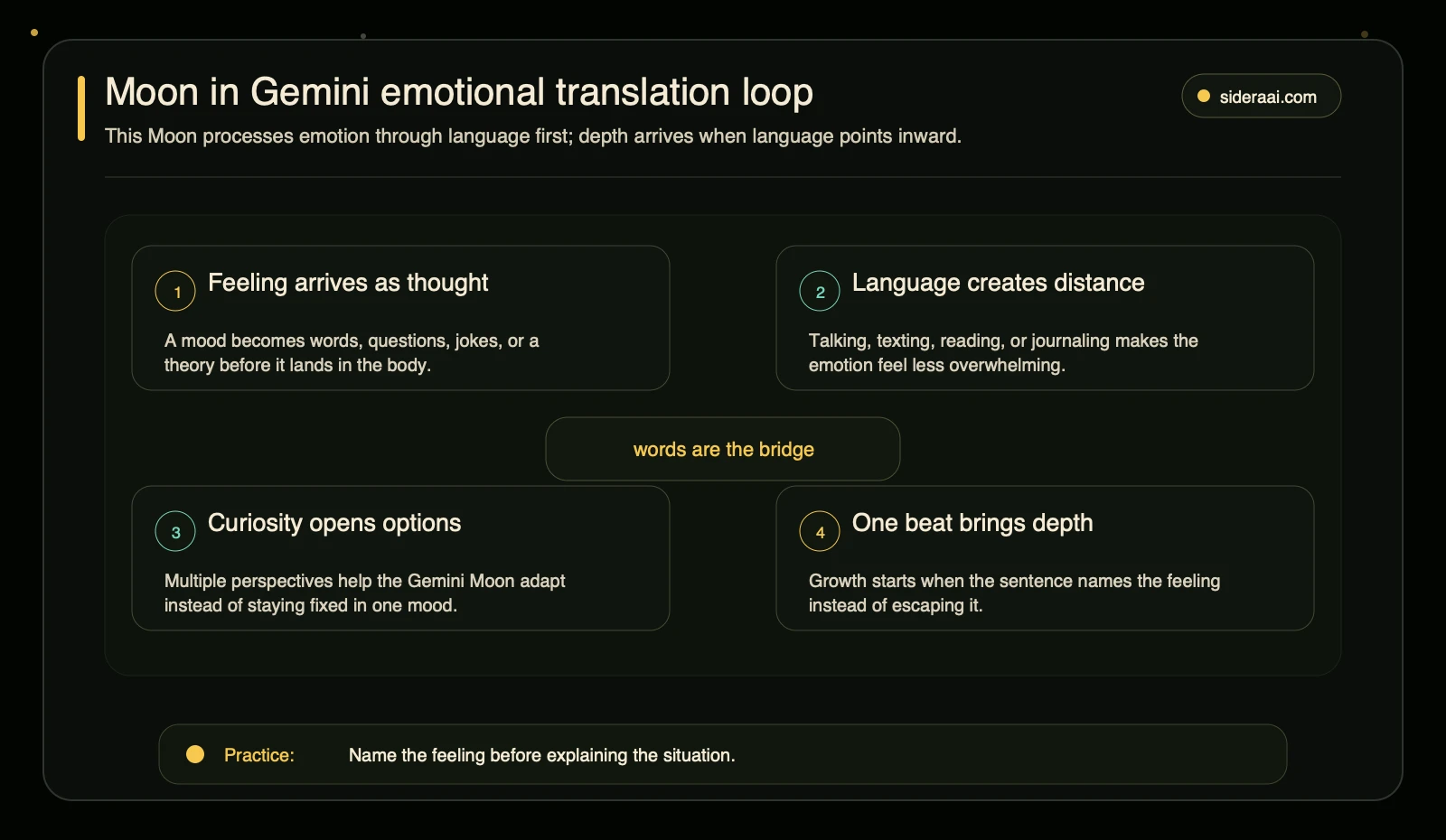
Use the emotional translation loop to see when language helps you process a feeling and when it becomes an exit ramp away from the feeling.
Mercury’s Influence: The Emotional Messenger
Gemini is ruled by Mercury, the planet of communication, intellect, and information exchange. This planetary influence shapes how you experience and express emotions in profound ways.
Mercury Makes You Emotionally Articulate
While some people struggle to name their feelings, you can describe emotional nuances with precision. You’re the friend who can put into words what everyone else is feeling but can’t express. This gift makes you an excellent mediator, therapist, or writer.
Mercury Speeds Up Your Emotional Processing
Just as Mercury is the fastest-moving planet, your emotional responses are quick. You rarely hold grudges because you’ve already analyzed the situation, understood it, and moved on. This rapid processing can confuse others who need more time to work through feelings.
Mercury Retrograde Hits You Harder
When Mercury goes retrograde (appearing to move backward), you might feel emotionally scattered, misunderstood, or unable to articulate what you’re experiencing. During these periods, journaling becomes especially important - it externalizes the mental chaos.
The useful question during Mercury-heavy periods is not “Why am I so scattered?” but “What conversation, decision, or assumption needs more precision than usual?” Gemini Moon steadies itself by naming the moving parts.
The Mercury-Moon Connection in Your Chart
Pay attention to where your Mercury is placed - it colors your Gemini Moon expression. Mercury in a fire sign (Aries, Leo, Sagittarius) makes you more passionate and direct with emotions. Mercury in an earth sign (Taurus, Virgo, Capricorn) grounds your mental processing with practical solutions. Mercury in another air sign (Libra, Aquarius) amplifies your intellectual approach. Mercury in a water sign (Cancer, Scorpio, Pisces) creates fascinating tension between mental analysis and emotional depth.
To explore how Mercury interacts with other planets in your chart, check out our planets in astrology guide.
Find your perfect moment with AI-powered electional astrology.
Discover your timing →Emotional Needs: What Makes You Feel Safe
To feel emotionally secure, Moon in Gemini needs:
1. Mental Stimulation
Boredom is your biggest emotional trigger. You need books, podcasts, conversations, puzzles - anything that keeps your mind engaged. When your brain is busy, your heart feels calm.
2. Freedom to Explore
Being locked into one way of thinking or feeling makes you anxious. You need the freedom to change your mind, explore different perspectives, and follow your curiosity wherever it leads.
3. Communication and Expression
You can’t just feel your feelings - you have to express them. Whether through talking, writing, or texting your thoughts to a friend at 2 AM, you need an outlet. Bottled-up emotions make you restless and irritable.
4. Variety and Novelty
Doing the same thing every day, even if it’s “good for you,” drains your emotional energy. You need spontaneity, new experiences, and the occasional plot twist to feel alive.
5. Social Interaction
You’re not necessarily an extrovert, but you are socially engaged. You need people to bounce ideas off, share observations with, and keep you mentally sharp. Isolation makes you anxious.
How Moon in Gemini Shows Up in Real Life
At Work
You do best when your work gives you changing inputs: people, ideas, problems, messages, data, stories, or decisions to untangle. You may thrive in writing, teaching, media, research, strategy, sales, counseling, social roles, or any job where communication is part of the craft.
The hard part is repetition without meaning. If a task feels boring, your mind starts looking for escape routes: a new tab, a new project, a new theory about why you should reorganize everything. Your best work rhythm usually includes variety on purpose, not chaos by accident.
In Conflict
Your instinct is to talk now, clarify now, and make the emotional weather less confusing as quickly as possible. You may ask a lot of questions, explain your side in detail, or turn the conflict into a debate because debate feels safer than raw vulnerability.
The shadow version is deflection: jokes, clever wording, changing the subject, or acting like you are “just curious” when you are actually hurt. A healthier move is simple and direct: “I need to talk this through, but I am also having a feeling I have not caught up with yet.”
In Self-Image
You may see yourself as adaptable, funny, hard to pin down, and good at reading a room. You may also privately worry that you are inconsistent, too scattered, or not as emotionally deep as people who feel things more slowly.
Gemini Moon depth is not always quiet or dramatic. Sometimes your depth is the exact question that opens the room, the sentence that names what everyone was circling, or the willingness to see three sides of a story before deciding what is true.
Relationships: Love Through Words
How You Love
You show love by sharing ideas, making your partner laugh, and keeping things interesting. Grand romantic gestures feel awkward, but a perfectly timed meme or a thoughtful article you found? That’s your love language.
You need a partner who can keep up mentally. If they can’t engage in interesting conversations or appreciate your wit, the spark fades fast. Mental chemistry is not a bonus for you; it is how emotional intimacy stays alive.
What You Need From a Partner
- Mental chemistry - Physical attraction fades fast if you can’t talk to them
- Independence - You need space to explore your interests and don’t want someone clingy
- Playfulness - Life is too short to take everything seriously
- Flexibility - You change your mind a lot, and you need someone who can roll with it
Your Best Moon Sign Matches
Libra Moon - Fellow air sign who values communication and intellectual connection. They match your need for social stimulation while bringing more emotional harmony. Check today’s Libra horoscope to see how this pairing might unfold.
Aquarius Moon - Another air Moon who respects your independence and shares your love of ideas. Together, you create a relationship based on friendship and mental exploration. See Aquarius daily insights for compatibility timing.
Aries Moon - Fire Moon energy keeps things exciting. They appreciate your quick mind and don’t take your need for space personally.
Leo Moon - Playful and expressive, they bring warmth to your intellectual approach. You entertain each other endlessly.
For a deeper dive into how different zodiac signs interact, check our comprehensive compatibility guide.
Challenging Moon Sign Pairings
Scorpio Moon - They need deep emotional intensity and can’t understand your light, analytical approach. Your need to talk through feelings clashes with their need to brood in silence.
Capricorn Moon - Too serious and traditional for your spontaneous nature. They want stability; you want variety.
Cancer Moon - They process emotions through nurturing and physical closeness, while you process through words and mental distance. Can work with effort, but requires understanding.
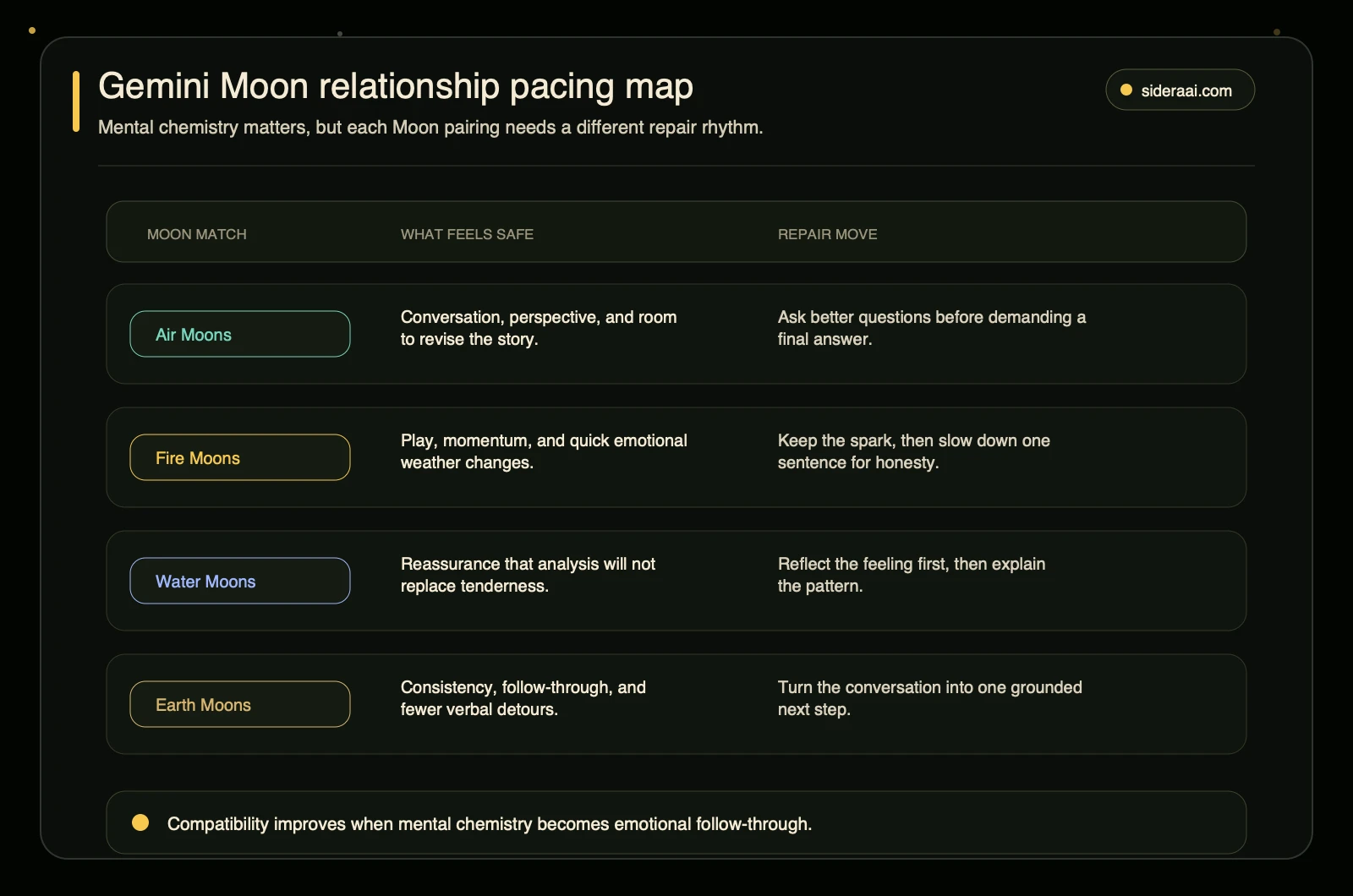
Use the relationship pacing map to translate mental chemistry into the repair rhythm each Moon pairing needs.
Gemini Moon as a Parent
As a parent, you shine at fostering curiosity and communication. You’re the parent who reads endlessly to your kids, encourages questions, and treats them like intelligent humans worthy of real conversations.
Your Parenting Strengths:
- You teach kids to articulate their feelings instead of acting out
- You expose them to diverse ideas, books, and experiences
- You make learning fun and never talk down to them
- You adapt quickly to their changing developmental needs
Your Parenting Challenges:
- Heavy emotional processing (tantrums, big feelings) can overwhelm you
- You might intellectualize their emotions instead of just sitting with them
- Routine-heavy phases (newborn stage) test your patience
- You struggle with kids who need quiet, solitary connection
The key is finding partners or support systems who can handle the heavy emotional moments while you excel at the verbal, educational, and playful aspects of parenting.
Understand your connections on a cosmic level.
Explore your bonds →Health & Wellness: Caring for Your Restless Mind
Your mental nature directly impacts your physical and emotional health. Understanding this connection helps you stay balanced.
Mental Health Patterns
Anxiety and Overstimulation
Your mind is constantly active, which can tip into anxiety when unchecked. You’re prone to racing thoughts, especially at night when there’s nothing to distract you. The pattern is usually easy to recognize: one small concern turns into five possible interpretations, three draft messages, and a mental replay of every relevant conversation.
Nervous System Dysregulation
Your quick emotional processing means your nervous system is in constant “on” mode. You jump between sympathetic (fight-or-flight) and parasympathetic (rest) states rapidly, which can be exhausting over time.
Attention and Focus Challenges
You’re not necessarily ADHD (though correlation exists), but you do struggle with sustained attention on boring tasks. Your brain is wired for variety, not repetition.
Physical Health Considerations
Respiratory System Sensitivity
Gemini rules the lungs, shoulders, arms, and nervous system. Stress often manifests as:
- Shallow breathing or feeling “out of breath” when anxious
- Tension in shoulders and neck from mental stress
- Susceptibility to respiratory infections when run down
Sleep Disruption
Your active mind makes quality sleep challenging. You’re the person whose brain suddenly solves problems at 3 AM or replays conversations from five years ago.
Wellness Practices for Gemini Moon
1. Breathwork and Pranayama
Since Gemini rules the lungs, conscious breathing practices are your superpower. Try:
- Box breathing (4-4-4-4 count) to calm racing thoughts
- Alternate nostril breathing to balance mental energy
- Deep belly breathing before sleep
2. Journaling for Mental Release
Your need to express emotions makes journaling essential. Stream-of-consciousness writing before bed can clear mental clutter and improve sleep quality.
3. Variety in Exercise
Forget the gym routine - you need varied movement. Try:
- Rock climbing (problem-solving + physical)
- Dance classes (constantly learning new choreography)
- Team sports (social + competitive)
- Yoga with different styles/teachers
4. Information Fasting
Ironically, you need regular breaks from your favorite thing: information. Schedule digital detoxes where you don’t consume news, podcasts, or social media. Your nervous system needs the rest.
5. Creative Expression
Writing, improv classes, stand-up comedy, podcasting - any outlet that combines communication with creativity helps you process emotions constructively.
6. Social Connection with Boundaries
You need people, but also solitude. Create “office hours” for social time and protect solo time fiercely. Quality friendships beat quantity for your emotional health.
The key lesson is that rest is not the same as boredom. Your mind needs quiet on purpose, especially when it has been fed too much information.
Strengths of Moon in Gemini
1. Emotional Intelligence Through Communication
You’re great at naming feelings, both yours and others’. You can articulate what people struggle to express. This makes you an excellent communicator in personal and professional settings.
2. Resilience and Adaptability
You bounce back quickly from setbacks because you don’t get stuck in one emotional state for long. While others ruminate, you’ve already analyzed, learned, and moved forward.
3. Curiosity About People
You’re genuinely interested in what makes people tick. You ask questions, listen actively, and remember details others overlook. This makes you an engaging conversationalist and trusted confidant.
4. Lightness and Humor
You don’t take yourself too seriously, which makes you fun to be around. You can defuse tense situations with wit and perspective. The strength is not avoiding seriousness; it is helping people breathe long enough to tell the truth.
5. Versatility
You can relate to many different types of people because you see multiple perspectives. This versatility helps in careers requiring communication and people skills, especially writing, teaching, media, counseling, sales, research, community work, and roles where the context changes often.
Challenges and Shadow Side
1. Emotional Avoidance
When feelings get too heavy, you distract yourself. You might explain the situation to three people, binge information, draft the perfect message, and still avoid the quiet minute where the feeling lands in your body. Watch for the moment when every sentence starts with “I know” and none start with “I feel.”
2. Inconsistency
Your moods and interests shift quickly. A plan that felt exciting on Tuesday can feel suffocating by Friday. Other people may experience this as mixed signals, especially if you change direction without telling them what changed internally.
3. Restlessness
You struggle to be present when bored. This can make it hard to stay with routines, relationships, or long-term goals after the novelty wears off. The shadow is not curiosity; it is using curiosity to avoid the discomfort of commitment.
4. Overthinking Emotions
You can analyze your feelings to the point where you disconnect from them. You may have a clear theory about your attachment patterns, family history, and communication style while still not knowing what you need in the next ten minutes.
5. Surface-Level Connection
Your fear of emotional heaviness can keep relationships at an intellectual level. You may let people know your opinions, stories, jokes, and observations while hiding the one sentence that would actually make you vulnerable: “This mattered to me.”
Sidereal vs Tropical: Is Your Moon Really in Gemini?
One critical factor many don’t realize: the zodiac system matters. Most Western astrology uses the tropical zodiac (based on seasons), while Vedic astrology and some modern astrologers use the sidereal zodiac (based on actual star positions).
Due to a phenomenon called axial precession, the tropical and sidereal zodiacs have drifted apart by about 24 degrees over the past 2,000 years. This means your Moon sign might be different depending on which system you use.
How to Check:
- Use a sidereal chart calculator with your exact birth time and location
- Compare results to tropical charts (most popular astrology apps use tropical)
- Read descriptions for both Moon signs and see which resonates more
Sidereal Moon in Gemini Dates (Approximate): If your tropical Moon is in late Gemini or early Cancer, your sidereal Moon is likely in Gemini. The exact dates shift slightly each year, but here’s a rough guide:
| Tropical Moon Sign | Sidereal Moon Sign (Likely) |
|---|---|
| Late Taurus (20-30°) | Early/Mid Gemini |
| Gemini (0-30°) | Gemini or Early Cancer |
| Early Cancer (0-10°) | Late Gemini |
Why This Matters: If you’ve always identified as a Cancer Moon but felt too mentally driven and emotionally detached, you might actually be a sidereal Gemini Moon. Conversely, if you’re tropical Gemini but relate more to emotional depth and nurturing, check if you’re sidereal Cancer.
At Sidera, we use the tropical zodiac – the Western system based on the seasons and solstice/equinox points. If you’ve run a tropical chart and your Moon lands in Gemini, that’s your Moon sign for the purposes of this guide. Sidereal charts (used in Vedic astrology) will show a different result, typically 23–24° earlier in the zodiac.
Want to check your Moon sign? Try our free birth chart calculator.
Practical Advice for Moon in Gemini
Name the Feeling Before You Fix It
Before you explain, research, text, or troubleshoot, pause and name the feeling in plain language: hurt, lonely, excited, ashamed, bored, jealous, afraid. This keeps your intelligence connected to the emotion instead of floating above it.
Give Boredom a Planned Outlet
Don’t guilt yourself for needing variety. Build it into your life intentionally so you don’t sabotage stability out of boredom. Rotate hobbies, change your routes, learn in seasons, and keep one or two anchors that stay consistent.
Use a Conflict Script
When you feel yourself turning a feeling into a debate, try: “I want to understand this, but I also need a minute to notice what I am feeling.” It gives your mind a job without letting it run the whole conversation.
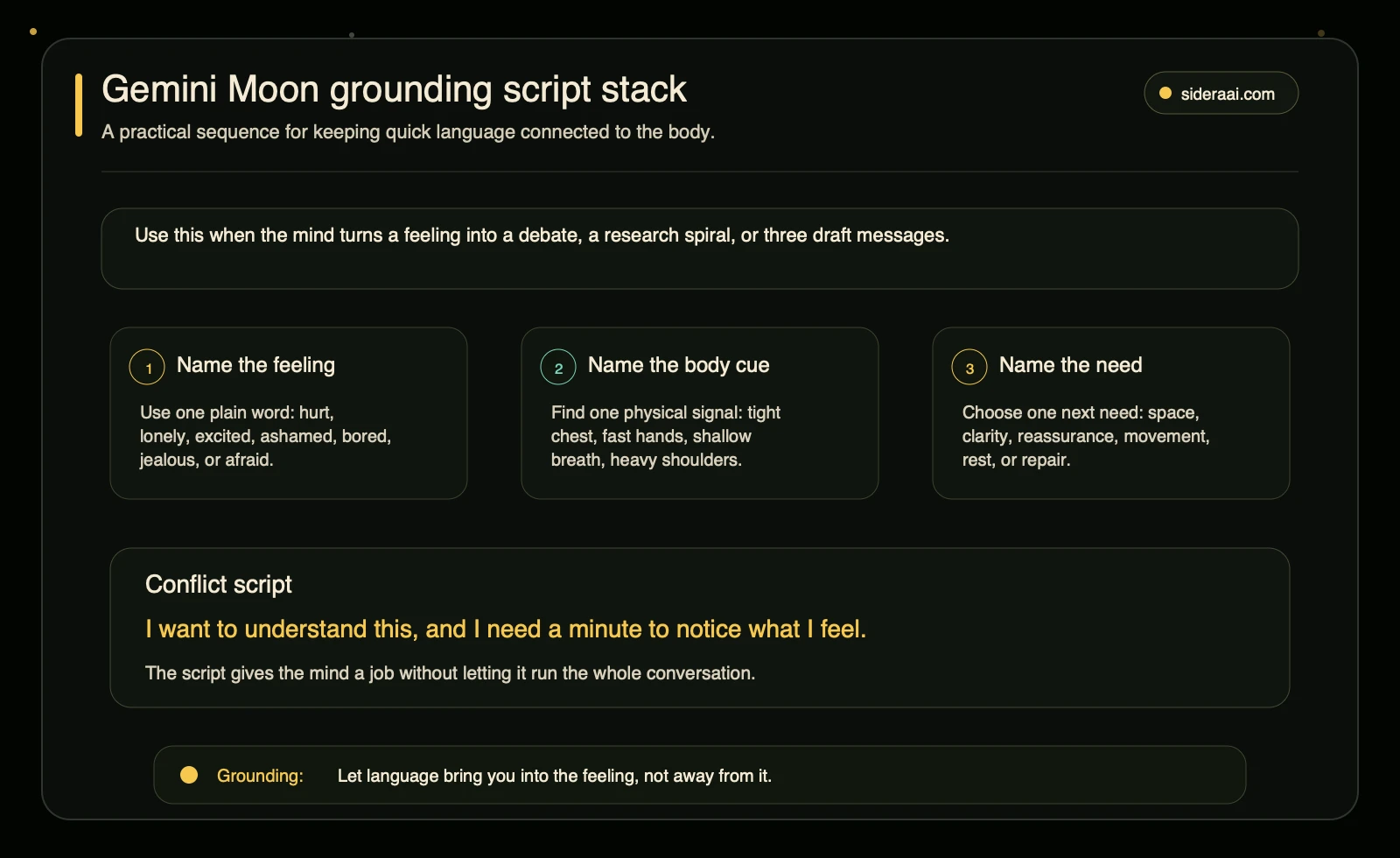
Use the grounding script stack when your mind starts debating a feeling before your body has caught up.
Find the Right Communication Outlets
Therapy, journaling, voice memos, or a trusted friend who lets you talk things out can all work. The point is not to talk endlessly; it is to talk until the real feeling becomes clear.
Choose Partners Who Understand Your Wiring
You’re not emotionally shallow - you’re just wired differently. Find people who appreciate your mental energy instead of trying to change it. Look for other air signs or fire Moons who match your pace.
Work With Mercury Retrograde, Not Against It
During Mercury retrograde periods (3-4 times per year), slow down. Journal more, clarify communication, and give yourself grace for feeling scattered. It’s temporary.
Distinguish Sun Gemini from Moon Gemini
If you have both Sun and Moon in Gemini, your need for mental stimulation is doubled. If only your Moon is in Gemini, your Sun sign shows how you express this energy outwardly.
Understand Your Full Emotional Picture
Your Moon sign is just one piece. Learn about your Sun, Moon, and Rising signs to understand how your emotional world (Moon) interacts with your identity (Sun) and how you’re perceived (Rising).
Ready to See Your Personal Birth Chart?
Discover your unique cosmic blueprint — planets, houses, and aspects personalized to your exact birth time and location.
Get Your Birth Chart →✓ Birth chart analysis ✓ Personalized insights ✓ Free to use
Frequently Asked Questions
What does Moon in Gemini mean in astrology?
Moon in Gemini means you process emotions through your intellect and communication. Your emotional needs center on mental stimulation, variety, and the freedom to explore ideas. You feel safe when you can talk through feelings and access new information.
Are Gemini Moons emotionally detached?
Not detached - differently engaged. You process emotions through analysis and verbalization, which can look like detachment to people who process through feeling and silence. You’re deeply emotional but express it through words and ideas rather than intensity or displays.
What is the difference between Sun in Gemini and Moon in Gemini?
Sun in Gemini is your core identity and how you express yourself to the world. Moon in Gemini is your emotional needs and instinctive responses. You can have one without the other. For example, a Cancer Sun with Gemini Moon would be nurturing and sensitive (Cancer) but process emotions mentally (Gemini Moon).
What are the best careers for Gemini Moon?
Careers involving communication, variety, and mental stimulation: writer, journalist, teacher, therapist, social media manager, podcaster, translator, researcher, sales, public relations, or any role requiring verbal skills and adaptability. You thrive in environments that change frequently and allow you to interact with diverse people.
What Moon signs are compatible with Gemini Moon?
Most compatible: Libra Moon (fellow air sign, values communication), Aquarius Moon (intellectual connection, respects independence), Aries Moon (exciting, mentally engaging), Leo Moon (playful, appreciates wit). Challenging: Scorpio Moon (too intense), Capricorn Moon (too serious), Cancer Moon (needs more emotional depth than you naturally give).
How does Mercury retrograde affect Gemini Moon?
Mercury retrograde can make you feel mentally foggy, emotionally scattered, or unable to articulate your feelings clearly. You might misunderstand others or feel misunderstood yourself. During these periods (3-4 times yearly), slow down communication, journal more, and give yourself grace. Your usual mental clarity will return when Mercury goes direct.
Moon in Gemini is not a lack of depth. It is an emotional life with a fast verbal nervous system. You bring curiosity, adaptability, and intellectual honesty to feelings that other people may only sense but never name.
Your growth edge is to let language bring you into the feeling, not away from it. Ask the question, write the sentence, make the joke if you need to - then stay one beat longer and notice what is underneath.
Check today’s Gemini horoscope to see how your quick-thinking Moon navigates today’s emotional currents.