Moon in the 9th house often feels like needing a reason before you can relax. You may handle distance, change, or unfamiliar places surprisingly well, yet feel unsettled when life seems meaningless, hypocritical, or too small for the person you are becoming.
Where other Moon placements seek security in what is close – home, relationships, daily structure – Moon in the 9th house reaches outward and upward. Philosophy provides the emotional container. Belief systems are not intellectual positions but felt anchors. When the meaning-making framework holds, the person feels held. When it is challenged, the emotional response is disproportionate to what the situation appears to warrant.
In love, this can look like needing a partner who keeps your world open. At work, it can look like losing morale when there is no mission, learning curve, or larger purpose. In conflict, it can look like arguing from principle when the immediate feeling is hurt, disappointment, or fear. In self-image, it can become the pressure to be the seeker, the teacher, or the person who should already know better.
Moon in the 9th house is the astrology of a person who processes life through why – and who cannot rest emotionally until the bigger picture makes sense.
Ready to See Your Personal Birth Chart?
Discover your unique cosmic blueprint — planets, houses, and aspects personalized to your exact birth time and location.
Get Your Birth Chart →✓ Birth chart analysis ✓ Personalized insights ✓ Free to use
What the 9th House Means in Astrology
The 9th house is the house of the higher mind: philosophy, religion, higher education, long-distance travel, foreign cultures, publishing, law, and the search for truth. Where the 3rd house (its opposite) deals with local information, everyday communication, and the facts of immediate experience, the 9th house seeks the universal principles beneath those facts.
Sagittarius and Jupiter in astrology naturally rule the 9th house. This imprints the space with a quality of expansion, optimism, and the instinct to move beyond what is already known. The 9th house does not want the familiar – it wants the horizon.
When a planet occupies the 9th house, it shapes not just how you think about philosophy but how you feel about meaning itself. Planets here color what the person believes the universe is fundamentally like, and whether they feel the cosmos is essentially friendly, hostile, or indifferent. To understand the full architecture of the 12 houses of astrology, each placement builds on the ones that precede it.
What Moon in the 9th House Means: Core Themes
Emotional Security Through Meaning and Philosophy
The Moon’s fundamental drive is security. In the 9th house, that drive attaches to the meaning-making function: to philosophical frameworks, belief systems, religious or spiritual traditions, and the sense that life adds up to something coherent.
This is not an abstract preference. For Moon in the 9th house, philosophy is the nervous system. Having a worldview that holds together is as emotionally necessary as having a roof over one’s head. When beliefs are intact and meaning is available, there is a felt sense of calm – an inner orientation that nothing in the environment can fully destabilize. When beliefs are shaken, the destabilization is visceral.
Research supports how structurally important meaning is to psychological functioning. A comprehensive review by Park (2010) in Psychological Bulletin, examining over 200 studies on meaning-making and coping, found that individuals who successfully reframed stressful or traumatic experiences within a coherent worldview showed significantly faster psychological recovery than those unable to access meaning-based frameworks. For Moon in the 9th house, this is not a coping strategy employed under pressure: it is the default architecture of the psyche.
This means that philosophical crises – the dark night of the soul, the loss of religious faith, the encounter with evidence that dismantles a long-held worldview – tend to be profoundly disorienting in a way that other people may not fully understand. It is not melodrama. The belief system was doing structural emotional work.
Astrologically, the important point is practical: if you have this placement, a belief crisis may not feel like a debate. It may feel like losing the map you use to regulate your emotional life. That is why advice like “just be open-minded” often misses the depth of what is happening.
The Mother as Philosophical Imprint
The Moon represents the mother in the natal chart, or more precisely, the quality of the early nurturing environment and the emotional blueprint it installed. In the 9th house, the mother figure tends to carry a philosophical, religious, idealistic, or culturally expansive quality.
She may have been deeply religious or spiritual, modeling faith as an emotional anchor. She may have been an intellectual, an educator, or someone who emphasized learning and the life of the mind as a source of security and pride. She may have been a traveler, or herself foreign, or from a markedly different cultural background – someone whose worldview expanded the child’s frame of reference simply by existing.
The imprint is not always comfortable. If the mother’s philosophy was rigid or dogmatic, Moon in the 9th house can produce an adult who either replicates that rigidity or spends considerable energy dismantling it. If she was scattered or idealistic to the point of impracticality, the child may have internalized an ambivalent relationship with beliefs: drawn to them for comfort, suspicious of their reliability.
Emotional Restlessness and the Need for Expansion
The 9th house is the house of horizons. The Moon here carries a restlessness that is fundamentally emotional in origin: familiar territory does not provide the feeling of safety. Expansion does.
This can express as a genuine love of travel, particularly to foreign countries or cultures that feel meaningfully different from the one the person was raised in. The encounter with difference is not unsettling – it is nourishing. Other perspectives, other cosmologies, other ways of organizing a life provide exactly the emotional nutrition Moon in the 9th house requires.
It can also express as a persistent drive toward education, not as a career strategy but as an emotional necessity. Learning – particularly in areas that address the big questions (philosophy, theology, anthropology, law, literature) – provides a felt sense of growth that is deeply comforting for this placement.
Research by Lyubomirsky, Sheldon & Schkade (2005) in the Review of General Psychology found that voluntary activities – including novel experiences, learning, and cultural exploration – account for approximately 40% of the variance in individual happiness levels, outpacing circumstantial life factors (which account for roughly 10%) in their contribution to sustained wellbeing. For Moon in the 9th house, the pull toward expansion is not optional self-improvement: it is the primary emotional maintenance strategy of the psyche.
The shadow is emotional restlessness that cannot settle: always looking for the next teacher, the next tradition, the next country, the next belief system – never inhabiting what has already been found long enough to actually integrate it.
Beliefs as Emotional Territory
Because the 9th house Moon’s emotional security is anchored in belief, the person tends to have a heightened emotional investment in their philosophical or religious positions. This is the placement most likely to take a disagreement about ideas personally – not out of intellectual arrogance but because the belief system is doing the work of an emotional container.
The scale of this phenomenon is measurable. A comprehensive review by Koenig, King & Carson (2012) published in the “Handbook of Religion and Health” – drawing on over 3,000 peer-reviewed studies – found that religious and spiritual belief was associated with positive mental health outcomes in approximately 79% of the research literature, making worldview coherence one of the most consistently replicated protective factors in psychology. The belief system, whatever its content, functions as a genuine psychological resource.
The paradox is that this Moon needs enough faith to feel safe and enough openness to keep learning. Too little structure becomes drift. Too much certainty becomes a fortress.
The shadow arc here is righteousness: the inability to tolerate perspectives that genuinely challenge the worldview, the tendency to preach, to convert, to meet disagreement with more volume rather than more curiosity. The gift, when developed, is genuine wisdom: the capacity to hold multiple perspectives with emotional equanimity, to encounter the unfamiliar without threat, and to revise beliefs in response to new experience without existential collapse.
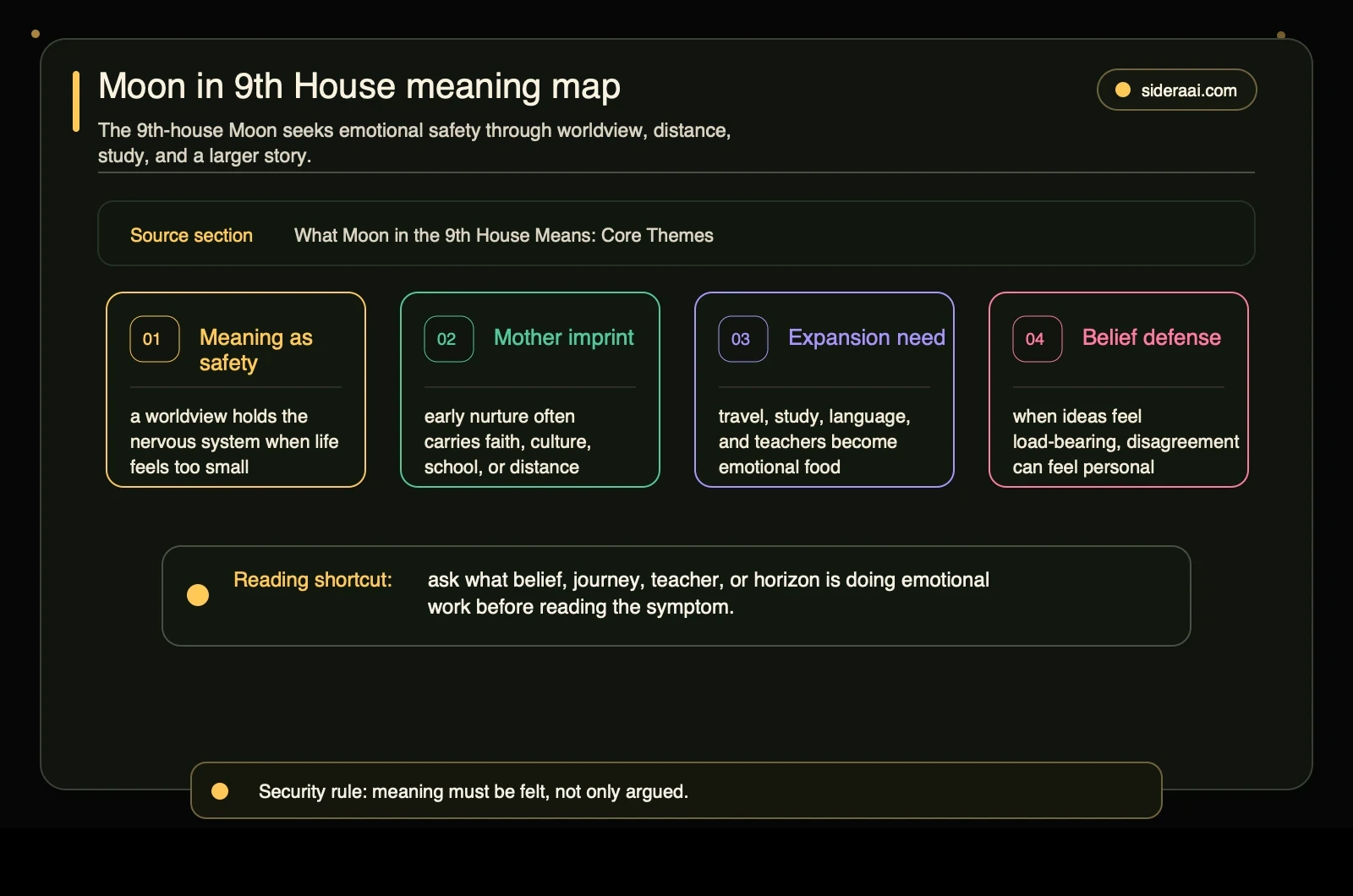
Read this placement by asking what belief, journey, teacher, or horizon is doing emotional work before interpreting the symptom.
How Moon in the 9th House Shows Up in Real Life
The useful reading of Moon in the 9th house is not just “travel, faith, philosophy.” It is the emotional habit of moving above the immediate situation so the pain, choice, or relationship can be placed inside a larger story.
In love: You need a relationship that keeps life open. This does not always mean travel or grand adventure; it can mean honest conversations, shared curiosity, moral growth, and room to become different over time. The shadow is mistaking normal relational limits for imprisonment. A partner may not be “holding you back” just because they need practical consistency, emotional presence, or a plan before the next leap.
At work: Motivation rises when the work has a mission, a learning curve, or contact with a larger world. Teaching, writing, law, research, publishing, coaching, travel, cultural work, and strategy can all fit this Moon when they give the person a sense of meaningful expansion. Repetitive work becomes hard when nobody can explain why it matters.
In conflict: This placement can turn a specific hurt into an argument about truth, ethics, or worldview. The question is not only “What do I believe?” but “What did I feel before I made this philosophical?” Naming the local emotion first keeps the conversation human.
In self-image: Moon in the 9th house often identifies as the seeker, the wise one, the teacher, or the person who sees the bigger picture. That can be a gift. It can also become pressure to interpret pain too quickly. Sometimes the next step is not a new theory. Sometimes it is admitting, plainly, “I am sad,” “I am scared,” or “I do not know yet.”
A practical reflection for this placement: am I expanding because this is genuinely true for me, or because staying present would make me feel ordinary, limited, or uncertain?
Sidera uses your actual birth chart—not generic horoscopes.
Get personalized insights →The 3rd/9th House Axis: Facts vs. Meaning
The 9th house does not exist in isolation. Its polarity is the 3rd house, the house of local communication, everyday information, siblings, and the thinking mind as a practical instrument.
Where the 3rd house gathers facts, the 9th house seeks the principles behind them. Where the 3rd house communicates within known territory, the 9th house broadcasts meaning across distance. The full picture of the 12 houses of astrology reveals how each axis creates a developmental arc: the 3rd/9th axis runs from local knowing to universal meaning, and back again.
The developmental arc for Moon in the 9th house moves from the global to the particular: the capacity to eventually bring the wisdom gained in the wider world back to the immediate, the specific, the close-at-hand. Moon in the 9th house people who are still in the early stages of this arc may be most comfortable in the abstract and most challenged by the particular – the philosophical framework lands easily, but applying it in a specific, messy, real relationship is where the difficulty lives.
The axis also highlights communication. The 3rd house Moon (its opposite) processes emotions through conversation, local connection, and immediate expression. Moon in the 9th processes through writing, teaching, publishing, or the inner monologue of meaning-making. When the 9th house Moon finds its voice across distance – through a book, a lecture, a cross-cultural encounter – it is doing exactly what the placement calls it to do.
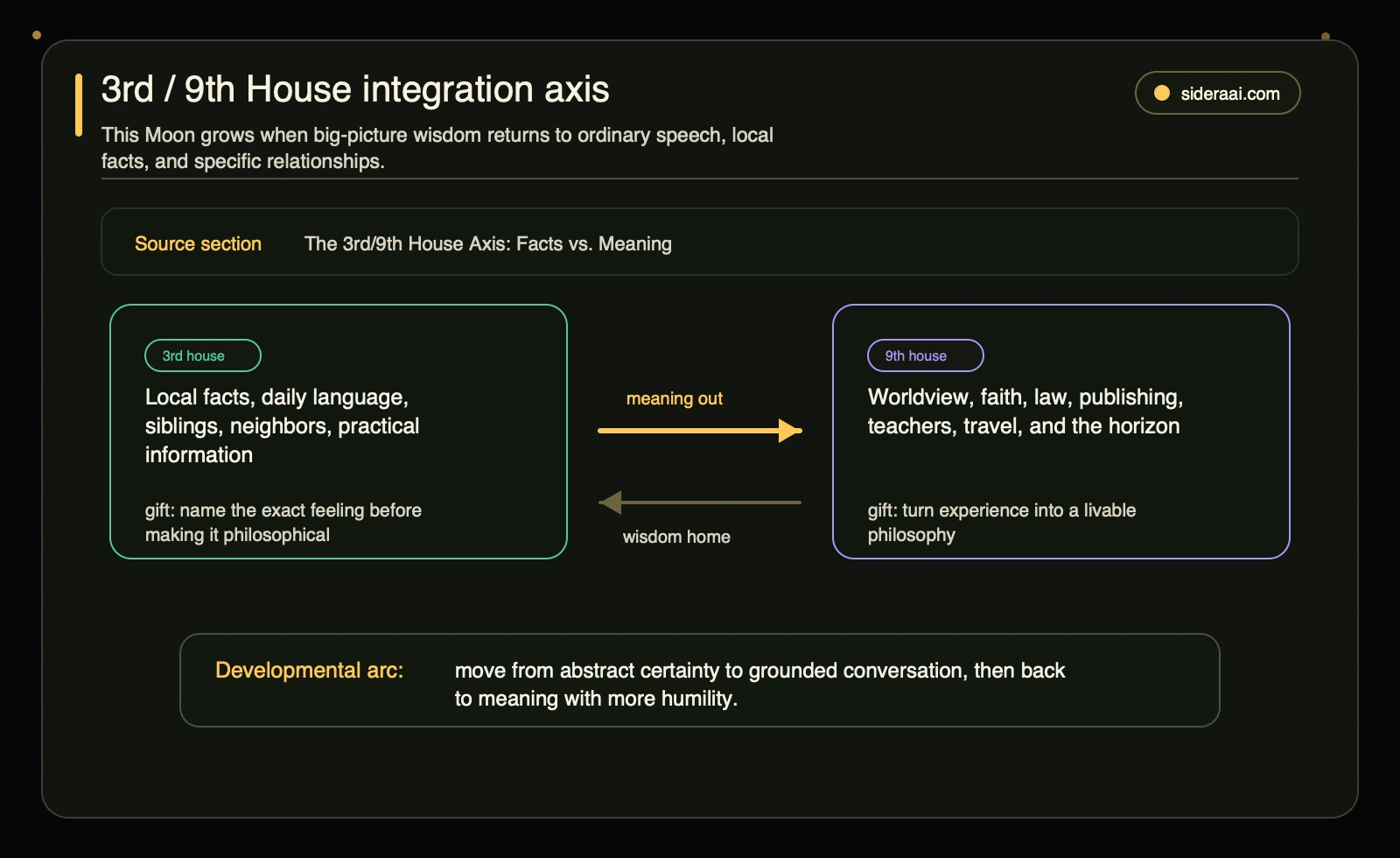
The axis shows the developmental task: send experience outward into meaning, then bring wisdom back into ordinary conversation and specific relationships.
Body Rulership: Hips, Thighs, Liver, and the Sciatic Nerve
In traditional medical astrology, the 9th house corresponds symbolically to the body regions governed by Sagittarius and Jupiter. This is not medical advice or diagnosis. For Moon in the 9th house, these correspondences can be used as reflective body cues rather than proof that a placement causes a physical condition.
The hips and thighs are the primary 9th house zone. These are the body’s literal locomotion structures – the physical architecture that enables movement into new territory. Symbolically, tension here can invite the question: where do I feel unable to move, explore, or choose a wider life?
The liver is Jupiter’s organ in traditional medical astrology, responsible for processing and filtering what the body takes in. The emotional parallel is useful: the psyche must process vast amounts of incoming experience, philosophy, and cultural input. If the person is consuming new ideas constantly without integration, the body may become a reminder to slow down and digest life more deliberately.
The sciatic nerve, running from the lower back through the hips and down through the legs, maps symbolically onto the experience of outward movement. In this framework, discomfort around movement can be used as a prompt to ask whether the drive to expand is blocked, pressured, or being ignored.
Emotional attunement to these body areas – movement practice, rest after intensive learning, and awareness of when the body feels braced against change – can serve as practical somatic reflection for this placement. For physical symptoms, use qualified medical care.
Moon in the 9th House: Dignity Table by Sign
The sign the Moon occupies shapes how the 9th house themes express emotionally. Below are all 12 placements, with dignity notes where they apply.
| Moon Sign | Dignity in 9th House | Emotional Expression |
|---|---|---|
| Aries | Neutral | Beliefs formed quickly, defended with passion. Comfort as a pioneer of thought or philosophical leader. Aries daily horoscope. |
| Taurus | Exalted | Practical, grounded philosophy. Security through traditions with material and sensory expression: ritual, ceremony, sacred landscape. |
| Gemini | Neutral | Multiple frameworks held simultaneously. Comfort in exploration itself more than fixed answers. Philosophy as conversation. |
| Cancer | Domicile | Emotional philosophy rooted in family, ancestry, cultural heritage. Faith traditions felt as ancestral connection. The homeland carries spiritual weight. Cancer daily horoscope. |
| Leo | Neutral | Generous, dramatic philosophical expression. Comfort in teaching, inspiring, or embodying a philosophy others can learn from. |
| Virgo | Neutral | Pragmatic approach to belief. Needs worldviews that are internally consistent and applicable to daily life. Comfort in analysis. |
| Libra | Neutral | Philosophy centered on justice, balance, and beauty. Comfort in traditions emphasizing harmony and aesthetic meaning. Law as a philosophical home. Libra daily horoscope. |
| Scorpio | Fall | Intense, private philosophical life. Drawn to esoteric systems and transformative dimensions of religion. The worldview must go all the way down. |
| Sagittarius | Neutral | Moon in the natural 9th house sign. Enthusiastic, optimistic orientation. Emotional nourishment through adventure and direct encounter with the foreign. Sagittarius daily horoscope. |
| Capricorn | Detriment | Practical, structured approach to belief. May resist faith as emotional resource. Finds comfort in frameworks that legitimize discipline and delayed reward. Capricorn daily horoscope. |
| Aquarius | Neutral | Progressive, collective philosophical orientation. Emotional comfort in humanitarian belief systems and contributing to the larger human project. |
| Pisces | Neutral | Mystical, compassionate philosophical life. Spiritual boundaries are porous. Security through transcendence, prayer, meditation, or creative spiritual practice. |
The Moon’s dignity in the 9th house is strongest in Cancer (domicile: maximum receptivity to nurturing and emotional attunement, applied to philosophy and ancestral wisdom) and Taurus (exalted: grounded, stable, sensory engagement with tradition). It is most challenged in Capricorn (detriment: the Capricorn drive toward practicality can dismiss the 9th house need for meaning as impractical) and Scorpio (fall: the intensity of Scorpio can make belief systems secretive or extreme, with difficulty finding philosophical peace).
Moon in the 9th House and the Nodal Axis
When the north node falls in the 9th house (with the south node in the 3rd), the soul’s evolutionary arc in this lifetime runs from local knowing toward universal meaning. The south node in the 3rd carries well-developed skills: facility with language, quick information processing, ease in everyday communication. These are genuine gifts from previous experience.
The north node in the 9th is the invitation to develop what is less comfortable: the capacity to synthesize facts into meaning, to develop a coherent philosophical framework, to seek teachers and traditions that offer something larger than what the immediate environment provides. This placement can show up as resistance to formal education or travel early in life, followed by a marked flourishing once those experiences are embraced.
When the south node falls in the 9th house (north node in the 3rd), the dynamic reverses. The soul carries strong philosophical resources – well-developed beliefs, comfort with abstraction, a natural orientation toward meaning – but may be over-relying on the grand framework at the expense of immediate, local engagement. The north node in the 3rd calls toward specificity: learning from what is immediately at hand, communicating directly rather than from a position of philosophical authority, finding meaning in the ordinary conversation.
For Moon in the 9th house in a birth chart, the nodal axis interaction deepens the meaning considerably. A Moon-north-node conjunction in the 9th house is one of the most significant indicators of a lifetime oriented around belief, philosophy, and the pursuit of wisdom as an emotional calling.
Moon in the 9th House in Synastry
In synastry, the 9th house Moon creates a distinctive relational dynamic around shared values, philosophical compatibility, and the emotional need for a partner who expands rather than contracts the person’s world.
9th house overlay: When one partner’s Moon falls in the other’s 9th house, the Moon person tends to naturally expand the house person’s philosophical world. Conversations go to big questions easily. The Moon person may feel like a gateway to a larger view of life. This is a deeply stimulating overlay for the 9th house person – they feel philosophically nourished in the relationship.
Moon conjunct Moon: Shared emotional wavelength. When both partners have Moon in the 9th (or Moon in compatible fire/mutable signs), there is an instinctive agreement about the importance of meaning, growth, and exploration. The relationship itself becomes a philosophical partnership.
Moon opposite Moon (3rd/9th axis): One partner is oriented toward facts, immediate communication, and local knowledge; the other toward meaning, principles, and broader frameworks. This creates genuine productive tension when navigated consciously – each partner offers what the other lacks. Without awareness, the 9th house Moon can experience the 3rd house partner as intellectually flat; the 3rd house Moon can experience the 9th house partner as grandiose or impractical.
Moon trine Jupiter: A naturally expansive and emotionally generous aspect. Jupiter’s optimism harmonizes with the Moon’s emotional needs, and the 9th house Moon’s native territory (Jupiter’s realm) is activated positively. This aspect often shows up in relationships where the partners genuinely encourage each other’s growth.
Moon square Saturn: Tension between the 9th house Moon’s need for expansive philosophical freedom and Saturn’s drive toward structure and limitation. The 9th house Moon may feel constrained by a Saturn partner’s caution about belief, travel, or formal learning. Over time, this can become productive: Saturn can help the 9th house Moon land and integrate what it has gathered.
Moon conjunct Jupiter: One of the most philosophically generous synastry aspects. The Jupiter person naturally amplifies the Moon person’s emotional world, and the 9th house Moon receives this amplification with particular gratitude. Risk is that excess optimism displaces honest emotional accountability.
Understand your connections on a cosmic level.
Explore your bonds →Vedic Astrology: Chandra in Dharma Bhava (9th House)
In Vedic astrology, the 9th house is called Dharma Bhava (the house of righteous duty) or Bhagya Bhava (the house of fortune and luck). It is considered one of the most auspicious houses in the chart (a member of the dharma trikona: 1st, 5th, 9th), governing dharma, higher learning, the guru relationship, long journeys, the father figure, and divine grace.
For the distinction between the western tropical chart system used by Sidera and the Vedic sidereal approach, see the sidereal vs tropical astrology breakdown. The two traditions read the sky differently, which is why your Moon sign in Sidera may differ from a Vedic chart.
Chandra in Dharma/Bhagya Bhava: The Moon (Chandra) in the 9th house in Vedic astrology is considered a powerful and generally auspicious placement. It confers a philosophical temperament, strong devotion, and a natural connection to the guru (spiritual teacher). The native tends to have a pious mother or a mother who shaped their early relationship to dharma, tradition, or spiritual practice.
The nakshatra (lunar mansion) the Moon occupies within the 9th house refines the expression considerably. In the Sagittarius section of the 9th house, the relevant nakshatras are Mula (0-13°20’ Sagittarius, ruled by Ketu: the root, dissolution, the foundation beneath the foundation), Purva Ashadha (13°20’-26°40’ Sagittarius, ruled by Venus: invincibility through purification), and Uttara Ashadha (26°40’ Sagittarius into Capricorn, ruled by the Sun: victory through dharma). Each nakshatra gives the Chandra-in-9th a different quality of philosophical pursuit.
Chandra Mahadasha (Moon period, 10 years): When a native with Chandra in the 9th house runs their Moon Mahadasha, the period tends to activate the 9th house themes: a strong draw toward higher learning, potential foreign residence or significant travel, deepening of philosophical or spiritual practice, and heightened emotional attunement to questions of meaning. The period can also bring a significant guru or teacher relationship. For what-is-sidereal context on how the Vedic timing system differs from western approaches, see the linked guide.
Shadow Arc: Righteousness, Restlessness, and the Preacher Problem
Every Moon placement has a shadow, and the 9th house Moon’s tends to organize around three patterns.
Righteousness: When beliefs are emotional containers, challenges to those beliefs feel like personal attacks. The response can be disproportionate, defensive, and dismissive. The shadow here is an inability to genuinely encounter a perspective that differs from the established worldview without collapsing it into a threat. The belief system that was meant to create openness – to make the world intelligible and safe – calcifies into a wall.
Restlessness without arrival: The 9th house hunger for expansion can become a pattern of perpetual seeking that never settles. A series of teachers, traditions, and geographical moves – each nourishing for a time, each abandoned before full integration – is the shadow version of genuine philosophical development. The developmental task is learning to stay long enough to go deep.
Preaching: The desire to share meaning can tip into the need to correct. The person becomes the bearer of truth that others need to receive, rather than a fellow traveler in the inquiry. The gift is teaching. The shadow is conversion. The distinction lies in whether the philosophical offering comes from genuine generosity or from the anxious need to have the worldview confirmed by others’ adoption of it.
The integration path for Moon in the 9th house runs through the 3rd house: the ability to bring philosophical insight back into ordinary conversation, to apply the wisdom in specific and immediate situations, and to listen as readily as it teaches.
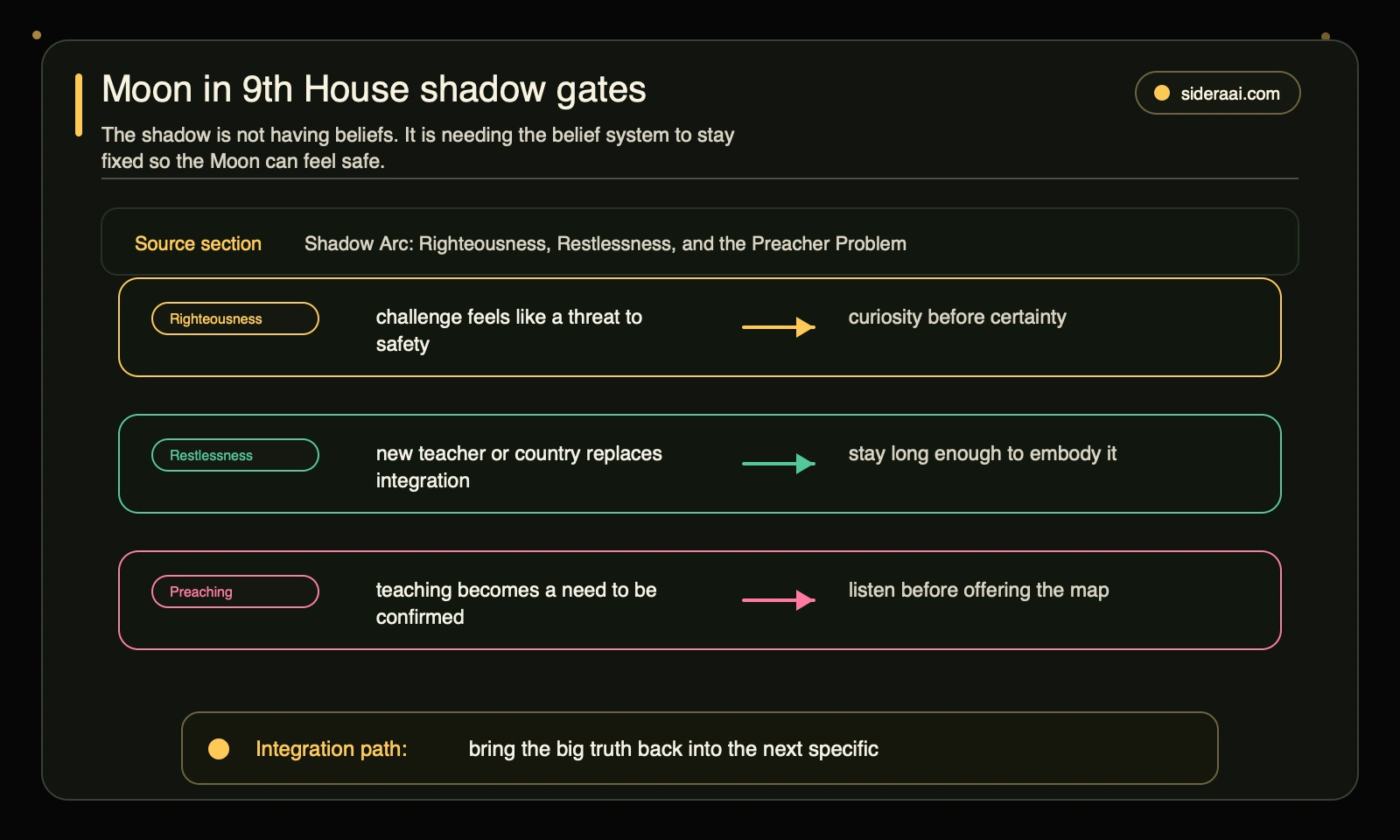
The shadow gate is not belief itself; it is needing the belief system to stay fixed so the Moon can feel safe.
For tools to work with the shadow dynamics specific to this placement, see the shadow work and astrology guide.
Frequently Asked Questions About Moon in the 9th House
Is Moon in the 9th house a good placement? It is a rich and active placement rather than an easy one. The emotional comfort zone is expansive, which means the person has access to genuine wisdom, curiosity, and philosophical resilience. The challenge is that the emotional need for meaning can become a vulnerability when beliefs are disrupted. On balance, this placement tends to produce people who are intellectually alive and emotionally generous when they have found their philosophical footing.
Why does Moon in the 9th house take beliefs so personally? Because the belief system is doing emotional work. For this Moon, philosophy is not an intellectual hobby but the nervous system’s organizing framework. A challenge to a belief is experienced as a destabilization of emotional security – not because the person is intellectually fragile but because the stakes are genuinely higher for them than they appear from the outside.
Does Moon in the 9th house always need to travel? Not necessarily in a literal sense. The 9th house need is for expansion – for encounter with what is genuinely different from what is already known. This can be satisfied through foreign language study, immersion in a philosophical tradition, intensive academic work, or close relationships with people from significantly different cultural backgrounds. Physical travel is one expression; philosophical travel is the deeper need.
What is the hardest challenge for Moon in the 9th house? Most people with this placement find the greatest challenge in the developmental arc back toward the 3rd house: the capacity to bring wisdom home. The philosophy lands easily in the abstract. The difficulty is applying it in the particular – in the specific, ordinary, sometimes mundane relationships and situations that constitute daily life. The 9th house Moon can become so comfortable with the universal that the immediate feels like a disappointment.
How does Moon in the 9th house affect close relationships? It creates a need for a partner (or close friends) who engage philosophically – who can discuss ideas at depth, who are curious about the world, and whose lives are oriented toward growth rather than stasis. A relationship that feels intellectually or spiritually contracting is experienced as emotionally depleting for this Moon. Conversely, a relationship that opens new ways of seeing is deeply nourishing.
What happens when Moon in the 9th house loses its beliefs? This is one of the most significant crises this placement can face. When the organizing philosophical framework collapses – through loss of religious faith, disillusionment with a teacher, or an experience that dismantles a long-held worldview – the emotional disorientation can be profound. The work is not to quickly replace the old belief with a new one (which often happens) but to tolerate the in-between space long enough to rebuild from a more honest foundation. See the shadow work guide for tools applicable to this kind of core-level belief reconstruction.
Can Moon in the 9th house lead to dogmatism? Yes, and it is one of the placement’s primary shadow risks. When the belief system is the emotional container, losing it feels like losing structural integrity. One common defense is doubling down – making the belief more rigid, more absolute, more resistant to revision. The antidote is developing what might be called philosophical security: the ability to hold beliefs as provisional frameworks rather than load-bearing walls, which requires enough emotional stability to survive the revision process.
Final Thoughts
Moon in the 9th house is one of the most intellectually and spiritually rich Moon placements in the natal chart. It produces people who think genuinely in terms of meaning, who find the philosophical question interesting in a felt rather than merely theoretical way, and who bring a quality of adventurousness to the inner life that other placements rarely match.
The work is in learning to hold beliefs with open hands – to let them provide emotional structure without requiring them to be permanent, and to recognize that wisdom gained across distance is only fully integrated when it can be brought home to the near and the ordinary. Use the birth chart calculator to see which sign your Moon occupies in the 9th, and explore your natal chart reading for the full picture of how this placement interacts with the rest of your chart.
When that integration happens, Moon in the 9th house becomes what it is at its best: the placement of the wise traveler, who has been to enough different worlds to stop being threatened by any single one – and who carries that worldly equanimity gently enough that it becomes, at last, a gift to share rather than a position to defend.