Introduction
The Moon in the 6th house is where emotional security is built one day at a time. The 6th house governs daily routines, health, work habits, service, and the body’s inner workings. With the Moon here, your emotional stability isn’t found in grand romantic gestures or peak experiences. It’s found in whether you ate well today, whether your workspace is organized, whether your body feels clean and cared for.
This is the house of Virgo and Mercury’s natural domain. The Moon here absorbs Virgo’s drive to order and refine, applying those impulses to the emotional realm. Your feelings move through the body and the schedule. Emotional distress often first manifests as physical symptoms: digestive disruption, sleep irregularity, restlessness, or an almost physical discomfort when your environment is chaotic.
The 6th house is also the house of service. You feel most emotionally grounded when you’re useful, when you have a clear function, when your daily actions contribute to something larger. The risk is conflating self-worth with productivity: feeling emotionally hollow on days when nothing gets done, or using work and caretaking as a substitute for deeper emotional engagement. To understand how this placement fits your full chart, start with a natal chart reading or use the birth chart calculator.
The 6th House Moon Personality
Routine as Emotional Anchor
Your nervous system is genuinely organized by structure. A consistent morning routine, regular mealtimes, a predictable weekly rhythm: these aren’t preferences or habits. They’re the scaffolding that holds your emotional life stable. When that scaffolding collapses (illness, travel, life disruption), you don’t just feel inconvenienced. You feel emotionally untethered in a way that can surprise people who don’t share this wiring.
This isn’t rigidity. It’s a legitimate emotional need. The Moon in astrology represents feelings, security, and the instinctive self. When it falls in the house of daily rhythm, wellbeing is housed in the ordinary. You process life through repetition. You find meaning in the details others overlook. The way your desk is arranged, the ritual of your morning coffee, the particular order in which you do things: these are how you feel safe.
Research supports what astrology has long described. A 2010 study by Phillippa Lally et al. in the European Journal of Social Psychology found that habit formation requires an average of 66 days (range: 18 to 254 days) of consistent repetition before a behavior becomes automatic. For the 6th house Moon, this isn’t a matter of willpower. The nervous system is literally building emotional infrastructure through repeated daily action, and disrupting that infrastructure has real psychological cost.
The challenge is when life inevitably disrupts routine. Learning emotional resilience when structure breaks down, without abandoning the structure entirely or spiraling into anxiety, is one of the core growth edges of this placement.
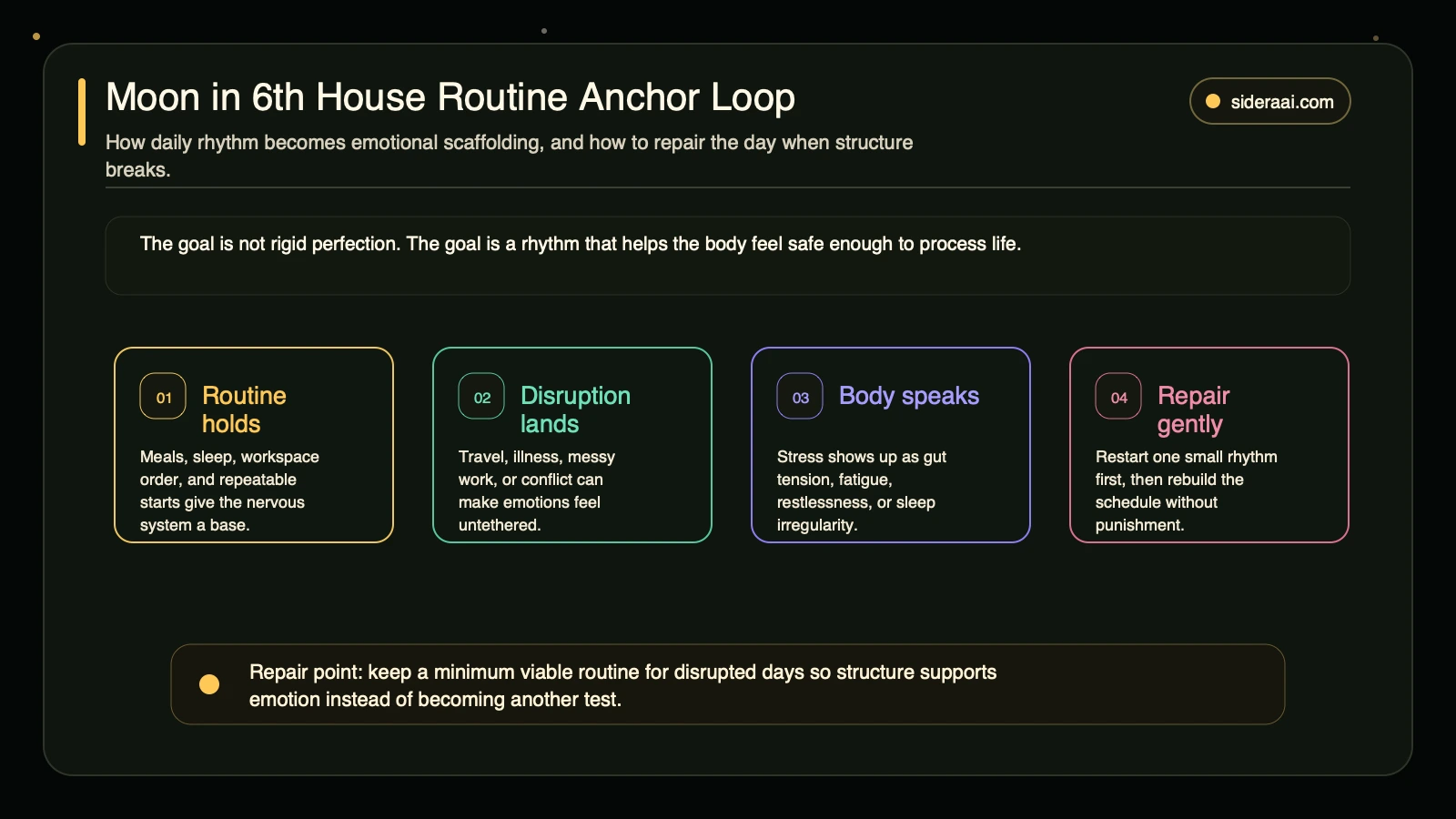
Use this loop to keep routine supportive instead of punitive: a disrupted day needs one small rhythm restored before the whole schedule is rebuilt.
The Body as Emotional Barometer
With the Moon in the 6th house, the body and emotions are unusually interconnected. Emotional states register in the body quickly and unmistakably: anxiety as stomach tension, overwhelm as fatigue, unprocessed feelings as persistent physical discomfort. You’re not imagining symptoms. You’re physically sensitive in ways that require listening.
Research has confirmed the biological reality of this connection. Psychoneuroimmunologist Janice Kiecolt-Glaser at Ohio State University demonstrated that emotional stress can slow wound healing by 24 to 40%, with couples in high-conflict interactions showing measurably slower tissue repair than those in supportive ones. The body is not separate from the emotional life. It is a direct readout of it.
This can manifest as health consciousness: awareness of diet, digestion, energy levels, and bodily patterns that others might ignore. At its best, this produces remarkable self-care and body attunement. At its most difficult, it can tip into health anxiety: monitoring symptoms obsessively, interpreting normal bodily variation as signs of illness, or using physical complaints as an indirect expression of emotional needs that haven’t found another outlet.
The Moon in the 6th house benefits deeply from body-based emotional practices: movement, breathwork, somatic therapy, time in nature. These aren’t indulgences. They’re maintenance. Your body is where your feelings live, and tending your body is how you tend your emotional life. The shadow work guide offers practices that address the emotional-body connection directly.
Work as Emotional Expression
The 6th house is the house of daily work: the ongoing tasks and routines that fill your days, distinct from the career and public identity of the 10th house. With the Moon here, work isn’t just what you do. It’s how you feel.
When work is meaningful and structured, you feel emotionally alive. When work is chaotic, pointless, or disconnected from your sense of usefulness, you feel emotionally flat or deeply unhappy in a way that’s hard to explain to others who don’t share this connection. You’re not being dramatic when a poorly organized workplace genuinely distresses you. That distress is real and structural.
You’re also likely to be a natural caretaker in work settings: the person who notices when colleagues are struggling, who maintains team morale through practical attention, who handles the details others overlook. Service as a love language shows up strongly here. You feel most emotionally connected through acts of practical usefulness, not just emotional expression.
Research on this pattern is compelling. A 2013 study in BMC Public Health by Okun et al. found that regular volunteering reduced depression risk by 28% in adults over 50, with structured, routine-based helping producing the strongest protective effect. For the 6th house Moon, service that is habitual (not just occasional) nourishes the emotional architecture in ways that episodic giving does not.
“Those with the Moon in the 6th house experience emotional security not through warmth or romance but through the sense of being needed in their immediate environment. The daily round of service is not servitude: it is the form through which their emotional life finds its deepest expression.” – Howard Sasportas, The Twelve Houses (1985)
Health and the 6th House Moon
The 6th house rules health in the natal chart, and the Moon here makes the emotional-physical connection explicit. Stress and unresolved emotion often express first through the body: particularly the digestive system (small intestine, assimilation), the nervous system (anxiety, sleep), and the areas associated with the Moon’s sign placement.
Emotional eating patterns can be pronounced: using food as comfort, regulating mood through dietary restriction, or digestive upset as a direct response to emotional stress. Paying attention to the relationship between emotional states and physical symptoms is not hypochondria. It’s accurate perception that, when understood correctly, becomes powerful self-knowledge.
“When the Moon falls in the 6th house, the emotional body and the physical body become inseparable partners. Illness often has its roots in feelings that have not found direct expression. What cannot be said will eventually be felt in the gut, the sleep, the daily ache of unacknowledged need.” – Liz Greene, The Luminaries (1992)
The 6th house Moon benefits from treating health as a daily practice rather than a crisis-response system. Regular routines around sleep, movement, nutrition, and stress management are genuinely protective. The nervous system is more sensitive than average; stimulant overload, sleep deprivation, and irregular eating affect this Moon placement acutely.
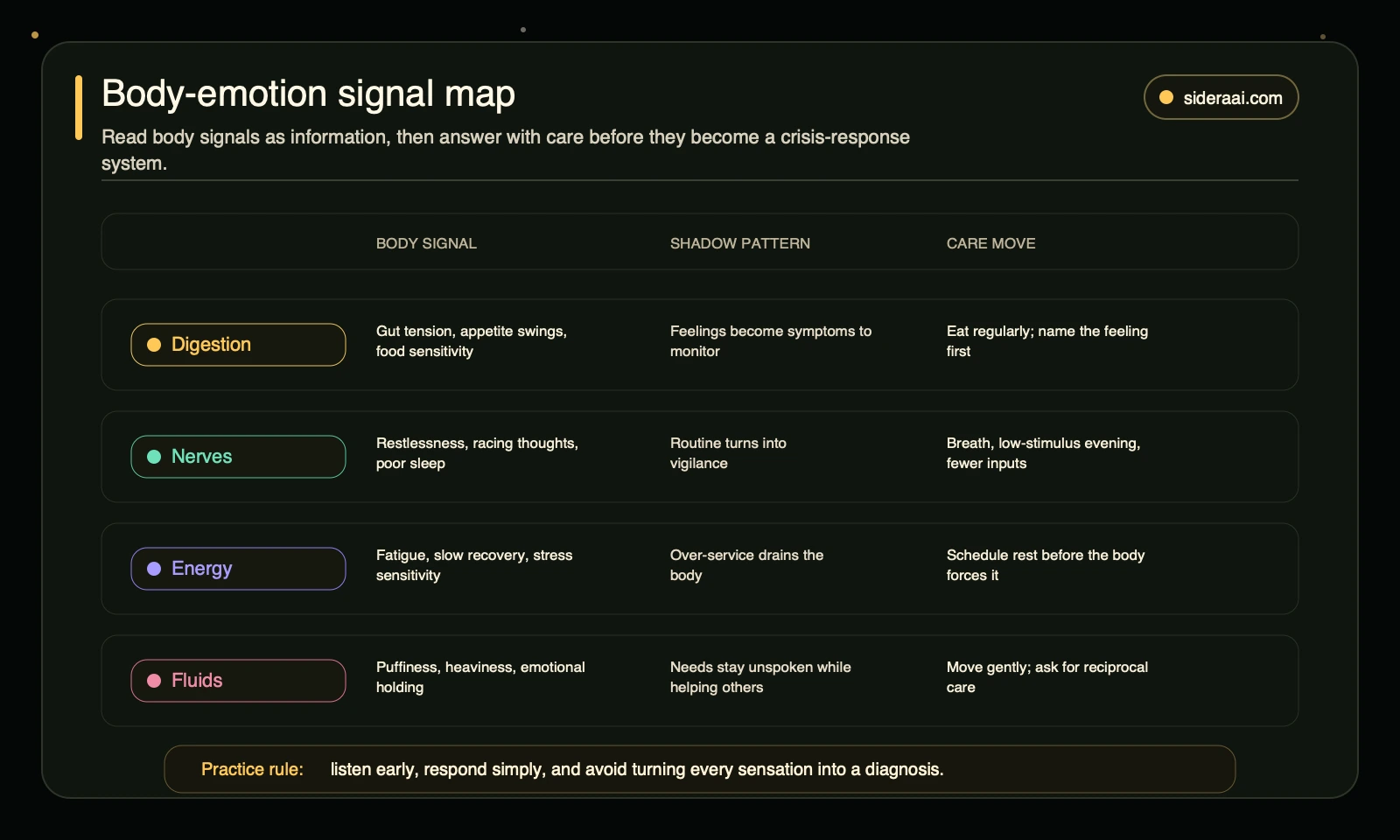
The signal map turns body sensitivity into a practical check-in: listen early, respond simply, and avoid making every sensation a diagnosis.
The 6th/12th House Axis: Service and Surrender
Every house has its opposition, and the 6th house Moon operates within the 6th/12th polarity: the axis of visible service and invisible transcendence.
The 6th house is the domain of the tangible: daily tasks, bodily health, practical helpfulness, skill development, and the routines that make ordinary life workable. The 12th house (its opposition) governs what lies beneath: solitude, spiritual retreat, hidden emotional material, dissolution, and the kind of service that goes unacknowledged and unrewarded.
For the Moon in the 6th house, the developmental tension runs like this: you ground through doing, through helping, through the structured predictability of daily action. But the 12th house asks you to sometimes surrender the doing entirely: to rest without productivity, to serve without recognition, to feel without organizing those feelings into practical solutions.
The most evolved expression of this axis integrates both poles. Visible service (6th) and invisible restoration (12th) become a rhythm. Work and retreat alternate rather than fight. Daily practice includes not only health routines but contemplative spaciousness: time without agenda, emotional experience without fixing, the willingness to be unproductive for a while without it registering as a threat.
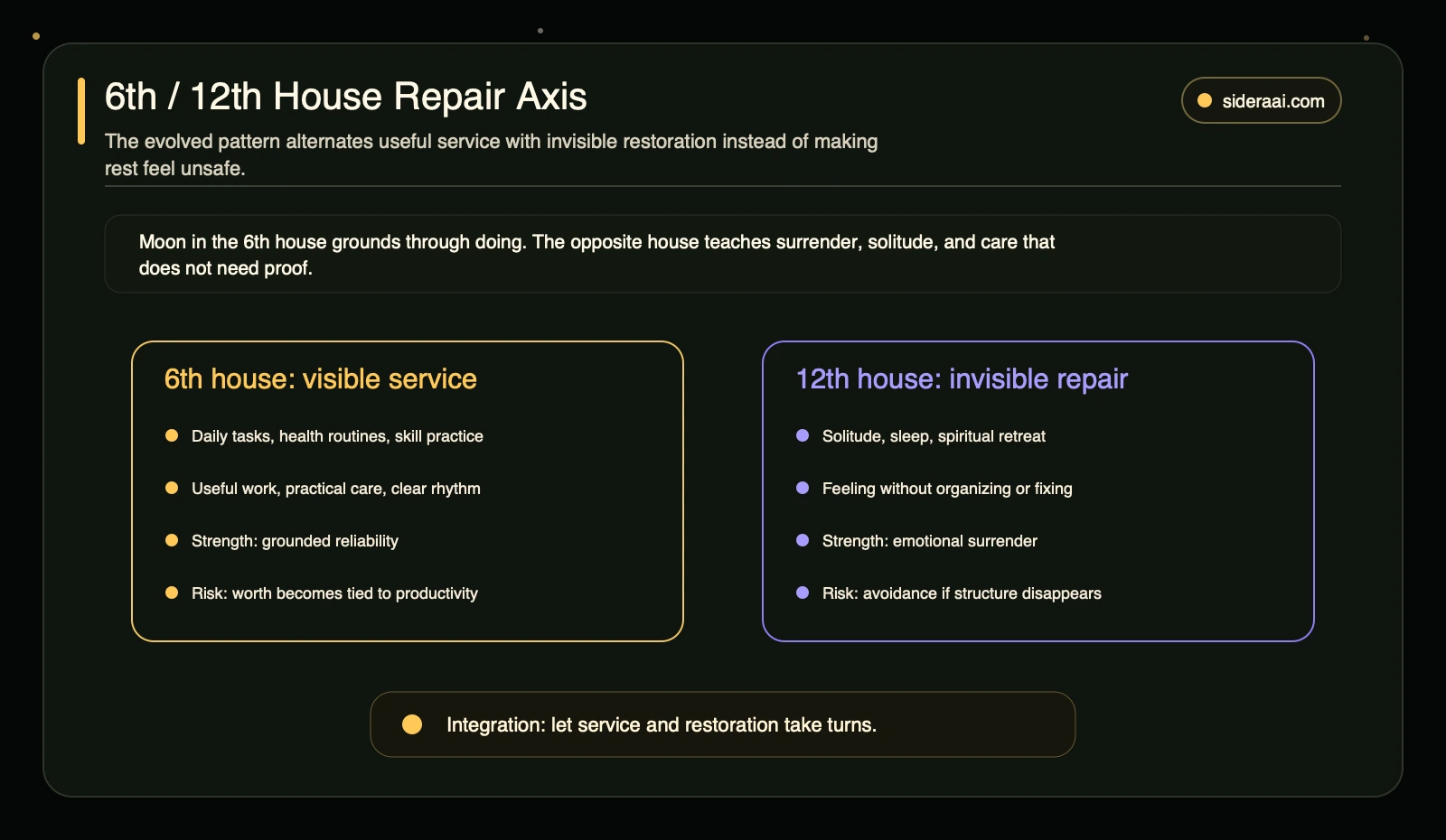
The axis repair map shows the growth edge: service and restoration need to take turns, so rest does not feel like a threat to usefulness.
An active north node conversation (especially if the North Node is in the 12th) can illuminate this tension and show the specific direction of soul growth. The full map of house polarity dynamics is covered in the astrology houses guide.
Body Rulership and Physical Sensitivity
The Moon natally rules the stomach, breasts, lymphatic system, and bodily fluids. In the 6th house, the Moon’s bodily sensitivity is amplified by the 6th house’s domain of health and daily physical functioning.
The organs most associated with the 6th house Moon:
- Digestive system: Small intestine, colon, and assimilation processes; emotional disruption frequently registers as digestive upset, food sensitivity, or irregular appetite
- Nervous system: Anxiety response, sleep quality, cortisol cycling; the nervous system is unusually attuned to the emotional tone of the environment
- Immune response: Psychoneuroimmunological sensitivity; chronic stress directly affects the body’s defensive capacity in measurable ways
- Lymphatic circulation: Fluid retention and lymphatic function, particularly during emotional suppression or sustained high-stress periods
The body’s signals are worth listening to carefully. For those with this placement, physical symptoms are often communication before they become pathology. Movement, hydration, rest, and consistent nutritional rhythm are not optional supplements. They are the emotional regulation system.
Moon in the 6th House: Sign Placements
The Moon’s sign modifies how this placement expresses through the body and daily life. Dignity positions are noted.
| Sign | Dignity | 6th House Expression |
|---|---|---|
| Aries | – | Driven, physically active routine; emotional energy needs movement; inflammation and burnout risk from too-fast pacing |
| Taurus | Exalted | Deep sensory anchoring through consistent routines; most stable 6th house placement; resistant to changing health habits once established |
| Gemini | – | Mentally restless routine; needs informational variety in daily work; stress and overstimulation go to the nervous system and breathing |
| Cancer | Domicile | Deeply nourishing caretaker orientation; home-based or care-sector work feels emotionally natural; digestive-emotional link is most pronounced – Cancer daily horoscope |
| Leo | – | Needs creative recognition in daily work to feel emotionally alive; generosity and warmth define the service style; health affected by invisibility |
| Virgo | – | Analytical perfection amplified; magnificent health attunement and diagnostic precision; self-critical spiral is the shadow – Virgo daily horoscope |
| Libra | – | Wellbeing depends on harmonious work relationships and ordered environment; conflict in the workplace registers physically |
| Scorpio | Fall | Compulsive work intensity; deep emotional investment in daily rituals; transformation through embodied practice is the positive arc |
| Sagittarius | – | Emotional restlessness in routine; needs meaning and expansive purpose behind daily tasks; benefits from outdoor movement and flexible scheduling |
| Capricorn | Detriment | Emotional needs suppressed by productivity drive; overwork and stoicism risk; Saturn’s discipline requires conscious body-emotion integration – Capricorn daily horoscope |
| Aquarius | – | Collective orientation in service; erratic routine can unsettle the nervous system; community-oriented work suits best |
| Pisces | – | Highly porous emotional-physical boundary; absorbs workplace atmosphere; needs daily solitude and spiritual practice to maintain health |
For a full breakdown of how your Moon sign interacts with house position, see the planets astrology cheat sheet.
The Nodal Axis: North Node and South Node in the 6th House
North Node in the 6th House
With the North Node in the 6th house, the soul’s growth direction is toward embodied service, health consciousness, and the discipline of daily practice. You’re learning to find meaning in the ordinary: to develop real skills, show up consistently for your body, and meet others through practical contribution. The 12th house South Node carries a past or karmic pattern of retreat, dissolution, and perhaps escapism or martyrdom. The invitation now is to ground: to become useful, to attend to health, to stop waiting for transcendence and start building it into the daily routine.
South Node in the 6th House
With the South Node in the 6th house, the default pattern runs toward over-service, perfectionism, and excessive focus on health management. There is karmic familiarity with being the caretaker (the details person, the maintainer) while remaining emotionally invisible. Growth lies in the 12th house direction: surrender, trust, spiritual depth, and the willingness to be served rather than always serving.
See the south node astrology guide for the karma and release dynamics of this nodal placement.
Moon in the 6th House in Synastry
When one person’s Moon falls in another person’s 6th house in a synastry chart, the dynamic centers around care, health, and daily support. This is not a glamorous overlay, but it is one of the most practically sustaining connections in relationship astrology.
Six Key Aspects
Moon conjunct 6th house (overlay): The Moon person instinctively nurtures the house person through practical action: preparing food, managing details, attending to health needs. The house person feels deeply cared for, though the Moon person risks slipping into caretaker exhaustion if the dynamic becomes one-directional. The connection is grounding and sustaining over time.
Moon opposite Moon (6th/12th axis): One partner grounds in daily service and routine; the other anchors in solitude and spiritual depth. This polarity creates profound complementarity. The 6th house Moon needs the 12th house partner’s reminder to rest and surrender. The 12th house Moon needs the 6th house partner’s reminder to show up practically. In healthy expression, the two poles complete each other.
Moon trine Venus: The Moon person’s emotional support and the Venus person’s warmth create an easy, appreciative daily life together. Practical care feels like love. The 6th house orientation means this trine expresses through nurturing routines: cooking together, shared health habits, daily rituals that reinforce affection. See Venus in astrology for how Venus shapes the relational expression.
Moon square Saturn: The Moon person’s emotional needs meet the Saturn person’s structure and restriction. In the 6th house context, this can manifest as health concerns being minimized or the Saturn person’s expectations around productivity feeling emotionally cold. This aspect requires bridging: Saturn’s structure can stabilize the 6th house Moon’s nervous system when applied with care rather than critique. See Saturn in astrology for Saturn’s role in this tension.
Moon conjunct Ascendant (6th house overlay): The Moon person sees the house person’s physical presence and daily self as something to tend and nurture. There’s deep bodily recognition. The house person feels the Moon person is attentive to their physical wellbeing in ways that feel instinctive rather than calculated. Health and body-comfort become a primary language of connection.
Moon square Mars: Emotional activation around work and health habits. The Moon person’s need for stable routine can clash with the Mars person’s drive for direct action and change. In the 6th house, this often plays out in disagreements about how daily life should be organized: the Moon needs structure; Mars needs momentum. Productive when channeled into shared physical activity or health-building practices.
Sidereal and Vedic Astrology: Chandra in Shatru Bhava
In Jyotish (Vedic astrology), the 6th house is called Shatru Bhava (house of enemies) or Roga Bhava (house of disease). It governs obstacles, illness, service, debts, and adversaries. The Moon (Chandra) placed here is classically considered a challenging position in Jyotish, as the 6th is a Dusthana (house of difficulty).
Chandra in Shatru Bhava: Emotional fluctuations around health, service burdens, and workplace dynamics are highlighted. There can be difficulty receiving help, as the emotional default is to be the one who helps. Maternal relationships may carry themes of service, illness, or care demands. When well-aspected, Chandra in the 6th develops exceptional healing instincts and the capacity to transform personal difficulty into purposeful service.
Sign Equivalence: In tropical astrology, Moon in Virgo in the 6th maps roughly to Chandra in Kanya Rashi in Jyotish, amplifying the analytical and healing dimensions. The Nakshatras most relevant to Chandra in the 6th house include Hasta (Moon-ruled, centered in Virgo: highly practical and precise), Uttara Phalguni (Sun-ruled, spanning late Leo/early Virgo), and Chitra (Mars-ruled, bridging Virgo and Libra with creative precision).
Chandra Mahadasha: If Chandra is the Mahadasha lord in your Jyotish chart, its 10-year period will bring 6th house themes to the foreground with particular intensity: health attention, service commitments, workplace dynamics, and the body-emotion relationship all heighten during this window. Sidereal vs tropical astrology explains how these two systems interpret the same Moon placement through different frameworks.
For those exploring the Jyotish interpretation of this placement, the sidereal astrology guide provides an accessible introduction to the Vedic approach.
The Shadow Arc
The perfectionist trap. With the Moon in the 6th house, the need for order and usefulness can become compulsive. Emotional discomfort is managed through fixing, organizing, and doing rather than feeling. The house gets tidied when the heart is in turmoil. Work absorbs anxiety. Caretaking of others substitutes for self-care.
Health anxiety. Physical symptoms can become a focal point for free-floating emotional distress. Medical appointments, monitoring, and worry about bodily function provide a structured channel for diffuse anxiety that hasn’t found its real source.
Self-worth through productivity. Rest feels emotionally dangerous: not because you’re lazy, but because your sense of self-worth has become entangled with being useful. Days without accomplishment register as personal failure rather than restoration.
Emotional invisibility in service roles. The 6th house Moon can become so adept at tending to others’ needs that their own emotional needs go unaddressed. Service without self-awareness becomes emotional debt. The helper who never asks for help is not a saint. They are someone who doesn’t yet believe their needs deserve the same attention they give others.
The development arc of Moon in the 6th house is learning to feel safe without doing. Emotions need to be felt, not organized. The body needs to rest, not just perform wellness. Service to others should arise from fullness, not from emotional debt. The shadow work guide offers practices specifically designed for this integration.
Final Thoughts
The Moon in the 6th house is one of astrology’s most quietly powerful placements. It doesn’t announce itself through dramatic emotional displays or sweeping life events. It shows up in the morning routine that holds your sanity together, in the careful attention you give to your body’s signals, in the way you love people by making sure they’ve eaten.
Your emotional intelligence is embodied. It lives in the rhythm of your days, in your sensitivity to environmental chaos, in the almost physical satisfaction of a task done well. That’s not a small thing. In a world that valorizes grand gestures and peak experiences, the 6th house Moon carries something rare: the capacity to find genuine emotional meaning in the ordinary.
The work is learning that your wellbeing doesn’t have to be earned through usefulness. That rest is not failure. That feeling something, without immediately organizing it into action, is not wasted time. The body has already been teaching you this all along. It speaks in symptoms when the feelings go unexpressed. It settles and softens when the emotional life is tended with the same care you give everything else.
Understand your full emotional wiring with the Sidera birth chart calculator and let your chart show you the whole picture.
Frequently Asked Questions
What does Moon in the 6th house mean in a natal chart? The Moon in the 6th house means emotional security is built through daily routine, health attention, and practical service. You feel most yourself when you’re useful, structured, and connected to a regular rhythm. Emotional disruption often expresses through the body: digestive upset, sleep issues, or physical restlessness when routines are disturbed. The 12 houses in astrology guide covers the full context of the 6th house in chart interpretation.
Is Moon in the 6th house good or bad? No placement is inherently good or bad. The 6th house Moon produces strong practical intelligence, excellent body awareness, and a deeply reliable and nurturing presence in daily life. The challenges (health anxiety, self-worth entangled with productivity, difficulty resting) are growth edges, not flaws. See all the moon sign meanings for comparative context.
What health issues are associated with Moon in the 6th house? Digestive sensitivity is the most common pattern: the gut-emotion connection is unusually direct. Nervous system reactivity, irregular sleep, and immune sensitivity to chronic stress are also typical. The body is highly responsive to emotional states, which means physical symptoms often carry emotional information worth attending to rather than suppressing.
How does Moon in the 6th house affect work? Work is emotionally central. A chaotic, meaningless, or relationally toxic work environment is genuinely distressing for this placement, not just inconvenient. You do best in structured, purposeful work with a clear service dimension. Natural caretaker tendencies make you valuable in teams, though the risk is over-giving without reciprocal support.
What is the difference between Moon in the 6th house and Moon in Virgo? Moon in Virgo indicates the emotional tone is analytical, practical, and service-oriented regardless of house position. Moon in the 6th house means the emotional function is housed in daily routines, health, and work regardless of sign. Both can occur together (Moon in Virgo in the 6th), amplifying those qualities considerably. Understand your full chart context with a natal chart reading.
How does Moon in the 6th house manifest in relationships? In relationships, this Moon expresses love through practical acts: cooking, organizing, attending to health needs, maintaining daily rhythms. It can be deeply devoted and attentive. The challenge is emotional avoidance through caretaking: using helpfulness to sidestep deeper emotional vulnerability. The ideal partnership has mutuality rather than a permanent care hierarchy.
What does Moon in the 6th house mean in synastry? When your Moon falls in someone’s 6th house, you instinctively tend to their daily needs and health. It’s a sustaining, practical connection that deepens over shared daily life. The risk is becoming the other person’s caretaker rather than their equal partner. Healthy expression involves both people actively attending to each other. See the synastry chart guide for the full interpretation framework.
Ready to See Your Personal Birth Chart?
Discover your unique cosmic blueprint — planets, houses, and aspects personalized to your exact birth time and location.
Get Your Birth Chart →✓ Birth chart analysis ✓ Personalized insights ✓ Free to use