
There is a specific kind of person who goes quiet when they have a big goal. They do not announce it. They do not talk about what they are building while they are building it. They start taking small, deliberate steps – at 7 AM, then again at 10 PM, then again the following week – until one day the thing exists that did not exist before. That is Mars in Capricorn. Not the loudest drive in the room. The most durable one.
Mars in Capricorn is the placement where wanting does not announce itself – it accumulates. The desire is real, often quietly intense, but it runs through a planning faculty before it becomes action. By the time this Mars placement moves toward something, it has already rehearsed the outcome, mapped the obstacles, and decided the cost is acceptable. The fire of Mars does not flame up here. It runs low and steady, like a kiln: invisible from the outside, generating temperatures that transform material over time.
In traditional western tropical astrology, Capricorn is the sign of Mars’s exaltation – the highest planetary dignity available. This is not a guest placement. This is Mars operating at full structural capacity, with every Capricornian quality amplifying what Mars does best: discipline, strategic patience, awareness of consequences, orientation toward what lasts.
For a deeper foundation on what Mars governs across the natal chart, see our guide to Mars in astrology.
At a Glance: Mars in Capricorn
| Dignity | Exaltation (highest Mars dignity) |
| Ruling filter | Saturn: structure, limits, earned authority, deferred gratification |
| Drive mode | Sustained strategic effort; commits after internal assessment, not impulse |
| Core strength | Long-arc follow-through, composure under pressure, strategic ambition |
| Core shadow | Emotional distance, planning as avoidance, overwork as emotional displacement |
| Body zone | Knees, joints, skeleton, skin |
| Anger style | Cold, forensic; arrives having already been decided |
| Desire style | Calibrated, declared only when conditions are assessed as right |
| Approximate frequency | Roughly 1 in 12 natal charts |
Mars in Capricorn: The Exaltation Explained
Traditional astrologers distinguished four levels of planetary dignity: domicile, exaltation, detriment, and fall. Mars rules Aries (domicile) and is exalted in Capricorn. Its fall is in Cancer – the sign directly opposite Capricorn on the zodiac axis – and this polarity is instructive. Where Cancer acts from emotional instinct and protective reaction, Capricorn acts from earned authority and action calibrated to long-term consequence. Mars in Cancer acts from feeling. Mars in Capricorn acts from a plan.
Capricorn is cardinal earth: it initiates through material reality. Cardinal energy starts things; earth grounds them in tangible, physical terms. Mars in cardinal earth initiates action through structured, goal-oriented building. It does not rush for the sake of rushing. It begins what it has assessed is worth beginning, with a plan that accounts for cost, timeline, and reversibility.
Saturn rules Capricorn. When Mars occupies Saturn’s sign, the drive becomes discipline-colored: aware of limits, oriented toward earned authority, calibrated to long-term consequence rather than immediate gratification. Mars spends approximately six to seven weeks in each sign during direct motion, completing its cycle through all twelve signs in roughly two years.
When Mars turns retrograde in Capricorn – approximately every 26 months, for roughly ten weeks – the outward ambition drive turns inward. The question that surfaces during this period is not what to build next, but whether the goals being pursued are genuinely self-directed or are inherited expectations wearing the costume of personal ambition.
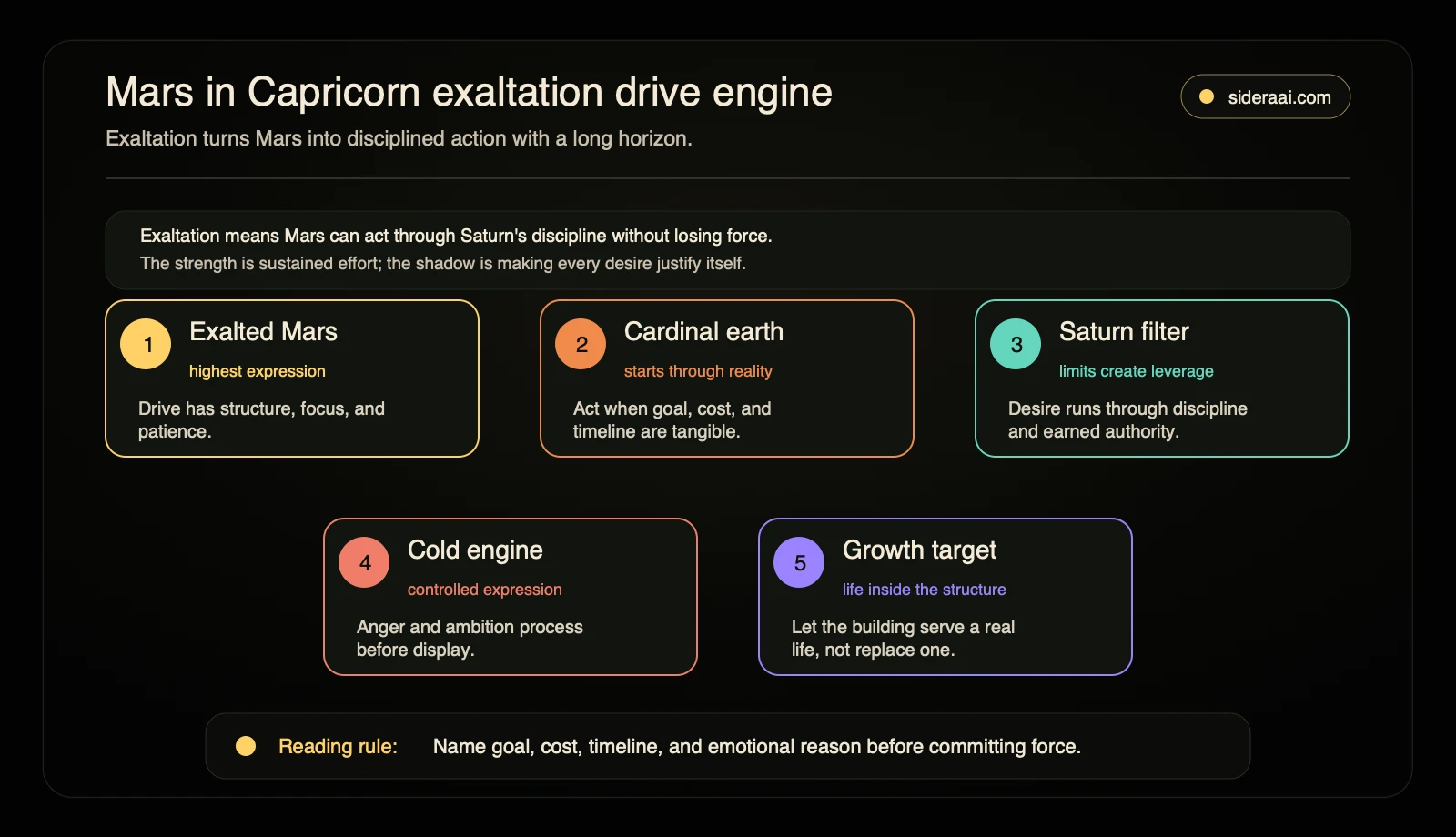
Read Mars in Capricorn as a drive engine: Saturn gives structure, cardinal earth turns it into action, and the growth task is keeping desire accessible while the plan matures.
Four Core Themes of Mars in Capricorn
1. Ambition as Architecture
Mars in Capricorn experiences ambition as a design problem, not an emotional surge. The internal experience sounds like: What is the goal, what are the necessary steps, what resources are required, and what is the realistic timeline? The drive is real – often quietly intense – but it clears the planning faculty before it becomes action.
This produces a strategic dimension other Mars placements lack. It also produces a specific shadow: planning as a disguised form of avoidance. The internal script often runs: I will begin once I have everything in order. The preparing-to-begin can extend indefinitely because it feels like responsible preparation rather than delay. The distinction between prudent groundwork and fear-of-failure management is not always obvious from the inside.
2. Discipline as Desire
One of the more counterintuitive qualities of Mars in Capricorn: the discipline itself becomes a source of satisfaction. Where Mars in Taurus desires comfort and Mars in Scorpio desires intensity, Mars in Capricorn can genuinely want the experience of controlled, sustained effort. The climb is satisfying. The long weeks of necessary work before any visible result are activating rather than merely a cost to endure.
The shadow is the belief that difficulty is inherently virtuous. The internal script: If something came easily, I did not really earn it. Or more quietly: Asking for help would mean I did not actually deserve this outcome. Help is refused, shortcuts declined – even when they do not compromise the integrity of the outcome – because receiving feels structurally wrong.
3. Authority as Drive Motor
Mars in Capricorn is motivated by authority – not as vanity in the Leo sense, where visibility functions like love, but as structural evidence. The corner office is worth pursuing because it represents having built something real, having earned a position through demonstrated competence rather than social performance.
The shadow of this drive is calculation that replaces conviction. The internal script: Once I reach this level, I will have earned the right to relax. The level keeps moving. External markers of authority are pursued as a substitute for self-worth rather than as a consequence of genuine achievement – and the drive, which should be a tool, becomes a treadmill.
4. The Cold Engine: Drive Behind Glass
The exaltation of Mars in Capricorn comes with a specific cost: emotional access. The Saturn filter treats emotional experience as something to be managed rather than expressed. The desire-nature does not disappear – it goes behind glass.
What this looks like from the inside: You know you want something months before you say it. You process anger by taking a precise inventory of the facts before anyone knows you are angry. This reads as calm from the outside and feels like control from the inside – but occasionally loses contact with what you actually feel in the present moment.
What failure feels like for this placement: Not a hot emotional collapse, but a cold forensic review. You identify exactly where the plan went wrong. The self-criticism is precise rather than dramatic, and it can run for a long time without showing on the surface.
The deeper shadow is not emotional suppression as strategy – it is the genuine loss of access: becoming so practiced at controlling expression that you no longer know in real time what you want or feel.
Strengths, Shadow, and Integration: Quick Reference
| Theme | Strength | Shadow | Integration Practice |
|---|---|---|---|
| Ambition | Sustained effort across timelines others abandon | Planning as disguised avoidance; preparation that never reaches launch | Set a “good enough to begin” threshold and act before it feels ready |
| Discipline | Genuine satisfaction in the process of earned achievement | Difficulty is virtuous; shortcuts are cheating; help is weakness | Accept one form of assistance this week without mentally docking yourself for it |
| Authority drive | Competence-based confidence not easily destabilized by flattery | External markers replace internal worth; the level keeps moving | Identify one area where you have already earned the right to stop proving yourself |
| Emotional control | Composure under pressure; deliberate, measured response to conflict | Desire goes behind glass; real-time access to feeling and want closes off | Name what you want before the conditions are assessed as safe |
| Physical drive | High endurance for structured, progressive physical challenge | Overwork as emotional displacement; rest treated as structural failure | Schedule recovery as infrastructure, not reward |
How This Shows Up: Love, Work, Conflict, and Self-Image
| Domain | Strength pattern | Shadow pattern |
|---|---|---|
| Love | Expresses care through reliability, provision, and sustained follow-through; shows up consistently over years | Withholds desire until the outcome is assessed as safe; replaces emotional intimacy with productivity |
| Work | Strategic, patient, excellent long-arc execution; sustains effort where others drop off | Cannot stop even when the cost is visible; achievement becomes an identity container rather than a tool |
| Conflict | Measured, precise response; waits before engaging; arrives prepared | Runs a silent internal inventory for months; grievances catalogued but not addressed because they do not yet meet the threshold |
| Self-image | Grounded in demonstrated competence, not flattery or approval | Worth becomes tightly coupled to output; rest feels like structural failure rather than recovery |
What This Looks Like in Practice
Abstract behavioral descriptions make sense until you need to recognize them in real life. These three scenarios are specific enough that Mars in Capricorn readers will recognize the texture – not as character flaws, but as the actual shape this placement takes.
In love: Your partner asks what you want for your anniversary. You say “I’m easy, whatever you think.” This is not indifference. You have already considered two or three options. But naming them aloud – before you know whether they want the same thing, before the conditions are confirmed as right – feels like exposure that cannot be undone if it goes wrong. So you defer. Then feel quietly unmet when the evening is fine but not quite what you had in mind. The gap between what you wanted and what you said you wanted is the thing.
At work: The report is due tomorrow. You finished it three hours ago. You know it is good. You are now on the fourth pass, finding smaller and smaller things to adjust, because submitting it is an act of finality – and finality creates exposure. The continued reviewing does not feel like avoidance from the inside. It feels like responsible thoroughness. This is the planning-as-avoidance loop in its professional form: the work is done, but done does not feel like permission to stop.
In conflict: A colleague misrepresented your contribution in a meeting. You did not address it in the moment. You noted the facts. Over the following six weeks, you noted two additional instances of similar behavior. You now have a precise internal record. You have also not yet decided whether the pattern clears the threshold of something worth addressing directly. The colleague assumes everything is fine. If this eventually surfaces, it will arrive as a composed, structured account of events across months – and the colleague will experience it as disproportionate, because from their perspective the first incident never even registered.
What Most Guides Miss
Exaltation is usually treated as an uncomplicated positive: Mars is strong here, therefore things go well. That is not what the exaltation actually produces.
Exaltation means Mars expresses its drive through Capricorn’s filter at full structural capacity. And Capricorn’s filter is Saturn’s filter: limits, cost-awareness, the chronic awareness of what is still not enough. The practical result is that Mars in Capricorn can achieve more than almost any other Mars placement and still struggle to feel that the achievement is real, sufficient, or permission to stop.
The drive does not pause to let the accomplishment register. It moves immediately to the next target, because stopping would mean something has to be felt, and feeling requires not being in motion.
This is what most astrology guides miss. They describe the strength without describing the internal experience of it: the person who has worked until 10 PM for the fourth night this week, alone, telling themselves this is what building requires, while the actual life they were supposed to be building toward recedes further into “later.” The exaltation is not ease. It is functional fire – and function can become its own cage.
The second thing most guides miss is that the withholding of desire is not strategic. It feels protective. Announcing what you want before the outcome is certain creates exposure that Capricorn does not manage well. The result: a person whose partner often has to ask what they actually want – for their birthday, for the relationship, for the next five years – not because the person has not thought about it, but because saying it aloud feels premature, or like asking for something that should be earned through demonstrated worthiness first.
Mars in Capricorn and the Body
Capricorn rules the knees, skeleton, joints, teeth, and skin. Mars in Capricorn often manifests physical tension in these areas during periods of blocked drive or sustained effort without visible progress – specifically in the knees and lower joints when ambition is stalled or effort is not translating into measurable results.
Physical practices that suit this Mars well: resistance training, endurance sports, climbing, anything with a structured progression that rewards months of consistent preparation. Erratic, unstructured movement tends to feel less satisfying than effort that has a plan behind it. Recovery, when this Mars placement learns to take it, needs to look like structured rest rather than collapse – because even rest benefits from a framework this Mars can respect enough to actually use.
Mars in Capricorn in Relationships
Mars governs how we pursue what we want – in career and equally in intimacy, desire, and conflict. The placement’s behavior across those specific domains matters more than a general description of patience and reliability.
Desire and attraction: Mars in Capricorn is drawn to competence, composure, and self-direction. The person who knows what they are doing and does it without requiring management is attractive in a way that obvious charm or emotional expressiveness often is not. Attraction is assessed rather than felt immediately. This is not aloofness – it is a Mars that only commits energy after the investment has been evaluated.
Intimacy: The depth of care is often invisible to the partner until they look backwards. Acts of sustained commitment – showing up consistently over years, following through without being reminded, building a stable life together – are how Mars in Capricorn demonstrates desire. Explicit warmth is harder. The person knows they love their partner; articulating it before an anniversary or meaningful moment requires overriding the sense that feelings should be demonstrated, not announced.
The shadow in intimacy is the displacement script: I do not need much. I have work. The capability that makes this placement effective in the world can become the reason it does not let anyone close enough to matter. Not through indifference – through the habit of channeling aliveness into achievement rather than connection. The partner eventually gets consistency without presence, provision without vulnerability, and a person who is building something impressive while being unavailable for what the building was supposed to make possible.
Conflict: Mars in Capricorn does not react quickly. The first internal response to a grievance is an inventory: Is this significant enough to address? What are the facts? What outcome am I actually trying to reach? This process takes time – sometimes days, sometimes longer. From the outside, this reads as calm or even indifference.
The shadow in conflict: grievances that never quite clear the threshold. The inventory runs, the assessment concludes “not worth the disruption,” and the issue is filed rather than addressed. These filed issues accumulate. When Mars in Capricorn eventually does express anger, it often arrives as a list – months of catalogued evidence delivered with precision. Partners who were unaware a problem existed experience this as disproportionate. The problem is that the evidence was being gathered in silence.
Desire and self-worth: For Mars in Capricorn, self-worth is built through earned competence. This is durable in some ways: flattery does not land easily, and external approval does not substitute for internal assessment. But it creates a coupling problem. When work is the primary arena where worth is established, the desire to be loved – to be seen, to matter to someone regardless of output – is hard to express, because it asks for something that cannot be earned, only received. And receiving without earning is structurally uncomfortable for this placement in ways that run deeper than social inhibition.
Mars in Capricorn vs Mars in Cancer: The Exaltation-Fall Axis
Mars in Capricorn and Mars in Cancer sit at opposite ends of the same axis. Understanding the contrast clarifies what makes Capricorn the highest Mars territory and Cancer the most challenging.
| Dimension | Mars in Capricorn | Mars in Cancer |
|---|---|---|
| Dignity | Exaltation | Fall |
| Element / Mode | Cardinal Earth | Cardinal Water |
| Ruling planet filter | Saturn: structure, limits, earned authority | Moon: emotion, instinct, protection |
| Action style | Strategic, deliberate, long-horizon | Reactive, protective, mood-driven |
| Desire nature | Calibrated to long game; declared after assessment | Immediate; driven by emotional safety and belonging |
| Anger expression | Measured, controlled; arrives having already been decided | Defensive, indirect; can become passive-aggressive |
| Primary achievement arena | External: career, status, earned authority | Internal: home, family, emotional security |
| Strength | Sustained effort, follow-through, strategic patience | Fierce protectiveness, emotional attunement, instinctive responsiveness |
| Shadow | Emotional disconnection, planning as avoidance, difficulty receiving | Overprotection, indirect conflict, martyrdom patterns |
| Integration task | Access feeling without losing structure | Build external footing without abandoning instinct |
The axis reveals the integration task for Mars in Capricorn: what it most needs to develop is what Cancer already has – the capacity to act from feeling, to want openly, to value emotional life as equally real as external achievement.
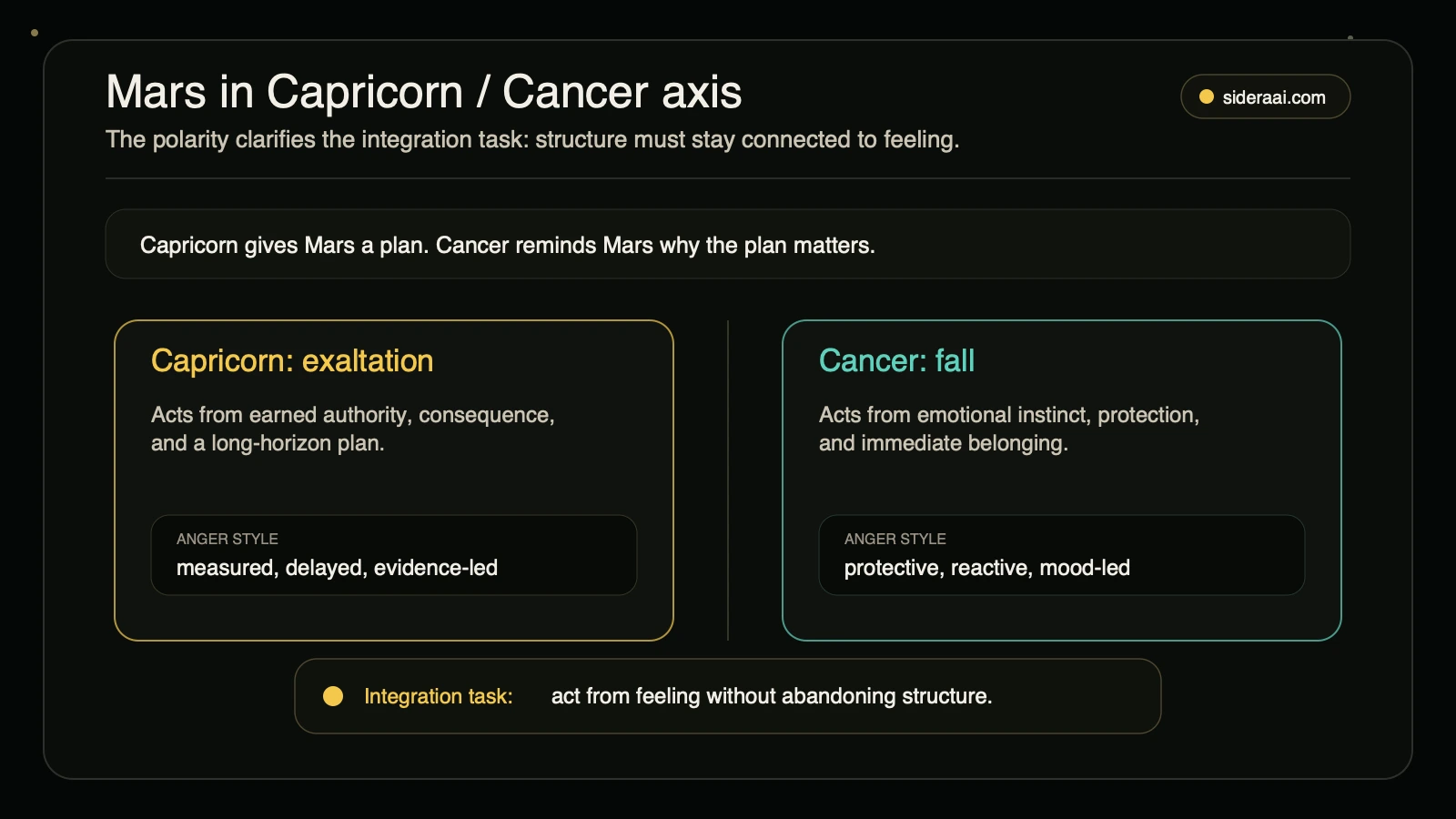
The Capricorn-Cancer axis shows the tradeoff clearly: structured ambition becomes healthier when it can also name feeling before every condition is proven safe.
Mars in Capricorn in the Natal Chart
The house where Mars in Capricorn falls shows which life domain receives this disciplined drive most directly. Each description prioritizes behavior over placement shorthand.
1st house: The drive shapes the entire self-presentation. A composed, controlled exterior concealing significant internal ambition – and often significant internal pressure about whether it is ever enough. People typically read this person as older, steadier, and more authoritative than their age warrants. The shadow is that composure can become a management strategy rather than a genuine state, leaving the person performing calm rather than feeling it. The work is discovering that the composed exterior does not have to be armor.
2nd house: Financial architecture. This placement builds wealth patiently through systematic accumulation rather than opportunity-chasing. It is skeptical of shortcuts, attentive to compounding over long timelines, and deeply uncomfortable with financial exposure. The shadow is equally behavioral: difficulty spending what has been accumulated, because the building is more satisfying than the having – and spending can feel like undoing progress, even when the resources are there specifically to be used.
4th house: Brings the drive to build into home and family. The person may approach creating a home with the same strategic deliberateness applied to career – which produces stability and material provision, but can make the home feel like a managed environment rather than a refuge. The people inside it may feel well cared-for in concrete terms while sensing that warmth is not fully available. The question for this placement is whether the family becomes another project to optimize, or a place to stop performing.
7th house: Applies strategic, authority-aware drive to partnership. Seeks partners who are equally capable and self-directed. The shadow is the relationship approached like a project: well-structured, competently managed, underemotioned. It holds together through competence and reliability more than intimacy. This person is an excellent partner in practical terms and often unclear why the relationship feels thin – because they have provided everything except what they are least practiced at providing.
10th house: One of the most vocationally focused placements in the chart. The drive applies directly to public position, professional reputation, and earned authority. The shadow is equally direct: reputation and standing replace self-worth as the identity foundation. When the external position is threatened, plateaus, or is removed, there is nothing built underneath it. The challenge is distinguishing between what the person genuinely wants to build and what the Capricorn filter has decided they are supposed to pursue.
12th house: The drive is mostly invisible – to others and often to the self. Ambition operates beneath the surface through private effort, long periods of behind-the-scenes work, and output that does not produce attribution. This placement can accomplish significant things with very little external recognition, and may spend years uncertain whether the effort was worth it. The integration task is learning to value the effort itself rather than requiring external proof that it counted.
Sun sign combinations add texture. An Aries Sun with Mars in Capricorn holds internal tension between Aries instinct and Capricorn strategy – a person who wants to act immediately and keeps overriding that impulse to plan first. A Cancer Sun with Mars in Capricorn carries the polarity axis internally: the pull toward emotional security and nurturance sitting alongside a drive toward external achievement that can feel like they belong to different people. A Capricorn Sun with Mars in Capricorn doubles the Saturnian influence – extraordinary capacity for sustained effort, with the shadow of work becoming the primary emotional container and the life it was supposed to make possible remaining perpetually deferred.
To see which house Mars in Capricorn falls in your chart, use the natal chart reading tool.
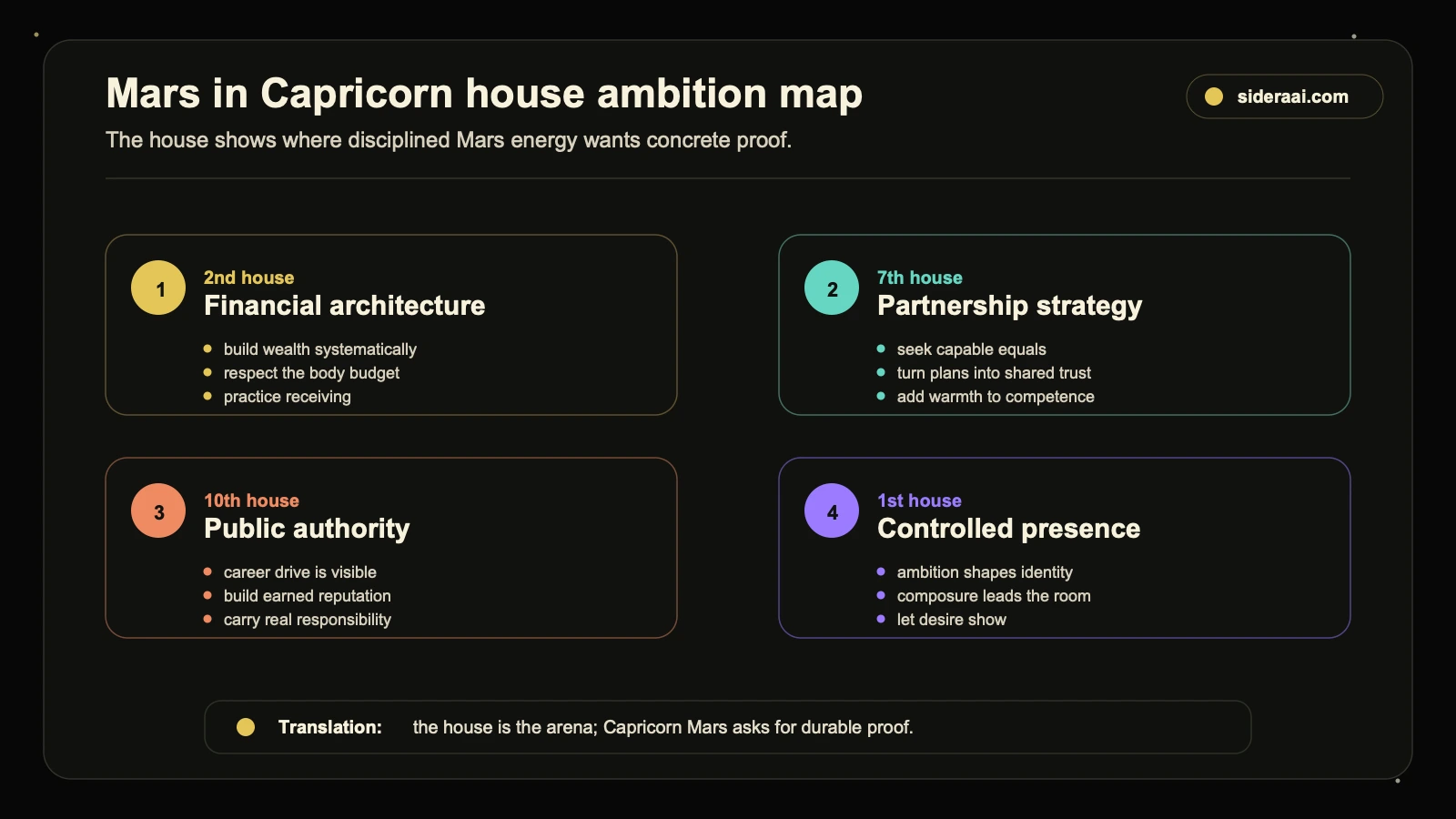
House placement tells you where the disciplined Mars in Capricorn engine concentrates: resources, partnership, public role, and visible presence.
Reflection: Is the Building Housing a Life?
If you have Mars in Capricorn natally, these questions are worth sitting with honestly:
- On overwork: Is the drive to keep working coming from genuine engagement with meaningful goals – or from the low-grade anxiety of what it would feel like to stop?
- On controlled wanting: When was the last time you wanted something and said so before you were certain it would be well received?
- On delayed anger: Is there something you are still taking an inventory of – grievances catalogued but not addressed – because you have decided they do not yet meet the threshold for response?
- On achievement and emotional life: Has reaching the next milestone become a condition for allowing yourself to rest, feel, or connect? What would it mean to remove that condition?
- On asking for help: Where are you refusing help not because you genuinely do not need it, but because needing it feels like evidence of structural failure?
These are not character flaws. They are the pressure that lives inside the exaltation – what the placement costs, alongside what it delivers.
Integration: What Mars in Capricorn Needs to Practice
The goal is not to dismantle the drive. It is to restore access to the desire that the drive is supposed to be in service of.
Express want before the assessment is complete. Mars in Capricorn typically waits until desire has been fully evaluated, the outcome assessed, and the exposure calculated before saying anything. The practice is to speak earlier – not impulsively, but before certainty. I want this is a sentence that does not require supporting evidence. The discomfort of saying it before the conditions are right is data, not a reason to wait.
Count recovery as part of the work. The internal script treats rest as something that must be earned. The reframe is structural rather than motivational: sustained output requires sustainable input. A drive that runs continuously at high capacity without scheduled maintenance degrades – not gradually, but suddenly. This placement tends to discover this through burnout rather than foresight.
Let something arrive without having earned it. This is the deepest challenge for Saturn-filtered desire. Receiving – care, recognition, love – that is not contingent on demonstrated competence. Letting it in without immediately calculating whether it was deserved. The practice is not gratitude as affirmation; it is genuinely staying with the discomfort of being valued without proof of worth, and not moving away from it.
The integration is not becoming less Capricorn. It is becoming a Capricorn who can feel what they are building toward – and let the people they are building with actually see them.
Frequently Asked Questions
Is Mars in Capricorn a good placement? Yes – it is one of the most favorable Mars placements in western astrology. Capricorn is Mars’s sign of exaltation, meaning the planet operates at its highest dignified expression here. The drive is structured, patient, and capable of sustained achievement across long timelines. The cost is reduced spontaneity and sometimes genuine difficulty accessing what you want and feel in real time.
Why is Mars exalted in Capricorn? Classical astrologers observed that Mars in Capricorn expresses its essential function – the will to act, achieve, and overcome – through the most productive possible filter: Saturn’s structure, Capricorn’s goal-orientation, and earth’s grounding in material consequence. The result is Mars at its most purposeful rather than its most reactive.
How does Mars in Capricorn express anger? Slowly, deliberately, and with intention. Unlike Mars in Aries (fast flare) or Mars in Scorpio (sustained internal burn), Mars in Capricorn processes anger before expressing it – sometimes for a very long time. When it finally emerges, it is measured and precise, often arriving as a list of catalogued evidence. This can be more unnerving than impulsive anger because it arrives having already been decided upon.
What does Mars in Capricorn mean for career? Career is often the primary arena for this placement’s expression. It produces exceptional professional discipline, long-term strategic thinking, comfort with earned authority, and the patience to build across decades rather than quarters. The risk is that career becomes the primary emotional container – the place where desire, worth, and aliveness are all deposited, leaving the personal life underbuilt.
What are Mars in Capricorn traits in men and women? Both share the core profile: controlled ambition, patient pursuit of goals, and emotional reserve that can read as coolness to those who do not know them well. The drive is real and often strong – it simply does not advertise itself. Mars in Capricorn people frequently accomplish more than those who appear more obviously driven, precisely because their effort is sustained rather than intermittent.
How does Saturn’s rulership affect Mars in Capricorn? Saturn as Capricorn’s ruler adds structure, awareness of limits, and long-term consequence to the Mars drive. What remains is a drive that does not waste itself on impulsive starts, that considers whether the cost is acceptable before committing, and that can sustain effort across timelines that would exhaust other placements. The risk is that Saturn’s weight also adds shame around need, rest, and dependency – which can make the ambition feel more like obligation than genuine drive.
How does Mars in Capricorn show up in love and intimacy? Through acts of sustained commitment rather than explicit warmth. Showing up consistently over years, following through without reminders, building a stable life together – these are how this placement demonstrates desire. The challenge is expressing want before the conditions are assessed as right, and allowing care in without calculating whether it was earned. Partners often feel deeply provided for and not quite fully seen – because the emotional layer runs behind glass.
Mars in Capricorn is not the flashiest drive in the room. It does not announce itself. It builds. The exaltation is not about performance – it is about structural integrity, the long game, and the satisfaction of having earned what you have. The challenge is remembering that the building is supposed to house a life, not replace one. And the integration work is not softening the drive – it is restoring the desire that the drive was always meant to serve.
Ready to See Your Personal Birth Chart?
Discover your unique cosmic blueprint — planets, houses, and aspects personalized to your exact birth time and location.
Get Your Birth Chart →✓ Birth chart analysis ✓ Personalized insights ✓ Free to use
Related Sidera Guide
Continue with this closely related guide: