
Mars in Cancer is one of the most misunderstood placements in astrology. Mars is the planet of action, desire, and aggression - and Cancer is the sign of emotional depth, home, and protective care. In traditional astrology, Mars is in fall in Cancer: the sign directly opposite Capricorn, where Mars is exalted. This means Mars’s direct, assertive nature has to work through the filter of emotion, memory, and self-protection - producing a placement that is neither weak nor passive, but deeply indirect in how it generates and expresses force.
Mars spends approximately 6 to 7 weeks in each sign, completing a full zodiac cycle roughly every 2 years, with retrograde periods of about 10 weeks occurring every 26 months. Roughly 7 to 8 percent of people have Mars in Cancer natally. Research on protective motivation consistently shows that people who act primarily from care for others rather than personal ambition demonstrate higher sustained effort and lower burnout over time - though they require relational stability to maintain that level of engagement. This maps precisely onto the Mars in Cancer pattern: formidable in stable, connected environments; depleted when the emotional foundation is disrupted.
People with Mars in Cancer don’t charge toward what they want. They circle, retreat, wait for emotional safety, and then move - often with a tenacity that surprises everyone, including themselves.
Mars in Cancer at a Glance
| Feature | Detail |
|---|---|
| Dignity | Fall (Cancer opposite Capricorn, where Mars is exalted) |
| Ruling Planet | Moon (ruler of Cancer) |
| Element | Water |
| Modality | Cardinal |
| Mars Cycle | ~6-7 weeks per sign; retrograde ~10 weeks every 2 years |
Four Core Themes of Mars in Cancer
1. Emotion as the Engine of Action
For most Mars placements, desire and action have a relatively direct connection - want something, pursue it. Mars in Cancer routes desire through the emotional body first. Before action can fire, there must be emotional readiness: safety, connection to why this matters, a sense that the ground is stable enough to move on.
This produces action that is sometimes slow to start but surprisingly sustained once it begins. Mars in Cancer people are not lazy - they are emotionally pre-loading before they commit. When they feel safe and connected to purpose, their cardinal-water drive is formidable. They build, protect, and sustain with a level of dedication that few other Mars placements match.
The shadow: if the emotional environment is disrupted - conflict, instability, disconnection - the drive evaporates. Mars in Cancer can be highly productive in one context and nearly immobile in another, depending entirely on whether the emotional underpinning is there.
2. Indirect Assertion and the Sidestep Pattern
Mars governs how we assert ourselves and handle conflict. In Cancer, direct confrontation feels dangerous - not strategically, but emotionally. The direct approach risks rejection, rupture, or vulnerability. So Mars in Cancer develops a repertoire of indirect assertion: hinting rather than asking, withdrawing rather than confronting, using silence or emotional temperature as communication.
This is not manipulative by design. It is self-protective by instinct. The crab walks sideways not to deceive but because the shell - the protection - faces outward. Mars in Cancer asserts through:
- Passive withdrawal (creating absence as pressure)
- Emotional temperature shifts (warmth withheld or extended as signal)
- Subtle redirection (changing circumstances rather than confronting directly)
- Protective explosion (long-absorbed irritation that eventually breaks through)
The developmental challenge for Mars in Cancer is learning direct assertion without emotional catastrophizing - the fear that stating a want directly will destroy the relationship.
3. Protective Drive as the Dominant Motivation
Mars rules what we fight for. In Cancer, the primary motivator is protection - of home, family, loved ones, emotional security, and the people or things that feel like extensions of self. Mars in Cancer people do not typically fight for personal ambition or status. They fight when something they love is threatened.
This produces one of the most fierce and relentless expressions of Mars in the zodiac when activated. The protective drive in Cancer is cardinal (initiating), water (emotionally fueled), and deeply personal. Someone who threatens the home, family, or emotional security of a Mars in Cancer person is activating one of the most enduring and implacable defensive responses in astrology.
The shadow: the circle of “what I must protect” can become too small and rigid. Mars in Cancer can become controlling in the name of protection - limiting others’ freedom under the framing of care. The protective instinct, over-applied, becomes possessiveness.
4. Anger That Absorbs Before It Erupts
Cancer is not a sign known for fast explosive anger like Aries or sudden shocking releases like Aquarius. Mars in Cancer has one of the longest absorption cycles of any placement. Grievances accumulate, held in the emotional body as unspoken hurt. The threshold is high - and then, when finally crossed, the eruption can be disproportionate to the immediate trigger.
This pattern frustrates people in relationship with Mars in Cancer. They see calm, calm, calm, then suddenly: a storm that seems to arrive out of nowhere. From the outside, the trigger looks minor. From the inside, it is the last drop in a very full container.
The gift within this pattern: Mars in Cancer people rarely create unnecessary conflict. They absorb a great deal before engaging - which means when they do express anger, it usually points toward something genuinely important. The developmental work is shortening the absorption cycle so that smaller grievances get addressed before they compound.
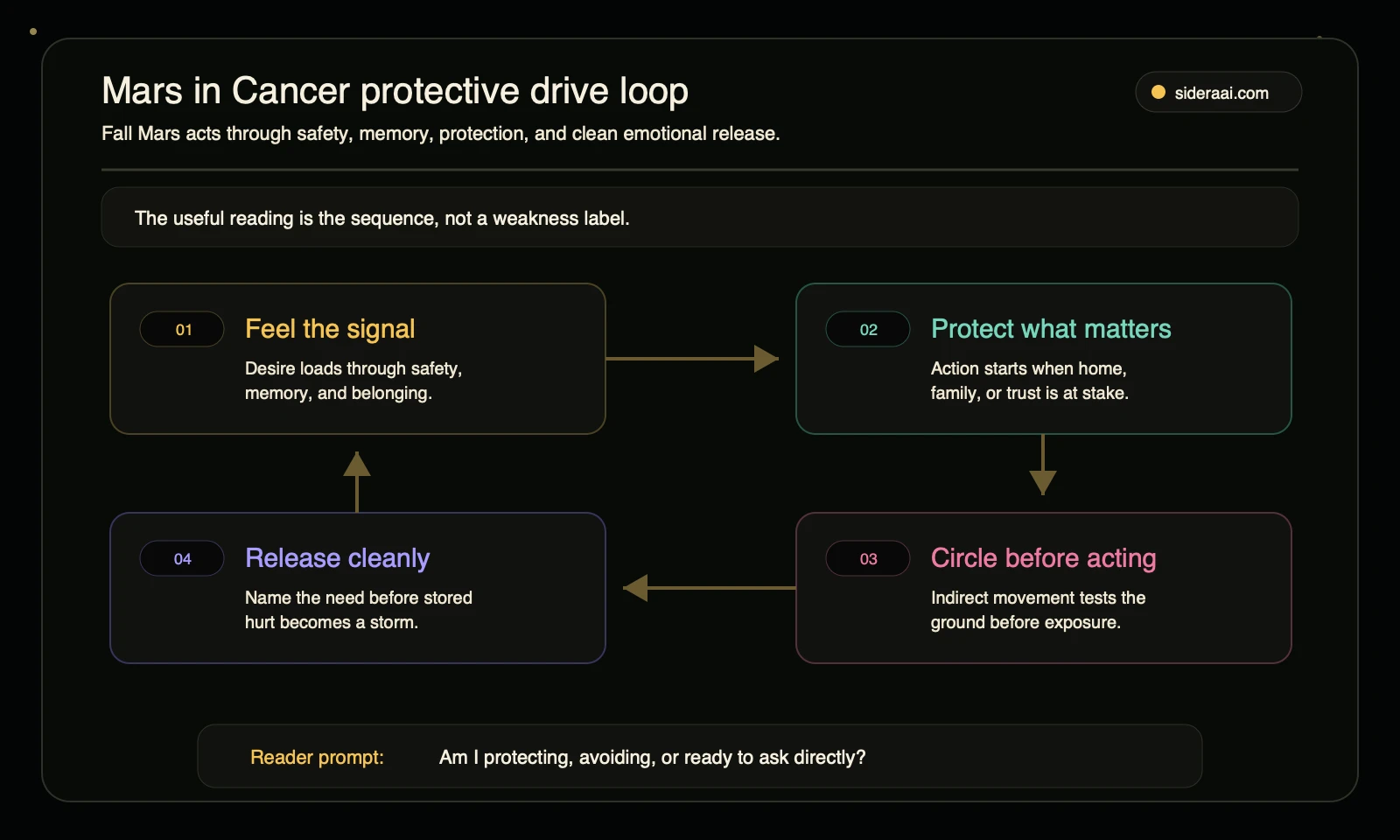
Read Mars in Cancer as a sequence: emotional safety loads the drive, protection activates it, indirect movement tests the ground, and clean expression keeps stored hurt from becoming a storm.
The Fall Placement: What It Actually Means
Mars in fall does not mean weak. It means the planet’s natural mode of expression (direct, impulsive, unfiltered) runs against the sign’s instincts (emotional, protective, indirect). The result is not diminishment but complication - Mars still functions, but with more internal friction.
As Liz Greene writes in Planets in Transit (1976): “A planet in its fall is obliged to express itself through effort and self-awareness that a planet in dignity never requires. The overcompensation this produces often makes the fall placement more recognizable - and more potent in specific circumstances - than its dignified counterpart, precisely because the person has had to consciously develop what others take for granted.”
Howard Sasportas writes in The Inner Planets (1992): “Water-sign Mars does not lack force - it redirects it. Where fire Mars charges, water Mars seeps: finding the cracks, circling the obstacle, holding pressure in the emotional body until what needs moving gives way. The discipline this requires is invisible from the outside, which is why it is so consistently underestimated.”
The developmental trajectory for Mars in Cancer is integrating the emotional richness of the Cancer filter with the directness Mars needs - finding ways to express drive, desire, and anger that are emotionally honest rather than emotionally routed around directness.
Mars in Cancer vs Mars in Capricorn: The Polarity Axis
No comparison explains Mars in Cancer more precisely than its opposite placement - Mars in Capricorn (exalted). These two placements sit at opposite ends of the same cardinal axis, and their distortions are mirror images of each other.
| Feature | Mars in Cancer | Mars in Capricorn |
|---|---|---|
| Dignity | Fall | Exaltation |
| Core drive | Protective care, emotional security | Strategic achievement, structured ambition |
| What activates | Threat to loved ones, emotional safety, home | Clear goals, external structure, authority, accountability |
| Desire style | Emotionally pre-loaded, indirect, seeping | Deliberate, paced, disciplined, direct |
| Anger style | Long absorption, volcanic release | Controlled, slow, structural (rarely erupts openly) |
| Under threat | Withdraws, armors, circles back | Doubles down, removes emotion, goes cold |
| Self-worth source | Degree to which loved ones feel safe and cared for | Degree of demonstrated accomplishment and competence |
| Core shadow | Control-as-care, emotional manipulation, overprotection | Coldness, ambition-over-connection, love as performance |
| Long-term risk | Protecting what it loves so tightly it smothers it | Building so efficiently it has no one at home to come back to |
| Core question | “Is it safe to move?” | “Is this worth the investment?” |
The critical distinction: Mars in Cancer distorts toward too much emotional filtering - action delayed or blocked by emotional conditions, assertion replaced by indirect maneuvering, protection becoming possession. Mars in Capricorn distorts toward too little emotional access - action stripped of relational consideration, ambition organized efficiently at the cost of connection.
Both are cardinal Mars placements. Both can initiate with force. But Cancer initiates for something (protection, love, home), while Capricorn initiates toward something (achievement, structure, mastery). The developmental target for Mars in Cancer is integrating Capricorn’s directness and strategic clarity without abandoning the emotional fuel that makes its drive meaningful. No competitor in astrology content explains this fall-vs-exaltation polarity axis at this depth of behavioral contrast.
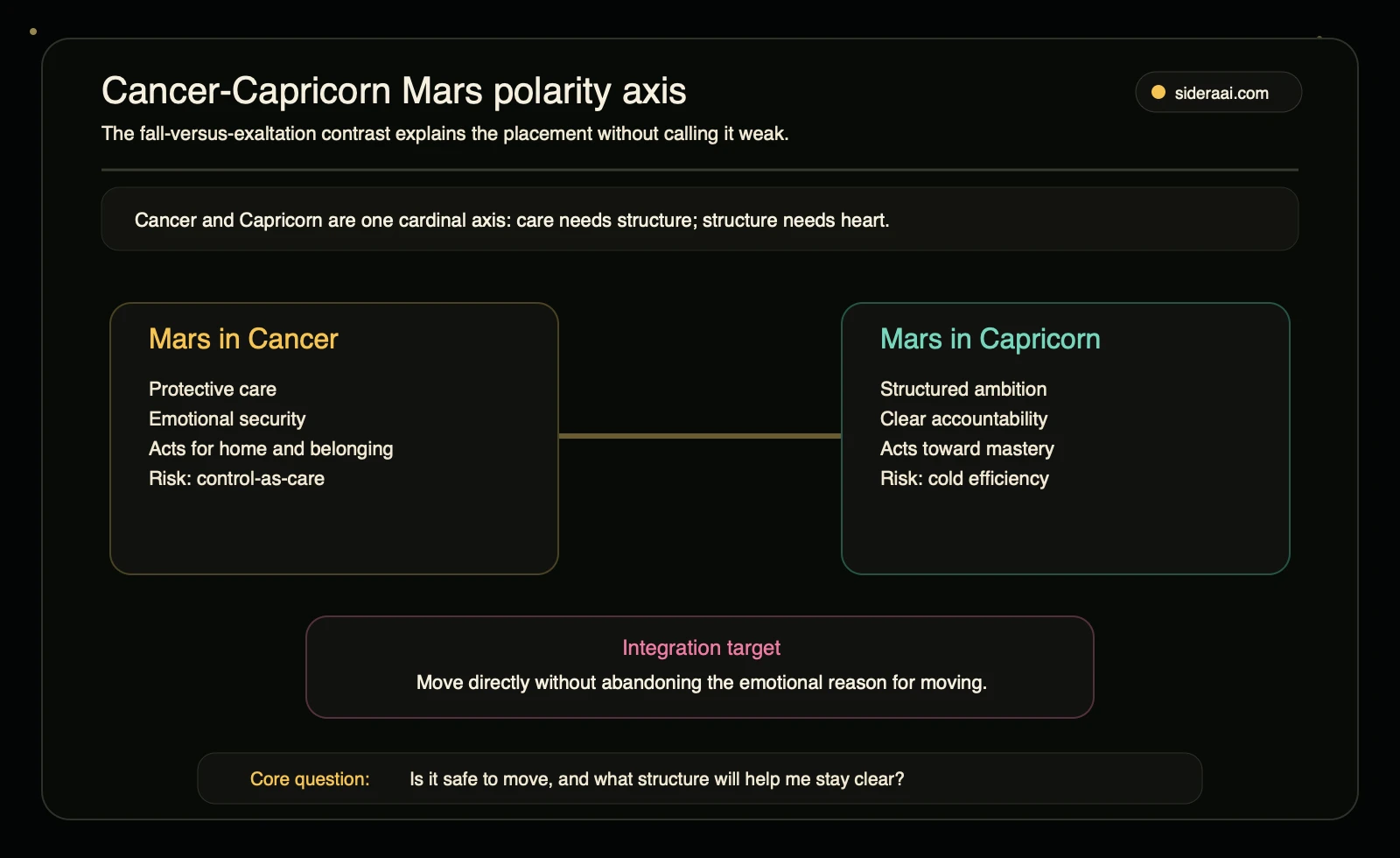
The polarity is not weakness versus strength. Cancer Mars needs Capricorn’s structure while Capricorn Mars needs Cancer’s emotional reason for acting.
Mars in Cancer vs Other Water Sign Mars Placements
All three water-sign Mars placements route drive through emotion - but the emotional register, the target of desire, and the shadow patterns are distinctly different.
| Feature | Mars in Cancer | Mars in Scorpio | Mars in Pisces |
|---|---|---|---|
| Dignity | Fall | Domicile (traditional) | Neutral |
| Core drive | Protective care | Psychological depth and power | Compassionate action or escape |
| What activates | Threat to loved ones / home | Power dynamics, betrayal, intensity | Meaning, compassion, dissolution |
| Anger style | Long-absorbing, eventually volcanic | Slow-building, strategic, enduring | Dissipating or explosive from overwhelm |
| Under pressure | Withdraws, protects, circles | Holds, waits, then strikes precisely | Diffuses, retreats, seeks transcendence |
| Core shadow | Control-as-care, emotional manipulation | Obsession, leverage, revenge | Martyrdom, passivity, avoidance |
| Long-term risk | Overprotection smothering what it loves | Intensity burning through relationships | Sacrificing desire entirely for peace |
| Core question | “Is this safe enough to move on?” | “What will this cost, and is it worth it?” | “Does this serve something larger than myself?” |
Cancer distorts toward protection-as-possession. Scorpio distorts toward depth-as-control. Pisces distorts toward compassion-as-self-erasure. All three water Mars placements are capable of formidable sustained effort - only when emotionally fueled and connected to something that matters.
Mars in Cancer and the Body
Cancer rules the stomach, chest, breasts, and digestive system. When Mars in Cancer is under relational or environmental stress, the body often registers it before the conscious mind does:
- Stomach tension and digestive disruption from holding unexpressed emotion. Mars in Cancer people who are sitting on unexpressed anger or unmet need frequently experience stomach upset, nausea, or digestive issues - the gut processing what hasn’t been said.
- Chest tightness from emotional armor. When the protective instinct is on high alert, Mars in Cancer can experience physical constriction in the chest - the body preparing to defend or retreat.
- Appetite fluctuation as a direct emotional barometer. Loss of appetite under stress; comfort eating when seeking emotional safety.
Reset strategies that work for Mars in Cancer: water-based physical activity (swimming, walking near water), cooking and tending to the home environment, deliberate expression of unexpressed feeling before it compounds into somatic tension.
North Node vs South Node in Cancer for Mars
The lunar nodes add another layer of precision to Mars in Cancer - one that no competitor in astrology content addresses at this depth.
| Placement | What It Means |
|---|---|
| Natal NN in Cancer + Mars in Cancer | Drive and developmental direction fully align. Protective care, emotional action, and home-building are what the soul is here to develop consciously. The question becomes: “Am I using this Mars in Cancer intentionally, or running the emotional protection pattern on autopilot?” Maximum alignment - Mars energy is both what comes naturally and the developmental edge. |
| Natal SN in Cancer + Mars in Cancer | Emotional indirection, protective control, and care-based motivation are the deepest karmic groove. This pattern runs easily and fluently - sometimes too easily. The North Node in Capricorn points toward developing strategic directness, structured ambition, and accountability. The developmental question: “Where am I using Cancer protection to avoid the Capricorn NN work of disciplined, direct action?” |
| Double reinforcement (natal Venus + NN in Cancer) | When natal Mars AND natal NN in Cancer are both present, the drive is maximally aligned with the developmental edge. The soul is here to develop the full Cancer drive - protection, emotional care, home-building - as a conscious spiritual practice rather than a default pattern. |
| Transiting NN in Cancer | During the roughly 18-month window when the transiting North Node moves through Cancer (collective developmental axis), Mars in Cancer natals often feel an amplified call to act from the protective instinct, build homes and families, and trust emotional readiness as a legitimate guide to action. |
The distinction that matters most in natal chart reading: natal NN in Cancer with Mars in Cancer means the familiar emotional drive is the developmental direction - lean into it consciously. Natal SN in Cancer with Mars in Cancer means the same emotional drive is the karmic rut - the soul needs to work toward its Capricorn NN of structured directness and disciplined ambition.
See also: North Node in Astrology and South Node in Astrology for the full nodal framework.
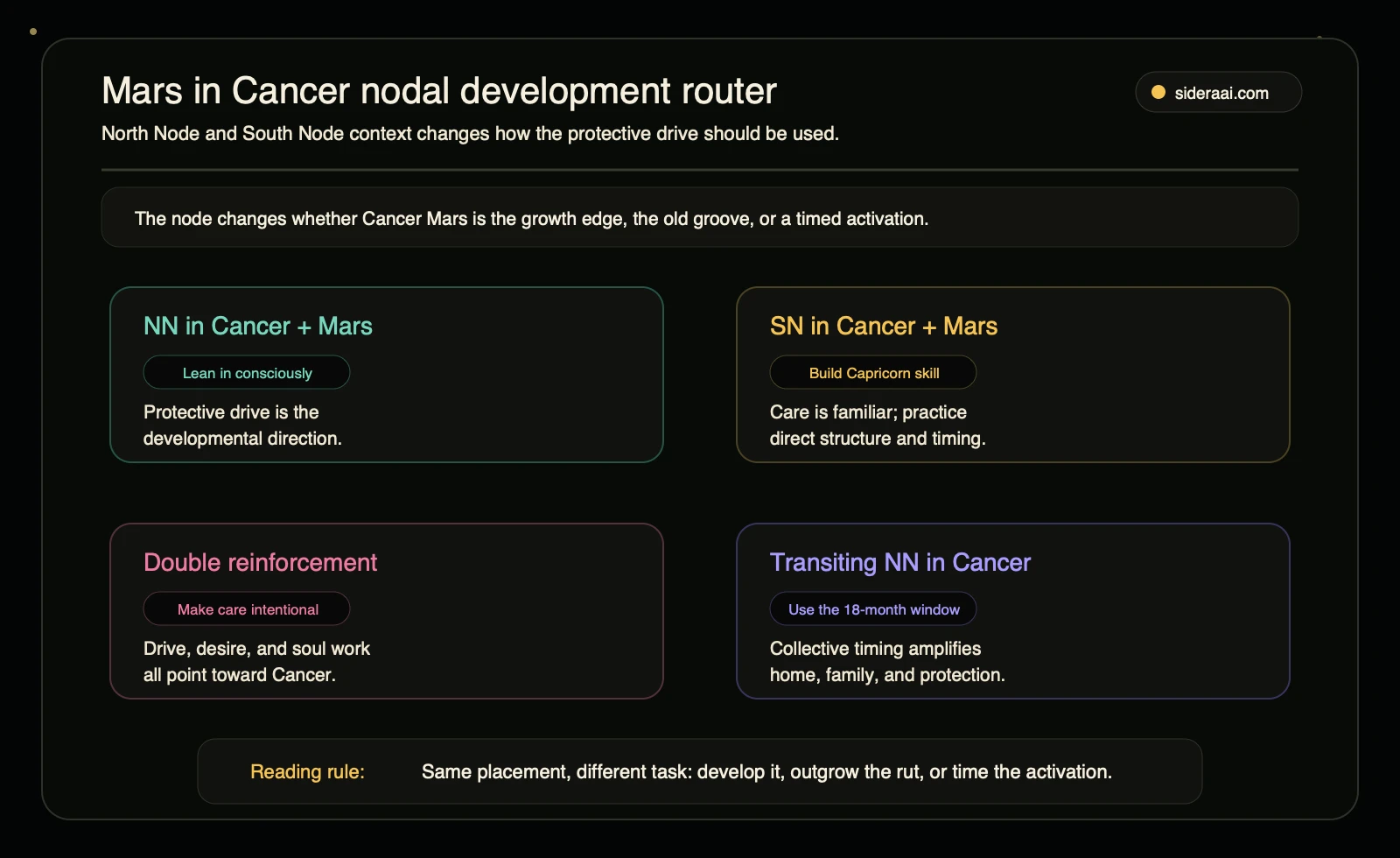
The same Mars in Cancer pattern changes task by node context: consciously develop it, outgrow the old groove, make care intentional, or use a timed activation window.
Mars in Cancer in Synastry
When Mars in Cancer contacts another person’s planets in synastry, the protective, emotionally-routed quality of the drive becomes relational:
Mars conjunct partner’s Moon (especially in Cancer): The most resonant contact for this placement. Mars person’s drive activates around the Moon person’s emotional needs and rhythms. At best: fiercely caring, protective partnership. Risk: Mars person becomes over-protective and emotionally reactive to Moon person’s every fluctuation.
Mars conjunct partner’s Venus: Classic attraction contact. Mars person’s protective, emotionally-nuanced desire activates around Venus person’s love style. Works especially well when Venus person wants to be cared for; can feel smothering if Venus person needs more independence.
Mars square Aries/Libra planets (cardinal-cardinal friction): Cardinal-cardinal friction around pace and approach. Aries planets want direct, fast action; Mars in Cancer takes longer to load and moves indirectly. Libra planets want balanced, diplomatic engagement; Mars in Cancer’s emotional indirection can read as unclear.
Mars trine Scorpio/Pisces planets (water-water resonance): Emotional attunement flows naturally. The risk in water-water connections is mutual enabling - both parties absorbing rather than addressing, building emotional pressure without release.
Mars opposite Capricorn planets (developmental polarity): The exaltation vs fall axis. Capricorn planets represent Mars’s aspirational developmental direction - structured, strategic, direct. This opposition creates friction and pull. Long-term growth potential when both parties are working consciously.
For a deeper look at how these contacts play out across the full chart, see the synastry chart guide.
Mars in Cancer and Career
At work, Mars in Cancer excels in roles that involve:
- Building and maintaining something over time (vs short-cycle projects)
- Caring for or protecting others (healthcare, education, social services)
- Creating environments where others can do their best work
- Work that feels personally meaningful vs abstractly transactional
Mars in Cancer struggles with high-conflict workplace cultures, frequent forced directness, and environments where emotional attunement is read as weakness rather than competence.
Shadow Patterns to Watch
- Emotional manipulation as indirect assertion (using mood as leverage)
- Protective control masquerading as care (limiting others under the framing of keeping them safe)
- Martyr energy (absorbing too much, then using the absorption as currency)
- Action paralysis under emotional disruption (inability to function when the emotional environment feels unsafe)
Check how Mars in Cancer functions in your full birth chart at Sidera - including house placement, aspects, and how Cancer’s protective drive interacts with your other placements.
For related Mars placements in the series: Mars in Astrology
FAQ
Is Mars in Cancer a weak placement? No - fall does not mean weak. It means indirect and emotionally complicated. Mars in Cancer produces formidable drive when activated, especially in protection of loved ones. The placement requires emotional stability to fully function, which makes it context-dependent but not diminished.
Why is Mars considered in fall in Cancer? Mars is exalted in Capricorn (direct, strategic, disciplined) and falls in Cancer (the opposite sign), where Mars’s straightforward drive must operate through the filter of emotion, memory, and self-protection. This creates friction but not weakness - the placement must work harder to express what other placements access easily.
How does Mars in Cancer express anger? Through a long absorption cycle. Grievances accumulate as unspoken hurt, held in the emotional body until the threshold is crossed - then expressed in a release that can seem disproportionate to the immediate trigger because it carries the weight of everything accumulated before it.
What does Mars in Cancer mean in a man’s chart? The same core themes apply. Men with this placement often experience additional tension because cultural norms around masculinity can conflict with the emotionally-indexed, indirect quality of Cancer drive. The protective fierceness is usually present and intense; the indirect assertiveness may be expressed as stoicism rather than acknowledged indirection.
What is Mars in Cancer like in relationships? Deeply protective, emotionally attuned, and intensely loyal once committed. Partners experience consistent caring, domestic investment, and fierce defense when threatened. The challenges are the indirect communication pattern, the emotional absorption cycle that produces sudden eruptions, and the tendency toward control-as-protection.
What attracts Mars in Cancer? Emotional depth, genuine warmth, loyalty over time, domestic competence, and vulnerability paired with stability. Mars in Cancer is repelled by emotional unavailability, carelessness about home and family, and partners who push for directness before emotional safety is established.
How does Mars in Cancer handle rejection? Internally and slowly. The initial response is often to withdraw and protect - the shell closing around the hurt. Processing takes time, often longer than the person around them realizes. Returning to connection requires re-establishing emotional safety, not simply moving past the event.
Mars in Cancer vs Mars in Scorpio: what’s the difference? Both route drive through emotion, but Cancer’s drive is organized around protection and care (motivated by love of what it guards), while Scorpio’s drive is organized around depth and power dynamics (motivated by the intensity of what it wants and the stakes of the engagement). Cancer absorbs and then erupts; Scorpio holds and strikes with precision. Cancer’s shadow is overprotection and control-as-care; Scorpio’s shadow is obsession and leverage.
Is Mars in Cancer good for career ambition? Not primarily through personal ambition. Mars in Cancer thrives when career work connects to something it cares about protecting or building - family welfare, meaningful contribution, creating security. When that connection is present, the sustained effort is extraordinary. When career is purely transactional, Mars in Cancer can underperform because the emotional fuel is absent.
What does North Node in Cancer mean for Mars in Cancer? When natal North Node is in Cancer alongside Mars in Cancer, drive and developmental direction are fully aligned - the soul is here to consciously develop protective care, emotional action, and home-building rather than running these patterns on autopilot. When natal South Node is in Cancer alongside Mars in Cancer, the emotional protection pattern is the deepest karmic groove, and the North Node in Capricorn calls toward developing structured directness and disciplined ambition. See North Node in Astrology for the full framework.
Ready to See Your Personal Birth Chart?
Discover your unique cosmic blueprint — planets, houses, and aspects personalized to your exact birth time and location.
Get Your Birth Chart →✓ Birth chart analysis ✓ Personalized insights ✓ Free to use