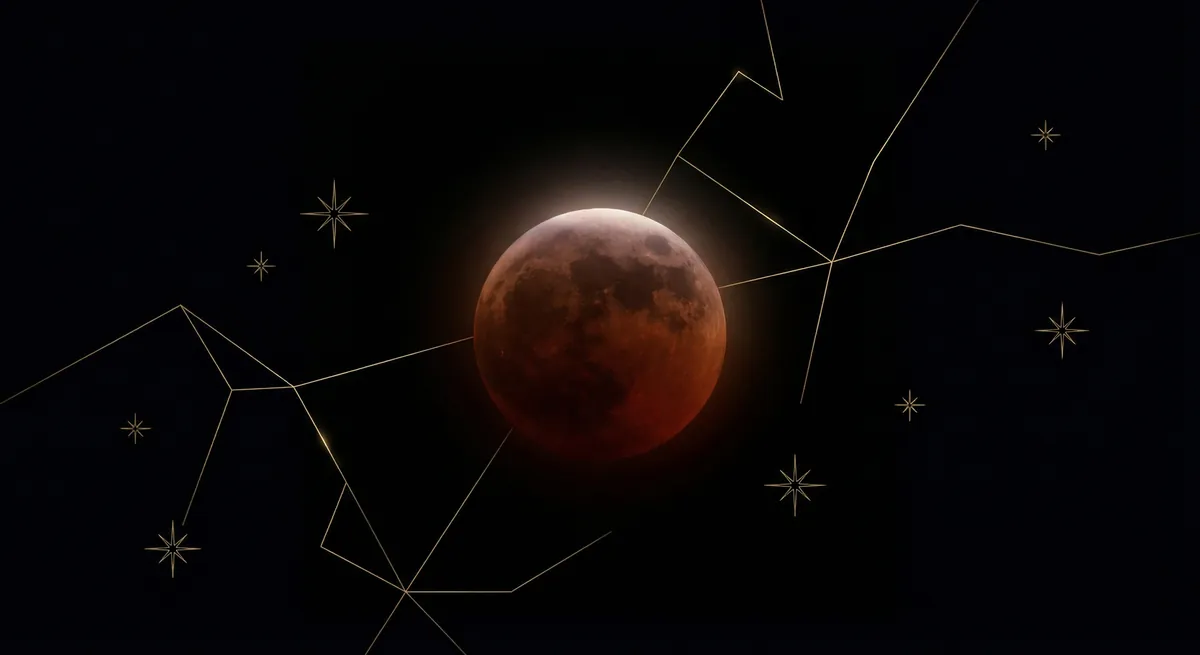
Lunar eclipse - an astronomical event where the Earth passes between the Sun and Moon, casting a shadow that darkens the lunar surface. In astrology, eclipses mark turning points that accelerate change, reveal hidden truths, and reshape life’s direction within weeks.
On August 28, 2026, the sky delivers one of the most dramatic celestial events of the year: a deep partial lunar eclipse that will plunge 96.2% of the Moon into Earth’s shadow. While technically partial, this eclipse will look almost total to the naked eye - a blood-red Moon hanging over the Americas, Europe, and Africa.
This is the final act of an eclipse sequence that began in March 2025. If you’ve felt seismic shifts over the past 18 months, this eclipse closes the chapter.
Key Facts: August 2026 Lunar Eclipse at a Glance
| Detail | Value |
|---|---|
| Date | Friday, August 28, 2026 |
| Type | Deep partial lunar eclipse (96.2% coverage) |
| Greatest eclipse | 4:12 AM UTC |
| Partial phase duration | 3 hours 18 minutes |
| Penumbral duration | 5 hours 38 minutes |
| Umbral magnitude | 0.9319 |
| Saros cycle | 138 (30th of 83) |
| Tropical sign | Full Moon at ~5° Pisces |
| Sidereal sign | Full Moon at ~11° Aquarius |
Where Will the Lunar Eclipse Be Visible?
This eclipse favors the Western Hemisphere. Over 3.5 billion people live within the visibility zone, making it one of the most widely observed eclipses of the decade.
Full visibility (entire partial phase):
- United States and Canada
- Mexico, Central America, and the Caribbean
- All of South America
- Western Europe (UK, France, Spain, Portugal)
Partial visibility (moonset cuts the show short):
- Central and Eastern Europe (Germany, Italy, Poland)
- West Africa and parts of Central Africa
- Middle East (western regions)
Not visible:
- East Asia, Southeast Asia, and Australia
- Most of the Pacific region
“Eclipses are the universe’s way of course-correcting. They don’t ask permission - they rearrange.” - Chani Nicholas, astrologer and author of You Were Born for This
Timeline (UTC)
- 11:23 PM (Aug 27) - Penumbral eclipse begins
- 12:33 AM (Aug 28) - Partial eclipse begins (Moon enters umbra)
- 4:12 AM - Greatest eclipse (96.2% coverage)
- 5:51 AM - Partial eclipse ends
- 7:01 AM - Penumbral eclipse ends
For US viewers, greatest eclipse occurs around 12:12 AM EDT / 9:12 PM PDT on August 27 - prime evening viewing.
Astrological Meaning: The Aquarius-Leo Eclipse Axis
In sidereal astrology, this eclipse falls with the Moon at approximately 11° Aquarius and the Sun at 11° Leo. This activates the Aquarius-Leo axis - a cosmic tension between the collective and the individual, between serving humanity and honoring your personal creative fire.
This is not just any Full Moon. In traditional astrological practice, eclipses are considered to amplify emotional intensity far beyond regular lunations - which is why astrologers have tracked them for over 4,000 years, from ancient Babylon to modern birth chart software. The Saros cycle that governs this eclipse (Saros 138) has been producing eclipses since 1503 AD and will continue until 2983.
What the Aquarius-Leo Axis Means for You
Aquarius energy (Moon): Community, innovation, humanitarian ideals, detachment, the future. The Moon here asks: What greater purpose are you serving?
Leo energy (Sun): Self-expression, creativity, recognition, warmth, personal identity. The Sun here asks: Are you dimming your light to fit in?
The eclipse demands integration - finding how your unique gifts (Leo) serve something larger than yourself (Aquarius). People who’ve been over-giving to causes at the expense of their own joy may snap back. Those who’ve been self-absorbed may suddenly feel the pull toward community.
“The lunar eclipse is the exhale. Whatever the solar eclipse set in motion, the lunar eclipse releases what’s no longer aligned.” - Rebecca Gordon, astrologer and Columbia University professor
The Eclipse Season Context
This partial lunar eclipse arrives just 16 days after the total solar eclipse on August 12, 2026 - making late August 2026 one of the most astrologically charged periods of the entire year. Together, these eclipses create a one-two punch:
- Solar eclipse (Aug 12): New beginnings, fresh seeds planted
- Lunar eclipse (Aug 28): Culmination, emotional release, endings
It also marks the end of an “almost tetrad” - a rare sequence of four consecutive eclipses where three were total (March 2025, September 2025, March 2026) and this final one is partial. Astronomers note that true tetrads (four consecutive totals) occur only about 5 times per century.
How Each Zodiac Sign Is Affected
The sidereal Aquarius eclipse impacts each sign differently based on which house it activates. Here’s what to expect:
Aries: Social circles shift. A friendship may end or deepen dramatically. Group projects reach a turning point. Check your Aries daily horoscope for transit details.
Taurus: Career revelations. Something hidden about your professional path comes to light. A job change or public recognition is possible.
Gemini: Beliefs are tested. Travel plans may change suddenly. An educational pursuit reaches a milestone or needs redirecting.
Cancer: Shared finances or intimacy undergo transformation. Debts, inheritances, or deep emotional bonds demand attention.
Leo: Relationships reach a crossroads. This eclipse opposes your Sun - expect partnership dynamics to shift. Compromise or release.
Virgo: Daily routines and health habits need an overhaul. A work project completes or a health matter demands action.
Libra: Creative projects and romance reach a climax. Children-related matters may surface. Joy demands to be prioritized.
Scorpio: Home and family matters peak. A move, renovation, or family dynamic shifts. Emotional foundations are tested.
Sagittarius: Communication breakthroughs or breakdowns. A sibling relationship evolves. Writing, teaching, or media projects culminate.
Capricorn: Finances recalibrate. Your values around money and possessions shift. A purchase or sale reaches completion.
Aquarius: This is YOUR eclipse. Identity transformation is unavoidable. How you present yourself to the world changes. Embrace reinvention. See your Aquarius daily horoscope for personalized guidance.
Pisces: Hidden matters surface. Dreams intensify. Solitude and spiritual practices become essential. Let go of what you’ve been carrying in secret.
Sidereal vs. Tropical: Why It Matters for This Eclipse
Most Western astrology uses the tropical zodiac, which places this eclipse in Pisces. But the sidereal zodiac - aligned with the actual star constellations - puts the Moon at 11° Aquarius. That’s a 24-degree difference thanks to the precession of equinoxes.
Why does this matter? Because the themes are fundamentally different:
- Tropical Pisces eclipse: Dissolution, spirituality, endings, compassion, escapism
- Sidereal Aquarius eclipse: Innovation, community, rebellion, technology, humanitarian change
The sidereal placement connects this eclipse to Aquarian themes: innovation, technology, community reform, and humanitarian progress. Since sidereal astrology tracks the actual position of planets against the fixed stars, many practitioners find it offers a more astronomically precise framework - especially for eclipses, where the physical alignment of Sun, Earth, and Moon is the whole point.
If you’ve been curious about the difference between tropical and sidereal astrology, this eclipse is a perfect case study. Learn more in our guide to the Full Moon in April 2026, which also explored this fascinating divergence.
Eclipse Rituals and Practical Tips
What TO Do During the Lunar Eclipse
- Journal: Write down what you’re ready to release. Eclipses excel at clearing emotional backlog
- Observe: Simply watch the eclipse. The experience of seeing Earth’s shadow cross the Moon connects you to something ancient
- Rest: Eclipses are energetically intense. Sleep more in the days surrounding August 28
- Reflect on the past 6 months: What began around the February 2026 eclipses? This is its culmination
What NOT to Do
- Don’t start major new ventures. Eclipse energy is unstable - wait 48 hours after the eclipse to launch anything important. If timing matters, electional astrology can help you find the right moment
- Don’t force outcomes. Let the eclipse show you what needs to change
- Don’t panic about “bad” eclipses. Not every ending is a loss - sometimes release is the gift
Moon Water and Crystals
Some practitioners avoid making Moon water during eclipses, as the energy is considered chaotic rather than nurturing. If you do work with crystals, labradorite (transformation), aquamarine (emotional clarity), and amethyst (spiritual insight) align with the Aquarius eclipse energy.
The 2026 Eclipse Sequence
This lunar eclipse is part of a larger story unfolding across 2026:
| Date | Type | Sidereal Sign |
|---|---|---|
| February 17, 2026 | Annular Solar Eclipse | Aquarius |
| March 3, 2026 | Total Lunar Eclipse | Leo |
| August 12, 2026 | Total Solar Eclipse | Leo |
| August 28, 2026 | Partial Lunar Eclipse | Aquarius |
Notice the Aquarius-Leo theme running through the entire year. This axis is demanding evolution - in how we balance personal ambition with collective responsibility.
For more on navigating 2026’s celestial events, check out our comprehensive Blue Moon May 2026 guide, another rare lunar event this year.
Frequently Asked Questions
Is the August 2026 lunar eclipse total or partial?
It’s technically a deep partial eclipse with 96.2% of the Moon entering Earth’s umbral shadow. While classified as partial, it will appear nearly total, with most of the Moon turning a dark copper-red color. Only a thin sliver will remain illuminated.
What time is the lunar eclipse on August 28, 2026?
Greatest eclipse occurs at 4:12 AM UTC on August 28. For the US East Coast, that’s 12:12 AM EDT. For the US West Coast, it’s 9:12 PM PDT on August 27 - perfect evening viewing. The entire partial phase lasts 3 hours and 18 minutes.
Can I see the August 2026 lunar eclipse from the United States?
Yes! The entire eclipse is visible from all 50 US states. West Coast viewers get the best timing with the eclipse peaking during prime evening hours. No special equipment is needed - lunar eclipses are safe to view with the naked eye.
What zodiac sign is the August 2026 lunar eclipse in?
In tropical astrology (most Western horoscopes), the eclipse is in Pisces. In sidereal astrology (aligned with actual constellations), it falls in Aquarius at approximately 11°. The sidereal placement activates themes of innovation, community, and humanitarian ideals.
How long do lunar eclipse effects last in astrology?
Astrological tradition holds that eclipse effects can be felt 1 month before and up to 6 months after the event. The effects tend to peak within 2 weeks of the eclipse date. If the eclipse contacts planets in your birth chart (within 3° orb), effects may be more pronounced and longer-lasting.
Is it safe to look at a lunar eclipse?
Yes, completely. Unlike solar eclipses, lunar eclipses are 100% safe to observe with the naked eye, binoculars, or telescopes. No special filters or glasses are needed.
Should I do manifestation rituals during the lunar eclipse?
Most astrologers advise against active manifestation during eclipses. The energy is unpredictable and better suited for release, reflection, and surrender. Save intention-setting for a regular New Moon and use the eclipse energy to let go of what’s no longer serving you.