You text a friend: “drinks at my place, Friday at 7?” They reply within minutes: “that’s Erev Shabbat for us–could we do earlier, or Sunday instead?”
You apologize and reschedule. No real harm. But you feel it: the moment when your calendar reality and someone else’s are simply not the same evening. Your phone said Friday. Their experience of Friday evening had already become something else at sundown.
This is not a rare glitch. It is a structural feature of how many people move through the world. Hebrew calendar days begin at nightfall. Islamic lunar dates carry religious meaning tied to sunset and lunar month cadence. For millions of people, civil midnight-to-midnight time is not the only time they live by–and almost no planning tool acknowledges the difference.
Most apps let you block “Friday 7pm” without ever knowing that someone at the same table crossed into Shabbat the moment the sun went down. They default to midnight as the universal day boundary and leave every other calendar reality invisible.
Sidera’s Lucky Day Planner includes two layers that address this: Jewish / Halachic timing and Islamic lunar timing. They are not fortune scores. They are calendar-awareness layers that show date context, sunset boundaries, observance markers, and method confidence–with explicit limits about what the app can and cannot know.
If you are building a full timing picture for a decision, compare this calendar-boundary lens with Sidera’s astrology calendar guide, the Chinese Ze Ri good-day system, or the Vedic Muhurta timing layer. The point is not to merge these traditions. It is to notice when civil time, astrological time, and religious calendar time are asking different planning questions.
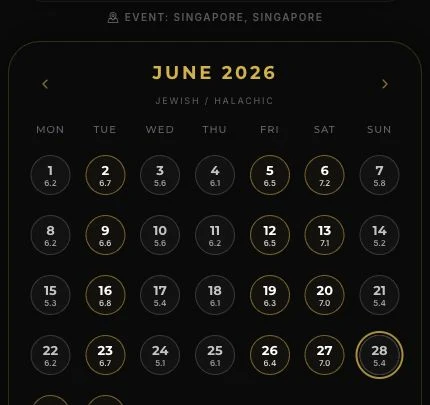
The screenshots throughout this article are real captures from Sidera Lucky Day Planner taken on June 28, 2026, using a neutral Singapore demo profile–not stock images or mockups.
What the Calendar Screens Show
The Jewish / Halachic calendar screen shows a Hebrew cadence day with a 5.4 score. The Islamic lunar calendar screen shows White days with a 6.8 score. Those numbers are planning scores, not religious rulings.
The useful data is the combination: calendar marker, sunset estimate, date conversion, selected-day explanation, and method confidence in one planning view. That is what makes the screenshots different from a generic calendar lookup. They show how Sidera represents uncertainty and authority boundaries inside the UI itself.
When One Evening Holds Two Realities
Imagine you are planning something that matters: a graduation dinner, a family announcement, a product launch. You pick a Saturday and send the invites.
Half your guests read it as a civil Saturday. One family sees it as Shabbat, already in effect from Friday sundown. A colleague is hosting Iftar during Ramadan. Another person in the group keeps a Gregorian workweek with no particular observance, but they have the only car and were planning to leave at 7pm.
You are all looking at the same civil calendar square. You are not all living inside the same calendar reality.
This is the experience that most planning apps simply cannot see. They are built around a midnight-to-midnight model that never asks: for whom does today begin at sundown? For whom does this date carry devotional meaning that a blank square cannot hold?
That is not an astrology question in the traditional sense. It is a planning question with real consequences: events scheduled without awareness of Shabbat or Eid; work events dropped during Iftar hour; meetings set on Jumu’ah; deadlines placed on days that carry sacred rest for part of the team. Most of the time, people manage this friction quietly. But the friction is real, and it compounds when the tool has no language for it.
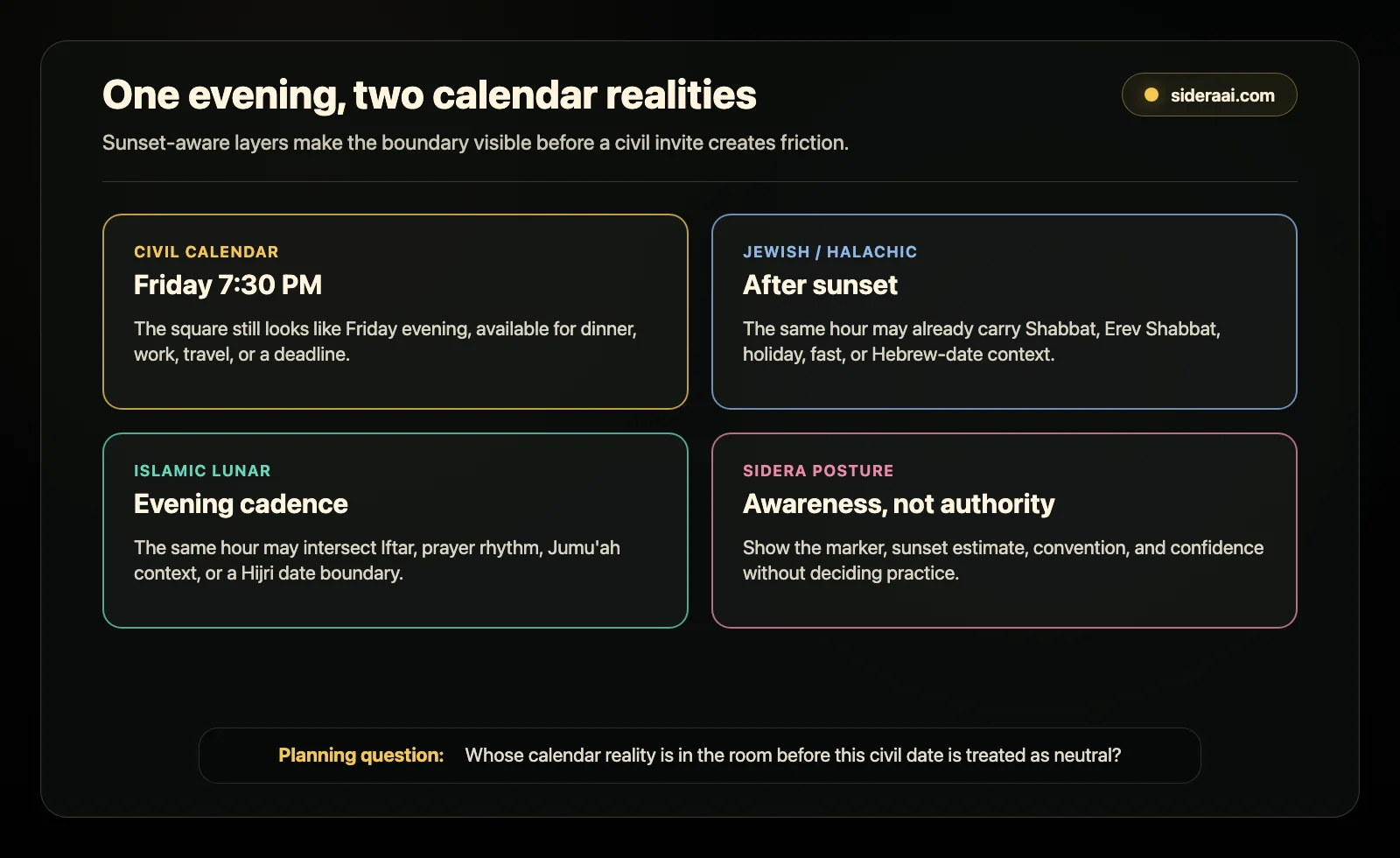
The same civil evening can hold different calendar realities after local sunset. That is the planning problem these layers make visible.
The Specific Feeling of a Dual-Calendar Day
If you have ever lived in a household where two calendar systems run in parallel–or been the person explaining, again, why Friday evening is not just Friday evening–you know the particular texture of that experience.
It is not dramatic. It is small. It is the slightly awkward pause when someone says “let’s just do it tonight” and you have to recalibrate. It is the mental note-keeping you do automatically that the tool never does for you. It is explaining Erev Shabbat to someone who has known you for years and still forgets every few months.
It is also, sometimes, the loneliness of watching a calendar that is built entirely around civil conventions and knowing that it will never flag the one thing that actually structures your week.
Sidera’s sunset-aware layers do not solve this entirely. They do something smaller and more honest: they make the boundary visible in the planning view. They surface that a civil Friday evening holds a different calendar reality for part of the room, and they name the convention they are using to calculate it.
Methodology Box: Why Sunset Changes the Day
The Gregorian calendar changes date at midnight. Many religious calendar contexts do not.
In Jewish calendar practice, days are traditionally reckoned from evening to evening. Chabad’s overview of Jewish days describes holidays and the Shabbat as beginning at nightfall. Yale University Library’s Hebrew calendar overview summarizes the Hebrew calendar as lunisolar, built around lunar months coordinated with the solar year.
In Islamic practice, lunar months and religious dates may depend on crescent visibility, community convention, and sunset boundaries. Civil calendars such as Umm al-Qura provide reproducible calculated dates, but those dates are not the same thing as every local moon-sighting practice.
For a planning app, the implication is concrete: do not treat midnight as the only meaningful date boundary. Show when the Hebrew date and the civil date diverge after sunset. Show when a Hijri observance day depends on the sunset time in the user’s location.
Real Example: The Friday Dinner That Is Not Just Friday
Say a team dinner is proposed for Friday at 7:30pm. On the shared work calendar, it is just Friday evening. For an observant Jewish colleague, it may already be Shabbat. For a Muslim colleague during Ramadan, that same hour may sit inside Iftar or evening prayer rhythm. For someone else, it may be the only practical slot after work.
No one is wrong about the time. They are using different calendar realities to describe the same evening. A sunset-aware planning layer helps the organizer notice that before the invite becomes an awkward negotiation.
The same friction can be more private. In a mixed-observance family, one person may keep explaining why a “normal” Saturday plan already began the night before, or why a holiday rhythm is not visible on the shared calendar. After enough repetitions, the issue is no longer convenience. It is the fatigue of having to translate your calendar reality before anyone treats it as real.
Sidera’s Jewish / Halachic Timing Layer
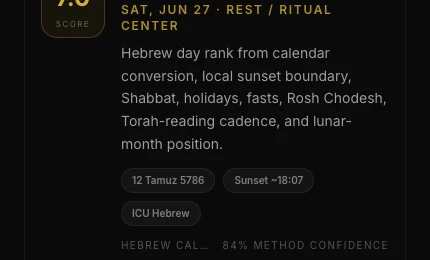
Lucky Day Planner’s Jewish / Halachic system converts the Gregorian date to a Hebrew calendar context and estimates local sunset using the user’s location and timezone where available.
The selected day panel can show:
- Hebrew date and context
- Shabbat or Erev Shabbat
- Rosh Chodesh
- major holidays
- minor holidays
- fasts
- Omer count
- Torah-reading cadence
- Tuesday tov marker
- sunset estimate
- method confidence
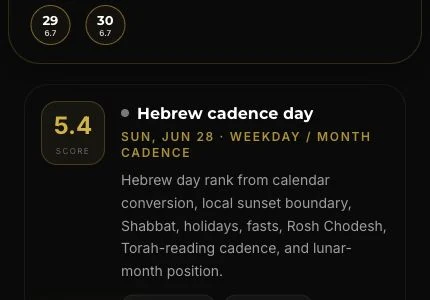
In the June 2026 example, the selected day is shown as a Hebrew cadence day with a 5.4 score. That score is not a “good luck” rating. It is a planning rank based on how significant the calendar marker is within the timing view. The meaning comes from what the marker actually says: weekday cadence, month cadence, and day boundary.
The 84% method confidence reflects that the app had location and timezone data available and was able to produce a usable sunset estimate. If location data is missing, method confidence drops and sunset estimates become less precise.
How to read this screen. Read the marker first: Shabbat, Erev Shabbat, Rosh Chodesh, holiday, fast, or ordinary Hebrew date. Then check the sunset estimate, because the civil date may change meaning after evening begins. Finally, read method confidence as a reliability signal for the calendar and location inputs, not as religious authority.
What This Jewish Layer Is Not
Sidera is direct about what this layer does not do.
It is not:
- a rabbinic ruling engine
- a minute-level zmanim calculator
- a replacement for community custom or authority
- a complete holiday observance guide
- a tool for deciding halachic obligations
It is a calendar-awareness layer. It can remind a user that a date has Shabbat, holiday, fast, Rosh Chodesh, or sunset-boundary context. For practice-specific guidance, users should follow their community, calendar, rabbi, or trusted halachic source.
That limitation is not a weakness. It is the only honest way to include this layer in a general planning app. Overclaiming religious authority would make the app less trustworthy, not more useful.
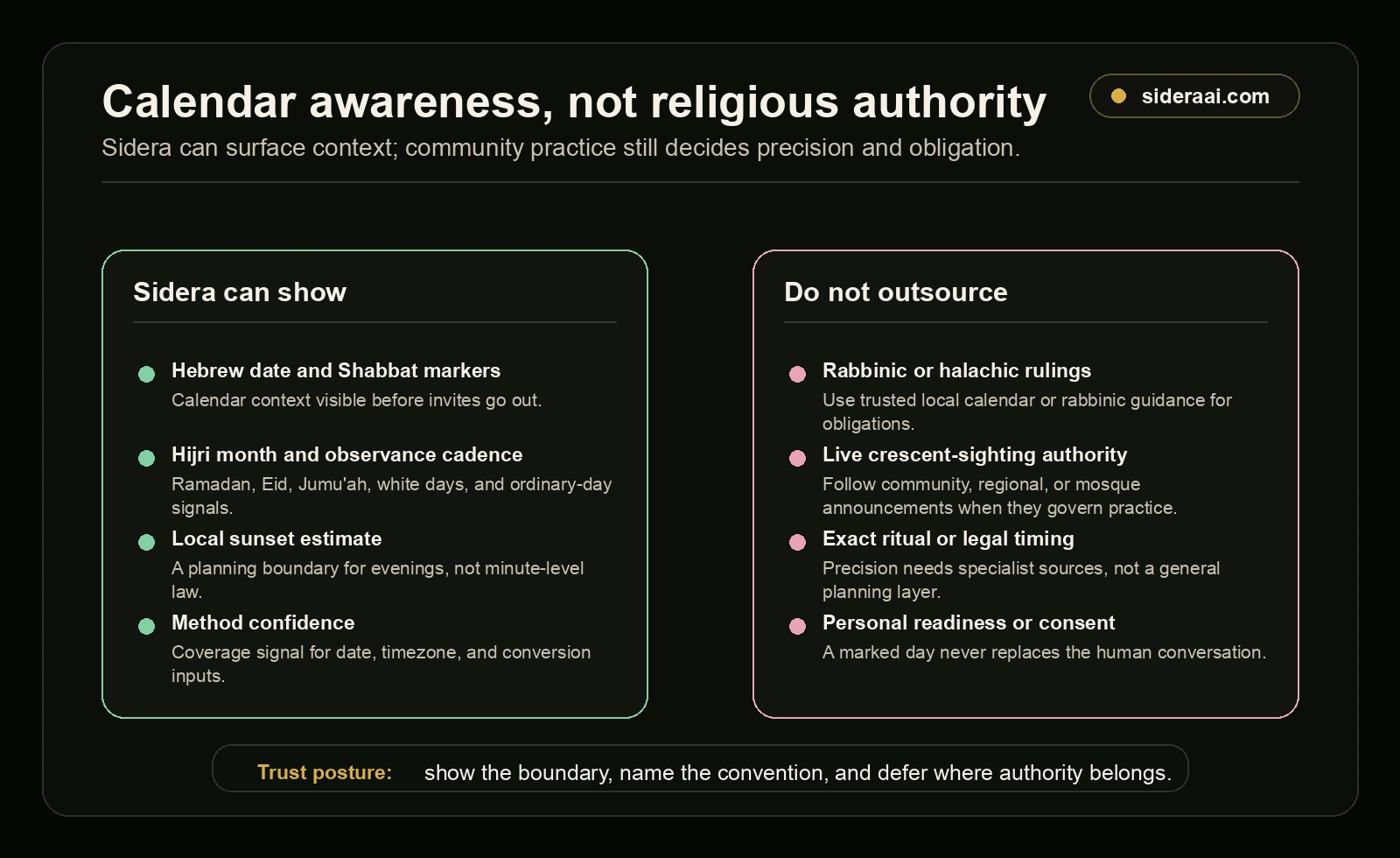
Sidera can show calendar context, sunset estimates, and method confidence. Community practice still owns precision, obligation, and authority.
For external Jewish calendar tools, Hebcal is widely used for Hebrew dates, holidays, candle-lighting times, and Torah readings.
Hebrew Date After Sunset: The Practical Problem
“Hebrew calendar date after sunset” is a common point of confusion: why does a holiday appear to start the evening before the civil date?
The answer is structural. The Hebrew day begins at nightfall. If a planning app only checks the civil date at noon, it may show “Friday” without flagging that a user’s community has already transitioned into Shabbat by 7pm.
This is the specific planning failure that Sidera’s layer is designed to surface. A friend scheduled for “Friday evening” may be unavailable from sunset. A family event planned “Saturday morning” may mean different things to people at the same table depending on whether they are observing the Saturday as a civil day or as Shabbat.
Lucky Day Planner shows sunset-aware metadata to make this visible. The sunset estimate is approximate and should not be treated as minute-level precision. But it is meaningfully better than pretending every date begins at midnight for every user.
Sidera’s Islamic Lunar Timing Layer
The Islamic lunar system in Lucky Day Planner converts the Gregorian date to a Hijri context and estimates local sunset where possible.
The selected day can show:
- Ramadan and its devotional arc
- last ten nights of Ramadan
- Eid al-Fitr
- Arafah
- Eid al-Adha days
- white days
- Jumu’ah
- lunar month boundary
- Monday/Thursday voluntary fast cadence
- ordinary Hijri cadence
- sunset context
- method confidence
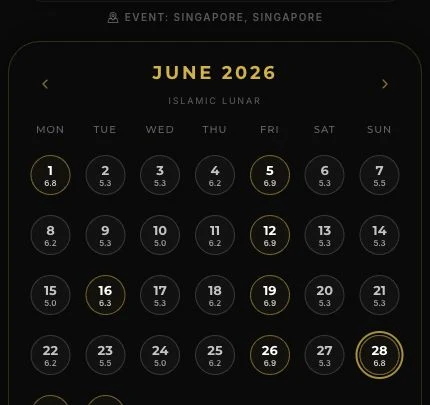
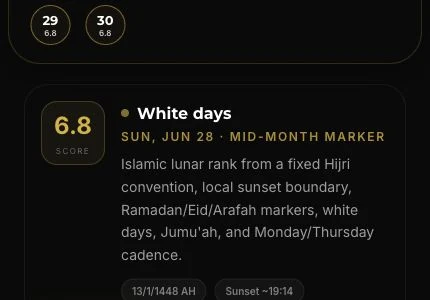
In the June 2026 screenshot, the selected day is labeled “White days” with a 6.8 score. That label points to a mid-month lunar marker, not a universal fortune verdict. The Hijri cadence continues regardless.
What Ramadan Looks Like in a Civil Calendar
For people who observe Ramadan, the civil calendar carries almost no useful information. Thirty squares that say nothing about the month-long shift in sleep schedules, meal timing, communal prayers, and daily rhythms. No marker for Iftar. No flag for the last ten nights. No signal for the transition into Eid.
If you have ever tried to schedule a team event with colleagues who are observing Ramadan–or tried to plan a social gathering during Iftar hour without realizing it–you know the friction this creates. The civil calendar invited you into a time that was already someone else’s most important moment of the day.
The Islamic lunar layer in Lucky Day Planner makes some of this visible before the invites go out. It does not replace community knowledge, local announcements, or personal religious practice. But it shows, at the planning stage, that a given civil date carries Hijri meaning that a blank square would never surface.
Jumu’ah on Friday, white days near the middle of the lunar month, and Monday/Thursday fasting cadence are all legible in the UI. These are not generic lucky-day labels. They are calendar and devotional markers that help a user recognize when a date has significance that civil time does not record.
Hijri Date After Sunset: The Design Choice
The phrase “Hijri date after sunset” matters because Islamic dates are lunar and religious days commonly begin at sunset. In practice, communities differ: some follow local moon sighting, some follow national or regional announcements, and some use calculated civil calendars.
Sidera uses fixed/civil Hijri conversion where available. That makes the UI reproducible and consistent. It does not make it universally authoritative. Some communities will observe dates a day earlier or later depending on local moon sighting.
The right posture is to show the convention being used, show the date context, show sunset awareness, flag method confidence, avoid claiming live moon sighting, and avoid replacing local religious authority.
For general Islamic calendar background, organizations such as Islamic Relief note that dates can depend on moon sightings. For reproducible calculated convention, the Umm al-Qura calendar is one widely used reference point.
What These Two Systems Share
Jewish and Islamic calendars are different traditions with different structures, authorities, and lived rhythms. They should not be collapsed into one category.
But they share a planning lesson: different people can be living in genuinely different calendar realities at the same moment.
This is worth sitting with–not as a slogan, but as a social fact.
When someone in your life says “that’s Shabbat” or “I’m fasting that week” or “Eid falls right in the middle of the trip,” they are describing an experience of time that is not legible in civil calendars. They are not asking you to adopt their calendar. They are noting that the shared civil square you are both looking at holds a completely different reality for them after sundown.
A better planning app does not collapse that difference. It surfaces it. It lets the person planning see that a Friday evening is a specific kind of Friday evening for part of the room, and gives them enough information to ask the right question before the invites go out.
What Most Guides Miss
Most content about Jewish and Islamic calendar apps focuses on the calendar lookup: “this app shows Hebrew dates.” What they miss is the planning layer underneath.
The planning question is not “what is the Hebrew date today?” The planning question is “does this date I just chose mean something different to someone I am planning with?” Those are different questions. The first is informational. The second is relational.
Sunset-aware calendar layers are useful not because they tell you the Hebrew or Hijri date. They are useful because they interrupt the assumption that civil midnight-to-midnight time is the only time system at the table.
That interruption is the actual value. And it only works if the app also tells you what it does not know: local customs, community variation, live moon sighting, minute-level precision, rabbinic authority. Sidera’s method confidence display and explicit limits are not disclaimers bolted on at the end. They are the interface being honest about the boundary between calendar awareness and religious authority.
Decision Tree: When to Check the Sunset-Aware Layers
Use the Jewish / Halachic or Islamic lunar layer when the date involves people, communities, or observances that might not follow a midnight-only calendar:
| Planning situation | Check this layer | Why it matters |
|---|---|---|
| Friday evening dinner, meeting, or deadline | Jewish / Halachic | The civil evening may cross into Shabbat or Erev Shabbat context |
| Event during Ramadan | Islamic lunar | Iftar, fasting rhythm, and evening prayer can change how the time lands |
| Family gathering with mixed observance levels | Both, when relevant | One civil date may carry different meanings for different relatives |
| Public launch or announcement near a holiday | Relevant tradition-specific layer | The date may be socially or devotionally loaded for part of the audience |
| Exact ritual or legal religious timing | Do not rely on Sidera alone | Use community authority, local calendar, rabbi, imam, or trusted religious source |
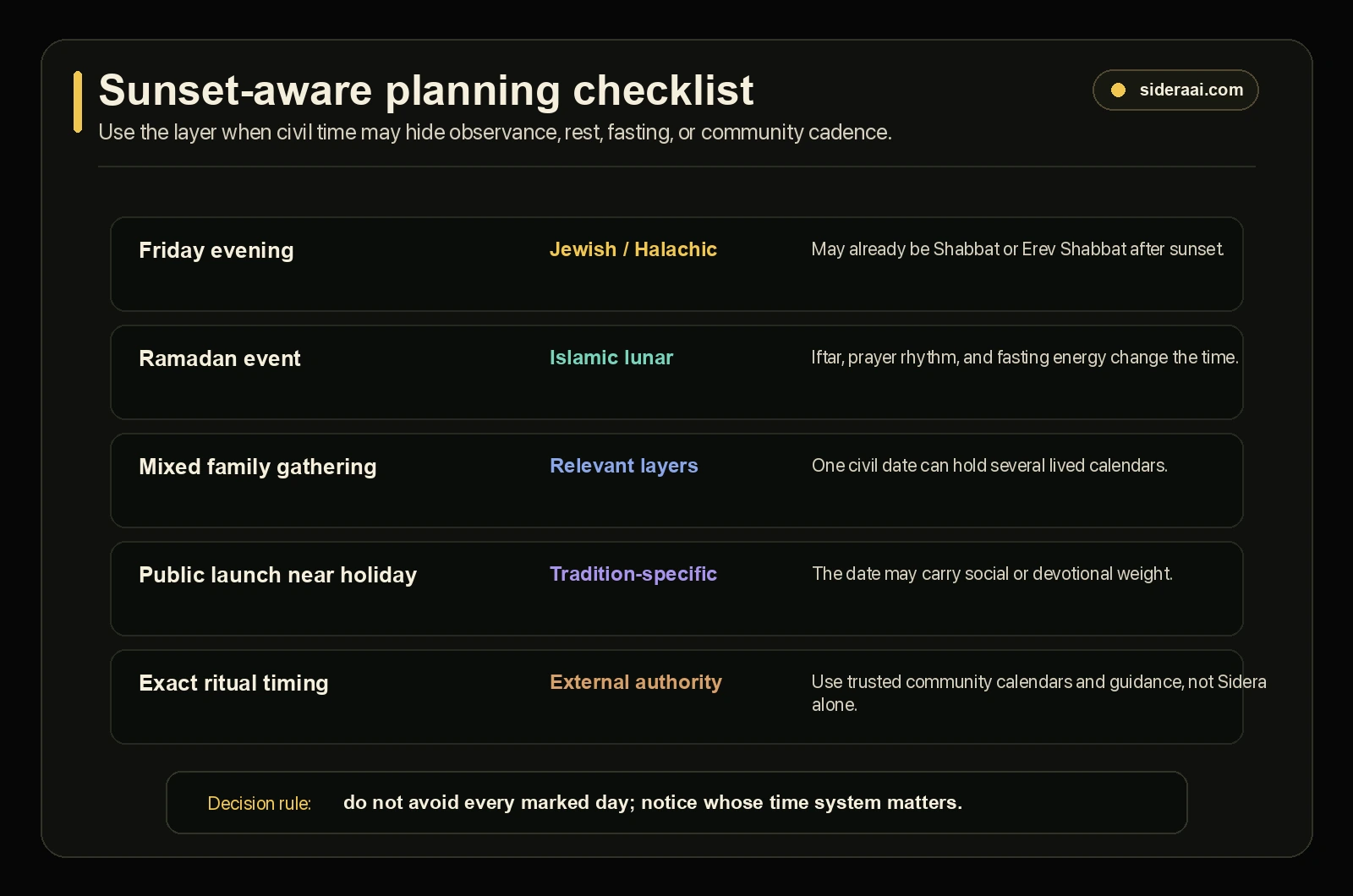
Do not avoid every marked day. Use the checklist to notice whose time system matters before the invite, deadline, or gathering is finalized.
The decision tree is not “avoid every marked day.” It is “notice whose calendar reality is in the room before you treat the civil date as neutral.”
How to Use These Layers in Sidera
Use the Jewish / Halachic and Islamic lunar tabs when calendar observance, holiday context, rest cadence, fasting cadence, or sunset-aware date boundaries might affect a plan.
Practical uses:
- Scheduling an evening event and wanting to check whether it crosses a Shabbat or Erev Shabbat boundary before invites go out.
- Planning a team event during a period that includes Ramadan for part of the group.
- Wanting to understand why someone you care about treats Friday evening as a different kind of time.
- Comparing dates for a family gathering and needing a reminder that civil time is not the only calendar reality present.
- Checking when white days, Jumu’ah, or a lunar month boundary falls within a planning window.
Do not use these layers to override rabbinic guidance, local imam or community announcements, medical advice for fasting, legal deadlines, or family and community expectations. The app shows context. Community and tradition hold the authority.
Check sunset estimates before scheduling evening events. If a planned dinner, meeting, or reminder crosses a sunset boundary, the Hebrew or Hijri layer shows when the date context shifts. That matters for invitations sent to contacts who observe those systems.
Update location input when sunset precision matters. If method confidence reads low because no location is available, providing a city or timezone improves sunset estimates.
Compare the civil date and the Hebrew or Hijri context together. A Friday on the civil calendar is also Jumu’ah in the Islamic layer and may be Erev Shabbat in the Jewish layer. Seeing both in the same view helps users who hold multiple calendar contexts without needing to switch between separate apps.
Common Mistakes With Sunset-Aware Calendar Timing
The first mistake is treating Sidera’s score as religious authority. A Shabbat marker, Hijri date, or method confidence value can help with awareness. It cannot decide observance, obligation, community practice, or ritual timing.
The second mistake is assuming the same civil date means the same lived day for everyone. Friday evening may be work time, Shabbat time, Iftar time, travel time, or rest time depending on the person and season.
The third mistake is ignoring method confidence. A sunset estimate with location context is more useful than a generic date conversion. If location data is missing or the community follows a different convention, the app should be treated as a prompt to check, not as the final answer.
The Question Worth Asking
The most useful thing a sunset-aware calendar layer can do is prompt a question you were not planning to ask.
Not “what is today’s Hebrew date?” Not “what score does Sidera give this Shabbat?” But something closer to: whose calendar reality am I planning inside right now?
That question does not have a universal answer. It depends on who is in the room, who is on the invite list, who you are trying to share time with. Civil calendars assume one time system. Real life contains more than one.
Sidera’s Jewish and Islamic layers will not resolve that for you. They will make the boundary visible. They will name the convention they are using. They will show the sunset estimate and the method confidence. They will be honest about what they do not know.
What you do with that information is still yours to figure out. But at least the calendar will have told you there was something to figure out.
Related Sidera Guides
Continue with these closely related guides: