
Jupiter in astrology represents where you grow: the sector of life where opportunity, abundance, and wisdom accumulate most naturally. Excess, in turn, becomes the shadow side of every gift.
Jupiter is the largest planet in the solar system, and its role in astrology matches its size. Known traditionally as the Great Benefic, Jupiter is the planet of expansion: of knowledge, luck, wealth, faith, and possibility. Where Mars is the planet of action and Venus the planet of desire, Jupiter is the planet of meaning. It asks the biggest question a chart can ask: what does all of this add up to?
But Jupiter is not purely good fortune dispensed from the sky. It amplifies whatever it touches, including problems. And it has a shadow side that shows up consistently when its gifts are mistaken for permission to skip the work.
What Does Jupiter Represent in Astrology?
Jupiter rules the principle of growth, expansion, and seeking. Its core domains in the birth chart include:
Abundance and Luck: Jupiter is associated with good fortune, but a more precise framing is this: Jupiter shows where the natural flow of life tends to reward you. It’s less “random luck” and more “areas where effort compounds faster than average.”
Philosophy and Belief: Jupiter rules Sagittarius, the sign of higher truth, and this connection runs deep. Jupiter governs your worldview: the lens through which you interpret experience, the ideologies and belief systems that give your life structure and meaning.
Learning and Wisdom: Jupiter governs higher education, long-distance travel, and any pursuit that broadens your understanding of the world. It’s the planet of the teacher, the scholar, the seeker, and the pilgrim.
Generosity and Optimism: Jupiter-influenced people tend toward warmth, optimism, and a natural inclination to share what they have. The shadow of this is largesse without boundaries: giving or promising more than you can sustain.
Growth and Opportunity: In transit and in the natal chart, Jupiter marks the areas of life most ripe for expansion. A Jupiter transit to the 2nd house often coincides with financial growth. A Jupiter transit to the 7th often brings significant relationships. For a deeper look at how Jupiter transits interact with money timing, see Jupiter transits and wealth timing.
As Robert Hand writes in Horoscope Symbols (1981): “Jupiter represents the urge to grow and expand beyond present limitations, to seek out new experiences and assimilate them into a larger whole.”
Jupiter vs. the Personal Planets
Jupiter occupies an important middle position in the planetary hierarchy. The personal planets, which are the Sun, Moon, Mercury, Venus, and Mars, are individual and fast-moving, describing you specifically. The outer planets, namely Uranus, Neptune, and Pluto, are generational and slow, describing collective forces that shape entire cohorts.
Jupiter (along with Saturn) sits in between as a social planet. It completes one full orbit in approximately 11.86 years, moving through each zodiac sign for roughly 12 to 13 months at a time. This pace is fast enough to be personally significant but slow enough to reflect shared generational themes within a few-year window.
This matters because Jupiter’s gifts tend to operate at the intersection of the personal and the social: opportunity, education, travel, religion, law, and cultural participation are all Jupiterian domains where individuals meet larger structures.
Jupiter’s Dual Rulership
Jupiter traditionally rules two signs: Sagittarius and Pisces. Modern astrology assigned Pisces to Neptune, but traditional and classical astrologers still use Jupiter for both, and the connection to Pisces remains meaningful even in modern practice.
Jupiter in Sagittarius mode operates through the outward, philosophical dimension: exploration, belief systems, higher education, international travel, and the pursuit of truth through experience. It’s the Jupiter that says “go further, expand the horizon, seek the next mountain.”
Jupiter in Pisces mode operates through the inward, spiritual dimension: compassion, faith, boundlessness, mystical experience, and the dissolution of limiting definitions of self. It’s the Jupiter that says “you are connected to something larger.”
Both modes express Jupiter’s core function: movement beyond current limits. But they move in opposite directions, one outward into the world and one inward into the soul.
Jupiter Dignity: Where It Thrives and Struggles
| Dignity | Sign | Meaning |
|---|---|---|
| Domicile | Sagittarius, Pisces | Most natural expression; abundant and confident |
| Exaltation | Cancer | Exceptionally nurturing, emotionally generous growth |
| Detriment | Gemini, Virgo | Expansion scattered (Gemini) or over-analyzed (Virgo) |
| Fall | Capricorn | Growth slows; luck is earned through discipline, not freely given |
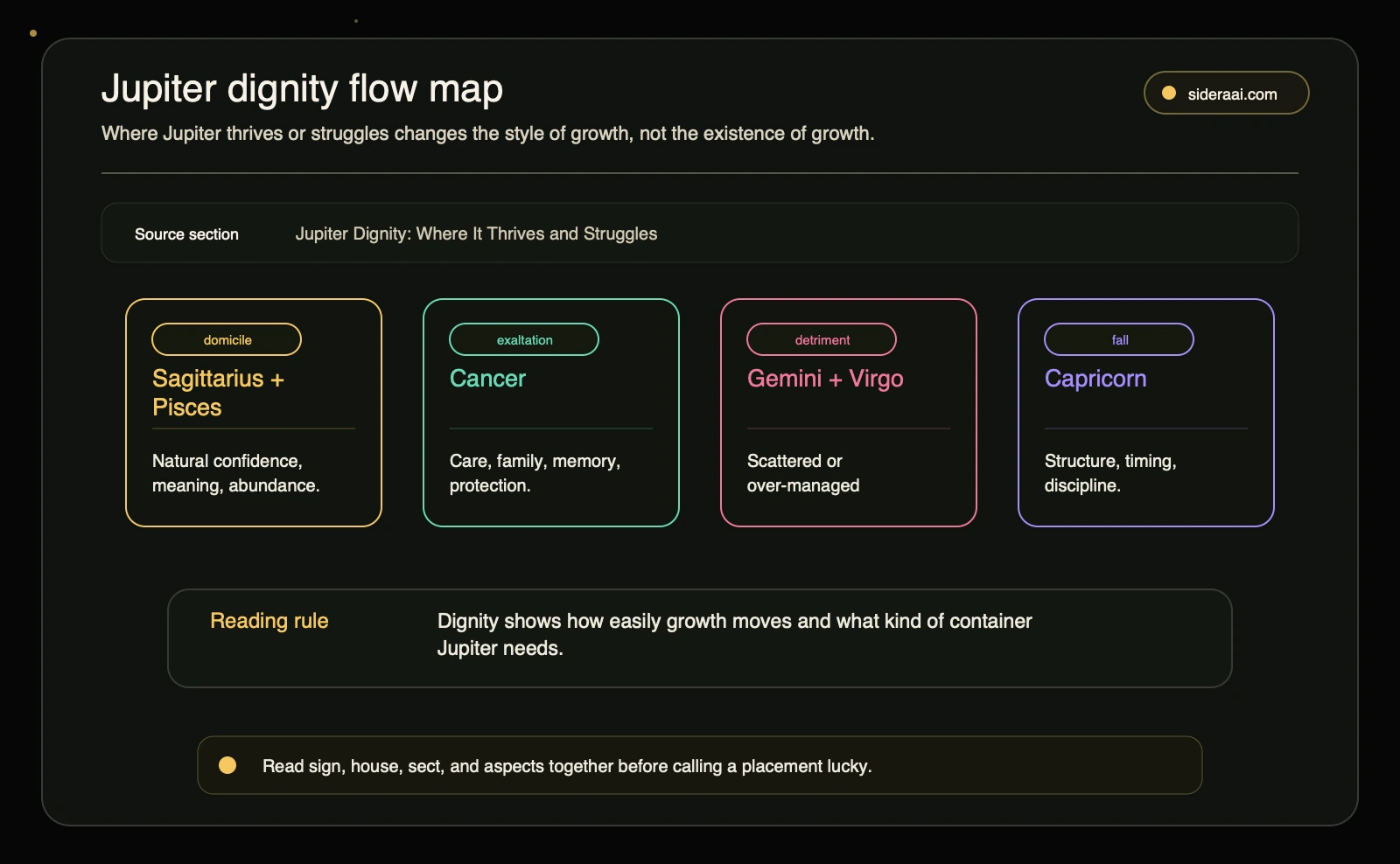
Use the dignity map as a quick reference for how Jupiter’s growth style changes by sign condition before reading the house, sect, and aspects.
Jupiter in Cancer, its exaltation sign, is considered one of the most fortuitous natal placements for abundance related to home, family, and emotional intelligence. Jupiter in Capricorn (its fall) does not deny success, but the path is longer and more structured; the rewards come through sustained effort rather than fortunate timing.
Understanding your Jupiter’s dignity status from your birth chart gives you a practical baseline for how easily Jupiterian gifts flow in your life.
The Jupiter Permission Dynamic
One of the most practically useful framings of Jupiter in the birth chart is the permission planet concept: Jupiter’s house and sign placement often reveals where you unconsciously give yourself permission to receive abundance, and where you may block or dismiss opportunity when it arrives.
Jupiter in the 2nd house tends to feel permission to accumulate resources naturally. Jupiter in the 10th house often feels permission to rise publicly, to aim high in career. Jupiter in the 12th house, one of the more layered placements, may give permission to receive spiritual gifts but sometimes struggles to claim material abundance visible to others.
Noticing your Jupiter placement and asking “do I actually let myself receive what Jupiter promises?” can be a revealing exercise in understanding where invisible self-limits operate.
Jupiter and Chart Sect: Day Chart vs Night Chart
Here’s a distinction almost no beginner astrology guide covers, but it significantly affects how Jupiter operates in your chart.
Traditional astrology divides charts into two types based on whether the Sun is above or below the horizon at birth:
- Day chart (diurnal): The Sun is above the horizon, meaning you were born between sunrise and sunset.
- Night chart (nocturnal): The Sun is below the horizon, meaning you were born between sunset and sunrise.
This distinction is called sect, and it changes which planets are most active and supportive in your life.
Jupiter is a diurnal planet, which means it operates most fully and visibly in day charts. If you were born during the day, Jupiter is what traditional astrologers call “in sect”: it functions with full expression, providing opportunities and expansion that are more publicly visible and easier to claim.
If you were born at night, Jupiter is out of sect. It doesn’t disappear, but it tends to operate more quietly, more internally, or through behind-the-scenes channels rather than obvious windfalls. Night chart Jupiter luck often requires more intentional claiming than day chart Jupiter luck.
Meanwhile, Venus becomes the more powerful benefic in a night chart, delivering its gifts with greater ease and visibility for nocturnal natives.
How to check your sect: Look at your natal chart. If the Sun is in houses 7 through 12 (above the horizon), you have a day chart. If the Sun is in houses 1 through 6 (below the horizon), you have a night chart. You can find your complete chart with this detail at Sidera’s birth chart calculator.
Practical insight: If you have a night chart and Jupiter doesn’t seem to deliver the obvious luck you expect, this is likely why. Your Jupiter is real and active, but its mode is more private and earned than effortless.
No mainstream beginner astrology resource explains this practical day/night chart Jupiter distinction, but traditional practitioners consider it one of the most reliable tools for understanding why the same Jupiter placement behaves differently across two people with the same sign.
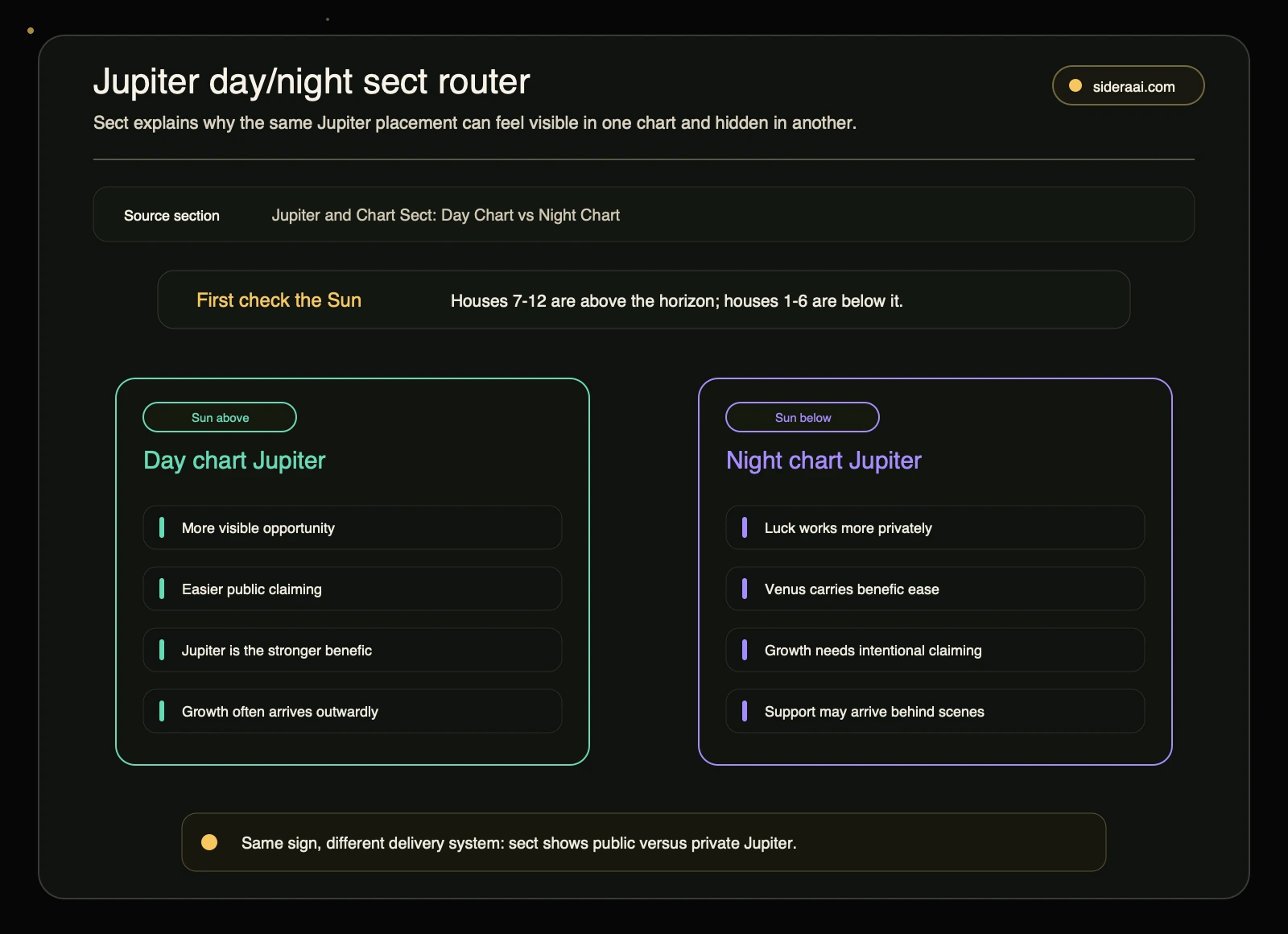
The sect router shows why Jupiter can feel publicly available in a day chart and more private or intentionally claimed in a night chart.
The Jupiter Trap
Jupiter’s shadow isn’t malice: it’s excess. Because Jupiter expands whatever it touches, it can expand problems as readily as gifts. Jupiter in the 7th house can attract significant partnerships, but it can also produce a pattern of taking on partners’ problems as your own, or attracting people who overpromise.
Common Jupiter traps include:
- Overconfidence: Assuming luck will cover for lack of preparation
- Overextension: Saying yes to everything, committing beyond capacity
- Philosophical dogmatism: Certainty about one’s own belief system that closes off learning from others
- Excess: Jupiter rules indulgence. Food, travel, spending, and ambition can all tip into excess under strong Jupiter influence
The key with Jupiter is learning to expand without losing discipline. Jupiter paired with Saturn (either by transit, aspect, or careful planning) usually produces the best outcomes: vision with structure.
Jupiter Retrograde
Jupiter spends approximately 120 days per year in retrograde motion, a period when its expansive energy turns inward. This happens once per year and lasts roughly four months.
Jupiter retrograde does not indicate bad luck or blocked opportunity. Instead, it signals a period of internal review and course-correction for Jupiter themes. Where you’ve overextended, Jupiter retrograde often surfaces the consequences. Where you’ve been genuinely building, Jupiter retrograde often deepens the foundation.
Howard Sasportas observes in The Twelve Houses (1985) that Jupiter retrograde in the natal chart often correlates with a person who internalizes their belief systems and philosophical growth rather than broadcasting them outward. Their luck is more personal and less publicly visible, but no less real.
Key things to know about Jupiter retrograde:
- Occurs once per year for approximately 120 days
- Best used for reviewing, revising, and deepening existing Jupiter themes rather than launching new ones
- If you were born with Jupiter retrograde in your natal chart, your growth path may operate more inwardly or take longer to become externally visible
- Jupiter retrograde transits across personal natal planets can trigger significant internal reassessment of where and how you seek expansion
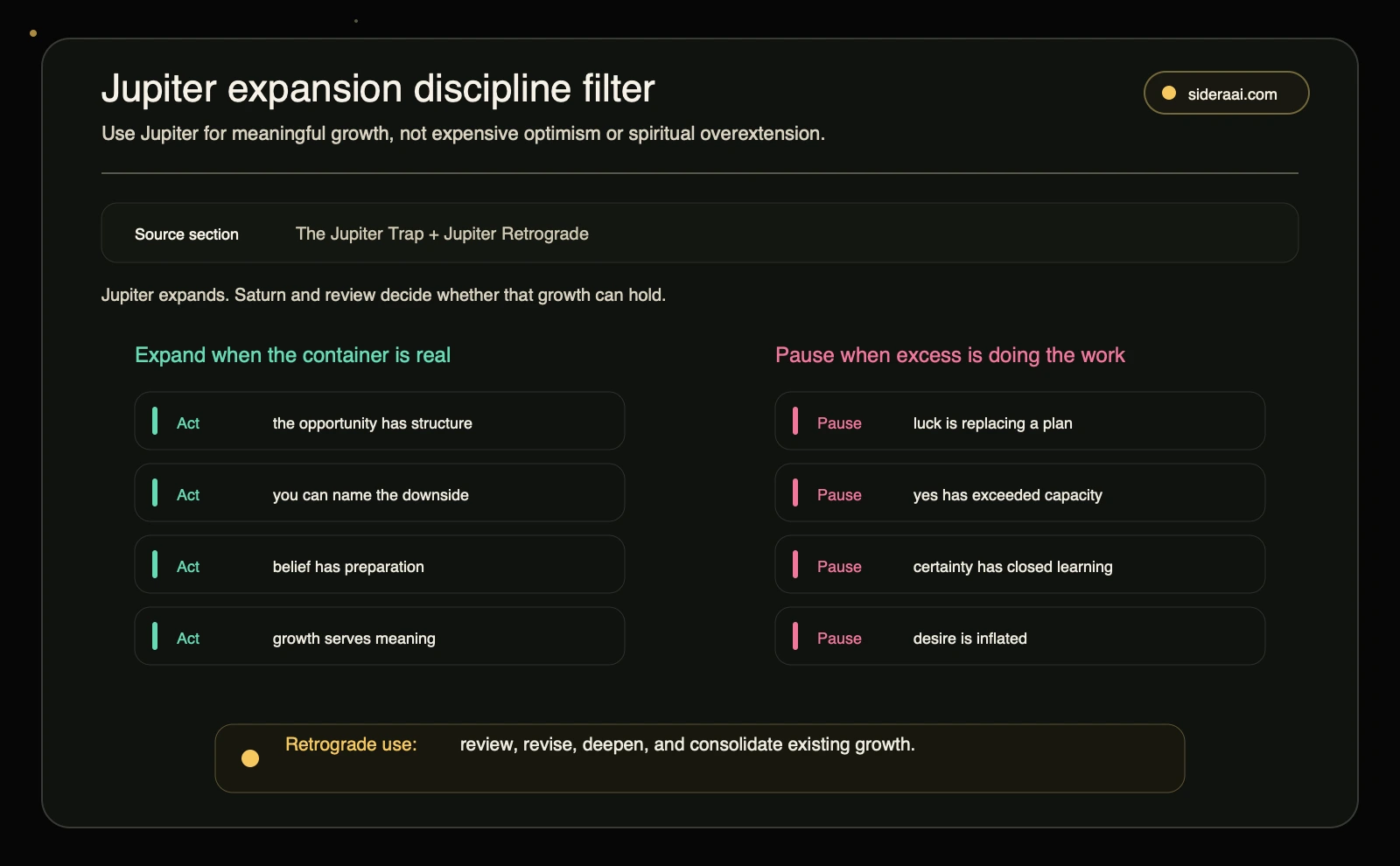
Use the filter to separate meaningful Jupiter growth from overextension, then treat retrograde periods as review windows for what has already opened.
Jupiter in Aspects
How Jupiter relates to other planets in your chart shapes how its gifts manifest.
Jupiter conjunct Sun: Strong identity around expansion, philosophy, and generosity. Public-facing confidence. Risk of overconfidence or grandiosity.
Jupiter conjunct Moon: Emotional generosity and optimism. Strong domestic luck. Tendency toward emotional excess or over-giving.
Jupiter conjunct Saturn: One of the most powerful aspect patterns for building lasting success. Jupiter provides vision; Saturn provides discipline. This combination often produces achievements that outlast a given moment of luck. The Jupiter-Saturn cycle (the Great Conjunction) repeats approximately every 20 years and historically marks major social and cultural resets.
Jupiter conjunct Venus: Abundance in relationships and aesthetics. Financial generosity. Risk of excess spending or unrealistic partnership expectations.
Jupiter conjunct Mars: High energy, ambition, and drive. Excellent for athletic or competitive endeavors. Risk of overexertion or recklessness.
Jupiter square or opposite Saturn: Tension between expansion and contraction, between optimism and caution. Often produces significant growth through working the opposition between two forces.
Jupiter Through the 12 Signs
Jupiter’s sign describes the style and flavor of your expansion: how you grow, where you seek meaning, and the quality of the luck you attract.
Jupiter in Aries: Luck through courage and initiative. Growth comes from starting, not waiting. Best results when you act on instinct and lead.
Jupiter in Taurus: Luck through patience and sensory engagement. Growth comes through quality, craftsmanship, and building slowly. Financial abundance is one of the stronger Jupiter-Taurus signatures.
Jupiter in Gemini: Luck through communication and curiosity. Growth comes from information and networking. The risk is scattered focus across too many pursuits.
Jupiter in Cancer: Jupiter’s exaltation sign. Growth through nurturing, home, family, and emotional intelligence. Exceptional warmth, domestic abundance, and emotional generosity are common hallmarks.
Jupiter in Leo: Luck through self-expression and leadership. Growth comes when you step into visibility and act from creative confidence rather than performance anxiety.
Jupiter in Virgo: Luck through precision and service. Growth comes from mastery of craft and improvement of systems. The risk is missing the big picture through over-analysis.
Jupiter in Libra: Luck through partnership and collaboration. Growth comes through relationships and aesthetic pursuits. The best opportunities tend to arrive through other people.
Jupiter in Scorpio: Luck through depth and transformation. Growth comes by going where others avoid: the psychological, financial, and investigative depths. Joint resources and inheritance are common Jupiter-Scorpio themes.
Jupiter in Sagittarius: Jupiter’s home sign. Growth through exploration, education, and philosophy. Expansion is most natural here, but so is overextension.
Jupiter in Capricorn: Jupiter’s fall sign. Growth is slower but more durable, earned through structure, discipline, and long-range planning rather than spontaneous luck. Often produces late-blooming, lasting success.
Jupiter in Aquarius: Luck through community, innovation, and social reform. Growth comes from thinking collectively and participating in movements or networks larger than oneself.
Jupiter in Pisces: Growth through spirituality, creativity, and compassion. Luck often arrives through synchronicity and acts of faith rather than strategic planning. This is Jupiter’s second home sign and one of its most spiritually potent placements.
You can explore how Jupiter’s sign placement interacts with your full chart using the Sidera birth chart calculator. For a broader overview of all planetary meanings, the planets in astrology cheat sheet is a useful companion.
Jupiter Return: Your 12-Year Life Chapter
Jupiter completes one full orbit of the Sun in approximately 11.86 years. When Jupiter returns to the exact position it held at your birth, this is called a Jupiter Return, and it marks the opening of a new life chapter.
Jupiter Returns happen at approximately ages 12, 24, 36, 48, 60, and 72, each corresponding to a recognized life transition in most cultures. The 12-year-old entering adolescence. The 24-year-old finishing formal education and entering the world. The 36-year-old reassessing what they want from adult life. The 48-year-old in the midst of midlife reckoning.
The Jupiter Return year is traditionally considered among the most favorable 12-month windows for beginning major new endeavors: launching a business, starting a degree, relocating, committing to a relationship, or beginning a significant creative project. It’s not magic: it’s timing. The energy of Jupiter returning to its natal position tends to open doors that were previously closed and create momentum that wouldn’t be available in other years.
To find your personal Jupiter placement and upcoming Jupiter Return dates, explore your birth chart.
Jupiter in Houses: Key Placements
The house Jupiter occupies in your natal chart describes the life arena where its gifts concentrate.
Jupiter in the 1st house brings optimism and warmth to your outer presentation. People with this placement often carry a natural buoyancy that opens social doors.
Jupiter in the 2nd house tends toward financial growth and a generous relationship with material resources. Abundance flows more easily when effort is applied.
Jupiter in the 5th house expands creative expression, romance, and joy. This placement often indicates luck in artistic pursuits or a particularly warm relationship with children.
Jupiter in the 7th house brings luck and expansion through partnerships, both personal and professional. The risk is idealizing partners or attracting those who overpromise.
Jupiter in the 9th house (its natural domain) expands through education, philosophy, travel, and spiritual seeking. This is Jupiter’s most comfortable house placement.
Jupiter in the 10th house often produces career visibility, public recognition, and professional opportunity, particularly when Jupiter transits this house as well.
Jupiter in the 11th house brings luck through community, networks, and collective endeavors. Friends and groups serve as Jupiter’s vehicles here.
Jupiter in the 12th house brings hidden support, spiritual gifts, and often behind-the-scenes luck that isn’t immediately visible. The gifts of this placement often operate beneath the surface but provide genuine protection in difficult times.
For Sagittarius and Pisces in particular, Jupiter’s current transit position directly activates their ruling planet, making Jupiter transits especially significant in these signs’ annual cycles. Cancer placements also experience Jupiter transits with particular intensity given the exaltation connection.
FAQ
What does Jupiter mean in astrology? Jupiter represents expansion, growth, and abundance. It describes the area of life where opportunity flows most naturally, where you seek meaning, and where the shadow of excess can also appear. It’s traditionally called the Great Benefic.
What is my Jupiter sign? Your Jupiter sign is determined by your birth date and year. Because Jupiter spends roughly 12 to 13 months in each sign, everyone born within a given year shares the same Jupiter sign. Your birth chart will show your exact Jupiter placement by sign and house.
Is Jupiter a benefic planet? Yes. Jupiter is the Greater Benefic in traditional astrology (Venus is the Lesser Benefic). This means Jupiter naturally inclines toward positive outcomes in the areas it touches. However, “benefic” doesn’t mean automatically lucky; Jupiter amplifies whatever it contacts, including difficult patterns if those are present.
What happens during a Jupiter Return? A Jupiter Return occurs every 11.86 years when Jupiter completes its orbit and returns to your natal Jupiter’s position. It marks the beginning of a new life chapter and is traditionally considered a favorable time to launch major initiatives, expand in career or education, or begin significant new commitments.
How often does Jupiter go retrograde? Jupiter goes retrograde approximately once per year for about 120 days (four months). During retrograde, its expansion energy turns inward, prompting review rather than initiation. It’s a better time for deepening existing efforts than launching new ones.
What does Jupiter in my 12th house mean? Jupiter in the 12th house is one of the more layered placements. It often brings hidden support, spiritual gifts, and a protective quality that operates behind the scenes. People with this placement may find that luck arrives through privacy, solitude, or spiritually oriented work rather than through public channels.
What is Jupiter’s exaltation sign? Jupiter is exalted in Cancer. In this placement, Jupiter’s gifts of abundance and generosity express most fully through home, family, emotional nurturing, and domestic life.
What does Jupiter conjunct Saturn mean? Jupiter conjunct Saturn, known as the Great Conjunction, occurs approximately every 20 years and represents a meeting of expansion (Jupiter) and contraction (Saturn). In the natal chart, this aspect often produces someone who builds lasting structures through a combination of optimism and discipline. In transit, Great Conjunctions historically mark the start of new social and cultural cycles.
What is chart sect and how does it affect Jupiter? Chart sect refers to whether you were born during the day (Sun above the horizon) or at night (Sun below the horizon). Jupiter is a diurnal (day) planet, meaning it operates most fully and visibly in day charts. In a night chart, Jupiter is out of sect and its gifts tend to arrive more quietly or through private channels, requiring more intentional claiming. Venus becomes the stronger benefic in night charts. You can determine your sect by checking whether your natal Sun is in houses 7 through 12 (day chart) or houses 1 through 6 (night chart).
Ready to See Your Personal Birth Chart?
Discover your unique cosmic blueprint — planets, houses, and aspects personalized to your exact birth time and location.
Get Your Birth Chart →✓ Birth chart analysis ✓ Personalized insights ✓ Free to use
Related Sidera Guide
Continue with this closely related guide: