A birth chart (natal chart) is a snapshot of the sky at your exact moment of birth, showing the planets, signs, and houses that describe your emotional patterns, self-image, relationship style, and recurring life lessons.
If you have ever opened your chart and thought, “I can see the symbols, but I still do not know what this says about my actual life,” that is the real beginner problem. A useful birth chart reading should not stop at “Moon in Scorpio means intense” or “Mars in Cancer means sensitive.” It should help you recognize how you love, work, fight, protect yourself, seek approval, and make decisions under pressure.
Your Sun sign gets the most attention, but your complete natal chart gives a far more specific picture: your emotional needs, communication style, attachment patterns, ambition, anger, blind spots, and timing cycles. That specificity is what makes a chart feel personal instead of recycled.
Most people get overwhelmed because they try to interpret every symbol at once. This guide gives you a practical order: read the planet, sign, house, and aspect, then translate the placement into real-life behavior.
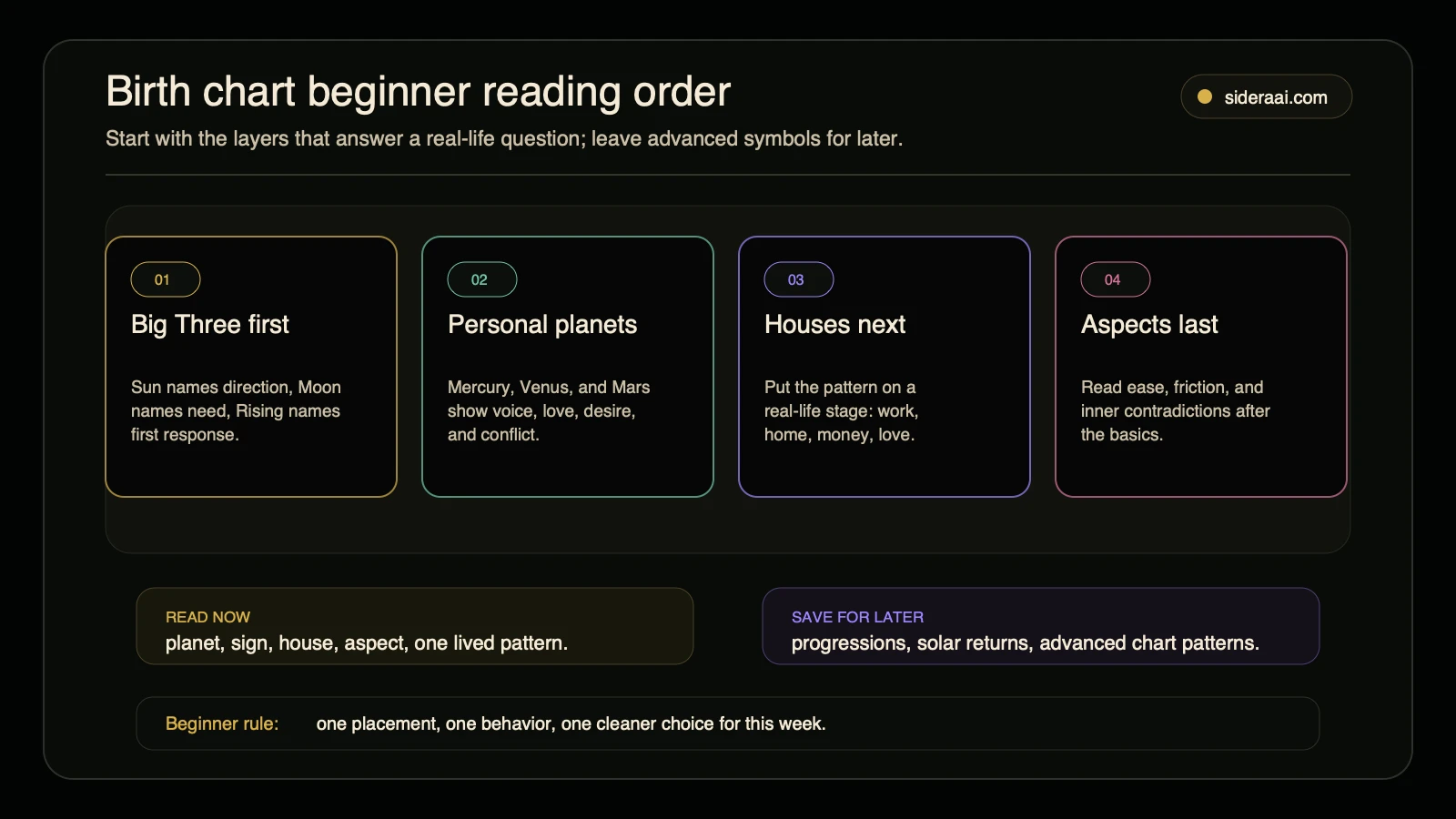
Use this reading order when the wheel feels crowded: start with the layers that answer a real-life question, then save advanced techniques for later.
Ready to See Your Personal Birth Chart?
Discover your unique cosmic blueprint — planets, houses, and aspects personalized to your exact birth time and location.
Get Your Birth Chart →✓ Birth chart analysis ✓ Personalized insights ✓ Free to use
What Is a Birth Chart?
Your birth chart (also called a natal chart or astrology birth chart) is a map of where every planet was positioned in the zodiac at the moment you were born – down to the minute and location.
Think of it as a personal pattern map. No two birth charts are identical, even for twins born minutes apart, because the Ascendant and house cusps can shift. The chart does not replace your choices, background, or lived experience; it gives you a language for noticing repeating patterns.
What you need to generate your birth chart:
- Date of birth
- Exact time of birth (to the minute, if possible)
- Place of birth (city/town)
Pro tip: If you don’t know your exact birth time, check your birth certificate, hospital records, or ask family members. Without it, your chart will be incomplete (missing houses and Ascendant).
Why Learning to Read Your Chart Matters
Understanding your birth chart is not about collecting labels. It is about noticing the patterns you keep living out before they become automatic.
Self-awareness: Instead of “I am emotional,” your Moon placement can show what makes you feel unsafe, what helps you regulate, and what kind of comfort you secretly want but may not ask for directly.
Relationship insight: Venus, Mars, the Moon, and the 7th house can show how you bond, what makes you pull away, how you handle desire, and where you confuse intensity with intimacy.
Work and decision clarity: The 6th house, 10th house, Saturn, and Mars can describe your work rhythm, ambition, stress style, and what you need to stay consistent without burning out.
Timing decisions: Transits and electional astrology help you understand timing windows for major life events, from best days to start a job to how to navigate Mercury Retrograde without overreacting to every delay.
Sidera uses your actual birth chart—not generic horoscopes.
Get personalized insights →The 3 Core Components of Any Birth Chart
Every birth chart reading breaks down into three essential layers:
1. The Planets (WHAT)
The planets represent different parts of your psyche and life areas. When you read a planet, ask, “What part of me is speaking here?”
| Planet | Represents | Keywords |
|---|---|---|
| Sun | Core identity, ego, vitality | Purpose, self-expression, consciousness |
| Moon | Emotions, instincts, inner world | Needs, habits, subconscious patterns |
| Mercury | Communication, thinking style | Learning, speech, mental processing |
| Venus | Love, beauty, values | Relationships, pleasure, aesthetics |
| Mars | Drive, energy, action | Desire, anger, assertion |
| Jupiter | Expansion, luck, philosophy | Growth, optimism, wisdom |
| Saturn | Discipline, responsibility, karma | Lessons, structure, maturity |
| Uranus | Innovation, rebellion, change | Freedom, originality, disruption |
| Neptune | Dreams, illusion, spirituality | Imagination, compassion, dissolution |
| Pluto | Transformation, power, rebirth | Intensity, regeneration, shadow work |
For a practical reading, start with the planets that show up most clearly in daily life:
- Moon: What do I need when I am overwhelmed, rejected, tired, or emotionally exposed?
- Mercury: How do I explain myself, process information, argue, learn, and repair misunderstandings?
- Venus: What makes me feel chosen, valued, beautiful, secure, or turned off?
- Mars: How do I pursue what I want, handle anger, compete, initiate, and defend myself?
Learn more about Mercury in Astrology Discover the meaning of the Sun in Astrology Read about Saturn in Astrology
2. The Zodiac Signs (HOW)
The signs color how each planet expresses itself. A sign is not a personality stamp by itself; it describes the style, tone, and instinctive strategy of the planet.
- Fire signs (Aries, Leo, Sagittarius) – Passionate, bold, action-oriented
- Earth signs (Taurus, Virgo, Capricorn) – Grounded, practical, reliable
- Air signs (Gemini, Libra, Aquarius) – Intellectual, communicative, social
- Water signs (Cancer, Scorpio, Pisces) – Emotional, intuitive, empathetic
Example: Mercury in Aries may think by reacting quickly. In real life, that can look like direct honesty, fast decisions, interrupting when excited, or sounding sharper than intended during conflict. Mercury in Pisces may think through feeling and association. That can look imaginative, intuitive, compassionate, or hard to pin down when someone demands a clear answer too quickly.
Explore Water Zodiac Signs Discover Air Signs in Astrology Learn about Fire Signs Read about Earth Signs Understand Zodiac Sign Elements
3. The Houses (WHERE)
The 12 houses represent life areas where planetary energy plays out. Houses turn a trait into a life context.
- 1st House – Self, appearance, first impressions (Ascendant/Rising)
- 2nd House – Money, possessions, values, self-worth
- 3rd House – Communication, siblings, short trips, learning
- 4th House – Home, family, roots, private life
- 5th House – Creativity, romance, children, pleasure
- 6th House – Work, health, daily routines, service
- 7th House – Partnerships, marriage, contracts, open enemies
- 8th House – Transformation, sex, death, shared resources
- 9th House – Travel, philosophy, higher education, spirituality
- 10th House – Career, reputation, public life (Midheaven)
- 11th House – Friendships, groups, hopes, social causes
- 12th House – Subconscious, secrets, isolation, spirituality
Example: Mars in the 10th house may show ambition, competitiveness, or conflict in career and public reputation. Mars in the 4th house may show protective instincts, family tension, or a strong drive to control the private home environment. Same planet, different stage.
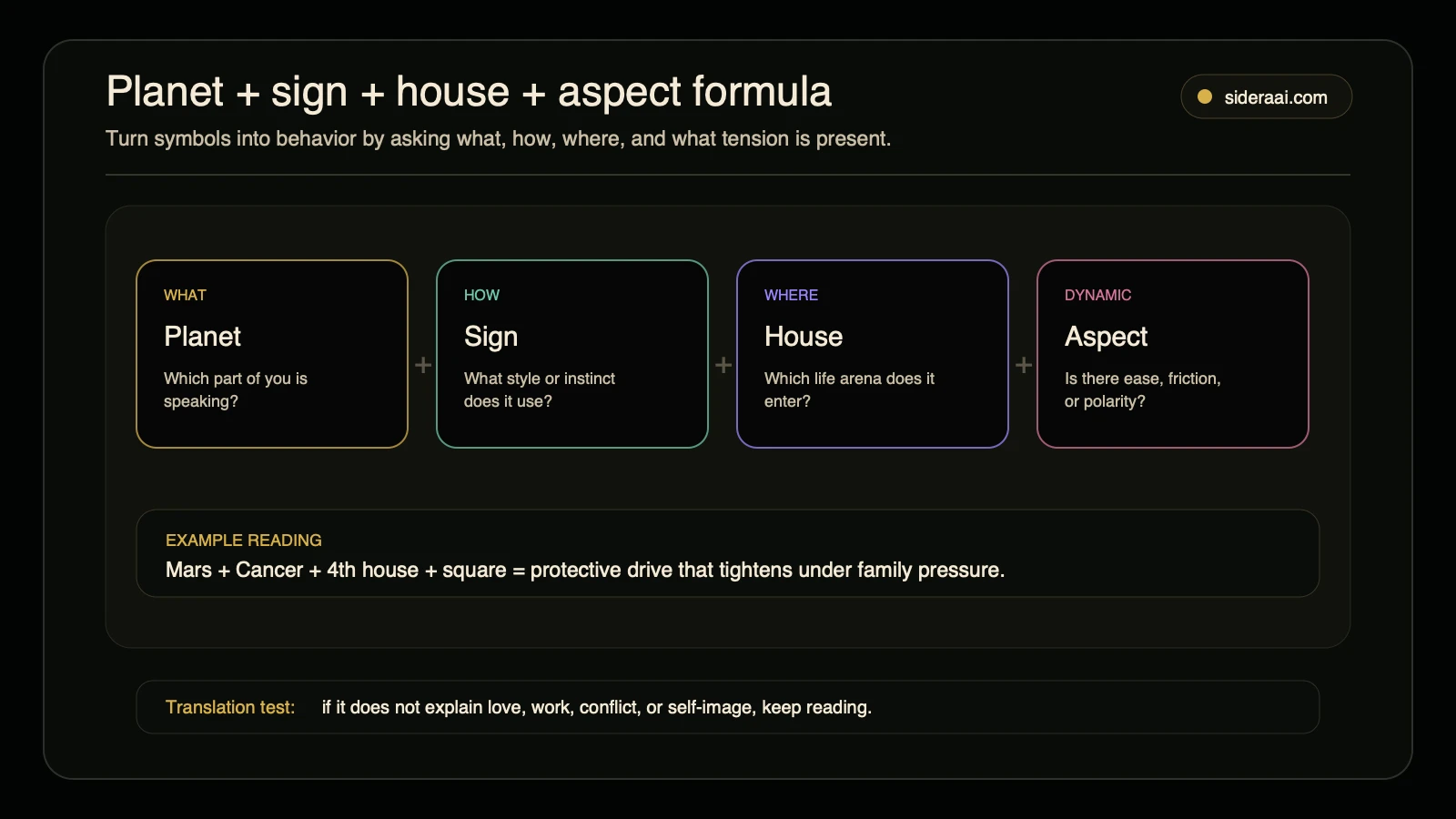
The formula keeps a beginner reading grounded: planet names the function, sign names the style, house names the life arena, and aspect names the inner dynamic.
Step-by-Step: How to Read Your Birth Chart
Step 1: Generate Your Birth Chart
Use a birth chart calculator like Sidera AI (Western/tropical) or Astro.com (tropical/Western). Enter your birth date, time, and location.
Note: Most Western astrology uses the tropical zodiac. Sidera uses the tropical (Western) zodiac, the most widely used system in modern astrology.
Step 2: Find Your “Big 3”
Start with the three most important placements:
Sun Sign – Your core self, ego, conscious identity Moon Sign – Your emotional nature, subconscious, inner needs Rising Sign (Ascendant) – Your outward mask, first impression, physical appearance
Read them as a small conversation:
- Sun: What kind of person am I trying to become?
- Moon: What do I need to feel safe enough to be honest?
- Rising: What role do I instinctively play when I enter a room or face something new?
Example Chart Interpretation: Sun in Leo = confident, expressive, creative core Moon in Scorpio = intense, private, deeply feeling emotions Rising in Gemini = curious, talkative, youthful vibe
This person may appear chatty and adaptable (Gemini Rising), but beneath the surface they are private, loyal, and emotionally intense (Scorpio Moon), with a core need to create, perform, lead, or be recognized for what makes them special (Leo Sun). In love, they may seem casual at first but need deep trust. At work, they may thrive when ideas move quickly and their voice is noticed.
Check your Leo daily horoscope or Scorpio daily horoscope for personalized insights based on your signs.
Step 3: Look at Personal Planets (Mercury, Venus, Mars)
These shape your personality and day-to-day life:
- Mercury – How you think and communicate
- Venus – How you love and what you value
- Mars – How you take action and express anger
Example: Someone with Venus in Taurus may value stability, physical affection, loyalty, and sensory comfort. In love, they may need consistency before they open up. In conflict, they may dig in or go quiet when pushed too fast. Venus in Aquarius may value intellectual connection, independence, friendship, and unconventional relationship dynamics. In love, they may need space to keep desire alive.
To make these placements useful, ask:
- What does my Venus need to feel valued without performing for approval?
- What does my Mars do when I am angry but trying to stay acceptable?
- What does my Mercury sound like when I feel misunderstood?
Step 4: Check Outer Planets (Jupiter, Saturn, Uranus, Neptune, Pluto)
These reveal growth cycles, pressure points, and life lessons:
- Jupiter – Where you expand, find luck, and grow
- Saturn – Where you face challenges, build discipline, and mature
- Uranus, Neptune, Pluto – Generational placements (everyone born in the same ~7-15 years shares these)
Timing example: Saturn Return, usually around ages 27-30 and 57-60, often coincides with a harder look at commitment, career, responsibility, and whether your life structure can actually hold the person you are becoming. It does not force one specific event, but it can make avoidance more expensive.
Learn more about Saturn Return and career change
Find your perfect moment with AI-powered electional astrology.
Discover your timing →Step 5: Understand Aspects (Planetary Relationships)
Aspects are angles between planets that create harmony or tension:
- Conjunction (0°) – Blending, intensification (planets merge energy)
- Sextile (60°) – Opportunity, ease, support (gentle flow)
- Square (90°) – Tension, challenge, growth through friction (dynamic energy)
- Trine (120°) – Flow, natural talent, harmony (effortless gifts)
- Opposition (180°) – Balance, awareness through polarity (push-pull dynamic)
Example: Sun square Saturn can feel like an inner conflict between self-expression (Sun) and self-judgment, discipline, or fear of failure (Saturn). In self-image, it may show up as “I have to prove I deserve attention.” At work, it can become overpreparation or perfectionism. In relationships, it may create sensitivity around criticism. The growth is not pretending the fear is gone; it is building confidence through repeated, honest effort.
Pro tip: Don’t fear challenging aspects. Squares and oppositions create the tension that drives growth. Trines can make you lazy because things come too easily.
Step 6: Identify Chart Patterns
Look for dominant elements, planet clusters, or geometric shapes:
- Stellium – 3+ planets in one sign/house (concentrated energy in that area)
- Grand Trine – Three planets forming a triangle (natural talents, but can lead to complacency)
- T-Square – Three planets forming tension pattern (high achievement driven by internal conflict)
- Grand Cross – Four planets in square (intense life, constant challenge, powerful transformation)
- Bowl/Bucket/Seesaw – Distribution patterns showing how energy flows in your chart
Pattern Example: If you have five planets in water signs (Cancer, Scorpio, Pisces), your chart may run through emotion first. You might read the room quickly, absorb other people’s moods, and remember emotional details others miss. The shadow is porous boundaries, resentment when needs go unnamed, or confusing intuition with anxiety. The practical takeaway is to build rituals that separate your feelings from everyone else’s before making major decisions.
Quote: “A birth chart is not a life sentence – it’s a weather forecast. You can’t change the weather, but you can choose how to dress for it.” – Steven Forrest, evolutionary astrologer and author of The Inner Sky
How to Read a Placement in Real Life
Once you know the planet, sign, and house, translate the placement into behavior. This is where a chart stops being a list of keywords and starts becoming useful.
| Life area | Ask this | Example interpretation |
|---|---|---|
| Love | What makes this placement feel safe, wanted, rejected, or trapped? | Venus in Aquarius may love deeply but resist feeling owned. |
| Work | What rhythm, pressure, or recognition does this placement need to do its best work? | Mars in Capricorn may handle long-term goals well but resent chaotic leadership. |
| Conflict | How does this placement protect itself when it feels threatened? | Moon in Cancer may withdraw, test loyalty, or become protective before naming the hurt directly. |
| Self-image | What story does this placement tell me about who I am allowed to be? | Sun square Saturn may believe respect has to be earned through constant competence. |
Use this four-part translation when reading any placement. If an interpretation does not show up in love, work, conflict, self-image, or decision-making, it may still be too vague.
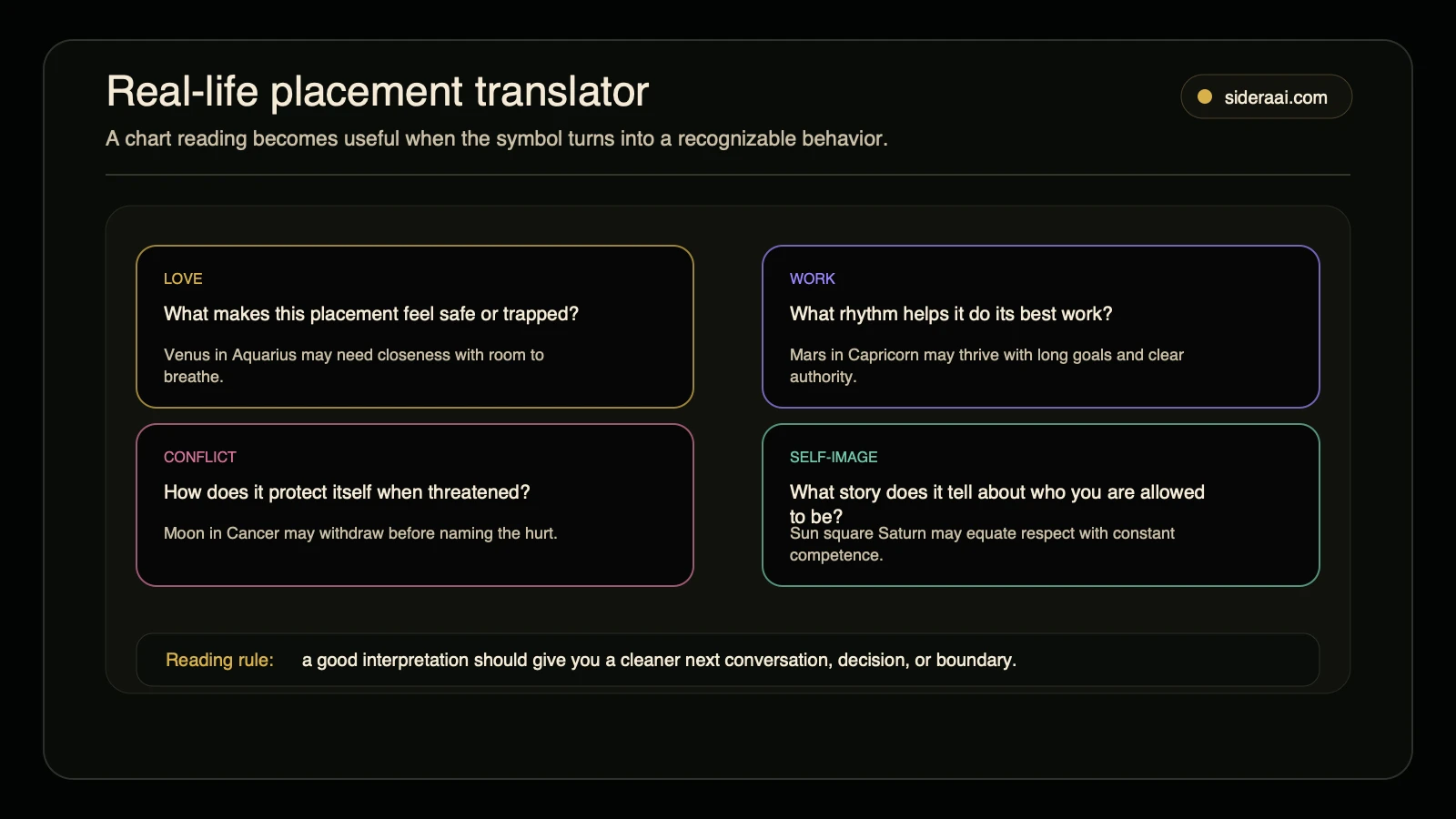
Use the translator as a quality check: a helpful placement reading should point to a recognizable behavior and a cleaner next choice.
Common Birth Chart Reading Mistakes
Mistake #1: Only reading your Sun sign Your Sun is important, but it’s just one piece. A Gemini Sun with a Capricorn Moon and Virgo Rising will feel very different from a Gemini with a Sagittarius Moon and Leo Rising.
Mistake #2: Ignoring house placements A planet’s house shows where its energy manifests. Mars in your 10th house = career drive and public ambition. Mars in your 7th house = relationship passion (or conflict).
Mistake #3: Fearing “bad” placements There are no “bad” placements – only challenges that build strength. Saturn in the 7th house doesn’t doom relationships; it teaches commitment and maturity through experience. Chiron in the 6th house reveals where you heal others through your own wounds.
Mistake #4: Comparing tropical and sidereal charts These are different systems measuring different things. Tropical (Western) tracks seasons; sidereal (Vedic) tracks stars. Don’t try to “merge” them – pick the system that resonates and go deep.
Mistake #5: Reading isolated placements Context matters. Venus in Scorpio in the 2nd house (deep attachment to possessions, intense values) is different from Venus in Scorpio in the 11th house (intense friendships, transformative group connections).
Real Birth Chart Example: Putting It All Together
Hypothetical Chart:
- Sun in Virgo (6th house)
- Moon in Pisces (12th house)
- Ascendant in Aries
- Mercury in Virgo (6th house)
- Venus in Leo (5th house)
- Mars in Cancer (4th house)
Quick Interpretation:
This person has a strong service-oriented identity (Sun + Mercury in Virgo, 6th house) with meticulous attention to detail. Their emotional world is deeply spiritual and imaginative (Pisces Moon, 12th house), creating an inner tension between practical analysis and mystical intuition.
They come across as direct and bold (Aries Rising), but their actions are motivated by emotional security and family (Mars in Cancer, 4th house). They express love playfully and creatively (Venus in Leo, 5th house), yet their core work is in healing, analysis, or daily service.
Key challenge: Balancing the analytical mind (Virgo) with sensitive, boundary-blurring emotions (Pisces). Under stress, they may try to solve feelings like problems, then disappear when the feelings cannot be neatly fixed. Key strength: Blending practicality with compassion. This chart could excel in nursing, therapy, operations, editing, holistic health, or any role where care becomes useful structure.
Understand your connections on a cosmic level.
Explore your bonds →Frequently Asked Questions
What is a birth chart in astrology?
A birth chart, also called a natal chart, is a map of where every planet was positioned in the zodiac at the exact moment and location of your birth. It functions like a cosmic fingerprint, revealing your personality, emotional needs, communication style, relationship patterns, and potential life themes through the positions of planets in signs and houses.
Do I need my exact birth time to read my birth chart?
Yes, your exact birth time is important for determining your Rising sign and house placements. Without it, you can still interpret your planetary sign placements but will miss approximately 30 to 40 percent of the chart information. The Rising sign changes approximately every two hours, so even a small time difference can significantly alter your house cusps.
What are the Big Three in astrology?
The Big Three refers to your Sun sign, Moon sign, and Rising sign. Your Sun represents your core identity and life purpose, your Moon reflects your emotional nature and inner needs, and your Rising describes how you present yourself to the world. Together these three placements give the most essential overview of your personality and how you move through life.
What is the difference between a sun sign and a rising sign?
Your Sun sign is determined by the date of your birth and represents your core identity and life purpose. Your Rising sign, also called the Ascendant, is determined by the time and location of your birth and describes how you come across to others and the lens through which you experience the world. They can feel very different from each other.
What are the 12 houses in a birth chart?
The 12 houses in a birth chart represent different areas of life where planetary energies play out. House 1 governs self and appearance, House 2 covers money and values, House 7 rules partnerships, and House 10 represents career and public reputation. Each house is associated with a zodiac sign that colors how that life area operates for you.
What is the difference between tropical and sidereal astrology?
Tropical astrology, the most common Western system, bases zodiac sign dates on the seasons with Aries starting at the spring equinox. Sidereal astrology, used in Vedic traditions, tracks the actual positions of constellations in the sky. Due to the precession of the equinoxes over thousands of years, the two systems differ by approximately 24 degrees, which can shift your sign by nearly a full sign.
Can a birth chart predict the future?
A birth chart shows your potentials, natural talents, and recurring challenges rather than predicting specific events. Transits, which are the movements of current planets over your natal chart, can indicate timing windows for change and growth. Think of your chart as a weather map showing climate patterns, while free will determines how you navigate those conditions.
How long does it take to learn to read a birth chart?
Basic birth chart interpretation takes one to three months of consistent study if you focus on your own chart. Intermediate proficiency typically develops over one to two years. True mastery, including the ability to read transits, progressions, and synastry charts fluently, takes five to ten or more years of dedicated practice and real-world application.
Next Steps: Go Deeper with Your Birth Chart
Once you’ve learned the basics, explore:
- Transits – How current planetary movements activate your chart (Mercury Retrograde 2026 guide)
- Progressions – Your evolving chart (secondary progressions use 1 day = 1 year symbolism)
- Synastry – Chart comparisons for relationships, friendships, business partnerships
- Electional astrology – Choosing auspicious timing (Best day to start a new job)
- Solar Return Charts – Your “birthday chart” for the year ahead
- Composite Charts – The “relationship chart” created by combining two natal charts
Your birth chart is a lifelong tool. The more you work with it, the more patterns you’ll recognize – not just in yourself, but in the world around you. Many astrologers report that after 5-10 years of practice, they can see planetary signatures playing out in real-time events, relationships, and personal growth cycles.