Most people searching for “Chinese almanac good days” are not really looking for a lucky number. They are trying to choose a date for something that matters enough to feel precarious: a conversation they have been putting off for months, a commitment that feels permanent, a first step after something that ended badly.
The question is not usually “is Friday the 13th unlucky?” It is closer to: “I need to do this thing and I want to know if the timing is working with me or against me.”
Chinese almanac timing, or Ze Ri, offers a different kind of answer. In English, people often search for this as feng shui date selection, feng shui auspicious dates, or a feng shui business opening date. More precisely, Ze Ri belongs to Chinese almanac and Tong Shu date selection within the wider Chinese metaphysics world. It is related to feng shui timing language, but it is not the same thing as arranging a home, office, desk, or doorway.
The question is not “is this lucky in general?” It is about fit: what kind of day is this, and does that match what you are actually about to do?
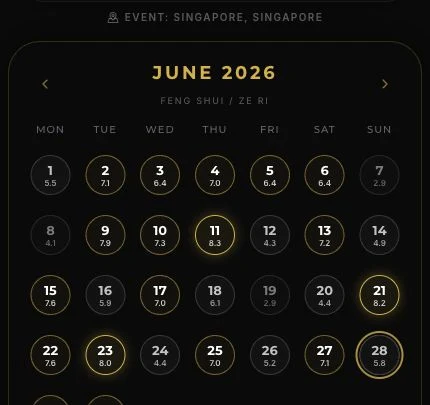
All screenshots in this article are real Sidera Lucky Day Planner captures taken on June 28, 2026 from a repeatable Singapore demo profile. The Chinese almanac layer runs on a client-side calculation path: lunar date, sexagenary day, day officer, and solar-term context derived in the browser without a remote almanac service.
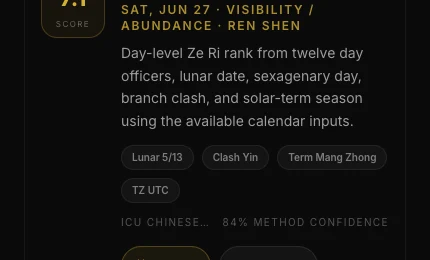
The Chinese almanac layer is useful because it exposes the actual day signals behind a score: lunar date, clash, solar term, timezone, and confidence.
If You Only Have Two Minutes
Ze Ri timing comes down to one question: does the character of this day match the kind of action you are about to take? The twelve day officers each describe a different type of support. Match the officer to the action first, then check the score. Everything else in this article is context for doing that more accurately.

Choose the day officer by purpose first: the useful signal is the one whose shape fits the action you are actually taking.
| Decision type | Best-fit officers | Officers that create friction | Key question |
|---|---|---|---|
| New beginning, public launch | Establish, Initiate, Open | Close, Danger | Are you actually starting, or announcing something already underway? |
| Commitment, long-term agreement | Stable | Destruction, Danger | Is this meant to hold for years or just feel final today? |
| Repair, reconciliation | Balance, Receive | Success, Initiate | Are both people entering with willingness to listen? |
| Ending a pattern or chapter | Remove, Close | Establish, Open | Are you closing, or clearing to make room for something new? |
| Sharing work, visibility | Full, Open, Success | Close, Danger | Are you ready to be seen, or do you need more preparation? |
| Rest, containment, reflection | Close, Danger | Initiate, Full | Is the value here in pausing rather than producing? |
| Receiving help, feedback, intake | Receive | Initiate, Success | Is this a day to take in, not to act outward? |
This table uses Sidera’s editorial interpretation of the Twelve Day Officers for modern decision contexts, not classical Tong Shu scholarship. If you came here looking for feng shui lucky dates, this is the practical bridge: match the almanac day officer to the action before treating the date as auspicious. That distinction matters and is explained below.
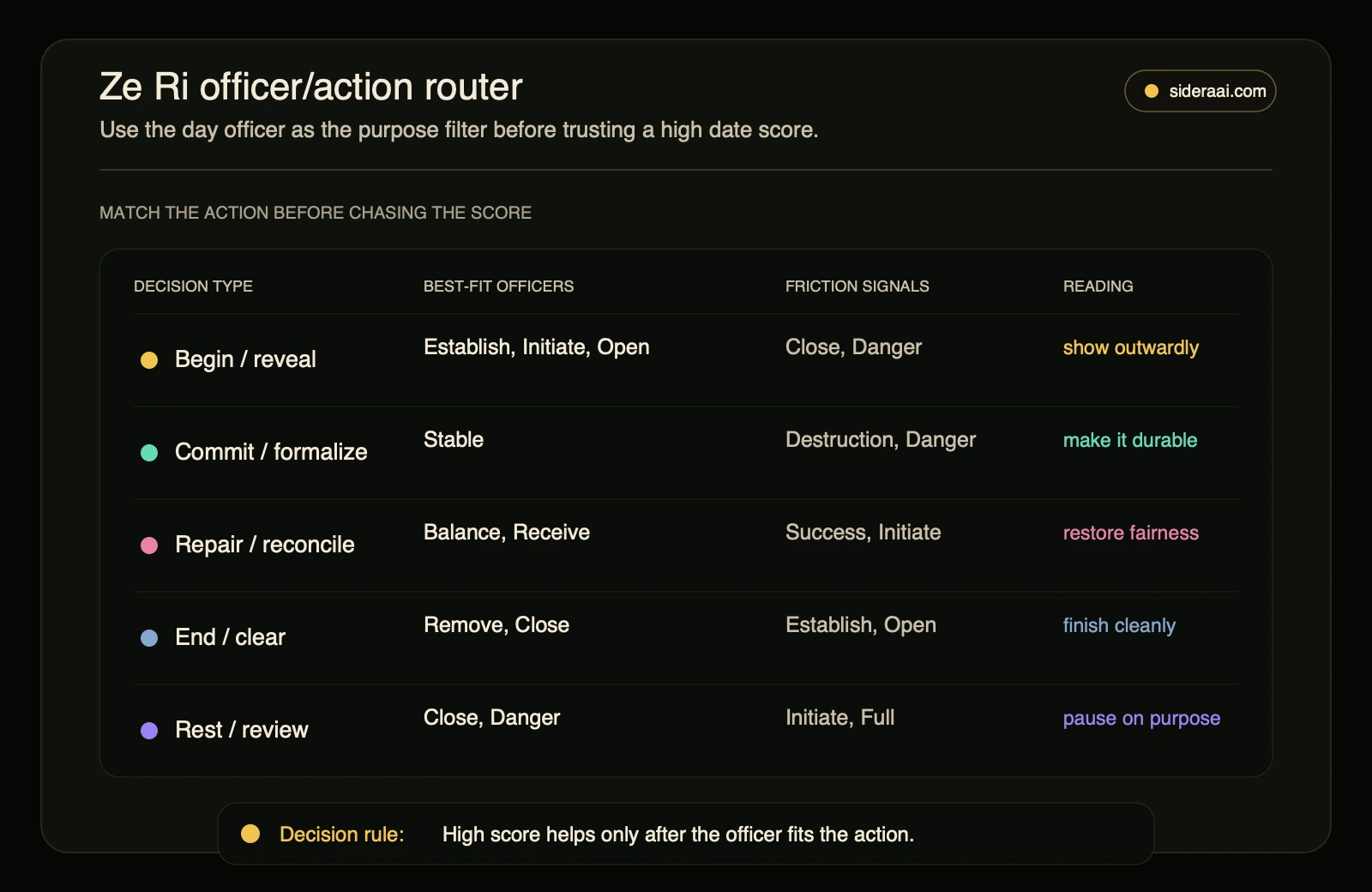
Use the officer as the purpose filter first. A high score is useful only after the day label matches the action you are actually taking.
The Tension That Brings People to Almanac Timing
There is a specific feeling that leads someone to open a timing tool before a significant decision. It is not superstition. It is something closer to wanting one more input before committing to something irreversible.
Date selection does not eliminate that tension. What it does is give you a framework for asking a better question. Instead of “is this a good day?” the question becomes: “Is this the right kind of day for what I am actually doing?”
A day suited for beginning something public is not the same as a day suited for quiet resolution. A day that supports clearing out the old is not the same as a day that supports commitment. Chinese almanac timing calls these distinctions day officers, and they are what separates Ze Ri from horoscope lottery.

Timing adds one more practical input before commitment: first decide whether the action needs opening, holding, clearing, or closure.
What Ze Ri Actually Asks
Ze Ri date selection uses several layers of calendar information to describe a day:
- Lunar date: where the day falls in the lunar month, carrying resonance distinct from the Gregorian calendar
- Sexagenary label: a Heavenly Stems and Earthly Branches combination from the traditional 60-day cycle that gives the day a quality signature
- Day officer: one of twelve rotating labels that describe the action-fit of the day
- Clashes: branch relationships that create friction for certain activities
- Solar term context: the seasonal placement, because Chinese timing is lunisolar and keeps one foot in the sun’s seasonal cycle
For calendar background, the Hong Kong Observatory Almanac publishes traditional Chinese calendar, solar term, and moon phase data. Sidera’s Ze Ri layer uses that kind of calendar context as a planning signal, not as a full Tong Shu replacement.
The goal is not to pick the “highest” day. It is to pick a day whose character fits the action.
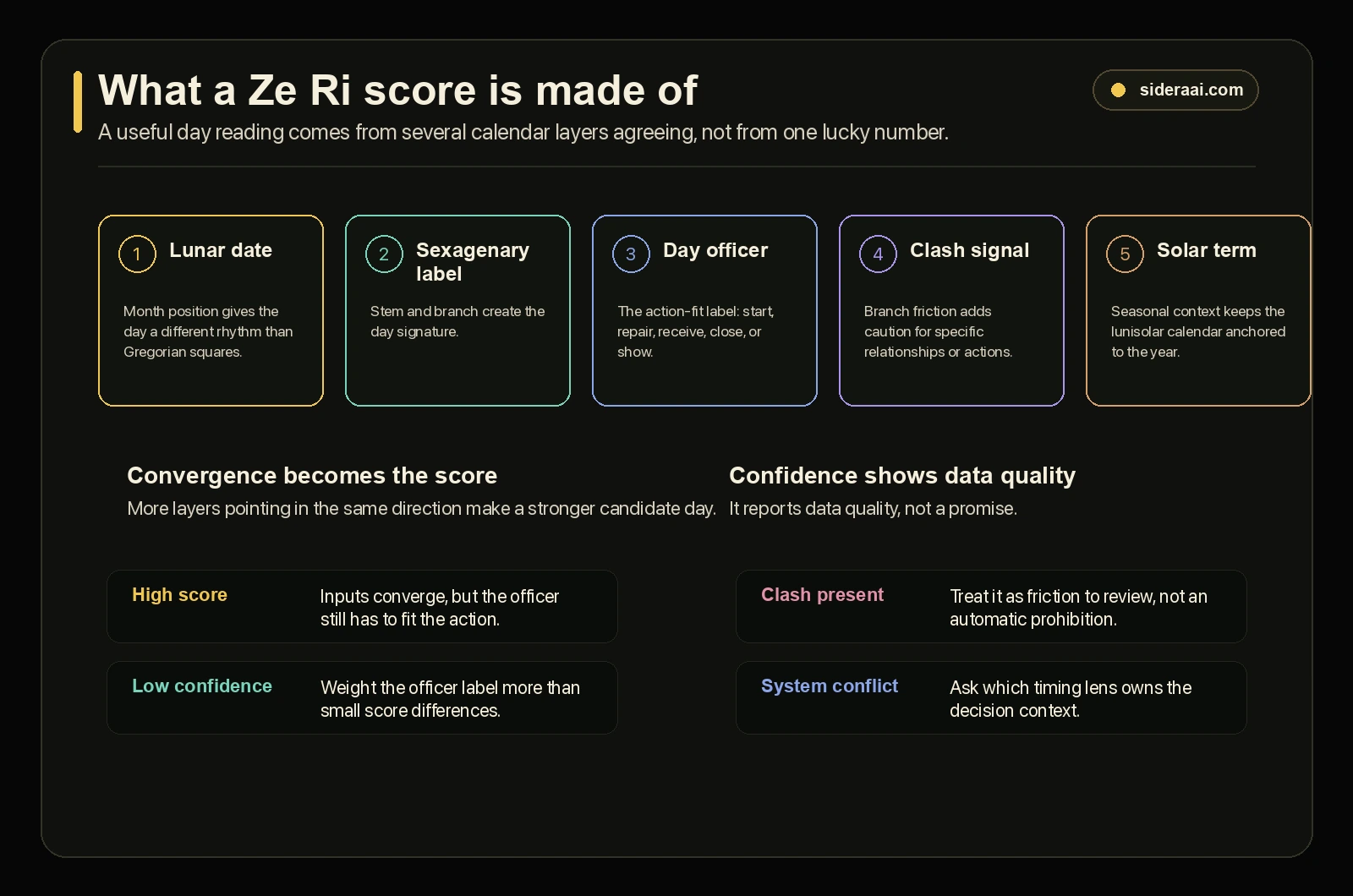
A useful Ze Ri reading comes from several calendar layers agreeing. Score ranks convergence, while confidence shows how cleanly the inputs resolved.
What Most Guides Miss About Chinese Almanac Good Days
Traditional labels versus Sidera’s editorial interpretation
Methodology note: The Twelve Day Officers come from classical Chinese almanac tradition, where their meanings were tied to specific ritual, agricultural, and civic contexts that do not map cleanly onto modern life. The traditional “Destruction” label described demolishing structures and cutting down trees. The traditional “Danger” label indicated avoidance of water travel and crossing rivers. Sidera translates these characters into modern decision contexts without claiming that editorial layer is equivalent to classical Tong Shu scholarship. What you see in Lucky Day Planner is a practitioner-facing interpretation, not a direct translation of traditional almanac text. A trained Tong Shu practitioner may apply these labels with additional rules, personal chart overlays, and hour-selection logic outside this day-level view.
If you see “Danger” in Sidera and feel alarmed: the label is not predicting harm. It is signaling that the environment is less forgiving of outward action. That is a useful input for decision timing, not a bad omen.
What high-score days actually tell you
A high score means more of the day’s inputs agree. The sexagenary character, the day officer, the lunar date position, and the solar-term placement point in a similar direction. It is a convergence signal, not a guarantee.
The score does not account for your personal BaZi chart, the specific hour of the action, or the detailed activity filters a traditional Tong Shu practitioner would apply. It is a day-level reading: strong enough for filtering and comparison, not fine enough to replace a trained consultation for a genuinely high-stakes decision.

A high score can show several timing inputs converging, but the practical launch latch still depends on preparation and judgment.
How Sidera Shows the Chinese Almanac Layer
Lucky Day Planner presents Ze Ri across three surfaces: the month calendar, the selected-day detail panel, and the top-days list.
The calendar gives a month-level read on which days score higher. The selected-day panel shows the full detail when you choose a specific date: score, day officer, signal phrase, lunar date, sexagenary label, clash, solar-term context, timezone, and method confidence.
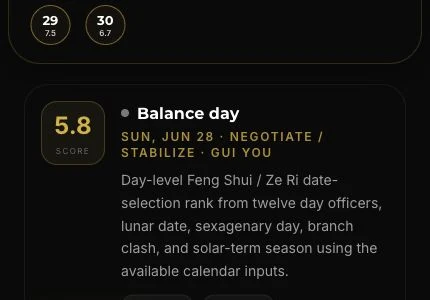
June 28 in the screenshots returns a 5.8 score and a “Balance day” officer. That points toward negotiation, stabilization, and fair adjustment rather than a pure launch signal. It is a good example of why the officer matters as much as the number.
The top-days view surfaces the month’s strongest candidates ranked by score:
- Thu, Jun 11: Announce / begin, Bing Chen, 8.3
- Sun, Jun 21: Completion / launch, Bing Yin, 8.2
- Mon, Jun 15: Visibility / abundance, Geng Shen, 7.6
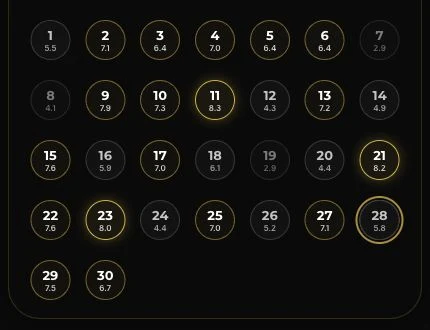
Open the top-days view before scrolling the calendar. Scrolling tends to stop at the first date that looks acceptable. The ranked list forces comparison and prevents premature anchoring on a suboptimal candidate.
What the Day Officers Feel Like in Real Life
Most almanac guides define the officers and stop. Here is what each tends to match in lived experience, using Sidera’s editorial interpretation.
Establish is for beginnings with structure. Starting a health routine you intend to keep. Beginning therapy. Setting a boundary in a relationship. Opening a difficult conversation you want to approach with care rather than urgency.
Remove is for clearing. The day for the conversation you have been postponing because ending things feels too final. Closing an account. Ending a pattern. Letting go of something that no longer fits. Remove days can feel uncomfortable precisely because they ask you to act on what you already know.
Full is for visibility and abundance. Announcing something publicly, sharing work you are proud of, expanding outward. Full days suit launches, public reveals, and moments of offering something to the world.
Balance is for fairness and agreements. Reconciliation conversations, apologies, negotiations where both sides need to leave with something real. If you are trying to repair something, a Balance day asks that you show up for the other person, not just to be heard.
Stable is for durability. Commitments meant to last. Marriage. Long-term financial agreements. Decisions you want to hold their shape over years. Stable days are not exciting, which is exactly the point: they support things meant to endure without drama.
Initiate is for first steps and momentum. Not a day for planning, a day for starting. A first call. A first draft. The first step of a process you have been building toward. If you are not ready to move, this is not your day.
Destruction carries a label that triggers avoidance, but the traditional meaning was more specific: intentional dismantling before rebuilding. Used correctly, a Destruction day suits deliberate clearing before a renovation or a purposeful ending before a new start. Used for a new beginning, it tends to unravel the start rather than support it.
Danger is a day for caution rather than outward action. Quiet internal work, reflection, preparation, rest, and review suit it better than high-stakes launches or irreversible commitments. Danger does not mean something bad happens. It means the environment is less forgiving of errors.
Success is for completion and public result. Finishing something significant. Presenting finished work. Receiving recognition. Closing a milestone. Success days are for the moment when something lands, not for starting something new.
Receive is for intake and gathering. Accepting help. Taking in feedback. Listening more than speaking. Signing something where you are the recipient rather than the initiator. Receive days suit humility and openness more than assertion.
Open is for access and invitation. Launch, welcome, introduction. Opening a new chapter with other people involved. If Full is for showing yourself, Open is for letting others in. Open days suit beginnings that require other people’s participation to work.

An Open day supports access and invitation: the work is prepared, the threshold is clear, and participation can begin.
Close is for endings, rest, and containment. A wedding on a Close day is mismatched. Finishing an old chapter, sealing a decision already made, putting something to rest, or resting without guilt suit this officer well. Close days are undervalued because treating rest as waste is a cultural habit, not a timing insight.
Real Decision Walkthrough: A Conversation With Stakes
Here is how the matching process works in practice, using a scenario that comes up often in relationship timing: deciding when to bring up a long-standing pattern with someone you love.
The situation: the conversation has been postponed for weeks. The goal is not to win an argument but to change something that has been recurring. The other person does not yet know this conversation is coming.
Step 1: Name what you actually need from the day. This is not a launch or a beginning in the outward sense. It is a repair attempt with an honest confrontation embedded in it. The day needs to support mutual hearing, not momentum. Clarity about this rules out Initiate, Full, and Success immediately.
Step 2: Check the officer table. Best fits are Balance, which supports fairness and mutual listening, and Receive, which asks you to take in before asserting. Remove could work if one explicit goal is ending the pattern rather than opening dialogue. Open works if the conversation is genuinely an invitation rather than a confrontation.
Step 3: Open the top-days list and filter by officer. Scan the month for Balance or Receive officers with scores above 6.5. Ignore the highest-scoring day if its officer is Full or Initiate, even if the number looks attractive. Score reflects convergence, not purpose-fit.
Step 4: Check the selected-day detail on the candidate. Confirm score, method confidence, clash, and solar term. If the clash involves a branch associated with the other person’s birth year, note it without treating it as prohibitive. Clashes add friction but do not make an action wrong.
Step 5: Check the reflection question before you finalize. Am I ready to show up for the other person, or am I using the date search to postpone? If the real block is unfinished internal processing, no officer resolves that. The date selection work is finished; the internal work continues separately.
This walkthrough applies the same logic to auspicious days for signing contracts and choosing when to start a new job: name the action type precisely, match it to an officer, filter the calendar, then distinguish timing hesitation from action hesitation.
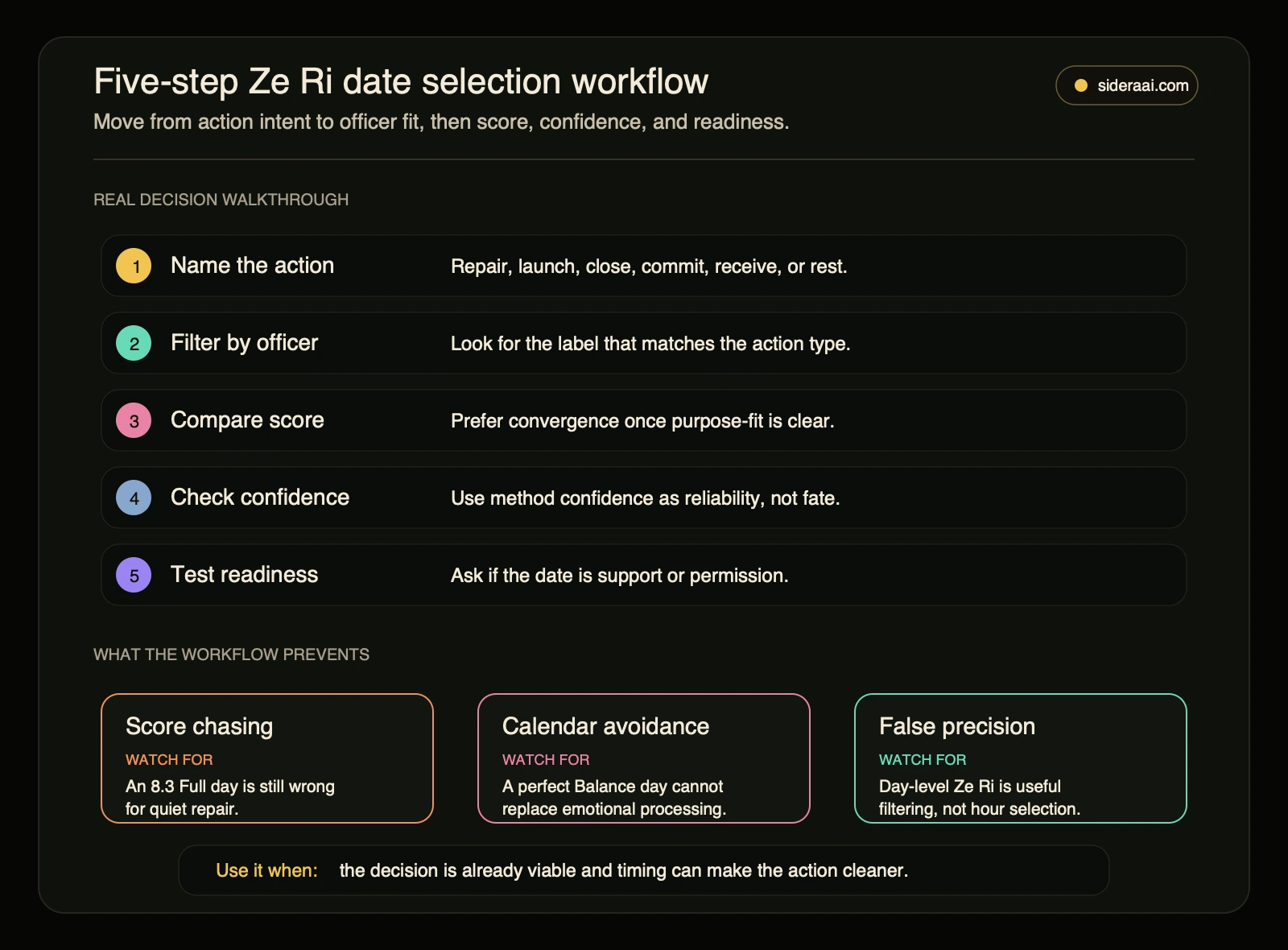
Move through the gates in order so the calendar supports a decision that is already viable instead of becoming a way to avoid the decision.
Common Mistakes People Make with Ze Ri Timing
These patterns appear repeatedly when almanac timing is used without enough friction in the process:
Chasing score without checking officer match. A day can score 8.5 with a “Destruction” officer and be exactly wrong for signing a new contract. The score reflects convergence of inputs; the officer tells you what kind of convergence. Both matter, in that order.

A strong signal for dismantling is still the wrong fit for a new commitment; purpose comes before the score.
Using the top-days list as the only filter. The top days are the strongest candidates for general purposes. They are not necessarily the right days for your specific action. A month’s highest-scoring day might carry a “Full” officer when what you need is a “Balance” day for a repair conversation.
Treating low confidence as a bad omen. A score at 58% confidence is not a warning. It is a signal that the calculation had fewer inputs to resolve. Focus on the officer label at low confidence; treat the number as directional, not precise.
Using the almanac to replace readiness. A high-score Stable day will not make you feel ready to make a commitment you are genuinely ambivalent about. Timing tools work as a filter within a range of viable options. They do not manufacture certainty you have not built.
Avoiding Destruction and Danger entirely. Both have legitimate uses. Destruction suits deliberate dismantling before rebuilding. Danger suits rest, internal review, and purposeful pause. Avoiding them reflexively means missing some of the most useful days in the twelve-officer sequence.
The Reflection Question You Should Ask Before Checking the Score
Before you look at the date score, ask yourself three questions:
- Am I looking for support, or am I looking for permission?
- If the score comes back low, will I wait for a better date or proceed anyway?
- If the score comes back high, will I actually feel more ready to act?
These questions reveal what role timing is playing in your decision-making.
If you are looking for support, a score and day officer can be genuinely useful: one more signal to weigh alongside your own judgment, the practical calendar, and the other factors already in play. Timing tools work well as confirmation layers.
If you are looking for permission, the score will probably not give it to you. A “Full day” at 8.3 will not resolve ambivalence about whether to send the message. An “Establish” signal will not make you feel ready to begin something you are afraid of. Almanac timing works best after you have already decided to act; it helps you choose when, not whether.
The third question matters most. If a high score would genuinely help you move, the tool is doing its job. If you already know you will find a reason to hesitate regardless of the score, that is information about the decision, not the date.
When the Timing Looks Right and You Are Not Ready
Here is a situation almanac guides rarely address: you find a day that scores well, the officer matches your intention, method confidence is high, and you still feel wrong about it.
Maybe you found a “Balance” day that looks ideal for a reconciliation conversation, but when you imagine sending the message, the resistance is not about the date. It is about whether you have processed enough to show up without defending yourself.
Maybe you found an “Open” day for sharing something you have been working on privately, the score looks strong, but the hesitation is not about timing. It is about the work not being finished.
In these moments, almanac timing has done something useful: it has removed the date as a variable. When the timing looks right and you are still not moving, the blocker is not when.
When systems disagree, the same logic applies. If Chinese almanac timing shows a “Stable” day with a strong score, but Western timing shows a void-of-course Moon and your sense is that the conversation will not land, do not use the almanac score to override what you already sense. Ask instead: which system is most relevant to this specific action? For long-term commitment decisions, Stable reads strongly in Chinese timing. For interpersonal communication timing, lunar energy in Western astrology often carries more relevance. Disagreement between systems is not confusion; it is information about which lens to weight for this particular moment. See the astrology calendar comparison for how the seven Lucky Day Planner systems map to different types of decisions.
Using Ze Ri for Relationship and Family Decisions
Most people think of almanac timing in the context of business: contracts, launches, job starts. The day officers are equally relevant for decisions involving people you love, often more personally resonant because the stakes are harder to walk back.
Reconciliation: A “Balance” or “Receive” day creates a better environment for repair conversations than a “Success” or “Initiate” day. Balance asks both people to come with fairness. Receive asks you to listen before speaking. Initiating a reconciliation on an Initiate day often means one person is driving and the other is not yet there.
A difficult family conversation: If the purpose is to end a pattern, look for a “Remove” day. If you want to set a new foundation, look for “Establish.” Avoid “Destruction” or “Danger” for conversations where the goal is understanding rather than dismantling.
A commitment: If you are registering something official, setting a long-term plan with a partner, or formalizing a relationship change, “Stable” is the officer that fits. It does not promise a smooth conversation. It supports durability.
An ending: A “Close” or “Remove” day suits the action better than trying to force a beginning on the same day. Endings that happen on Remove or Close days tend to feel more complete rather than cut short.
Reading Score and Confidence Together
Score reflects how well the day’s combined inputs align with the default weighting in the calculation. A high score means more inputs agree.
Method confidence reflects how much of the calculation resolved cleanly given timezone, calendar conversion, and available local rules. A high score with high confidence means the calculation had enough to work with. A middling score with lower confidence should be treated as directional, not precise.
When confidence falls below 70%, focus on the day officer signal rather than the numeric score. “Remove” at 62% confidence still tells you something meaningful about the character of the day. The score at that level is less reliable for fine comparison between close candidates.
When comparing two dates with similar scores, prefer the one with higher confidence unless the lower-confidence day has a significantly better officer fit for your specific action.
For Vedic timing comparison, Muhurta calculator and Jyotish timing offers a parallel lens that often complements the Ze Ri layer for significant timing decisions.
Scope: What This Day-Level Layer Does Not Do
This day-level Ze Ri layer does not:
- Choose exact hours within the day
- Personalize results to your individual BaZi chart
- Apply activity-specific filters from a traditional full Tong Shu
- Replace a trained date-selection consultation
- Guarantee that a chosen day will produce a specific outcome
The method confidence figure exists to flag when the calculation had less to work with. A planning tool that surfaces where its calculation stops is more useful than one that hides uncertainty behind a clean number. The Chinese tab is a day-level almanac filter, and it is honest about that scope.
How to Use Chinese Almanac Good Days in Practice
Use the Chinese tab as a filter layer, not a final verdict.

Treat the almanac as a filter: narrow viable dates by action fit, then choose the strongest practical window you can actually use.
Step 1: Name the action. Are you beginning something? Ending something? Making a commitment? Receiving something? Clearing? The officer match only works if you know what you are actually doing. “I need a good day” is not specific enough.
Step 2: Open the top-days view first. Scan the month’s strongest candidates with their officers visible before scrolling the calendar. This prevents anchoring on the first date that looks acceptable.
Step 3: Match the officer to the action. Use the quick reference table above. A “Stable” day for a commitment. An “Open” day for a launch or introduction. A “Remove” day for a conversation about ending a pattern. A “Balance” day for a repair conversation. A “Close” day for rest or sealing something already decided.
Step 4: Check the selected-day detail. Review the score, confidence, clash, and solar term before committing to a date. If confidence is below 70%, treat the score as directional and weight the officer label more heavily.
Step 5: Compare with other layers. Check how the Western, Rokuyo, or Jyotish layers read the same day. Rokuyo calendar timing offers a useful second cultural timing lens. Disagreement between systems often tells you which lens is most relevant to the specific action, not which system is wrong.
For a business launch, cross-check with best days to start a business in 2026 and use the Chinese tab as a secondary signal. For signing, compare the Ze Ri reading with auspicious day for signing a contract.
The Practical Takeaway
Chinese almanac good days are action-fit signals, not universal luck scores. The day officer tells you what kind of day this is. Your job is to know what kind of day you need.
The decision table and the real-decision walkthrough in this article both point to the same underlying move: Ze Ri gives you a vocabulary for asking a more specific question earlier in the process. Not “is today lucky?” but “what does today support, and is that what I need?”
That reframe is more useful than any single score. It turns date selection from superstition into a practical filter for timing decisions that actually matter. The Lucky Day Planner Chinese layer surfaces score, officer, confidence, clash, and solar term in a single panel so that comparison and filtering take minutes rather than hours of almanac research.
Want to see how Ze Ri stacks against Western transits, Jyotish, and other timing systems for the same date? The chart view layers all seven Lucky Day Planner systems for a comparative read on any decision window.
Ready to See Your Personal Birth Chart?
Discover your unique cosmic blueprint — planets, houses, and aspects personalized to your exact birth time and location.
Get Your Birth Chart →✓ Birth chart analysis ✓ Personalized insights ✓ Free to use