
If you have ever opened a birth chart calculator, recognized one placement immediately, then got lost in a wheel of symbols and degrees, this guide is for you. The calculator is only step one. The useful part is learning how the chart describes behavior you can actually recognize: how you protect yourself in conflict, what makes you feel emotionally safe, why certain work environments bring out your best or worst, and where your self-image gets rigid.
A birth chart calculator converts three pieces of data - date, time, and place of birth - into a snapshot of the sky at the exact moment you arrived. That snapshot becomes your astrological blueprint: every planet frozen in its sign and house, every angle noted, every relationship between planets mapped. The calculator does the math. Your job is to translate the results into real life without turning every placement into destiny.
Not sure what your Sun sign is yet? The What Is My Zodiac Sign guide covers all 12 sign date ranges with a tropical lookup table - a solid starting point before you run a full chart.
Western birth chart interpretation has a documented history stretching back to Ptolemy’s Tetrabiblos in the 2nd century CE - roughly 1,800 years of accumulated technique. The calculator is new. The underlying system is not.
This guide walks you through how to use a birth chart calculator, what it shows you, and how to start reading your results in a way that gives you something practical to reflect on.
Ready to See Your Personal Birth Chart?
Discover your unique cosmic blueprint — planets, houses, and aspects personalized to your exact birth time and location.
Get Your Birth Chart →✓ Birth chart analysis ✓ Personalized insights ✓ Free to use
How to Read the Chart Like It Belongs to a Real Person
Do not start by memorizing keywords. Start by asking what a placement does under pressure.
- In love: does this placement seek closeness, independence, intensity, reassurance, admiration, or consistency?
- At work: does it push you toward leadership, precision, service, visibility, autonomy, or creative control?
- In conflict: does it fight, withdraw, over-explain, appease, detach, or try to regain control?
- In self-image: does it make you proud of being competent, needed, original, disciplined, emotionally perceptive, or impossible to pin down?
That is the difference between astrology as personality content and astrology as self-understanding. A good reading should make you think, “I do that,” then give you a cleaner choice for the next conversation, decision, or boundary.
Use three questions as you read:
- Where do I overuse the strength? The same trait that makes you capable can also make you defensive, controlling, avoidant, or exhausted.
- Where does the shadow show up? Look for repeated patterns, especially the ones you justify quickly.
- What would growth look like this week? Pick one behavior you can practice, not a vague identity upgrade.
What You Need Before You Start
Three things, and the precision of each matters:
Date of birth. Day, month, year. This determines which sign the Sun was in and sets the baseline positions of slower-moving planets.
Time of birth. As accurate as possible - ideally to the minute. Your birth time determines your Ascendant (rising sign) and, crucially, which house every planet falls in. The Ascendant moves approximately one degree every four minutes, which means a 30-minute error in your birth time can shift your Rising sign by up to seven or eight degrees - enough to change which house a planet occupies. Even a one-hour difference can push the entire Ascendant into a different sign.
Without the birth time, you can calculate Sun, Moon, and planet signs, but house placements will be missing or estimated.
Place of birth. City and country (or latitude/longitude). The calculator uses your birthplace coordinates to determine local sidereal time, which sets the house wheel spinning from the correct starting point. Someone born at the same date and time in New York and in Sydney will have different Ascendants.
No birth certificate handy? Even an approximate birth time gives you useful data - many people work with “sunrise” or “noon” charts when exact time is unknown. Just note that Ascendant and house cusps will be imprecise.
If your time is uncertain, read the chart in layers. Treat Sun, Mercury, Venus, Mars, Jupiter, and Saturn signs as usable starting points. Treat Rising sign, houses, and angle-based interpretations as provisional until you can confirm the time.
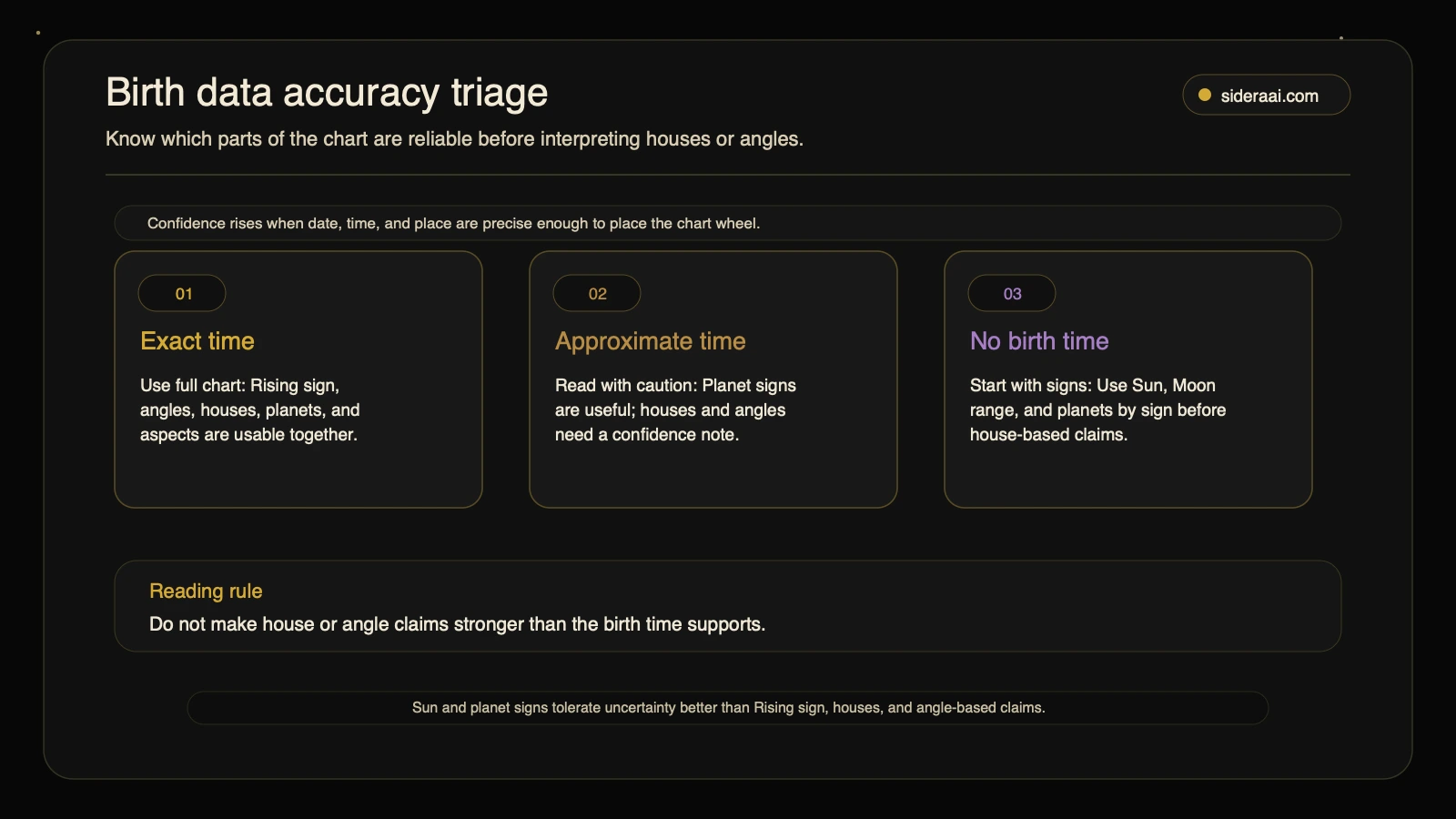
Use this triage before reading the wheel: exact time supports angles and houses, approximate time makes them provisional, and unknown time is best for planet signs first.
What a Birth Chart Calculator Shows You
Once you enter your data, the calculator produces a circular chart called the natal chart (or birth chart). It looks like a wheel divided into 12 segments. Read it as a map of what part of you is acting, how it acts, and where in life that pattern tends to play out.
The Zodiac Ring. The outer wheel is the 12 zodiac signs - Aries through Pisces - arranged in order. This is the style layer of the chart. It tells you whether a planet tends to act directly, cautiously, emotionally, analytically, intensely, playfully, or in some other recognizable mode.
The Houses. The 12 inner divisions of the wheel represent the 12 houses, each governing a distinct life area. The First House begins at the Ascendant and the rest follow counterclockwise. For a full breakdown of what each house governs, see our 12 Houses of Astrology guide. Houses show the arena: the 2nd is money and resources, the 7th is partnerships, the 10th is career and public reputation.
The Planets. Symbols scattered around the wheel mark where each planet was in the zodiac at your birth. Every planet sits in both a sign (its quality and style) and a house (its life area). The Sun in Capricorn in the 10th House may build identity through achievement and public competence. The Sun in Capricorn in the 4th House may build identity through privacy, family responsibility, or emotional self-sufficiency. Same sign, different life territory. For a reference guide to all planetary meanings, see Planets in Astrology: A Complete Cheat Sheet.
The Aspects. Lines drawn through the center of the chart show geometric relationships between planets. A trine (120 degrees) indicates ease and flow between two placements. A square (90 degrees) creates friction and challenge. A conjunction (0 degrees) merges two planetary energies. The full logic of aspects is covered in our Astrology Aspects guide. In practice, aspects often explain why two parts of you do not always want the same thing.
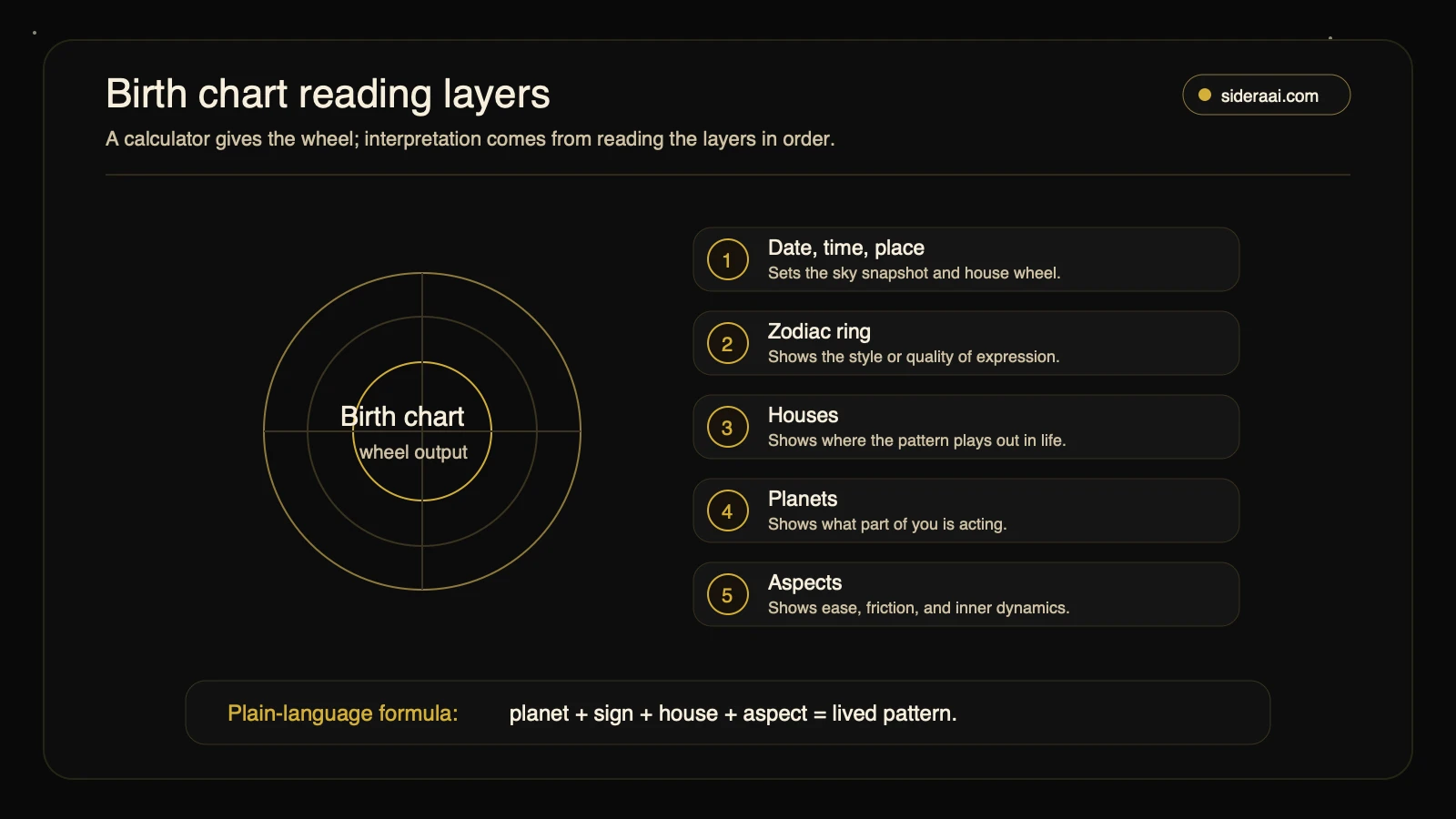
Use this layer map to read a calculator result in order: first the inputs and wheel, then signs, houses, planets, and aspects as lived patterns.
Sidera uses your actual birth chart—not generic horoscopes.
Get personalized insights →The Four Angles
Most birth chart calculators display four cardinal points called the angles. These are among the most sensitive positions in any chart, and new readers often miss them entirely.
Ascendant (AC) / Rising Sign. The zodiac degree rising on the eastern horizon at birth. It marks the start of the 1st House and shapes how others perceive you on first meeting - your outward presentation, physical bearing, and instinctive approach to new situations. In real life, it often describes your first line of defense: how you enter a room, start a task, or respond before you have had time to think.
Descendant (DC). Directly opposite the Ascendant. It marks the start of the 7th House and describes what you seek and attract in close partnerships - often qualities you project outward rather than claim for yourself. If relationship patterns feel repetitive, the Descendant is one of the first places to look.
Imum Coeli (IC). The lowest point of the chart, marking the start of the 4th House. It governs home, roots, family of origin, and your private emotional foundation. It can describe the version of you that appears when nobody is watching.
Midheaven (MC). The highest point of the chart, marking the start of the 10th House. It governs career, public life, reputation, and long-term ambitions. It often shows the kind of competence you want to be known for, even if you are still growing into it.
When a planet lands on or near an angle, its influence intensifies across that entire life domain.
Tropical vs. Sidereal: Which Calculator Setting?
Most mainstream birth chart calculators use the tropical zodiac - the system that anchors Aries to the March equinox. Western astrology, including most English-language astrology you encounter, uses tropical.
Some calculators offer a sidereal option - the system that aligns signs with the actual star constellations, accounting for the slow wobble of Earth’s axis (axial precession). Vedic and Jyotish astrology use sidereal. The two systems differ by roughly 23-24 degrees, which means your Sun sign may shift in a sidereal calculation.
Sidera uses the tropical/western zodiac. If you are exploring traditional Western astrology - Sun signs, natal chart readings, electional astrology, compatibility work - use a tropical calculator. For a broader look at how elements and modalities work within the tropical system, see our Zodiac Sign Elements guide.
The Three Placements to Read First
A full birth chart has dozens of data points. New readers often feel overwhelmed because every placement seems important at once. Start with three, and read each one as a lived pattern instead of a label.
Stephen Forrest’s The Inner Sky (1988; Wikipedia) frames the birth chart as weather, not a life sentence. That reframe matters before you begin reading.
Sun Sign. The sign the Sun occupied at your birth. Your Sun sign represents your core identity, creative drive, and the direction of your development across a lifetime. In self-image, it often shows what you want to become good at being. In work, it can describe the kind of contribution that makes you feel more like yourself. For a thorough look at what the Sun represents astrologically, see The Sun in Astrology.
Moon Sign. The sign the Moon occupied at your birth. The Moon moves approximately 13 degrees per day and passes through all 12 signs over the course of roughly 28 days, spending about 2.3 days in each sign. Your Moon sign describes your emotional nature, instinctive reactions, and what you need to feel safe and nurtured. In relationships, it often shows what you need before you can stop performing and relax. Once you know your Moon sign, explore your daily lunar weather by checking your sign’s horoscope at the end of this guide.
Ascendant (Rising Sign). The zodiac sign on the eastern horizon at the exact moment you were born. The Ascendant shapes your outward style, first impressions, and physical appearance. It also sets the house wheel - the Rising sign occupies the entire 1st House. In conflict, it can show the reflex you lead with: confronting, smoothing things over, analyzing, disappearing, joking, or taking charge.
Together, Sun + Moon + Rising give you a three-dimensional portrait that is far more precise than Sun sign alone. For a deeper exploration of how these three interact, see Sun, Moon, and Rising Sign: What They Mean Together.
Reading Your Planets in Houses
Once you have the three big placements, start exploring where your planets fall by house. Each combination tells a story. The simplest formula is: planet = what part of you, sign = how it behaves, house = where it shows up.
- Venus in the 7th House: Love, charm, and value get worked out through partnership. In real life, this can look like feeling most attractive when you are chosen, smoothing over tension too quickly, or needing to learn that harmony is not the same as honesty.
- Mars in the 10th House: Drive, anger, and courage move through career and public life. This can show up as ambition, impatience with vague authority, a strong competitive edge, or burnout when every goal becomes a test of worth.
- Saturn in the 4th House: Responsibility, fear, and maturity gather around home, family, and emotional roots. This may feel like growing up early, being private about need, or building stability later in life because it was not freely available at the start.
The sign describes how a planet operates; the house shows where in your life that energy plays out. A house with no planets in it is not empty of meaning - see the FAQ below for a full explanation of how empty houses work. What matters most is not whether a placement sounds flattering. It is whether it gives you a more honest read on the behavior you repeat.
Understand your connections on a cosmic level.
Explore your bonds →What Most Calculators Miss
Basic calculators show you signs and houses. More sophisticated tools go further. The deeper issue is interpretation: a calculator can tell you that Venus squares Saturn, but it cannot automatically know whether that feels like fear of rejection, guarded affection, choosing unavailable people, or needing proof before you trust warmth.
Aspects. The geometric relationships between planets reveal the internal dynamics of your chart. A Sun-Saturn square, for example, suggests ongoing tension between self-expression and the weight of discipline or responsibility. A Venus-Jupiter trine indicates natural ease around pleasure, abundance, and connection.
Chart Shape. The overall distribution of planets - bundled on one side, spread across all 12 houses, or split into two clusters - describes how your energy is concentrated or scattered. Robert Hand notes in Horoscope Symbols (1981; Wikipedia) that chart pattern analysis often reveals motivational tendencies that individual placements alone cannot explain.
Chiron and the Nodes. Many calculators include Chiron (the “wounded healer” asteroid, associated with core wounds and where you develop mastery through difficulty) and the North and South Nodes (points tied to karmic direction and past-life patterns in traditional interpretation). These are not planets but add another layer of interpretive depth.
Synastry (Chart Comparison). Sophisticated calculators allow you to overlay two charts and examine compatibility through planetary aspects between them. For a broader look at astrological compatibility principles, see our Zodiac Signs Compatibility Chart.
Turn Your Results Into One Useful Takeaway
After you run the calculator, do not try to decode the entire chart in one sitting. Choose one placement that feels emotionally true and write it out in plain language:
- Placement: Moon in Virgo in the 6th House.
- Pattern: I feel safer when I can be useful, organized, and prepared.
- Shadow: I may turn anxiety into fixing, criticizing, or over-functioning.
- Real-life test: This week, I can ask for support before I start managing everything alone.
That kind of note is more useful than a long list of traits. It turns the chart into a decision tool: what to notice, what to interrupt, and what to practice next.
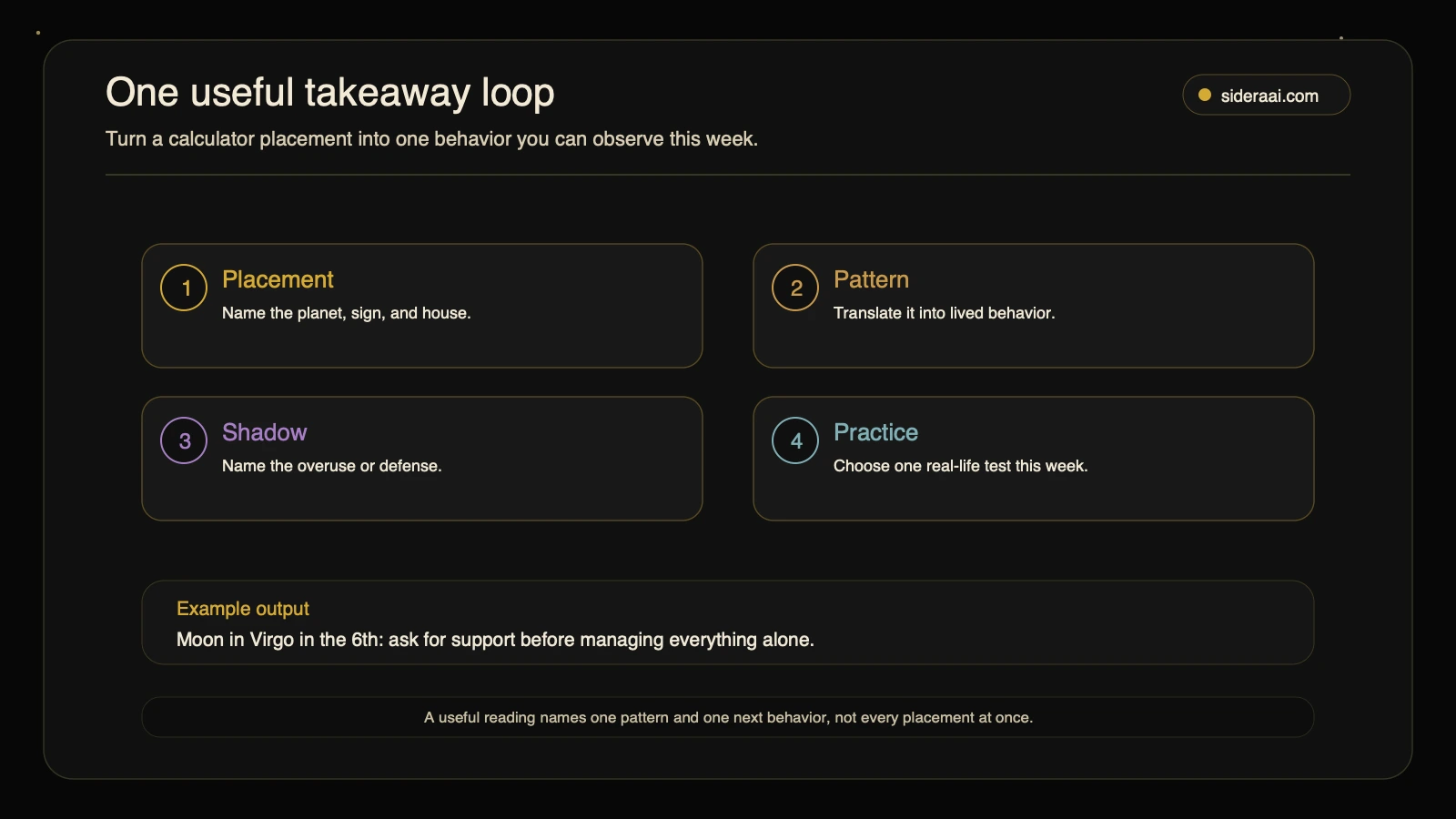
Use the loop after running a calculator so the chart becomes a concrete behavior to notice, interrupt, or practice instead of a list of traits.
Plan your life around the stars, not just the calendar.
Start planning →Explore Your Sign
Once you know your Sun, Moon, and Rising signs from your birth chart, check your daily cosmic weather:
- Aries Daily Horoscope
- Taurus Daily Horoscope
- Gemini Daily Horoscope
- Cancer Daily Horoscope
- Leo Daily Horoscope
- Virgo Daily Horoscope
- Libra Daily Horoscope
- Scorpio Daily Horoscope
- Sagittarius Daily Horoscope
- Capricorn Daily Horoscope
- Aquarius Daily Horoscope
- Pisces Daily Horoscope
FAQ
Do I need my exact birth time? For Sun and Moon signs, no - those change slowly enough that date alone usually works. The Moon is the exception: it changes signs every 2-3 days, so if you were born near a sign change, the exact time matters. For your Ascendant and all house placements, yes. Even a 15-minute error can shift your Rising sign by a few degrees, and a 2-hour error can push it into a new sign entirely.
What if I don’t know my birth time? Use a sunrise or noon chart as a starting point. Note that Ascendant and houses will be approximate. Many people request birth certificates or ask family members to locate a more precise time. Some rectification astrologers can estimate a likely birth time based on major life events.
What is the difference between a natal chart and a birth chart? They are the same thing. “Natal chart” is the formal astrological term; “birth chart” is the common English name. Both refer to the planetary snapshot at birth.
How is a birth chart calculator different from a horoscope? A horoscope is a general forecast based on your Sun sign, shared by everyone born in that sign. A birth chart is a personal map based on your exact birth data - unique to you. The two are related the way a regional weather report is related to your personal calendar.
What does it mean if a house has no planets? It means that house is not a primary arena of activity in your chart, but it is not empty of meaning. The sign on the house cusp and the planet that rules that sign still describe how that life area functions for you. An empty 7th House does not mean no relationships - it often means partnerships are less of a defining preoccupation.
What does it mean if two planets are in the same sign? They are in conjunction if they are close in degree. Both planets’ energies blend and reinforce each other in that sign. A Sun-Mercury conjunction, for instance, often indicates strong communication and a mind tightly woven into identity. Two planets in the same sign but far apart in degree are co-tenants, not a conjunction - they share a sign quality without necessarily merging their energies.
Can I read my own birth chart without an astrologer? Yes. Start with Sun, Moon, Rising. Then explore planets in houses one at a time. The full beginner’s guide to reading a birth chart covers each step in detail. Most people find patterns emerging naturally as they learn each layer.
Does birth location affect my chart much? More than most people expect. Location affects the Ascendant and house cusps directly - two people born at the exact same moment but in cities at different latitudes will have different Rising signs and different house placements, even with identical Sun and Moon signs. Astrocartography extends this logic further, mapping how different geographic locations shift which planets are angular in your chart.
Related Sidera Guides
Continue with these closely related guides: