
The best time to ask for a raise according to Sidera is a workable weekday under a New or waxing Moon, with a strong activity score driven by Jupiter, the Sun, and Venus. Thursday and Friday win tied scores, but a stronger Monday can outrank a weaker Thursday. Mercury retrograde and VOC are preparation cautions for this activity, not automatic rejections.
If you are looking this up, you probably do not need another vague answer about “money vibes.” You may already know you are underpaid. The harder part is choosing a moment when you can ask clearly without sounding rushed, resentful, or apologetic.
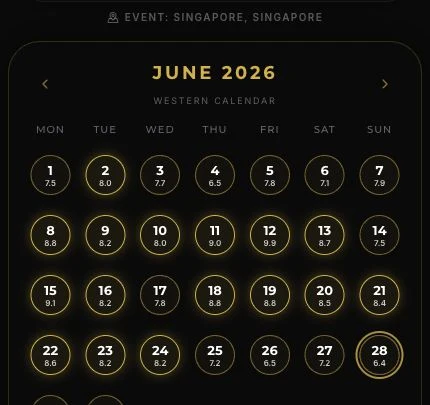
What You Are Really Timing
Good timing is not just a lucky date. It is the difference between walking into the conversation steady enough to name your value and walking in because one more frustrating meeting pushed you over the edge.
In real life, asking for a raise often brings up three layers at once:
- Work: Have you documented the wins, scope changes, revenue impact, saved time, or extra responsibility?
- Conflict: Can you stay direct if your manager hesitates, deflects, or asks for time?
- Self-image: Can you say the number without shrinking, overexplaining, or immediately bargaining against yourself?
Use astrology to choose a cleaner container for the conversation. If the chart says “go” but your body says “not yet,” treat that tension as information. The goal is not to let timing replace judgment. The goal is to act when your practical case and your internal readiness can support each other.
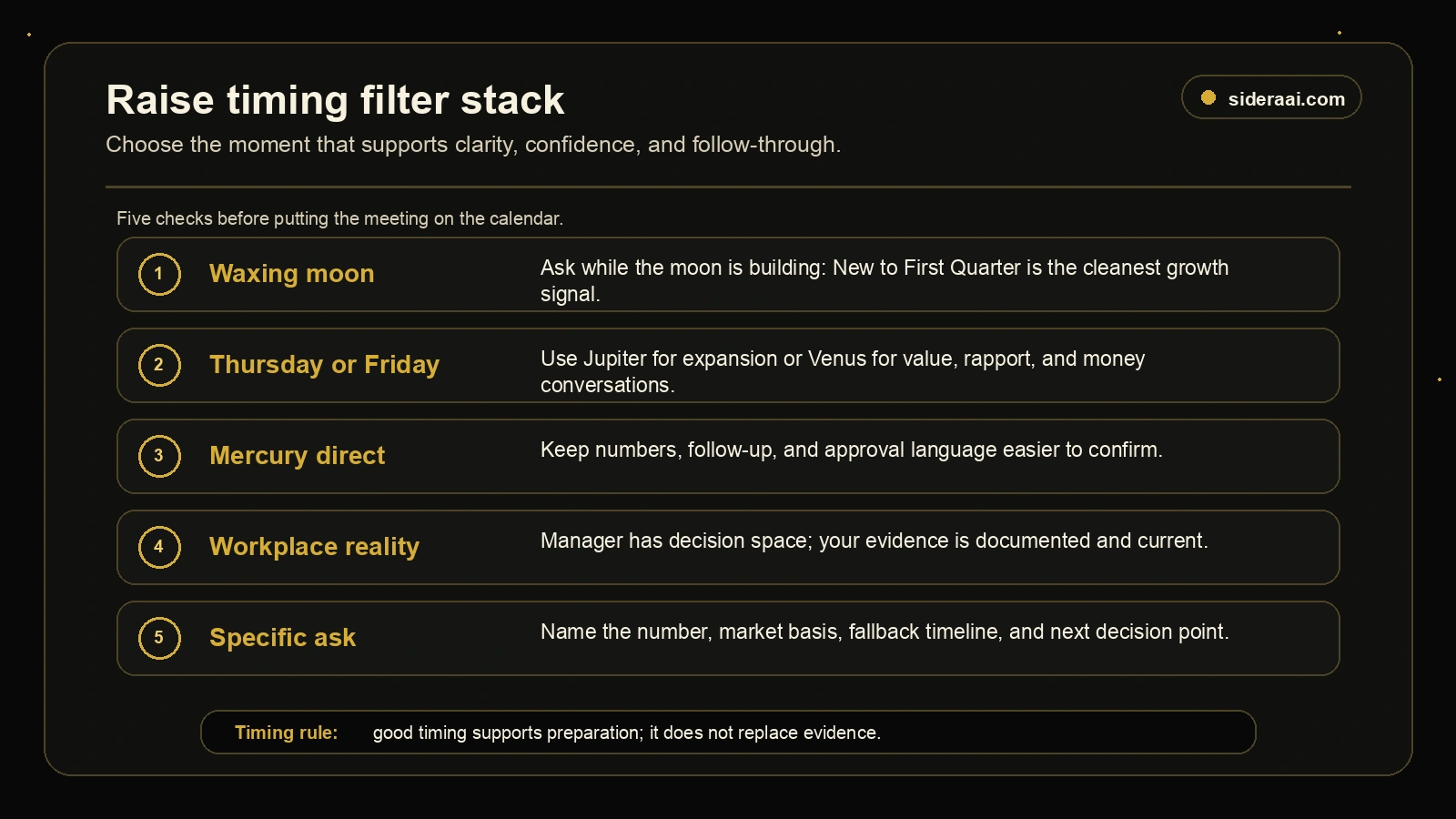
Use this stack before scheduling the conversation. The cleanest timing still needs workplace decision space, documented evidence, and a specific ask.
Why Astrological Timing Matters for Salary Negotiations
The practice of choosing optimal moments for important actions is called electional astrology. Instead of asking, “What is my personality?” electional astrology asks, “What kind of moment am I starting this under?”
That matters because salary conversations are not purely logical. A strong case can still land poorly if it happens during a budget freeze, a team crisis, or a week when your manager has no decision space. Astrology gives you symbolic timing; workplace strategy gives you the practical container. You need both.
The Power of Cosmic Receptivity
When you ask for a raise, you need confidence on your side and receptivity on the other side. Supportive timing does not force a yes. It helps you avoid starting the conversation under symbolism associated with confusion, contraction, pressure, or low visibility.
The Best Moon Phases for Asking for a Raise
The moon cycle is your most accessible timing tool-no birth chart required.
Waxing Moon (Best Overall)
| Moon Phase | Days After New Moon | Energy | Raise Potential |
|---|---|---|---|
| New Moon | 0-1 | New beginnings | Good for planting seeds |
| Waxing Crescent | 2-6 | Building momentum | Excellent timing |
| First Quarter | 7-10 | Taking action | Peak timing |
| Waxing Gibbous | 11-14 | Refinement | Good with preparation |
Why it works: The waxing moon grows from New to Full, so it symbolizes increase, visibility, and momentum. For a raise request, this is useful because you are asking for growth while presenting evidence that your role has already grown.
Moon Phases and Conditions to Handle
| Moon Phase | Energy | Why Avoid |
|---|---|---|
| Waning Moon | Release, decrease | Energy of letting go, not gaining |
| Dark Moon | Endings, rest | Low energy, poor visibility |
| Void of Course | Transition, weaker follow-through | Confirm ownership and the next decision date |
The Void of Course Moon deserves special attention. This occurs when the moon makes its last major aspect before changing signs, a period lasting anywhere from minutes to over a day. Traditional astrology treats void moons as low-follow-through windows. Sidera’s ask_for_raise activity does not deduct points for VOC because the first conversation can still surface useful information, even when the decision drifts. Prefer a non-VOC slot when two options are otherwise equal, and always leave with an owner, next step, and date.
Do not cross-check Moon phase, weekday, Mercury, and void hours by hand. Sidera scores each date so you can compare workable raise windows in one place.
Score my raise dates →Best Days of the Week for Salary Talks
Each day of the week is ruled by a planet with distinct energy:
| Day | Ruling Planet | Energy | Raise Suitability |
|---|---|---|---|
| Thursday | Jupiter | Expansion, luck, generosity | ⭐⭐⭐⭐⭐ Best |
| Friday | Venus | Harmony, value, money | ⭐⭐⭐⭐⭐ Excellent |
| Sunday | Sun | Authority, recognition | ⭐⭐⭐⭐ Very Good |
| Wednesday | Mercury | Communication, negotiation | ⭐⭐⭐ Good |
| Monday | Moon | Emotions, fluctuation | ⭐⭐ Variable |
| Tuesday | Mars | Conflict, aggression | ⭐ Avoid |
| Saturday | Saturn | Restriction, limits | ⭐ Avoid |
Pro tip: Combine day energy with the activity score. In the monthly tables below, Thursday or Friday wins only when favorability is tied; a materially stronger Monday or Tuesday remains eligible. That keeps weekday symbolism from overriding the actual Jupiter–Sun–Venus calculation.
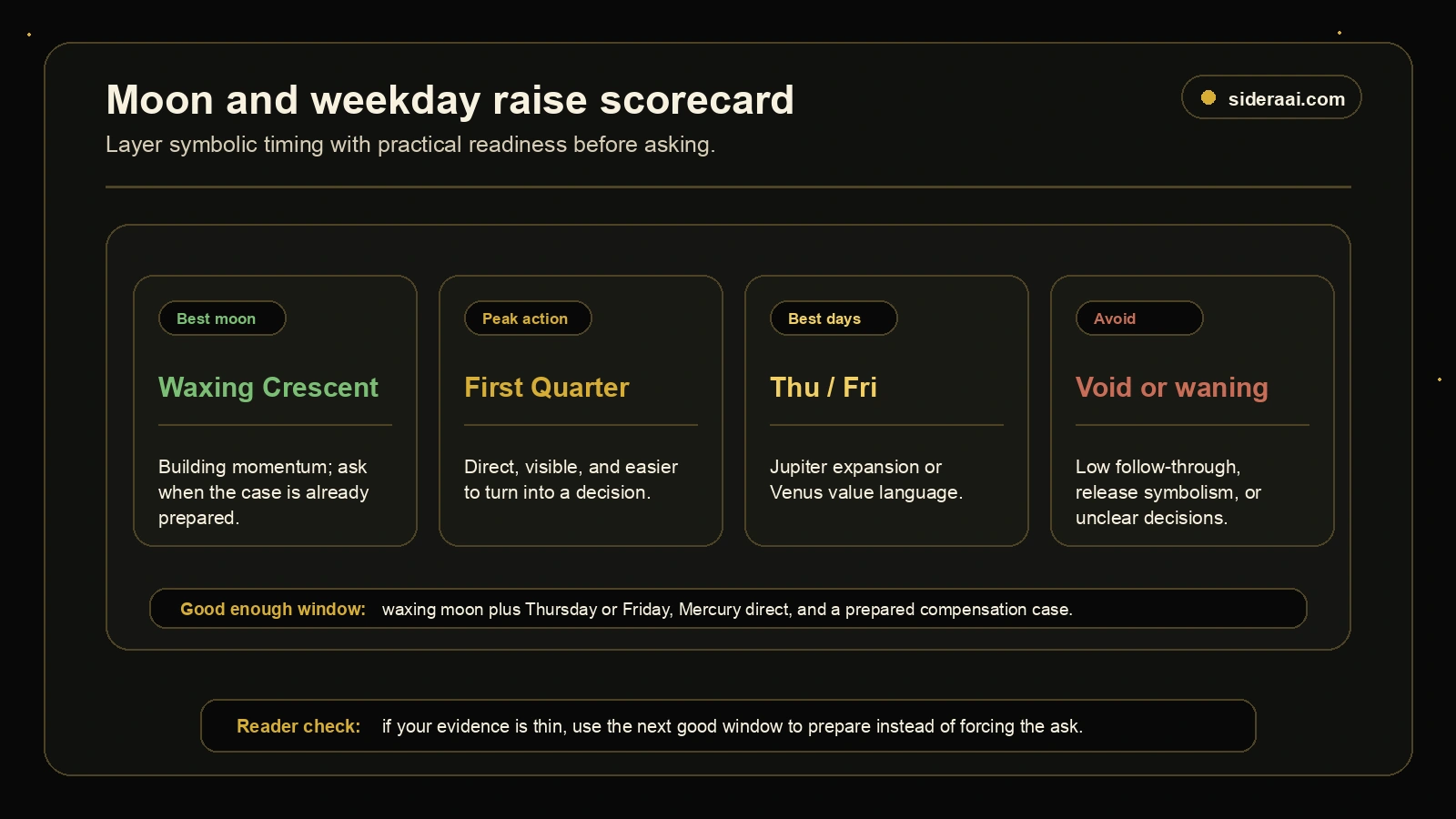
Use the scorecard to find a good-enough window instead of chasing perfection. Waxing moon plus Thursday or Friday is stronger when Mercury is direct and the case is prepared.
Planetary Transits That Boost Your Raise Request
Beyond moon phases and days, certain planetary transits describe the kind of confidence, value language, and communication climate you may be working with.
Jupiter Transits (The Money Planet)
Jupiter is the planet of expansion, growth, and opportunity. In a raise conversation, Jupiter can feel like permission to take up more professional space instead of minimizing what you have earned.
Look for Jupiter when it:
- Conjuncts your natal Sun or Midheaven: A visibility window where your contribution may be easier to recognize
- Transits your 2nd house: A money and self-worth period where compensation questions become harder to ignore
- Transits your 10th house: A career-status period that can support promotion, title, or leadership conversations
The shadow side of Jupiter is overreach. Do not turn a supportive transit into a vague pitch. Ask for a specific number, title change, or review timeline.
Venus Transits (Harmony and Value)
Venus governs value, rapport, and money. For salary talks, Venus helps when the conversation needs tact without self-erasure.
Favorable times include:
- Venus conjunct your natal Midheaven: Your work can read as more polished, visible, or appreciated
- Venus in Taurus or Libra: Value and agreement themes are emphasized
- Venus trine or sextile natal Jupiter: A smoother window for asking for more without making the room defensive
Mercury Transits (Communication)
For the actual conversation, you want Mercury strong because the details matter: numbers, dates, expectations, follow-up, and documentation.
Look for:
- Mercury direct: Fewer delays, misunderstandings, or reversals
- Mercury in an earth sign: More practical, concrete, compensation-focused language
- Mercury making favorable aspects to your natal Mercury: Easier phrasing, cleaner negotiation, and better follow-through
Generic dates cannot see your 2nd, 6th, and 10th houses or your Midheaven. Sidera uses your actual birth chart to make the timing personal.
Personalize my timing →What Needs Extra Handling
Mercury Retrograde: Separate the Ask from the Agreement
Traditional astrology treats Mercury retrograde as a review period rather than a clean launch window. That can still suit a raise conversation when you are revisiting an earlier promise, correcting a pay mismatch, or reopening a stalled compensation review. It is less clean for locking salary, title, effective date, and conditions into a final agreement.
At the calendar’s 12:00 UTC reference time, Sidera detects these runs:
- 2026: February 26–March 20, June 30–July 23, and October 24–November 13
- 2027: February 10–March 3, June 11–July 4, and October 8–October 28
The ask_for_raise activity has no retrograde penalty, so the calendar may retain a high-scoring date inside one of these periods. If it does, put your case and number in writing, confirm who owns the decision, and schedule a follow-up. When the conversation becomes a negotiation over final terms, use the stricter negotiate_deal timing described in our salary-negotiation guide.
Read our complete Mercury Retrograde 2026 guide for detailed timing.
Saturn Hard Aspects
When Saturn squares or opposes your natal Sun, Midheaven, or 2nd house ruler, you may face obstacles, delays, or outright “no’s.” These periods often last months. Use them to build proof, clarify responsibilities, and strengthen your leverage, then ask when the timing is less restrictive.
Mars-Saturn Conjunctions
These rare but potent alignments combine frustration (Mars) with limitation (Saturn). In real life, this can feel like pushing hard into a locked door: defensiveness, impatience, or a manager who only hears the cost.
Eclipse Season
Eclipses bring sudden changes and revelations, but also instability. The general publication filter below removes dates within three calendar days of a NASA-listed eclipse. A wider two-to-four-week caution is a personal electional choice, not something the general activity engine can justify without your natal chart and workplace context.
How to Use Your Birth Chart for Optimal Timing
For personalized timing, you need your natal chart, the snapshot of the sky at your exact birth moment.
Key Points to Analyze
- Your 2nd House: Money, self-worth, and what you believe you are allowed to charge
- Your 6th House: Daily work, workload, skills, and what you do every week
- Your 10th House: Career reputation, authority, title, and long-term direction
- Your Midheaven (MC): Visibility, status, and how decision-makers perceive your contribution
- Your Part of Fortune: A prosperity point that can add ease when activated
Finding Your Personal Windows
When benefic planets such as Jupiter or Venus transit these points or make favorable aspects to them, you have personal green lights. The best windows are not just “lucky.” They often coincide with moments when you can see your own value more clearly and communicate it with less apology.
Example: If your Midheaven is at 15° Aries, and Jupiter passes over that degree, that’s your prime raise-asking window for the next 12 years.
Practical Steps: Combining Astrology with Strategy
Astrology is a tool, not a substitute for preparation. Use it to choose the moment, then make the conversation professional enough to hold that moment.
Before the Conversation
- Document your achievements: projects shipped, revenue influenced, problems solved, time saved, team responsibility, or measurable quality improvements
- Research market rates: use salary bands, recruiter conversations, industry reports, or compensation tools as grounding
- Choose 2-3 astrological windows: do not build the entire plan around one fragile date
- Prepare your talking points before the meeting: numbers, examples, the exact ask, and a written follow-up draft
Choosing Your Moment
- Check the moon phase (waxing preferred)
- Note any Void of Course period and define a concrete follow-up date
- Prefer Thursday or Friday when the activity scores are tied
- If Mercury is retrograde, distinguish an opening/review conversation from final terms
- Check for major transits to your natal chart
- Confirm the workplace reality: budget cycle, review timing, manager availability, and recent performance context
During the Conversation
- Lead with achievements, not needs
- Use specific numbers, such as “I’m seeking a 15% increase”
- Reference market data
- Pause after the ask instead of filling the silence with discounts
- If the answer is not yes, ask for the criteria, timeline, and next decision point
The grounded rule: astrology can help you choose the door. Your evidence, tone, and follow-up determine what happens once you open it.
Best Dates to Ask for a Raise in the Rest of 2026
These are not editor-selected Moon windows. Sidera evaluated every date from August 10, 2026 through December 31, 2027 with the ask_for_raise activity. Its score combines the day’s overall quality and intensity with the New/waxing Moon modifier and aspects involving the activity’s primary planets: Jupiter for expansion, the Sun for recognition, and Venus for value and rapport.
The publication layer requires at least 4.5/5, Monday through Friday, a New or waxing Moon, and more than three days of separation from the eclipses in NASA’s catalog. When two dates have the same score, Thursday or Friday is preferred before quality and intensity break the remaining tie.
| Month | Sidera raise-request pick | Score | Moon | Why it passed |
|---|---|---|---|---|
| August | 5.0/5 Quality 9.6 · intensity 4.4 | Waxing Crescent | High quality and supportive Jupiter–Sun–Venus aspects (+0.56); VOC at 12:00 UTC is a follow-through caution, not a score penalty. | |
| September | No qualifying date | — | — | Thursday, September 17 is the best weekday under a waxing Moon, but challenging raise-request aspects keep it at 4.4/5. |
| October | 4.5/5 Quality 8.5 · intensity 4.6 | Waxing Crescent | Friday and a Waxing Crescent lift the date to the threshold; VOC means confirm the decision path and next review step. | |
| November | 5.0/5 Quality 8.1 · intensity 10.0 | Waxing Crescent | High base quality and intensity survive one challenging aspect; Mercury retrograde and VOC call for a written ask and a defined follow-up. | |
| December | 5.0/5 Quality 8.0 · intensity 5.0 | Waxing Gibbous | Friday wins the tied-score weekday preference with very supportive Jupiter–Sun–Venus aspects (+1.44). |
High raw scores excluded by practical publication gates
| Rejected date | Raw score | Blocked by | Why score alone is insufficient |
|---|---|---|---|
| 5.0/5New Moon | Eclipse buffer | A 5.0/5 New Moon result is not published on the date of the August 12 solar eclipse. | |
| 5.0/5Waxing Gibbous | Weekend | The highest-quality raw date is excluded because most managers and compensation processes are not available on Saturday. |
Why Mercury retrograde and VOC do not automatically block a raise request
| Engine-ranked date | Score | Caution | Practical comparison |
|---|---|---|---|
| 5.0/5Waxing Crescent | Moon VOC at 12:00 UTC; ask_for_raise applies no VOC score penalty. | Tuesday, August 18 is also 5.0/5, with quality 8.5 and a non-VOC Moon at 12:00 UTC—the cleaner option if both slots work. | |
| 5.0/5Waxing Crescent | Mercury retrograde and Moon VOC; neither affects this activity's raw score. | Use it to open or revisit the compensation case, document the number, and set a decision date. For final terms, apply the stricter negotiate_deal rules. |
General transit-only calculation, generated August 11, 2026 with Sidera engine baseline 382200b. Monthly order: favorability, then Thursday/Friday preference, quality, intensity, and earliest date. Raise-request picks require at least 4.5/5, a Monday–Friday date, a New or waxing Moon, and the stated eclipse buffer. The ask_for_raise activity does not penalize Mercury retrograde or VOC; both are surfaced as preparation cautions. No birth chart or location was used.
September is intentionally left as a hold. Thursday, September 17 has the preferred weekday and a Waxing Crescent Moon, but its challenging activity aspects leave it at 4.4/5. November 12 demonstrates the product-specific distinction: its raw 5.0/5 survives Mercury retrograde and VOC because this model evaluates opening the raise conversation, not signing the final compensation agreement.
Best Dates to Ask for a Raise in 2027
The same method returns ten ranked workdays and two holds in 2027. February 16 is the best weekday under an allowed Moon phase at only 3.6/5. March 15 reaches 3.5/5 after challenging Jupiter–Sun–Venus aspects. Neither month gets a recommendation simply to complete the table.
| Month | Sidera raise-request pick | Score | Moon | Why it passed |
|---|---|---|---|---|
| January | 5.0/5 Quality 7.1 · intensity 7.2 | Waxing Crescent | Thursday, a Waxing Crescent, and strong supportive raise-request aspects (+1.40). | |
| February | No qualifying date | — | — | Tuesday, February 16 is the best weekday under an allowed Moon phase, but the raw result reaches only 3.6/5; Mercury retrograde is disclosed but is not the reason for the hold. |
| March | No qualifying date | — | — | Monday, March 15 has a First Quarter Moon, but challenging raise-request aspects (-0.77) keep it at 3.5/5. |
| April | 5.0/5 Quality 10.0 · intensity 6.0 | Waxing Gibbous | Maximum base quality; Thursday wins the tied-score weekday preference, while one challenging aspect remains a preparation cue. | |
| May | 4.8/5 Quality 8.7 · intensity 3.5 | Waxing Gibbous | A high-quality Friday with a Waxing Gibbous Moon and a modest supportive aspect (+0.20). | |
| June | 5.0/5 Quality 8.1 · intensity 5.0 | New Moon | New Moon support (+0.40) and strong Jupiter–Sun–Venus aspects (+1.14), one week before Mercury retrograde. | |
| July | 4.7/5 Quality 7.3 · intensity 3.6 | Waxing Crescent | Thursday after Mercury turns direct, with a Waxing Crescent and supportive raise-request aspects (+0.48). | |
| August | 5.0/5 Quality 10.0 · intensity 10.0 | Waxing Crescent | Maximum intensity and quality on a Friday; one challenging aspect means the evidence and number should be rehearsed. | |
| September | 5.0/5 Quality 7.7 · intensity 5.6 | New Moon | Thursday with New Moon support (+0.40) and supportive raise-request aspects (+0.48). | |
| October | 4.6/5 Quality 6.8 · intensity 6.7 | Waxing Crescent | The only weekday to clear 4.5/5 under an allowed Moon phase; supportive aspects (+0.38) outweigh the weekday preference. | |
| November | 5.0/5 Quality 6.0 · intensity 6.8 | Waxing Crescent | Thursday wins the tied-score weekday preference, backed by strong supportive raise-request aspects (+1.31). | |
| December | 5.0/5 Quality 9.6 · intensity 6.2 | Waxing Crescent | High quality on a Friday with supportive Jupiter–Sun–Venus aspects (+0.96). |
High raw scores excluded by practical publication gates
| Rejected date | Raw score | Blocked by | Why score alone is insufficient |
|---|---|---|---|
| 5.0/5Waxing Crescent | Eclipse buffer | Maximum quality does not override the three-day buffer after the August 2 solar eclipse. | |
| 5.0/5New Moon | Weekend | A strong raw score and New Moon are insufficient when the conversation is impractical to schedule. |
Why Mercury retrograde and VOC do not automatically block a raise request
| Engine-ranked date | Score | Caution | Practical comparison |
|---|---|---|---|
| 4.9/5Waxing Gibbous | Mercury retrograde is disclosed but not penalized for opening a raise discussion. | Friday, June 4 is the month's published 5.0/5 pick before retrograde; June 17 is better framed as a follow-up or revision conversation. |
General transit-only calculation, generated August 11, 2026 with Sidera engine baseline 382200b. Monthly order: favorability, then Thursday/Friday preference, quality, intensity, and earliest date. Raise-request picks require at least 4.5/5, a Monday–Friday date, a New or waxing Moon, and the stated eclipse buffer. The ask_for_raise activity does not penalize Mercury retrograde or VOC; both are surfaced as preparation cautions. No birth chart or location was used.
October 4 is a useful counterexample to the weekday rule. It is a Monday, but its 4.6/5 result is the only October weekday to clear the threshold under an allowed Moon phase. A generic “Thursday is always best” rule would hide that activity-specific result.
How to Read the Raise-Request Data
- Favorability (1–5) is the final
ask_for_raisescore after activity modifiers. - Quality (1–10) describes how harmonious the overall pattern is and breaks tied results after the Thursday/Friday preference.
- Intensity (1–10) describes how active the day is; it can amplify a strong or difficult baseline.
- Mercury and VOC are disclosed, not gated. They change how you prepare and follow up, not whether the engine can rank the date.
- General is not personal. The tables do not include your 2nd, 6th, or 10th houses, Midheaven, natal planets, location, manager, budget cycle, or company policy.
All rows use 12:00 UTC for reproducibility. Moon/VOC conditions and retrograde station boundaries are time-sensitive, so check the exact local meeting time before confirming the conversation.
FAQ: Asking for a Raise with Astrology
Q: Can I still ask for a raise during Mercury retrograde?
Yes. Sidera’s ask_for_raise activity does not penalize Mercury retrograde because opening or revisiting a compensation case is different from finalizing terms. Put the number in writing, define the decision date, and use stricter negotiation timing for the final agreement.
Q: What if my boss’s sign isn’t compatible with mine?
Sun sign compatibility is less relevant than you might think. Focus on the universal timing principles (moon phase, planetary days, retrogrades) rather than trying to guess your boss’s full chart. That said, if you know they’re a Capricorn Sun, approaching them with practical, data-driven arguments (Saturn-ruled sign values) can help.
Q: Do I need to know my birth time for this to work?
Not for basic timing. Moon phases, planetary days, and Mercury retrograde periods work without a birth chart. However, for personalized windows (like Jupiter crossing your Midheaven), you need your birth time to calculate house positions accurately.
Q: How far in advance should I plan my raise request?
Start tracking your wins and building your case months in advance. Then, identify 2-3 optimal timing windows in the upcoming quarter. This gives you flexibility if one window doesn’t work out practically (vacation, crisis at work, etc.).
Q: What if all the cosmic factors aren’t perfect?
They rarely are. Aim for “good enough” rather than perfect. A waxing moon on a Thursday with Mercury direct is excellent even if Saturn is squaring your Sun. Real-world readiness matters too; being prepared beats waiting endlessly for a “perfect” moment that may never come.
Q: Does this really work?
Astrology is a belief system and timing tool, not a guarantee. Think of it like weather forecasting: it helps you choose when to plant your garden, but you still need to tend it. Many find that combining cosmic awareness with practical preparation creates a sense of confidence and alignment that improves outcomes, regardless of mechanism.
Q: What about asking for a promotion vs. a raise?
Similar principles apply, with extra emphasis on the 10th house (career status) and Midheaven transits. Promotions often benefit from Sun transits for visibility and Jupiter for expansion of role.
Q: Should I mention astrology to my boss?
Generally, no. Your astrological preparation is for you. Lead with achievements, market data, and professional reasons. The cosmic timing works in the background.
Q: Which dates are strongest for asking for a raise in 2027?
Sidera’s general ranking identifies January 14, April 15, May 14, June 4, July 8, August 6, September 30, October 4, November 4, and December 3, 2027. February and March do not produce a weekday that clears the full publication filter.
Ready to Find Your Perfect Timing?
The stars will not ask for your raise for you. They can, however, help you notice when the timing supports clarity, confidence, and follow-through.
Start with the activity score, a New or waxing Moon, and a workable weekday. Use Thursday or Friday as a preference when scores are tied. Then layer in your personal transits, especially your 2nd house, 10th house, and Midheaven. If Mercury is retrograde or the Moon is VOC, make the request concrete in writing and establish a follow-up date. If your evidence is thin, gather more proof. If your evidence is strong but your nerves are loud, use the timing window to practice asking without apologizing for the ask.
Your worth is not determined by the planets. The value of timing is that it helps you communicate that worth when you are most likely to stay clear, grounded, and specific.
Related Reading:
- What is Electional Astrology? – The ancient art of choosing the right moment
- Mercury Retrograde 2026: Complete Survival Guide – Know when to pause major decisions
- Best Day to Start a Business in 2026 – Timing principles for entrepreneurs
Last updated: August 2026.
Related Sidera Guides
Continue with these closely related guides: