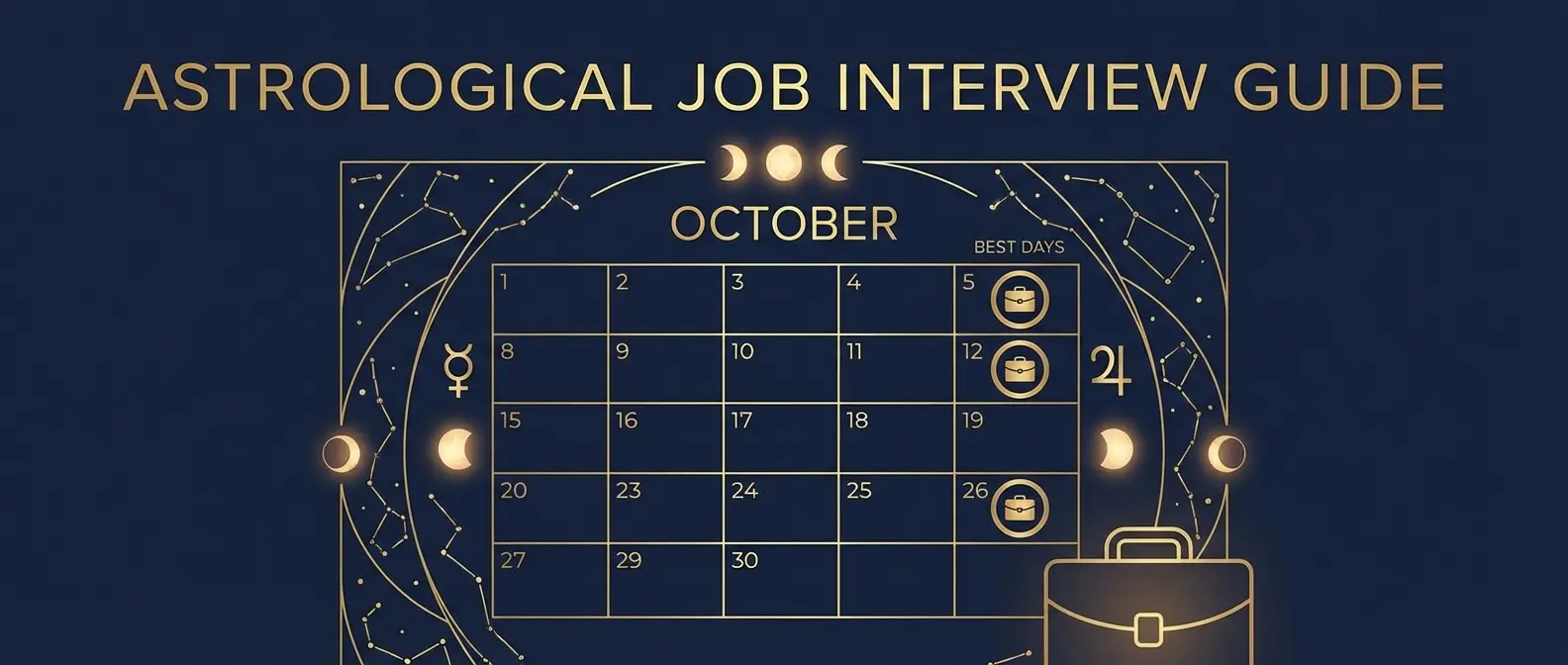
The best day for a job interview according to astrology is when the Moon supports a new beginning, Mercury is direct, and the exact interview time avoids avoidable void-of-course friction. Sidera’s current general ranking covers the remaining months of 2026 and all of 2027 below. The deeper question is whether the timing helps you sound like yourself under pressure: clear, prepared, interested, and not trapped in the need to perform perfectly.
A job interview can hit every self-image trigger at once. You may want to be chosen, need to prove competence, worry about saying too much, and read every pause from the interviewer as a sign. Good astrology timing will not guarantee the offer, but it can help you choose a moment with less friction around communication, confidence, and follow-through.
Electional astrology is the practice of choosing a better time for an important action. For interviews, it works best when you translate the symbolism into real behavior: how clearly you answer, how grounded you feel in your experience, whether the conversation moves cleanly, and whether the role still feels right once the pressure is real.
What Good Interview Timing Actually Does
The useful question is not only “Is this an auspicious day?” It is “What kind of emotional weather am I walking into, and what does it ask from me?”
In real life, strong interview timing should support:
- Clarity under pressure: Your answers have a through-line instead of becoming a nervous flood of details.
- Emotional regulation: You can notice nerves without letting them run the room.
- Accurate self-presentation: You sound confident without performing a version of yourself you cannot sustain.
- Better fit judgment: You can sense whether the role actually matches you, not just whether they like you.
Bad timing does not mean you will fail. It means the interview may require more conscious handling: slower answers, tighter notes, clearer boundaries, or patience with delays.

Useful timing creates enough steadiness to present your work clearly and judge whether the role is a door worth entering.
Why Astrological Timing Matters for Job Interviews
Interviews compress communication, status, money, and self-worth into a short conversation. That is why timing matters in electional astrology: you are not only choosing a calendar slot, you are choosing the tone of the room.
Electional astrology for job interviews focuses on several key factors:
- Moon phase and sign - emotional tone, receptivity, and the impression you make
- Mercury’s condition - clarity of answers, scheduling, follow-up, and first impressions
- Void-of-course periods - times when actions may drift, stall, or produce a different outcome than expected
- Beneficial aspects - supportive alignments that can make the conversation feel smoother
The goal is not to find a magical day that removes risk. The goal is to choose a time that supports the version of you who can answer directly, hold your value, and stay present if the interview gets tense.
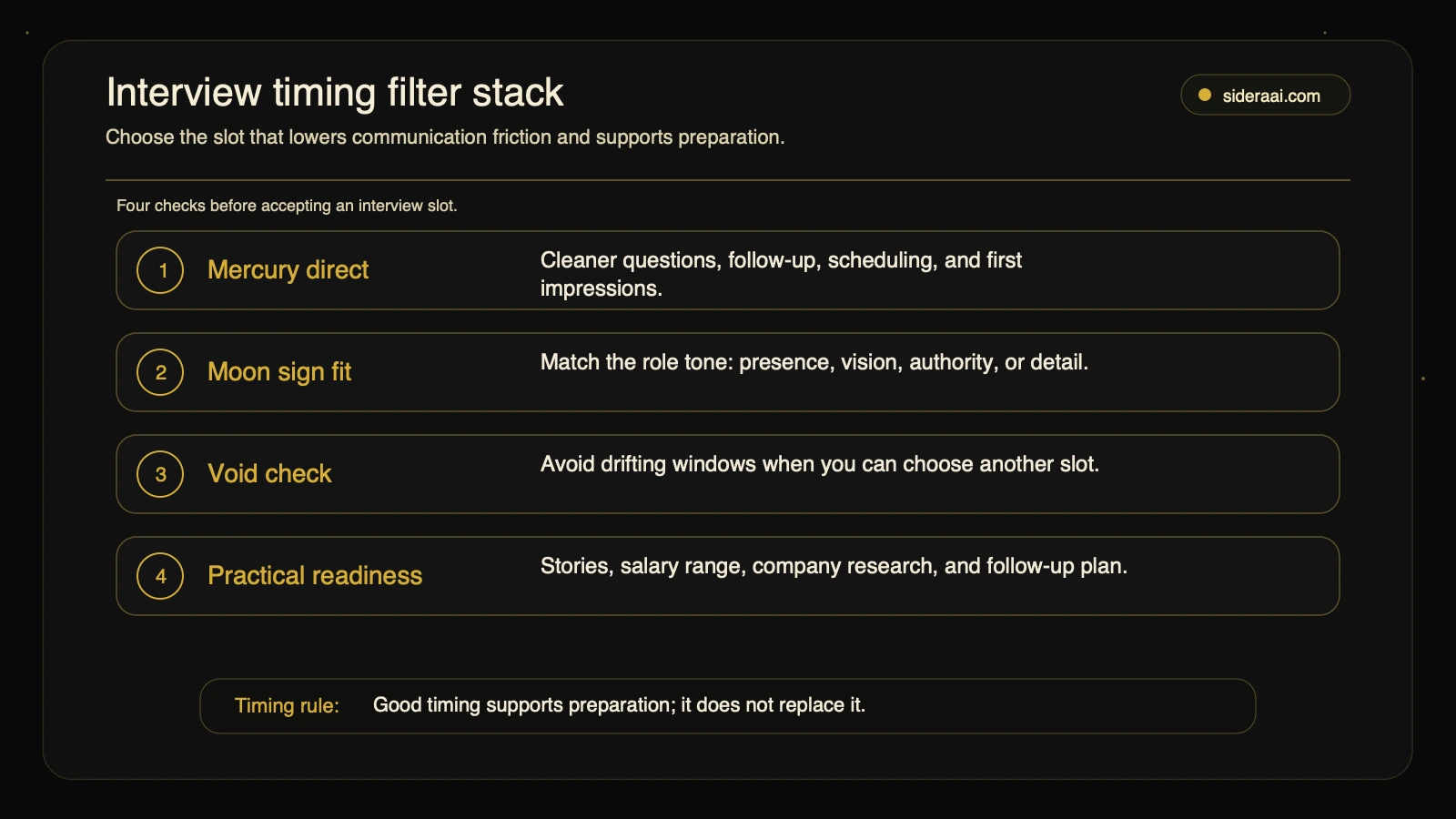
Use the timing filter before accepting an interview slot: astrology can lower friction, but preparation still carries the conversation.
Find your perfect moment with AI-powered electional astrology.
Discover your timing →The Best Moon Signs for Job Interviews
| Moon Sign | Rating | Why It Works |
|---|---|---|
| Leo | ⭐⭐⭐⭐⭐ | Confidence, charisma, natural leadership presence |
| Sagittarius | ⭐⭐⭐⭐⭐ | Optimism, enthusiasm, expansive communication |
| Capricorn | ⭐⭐⭐⭐⭐ | Professionalism, competence, authority |
| Aries | ⭐⭐⭐⭐ | Initiative, drive, assertiveness |
| Taurus | ⭐⭐⭐⭐ | Stability, reliability, practical skills |
| Virgo | ⭐⭐⭐⭐ | Attention to detail, competence, preparation |
| Libra | ⭐⭐⭐ | Diplomacy, likability, but can seem indecisive |
| Gemini | ⭐⭐⭐ | Quick thinking, but may come across as scattered |
| Aquarius | ⭐⭐⭐ | Innovative, but can seem detached |
| Scorpio | ⭐⭐ | Intense, powerful, but may intimidate |
| Pisces | ⭐⭐ | Creative, but boundaries may blur |
| Cancer | ⭐⭐ | Nurturing, but can seem overly emotional |
Best Moon Signs Explained
Leo Moon - Best when the role rewards visibility, leadership, creativity, or executive presence. You may come across warmer and more memorable. The shadow is over-performing, overselling, or treating the interview like a stage instead of a mutual fit check.
Sagittarius Moon - Best when you need to speak about growth, mission, teaching, travel, strategy, or future potential. It can help you sound expansive and interested. The shadow is rambling, promising too much, or skipping practical details.
Capricorn Moon - Best for corporate interviews, senior roles, operations, finance, management, or any position where reliability matters. It supports competence and authority. The shadow is sounding too guarded, stiff, or transactional.
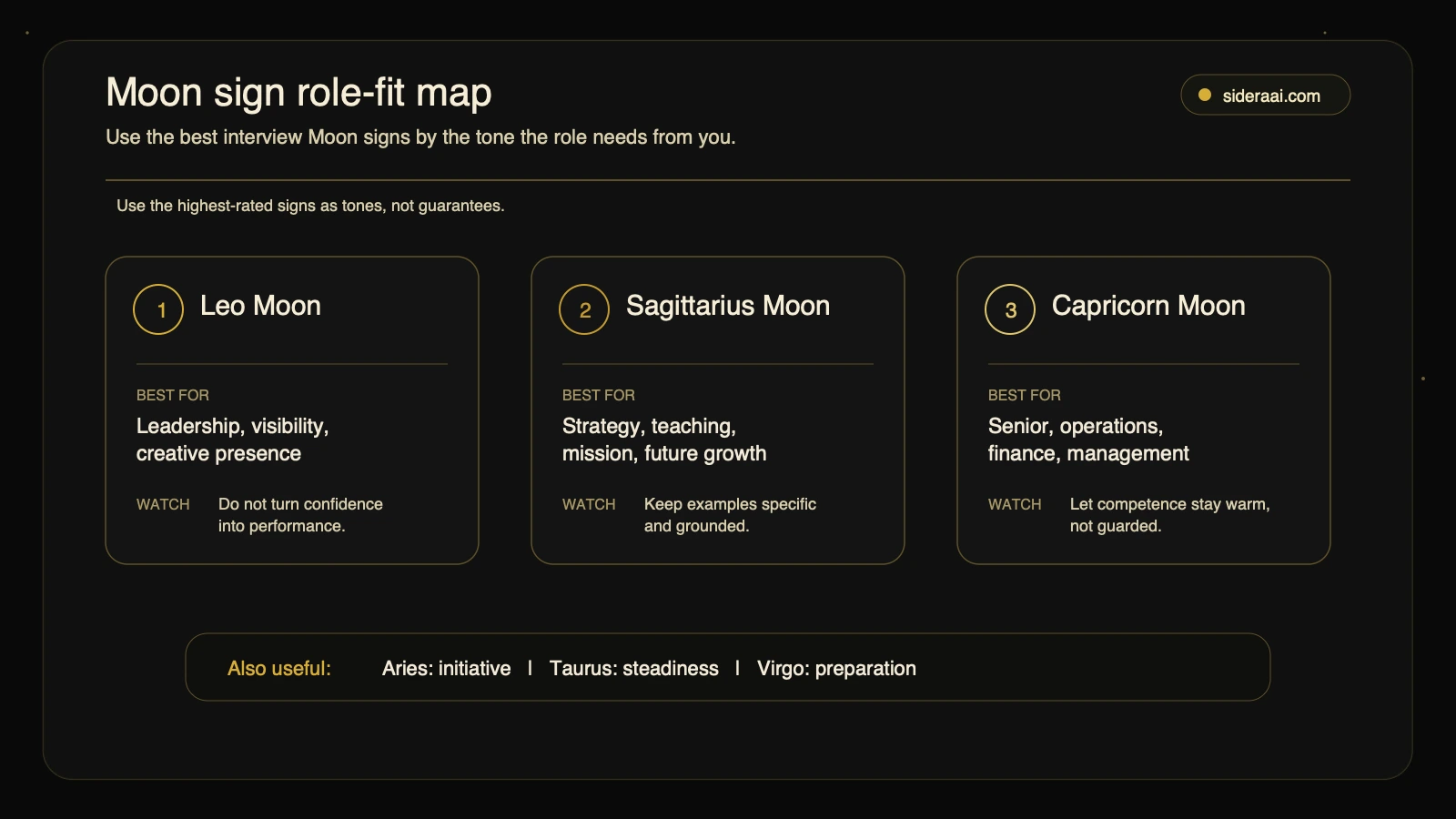
The map translates the strongest interview Moon signs into role tone: Leo for presence, Sagittarius for vision, and Capricorn for authority.

The strongest Moon sign is the one whose tone matches the work: presence, expansive vision, or disciplined authority.
What to Avoid: Void-of-Course Moon
A void-of-course (VOC) moon occurs when the Moon has made its last major aspect to another planet before changing signs. During these periods, which last from a few minutes to over 24 hours, traditional astrology warns that new ventures may not proceed as expected.
For job seekers, a VOC Moon is less “bad luck” than low containment. The interview may happen, but the role could change, the decision timeline may drift, the hiring manager may be distracted, or the conversation may feel like it never quite lands. If you can choose another slot without losing the opportunity, the stricter electional choice is a non-VOC time.
Sidera deliberately handles this differently from signing a contract. The job_interview activity does not deduct points or reject a date solely because the Moon is VOC; a conversation can still produce useful information even if the role or process changes. The calendar therefore surfaces VOC as a time-level caution. Contract timing uses it as a hard gate because the action is the commitment itself.
VOC Moon Rules for Job Seekers
- Prefer a non-VOC slot when the employer offers equally practical choices
- If unavoidable, take the interview, but expect that the role, timeline, or next step may change
- Check the VOC calendar for your timezone before confirming times

A void-of-course slot can still happen, but the role, timeline, or outcome may drift; choose another opening when you can.
Mercury: The Communication Planet
Mercury governs communication, thinking, documents, scheduling, and follow-up. In an interview, this shows up in very ordinary ways: whether the calendar invite is correct, whether your examples are easy to follow, whether the interviewer understands your experience, and whether the next steps are clear.
Mercury Retrograde: The Big Question
Mercury retrograde is not an automatic no. It is better for revisiting than launching from scratch, so it can work well for reconnecting with a former employer, applying to a company you already know, or interviewing for a role similar to one you have done before.
| Mercury Status | Interview Strategy |
|---|---|
| Mercury Direct | Ideal - communication flows smoothly |
| Mercury Retrograde | Not ideal, but not forbidden. Prepare extra thoroughly. Good for reconnecting with past employers or positions. |
| Mercury Stationing | Avoid if possible - the day before/after retrograde can be chaotic |
| Mercury Retrograde Shadow | Proceed with caution, have backup plans |
If you interview during Mercury retrograde, reduce ambiguity. Bring notes, confirm the time and location, ask direct questions about the role, send a clean follow-up email, and expect that timelines or job details may be revised.

Retrograde timing can favor a return to familiar work, provided you leave room for revised details, schedules, and follow-up.
Mercury Retrograde Dates Used in This Ranking
At the daily calculation’s 12:00 UTC reference time, Sidera detects these runs:
- 2026: February 26–March 20, June 30–July 23, and October 24–November 13
- 2027: February 10–March 3, June 11–July 4, and October 8–October 28
Station times can move the boundary by a calendar day in some timezones. For an interview near a boundary, check the exact local time instead of treating the date label as universal.
For detailed guidance on these periods, see our Mercury Retrograde 2026 Survival Guide.
Best Job Interview Dates for the Rest of 2026
These are not sign-only calendar dates. Sidera evaluated every day from August 10, 2026 through December 31, 2027 with its job_interview activity model, then ranked the usable weekdays inside each month. The score combines the day’s intensity and quality with interview-specific aspects to Mercury, Jupiter, and the Sun, a new-beginnings Moon-phase modifier, and Mercury’s status.
The publication layer then requires a score of at least 4.5/5, Monday through Friday, a New or waxing Moon, Mercury direct, and more than three days of separation from the eclipses in NASA’s catalog. VOC is shown but not used as a rejection rule because that matches the product’s interview configuration.
| Month | Sidera interview pick | Score | Moon | Why it passed |
|---|---|---|---|---|
| August | 5.0/5 Quality 9.6 · intensity 4.4 | Waxing Crescent | Supportive interview aspects (+1.20) and high quality; VOC at 12:00 UTC is a time-level caution, not an interview hard gate. | |
| September | 5.0/5 Quality 7.6 · intensity 5.4 | Waxing Crescent | Supportive interview aspects (+0.96); Mercury direct; VOC at the reference time requires an exact-slot check. | |
| October | 5.0/5 Quality 8.5 · intensity 4.6 | Waxing Crescent | Supportive interview aspects (+0.96) and high quality; verify a non-VOC local-time slot if one is available. | |
| November | No qualifying date | — | — | November 12 scores 4.7/5 but Mercury is retrograde; the best direct, waxing weekday is November 18 at 4.4/5, below the publication threshold. |
| December | 5.0/5 Quality 9.2 · intensity 6.4 | Waxing Gibbous | High base quality and supportive interview aspects (+0.55); Mercury direct; Moon not VOC at 12:00 UTC. |
High raw scores rejected by interview hard flags
| Rejected date | Raw score | Blocked by | Why score alone is insufficient |
|---|---|---|---|
| 4.7/5Waxing Crescent | Mercury retrograde | High intensity and a waxing Moon do not override the communication warning for a brand-new interview. |
Why VOC changes an interview ranking without blocking the date
| Engine-ranked date | Score | Caution | Practical comparison |
|---|---|---|---|
| 5.0/5Waxing Crescent | Moon VOC at 12:00 UTC; the job_interview configuration applies no VOC score penalty. | August 18 is also 5.0/5, with quality 8.5 and a non-VOC Moon at 12:00 UTC—a cleaner alternative when the exact slot is flexible. | |
| 5.0/5Waxing Crescent | Moon VOC at 12:00 UTC; the date remains eligible for interviews, unlike contracts. | October 15 is also 5.0/5, with quality 7.8 and a non-VOC Moon at 12:00 UTC; use it if you want the stricter electional option. |
General transit-only calculation, generated August 10, 2026 with Sidera engine baseline 382200b. Monthly order: favorability, then quality, then intensity, then earliest date. Interview picks require at least 4.5/5, a Monday–Friday date, a New or waxing Moon, Mercury direct, and the stated eclipse buffer. The job_interview activity does not use VOC as a hard gate, so VOC at 12:00 UTC is shown as a caution and the exact local interview time still needs checking. No birth chart or location was used.
November is intentionally a hold rather than a forced recommendation. November 12 still scores 4.7/5, but Mercury is retrograde. Once Mercury turns direct, November 18 is the best weekday under a waxing Moon, yet its 4.4/5 result misses the threshold. If the employer controls the calendar, take the opportunity and use the result as a preparation signal rather than a reason to withdraw.
Best Job Interview Dates in 2027
The same filter produces nine ranked weekdays and three honest holds in 2027. A hold means that no day cleared every publication rule; it does not mean that interviews during the month are doomed. It means the general sky does not justify labeling one date a strong election without your birth chart and exact location.
| Month | Sidera interview pick | Score | Moon | Why it passed |
|---|---|---|---|---|
| January | 5.0/5 Quality 7.4 · intensity 7.5 | Waxing Gibbous | Supportive interview aspects (+0.50); Mercury direct; Moon not VOC at 12:00 UTC. | |
| February | No qualifying date | — | — | No weekday reaches 4.5/5. The waxing weekdays begin during Mercury retrograde, while the stronger direct dates are waning or inside the eclipse buffer. |
| March | No qualifying date | — | — | March 15 is the best direct weekday with an allowed Moon phase, but challenging interview aspects keep it at 3.5/5. |
| April | 5.0/5 Quality 10.0 · intensity 6.6 | Waxing Gibbous | Maximum base quality with Mercury direct; one challenging interview aspect remains a preparation cue. | |
| May | 5.0/5 Quality 9.7 · intensity 2.1 | Waxing Gibbous | Supportive interview aspects (+1.14) lift a quiet, high-quality day; Mercury direct and Moon not VOC. | |
| June | 5.0/5 Quality 8.1 · intensity 5.0 | New Moon | New Moon support (+0.40) and supportive interview aspects (+0.51), one week before Mercury retrograde. | |
| July | 5.0/5 Quality 7.7 · intensity 5.0 | Waxing Crescent | Supportive interview aspects (+0.55) and a Waxing Crescent after Mercury turns direct. | |
| August | 5.0/5 Quality 10.0 · intensity 10.0 | Waxing Crescent | Maximum intensity and quality with a Waxing Crescent; one challenging aspect remains a cue to rehearse concise answers. | |
| September | 4.7/5 Quality 6.7 · intensity 9.0 | Waxing Gibbous | Supportive interview aspects (+0.59); Mercury direct; Moon not VOC at 12:00 UTC. | |
| October | No qualifying date | — | — | October 4 is the best direct, waxing weekday at 4.0/5; the later 4.6/5 result on October 20 is both waning and Mercury-retrograde. |
| November | 5.0/5 Quality 9.0 · intensity 9.3 | Waxing Crescent | High base quality and intensity with a Waxing Crescent; one challenging aspect remains a review cue. | |
| December | 5.0/5 Quality 9.6 · intensity 6.2 | Waxing Crescent | High quality, supportive interview aspects (+0.43), and a Waxing Crescent with Mercury direct. |
High raw scores rejected by interview hard flags
| Rejected date | Raw score | Blocked by | Why score alone is insufficient |
|---|---|---|---|
| 4.7/5Waxing Gibbous | Mercury retrograde | Supportive aspects keep the raw result high, but a new-role interview is held until Mercury turns direct. | |
| 4.6/5Waning Gibbous | Mercury retrograde, Waning Moon | The raw score clears 4.5, but both the communication and new-beginnings publication gates fail. |
General transit-only calculation, generated August 10, 2026 with Sidera engine baseline 382200b. Monthly order: favorability, then quality, then intensity, then earliest date. Interview picks require at least 4.5/5, a Monday–Friday date, a New or waxing Moon, Mercury direct, and the stated eclipse buffer. The job_interview activity does not use VOC as a hard gate, so VOC at 12:00 UTC is shown as a caution and the exact local interview time still needs checking. No birth chart or location was used.
February is constrained by low raw scores, the February eclipse windows, and Mercury retrograde beginning on February 10. March’s best direct, waxing weekday reaches only 3.5/5. In October, October 4 is the best direct waxing weekday at 4.0/5, while the superficially stronger October 20 result is both Mercury-retrograde and under a waning Moon. Publishing those as “best days” would hide the filters that make the ranking useful.
How to Read the Score Without Overpromising
- Favorability (1–5) is the activity-specific output after the interview modifiers are applied.
- Quality (1–10) estimates how harmonious the overall aspect pattern is; it breaks ties between equal favorability scores.
- Intensity (1–10) estimates how active the day is; more intensity can amplify a strong or difficult pattern.
- A VOC note is not a rejection for
job_interview. Use it to inspect the exact slot or choose the listed cleaner alternative. - General means unpersonalized. No natal Mercury, Midheaven, 10th-house ruler, location, or employer chart is included in these tables.
All rows use 12:00 UTC so they can be reproduced consistently. Moon/VOC conditions and station boundaries are time-sensitive, so a date that survives this daily screen still needs a local-time check before you confirm the meeting.
Step-by-Step: Using Astrology to Time Your Interview
- Start with real availability - Do not reject a strong opportunity because the first offered slot is imperfect.
- Check Mercury’s status - Is it direct, retrograde, stationing, or in shadow?
- Identify the Moon sign - Match the tone to the role: Leo for presence, Sagittarius for vision, Capricorn for authority.
- Verify no void-of-course Moon - Check the exact interview time, not only the date.
- Look for supportive aspects - Moon trine Sun, Moon sextile Jupiter, or other easy aspects can help the conversation flow.
- Consider your personal chart - Transits to your natal Mercury, Midheaven, Sun, or ruler of the 10th house may matter more than a generic list.
A useful interview window survives every filter: real availability, Mercury, Moon tone, void periods, supportive aspects, and your own chart.
Personal Chart Factors
Your birth chart adds another layer. Generic timing can be useful, but your own chart explains why one “good” day feels effortless while another feels strangely exposed.
- Strong fire signs - You may do well when the interview asks for confidence, initiative, and fast answers.
- Natal Mercury retrograde - Mercury retrograde periods may feel more familiar, especially for reviewing past work or returning to an old field.
- Prominent Saturn - Capricorn Moon days can enhance your authority, but watch for sounding overly formal.
- Heavy water placements - Avoid slots where you know you will be emotionally depleted. Your read of the room may get too personal.
This is why the best use of astrology is not blind rule-following. It is matching the sky to your actual nervous system, communication style, and career goal.
What Real Research Says
Astrology cannot prove an employer will choose you. The grounded case is simpler: interviews are influenced by first impressions, confidence, preparation, and emotional coherence.
- First impressions form quickly, so your opening presence matters.
- Confidence helps only when it is attached to substance: clear examples, relevant experience, and direct answers.
- Hiring decisions often include subjective fit, so your ability to stay present and read the room has real value.
The takeaway: use astrology to reduce avoidable friction, then do the practical work. Prepare your examples, research the company, know your salary range, and write the follow-up before you need it.
Common Mistakes to Avoid
1. Obsessing Over Perfect Timing
A moderately favorable day with excellent preparation beats a perfect-looking chart with weak answers. Astrology should support the interview, not become the reason you avoid taking action.
2. Ignoring Your Personal Chart
Generic timing advice doesn’t account for your natal chart. A day that’s challenging for most might activate your Jupiter beneficially.
3. Forgetting Time Zones
Void-of-course periods and Moon sign changes occur at specific Universal Times. Always convert to your local timezone.
4. Over-Relying on Astrology
Use astrological timing as one tool among many. Your resume, practice answers, and research on the company matter more.
Practical Checklist
Before your interview, verify:
- Mercury is direct (or you’ve prepared extra thoroughly)
- Moon is in a favorable sign (Leo, Sagittarius, Capricorn preferred)
- No void-of-course during your interview slot
- No challenging transits to your natal Mercury or Midheaven
- You’ve researched the company thoroughly regardless of cosmic weather
- You have three concrete stories ready: a challenge, a result, and a collaboration example
- You know your salary range, boundaries, and follow-up plan
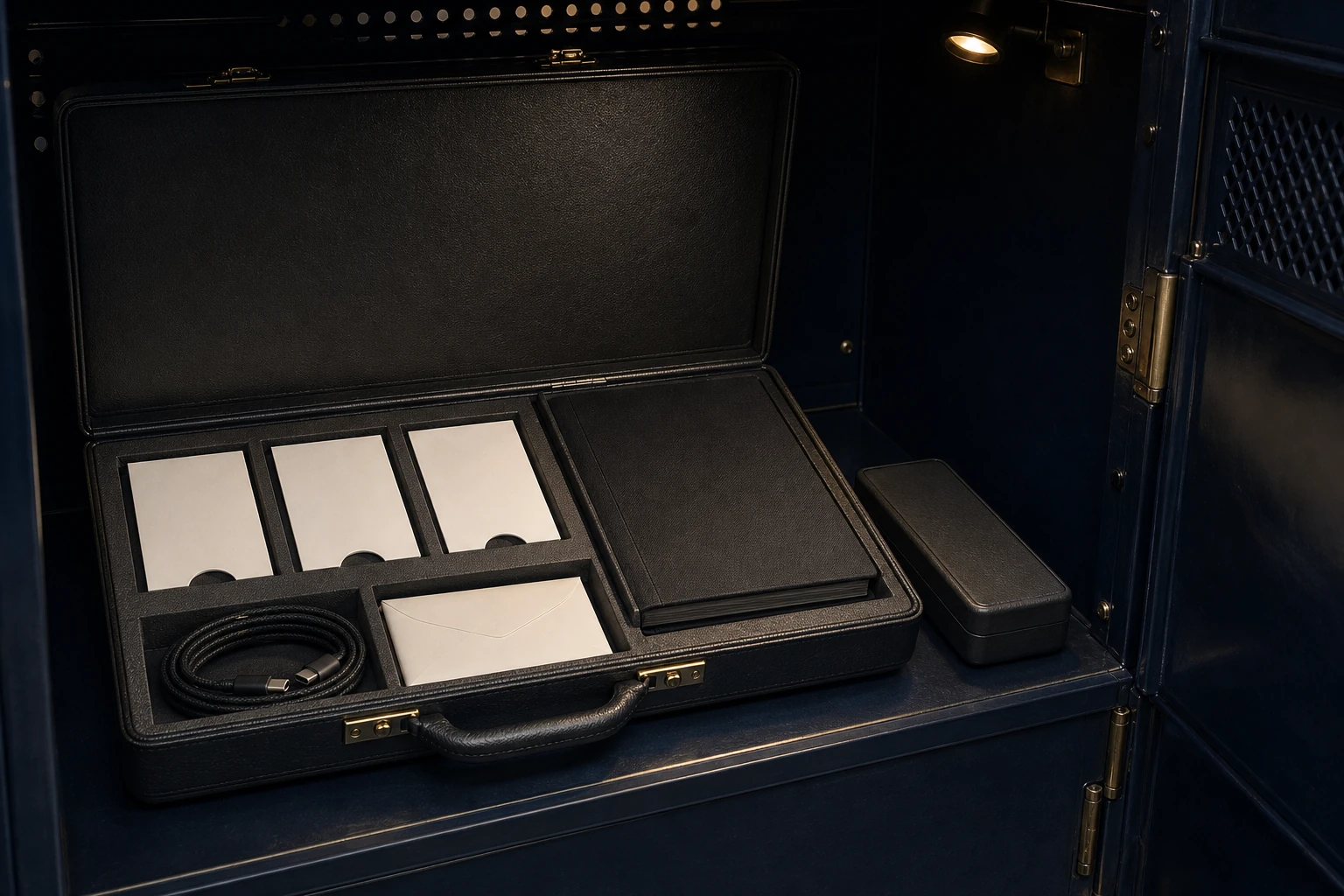
When the slot is fixed, preparation becomes the safeguard: concrete stories, company research, boundaries, a backup, and a ready follow-up.
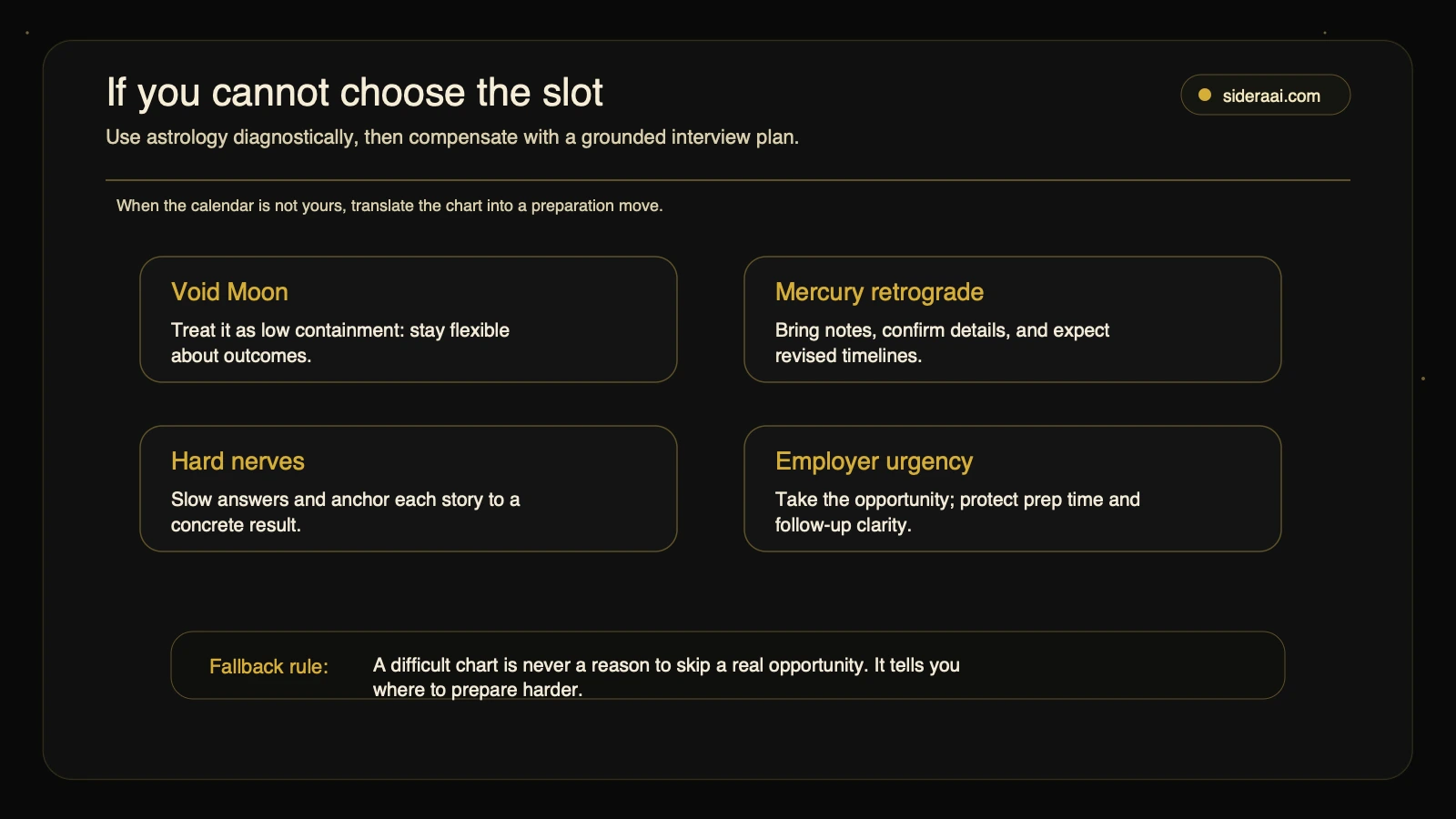
When the calendar is not yours, use the chart diagnostically: name the friction, then compensate with clearer preparation and follow-up.
Powered by Sidera — AI-driven cosmic timing.
FAQ: Best Day for Job Interview Astrology
Q: Does astrology really affect job interviews? A: There’s no scientific proof of direct planetary influence on interviews. However, choosing a time that aligns with your beliefs can improve confidence and preparation. Think of it as optimizing for your psychological state.
Q: What if I can’t choose my interview time? A: Most candidates can’t control timing. In that case, use astrology diagnostically - understand the energies present and prepare accordingly. If it’s a void-of-course moon, be extra flexible about outcomes.
Q: Is Mercury retrograde really that bad for interviews? A: Not necessarily. It’s actually favorable for reconnecting with former employers or interviewing for a position you’ve held before. For new roles, it simply suggests more revisions and delays in the process.
Q: Which moon phase is best for job interviews? A: The waxing moon (from new to full) supports new beginnings and growth. The first quarter to full moon period is particularly favorable for putting yourself forward.
Q: What about my personal horoscope? A: Your natal chart adds important nuances. Strong Mars or Jupiter transits to your Midheaven (10th house cusp) can be excellent for career moves regardless of general transit conditions.
Q: Should I mention astrology in my interview? A: Generally, no - unless you’re interviewing for an astrology-related position or the company culture clearly embraces it. Keep your cosmic research private.
Q: How far in advance should I check the astrology? A: At least 2-3 weeks ahead. This gives you time to request specific interview slots if the employer offers flexibility.
Q: What if the only available slot is during a bad transit? A: Take the interview! A “bad” astrological day is never a reason to miss an opportunity. Use extra preparation to compensate, and stay flexible about outcomes.
Q: Can electional astrology help with salary negotiation too? A: Yes, but the activity rules differ. A raise request emphasizes Jupiter, the Sun, and Venus, while an interview emphasizes Mercury, Jupiter, and the Sun. Sidera treats VOC as a caution rather than an automatic rejection for both activities. See our guide on best time to ask for a raise astrology for the raise-specific logic.
Q: Where can I find daily void-of-course moon times? A: Use a timezone-aware astrology calendar that converts void-of-course periods to your local interview time. Sidera also provides real-time void-of-course tracking.
Q: Which job interview dates are strongest in 2027? A: Sidera’s general transit ranking identifies January 18, April 19, May 17, June 4, July 7, August 6, September 9, November 30, and December 3, 2027. February, March, and October do not produce a weekday that clears the full publication filter.
Related Resources
- Mercury Retrograde 2026: Complete Survival Guide
- Best Time to Ask for a Raise According to Astrology
- What Is Electional Astrology?
Last updated: August 2026.
Related Sidera Guides
Continue with these closely related guides: