
The moment before you sign a contract can feel strangely loud. You may be excited, but you are also scanning for the clause you missed, the power dynamic you are ignoring, or the deadline pressure making you say yes before you feel clear.
That is where electional astrology becomes useful. It does not replace legal advice, negotiation, or practical readiness. It gives you a timing lens: when communication is cleaner, when the emotional tone is steadier, and when a serious commitment is less likely to begin from confusion or panic.
This guide gives you the strongest 2026 windows for signing contracts, a Sidera-scored 2027 calendar, the dates to avoid, and a practical way to choose a signing time that fits the kind of agreement you are making.
Find your perfect moment with AI-powered electional astrology.
Discover your timing →How This Timing Feels in Real Life
A good contract date should feel clean, not magically perfect. You still may feel nervous, because contracts involve money, responsibility, trust, and future consequences. But the better timing usually supports a calmer decision: fewer rushed replies, fewer vague promises, and more willingness to read the actual terms.
Before you use any date in this guide, check the real-life pattern around the agreement:
- In work: Are you signing because the role, scope, pay, and expectations are clear, or because you are afraid the opportunity will disappear?
- In business: Are both sides naming responsibilities plainly, or is everyone staying friendly while avoiding hard details?
- In relationships: Does the agreement create mutual safety, or does it formalize an imbalance you already feel?
- In self-image: Are you treating the signature as proof that you are chosen, successful, or safe, instead of asking whether the terms actually support you?
If the chart says “go” but your body says “not yet,” treat that tension as data. The strongest electional timing supports clear action. It should not talk you out of your own instincts.

Good timing supports a clear threshold: complete terms, steady judgment, and no pressure to cross before you are ready.
Why Astrological Timing Matters for Contracts
Every contract creates what astrologers call an “event chart”: a chart for the moment the agreement becomes active. In electional astrology, that moment describes the tone of the commitment and the kinds of issues that may repeat over the life of the deal.
For contract timing, the goal is not to find a flawless sky. The goal is to avoid obvious friction and choose symbolism that matches the job the contract needs to do.
- Mercury rules communication, agreements, and legal documents
- Venus governs partnerships, harmony, and mutual benefit
- The Moon represents the emotional foundation and public reception
- Saturn indicates lasting commitments and serious obligations
- Jupiter brings expansion, luck, and favorable outcomes
Read those planets behaviorally. A strong Mercury supports plain language and fewer misunderstandings. A steady Moon helps the agreement begin from emotional consistency. Saturn matters when the deal needs structure, responsibility, and follow-through.
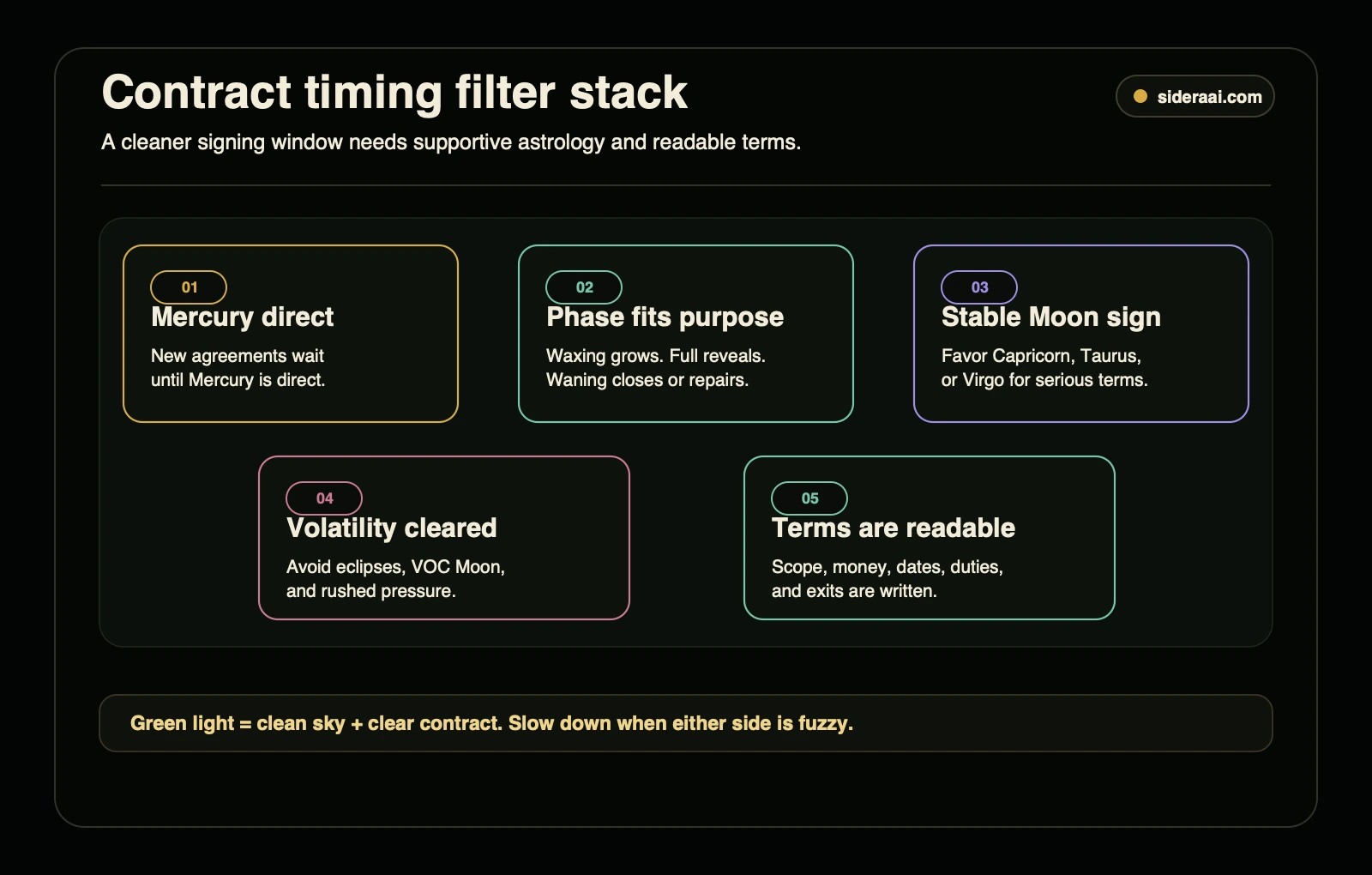
Use the filter stack before choosing a date: the sky, the Moon, and the contract terms all need to support a clean commitment.

Useful electional timing aligns communication, stability, growth, and obligation with the real job the agreement must do.
The #1 Rule: Avoid Mercury Retrograde
Mercury retrograde is the first timing filter for contract work. It is not a curse, and it does not mean every signature fails. It does mean the symbolism is less supportive for starting fresh agreements that depend on precise language, smooth communication, and shared understanding.
Mercury retrograde at the 12:00 UTC daily reference used in this article:
- 2026: February 26 – March 20; June 30 – July 23; October 24 – November 13
- 2027: February 10 – March 3; June 11 – July 4; October 8 – October 28
Station boundaries can fall on a different civil date in your timezone, so check the exact signing hour rather than treating a UTC day label as universal.
If you have a choice, do not sign a new job offer, lease, partnership agreement, major purchase, or legal settlement during these windows. If the contract is a renewal, correction, renegotiation, or return to an old agreement, Mercury retrograde can be more workable because the action itself matches the review symbolism.
If you must sign anyway, assume the shadow pattern is haste. Read every clause slowly, confirm names and dates, ask for unclear terms in writing, and add a review or amendment path where possible.

When versions conflict or terms are unclear, the useful response is review, correction, and an explicit path back—not haste.
Plan your life around the stars, not just the calendar.
Start planning →Best Moon Phases for Signing Contracts
The Moon describes the immediate mood of the agreement. For contracts, you want a Moon phase that matches the purpose of the signature.
Waxing Moon (New Moon to Full Moon) Best for agreements meant to grow: business partnerships, employment agreements, creative collaborations, investments, and launches.
Full Moon Useful when the terms need to be fully visible. This can be good for finalizing negotiations, but it can also expose disagreement, so do not use it to avoid a hard conversation.
Waning Moon (Full Moon to New Moon) Better for ending, reducing, restructuring, or closing something out. This is not usually ideal for a contract you want to expand.
Critical: Avoid Void-of-Course Moon When the Moon makes no more major aspects before changing signs, it is “void of course” (VOC). For contract work, VOC timing can show agreements that drift, stall, fail to land, or need to be redone. This matters most for high-stakes signatures.
For real-time void-of-course tracking, see our Void of Course Moon Guide.

A growth-oriented agreement benefits from a building phase only when the product, partnership, and practical terms are already ready.
Sidera-Scored Contract Dates: August–December 2026
Sidera evaluated every day from August 10, 2026 through December 31, 2027 with the product’s sign_contract formula. This is a general transit-only calculation at 12:00 UTC: no birth chart or location was used.
For a new agreement, a date reaches the table only when it scores at least 4.5/5, Mercury is direct, the Moon is not void of course, the Moon is New or waxing, and the date sits more than three days from an eclipse. Within a month, qualifying dates are ordered by score, then quality, then intensity.
| Month | Sidera contract pick | Score | Moon | Why it passed |
|---|---|---|---|---|
| August | 5.0/5 Quality 9.3 · intensity 5.3 | Waxing Crescent | Waxing Crescent support; Mercury direct; Moon not void of course. | |
| September | 5.0/5 Quality 7.5 · intensity 4.2 | Waxing Gibbous | Supportive contract aspects (+0.91); Mercury direct; Moon not void of course. | |
| October | 5.0/5 Quality 7.8 · intensity 3.3 | Waxing Crescent | Supportive aspects (+1.14) and Waxing Crescent support; Mercury direct; Moon not VOC. | |
| November | 5.0/5 Quality 8.0 · intensity 8.5 | Waxing Gibbous | High base quality after Mercury turns direct; Moon not void of course. | |
| December | 5.0/5 Quality 9.6 · intensity 7.3 | Waxing Gibbous | Supportive contract aspects (+1.36); Mercury direct; Moon not void of course. |
High raw scores rejected by contract hard flags
| Rejected date | Raw score | Blocked by | Why score alone is insufficient |
|---|---|---|---|
| 5.0/5Waxing Crescent | Moon VOC | The raw score stays high despite the engine's -0.2 VOC modifier, so the publication gate rejects it. | |
| 4.5/5Waxing Crescent | Mercury retrograde, Moon VOC | High intensity and a waxing Moon do not override two contract-specific hard warnings. |
General transit-only calculation, generated August 10, 2026 with Sidera engine baseline 382200b. Monthly order: favorability, then quality, then intensity. New-agreement picks require a score of at least 4.5/5, a New or waxing Moon, Mercury direct, a non-VOC Moon, and the stated eclipse buffer. No birth chart or location was used.
The rejected-date rows are deliberate. The activity formula applies penalties for Mercury retrograde and VOC Moon, but exceptional base quality can still leave a raw score at 4.5 or 5.0. For a contract, those two conditions remain hard gates: score first, commitment rules second.
Best Days to Sign Contracts in 2027: Sidera Calendar
The same run produces ten qualified monthly leaders for 2027. February and March are holds rather than forced recommendations: February has no date that clears the complete filter, while March’s strongest remaining result is 4.8/5 on a waning Moon.
| Month | Sidera contract pick | Score | Moon | Why it passed |
|---|---|---|---|---|
| January | 5.0/5 Quality 7.7 · intensity 7.9 | First Quarter | Supportive contract aspects (+0.95); Mercury direct; Moon not void of course. | |
| February | No qualifying date | — | — | No date reaches 4.5/5 after the Mercury, VOC, Moon-phase, and eclipse hard gates. |
| March | No qualifying date | — | — | March 28 reaches 4.8/5 but has a Waning Gibbous Moon, so no new-agreement pick clears the full filter. |
| April | 5.0/5 Quality 10.0 · intensity 6.6 | Waxing Gibbous | Exceptional base quality; Mercury direct; Moon not VOC; one challenging aspect remains a review cue. | |
| May | 5.0/5 Quality 10.0 · intensity 4.2 | Waxing Gibbous | Maximum base quality; Mercury direct; Moon not void of course. | |
| June | 4.9/5 Quality 8.1 · intensity 5.0 | New Moon | New Moon (+0.4) and supportive contract aspects (+0.27), before Mercury retrograde. | |
| July | 5.0/5 Quality 7.7 · intensity 5.0 | Waxing Crescent | Supportive aspects (+0.55) and Waxing Crescent support after Mercury turns direct. | |
| August | 5.0/5 Quality 10.0 · intensity 10.0 | Waxing Crescent | Maximum intensity and quality with supportive aspects; Mercury direct; Moon not VOC. | |
| September | 4.7/5 Quality 6.7 · intensity 9.0 | Waxing Gibbous | Supportive contract aspects (+0.59); Mercury direct; Moon not void of course. | |
| October | 4.9/5 Quality 6.3 · intensity 7.4 | Waxing Crescent | Supportive aspects (+0.88) after Mercury turns direct; Waxing Crescent; Moon not VOC. | |
| November | 5.0/5 Quality 9.3 · intensity 8.2 | New Moon | Supportive aspects (+0.9) and New Moon support; Mercury direct; Moon not VOC. | |
| December | 5.0/5 Quality 9.6 · intensity 6.2 | Waxing Crescent | Supportive aspects (+0.43) and Waxing Crescent support; Mercury direct; Moon not VOC. |
High raw scores rejected by contract hard flags
| Rejected date | Raw score | Blocked by | Why score alone is insufficient |
|---|---|---|---|
| 4.9/5Waning Gibbous | Mercury retrograde | Supportive aspects keep the raw score high, but a new contract is blocked while Mercury is retrograde. | |
| 5.0/5New Moon | Moon VOC | Even a 5.0/5 New Moon result is rejected when the Moon is void of course for a commitment activity. |
General transit-only calculation, generated August 10, 2026 with Sidera engine baseline 382200b. Monthly order: favorability, then quality, then intensity. New-agreement picks require a score of at least 4.5/5, a New or waxing Moon, Mercury direct, a non-VOC Moon, and the stated eclipse buffer. No birth chart or location was used.
These dates are designed for new growth-oriented agreements. A termination, reduction, correction, renewal, or settlement can require a different Moon-phase rule even when Mercury and VOC remain important. Use the table to create a shortlist, then check the exact local hour and the contract’s legal substance.
Dates to Avoid or Slow Down
Mercury Retrograde Periods:
- February 26 – March 20, 2026
- June 30 – July 23, 2026
- October 24 – November 13, 2026
Eclipse Dates (Energetically Unstable):
- February 17, 2026 (Solar Eclipse)
- March 3, 2026 (Lunar Eclipse)
- August 12, 2026 (Solar Eclipse)
- August 28, 2026 (Lunar Eclipse)
Other Caution Periods:
- Moon in Aries, especially if the negotiation already feels rushed or reactive
- Moon in Scorpio, especially if trust, control, secrecy, debt, or leverage is part of the deal
- Void-of-course Moon periods, especially for major commitments
- Any day when the practical process is messy: missing attachments, unclear payment terms, pressure to skip review, or verbal promises that are not in the document
The shadow pattern to watch is the urge to make astrology do the work your boundaries need to do. A bad contract signed on a beautiful date is still a bad contract. A difficult date can be managed if you slow down, document everything, and refuse vague terms.

Retrogrades, eclipses, missing attachments, and pressure are slowdown signals; a beautiful date cannot repair vague terms.
How to Find Your Perfect Signing Window
The Sidera app calculates real-time planetary positions and activity timing in the selected astrology system. The public tables in this article use the Western system at a fixed UTC reference; your result should use your location, timezone, preferred system, and exact signing hour instead of relying on a generic day label alone.
Step-by-step contract timing:
- Verify Mercury is direct (not in retrograde)
- Choose a waxing Moon phase for growth-oriented agreements
- Select a stable Moon sign (Capricorn, Taurus, or Virgo)
- Confirm it’s not void-of-course
- Check for eclipses (the public table uses a ±3-day hard buffer; use a wider buffer if your tradition requires it)
- Match the timing to the contract type instead of treating every agreement the same
Types of Contracts and Their Best Timing
| Contract Type | Best Moon Sign | What to Prioritize |
|---|---|---|
| Employment | Capricorn, Virgo | Clear scope, title, pay, review cycles, and reporting lines |
| Business Partnership | Taurus, Libra | Mutual benefit, decision rights, profit split, and exit terms |
| Real Estate | Taurus, Cancer | Stability, inspections, financing, repairs, and possession dates |
| Marriage/Prenup | Libra, Taurus | Fairness, emotional safety, separate counsel, and future changes |
| Creative/Artistic | Pisces, Libra | Usage rights, revisions, credit, payment timing, and boundaries |
| Legal Proceedings | Virgo, Capricorn | Precise language, documentation, deadlines, and accountability |
| Financial/Investment | Taurus, Capricorn | Risk, liquidity, fees, timeline, and downside protection |
Learn more about timing life decisions: What Is Electional Astrology?
What If You Can’t Choose the Timing?
Sometimes HR, a bank, a landlord, a client, or a legal deadline dictates the signing time. That does not mean you are powerless. It means the astrology becomes a preparation checklist instead of a date-selection tool.
Mitigation strategies for unfavorable timing:
- Read everything thoroughly - especially names, dates, payment terms, deliverables, penalties, and renewal clauses
- Request a review period - even one extra night can change the quality of your decision
- Ask direct questions in writing - do not rely on verbal reassurance for important terms
- Add amendment or cancellation language - build a path for correction if circumstances change
- Document the signing process - keep copies, timestamps, email threads, and version history
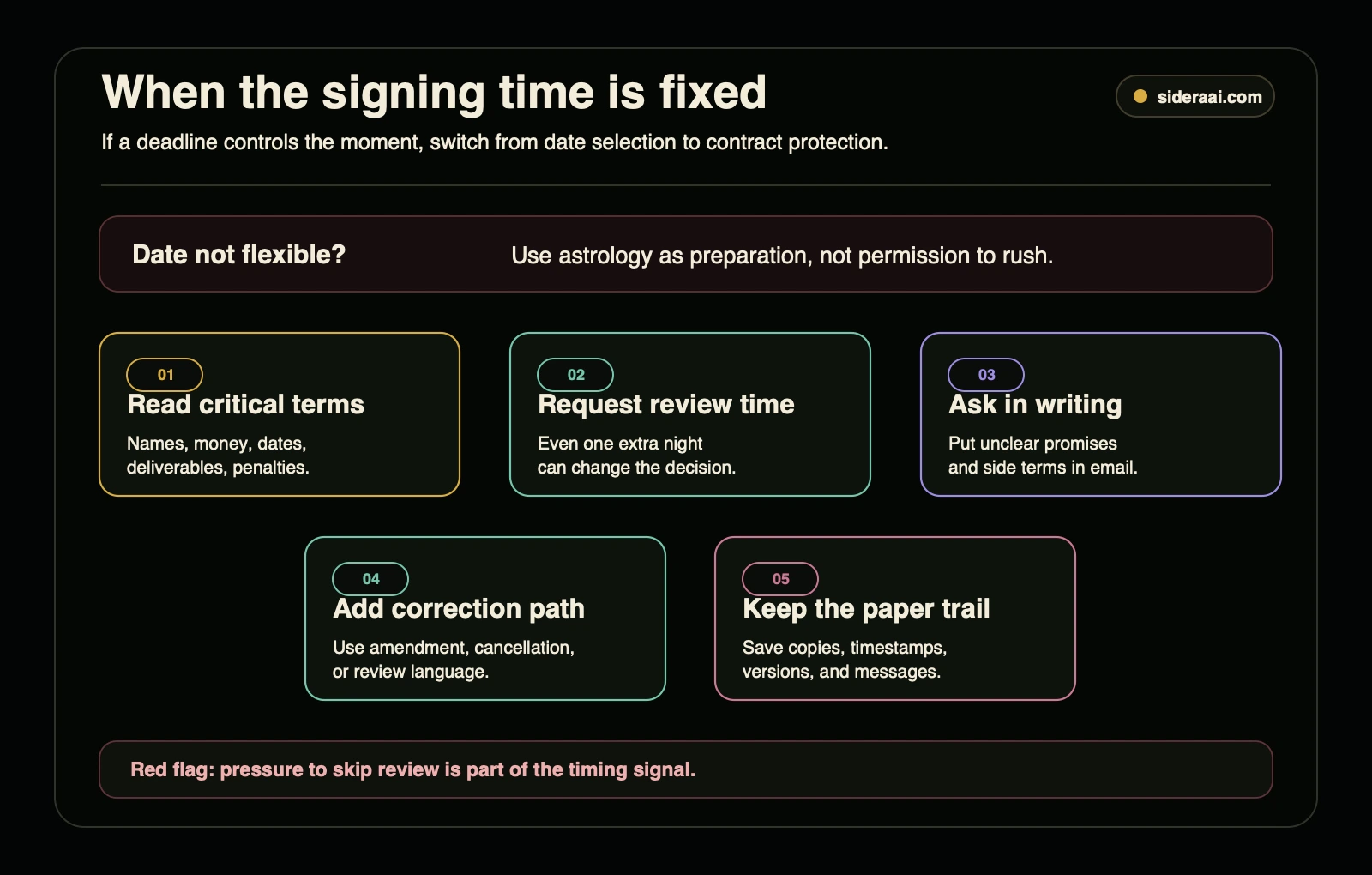
When the date is fixed, the useful move is preparation: read terms, ask in writing, request review time, add correction language, and keep records.

When the deadline cannot move, protection comes from review time, written questions, correction language, and a complete record.
If the timing is difficult and the other party pressures you to move faster, treat that as part of the chart reading. The real issue may not be the sky. It may be the power dynamic.
Powered by Sidera — AI-driven cosmic timing.
Frequently Asked Questions
Is it really bad luck to sign contracts during Mercury retrograde?
It is not about bad luck. In electional astrology, Mercury retrograde is treated as a caution period because agreements are more likely to involve unclear language, missing details, delays, or later revisions. If possible, wait for Mercury direct. If you must sign, add flexibility provisions and review everything multiple times.
Does the timing of digital signatures matter in astrology?
Yes. The moment you click “sign” or submit a digital signature is the commitment moment for the agreement, just as an ink signature would be. The physical medium matters less than the moment the contract becomes active for you.
Can I sign a contract during a void-of-course Moon?
For minor agreements, it may not matter much. For major life contracts such as employment, real estate, marriage, and business partnerships, traditional astrology recommends waiting until the Moon enters a new sign because VOC periods are associated with outcomes that drift, stall, or need reworking.
What if both parties sign at different times?
Both signature moments matter. Focus on optimizing your own signature time, since that is the moment you personally bind yourself to the agreement. If the other party signs later, their timing describes their side of the commitment.
How do I check if the Moon is void-of-course?
Use an ephemeris or astrology app that includes void-of-course data. Generally, avoid signing anything important when the Moon has completed its last major aspect and is “coasting” before changing signs.
What are the best days to sign contracts in 2027?
Sidera’s strongest general new-agreement candidates for 2027 are January 15, April 19, May 16, June 4, July 7, August 6, September 9, October 31, November 28, and December 3. February and March are hold months under the full score, Moon-phase, Mercury, VOC, and eclipse filter. These are transit-only reference dates, so confirm the exact local time and your personal chart before signing.
Conclusion
Astrological timing for contracts works best when it sharpens your judgment. Avoid Mercury retrograde for new agreements when you can, choose Moon phases that match the purpose of the deal, favor stable Moon signs for serious commitments, and stay away from eclipses and void-of-course periods for high-stakes signatures.
Most of all, use the timing to ask better questions. Is the language clear? Are the responsibilities mutual? Are you signing from confidence, or from pressure? The right date should support the right decision.
Related Articles: