Getting a free astrology chart takes about 30 seconds. The frustrating part comes after: you see a wheel full of glyphs, degrees, houses, and aspect lines, and the tool acts like labels such as “Moon in Cancer” or “Mars in the 7th house” should explain your life by themselves.
A useful chart reading does more than name placements. It helps you recognize why you protect yourself the way you do, where relationships keep hitting the same pressure point, what kind of work environment brings out your best judgment, and which habits are strengths pushed too far.
This guide shows what a free astrology chart includes, how to read the parts that matter first, what most free chart tools leave out, and how to turn the chart into something you can actually reflect on.
Start With One Real-Life Question
Do not try to decode every symbol at once. Start with one area where you want more self-understanding, then use the chart to look for a pattern.
- Love: Why do I repeat the same attachment pattern, attraction pattern, or shutdown response?
- Work: What conditions make me focused, respected, and useful - and what makes me resentful or scattered?
- Conflict: Do I push, withdraw, intellectualize, people-please, control, or go silent when I feel exposed?
- Self-image: Which part of me do I overperform for approval, and which part do I hide until I trust someone?
A free chart becomes useful when it moves from keywords to behavior. “Venus in Capricorn” is a label. “I test commitment before I let myself need someone” is a pattern you can work with.
Ready to See Your Personal Birth Chart?
Discover your unique cosmic blueprint — planets, houses, and aspects personalized to your exact birth time and location.
Get Your Birth Chart →✓ Birth chart analysis ✓ Personalized insights ✓ Free to use
What Is a Free Astrology Chart?
A free astrology chart - also called a natal chart or birth chart - is a circular map of the sky at the exact moment and place you were born. It shows where every planet was positioned, which zodiac sign each planet occupied, and how the planets relate to each other geometrically.
The chart is calculated using three pieces of data:
- Date of birth - determines which signs the Sun and outer planets occupy
- Time of birth - determines your Ascendant (Rising sign) and which house each planet falls in
- Place of birth - refines house calculations based on latitude and longitude
All three matter. If you enter only your date of birth, you get a partial chart. The Ascendant and house positions cannot be calculated without birth time - and the Ascendant changes by one full zodiac sign approximately every two hours, meaning a birth time error of just a few hours can shift your entire house structure.
The terms “natal chart,” “birth chart,” and “astrology chart” refer to the same calculation. They are interchangeable.
What You See in a Free Astrology Chart
A standard free birth chart displays four layers of information:
The Zodiac Ring (Outer Wheel)
The 12 zodiac signs arranged in a circle. Each sign occupies 30 degrees, and the chart shows which sign was rising on the eastern horizon at your birth - this is your Ascendant or Rising sign.
The Houses (Inner Divisions)
The chart is divided into 12 sections called houses. Each house governs a life area: identity, money, communication, home, creativity, health, relationships, shared resources, philosophy, career, community, and the inner life. Where your planets land in these houses shapes how their energy expresses in practice. For a full breakdown, see The 12 Astrology Houses Explained.
The Planets (Symbols Inside the Wheel)
Ten primary bodies appear: Sun, Moon, Mercury, Venus, Mars, Jupiter, Saturn, Uranus, Neptune, and Pluto. Each is placed in a zodiac sign and a house. The sign colors the planet’s energy; the house shows where that energy plays out in your life. The Planets in Astrology Cheat Sheet covers each planet’s core meaning.
The Aspect Lines (Center of the Chart)
Lines crisscross the center connecting planets that are in geometric relationship to each other. A trine (120 degrees) indicates flowing energy. A square (90 degrees) indicates tension. A conjunction (0 degrees) fuses two planetary energies together. Most free chart tools draw these lines without explaining what they mean - see Astrology Aspects: Conjunction, Square, Trine Explained for a full guide.
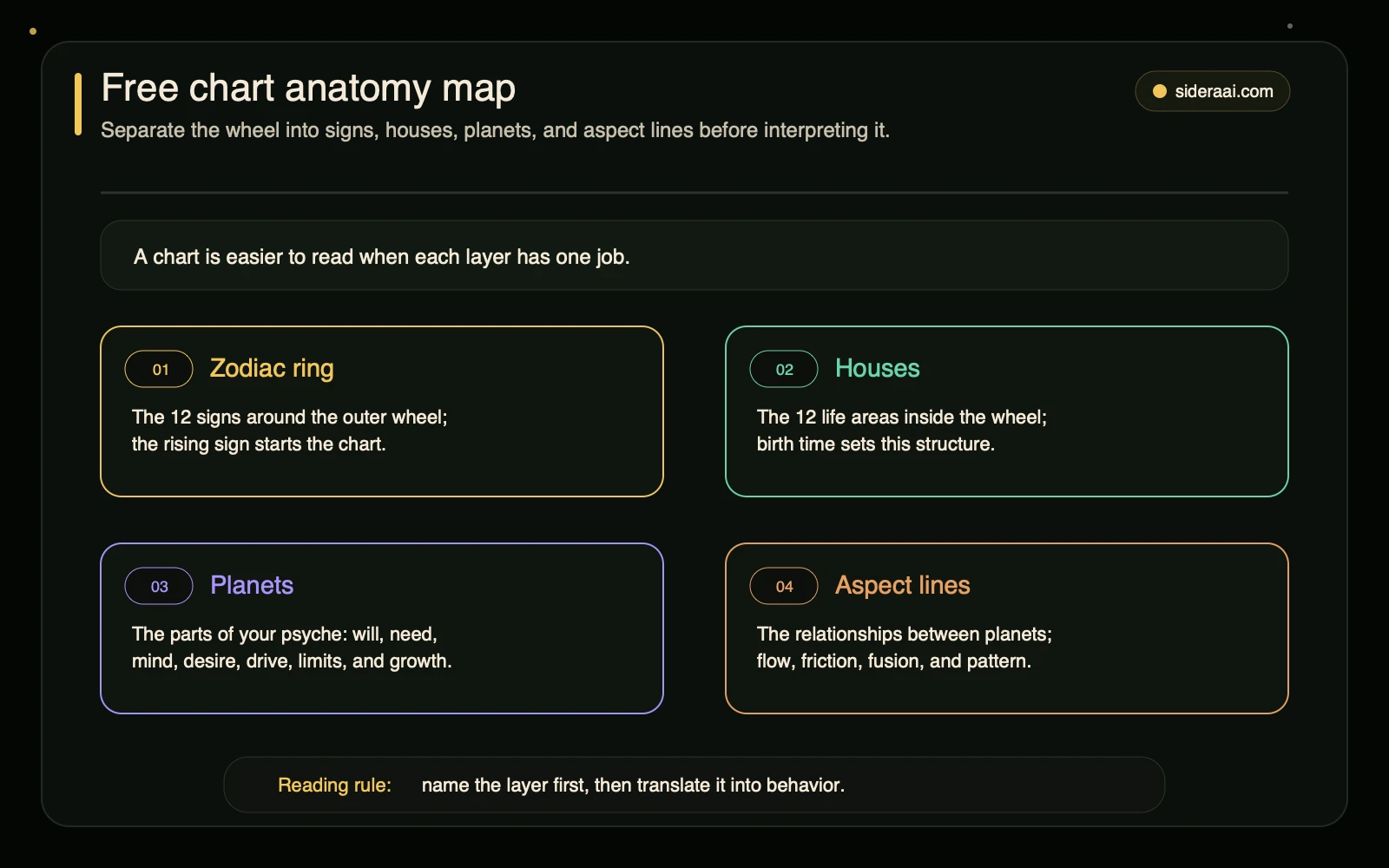
Use the anatomy map to separate the wheel into layers before interpreting it: signs name tone, houses name life area, planets name the inner part, and aspects show how those parts interact.
The Most Important Placements to Check First
When you pull up a free birth chart for the first time, start with three placements before anything else:
1. Your Sun Sign - your core identity, will, and vitality. In real life, the Sun describes where you need agency: the kind of choices that make you feel awake instead of passively carried along. The Sun spends approximately 30 days in each sign, so most people already know this one.
2. Your Moon Sign - your emotional nature, instinctive responses, and what you need to feel secure. The Moon shows how you self-soothe, what you expect from closeness, and what happens before you can explain your feelings clearly. The Moon moves fast: it changes zodiac sign approximately every 2.3 days, which is why your birth time matters. Even a few hours can mean the Moon has shifted signs. Use the Moon Sign Calculator if you are unsure of yours.
3. Your Ascendant (Rising Sign) - the sign that was rising on the eastern horizon at the moment of birth. This shapes your first response to life: how you enter rooms, meet pressure, protect your privacy, and start new chapters. It also determines the entire house structure of your chart. For a deeper look at how these three work together, see Sun, Moon, and Rising Sign Meaning.
These three - Sun, Moon, Rising - form the foundation of your chart. Everything else builds on them. Astrologer Robert Hand wrote in Horoscope Symbols (1981) that the Ascendant “colors everything else in the chart” precisely because it determines which houses govern which life areas - and that house structure only appears when birth time is known.
Use this quick reading order if the chart feels overwhelming:
- First, read the Sun, Moon, and Rising as three different jobs: identity, emotional safety, and life approach.
- Then check which houses those three placements occupy, because the house tells you where the pattern plays out.
- Next, look for hard aspects to those placements, especially squares, oppositions, and conjunctions.
- Finally, write one plain-language sentence for each pattern: “I tend to…” or “I need to practice…”
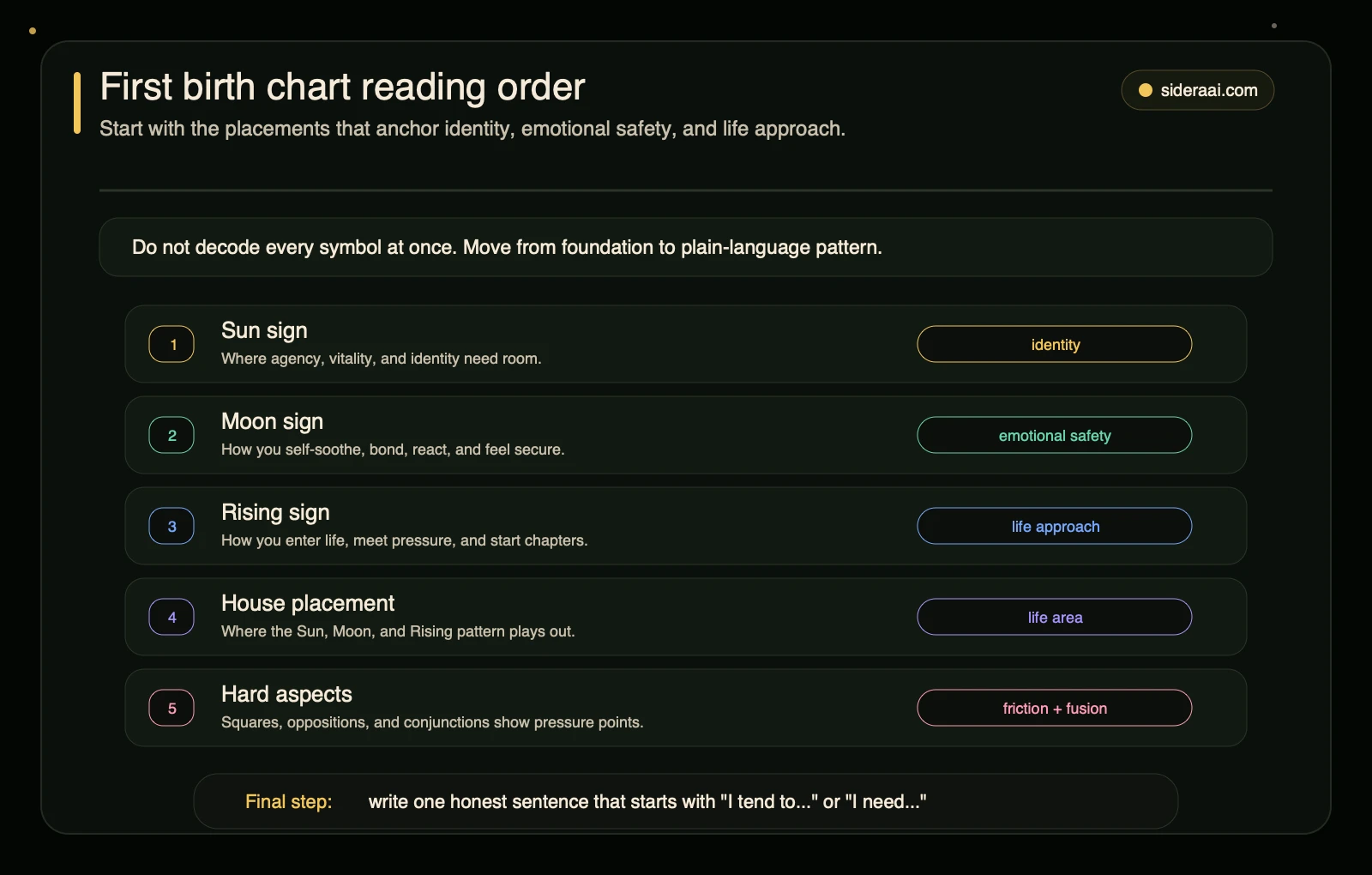
Follow this order when the chart feels crowded: read the Big Three first, locate where they act through houses, then turn the strongest pressure pattern into one honest sentence.
Sidera uses your actual birth chart—not generic horoscopes.
Get personalized insights →What Most Free Astrology Chart Tools Miss
Here is where most free chart generators fall short:
Sign Placement Only - No House Interpretation
Many free tools show you that your Mars is in Aries. But they do not tell you whether Mars is in your 1st house (direct and assertive energy front-and-center in your life) or your 12th house (that same energy operating beneath the surface, often unconsciously). Same sign, completely different expression. For a practical walkthrough of reading house placements, see How to Read a Birth Chart for Beginners.
Aspects With No Explanation
Free charts usually draw the aspect lines but do not interpret them. Knowing that Venus squares Saturn is not useful on its own - you need to understand what a Venus-Saturn square means in terms of relationships and self-worth. Liz Greene noted in Relating (1977) that aspects are “the dynamic relationships between planetary principles” - they describe how different parts of your psychology interact, which is precisely why a list of planets without aspects tells an incomplete story.
No Real-Time Transits
A natal chart is a snapshot. What is happening now - which planets are moving through your houses, what aspects they are making to your natal planets - requires transit tracking. Most free chart sites offer this only in paid tiers.
No Synthesis
A free chart gives you a list: Sun in Taurus, Moon in Aquarius, Mars in the 7th house, Venus square Saturn. A list of ingredients is not a recipe. Synthesizing the chart - reading how all the placements interact to create a coherent picture - is what separates a basic chart printout from a genuine reading. See Natal Chart Reading: A Step-by-Step Guide for a practical approach to building that synthesis.
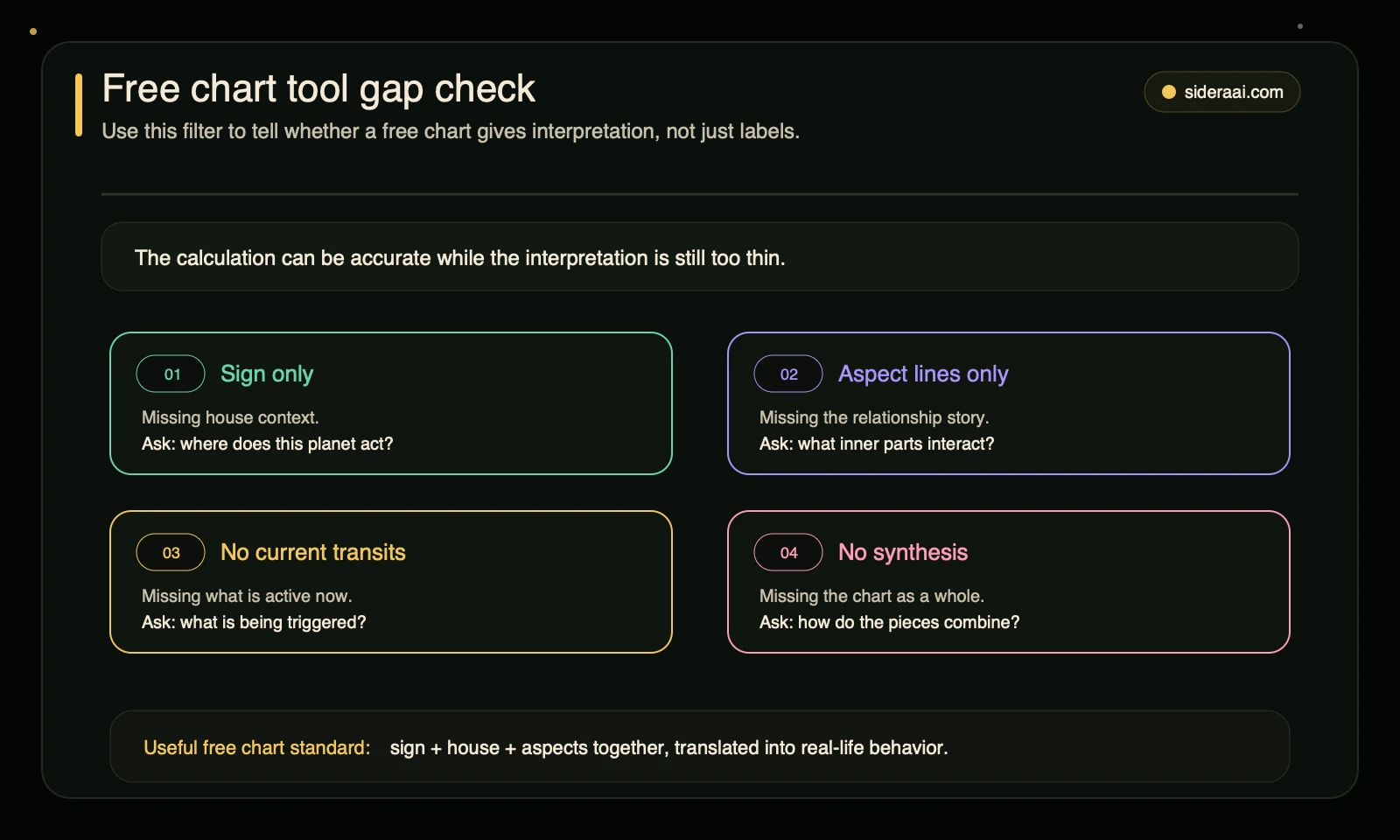
Use the gap check to tell whether a chart tool is only labeling placements or actually helping you combine sign, house, aspects, and timing into behavior you can reflect on.
Find your perfect moment with AI-powered electional astrology.
Discover your timing →What to Know About Free Astrology Chart Accuracy
A free astrology chart is calculated with the same mathematical precision as a paid one. The planetary positions, zodiac signs, and house divisions are a matter of astronomy - and any reputable tool, free or paid, will produce identical planetary placements for the same birth data.
The accuracy question is really a question of what the tool does with those placements. The chart itself is accurate. The interpretation quality is what varies.
One genuine accuracy concern: house systems. Different astrologers use different mathematical methods to divide the chart into 12 houses - Placidus, Whole Sign, Koch, Equal House, and others. Most free tools default to Placidus without mentioning it. If you compare two free charts and notice different house placements for the same birth data, the house system is likely why. For a Birth Chart Calculator Guide that explains what to enter and what to expect, start there.
What Sidera Offers Free
Sidera generates a free astrology chart that includes the interpretation layer most free options withhold.
When you enter your birth data, Sidera calculates:
- Your Sun, Moon, and Rising signs
- Every planet’s zodiac sign and house position
- Major aspects between planets - with meaning attached, not just symbols
- How the combination of sign, house, and aspects creates your unique placement profile
The emphasis is on the three-layer analysis: sign, house, and aspects working together. Moon in Cancer is a starting point. Moon in Cancer in the 4th house with a trine to Neptune is a portrait.
Sidera uses tropical (Western) astrology - the same system used by the majority of Western astrologers, rooted in the seasonal relationship between Earth and the Sun.
How to Use Your Chart After You Generate It
Once you have the chart, pick one practical application instead of trying to make the whole wheel mean everything at once.
For relationships, start with the Moon, Venus, Mars, the 7th house, and any hard aspects involving those planets. These can show what you need emotionally, how you give and receive affection, what you pursue, and where closeness activates fear or defensiveness.
For work, look at the Sun, Mars, Saturn, the 6th house, and the 10th house. The useful question is not “What job should I have?” It is “What kind of responsibility, rhythm, pressure, and recognition bring out my best behavior?”
For conflict, look at Mars, Mercury, Saturn, and repeated squares or oppositions. A chart can show whether you tend to confront too fast, explain too much, avoid directness, brace for criticism, or treat vulnerability like a loss of control.
For self-image, look at the Sun, Ascendant, 1st house, and any planets near the Ascendant. This is where the chart often names the difference between how you appear, how you try to be seen, and what you are still learning to own without overperforming it.
Understand your connections on a cosmic level.
Explore your bonds →Explore Your Daily Horoscope
Once you know your chart, see how today’s sky affects your sign:
- Aries Daily Horoscope
- Taurus Daily Horoscope
- Gemini Daily Horoscope
- Cancer Daily Horoscope
- Leo Daily Horoscope
- Virgo Daily Horoscope
- Libra Daily Horoscope
- Scorpio Daily Horoscope
- Sagittarius Daily Horoscope
- Capricorn Daily Horoscope
- Aquarius Daily Horoscope
- Pisces Daily Horoscope
FAQ: Free Astrology Charts
Is a free astrology chart accurate? Yes - the planetary calculations are the same regardless of whether you use a free or paid tool. What varies is the quality of interpretation attached to those calculations. A free chart that only shows signs without house positions or aspect meanings is technically accurate but limited in usefulness.
What is the difference between a natal chart and a birth chart? They are the same thing. “Natal chart,” “birth chart,” and “astrology chart” all refer to the circular map of planetary positions at the moment of birth. The terms are used interchangeably.
What information do I need to get a free birth chart? You need three pieces of data: your date of birth, your time of birth, and your place of birth. Date and place alone give you a partial chart (Sun sign, outer planets, basic placements). Birth time is needed for your Ascendant (Rising sign) and house positions.
Do I need my exact birth time? An accurate birth time is important because the Ascendant changes sign every two hours, and even a 10-minute difference can shift house cusps. Check your birth certificate for the most reliable source. If you do not know your birth time, most tools can generate a “solar chart” using noon as a default - but house placements will not be meaningful.
What is the difference between a Western chart and a Vedic (sidereal) chart? Western astrology (tropical) anchors the zodiac to the seasons - Aries always begins at the spring equinox. Vedic astrology (sidereal) anchors the zodiac to fixed star positions, which have shifted about 23-24 degrees over the centuries due to the Earth’s axial wobble. The result: your Sun sign may be one sign earlier in Vedic astrology than in Western. Sidera uses the tropical (Western) system. For a comparison of both systems, see How to Read a Birth Chart for Beginners.
Can I use a free chart to compare my chart with someone else’s? Yes - this is called synastry. You generate two natal charts and compare planetary placements to understand relationship dynamics. A synastry reading shows which planets harmonize between charts and where friction may arise. See the Synastry Chart Guide for a complete walkthrough on how to do this.
What if I want to understand my chart more deeply? Start with your Sun, Moon, and Rising sign (the Big Three), then explore each planet’s house position. The Natal Chart Reading guide walks through a step-by-step approach for interpreting placements in order, from the most personal to the generational. The Zodiac Signs Compatibility Chart is also a useful reference once you know your placements.
What is the best free astrology chart tool? Look for a tool that shows house positions (not just signs), explains aspect meanings (not just draws lines), and uses a house system it discloses. Sidera covers all three, plus it interprets each placement in combination - sign, house, and aspects together - rather than presenting a list of isolated keywords.
Your Chart Is Already Complete
A common misconception: that free charts are somehow incomplete or that you need an expensive reading to access accurate data.
The chart is a fixed calculation. Natal chart software calculates the same planetary positions whether it is free or paid. The difference is what the tool does with those positions afterward - whether it hands you a grid of symbols or walks you through what each placement means.
Your birth chart does not change. The sky was where it was. What changes over time is your understanding of what those positions mean - and the quality of tools you use to explore them.
Getting a free astrology chart is the right first step. Knowing what you are looking at is the second.