What Are Astrology Aspects?
Astrology aspects are the angles between planets that show how different parts of you interact in real life: what feels easy, what feels blocked, what you repeat in love, and what you do under pressure. A planet placement tells you the raw material. An aspect tells you the relationship between those parts of your chart.
That is why two people with the same Sun sign can feel nothing alike. One Leo Sun might trine Jupiter and move through life with visible confidence. Another Leo Sun might square Saturn and build confidence slowly through self-discipline, criticism, and a fear of being seen before they feel ready.
When you read aspects well, you stop collecting keywords and start seeing patterns: why you freeze in conflict, why a relationship feels magnetic but complicated, why work comes easily in one area and feels heavy in another, or why your self-image never quite matches what other people see.
Ready to See Your Personal Birth Chart?
Discover your unique cosmic blueprint — planets, houses, and aspects personalized to your exact birth time and location.
Get Your Birth Chart →✓ Birth chart analysis ✓ Personalized insights ✓ Free to use
The Major Aspects in Astrology
Conjunction (0°)
Two planets in the same sign and degree range merge their energies. Conjunctions intensify whatever they touch, for better or worse. They often feel like a part of you that does not have much distance from itself.
Effect: Fusion, intensity, blended energies
Nature: Neutral (depends on planets involved)
Orb: 0-8° (tight conjunctions are most powerful)
How it feels in real life: A Sun-Mercury conjunction can make your thoughts feel inseparable from your identity, so criticism of your ideas may feel personal. A Venus-Mars conjunction can make attraction, creativity, pleasure, and pursuit move through the same channel. A Mars-Saturn conjunction can create disciplined action, but also the feeling that every desire has to pass a test first.
Opposition (180°)
Planets opposite each other create tension that demands balance. Oppositions often show up through relationships, projection, and “why do I keep attracting this?” moments. One side of the aspect can feel like you; the other side may first appear through other people.
Effect: Tension, awareness, need for balance
Nature: Challenging but growth-oriented
Orb: 180° ± 8°
How it feels in real life: Sun opposite Moon can create a split between the self you present and the needs you protect in private. Venus opposite Uranus may want closeness and freedom at the same time, creating attraction to people who feel exciting but hard to pin down. The work is not choosing one side forever; it is learning when each side deserves the microphone.
Square (90°)
The square is usually the aspect you notice first because it creates repeated friction. It does not mean failure. It means two drives keep interrupting each other until you build a more mature strategy.
Effect: Conflict, motivation through friction, forced growth
Nature: Challenging (but builds strength)
Orb: 90° ± 8°
How it feels in real life: Mars square Saturn can feel like wanting to move quickly while an internal brake keeps asking, “Are you sure?” In work, this can become disciplined execution once you stop treating delay as proof of failure. In conflict, it can become suppressed anger that leaks out as resentment. The shadow pattern is not the square itself; it is the unconscious coping strategy you build around it.
Trine (120°)
Planets in the same element flow together with less resistance. Trines represent natural talents, emotional ease, and areas where you may not realize other people have to work harder.
Effect: Harmony, natural ability, ease
Nature: Beneficial (but can create complacency)
Orb: 120° ± 8°
How it feels in real life: Mercury trine Uranus can make unusual ideas arrive quickly. Moon trine Venus can make emotional warmth feel natural. The challenge is that ease can become passive. If a trine describes a gift, your job is to give it structure so it becomes useful instead of merely comfortable.
Sextile (60°)
A gentle, supportive aspect that creates opportunities you must choose to activate. Sextiles are not as automatic as trines; they are openings that respond to initiative.
Effect: Opportunity, mild harmony, needs activation
Nature: Beneficial (with effort)
Orb: 60° ± 4°
How it feels in real life: Venus sextile Mars can create natural chemistry, but you still have to make the first move. Mercury sextile Saturn can make you a careful thinker, but the skill sharpens when you write, study, plan, or teach consistently.
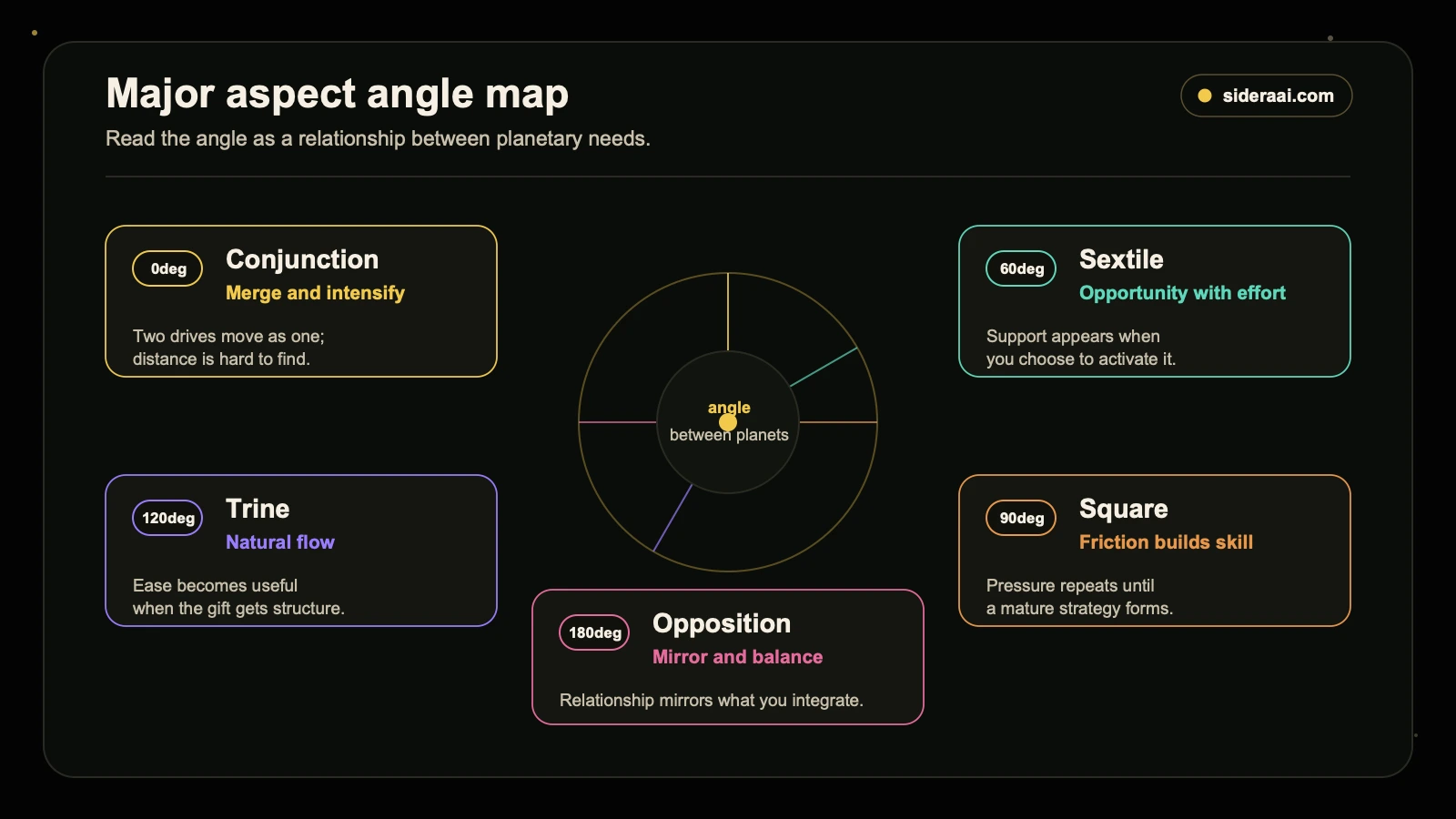
Use the angle map to translate the five major aspects into the way two planetary needs merge, support, challenge, flow, or mirror each other.
Sidera uses your actual birth chart—not generic horoscopes.
Get personalized insights →Minor Aspects Worth Knowing
Quincunx (150°)
Also called an inconjunct, this awkward angle creates a blind spot. Planets don’t understand each other and require constant adjustment.
Effect: Discomfort, need for adaptation, “off” feeling
Orb: 150° ± 2°
Example: Sun quincunx Saturn creates a disconnect between your identity and your discipline. You might feel like your goals don’t align with who you are.
Semi-Sextile (30°)
A mild tension that builds awareness gradually. Easy to miss but adds subtle friction that keeps you alert.
Effect: Slight friction, gradual awareness
Orb: 30° ± 2°
Quintile (72°) & Bi-Quintile (144°)
Creative, specialized talents. These aspects show unique abilities and innovative thinking that others don’t easily replicate.
Effect: Creative genius, unique expression
Orb: 72° ± 2° or 144° ± 2°
Example: Many musicians have Venus or Neptune quintiles - they hear music differently than others.
How Aspects Shape Your Chart
Aspect Patterns
Multiple aspects can form geometric patterns. Do not read these as destiny stamps. Read them as repeated problem-shapes: the kind of inner dynamic that keeps showing up until you learn how to work with it.
Grand Trine: Three planets forming an equilateral triangle (all trines). Extreme ease, natural talent, and a risk of staying too comfortable. You may have a gift that only develops when you choose challenge on purpose.
T-Square: Two planets opposing with both squaring a third. Pressure collects around the apex planet, which becomes both the stress point and the action point. When you work with the apex planet consciously, the whole pattern becomes easier to direct.
Grand Cross: Four planets in square formation. This can feel like several life areas demanding attention at once. The practical work is pacing: learning which pressure is urgent, which is old, and which belongs to someone else.
Yod (Finger of God): Two planets sextile with both quincunx a third. This can feel like a life pattern that requires constant adjustment. The apex planet shows where you are asked to refine your response rather than force a clean answer.
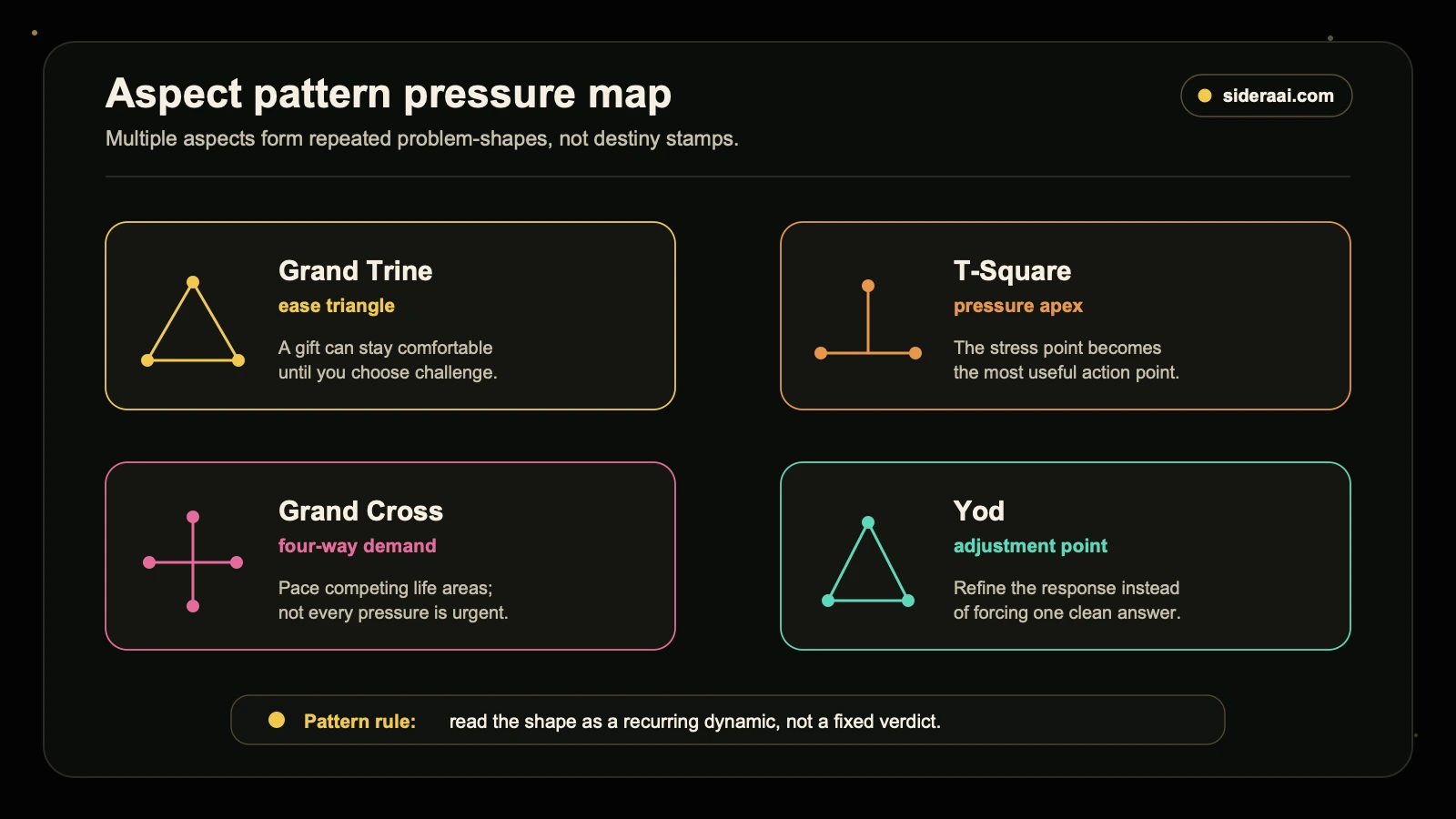
Use the pattern map to read chart shapes as recurring dynamics: ease that needs challenge, pressure that needs direction, and adjustment that needs refinement.
Orbs and Exactness
Aspects are strongest when exact. The orb is the allowable deviation:
- Tight orb (0-3°): Very strong influence, felt constantly in daily life
- Medium orb (3-6°): Clear influence, noticeable in relevant situations
- Wide orb (6-8°): Background influence, subtle but present
Applying vs. Separating:
Applying aspects (planets moving toward exactness) feel more intense and future-oriented. Separating aspects (planets moving apart) represent lessons you’re integrating from the past.
In your birth chart, all aspects are “frozen” at your birth moment. But transiting planets form temporary aspects that activate your natal patterns. That’s why some years feel easier than others.
Elements and Modalities
Aspects connect different elements and modalities, creating predictable patterns:
Trines connect same element:
- Fire to fire (Aries, Leo, Sagittarius): Creative, enthusiastic harmony
- Earth to earth (Taurus, Virgo, Capricorn): Practical, stable flow
- Air to air (Gemini, Libra, Aquarius): Mental, social ease
- Water to water (Cancer, Scorpio, Pisces): Emotional, intuitive connection
Understanding your elemental balance helps explain your aspect dynamics. Read more about zodiac sign elements.
Squares connect same modality:
- Cardinal square (Aries-Cancer-Libra-Capricorn): Action-oriented friction, impatient energy
- Fixed square (Taurus-Leo-Scorpio-Aquarius): Stubborn resistance, power struggles
- Mutable square (Gemini-Virgo-Sagittarius-Pisces): Scattered tension, overextension
For deeper understanding of how fire, earth, air, and water signs operate, see our guides on fire signs, air signs, earth signs, and water signs.
Aspect Priority: What to Read First
When you look at your birth chart for the first time, you may see dozens of aspect lines. Do not read every line equally. Start with the aspects connected to the question you are actually trying to answer.
Level 1: Core Identity Aspects (Read These First)
- Sun aspects - Your life purpose and ego expression
- Moon aspects - Your emotional needs and instinctive reactions
- Rising sign ruler aspects - How you navigate the world
These shape your fundamental personality. Start here.
Level 2: Daily Life Aspects
- Mercury aspects - Communication style, thinking patterns
- Venus aspects - Love style, values, what you find beautiful
- Mars aspects - Drive, anger, sexual energy, ambition
These affect your everyday interactions and decisions.
Level 3: Life Theme Aspects
- Jupiter aspects - Expansion, luck, philosophy, growth areas
- Saturn aspects - Discipline, responsibility, life lessons, career
- Outer planet aspects (Uranus, Neptune, Pluto) - Generational themes, deep transformation
These create the backdrop of your life story.
Level 4: Aspect Patterns
- T-Squares, Grand Trines, Grand Crosses, Yods - Chart-defining patterns
If you have any major pattern, it dominates your chart’s interpretation.
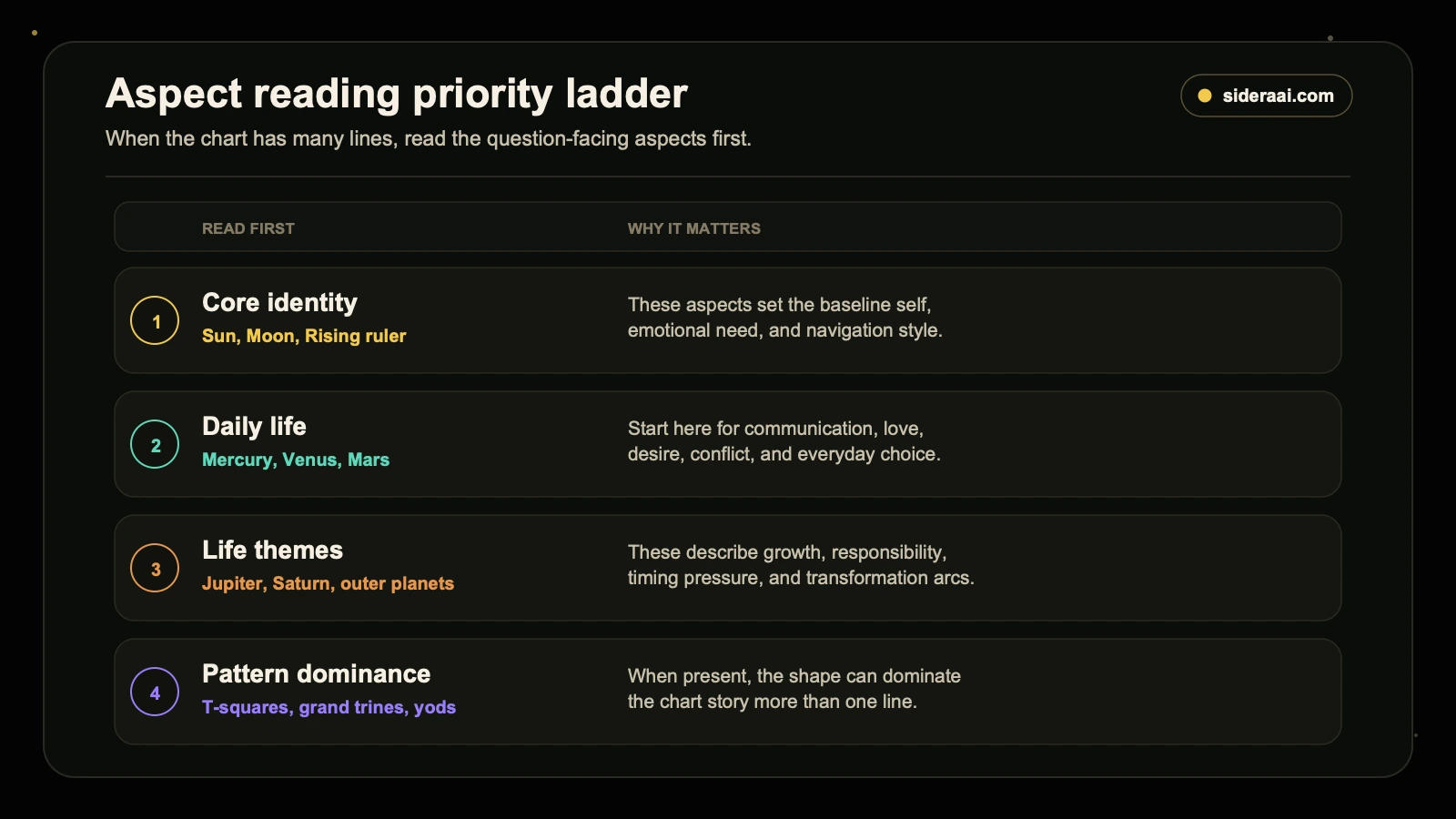
Use the priority ladder when the chart has too many lines: start with the question-facing planets, then widen into life themes and dominant patterns.
Using Aspects for Timing
Here’s the practical point: aspects are not only personality descriptors. They are also timing tools.
In sidereal astrology, transiting planets activate your natal aspects over time. When transiting Saturn squares your natal Sun, the symbolism is not just “hard year.” It can describe a period where identity, authority, responsibility, visibility, and self-respect become harder to avoid.
Knowing you have Mars square Saturn is useful. Knowing when that pattern gets triggered by a major transit is more actionable because it helps you plan for pressure, effort, restraint, or disciplined growth instead of reacting blindly.
Learn more about using transits for timing in our guide on electional astrology.
How to Work With Your Aspects
For Challenging Aspects (Squares, Oppositions)
Do not treat them as flaws. Treat them as pressure patterns.
- Mars square Saturn? Notice where you alternate between force and shutdown. Build a pace you can actually sustain.
- Sun opposite Moon? Notice where your public choices ignore your private needs. Make room for both before resentment starts making decisions.
- Venus square Pluto? Notice where intimacy turns into testing, control, or fear of betrayal. Depth becomes healthier when honesty replaces surveillance.
Reflection question: What same conflict keeps repeating, and what skill would make it less dramatic next time?
For Harmonious Aspects (Trines, Sextiles)
Activate them deliberately.
- Mercury trine Uranus? You have innovative ideas - but you need to act on them. Set aside time for creative brainstorming.
- Venus sextile Mars? You have natural charm - use it. Initiate the relationship, ask for the raise, pitch the client.
- Jupiter trine Sun? Opportunities may come easily, but you still need to choose the room you want to enter.
Reflection question: What comes so naturally that you underestimate its value?
For Conjunctions
Recognize which planets can work together.
- Sun-Mercury? Your thoughts and identity align - use this for authentic communication.
- Venus-Mars? Creative and sexual energy blend - powerful for artists and entrepreneurs.
- Moon-Neptune? Extreme empathy - protect your energy, use it for healing work.
Relationship Aspects: Venus & Mars
A common reason people study aspects is relationship clarity, because aspects describe chemistry and friction better than sign matching alone. Look for what two people activate in each other, not just whether the signs sound compatible.
Venus-Mars Aspects (Chemistry & Attraction)
- Conjunction: Magnetic attraction, creative energy, love and desire moving through the same channel
- Trine/Sextile: Natural chemistry, easier affection, balanced give-and-take when both people participate
- Square/Opposition: Intense attraction with friction; high chemistry, but also more chances to trigger insecurity, impatience, or mixed signals
Venus-Saturn (Commitment & Loyalty)
- Conjunction/Trine: Loyalty, commitment, seriousness, and a willingness to build slowly
- Square/Opposition: Fear of rejection, delayed trust, age-gap dynamics, emotional caution, or feeling like love has to be earned
Mars-Pluto (Intensity & Transformation)
Any hard aspect: Powerful sexual energy, transformative relationships, obsession, power struggles, or the need to learn clean boundaries around desire and control
A hard relationship aspect does not mean the connection is doomed. It means chemistry requires skill. Ask: what pattern do we repeat when we are scared, and do both people have the maturity to name it?
Understand your connections on a cosmic level.
Explore your bonds →How Aspects Show Up in Work, Conflict, and Self-Image
Aspects become useful when you translate them into behavior. If an interpretation does not help you recognize a real pattern, it is probably too vague.
Work: Mars aspects describe how you pursue goals, handle pressure, and respond to delay. Saturn aspects describe discipline, fear of failure, authority issues, and the standards you hold yourself to. Mercury aspects show how you think, explain, negotiate, and make decisions.
Conflict: Moon aspects show what you need when you feel emotionally unsafe. Mars aspects show your anger style. Pluto aspects can show where control, intensity, or all-or-nothing reactions take over. A tense aspect often becomes most visible when you are tired, rejected, rushed, or afraid of losing power.
Self-image: Sun aspects describe how you build confidence and visibility. Saturn can make self-worth feel conditional. Neptune can blur identity or idealize who you think you should be. Jupiter can amplify confidence, sometimes beautifully and sometimes past the point of realism.
The practical takeaway: name the behavior before you judge it. “I have Moon square Uranus” is less useful than “I pull away when I feel emotionally crowded, then wonder why people stop trusting my consistency.”
Reading Aspects in Practice
Step 1: Identify Your Major Aspects
Look at your birth chart (get yours at our free calculator) for the lines between planets. Many chart tools color-code aspects, though the exact colors can vary:
- Red = Square, Opposition
- Blue = Trine, Sextile
- Conjunctions may be marked separately or listed in the aspect table
Focus on aspects involving:
- Sun, Moon, Rising - your core identity
- Personal planets (Mercury, Venus, Mars) - daily life
- Outer planets (Jupiter through Pluto) - life themes
For a complete guide to reading your chart, see How to Read Your Birth Chart for Beginners.
Step 2: Count Aspect Types
More squares and oppositions? You may notice tension quickly and grow through direct confrontation with problems. The gift is resilience; the risk is treating peace like boredom.
More trines and sextiles? Some skills may come naturally. The gift is ease; the risk is waiting for motivation instead of building structure.
Mostly conjunctions? Your chart has concentrated energy. The gift is focus; the risk is over-identifying with one drive, role, or emotional state.
Balanced mix? You experience both ease and challenge, creating a well-rounded life.
Step 3: Look for Patterns
Find T-squares, grand trines, or stelliums (multiple planets in one sign). These dominate your chart’s story.
A T-square points to the situation that keeps demanding a response. A grand trine points to a talent that may feel so normal you forget to develop it. A stellium concentrates attention in one sign or house, making that life area especially loud.
Step 4: Integrate the Story
Aspects aren’t isolated. They create a web of interactions. Notice themes:
- Relationship patterns: Venus/Mars aspects to outer planets
- Career drive: Saturn/Midheaven aspects, Mars-Saturn dynamics
- Communication style: Mercury aspects, especially to Jupiter (expansive) or Saturn (careful)
- Emotional needs: Moon aspects, particularly to Saturn (need for security) or Uranus (need for freedom)
Use the pattern as a decision filter. If a choice activates Moon-Saturn, ask what would create emotional safety and adult responsibility. If it activates Venus-Uranus, ask how much closeness and freedom the situation can realistically hold. The best reading gives you a next move, not just a label.
Aspects vs. Transits
Your natal aspects are permanent - they’re the wiring of your personality. But planets keep moving after you’re born, forming transits that temporarily activate your natal patterns.
When transiting Saturn squares your natal Sun, your permanent Sun-Moon trine doesn’t change - but you experience a temporary period of pressure and discipline. That’s why astrology is useful for timing.
Common Aspect Questions
Q: What is the strongest aspect in astrology?
The conjunction (0°) is the most powerful aspect because planets completely merge their energies. Tight conjunctions (within 1-2°) dominate a chart’s interpretation. After conjunctions, most astrologers consider oppositions and squares the strongest due to their dynamic tension that forces action.
Q: Are squares always bad?
No. Squares create tension between two needs, drives, or life areas. That tension can feel frustrating, but it can also make you more honest, disciplined, and capable. The key is learning the skill the square demands instead of repeating the same defensive reaction.
Q: Can you have too many trines?
Yes. Too many trines can describe natural gifts that never get tested because they feel easy. A balanced chart has both ease and challenge: trines show what flows, while squares show where effort builds strength.
Q: Do aspects change over time?
Your natal aspects are permanent - frozen at your birth moment. But transiting planets form temporary aspects that activate your birth chart patterns. That’s why some years feel easier than others. A challenging natal aspect might be triggered during a difficult transit, or supported during a harmonious one.
Q: What aspect shows strong relationship chemistry?
No single aspect proves a destined relationship. In synastry (comparing two charts), Venus-Mars connections show chemistry and attraction. Moon-Moon or Moon-Venus aspects show emotional compatibility. Sun-Moon aspects can describe recognition and partnership rhythm. The most useful compatibility reading looks at several supportive contacts and the harder patterns both people are willing to handle consciously.
Q: How do you read aspects in a birth chart?
Start with aspects to your Sun, Moon, and Rising - these shape core identity. Then look at personal planets (Mercury, Venus, Mars). Check for major patterns like T-squares or grand trines. Finally, consider outer planet aspects for life themes. Prioritize tight orbs (within 3°) over wide ones.
Why Aspects Matter More Than Signs
Your sun sign is just one planet in one sign. Aspects show how all your planets interact, creating the full complexity of your personality.
Someone with Sun in Aries (typically bold and impulsive) but a Sun-Saturn square might be more cautious and disciplined than a Capricorn (typically cautious) with a Sun-Jupiter trine (optimistic and expansive).
Example: Two people born with Sun in Leo. Person A has Sun trine Jupiter - confident, lucky, expansive, natural leader. Person B has Sun square Saturn - self-critical, works hard for recognition, leadership through discipline. Both are Leos, but they express it completely differently because of aspects.
Aspects add the nuance that sun signs alone miss.
Finding Your Aspects
Your birth time, date, and location create a unique aspect pattern. Most people notice their challenging aspects first because friction demands attention. But your harmonious aspects are equally important - they’re your natural advantages.
To see your complete aspect pattern, you need an accurate birth chart. Visit our birth chart calculator to get started.
For daily guidance based on your chart, check your horoscope:
- Aries | Taurus | Gemini | Cancer
- Leo | Virgo | Libra | Scorpio
- Sagittarius | Capricorn | Aquarius | Pisces
Powered by Sidera — AI-driven cosmic timing.
Frequently Asked Questions
What are astrology aspects?
Astrology aspects are the geometric angles formed between planets in your birth chart. These angular relationships show how different planetary energies interact, creating harmony, tension, intensity, or opportunity. Common aspects include the conjunction at 0 degrees, trine at 120 degrees, square at 90 degrees, opposition at 180 degrees, and sextile at 60 degrees.
What is the most powerful aspect in astrology?
The conjunction is generally considered the most powerful aspect because two planets merge their energies in the same zodiac sign and degree range. Tight conjunctions within one to two degrees are especially dominant and can shape an entire birth chart interpretation more than any other single aspect.
What is the difference between a trine and a sextile?
A trine connects planets 120 degrees apart in the same element, creating natural talent and effortless flow. A sextile connects planets 60 degrees apart and represents opportunity that requires some initiative to activate. Trines are more automatic, while sextiles offer potential waiting to be used through deliberate action.
Are squares always negative in astrology?
No, squares are challenging but not negative. They create friction between two needs, drives, or life areas. That pressure can become ambition, resilience, and maturity when you work with it consciously, but it can become defensiveness or self-sabotage when you ignore the pattern.
What is a T-square pattern in astrology?
A T-square is a pattern where two planets oppose each other and both square a third planet. This creates concentrated pressure in one part of the chart. The planet receiving both squares is the apex planet and often represents both your biggest challenge and your strongest source of motivation.
How do I find aspects in my birth chart?
Look at the lines drawn between planets on your birth chart wheel. Many chart tools color-code them: red lines often indicate challenging aspects like squares and oppositions, while blue or green lines often show harmonious aspects like trines and sextiles. Start by focusing on aspects to your Sun, Moon, Rising sign ruler, Mercury, Venus, and Mars.
What is an orb in astrology?
An orb is the allowable degree of deviation from an exact aspect. A tight orb of zero to three degrees creates a very powerful, frequently felt influence in your personality and life. Medium orbs of three to six degrees are clearly noticeable, while wide orbs of six to eight degrees create a more subtle background influence.
Which aspect is most important for romantic compatibility?
Venus and Mars aspects between two people’s charts are important for romantic chemistry and attraction. Moon connections indicate emotional compatibility and long-term comfort. Sun-Moon aspects often describe recognition and partnership rhythm. The strongest connections usually combine several supportive aspects rather than relying on any single one.