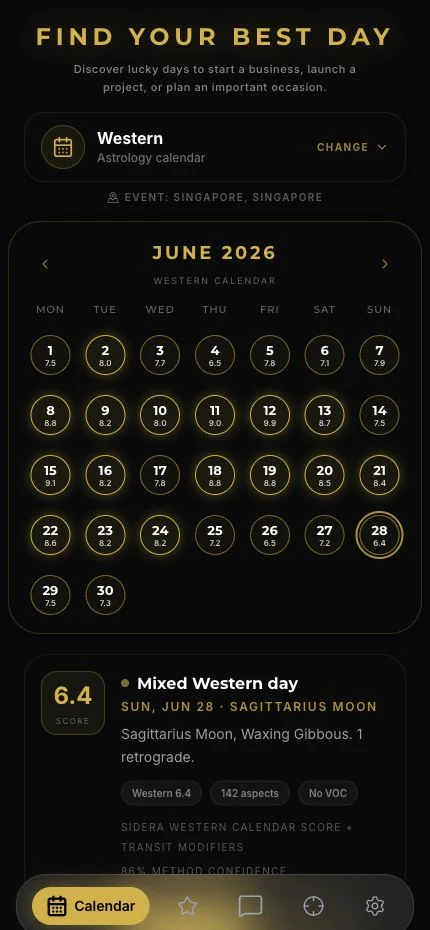
Quick answer: An astrology calendar maps dates to timing signals so you can compare realistic options for a specific action. Sidera’s calendar offers seven separate systems: Western, Jyotish, Chinese almanac, Rokuyo, Jewish, Islamic, and Mayan. Western uses tropical calculations; Jyotish uses Lahiri sidereal calculations. The other calendars add cultural, religious, or cycle-based context. Because these systems use different inputs, their labels should not be averaged into one universal “good day” score. None guarantees an outcome or replaces practical readiness.
How to Use Sidera’s Astrology Calendar
Open the monthly Calendar and tap the system button above the date grid. Choose Western calendar for tropical timing or Jyotish / Muhurta for Sidera’s Lahiri sidereal timing layer. Compare dates inside that system, then inspect the selected day’s details, source, and method-confidence context.
Western and Jyotish use a profile-backed Sidera calendar score. Chinese almanac and Rokuyo classify the civil date through calendar rules. Jewish and Islamic views add local sunset-aware context, while Mayan Tzolkin maps the date into a stated cycle. Keeping those inputs visible is more useful than blending them into an unexplained score.
A generic moon calendar usually answers a narrower phase or lunar-date question. A lunar calendar can also mean a religious or civil calendar. This pillar owns the broader astrology calendar comparison; the void-of-course Moon calendar and sunset-aware lunar calendar guide keep those narrower intents separate.
Selecting a calendar lens does not change your saved natal-chart settings. For chart context, read sidereal natal chart meaning and the sidereal versus tropical guide.
Product evidence: The screenshots below are real Sidera Lucky Day Planner captures made on June 28, 2026 with a consistent Singapore demo profile. The evidence pack records the seven-system selector, per-system calendar views, selected-day cards, top-day lists, and day-log controls. Method confidence describes input coverage, not the probability that a day will go well. We update this page when the system set, calculation inputs, or interface changes materially.
The system selector keeps each tradition visible as its own lens:
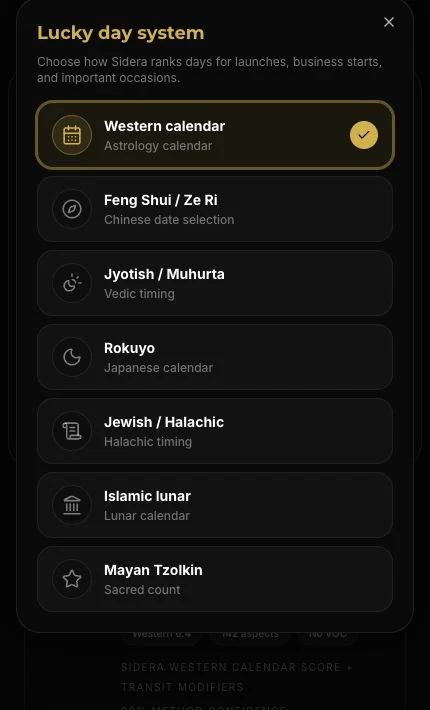
The selector makes each system explicit, so you choose the relevant calendar before reading scores.
What Most Timing Guides Miss
Most auspicious-day guides either explain one tradition or combine several into a single score. The missing step is choosing the system that matches the decision. A planetary transit, a Chinese day officer, a sunset boundary, and a sacred-cycle position do not measure the same thing.
A date can also score well while the decision remains unready. An unreviewed contract, an unfinished offer, or an unrehearsed conversation does not become sound because the timing looks supportive. Use the calendar to filter viable dates after the practical work is ready.

A favorable timing signal cannot finish the offer, test the system, or connect the operation; readiness still comes before the date.
The distinction is simple: timing support, emotional readiness, and logistical readiness are separate inputs.
Seven Systems, One Day: Which One to Use and When
Before going through each system in depth, here is the practical map. When you face a real timing decision, this table narrows which systems are worth consulting first – and what it means when they disagree.
| Decision type | Most relevant systems | Main risk of ignoring | What disagreement usually signals |
|---|---|---|---|
| Business launch, contract signing | Western electional, Jyotish Muhurta | Retrograde misfire, unfavorable action-category fit | Systems measuring different readiness dimensions: planetary picture vs Muhurta action fit. Both signals are useful; average them and you learn nothing from either. |
| Wedding or engagement date | Western, Jyotish, Chinese Ze Ri, relevant religious calendar | Missing a cultural clash or religious observance that matters to one family | Different traditions hold different weight for the people involved. Look for convergence across the traditions that matter to both partners, not across all seven. |
| Repair conversation or emotionally charged discussion | Moon phase / Moon sign (Western) | Initiating a difficult conversation when the emotional atmosphere is volatile | One system optimistic on the planetary picture, another showing Moon in a charged sign: this often means the timing is fine structurally but the emotional conditions are not settled. That is the more important signal. |
| Medical or surgical scheduling | Clinical advice and medical availability first; cultural preferences only if safe | Delaying necessary care for a timing label | Medical urgency and clinician guidance take priority. Astrology must not delay or override care. |
| Religious observance or ceremony | Jewish / Islamic calendar, Mayan Tzolkin | Scheduling over a fast, holiday, or sunset-shifted boundary | These systems are not competing with Western astrology. They are measuring something categorically different. Disagreement between them and a planetary score is not conflict; it is irrelevance. |
| Creative launch or public announcement | Western electional, Rokuyo as cultural layer | Launching under retrograde pressure or on a culturally unlucky day in relevant contexts | A retrograde flag alongside a strong Rokuyo day usually means: proceed, but build a revision plan into the timeline. |
| Rest, reflection, internal work | Moon phase (Western), personal transits | Forcing output on a day that signals inward attention | A strong external-action score paired with introspective personal transits is not contradiction – it is a signal to do the internal work first and let the external moment follow. |
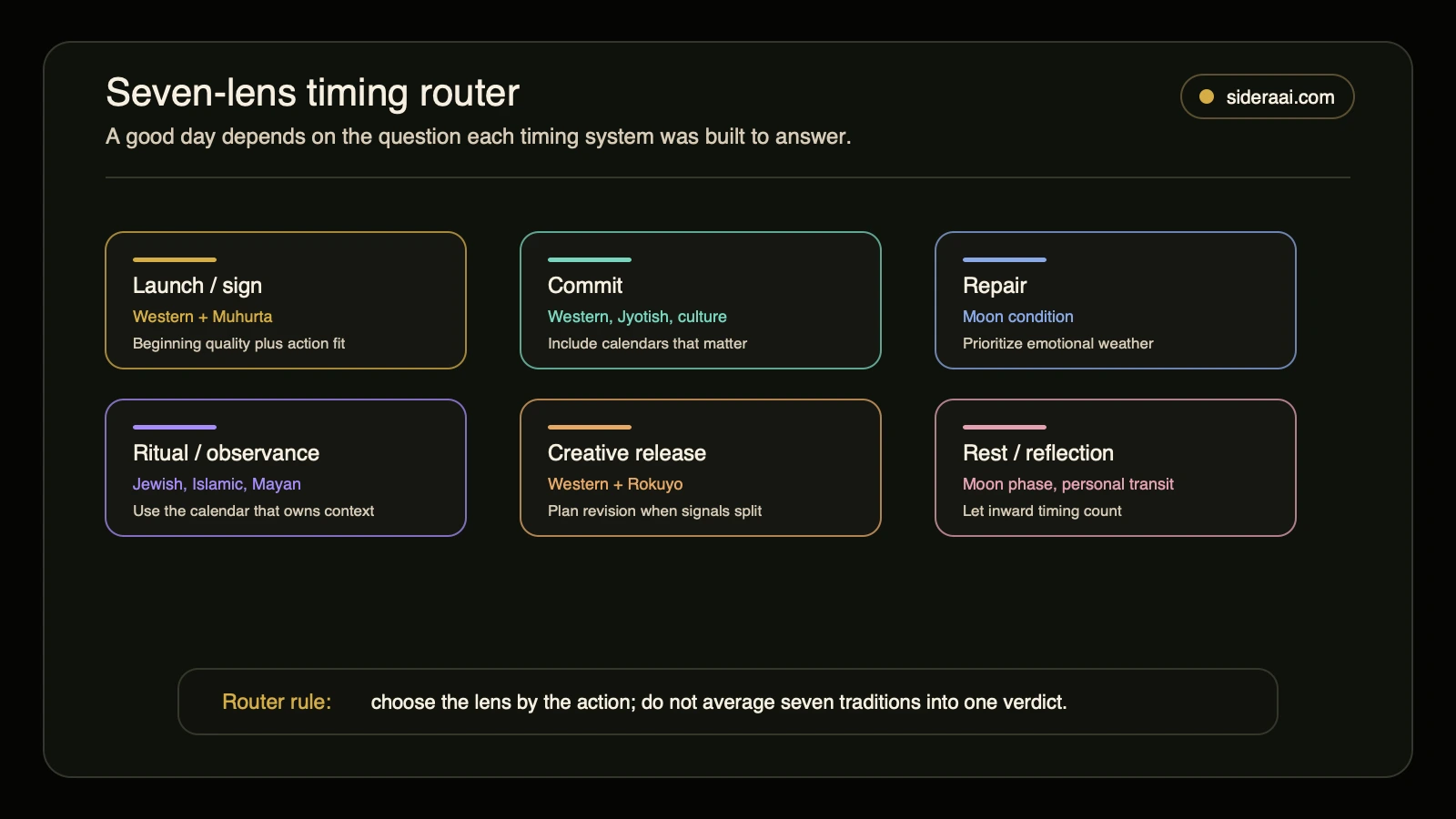
Use this router before comparing scores. A good day depends on the action, so choose the lens first instead of averaging seven traditions into one verdict.
This table is a starting filter. Each system gets its own practical depth below.
1. Western Astrology: Timing Personal Beginnings
Western electional astrology asks whether the current planetary picture supports a clean beginning. In Lucky Day Planner, the Western calendar presents Sidera’s existing calendar score on a 1-10 scale, with Moon phase, void-of-course caution, retrograde pressure, aspect count, and method confidence all visible for each day.
The felt experience of using Western timing well is specific. You are looking for a day when the Moon is not void of course, retrograde pressure does not undermine the action, and the aspect picture supports forward movement rather than revision or misfire.
Where it helps most: Job interviews, business launches, first dates, public announcements, contract signings, moving to a new place, starting a project, sending a proposal.
Scenario: You are choosing between three dates to submit a proposal. One falls on a void-of-course Moon, one sits near a Mercury retrograde station, and one has cleaner forward momentum. Western timing makes the cleaner candidate visible without pretending it guarantees the outcome. For the practical framework behind this, read what electional astrology is and the best days to start a business in 2026.

Western timing helps compare viable proposal dates: choose the route with clean forward motion, then let preparation carry the submission.
2. Jyotish / Muhurta: When the Moment Needs to Fit the Action
Muhurta is the Vedic practice of selecting a time fit for a specific action. In Lucky Day Planner, the Jyotish calendar uses Sidera’s Vedic score and adds Moon usability, retrograde pressure, intensity fit, and quality as day-level modifiers.
The distinction that matters: Muhurta is not asking “is this a good day generally?” It is asking “is this moment fit for this action?” Weddings, business openings, travel, medical procedures, and repair work are not interchangeable. Lucky Day Planner gives a practical day-level layer using Sidera’s Vedic score, not a full classical Muhurta analysis with nakshatra, tithi, yoga, karana, and lagna. For high-stakes decisions where full Muhurta precision matters, consult a Jyotishi directly.
Where it helps most: Weddings and engagements, moving day, starting a business, medical or surgical scheduling, ceremony, creative launches, and any ritual where Jyotish tradition carries meaning.
Scenario: You have three dates for a creative launch. Two have Moon usability issues; the third has a stronger Moon signal and cleaner intensity fit. You have not guaranteed the result, but you have narrowed the field with a criterion a single composite score would hide.
For deeper Vedic timing, see Muhurta calculator and Vedic timing explained.
3. Chinese Almanac / Ze Ri: What the Date Looks Like in Lunar-Almanac Terms
Chinese almanac timing treats the calendar as a structured field of meaning: lunar dates, sexagenary labels, solar terms, day officers, and clash context. This is not a personal transit reading. It is a classification of the day’s character in a lunar-almanac tradition, independent of your natal chart.
Lucky Day Planner displays the day officer, sexagenary label, lunar date, clash element, solar term, and timezone context for each selected day.
Where it helps most: Business openings, contract dates, wedding timing in cultural contexts where Ze Ri matters, significant purchase decisions, or any situation where you want to see how the date is classified in an almanac tradition alongside your personal astrology.
Scenario: Two wedding dates look similar in Western astrology. The Chinese almanac layer shows one with a favorable day officer and one with a clash. If this tradition matters to either family, that difference is decision-relevant. If it does not, the Ze Ri layer remains visible as context rather than being silently averaged into a score.
For more context on how Ze Ri date selection works, see Chinese almanac good days and Ze Ri explained.
4. Rokuyo: A Fast Cultural Timing Layer
Rokuyo is a Japanese six-day calendar label system. The six markers – including Taian (most auspicious) and Butsumetsu (least auspicious) – cycle through the month based on lunar date conversion. Sidera applies a six-step modular rule to produce the correct label for each day.
Rokuyo is not a deep timing framework. That is the point. It is a lightweight cultural layer for everyday scheduling decisions: a meeting, medical appointment, celebration, or legal signing. Its value is simplicity – one repeatable label, no chart data required.
Where it helps most: A quick cultural timing check for business or social events, adding a Japanese auspiciousness layer next to Western or Vedic signals, or scheduling when cultural timing markers hold weight in the context of the people involved.
Scenario: Two photoshoot dates look similar astrologically. One is Taian; the other is Butsumetsu. If the cultural marker matters to you or the client, it breaks the tie. If it does not, it is easy to set aside because the signal is visible.

When two workable dates are otherwise equal, a cultural timing layer that matters to the client can make the tie-break visible.
5. Jewish Calendar: When the Date Begins at Sunset
Most planning tools treat every date as a generic civil day starting at midnight. For Jewish ritual structure, this produces a specific and recurring planning error.
In Halachic Jewish time, the day begins at the previous evening’s sunset. Shabbat begins Friday at sunset, not Saturday morning. Holidays follow the same rule. Sidera’s Jewish layer converts the Gregorian date to a Hebrew calendar context, estimates local sunset, and marks Shabbat, holidays, fasts, Rosh Chodesh, Omer count, Torah-reading cadence, and other day markers.
Scenario: You are considering a business meeting on Friday evening. Shabbat begins before sunset on Friday and ends after nightfall on Saturday, so check the participant’s availability and local observance times before proposing it. Thursday evening is not the beginning of Shabbat. This is a religious-calendar constraint, not an astrology score. Chabad’s introduction to Shabbat explains the boundary; use local guidance for exact times.

A sunset-aware calendar changes the meeting boundary before the civil date does, turning a small scheduling check into basic respect.
Where it helps most: Scheduling significant conversations, contracts, or events with or for observant Jewish individuals; avoiding fast days or holidays for personal or community planning; understanding the calendar context for people whose time is structured by this tradition.
For Hebrew date reference, Hebcal is a widely-used community tool for cross-checking. Sidera’s sunset estimates are location-aware but should be treated as planning-layer approximations, not precision Halachic rulings, for decisions where exact timing matters.
6. Islamic Calendar: Lunar Observance and Crescent Boundaries
The Islamic calendar shares the sunset-boundary logic but is structured differently: the lunar month opens with the crescent, and many observances are keyed to sunset-aware markers. Treating Islamic dates as generic civil days produces the same category of planning error as ignoring the Jewish sunset boundary.
Sidera’s Islamic layer converts to a Hijri context and marks Ramadan, Eid al-Fitr, Eid al-Adha, Arafah, white days, Jumu’ah, Monday and Thursday observance cadence, and lunar boundaries.
Where it helps most: Scheduling around Ramadan and Eid periods, understanding Jumu’ah context for Friday scheduling, and planning significant events for or with people whose calendar structure is shaped by Islamic practice.
A note on precision: many Islamic observances depend on moon sighting and community convention. Fixed civil systems such as Umm al-Qura are reproducible and useful for planning orientation, but may not match every local religious practice. Use Sidera’s Islamic layer as a planning layer, not as religious determination of observance dates.
For a more detailed discussion of how sunset-aware systems change timing decisions, see lunar calendar and sunset timing for Jewish and Islamic dates.
7. Mayan Tzolkin: A Cycle Map, Not a Verdict
The Mayan Tzolkin maps a Gregorian date to Long Count position, Tzolkin tone and day sign, and Haab position using a stated GMT correlation constant. That reproducibility matters: Maya calendar correlations are a known technical area with multiple scholarly interpretations, and different sources may give different results for the same date. Sidera shows which correlation it applies so you can cross-check if precision matters.
This is best understood as a cycle-rhythm view, not an auspiciousness rating. The Tzolkin identifies where a date falls in a 260-day sacred calendar that intersects with the 365-day Haab to create the Calendar Round. If this tradition holds meaning for you, that cycle position is a real feature of the day that no other system in this article captures.
Where it helps most: Ritual timing, ceremony, creative work aligned with long-cycle rhythms, or any context where Maya sacred calendar tradition carries personal or cultural significance.
For a public reference, the Smithsonian National Museum of the American Indian’s Maya calendar converter shows how Gregorian dates map into the Maya calendar system and lets you cross-check Sidera’s output independently.
When Systems Disagree: How to Choose Without Spiraling
The main risk of a comparison planner is paralysis. If two systems favor a date and another raises a flag, do not average them. First identify the action and the lens that measures it. A launch may call for Western electional timing and Jyotish; a wedding may add the cultural or religious calendars that matter to the families. A religious observance needs its own calendar, with astrology only as optional context.
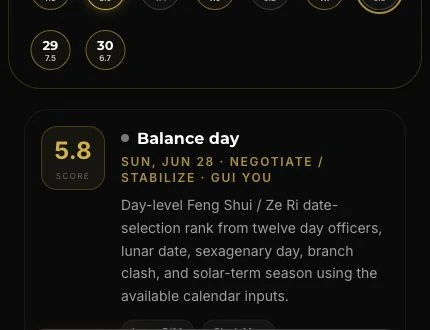
When a date needs interpretation, the chat entry point carries the selected day and system context instead of starting from a blank prompt.
Look for convergence only among relevant systems. If a retrograde flag appears beside a supportive Muhurta score, read both signals: the date may support beginning while still needing a communication or revision buffer.

Convergence is useful only among lenses that answer the same question; unrelated signals stay visible without being averaged in.
Finally, name any readiness gap. A strong date cannot review the contract, finish the launch plan, or make a relationship ready for a proposal. If the score looks good but the decision still feels wrong, determine whether the missing input is symbolic, emotional, or practical before moving the date.
A practical ordering when you feel stuck:
- Name the action: sign, launch, rest, celebrate, repair, propose, or commit.
- Select the one or two systems relevant to that action.
- Compare top days within those systems.
- Note convergence and read each disagreement instead of averaging it away.
- Check emotional and practical readiness separately.
- Choose the strongest workable date inside the window you actually have.
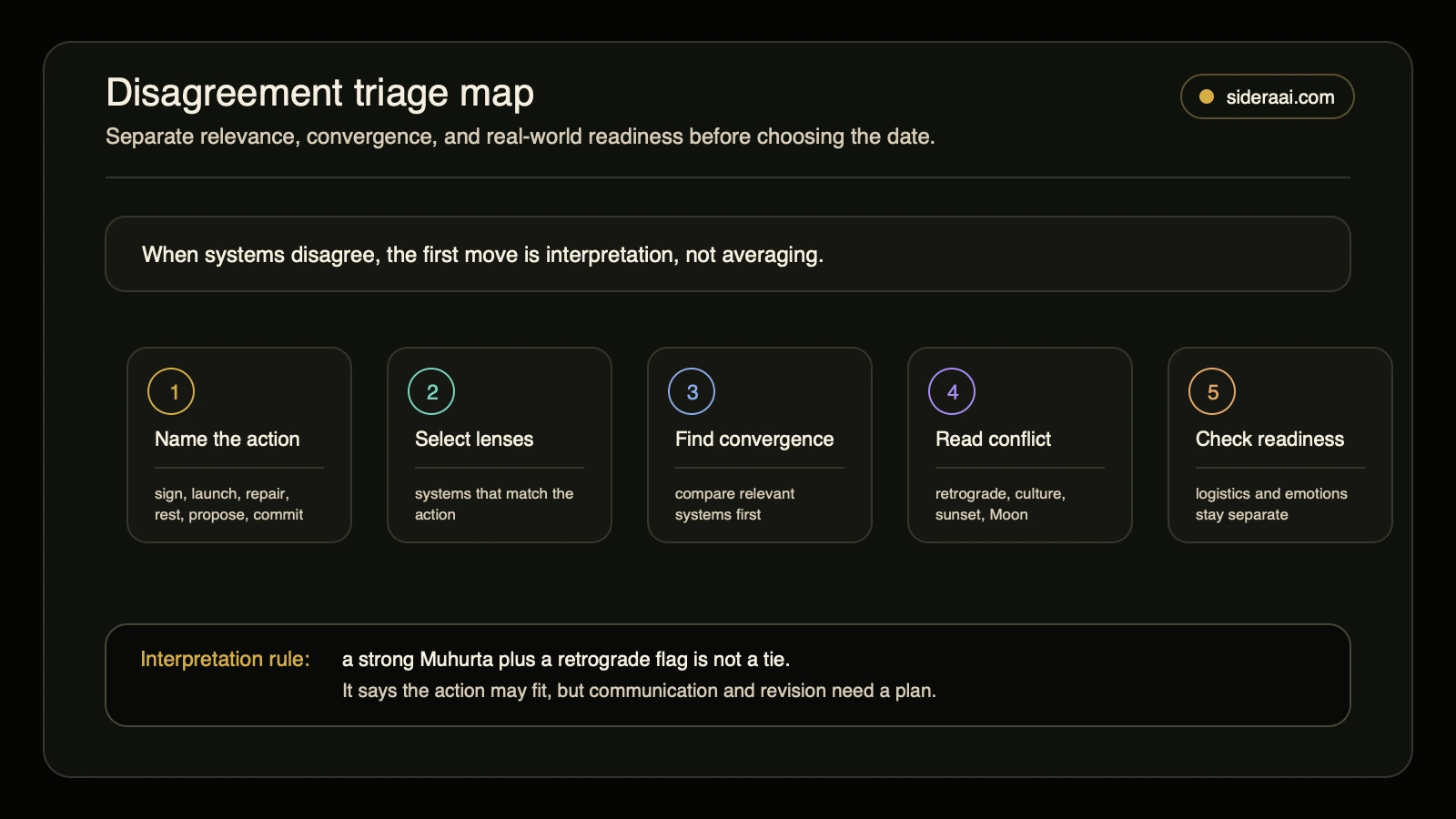
Use this triage map when the systems split. Relevance, convergence, and real-world readiness are separate decisions; averaging them hides the useful signal.
The Day Log: Testing Hypotheses, Not Confirming Predictions
Lucky Day Planner includes a local day log where you can mark energy, favorability, and fulfillment for any day. The log matters because it tests the gap between prediction and experience. A high method-confidence score means the calculation had enough input coverage; it does not mean the day will feel aligned for you.
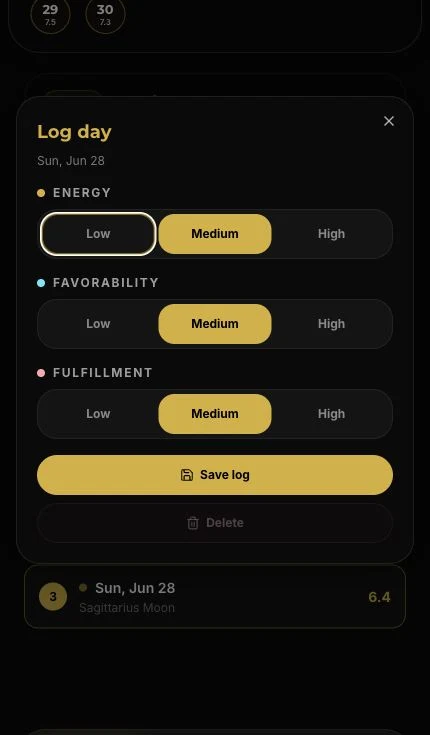
The log turns timing from a one-time prediction into a personal record of what actually happened.
Methodology note. Day-log patterns are hypotheses for personal observation, not outcomes the system already knows. Lucky Day Planner does not have access to your mood, energy, or relationship history. The personalized signals are inferred from chart data and backend scoring; the local calendar signals are reproducible but not personalized. The log is how you test which timing layers actually track your life over several weeks.

A timing hypothesis becomes personal evidence only when the same pattern survives repeated observation across real weeks.
Questions worth logging: which systems track your energy, which ones feel like background noise, whether relationship conversations correlate with Moon conditions, and whether method confidence corresponds to real-life resonance.
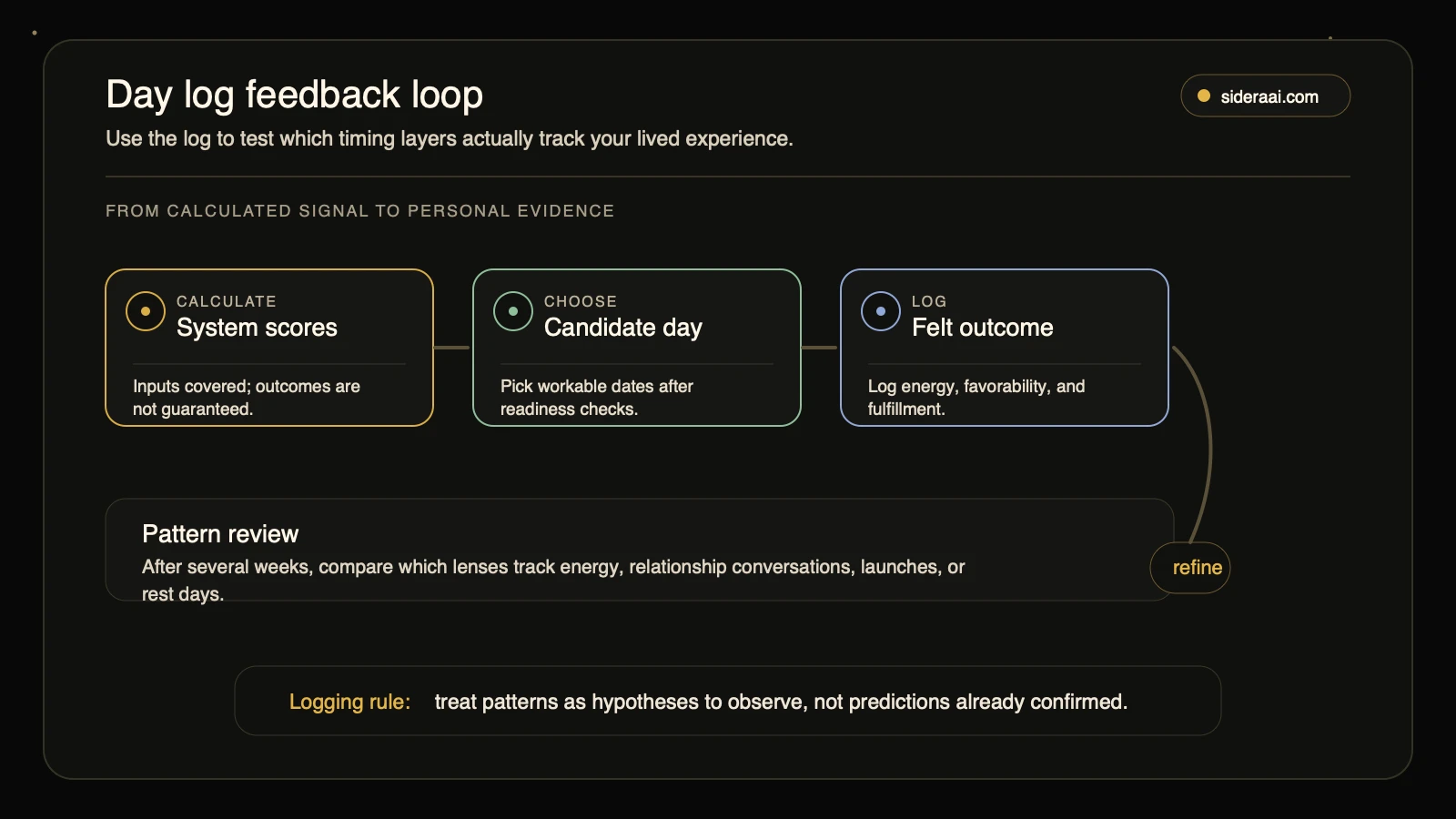
Use the log as a feedback loop, not proof. Repeated experience over several weeks is the signal that tells you which timing layers actually track your life.
A Next-Step Workflow for Your Next Real Date Decision
Use Lucky Day Planner as a filter on candidate dates you already have:
- Name the action clearly: launch, sign, propose, repair, rest, celebrate, or commit.
- Select only the timing systems relevant to that action.
- Review top-days first, then inspect the selected-day details.
- Look for convergence inside the relevant systems; do not average unrelated systems.
- Check whether the decision itself is ready before moving the date.
- Choose the strongest practical candidate in the window you actually have.
That is what comparative timing is for: a structured filter through lenses that are transparent about what they measure, not a verdict from above.
For users already using Sidera to navigate business launch timing, contract timing, and job interview timing, Lucky Day Planner is the next step: see the same day through seven lenses, understand what each one is measuring, and build a record of how calculated timing maps to your actual experience over time.