An AI astrology app is a mobile or web application that uses birth chart calculations, current transits, and artificial intelligence to turn astrological data into personalized interpretations. The useful version does more than tell you that your moon sign is sensitive or that Mercury retrograde is messy. It helps you understand what a pattern feels like in real life, where it shows up in love, work, conflict, and self-image, and what you can do with that information today.
That distinction matters because a lot of astrology apps still sound recycled. If a forecast says “big changes are coming” but cannot tell you whether that pressure is hitting your communication style, your relationship needs, your career timing, or your habit of avoiding hard conversations, it is not giving you much to work with.
A strong AI astrology app should help you leave with one clear sentence of recognition: “That is exactly what I do when I feel cornered, attached, ambitious, rejected, or uncertain.” Then it should give you one practical next step.
What a Useful AI Astrology App Should Actually Do
Most astrology apps can calculate a natal chart. The harder job is interpretation. A useful app should translate placements, houses, aspects, and transits into patterns you can recognize without drowning you in mystical filler.
Look for interpretation that moves through three layers:
- The placement or transit - What is being activated in the chart.
- The lived pattern - How that activation can show up in behavior, emotion, relationships, work, or decision-making.
- The practical reflection - What to notice, ask, choose, delay, initiate, or repair.
That progression is what separates insight from keyword content.
| Weak app output | Useful app output |
|---|---|
| “You are intense in love.” | “When you feel unsure of someone’s loyalty, you may test closeness instead of asking directly for reassurance.” |
| “Today is good for communication.” | “This is a better day for clarifying expectations than forcing a final answer.” |
| “You are ambitious.” | “You may tie competence to self-worth, which makes feedback feel more personal than it is.” |
| “Conflict is possible.” | “Notice whether you are protecting peace or avoiding the conversation that would create real repair.” |
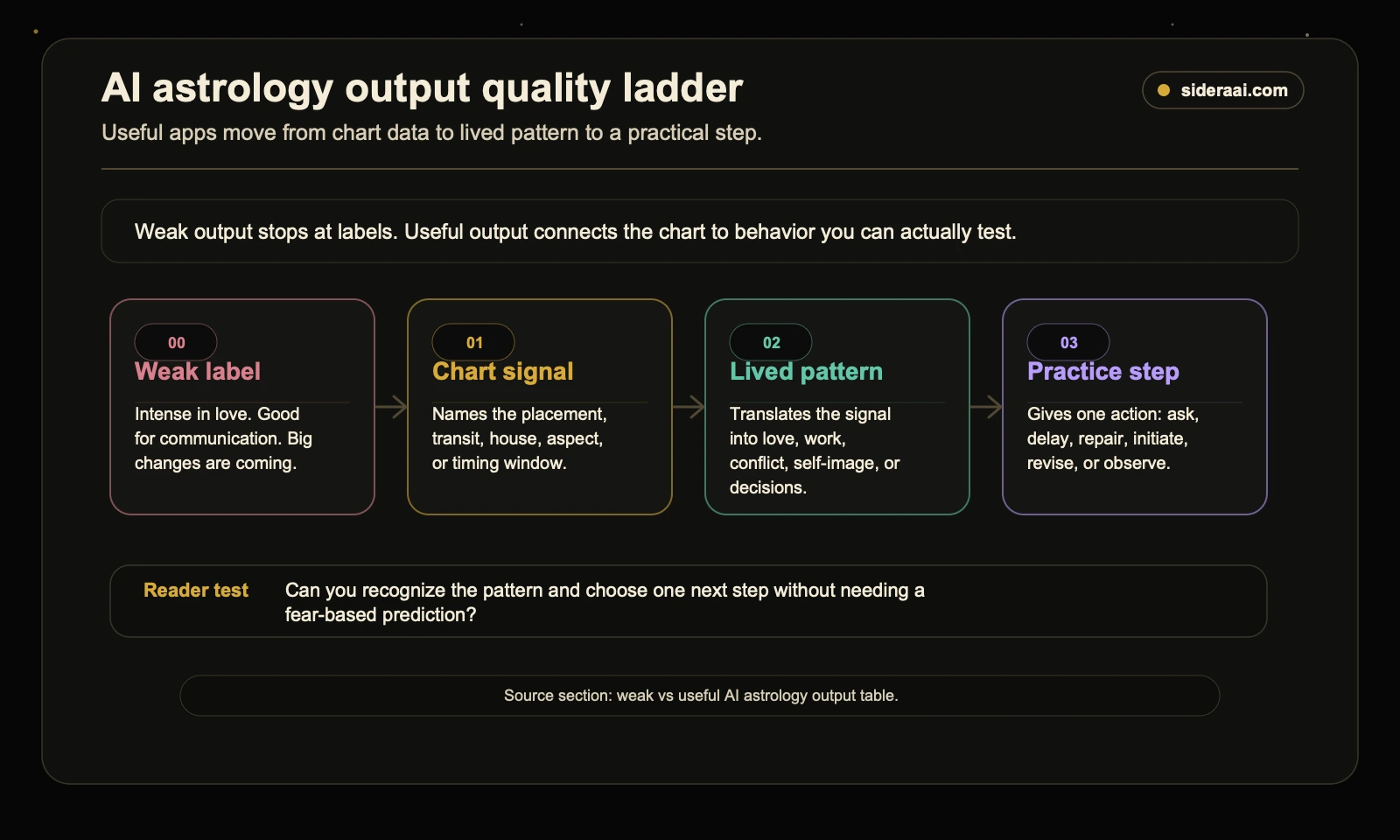
Use the ladder as a quick quality test: the app should move past a chart label into a recognizable lived pattern and one practical step.
The best AI astrology apps do not flatter you. They help you recognize a pattern clearly enough to make a different choice.
How AI Astrology Apps Work
Modern AI astrology apps usually combine four systems:
- Astronomical calculations for planetary positions, houses, aspects, and transits
- Birth chart logic that maps those calculations to astrological meaning
- Natural language processing that turns chart data into readable interpretation
- Personalization tools that adapt the reading to your full chart, current timing, and questions
Traditional astrology software often serves fixed text blocks: Venus in Taurus means this, Mars in Aries means that, and everyone with the same placement gets similar language. AI can go further by synthesizing multiple chart factors at once. For example, it can compare your natal moon, current lunar transits, relationship houses, and recent questions to create a more specific reading.
That does not automatically make every AI reading good. The quality depends on the chart engine, the interpretation framework, the writing model, and whether the app asks enough context to avoid vague answers.
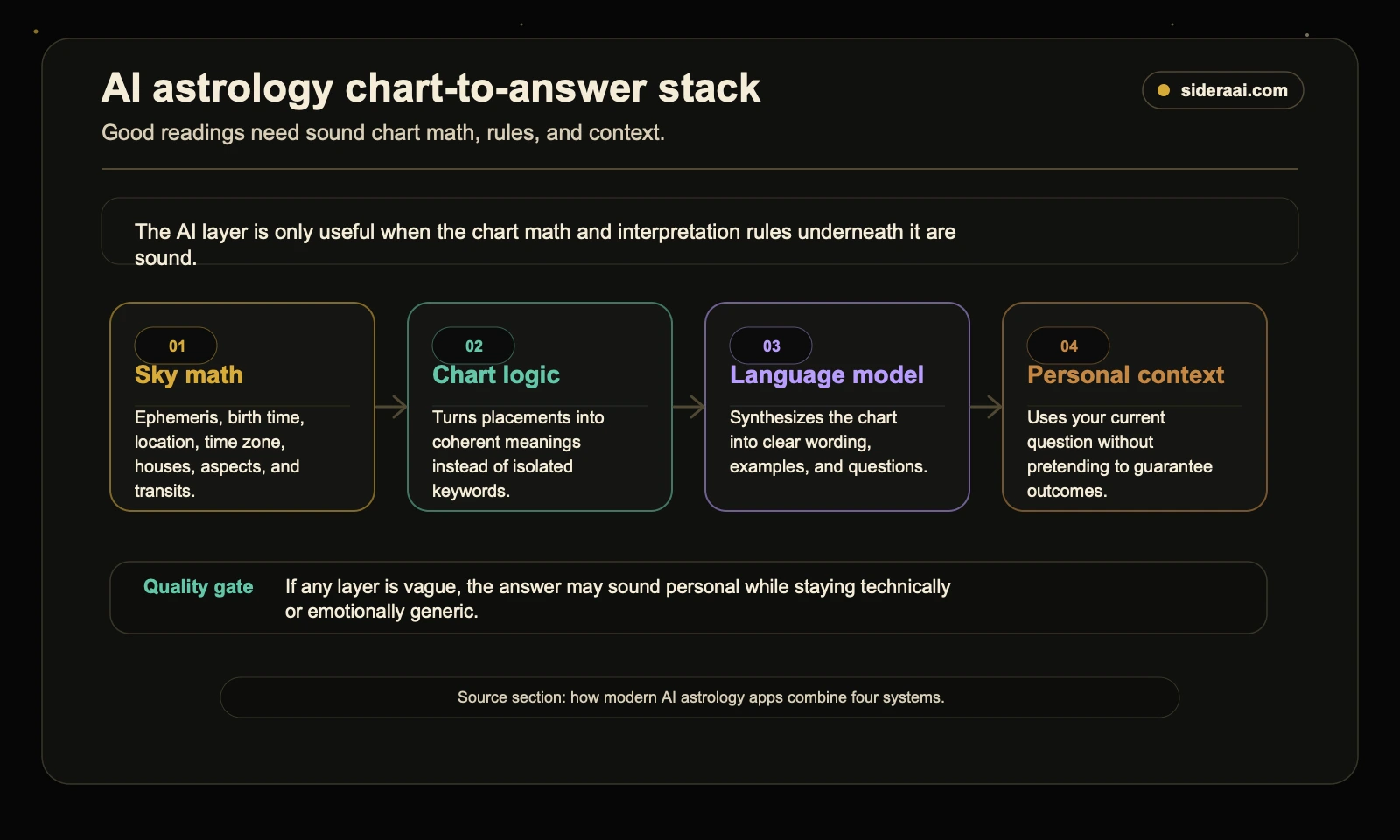
The stack shows why the AI layer is only as useful as the chart math, interpretation rules, and context underneath it.
Sidera uses your actual birth chart—not generic horoscopes.
Get personalized insights →Features That Matter Most
1. Complete Birth Chart Analysis
A serious AI astrology app should analyze the full natal chart, not just your sun sign. At minimum, it should include:
- Sun, Moon, and Rising signs for identity, emotional needs, and first response patterns
- Mercury, Venus, and Mars for communication, love, desire, conflict, and motivation
- Jupiter through Pluto for growth, pressure, transformation, and longer life themes
- House placements so you know which life area is being activated
- Aspects so the app can explain tension, ease, contradiction, and repeating patterns
Without houses and aspects, an app may tell you what a placement means but miss why it feels so specific in your life.
2. Real-Time Transit Tracking
Transits show how current planetary movement interacts with your birth chart. A good app should not simply announce that Mars is active or Venus is shifting. It should explain what that timing may ask from you.
Useful transit guidance sounds like this:
- “This is a high-friction day for reactive replies. Draft the message, then send it after you have cooled down.”
- “This week favors revising the plan, not proving that the old version still works.”
- “Relationship sensitivity is higher now, so name the need directly instead of making your partner guess.”
That kind of timing helps you plan, communicate, and regulate yourself. It should not make you feel like the planets are controlling your choices.
3. Electional Astrology and Planning
Electional astrology is the practice of choosing better timing for important actions. This is one area where AI can be genuinely useful because the calculations are complex and time-sensitive.
Look for planning features that help with:
- Best days to start a new business
- Launches, applications, proposals, and important first steps
- Difficult conversations where tone and timing matter
- Contract review windows, especially around Mercury retrograde
- Personal routines, creative work, and reflection periods
The practical value is not “this day is lucky.” It is knowing when a choice has more support, more friction, or more need for patience.
4. Relationship Compatibility
Relationship astrology should be more specific than a compatibility score. Scores can be entertaining, but they rarely explain the real work of being close to someone.
For synastry or compatibility, look for an app that can explain:
- Where attraction comes easily
- Where each person feels misunderstood
- How conflict styles differ
- What each person needs to feel safe
- Which patterns repeat when one person withdraws, pushes, tests, fixes, or overfunctions
A useful relationship reading might say, “One person seeks direct reassurance while the other protects themselves by becoming practical and quiet.” That gives both people something concrete to discuss. “80% compatible” does not.
Understand your connections on a cosmic level.
Explore your bonds →5. Shadow Work and Reflection Prompts
If an app includes shadow work, the prompts need to be specific enough that you can recognize yourself. “Release what no longer serves you” is too vague to be useful.
Better prompts sound like:
- “Where are you calling it independence when it is actually fear of needing someone?”
- “What feedback did you dismiss because it threatened your self-image?”
- “Where are you trying to be easy to love instead of being honest?”
- “What conflict are you avoiding because you do not want to be seen as demanding?”
Shadow work content should never shame you. It should name the behavior precisely, show the protective logic behind it, and give you a small way to practice something different.
6. Clear Boundaries and Healthy Use
An astrology app should support reflection, not dependency. Be cautious with apps that make absolute predictions, encourage obsessive checking, or frame every decision as something you need permission to make.
Healthy app design includes:
- Clear language that astrology describes patterns, not fixed outcomes
- Practical prompts instead of fear-based warnings
- Respectful handling of difficult transits
- Privacy clarity around birth data, relationship data, and personal questions
- Guidance that supports therapy, coaching, or professional advice when the topic requires it
Can AI Astrology Apps Be Accurate?
Accuracy has two parts: calculation accuracy and interpretation accuracy.
For calculations, AI astrology apps can be very strong when they use reliable ephemeris data and handle birth time, location, time zones, house systems, and daylight saving adjustments correctly. Your rising sign and house placements are especially sensitive to birth time, so exact birth data matters.
Interpretation accuracy is different. A reading feels accurate when it connects the chart to a real pattern in your life without becoming so broad that anyone could agree with it. The strongest apps give you language that is specific enough to test:
- Does this describe a behavior I actually repeat?
- Does it explain the emotional motive behind the behavior?
- Does it show how the pattern changes in love, work, conflict, or self-image?
- Does it give me a useful action or reflection instead of just a label?
If the answer is no, the app may be technically correct but emotionally generic.
How to Compare AI Astrology Apps
Use this quick scorecard before trusting an app with your daily reflection or paid subscription.
| Category | What to Check | Green Flag |
|---|---|---|
| Chart depth | Does it use the full chart? | Houses, aspects, transits, and personal planets are all included |
| Personalization | Does it adapt to your chart? | The reading combines multiple placements instead of repeating one trait |
| Real-life clarity | Does it describe behavior? | It explains love, work, conflict, self-image, or decision patterns |
| Timing | Does it help you plan? | It distinguishes good timing, friction, delay, review, and repair |
| Relationships | Does it go beyond scores? | It explains needs, triggers, conflict styles, and repair points |
| Tone | Does it respect your agency? | It avoids fear, fatalism, and vague spiritual filler |
| Privacy | Does it explain data use? | Birth data and personal questions are handled transparently |
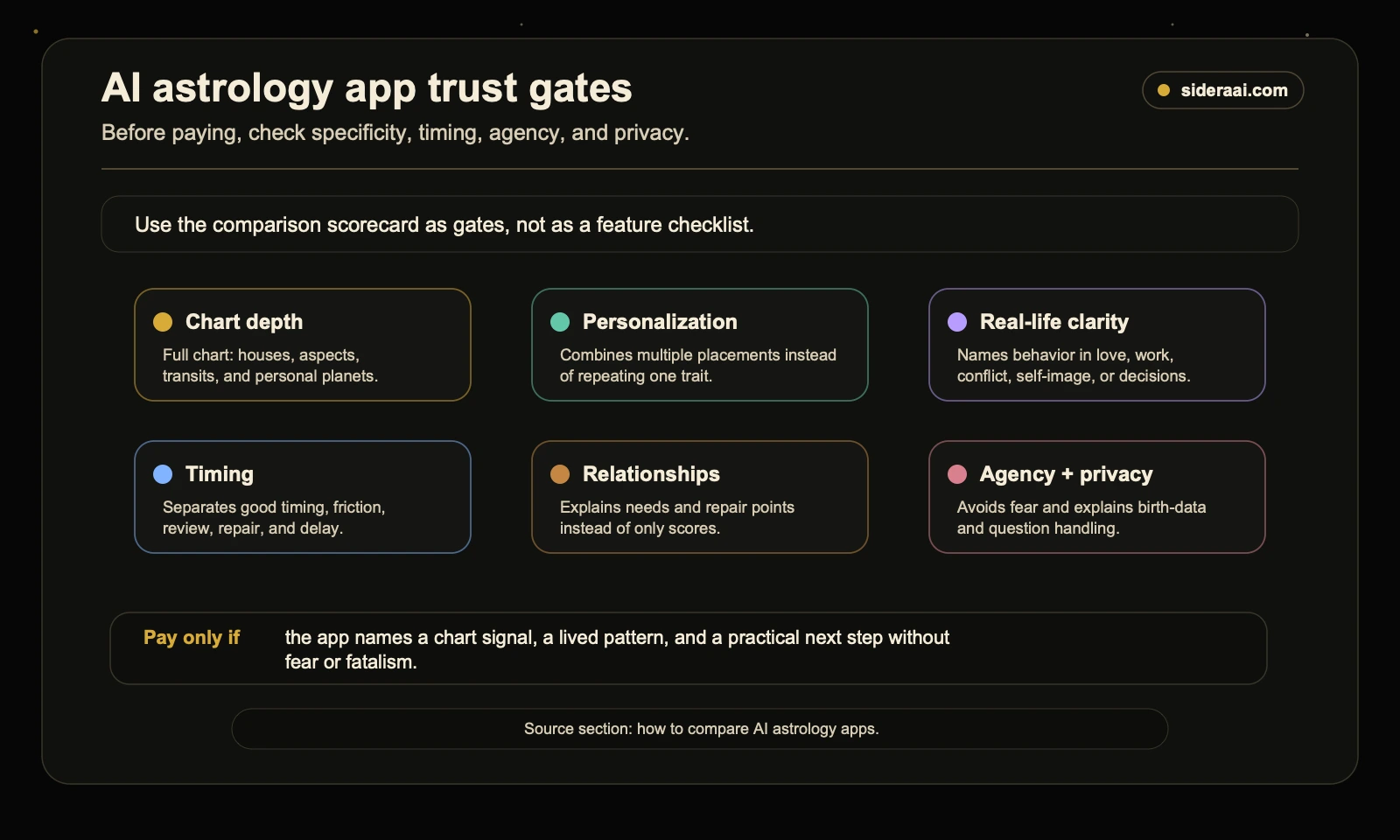
Treat the comparison categories as trust gates, not a feature checklist: pay only when the app can name a chart signal, lived pattern, and practical next step without fear or fatalism.
The fastest test: ask the app a question about a current pattern, not a broad personality label. For example, “Why do I shut down when someone needs an answer from me quickly?” or “What transit might explain why work feedback feels so personal this week?” If the answer stays abstract, keep looking.
How to Get Started
To get the most useful reading, enter your birth data carefully:
- Birth date - Day, month, and year
- Birth time - As exact as possible, especially for rising sign and houses
- Birth location - City and country, or the closest available location
Then start with one practical question. Do not begin with “tell me everything about my chart.” That usually produces a long reading that feels impressive but is hard to use.
Better first questions include:
- “What emotional pattern should I pay attention to this week?”
- “Where does my chart show defensiveness in conflict?”
- “What should I understand about my relationship needs?”
- “Is this a good window for launching, revising, or waiting?”
- “What is one behavior I can practice based on today’s transits?”
The point is not to outsource your decisions. It is to see the pattern with enough clarity that your next decision becomes more honest.
Find your perfect moment with AI-powered electional astrology.
Discover your timing →Frequently Asked Questions
Q: Are AI astrology apps accurate? A: They can be accurate for chart calculations when birth data and time zone handling are correct. Interpretation accuracy depends on whether the app connects your chart to specific emotional patterns, behavior, timing, and practical reflection.
Q: How is an AI astrology app different from reading my horoscope online? A: Generic horoscopes usually apply the same message to everyone with the same sun sign. A good AI astrology app uses your full birth chart, current transits, and sometimes your questions to create a more personal interpretation.
Q: Do I need my exact birth time? A: Exact birth time matters most for your rising sign and house placements. You can still learn from planets by sign without it, but timing and life-area interpretation become less precise.
Q: Can AI predict my future? A: No app can guarantee a specific outcome. AI astrology can describe timing themes, pressure points, and likely areas of focus, but your choices, context, and circumstances still matter.
Q: Are AI astrology apps expensive? A: Many apps offer free chart basics and paid subscriptions for deeper readings, transit tracking, or relationship tools. The better question is whether the app gives you specific, useful interpretation often enough to justify paying.
Q: Can AI analyze relationship compatibility? A: Yes, many AI astrology apps can compare two charts through synastry or composite chart features. The most useful ones explain emotional needs, conflict patterns, and repair points instead of relying only on compatibility scores.
Q: How often should I check my AI astrology app? A: Daily check-ins can be useful for reflection and timing, but the app should not become a source of constant reassurance. Use it to notice patterns, plan intentionally, and make more conscious choices.
Sidera is built for astrology readers who want practical, emotionally accurate interpretation: birth chart insight, relationship patterns, and timing guidance without vague horoscope filler.
Related Sidera Guides
Continue with these closely related guides: