What the 12 Houses Actually Show You
The 12 houses are where a birth chart stops being a list of traits and starts describing your lived patterns. A busy 7th house can feel like every relationship turns into a mirror. A loaded 10th house can make career choices feel tied to self-respect, not just ambition. A sensitive 4th house can make home, family, and emotional safety shape everything else.
That is why house meanings matter: they show where you seek safety, where you overcompensate, where conflict repeats, and which life areas ask for more conscious choices.
As you read, do not stop at keywords. Ask:
- Love: Which houses describe how you attach, pursue, withdraw, or negotiate?
- Work: Where do you try to prove your value, avoid visibility, or need stronger routines?
- Conflict: Which life area gets defensive when you feel unseen, unsafe, or out of control?
- Self-image: Which house describes the story you keep telling about who you are?
Ready to See Your Personal Birth Chart?
Discover your unique cosmic blueprint — planets, houses, and aspects personalized to your exact birth time and location.
Get Your Birth Chart →✓ Birth chart analysis ✓ Personalized insights ✓ Free to use
Introduction
If you’ve ever opened your birth chart and felt like the wheel gave you labels without life context, the houses are the missing layer. They show where a placement actually lands: love, money, home, daily work, visibility, friendship, solitude, and the private habits you may not notice until they repeat.
Here’s the key thing most astrology beginners miss: your houses aren’t fixed to the same signs everyone else has. Two people born on the same day can have completely different house placements if they were born in different cities or at different times. That’s why someone with the same Sun sign as you can have a very different life path. Your houses diverge based on your exact birth moment.
In this guide, you’ll learn what the 12 houses of astrology mean, how the zodiac sign on each house cusp changes the way that life area expresses for you specifically, and how to use house placements for clearer reflection, relationship insight, and decision-making.
What Are the 12 Houses of Astrology?
Your birth chart is a 360-degree circle divided into 12 slices. Those slices are the houses. Each house governs a specific area of life, from your personal identity all the way through to your spirituality and hidden motivations.
Unlike the 12 zodiac signs (which are fixed divisions of the sky based on the Sun’s annual path) or planets (which move and change positions constantly), the houses are tied to the Earth’s rotation. They’re calculated using your exact birth time and location.
As Steven Forrest writes in The Inner Sky (1984): “Signs describe the character of your voyage, planets name the crew, but houses reveal the destinations.” In other words, signs and planets describe who you are. Houses show where that energy lands in your actual life.
Birth time precision matters enormously here. A 4-minute error in your recorded birth time shifts the Ascendant by approximately 1 degree, which can move sensitive planets to a different house entirely and misread your chart. If you’re serious about houses, tracking down your accurate birth certificate is worth the effort.
The houses always count from 1 to 12 in counterclockwise order in your chart. They start from the Ascendant, the zodiac sign rising on the eastern horizon at the exact moment of your birth. The Ascendant is always the beginning of your First House.
The Two Key Elements of Any House
To understand any house in your chart, you need two things:
- The house’s natural life area (relationship, career, money, etc.): the same for everyone
- The sign on the house cusp: personal to you; changes how that life area expresses
This is the part most beginners skip. They read that “the 7th house is about relationships” and stop there. But if Sagittarius is on your 7th house cusp, your relationships have a very different flavor than someone with Cancer on their 7th house. The house shows WHAT life area. The sign shows HOW that area operates for you personally.
You can read more in our 12-house astrology explainer, including how each house maps to a distinct life area and why house choice matters for accuracy.
How to Find Your Houses
The simplest way is to calculate your birth chart using your birth date, time, and location. Your chart will show the sign on each house cusp.
If you don’t know your birth time, you can still use houses. Astrologers often use a noon chart or solar chart in that case. But your house placements won’t be as accurate. Birth time matters more for houses than for any other chart element. Our guide to reading a birth chart for beginners walks through the process in detail.
A note on house systems: Whole Sign houses, the oldest documented system (in use since the Hellenistic period, roughly the 1st century BCE), assigns one entire zodiac sign to each house, making the house cusp always 0° of a sign. Placidus, the modern default in most software, uses time-proportional divisions that produce unequal house sizes. Whole Sign is simpler for beginners; Placidus is more widely used in the West. See our sidereal astrology calculator for charts that default to Whole Sign houses.
The 12 Houses: Life Areas at a Glance
Here’s a quick overview of what each house governs:
| House | Life Area | Natural Sign | Natural Ruler |
|---|---|---|---|
| 1st | Identity, appearance, first impressions | Aries | Mars |
| 2nd | Money, values, possessions | Taurus | Venus |
| 3rd | Communication, siblings, local travel | Gemini | Mercury |
| 4th | Home, family, roots, inner life | Cancer | Moon |
| 5th | Creativity, romance, children, play | Leo | Sun |
| 6th | Work, health, daily routines, service | Virgo | Mercury |
| 7th | Partnerships, marriage, one-on-one relationships | Libra | Venus |
| 8th | Transformation, death, shared resources, depth | Scorpio | Pluto/Mars |
| 9th | Travel, philosophy, higher education, belief | Sagittarius | Jupiter |
| 10th | Career, public life, reputation, ambition | Capricorn | Saturn |
| 11th | Community, friendships, goals, collective | Aquarius | Uranus/Saturn |
| 12th | Spirituality, isolation, hidden matters, karma | Pisces | Neptune/Jupiter |
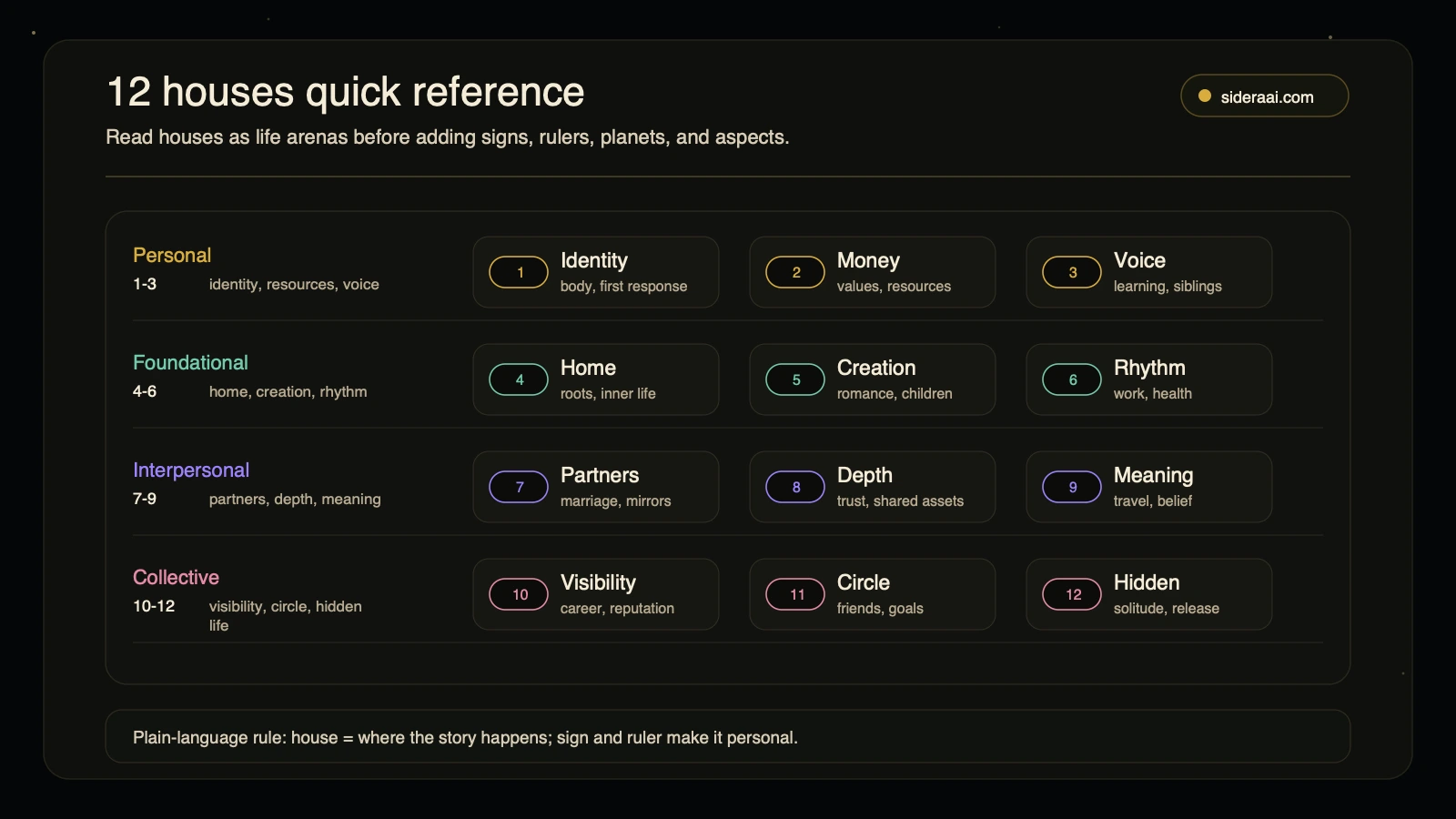
Use this reference to locate the life area first, then add the sign, ruler, planets, and aspects.
Sidera uses your actual birth chart—not generic horoscopes.
Get personalized insights →How the Sign on Your House Changes Its Meaning
This is the most underexplained concept in beginner astrology.
The house tells you WHAT life area is active. The sign on the cusp tells you HOW that area operates: the style, approach, and energy you bring to it. And the planet that rules that sign (called the “house ruler”) shows WHERE the energy of that house is directed in your chart.
As Dane Rudhyar explains in Astrological Houses: The Spectrum of Human Experience (1972): “The houses are fields of experience through which the soul develops and expresses its potential.” Each field has its own character. But the sign on the cusp is what makes it personal to you.
Examples: The Same House, Different Signs
7th House (Partnerships)
- Aries on 7th house: You’re attracted to bold, assertive partners. Relationships start fast and intensely. You may learn a lot about your own identity through how you relate to others. Mars rules this house for you.
- Cancer on 7th house: You seek emotionally secure, nurturing partners. Home and family are central to your relationships. The Moon rules this house. Check where your Moon sits for more insight.
- Capricorn on 7th house: You’re drawn to stable, ambitious, reliable partners. Relationships may start slowly but are built to last. Saturn rules this house. Your relationship karma often involves maturity and responsibility.
The house (7th) stays the same for everyone. The sign makes it uniquely yours. Learn more about your rising sign and what it reveals about your 1st house, and how sun, moon, and rising signs interact with your house placements.
10th House (Career and Reputation)
- Gemini on 10th house: Your career involves communication, multiple roles, or writing. You’re known for intellectual versatility. Mercury rules this house.
- Scorpio on 10th house: You’re known for intensity, investigative ability, or transformation-focused work. You may have a powerful or somewhat mysterious public reputation. Pluto/Mars rules this house.
- Pisces on 10th house: Your career connects to creativity, healing, or spirituality. You may be known for compassion or imaginative work. Neptune/Jupiter rules this house.
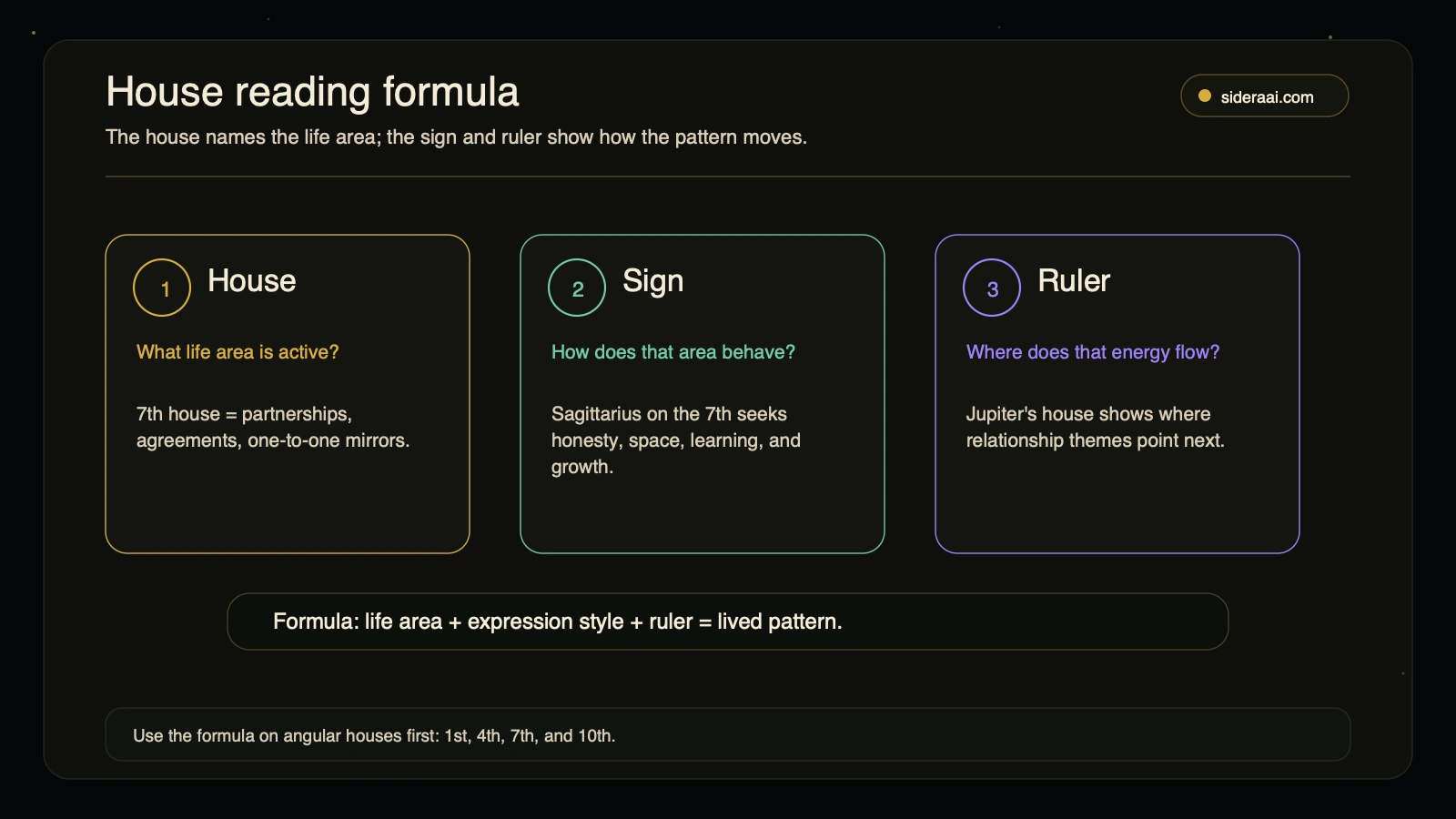
Use this formula when a house meaning feels too generic: the house gives the life area, the sign gives the style, and the ruler shows where the pattern flows.
How Houses Show Up in Love, Work, Conflict, and Self-Image
House meanings get more useful when you translate them into behavior. Start with the life area, then ask how it shows up when you are secure, stressed, attached, or trying to protect yourself.
| Life question | Houses to check | What to look for in real life |
|---|---|---|
| Love and attachment | 5th, 7th, 8th | How you pursue romance, what you expect from partnership, and how you handle trust, jealousy, vulnerability, or shared resources |
| Work and direction | 2nd, 6th, 10th, 11th | What makes you feel useful, how you build routines, how visible you want to be, and what communities or networks support your goals |
| Conflict patterns | 1st, 3rd, 4th, 8th, 12th | Whether you fight for autonomy, argue over tone or facts, protect old wounds, test loyalty, or disappear when overwhelmed |
| Self-image | 1st, 2nd, 10th, 12th | How you see yourself, where self-worth gets tangled with performance, and which parts of you stay hidden or hard to name |
For example, a tense 8th house pattern may not just mean “transformation.” In daily life, it can look like checking whether people are safe before you fully relax, feeling exposed around money or intimacy, or using control when what you really need is trust. A strong 6th house is not just “routine.” It may show how quickly your confidence rises or falls based on whether your day has structure.
Understand your connections on a cosmic level.
Explore your bonds →The 12 Houses as a Cycle of Human Experience
The 12 houses form a complete cycle, moving from the individual self outward to the collective and finally to transcendence.
Houses 1-3 (Personal, Self-Oriented): Who you are, what you value, how you think
Houses 4-6 (Foundational, Relational): Where you come from, how you express yourself, how you contribute
Houses 7-9 (Interpersonal, Outward): How you relate to others, shared resources, expanding your worldview
Houses 10-12 (Social, Collective, Transcendent): Your public life, your community, your spiritual dissolution back into the whole
This is why the 12th house, the last one, is associated with endings, isolation, and the spiritual surrender of individual identity. It’s the culmination of the entire cycle before everything resets at the 1st house.
Which Houses Matter Most?
Not all 12 houses carry equal weight in how your life unfolds. Astrologers organize houses into three groups:
Angular Houses (1st, 4th, 7th, 10th): These are the most powerful. Planets placed here are highly visible, active, and impactful. The 1st, 4th, 7th, and 10th houses mark the four angles of the chart and correspond to the four cardinal directions.
Succedent Houses (2nd, 5th, 8th, 11th): These support and build on the angular houses. Planets here have stable, accumulative energy. They consolidate resources, build skills, or create long-term results.
Cadent Houses (3rd, 6th, 9th, 12th): These houses are about information, service, and preparation. Planets here are more internalized and can sometimes struggle to express outwardly. But they provide depth, skill, and wisdom.
If most of your planets cluster in angular houses, you’re built for visible impact and action. The growth question is whether you are using that visibility deliberately or reacting to pressure. If they concentrate in cadent houses, you may be more of a behind-the-scenes contributor or a lifelong learner. The practical challenge is translating insight into habits, conversations, and decisions other people can actually see.
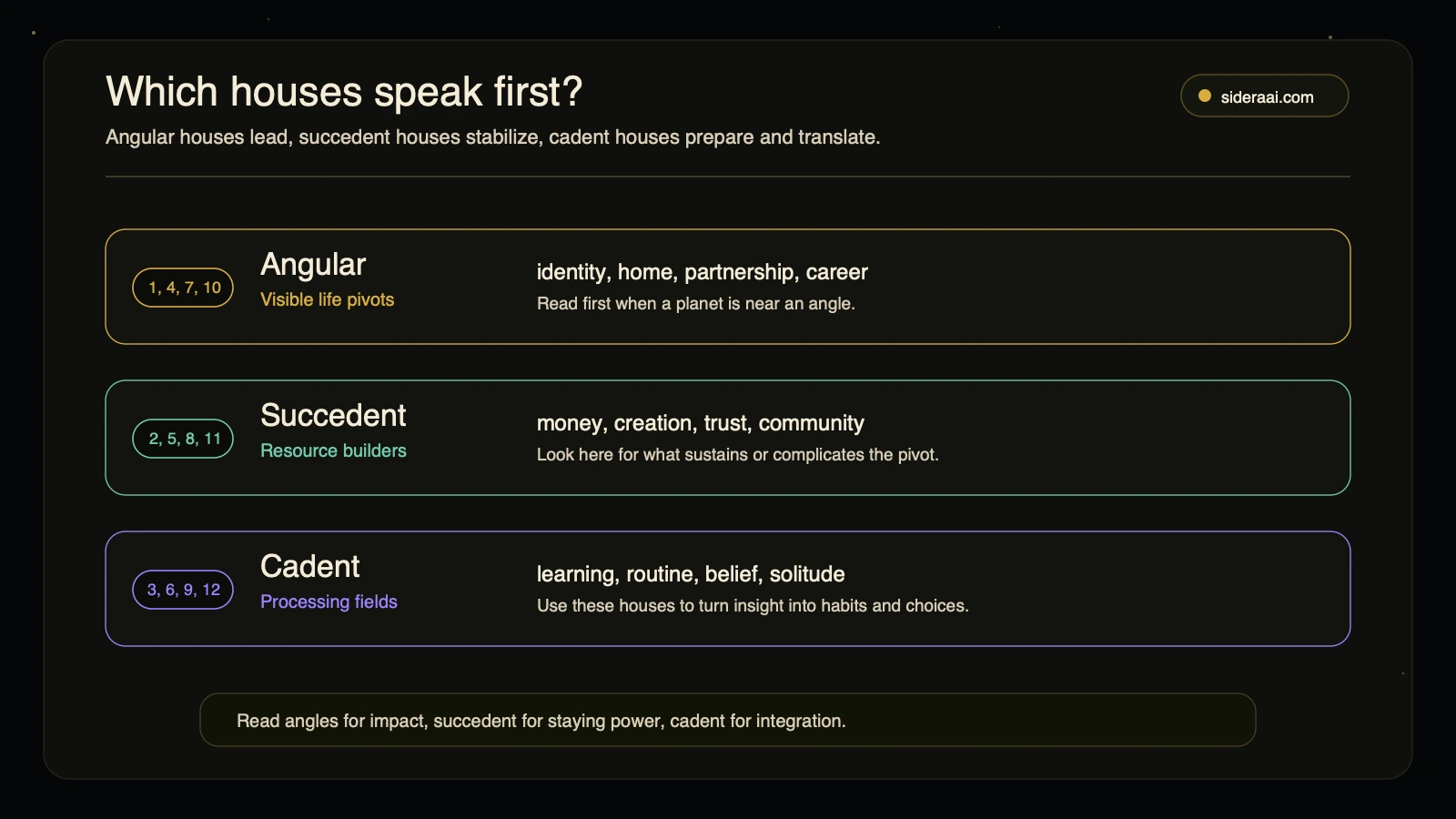
Use this priority map to decide which house placements to read first when a chart feels crowded.
See how planets in your chart interact with each other through aspects (conjunctions, squares, trines) across houses to build a complete picture.
Empty Houses: What They Mean
Most birth charts have several empty houses. With 10 traditional planets and 12 houses, at least 2 houses will always be empty, and most people have 4 to 7 empty houses. This is completely normal.
An empty house doesn’t mean that life area is inactive or unimportant. It simply means:
- You have more freedom and fewer karmic pressure points in that area
- The sign on the cusp still governs HOW that area operates
- The ruling planet of that sign (the house ruler) shows where that area’s energy flows
For example: An empty 5th house with Leo on the cusp still shows creativity and romance as a life theme. But it’s ruled by the Sun. Find where your Sun is in the chart to understand how you pursue creative expression and romance.
In real life, an empty house often feels less loaded until a transit, relationship, job change, or major decision activates it. You may not think much about 9th house themes until you move abroad, return to school, or question a belief system. Empty does not mean absent. It means the story usually enters through the house ruler or timing triggers.
Stelliums: When Multiple Planets Share a House
A stellium is three or more planets in the same house. If you have a stellium, that house becomes a major focal point of your life. The life area it governs gets amplified, complicated, and deeply significant.
Common stellium placements and their effects:
- Stellium in 1st house: Identity is a central theme. You may feel pushed to define yourself clearly, but the shadow is becoming overly self-protective or hard to influence.
- Stellium in 7th house: Relationships dominate your life experience. You may learn yourself through partners, but the shadow is outsourcing self-worth to someone else’s reaction.
- Stellium in 10th house: Career and public reputation are major life themes. You may be built for achievement, but the shadow is confusing being respected with being emotionally secure.
- Stellium in 12th house: Inner life, spirituality, or hidden matters are deeply significant. You may have deep intuition, but the shadow is disappearing, avoiding support, or carrying pain in private.
House Rulers: The Hidden Thread
Once you know the sign on each house cusp, you can find the house ruler, the planet that rules that sign. This planet becomes the “ambassador” of that house, carrying its themes throughout the chart wherever it sits.
For example: If Sagittarius is on your 6th house cusp (work and health), Jupiter rules your 6th house. If Jupiter sits in your 2nd house (money), this suggests that your work and health approach connects strongly to your finances. Perhaps you expand income through health-related work, or find that work quality affects your self-worth.
This technique, tracing house rulers to find cross-chart connections, is one of the most powerful tools in chart interpretation. For a deeper breakdown of individual house meanings, our complete guide to the 12 astrology houses covers each house in detail.
Your Chart Ruler: The Single Most Important Planet
Here’s a concept almost no beginner guide covers clearly: the planet that rules your 1st house sign is called your chart ruler, and it’s the single most important planet in your entire birth chart.
Why? Because your 1st house is you: your identity, your body, your approach to life. Whatever planet rules that house governs the whole chart.
Here’s how to find yours:
| Ascendant (Rising Sign) | Chart Ruler |
|---|---|
| Aries rising | Mars |
| Taurus rising | Venus |
| Gemini rising | Mercury |
| Cancer rising | Moon |
| Leo rising | Sun |
| Virgo rising | Mercury |
| Libra rising | Venus |
| Scorpio rising | Pluto (traditional: Mars) |
| Sagittarius rising | Jupiter |
| Capricorn rising | Saturn |
| Aquarius rising | Uranus (traditional: Saturn) |
| Pisces rising | Neptune (traditional: Jupiter) |
Once you know your chart ruler, find the house it occupies. That house describes the area of life where your chart’s primary energy is directed.
Example: Gemini rising = Mercury as chart ruler. If Mercury sits in your 9th house (philosophy, travel, higher education), your life is fundamentally oriented around learning, publishing, or exploring ideas. You are, at your core, a seeker of knowledge.
Example: Cancer rising = Moon as chart ruler. If your Moon is in the 4th house (home and family), home life and your roots are the central anchor of your chart. How you feel about home affects everything else.
This is why two people with the same Sun sign can live completely different lives: their rising signs and chart rulers differ, directing the same solar energy through completely different houses.
Check your rising sign and what it reveals about your chart. Today’s Aries daily horoscope, Scorpio daily horoscope, and Libra daily horoscope show how current planetary transits activate your house themes in real time.
A Practical Three-Step Formula for Reading Any House
Once you know the concept, here’s how to apply it to any house in your chart:
Step 1: Identify the life area. Use the quick-reference table above. The 7th house is relationships. The 10th house is career.
Step 2: Note the sign on the cusp. This tells you the style, approach, and energy of that life area for you. Sagittarius on the 7th = expansive, independent relationships. Saturn energy on the 10th = slow, serious career builds.
Step 3: Find the house ruler. The planet ruling that sign is the house ruler. Check what house IT sits in. That cross-connection reveals a hidden link between two life areas in your chart.
Apply this three-step sequence to your angular houses first (1st, 4th, 7th, 10th) and you’ll have the core of your chart mapped in under an hour. Then turn one insight into an action: start a clearer conversation, protect a routine, name a boundary, or make one decision that matches the life area your chart keeps emphasizing.
Plan your life around the stars, not just the calendar.
Start planning →Frequently Asked Questions
What are the 12 houses in astrology? The 12 houses in astrology are 12 divisions of your birth chart, each governing a specific area of life. They run from personal identity (1st house) through finances, relationships, career, and spirituality (12th house). They’re calculated from your birth time and location, making them the most personalized part of your chart.
How do I find my houses in astrology? You need your birth date, exact birth time, and birth location. Enter these into any birth chart calculator and your chart will show the zodiac sign on each house cusp. Knowing your Ascendant (the sign on your 1st house cusp) is the starting point for reading all 12 houses.
What does it mean if a house is empty? An empty house simply means no planets are placed there at your birth. It doesn’t indicate that life area is unimportant. The sign on the cusp and the planet ruling that sign still describe how you approach that life area. Most people have 4-7 empty houses.
Which house is most important in astrology? The angular houses, 1st, 4th, 7th, and 10th, are generally considered the most influential because planets placed there are highly active. The 1st house (Ascendant) and 10th house (Midheaven) are most frequently cited as the chart’s two most powerful points.
What is the difference between a house and a zodiac sign? Zodiac signs describe archetypes and personality styles shared by everyone born under them. Houses describe specific life areas (relationships, career, money) that are personal to you based on your birth time and location. Signs travel through all 12 houses in 24 hours as the Earth rotates. Your houses are a snapshot of which sign was in each position at your exact birth moment.
Does everyone have the same 12 houses? Everyone’s chart has 12 houses, but different zodiac signs appear on each person’s house cusps. Your 7th house could have Aries on the cusp while someone else’s has Scorpio. The house (partnerships) is the same, but its character is very different.
What is a chart ruler and why does it matter? Your chart ruler is the planet that rules the sign on your 1st house cusp (your Ascendant). It’s the most important planet in your entire chart because it governs your identity and overall life orientation. The house your chart ruler occupies shows the primary life area your chart energy flows into.