
Introduction
The 12 houses explain why the same planet can feel completely different from one person to the next.
Mars in your Seventh House may show up as conflict patterns in relationships: attraction to direct people, quick arguments, or a need to fight for fairness. Mars in your Fourth House may feel private and protective: tension at home, strong family loyalty, or anger that comes out when your safety is threatened. Same planet, different life arena.
That is what houses do. They move astrology out of vague personality keywords and into real behavior: how you love, work, argue, spend money, protect yourself, seek belonging, and avoid discomfort.
If you’ve ever looked at your birth chart and felt overwhelmed by all the lines, symbols, and numbers, the houses are the practical entry point. They show where the action unfolds in your actual life: career and reputation, money and self-worth, dating and commitment, home and family, health and daily habits, shadow work and emotional repair.
In this guide, you’ll learn what each of the 12 astrology houses means, how houses differ from signs and planets, and how to read them in a way that gives you something useful to reflect on instead of another recycled chart keyword.
Ready to See Your Personal Birth Chart?
Discover your unique cosmic blueprint — planets, houses, and aspects personalized to your exact birth time and location.
Get Your Birth Chart →✓ Birth chart analysis ✓ Personalized insights ✓ Free to use
What Are the 12 Houses in Astrology?
Think of your birth chart as a time-and-place map of the sky at the exact moment you were born. The 12 houses divide this 360-degree circle into 12 slices, each representing a different area of your life.
Unlike zodiac signs (which are based on the Sun’s yearly journey through the ecliptic) or planets (which move through the sky at varying speeds), the houses are fixed to the Earth’s rotation. They’re calculated based on your exact birth time and location, which is why two people born on the same day in different cities can have completely different house placements.
The houses rotate counterclockwise starting from the Ascendant (or Rising sign) - the eastern horizon at your birth moment. This is why your birth time matters so much in astrology. Even a 4-minute difference can shift planets between houses.
Use this simple formula:
- Planet: what part of you is active
- Sign: how that energy expresses
- House: where it shows up in real life
If a chart interpretation does not tell you where the pattern appears, it usually stays abstract. The house gives the interpretation a place to land.
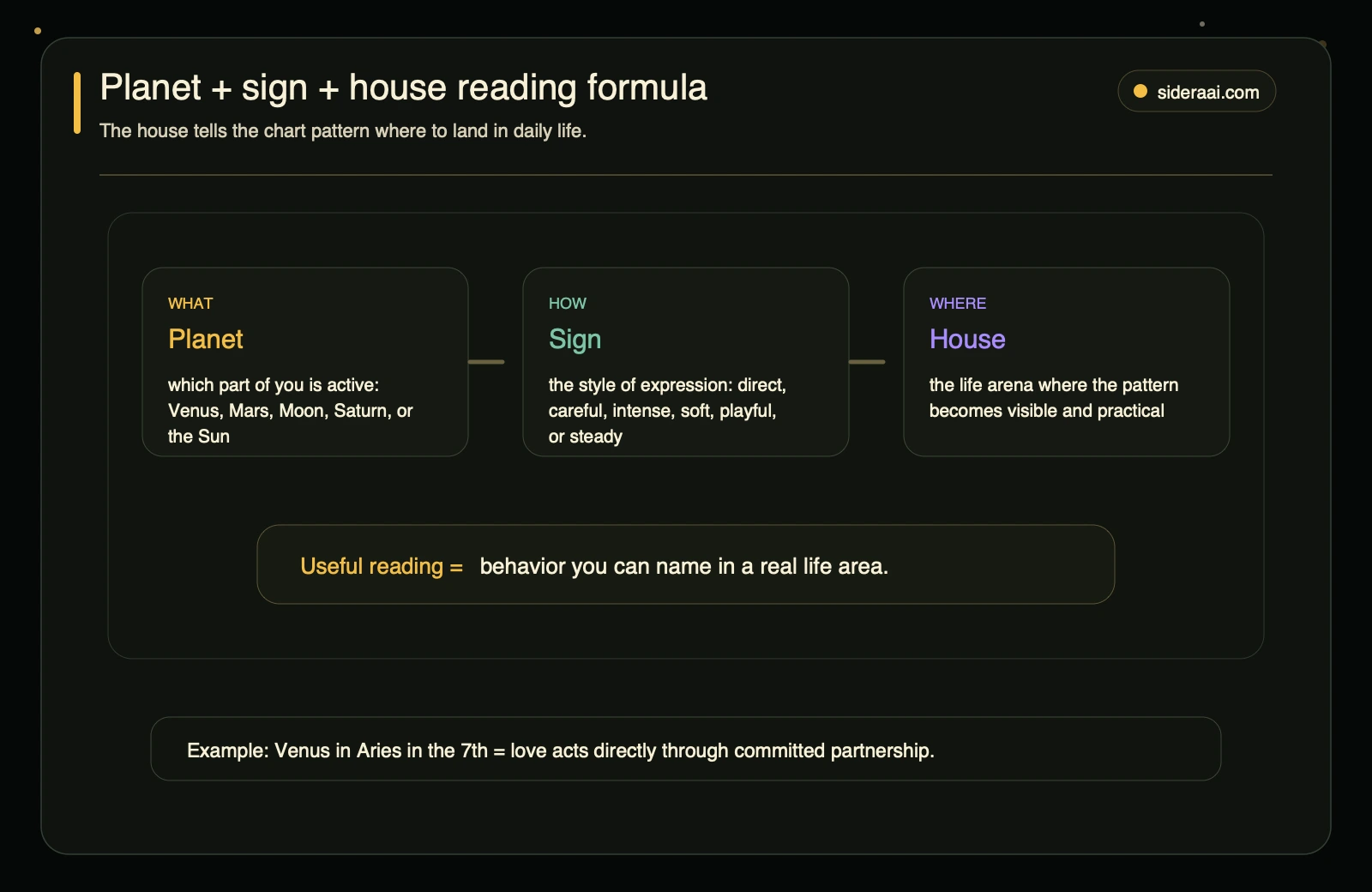
Use the planet-sign-house formula to turn a placement into behavior you can name: the planet shows what is active, the sign shows how it moves, and the house shows where it lands.
The 12 Houses: Complete Guide
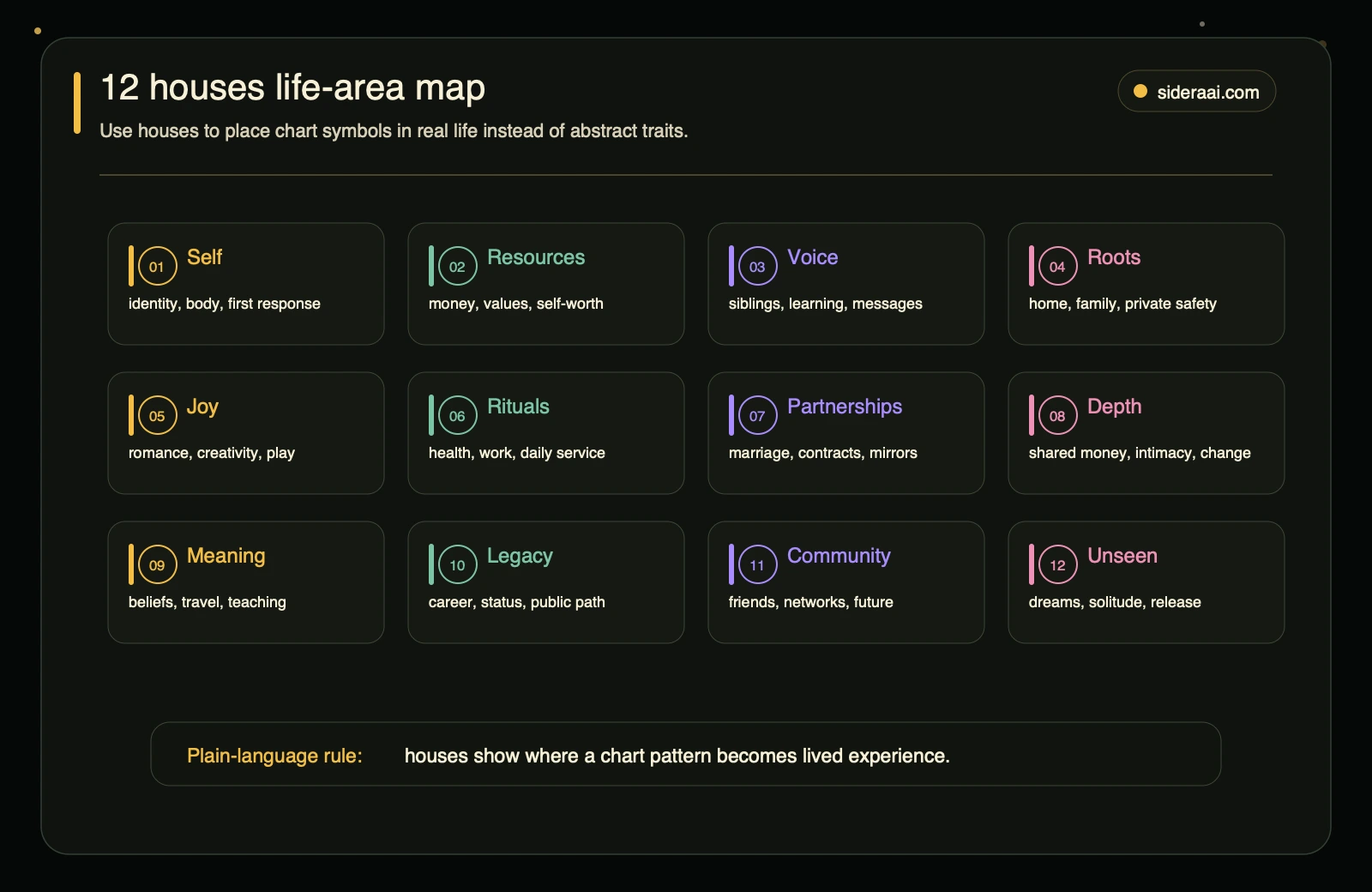
Keep this map beside the full guide: houses make a chart practical by showing the life area where each symbol becomes lived experience.
First House: The Self & Identity
Keywords: identity, appearance, first impressions, self-expression, vitality
Natural Ruler: Mars
Natural Sign: Aries
The First House is your chart’s introduction card. It rules how you present yourself to the world, your physical appearance, body type, and your immediate reactions to life. Your Ascendant (Rising sign) is always the beginning of the First House, making it one of the “Big Three” in astrology alongside your Sun and Moon signs.
Planets in the First House are highly visible in your personality. Someone with Venus in the First House often has natural charm and beauty, while Mars here creates a bold, assertive presence - think of Aries energy expressing through your entire persona.
Empty First House? You still have an Ascendant sign that colors this area. Empty houses simply mean there is less concentrated planetary emphasis in that life area.
Real-life pattern: First House placements are hard to hide. They show up in your facial expressions, pace, posture, first reactions, and the version of you people meet before they know your story. The shadow is mistaking your immediate defense for your whole identity.
Second House: Resources & Self-Worth
Keywords: money, possessions, values, earning capacity, self-esteem
Natural Ruler: Venus
Natural Sign: Taurus
This house governs what you value - both materially and personally. It shows your relationship with money, how you earn it, what you spend it on, and your fundamental sense of self-worth. The Second House reveals whether you find security through savings or experiences, luxury or simplicity.
Jupiter in the Second House often indicates natural financial luck and generosity, while Saturn here can create money anxieties but also disciplined savings habits. If you’re wondering about money timing in astrology, watch for beneficial transits through your Second House.
This house also rules your talents and what you have to offer the world. It’s not just about what you own, but what you ARE worth - the unique gifts you bring.
Real-life pattern: The Second House shows up in what you undercharge for, what you buy when you need comfort, what you refuse to risk, and where your self-respect gets tangled with money. The shadow is confusing stability with proof that you are safe, lovable, or valuable.
Third House: Communication & Immediate Environment
Keywords: communication, siblings, neighbors, short trips, early education, writing
Natural Ruler: Mercury
Natural Sign: Gemini
The Third House rules how you think and communicate. It covers siblings, neighbors, short journeys (under 500 miles), your car, and your learning style. Mercury feels naturally at home here, governing everyday conversations, emails, texts, and how you process information.
Planets here shape your communication style. Mercury in the Third makes you a natural writer or speaker - Gemini qualities amplified. Mars here can create a sharp, direct (sometimes argumentative) communication style.
This is also the house of “the beginner’s mind” - how curious you are, whether you’re a lifelong learner, and how you share ideas. It’s the domain of air signs - intellectual exploration and mental agility.
Real-life pattern: The Third House is visible in your text tone, your argument style, how quickly you reply, and whether you ask questions or rush to explain. The shadow is using words as armor: over-explaining, debating, joking, or staying mentally busy so you do not have to feel something directly.
Fourth House: Home & Emotional Foundation
Keywords: home, family, roots, ancestry, emotional security, private life
Natural Ruler: Moon
Natural Sign: Cancer
Often called the “bottom of the chart” or IC (Imum Coeli), this house represents your foundation - your home, family of origin, ancestry, and emotional security. It shows what you need to feel safe and where you retreat when the world gets too much.
The Fourth House reveals your relationship with parents (often the mother or nurturing parent), your childhood home environment, and the legacy you carry from your family line. Moon here creates a strong need for domestic security and emotional roots - the protective, nurturing quality of water signs.
This house also governs real estate, property, and your literal living space. When you’re ready to buy a home, astrologers look at Fourth House transits. Challenging transits here (like Saturn) might bring family responsibilities or home repairs.
Your Fourth House is deeply private - it’s the part of you only intimate family sees.
Real-life pattern: The Fourth House shows what makes you guarded, homesick, sentimental, or fiercely protective. In conflict, this house can surface as defensiveness around privacy, loyalty, family roles, or who gets access to your inner life. The shadow is recreating an old emotional climate simply because it feels familiar.
Fifth House: Creativity & Pleasure
Keywords: creativity, romance, children, self-expression, joy, hobbies, gambling, speculation
Natural Ruler: Sun
Natural Sign: Leo
This is the house of fun. It governs romance (not marriage - that’s the Seventh House), creative projects, children, hobbies, and anything that brings you joy. It’s where you play, create, and express your unique spark.
The Fifth House shows how you fall in love, what activities light you up, and how you express your creativity - whether through art, performance, or raising children. Venus here creates natural artistic ability and romantic charm. Neptune here can indicate creative genius or romantic illusions.
This house embodies fire sign energy - passion, playfulness, and spontaneous self-expression. It also rules risk-taking and speculation - gambling, investments, and any situation where you “put yourself out there” creatively or romantically.
Real-life pattern: The Fifth House shows how you flirt, create, perform, celebrate, and let yourself be seen before commitment is guaranteed. The shadow is making romance, applause, or attention prove that you are special instead of letting joy exist without an audience.
Sixth House: Health & Daily Rituals
Keywords: health, daily routines, work environment, service, pets, habits
Natural Ruler: Mercury
Natural Sign: Virgo
The Sixth House covers your daily rituals, health habits, work environment (not career path - that’s the Tenth House), and how you serve others. It’s about the maintenance of life - the unglamorous but essential tasks that keep everything running.
This house rules your physical health, diet, exercise routines, and relationship with your body. Mars here creates athletic discipline. Neptune here can indicate sensitivity to medications or mysterious health issues.
The Sixth House also governs your job (not career calling) - your day-to-day work environment, coworkers, and how you show up in service roles. It rules pets, especially animals you care for daily. The practical, analytical nature of earth signs shines here.
Challenging planets here can manifest as workaholic tendencies or health anxieties, while supportive planets create natural wellness and organized routines.
Real-life pattern: The Sixth House is where stress becomes a schedule, a symptom, or a work pattern. It shows whether you handle pressure by perfecting, fixing, serving, optimizing, or criticizing yourself. The shadow is trying to earn worth through usefulness.
Seventh House: Committed Partnerships
Keywords: marriage, business partnerships, contracts, “the other,” open enemies
Natural Ruler: Venus
Natural Sign: Libra
Directly opposite your Ascendant, the Seventh House represents “the other” - marriage, business partners, and any committed one-on-one relationships. It’s your relationship mirror, showing what you seek in partners and what you attract.
This is the house of equal partnerships - relationships where both parties have equal power and commitment. Unlike the Fifth House (romance and dating), the Seventh governs marriage, business partnerships, and contractual agreements. Check your zodiac compatibility to understand Seventh House dynamics.
Your Seventh House sign and planets reveal what you need in a life partner. Aries on the Seventh House cusp attracts independent, passionate partners. Capricorn here seeks stable, mature relationships.
This house also rules “open enemies” - people who oppose you publicly, like competitors or ex-partners. It’s about learning to relate, compromise, and see yourself through another’s eyes.
Real-life pattern: The Seventh House often reveals what you outsource into partners. If you disown anger, you may attract direct people. If you disown ambition, you may admire powerful people while resenting their confidence. The growth work is projection: noticing what a partner activates in you before making them carry the whole pattern.
Understand your connections on a cosmic level.
Explore your bonds →Eighth House: Transformation & Shared Resources
Keywords: death, rebirth, transformation, shared money, intimacy, psychology, occult
Natural Ruler: Pluto (modern), Mars (traditional)
Natural Sign: Scorpio
Often called the house of death, the Eighth House is really about transformation. This house governs shared resources (joint finances, inheritance, taxes, loans, partner’s income), intimacy, and deep psychological change. It rules what you merge with others - emotionally, physically, and financially.
The Eighth House shows how you handle crisis, loss, and transformation. It describes the endings, mergers, and honest confrontations that change you because you cannot stay in control forever. Pluto here intensifies transformation experiences. Venus here can indicate financial gain through partnerships or inheritance.
This house also rules sexuality (not romance), therapy, occult studies, and investigating hidden truths. It’s naturally intense and private. If you’re interested in psychology, mysticism, or research, your Eighth House is activated.
Crisis transits through the Eighth House often bring financial changes, deep healing, or confrontation with mortality. These are rarely easy, but always transformative.
Real-life pattern: The Eighth House becomes obvious when money, sex, grief, trust, or secrets are on the table. It shows where you crave depth but fear dependence. The shadow is control: withholding, testing, investigating, or staying guarded so nobody can see how much something matters.
Ninth House: Higher Learning & Expansion
Keywords: philosophy, higher education, long-distance travel, belief systems, teaching, publishing
Natural Ruler: Jupiter
Natural Sign: Sagittarius
The Ninth House expands your horizons. It rules higher education (university, not elementary school), philosophy, religion, long-distance travel (international or cross-country), and your worldview. This is where you seek meaning, truth, and wisdom beyond your immediate environment.
If the Third House is the encyclopedia, the Ninth House is the library of ancient wisdom. It governs teaching, publishing, law, ethics, and your personal philosophy of life. Jupiter here creates natural wisdom and luck through education or travel.
This house shows whether you’re drawn to formal religion or spiritual seeking, foreign cultures or hometown loyalty. It rules your beliefs about the nature of reality, morality, and the big questions of existence.
Beneficial transits here often bring opportunities for travel, higher education, or publishing. It’s the house of adventure, faith, and expanding beyond the familiar.
Real-life pattern: The Ninth House shows what you need to believe before you can take a leap. It appears in your politics, ethics, study habits, travel choices, and the stories you use to make life meaningful. The shadow is turning uncertainty into righteousness.
Tenth House: Career & Public Life
Keywords: career, reputation, public image, achievements, authority, legacy
Natural Ruler: Saturn
Natural Sign: Capricorn
The Midheaven (MC) marks the beginning of the Tenth House - your most public point. This house shows your career path, public reputation, life direction, and how you want to be remembered. It’s how the world sees your achievements and professional identity.
Unlike the Sixth House (daily work), the Tenth governs your career calling, professional status, and public reputation. Sun here creates natural leadership and ambition. Saturn here often indicates late success after years of disciplined effort.
This house also represents authority figures, bosses, and your relationship with hierarchy. It shows whether you’re meant to lead or support, work independently or within structures.
If you’re wondering about the best timing for career moves, watch for Jupiter entering your Tenth House or beneficial aspects to your MC. These periods often bring promotions, recognition, or career opportunities.
Your Tenth House is your legacy - what you build that outlasts you.
Real-life pattern: The Tenth House gets activated when you are evaluated: interviews, promotions, public criticism, leadership, reputation, or being known for something. The shadow is letting status decide your self-respect, either by chasing approval or hiding from visibility.
Eleventh House: Community & Future Vision
Keywords: friendships, groups, social causes, hopes, dreams, collective progress
Natural Ruler: Uranus (modern), Saturn (traditional)
Natural Sign: Aquarius
This house governs friendships (not romantic relationships), social groups, humanitarian causes, and your vision for the future. It shows where you find your tribe, your role in communities, and your hopes for collective progress.
The Eleventh House is about chosen family - friends who become like siblings, networks of like-minded people, and communities you build around shared values. Venus here creates social charm and many friendships. Saturn here might indicate few but loyal friends.
This house also rules technology, innovation, and progressive causes. It’s where you contribute to something larger than yourself. If you’re drawn to activism, group work, or future-focused thinking, your Eleventh House is strong.
Transits here often bring new friend groups, community involvement, or realization of long-held dreams. It’s the house of collective power and what we can achieve together.
Real-life pattern: The Eleventh House shows the rooms where you feel included, useful, admired, or alienated. It shapes friendships, audiences, networks, and long-term hopes. The shadow is fitting into a group that rewards your role but does not actually know you.
Twelfth House: The Unconscious & Spirituality
Keywords: spirituality, hidden matters, subconscious, solitude, karma, endings, retreat
Natural Ruler: Neptune (modern), Jupiter (traditional)
Natural Sign: Pisces
The final house rules what’s hidden - your subconscious, dreams, spirituality, karma, and self-undoing patterns. It’s about solitude, meditation, and spiritual connection. Things here operate behind the scenes, in the realm of the unconscious.
The Twelfth House governs hidden enemies (often your own self-sabotage patterns), hospitals, prisons, monasteries - any place of isolation or retreat. Neptune here creates natural psychic sensitivity. Sun here might indicate someone who works behind the scenes or prefers privacy.
This is the house of compassion, surrender, and letting go. It shows your dream life, your private grief, and unconscious patterns running your life from beneath awareness.
Challenging planets here can manifest as self-sabotage, addictions, or escapism. Supportive planets create natural healing abilities, spiritual depth, and compassionate service.
The Twelfth House reminds us that not everything needs to be seen to be real. Some of the most powerful growth happens in solitude.
Real-life pattern: The Twelfth House shows the feelings that leak out when you are tired, alone, overwhelmed, or trying to be noble. It can describe disappearing, numbing, rescuing, fantasizing, or carrying pain silently. The growth work is naming the pattern before it quietly runs your life.
To make these meanings personal, start with the house that has the most planets in your chart. Ask four questions:
- Love: How does this house affect how I attach, pursue, avoid, or repair?
- Work: Where does this house shape motivation, pressure, visibility, or service?
- Conflict: What do I defend when this life area feels threatened?
- Self-image: What story about myself gets reinforced here?
How Houses Differ from Signs and Planets
This is where beginners get confused. The distinction is simple, but it changes the whole reading:
Zodiac Signs = The “how” (the style, energy, approach)
Example: Aries energy is assertive, direct, pioneering.
Planets = The “what” (the function, the player)
Example: Venus represents love, values, beauty.
Houses = The “where” (the life area, the stage)
Example: The Seventh House is the arena of committed partnerships.
When you combine them, you get specific life stories instead of loose traits:
Venus in Aries in the Seventh House means love and values (Venus) express directly and independently (Aries) through committed partnership (Seventh House). This person may fall fast, need honesty immediately, and struggle when compromise starts to feel like being controlled.
Mars in Cancer in the Fourth House means action and anger (Mars) express protectively and emotionally (Cancer) through home, family, and privacy (Fourth House). This person may be gentle in public but fierce when family, emotional safety, or living space is threatened.
Understanding how signs, planets, and houses interact is the foundation of reading your birth chart. Explore zodiac elements to deepen your understanding of how energy flows through your chart.
House Systems: Sidereal vs Tropical
There are multiple house systems in astrology - Placidus, Whole Sign, Koch, Equal House, and others. Each divides the chart slightly differently.
Most Western astrologers use Placidus (which creates unequal house sizes based on your birth latitude), while many traditional and Vedic astrologers prefer Whole Sign houses (where each house is exactly 30 degrees).
The Tropical Zodiac and House Systems
Sidera uses the tropical zodiac - the standard in Western astrology - which anchors 0° Aries to the Spring Equinox. This is the system used by the vast majority of astrologers in the English-speaking world, and the basis for the house meanings in this guide.
How house systems differ:
- Placidus (most common in Western astrology): unequal house sizes based on birth latitude
- Whole Sign (traditional and Hellenistic): each house is exactly 30 degrees
- Equal House: equal 30-degree divisions from the Ascendant
The house system debate is deep, but for beginners, know this: the houses represent life areas regardless of which system you use. The First House is always self, the Seventh is always partnerships, etc.
What matters most is consistency - choose a system and explore your chart within it. Sidera’s tropical chart calculator gives you an accurate picture of your house placements using the Western tradition.
Why Your Houses Matter More Than You Think
While your Sun sign gives a general personality sketch, your houses show the actual terrain of your life. Two people with the same Sun sign can have completely different life experiences based on their house placements.
Consider someone with their Sun in the Second House versus the Tenth House:
Second House Sun: Identity and self-expression tied to resources, earning money, building security, and establishing personal values. This person finds themselves through what they create and own.
Tenth House Sun: Identity tied to career achievement, public recognition, and professional status. This person finds themselves through what they accomplish publicly.
Same Sun sign, completely different life focus and path to self-realization.
The houses also explain timing. Planetary transits moving through different houses activate specific life areas. This does not mean one transit guarantees one event. It means the topic of that house is more likely to demand attention.
When Saturn transits your Fourth House, home and family may require maturity: repairs, moving, caring for relatives, changing boundaries with parents, or becoming more honest about what makes you feel safe. When Jupiter enters your Tenth House, career opportunities may expand through visibility, promotion, reputation, or a bigger public role.
Professional astrologers spend significant time analyzing house placements because they reveal:
- Where you’ll experience the most growth (houses with benefic planets)
- Where you’ll face the most challenges (houses with malefic planets)
- Where your life energy naturally flows (houses with many planets)
- Areas that require less focus (empty houses)
Find your perfect moment with AI-powered electional astrology.
Discover your timing →Reading Your Houses: A Practical Guide
To understand your houses, read them in this order:
- Find your birth chart using your exact birth time, date, and location
- Identify your Ascendant/Rising sign (this determines your house system)
- Look at which signs fall on each house cusp
- Note which planets are in which houses
- Start with repeated emphasis, not every detail at once:
- Houses with multiple planets (emphasized life areas)
- Empty houses (less emphasis, more freedom)
- Angular houses (1st, 4th, 7th, 10th - most powerful)
Angular houses (1st, 4th, 7th, 10th) are action-oriented and visible.
Succedent houses (2nd, 5th, 8th, 11th) are about resources and values.
Cadent houses (3rd, 6th, 9th, 12th) are about learning and adaptation.
Planets in angular houses have the most direct impact on your life because they are tied to identity, home, relationships, and public direction.
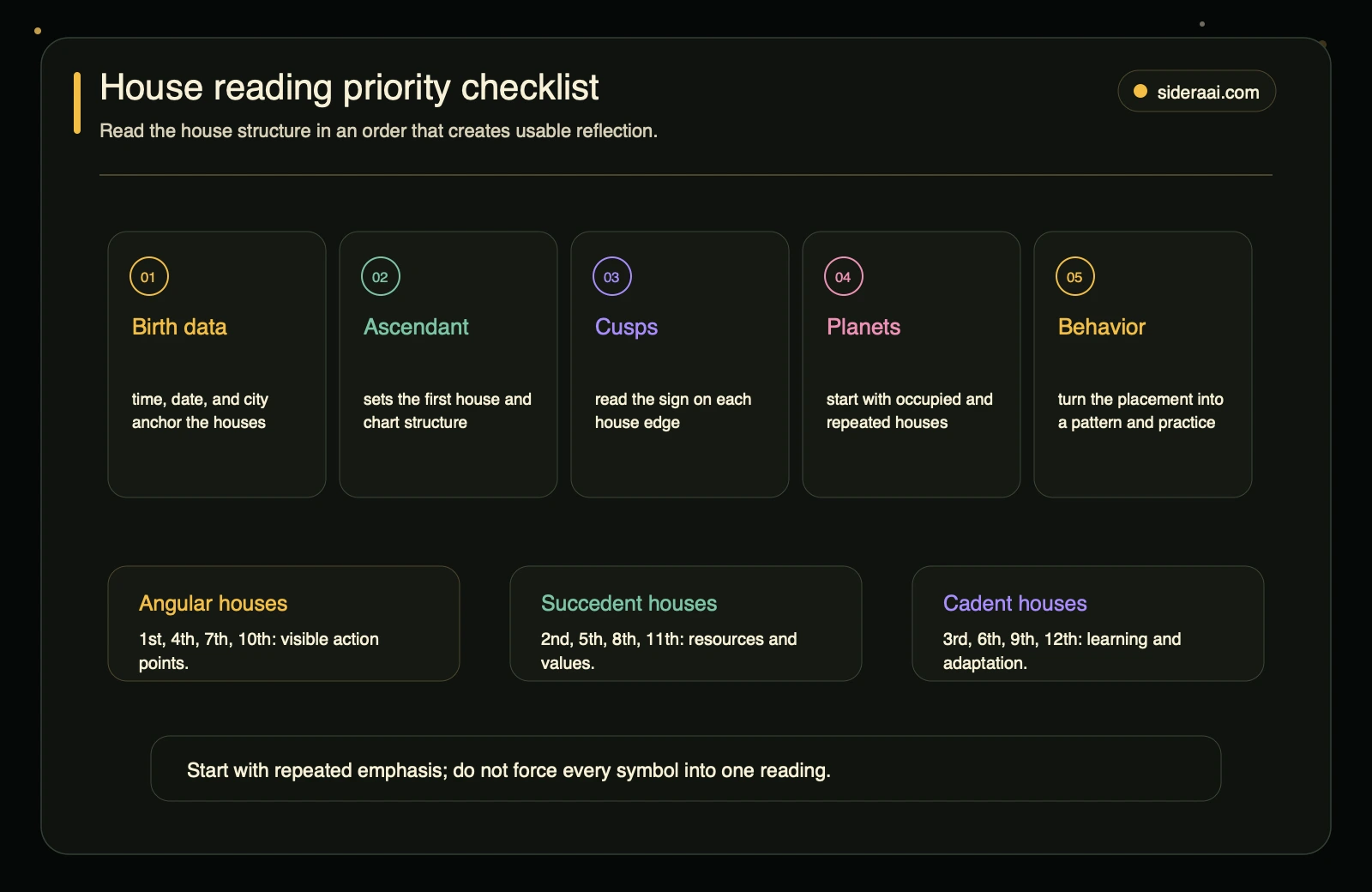
Read houses in a stable order: anchor the birth data, find the Ascendant, inspect cusps, start with occupied or repeated houses, then translate the placement into a pattern and practice.
For decision value, do not stop at “I have planets in the Sixth House.” Make it behavioral:
- Pattern: I over-function at work when I feel insecure.
- Shadow: I call it being helpful, but sometimes I am trying to be needed.
- Practice: I can let one task be good enough before my body turns stress into a symptom.
How to Find Your Houses
To calculate your houses accurately, you need:
- Birth date (day, month, year)
- Birth time (as exact as possible - even 4 minutes matters)
- Birth location (city and country)
Most birth chart calculators (including Sidera) will automatically calculate your houses based on this information. Without an accurate birth time, your house placements will be unreliable or impossible to determine.
If you don’t know your birth time, you can:
- Check your birth certificate (most have it)
- Ask your parents or birth attendants
- Request records from the hospital where you were born
Without a birth time, astrologers can still read your Sun, Moon, and planetary placements, but the houses - the most practical part of your chart - remain unknown.
Powered by Sidera — AI-driven cosmic timing.
FAQ: Common Questions About the 12 Houses
What is the most important house in astrology?
The First House (Ascendant) is considered most important because it sets up your entire house structure and represents your core identity and approach to life. The Tenth House (Midheaven) is second most important, showing your life direction and public path. Angular houses (1st, 4th, 7th, 10th) are generally more influential than others.
Can you have an empty house in your birth chart?
Yes, and it’s completely normal. Most people have several empty houses since there are 12 houses but only 10 planets. An empty house doesn’t mean that life area is unimportant - it simply means there is less concentrated planetary emphasis there. The sign on the house cusp still influences that life area.
Which house represents money in astrology?
The Second House governs earned income, possessions, and your relationship with money. The Eighth House rules shared resources, inheritance, loans, and partner’s income. The Eleventh House can indicate income from career (profits from your Tenth House work). For complete financial analysis, astrologers examine all three houses plus Venus and Jupiter placements.
Which house represents marriage?
The Seventh House is the primary house of marriage and committed partnerships. It shows what you seek in a life partner and the nature of your marriage. The Fifth House governs romance and dating (before commitment). The Eighth House rules sexual intimacy and merged resources within marriage.
How do you know what house you are in astrology?
Your houses are determined by your birth time and location. Calculate your birth chart using an accurate birth time, and the chart will show which planets fall in which houses. Your Ascendant (Rising sign) always marks the beginning of the First House, and houses proceed counterclockwise from there. Each person’s house structure is unique based on their exact birth moment.
What is the difference between houses and signs?
Signs describe HOW energy expresses (the style), while houses describe WHERE energy manifests (the life area). For example, Aries is assertive energy (sign), but the Seventh House is the arena of partnerships (house). You can have Aries energy expressing in any house, creating different life results - Aries in the Tenth House creates career ambition, while Aries in the Fourth House creates protective family instincts.
Conclusion
The 12 astrology houses transform your birth chart from abstract symbols into a practical life map. Each house represents a specific arena where your planetary energies play out: self-image, values, communication, home, romance, routines, partnership, intimacy, beliefs, career, community, and the private unconscious patterns that shape everything else.
Understanding houses in astrology meaning helps you see why certain life areas feel natural while others challenge you, why some years activate specific themes, and where to focus your energy for growth.
Your houses don’t change throughout your life - they’re your permanent blueprint. But the planets moving through them create the evolving story of your timing. When you understand your houses, you can ask better questions: What part of life is being activated? What pattern am I repeating there? What would a more honest choice look like now?
Whether you’re exploring your birth chart for the first time or deepening your astrological knowledge, the houses provide the framework that makes astrology more than personality description. They show where your chart becomes lived experience.
Ready to explore your complete house structure? Calculate your birth chart to see exactly where your planets fall and which life areas they’re activating.
Related Sidera Guides
Continue with these closely related guides:
- 8th House Astrology: Shadow and Transformation
- Moon in the 11th House: Friends, Groups & Future Goals
- Moon in the 2nd House: Money, Security, Self-Worth
- Moon in the 6th House: Routine, Health & Emotional Wellbeing
- Moon in 7th House Relationships
- Moon in 9th House Meaning
- Planets in the 12th House
- Planets in 9th House: Meaning and Traits